phuong @1704_mp
Joined December 2018-
Tweets56
-
Followers4
-
Following145
-
Likes317

Latest Deep RL class lectures are now online! youtube.com/playlist?list=… Thanks to @seohong_park, we now have CS185/285 for spring 2026 available to everyone to watch. Course website here: rail.eecs.berkeley.edu/deeprlcourse/ Apologies for a few recording glitches (it's not a perfect system).
this has become one of my most used prompts recently: > restate in your own words what you think my goals are and what the problem i'm trying to solve is

Here are some links from my bookmarks. - youtube.com/playlist?list=… - youtube.com/playlist?list=… - youtube.com/watch?v=jll-Xc… - pp4fpgas.readthedocs.io/en/latest/ - kastner.ucsd.edu/hlsbook/ - fastmachinelearning.org/hls4ml/backend… - cs231n.github.io/convolutional-… - mlsysbook.ai/slides/vol1.ht… - github.com/ayanayvleo/Gre…


@S2SmeX Hi can u suggest some playlist for ai accelerator chip design
beautiful, simple, human written
Took the time and wrote down everything I have been learning about GPUs and CUDA. Consider checking it out! x.com/i/article/2103…

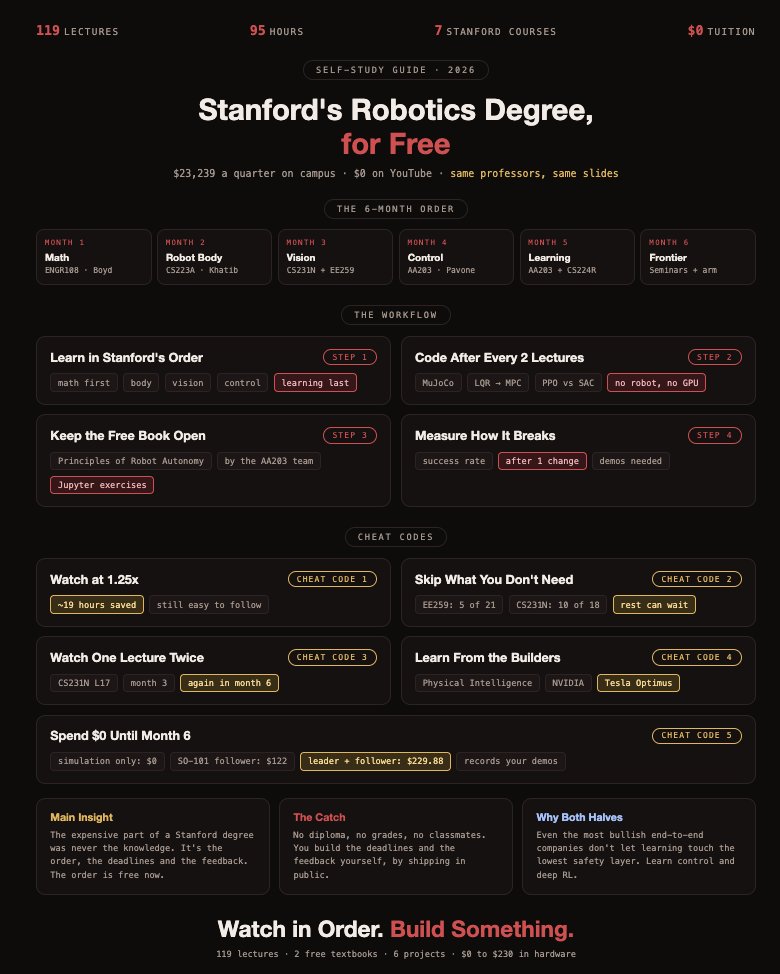
How to learn robotics from Stanford without paying Stanford: stanford charges $23,239 a quarter for graduate engineering in 2026-27 and 119 of its robotics lectures sit on YouTube for $0. same professors, same slides so here's my workflow for turning them into a robotics career: 1: learn in the order stanford students do math → the robot's body → vision → control → learning most people open a viral humanoid seminar first and quit at the word "Jacobian" start with Boyd's linear algebra course instead. 54 short lectures, most under 30 minutes 2: never watch two lectures in a row without writing code the videos are support. the practice tasks are the course - compute forward kinematics of a real robot arm model in MuJoCo - balance a cart-pole with LQR, then with MPC - train PPO and SAC on the same task and compare the curves - clone your own controller with behavior cloning and watch it drift all of it runs on a normal laptop. no robot, no GPU 3: keep the free textbook open next to the video AA203 has its own book, written by the same people who teach the course: Principles of Robot Autonomy, free online with Jupyter exercises when the professor goes too fast, the book goes slower 4: measure how it breaks everyone can make a demo work once your final project needs 3 numbers: - success rate on the task you trained - success rate after you change one thing in the scene - how many demonstrations it took the second number is the one interviewers ask about cheat-codes to get the most out of free stanford: 1. watch at 1.25x saves about 19 hours over the full 95-hour path 2. skip what you don't need you need 5 of EE259's 21 lectures and 10 of CS231N's 18. the rest can wait 3. watch the robot learning lecture twice CS231N lecture 17 in month 3, then again in month 6. after a month of RL it looks like a different lecture 4. learn from the people who build the robots Chelsea Finn, co-founder of Physical Intelligence. Marco Pavone, autonomous vehicle research at NVIDIA. Ashish Kumar, AI lead of Tesla Optimus, as a guest lecturer 5. spend $0 until month 6 then $122 for one SO-101 follower arm, or $229.88 for the leader + follower pair that records your demonstrations main insight: the expensive part of a Stanford degree was never the knowledge it's the order, the deadlines and the feedback the order is free now. the deadlines and the feedback you build yourself, by posting what you build in public and one more thing in the final AA203 lecture, Stanford explains where AI stops inside a robot: even the most bullish end-to-end companies still don't let learning touch the lowest layer, where the hard safety constraints live that's why this path teaches control theory and deep RL, not one or the other...
Took the time and wrote down everything I have been learning about GPUs and CUDA. Consider checking it out! x.com/i/article/2103…

🎓 I’m teaching CIS 6270: Discrete Generative Models at @Penn this fall! It’s a math-first course on modern generative modeling across continuous and discrete spaces, with full derivations, code, worked examples, and current research. Follow along with us this semester! 👇 cis6270.github.io We start this semester with core probability, ODEs/SDEs, the continuity and Fokker-Planck equations, and then derive flow matching and score matching through DDPM, DDIM, probability-flow ODEs, along with both single- and multi-objective guidance. 🌊 Then, we rebuild the story in discrete space. 🎲 That means CTMCs and master equations, time reversal, MDLM, D3PM, block diffusion, discrete scores and guidance, followed by discrete flow matching with jump processes and simplex-based flows. 🦘 We also go well beyond the standard material: multi-objective guidance, rectified flows, and a full lecture on modern flow maps, including consistency + shortcut models, categorical/discrete flow maps, Meta Flow Maps, expanding state spaces, and strong stochastic flow maps. 🗺️ We finish by connecting generation to optimal transport, stochastic optimal control, and path-space methods, working from Wasserstein geometry and Sinkhorn through Girsanov, Doob transforms, Schrödinger bridges, and modern continuous and discrete bridge-matching methods. 🌉 Throughout the semester, on the website, we’ll be releasing the lecture slides (you can see how deliberate they are!), project descriptions, exams + full solutions, and accompanying code on HuggingFace! 🤗 Our goal is that someone can start from the foundations and follow the math all the way to the newest papers. 📚 By the end, you should have the tools to turn your own research ideas into papers for the main conferences. Just promise me we won’t be the reason ICLR goes from 60k submissions to 70k! 😅 I’m incredibly grateful to my TAs (also my PhD students), for helping me build and teach all of this: @SophieVincoff @TongChen321 @RosieZ0512! 🥰 We hope you enjoy the material! 🥳

How to get a job as a Robotics Engineer: robotics is the one frontier field where the entry level still doesn't ask for a degree 1 in 5 robotics jobs posted right now is a technician role, and most of them only need a certificate or a two year degree so here's my workflow for getting a job as a robotics engineer: 1: pick one direction and drop the other two robot learning pays the most and everyone wants it autonomy and mobile robotics has the most openings by a wide margin embedded and mechatronics is boring and you'll never be out of work 2: build things that moved, and write down the numbers recruiters here open your github before they read your CV what gets you through: - a commit history where you're visibly fixing things, not one big final push - real hardware with reliability numbers, sim doesn't count - datasets on the lerobot hub - commits to ROS 2, Nav2, MoveIt, Isaac Lab, LeRobot 3: build your hardware in public the best way to prove your knowledge is the recognition of your skill from masses just build anything you want and share it on X/IG/YT good example of the guy who gets offers from Tier-S level robotics companies (you can copy his strategy): go to IG type in search: "aykhanium" and check which rubrics he does to be recognized repeat. 4: write down what broke everyone posts the demo that worked almost nobody writes up the four things that failed first and how they found each one that's the part you can't fake from a tutorial, and it's the part that survives the third question in an interview cheat-codes to stand out and get into the top 1%: 1. take the shift nobody wants teleoperation pays around $28 an hour. figure posted a humanoid robot operator at $25 to $35 with no degree asked for it's just driving a robot around a lab but it puts you inside a frontier company with a badge on, and now you're a person they know instead of a CV in a pile 2. sell the integration, not the robot the arm is about 25% of what a project costs the other 75% is engineering, safety, and making everything talk to each other a $35k arm turns into an $80k system, and that $45k is your job 3. go where nobody's competing 66% of robotics projects get delayed by certification functional safety pays well and almost nobody bothers learning it 4. C++ and Python, both every Figure and Skild listing I read asks for both, not one 5. delete the ROS 1 from your repos recruiters call it out by name as a red flag if there's still a catkin_make sitting in your github, that's the first thing they see main insight: $47.4B went into physical AI in the first half of 2026 the BLS still projects 1 to 2% job growth in the occupation the money showed up years before the headcount will so the people getting in right now aren't winning interviews, they're walking through the technician door and moving sideways once they're inside that's like to be hired in OpenAI in 2019... and one more thing nothing you learn here goes stale a PID loop works the same as it did in 1990, and the arm you fix this weekend teaches you something you'll still use in ten years you can't say that about anything else in AI right now...


Want to Learn Robotics From the Ground Up? I found Cornell's CS 4756 Robot Learning course, focused on how robots learn to make decisions and interact with the physical world. It covers topics around robot learning, reinforcement learning, imitation learning, perception and control, making it a useful resource if you are getting deeper into physical AI. It is a great next step after learning basic robotics, especially if you want to understand how modern robots learn instead of relying only on hand-written rules. Would you add robot learning to your 2026 study list?

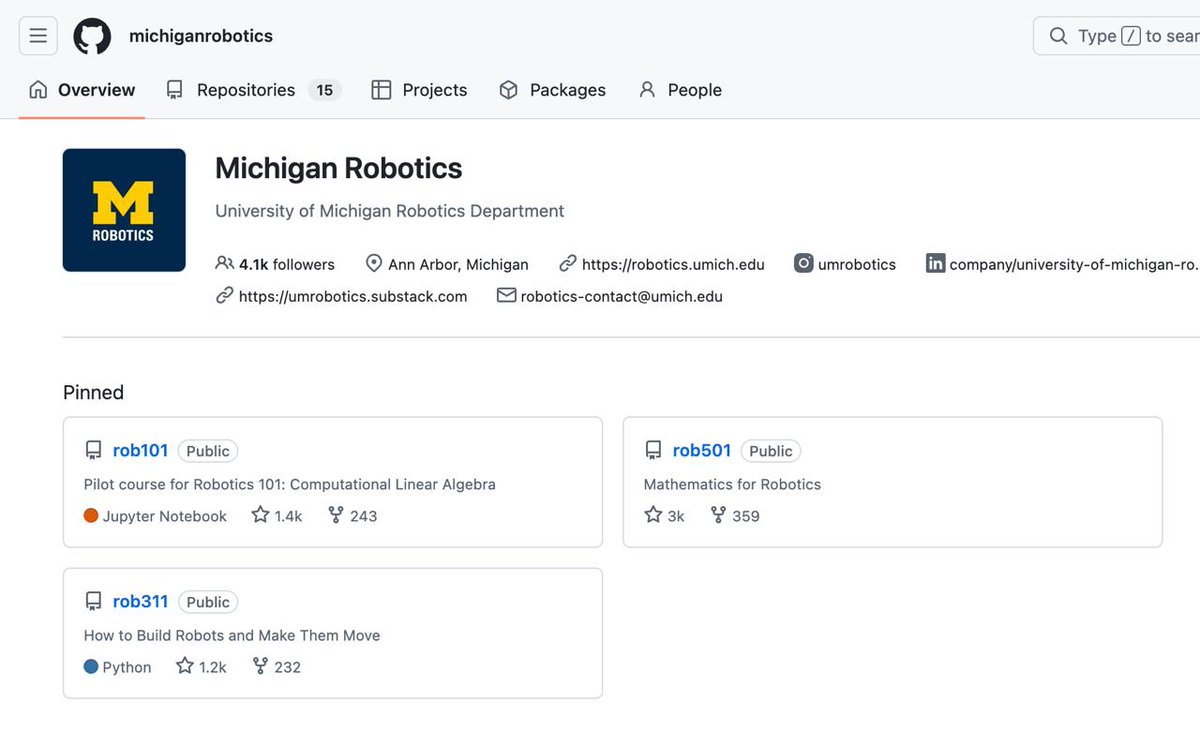
best addition to this article: five robotics courses from Michigan University: open-sourced, 100% FREE on GitHub, repo links below: - ROB 101, computational linear algebra: the transforms and Jacobians from month 5, done properly github.com/michiganroboti… - ROB 201, calculus for the modern engineer: full textbook sitting in the repo github.com/michiganroboti… - ROB 311, how to build robots and make them move: the mechatronics half of months 2 and 3 github.com/michiganroboti… - ROB 501, mathematics for robotics: the rigorous version of everything in month 5 github.com/michiganroboti… - ROB 530, mobile robotics: Kalman filters, localization and SLAM, the theory under month 4's Nav2 stack github.com/UMich-CURLY-te… lecture videos on YouTube, homework, and code in MATLAB, Python, Julia and C++ start at 101, and leave 501 and 530 until you have actually built something, because both are graduate courses and will bounce you cold this is the fundamentals layer underneath the article, not a replacement for it five courses is not a degree either, so treat it as depth rather than the whole thing build first, then come back and learn WHY it worked

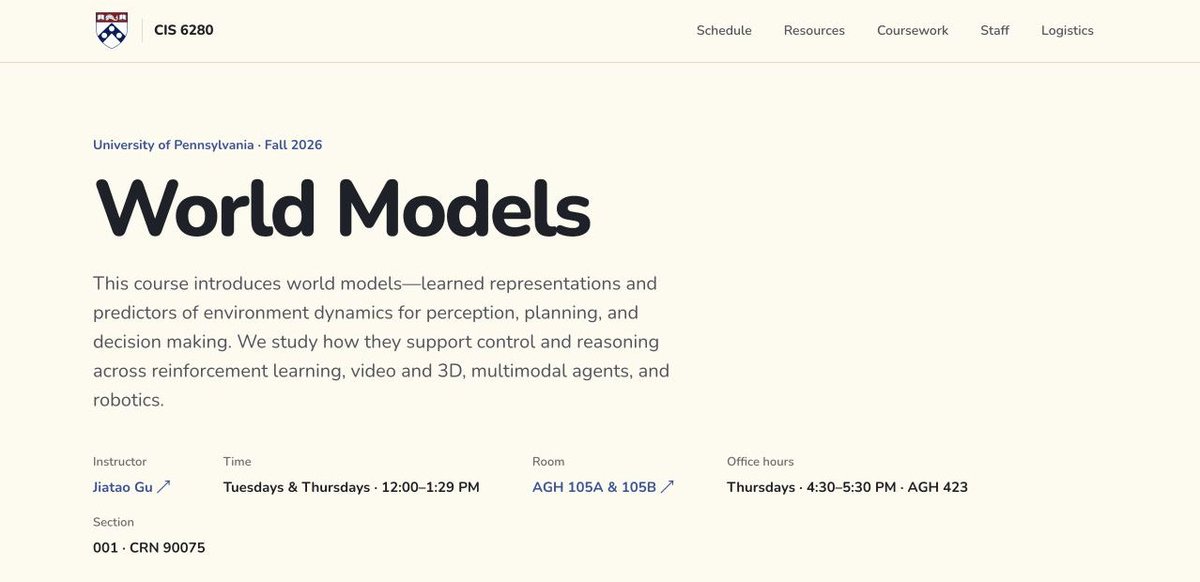
We’re teaching a new course at Penn: CIS 6280 · World Models 🌍 cis.upenn.edu/~cis6280/ Every day, LLMs amaze me with one more thing they can solve. But I’ve always felt there’s more to learn than what humans have written down—from observing the world, interacting with it, and experiencing what happens next. To me, that’s what world models are about—and why I see them as one of AI’s next big bets. However, I struggled to find a systematic course on them—so we are building one! Topics will include: representation learning, generative models, simulation, model-based RL, video and 3D generation, world models for robotics, reasoning, and code-based world models. Hands-on work will include: - Building an environment - Training a world model - Learning a policy and a final research project with leaderboard. We’re already six lectures in. Slides, demos, and readings are public, and we’ll keep adding materials throughout the fall. Big thanks to our TA team— @TongMutianTMT @hagsaeng_bag @EnxinSong @KeelyAi04 —for helping bring this course to life!

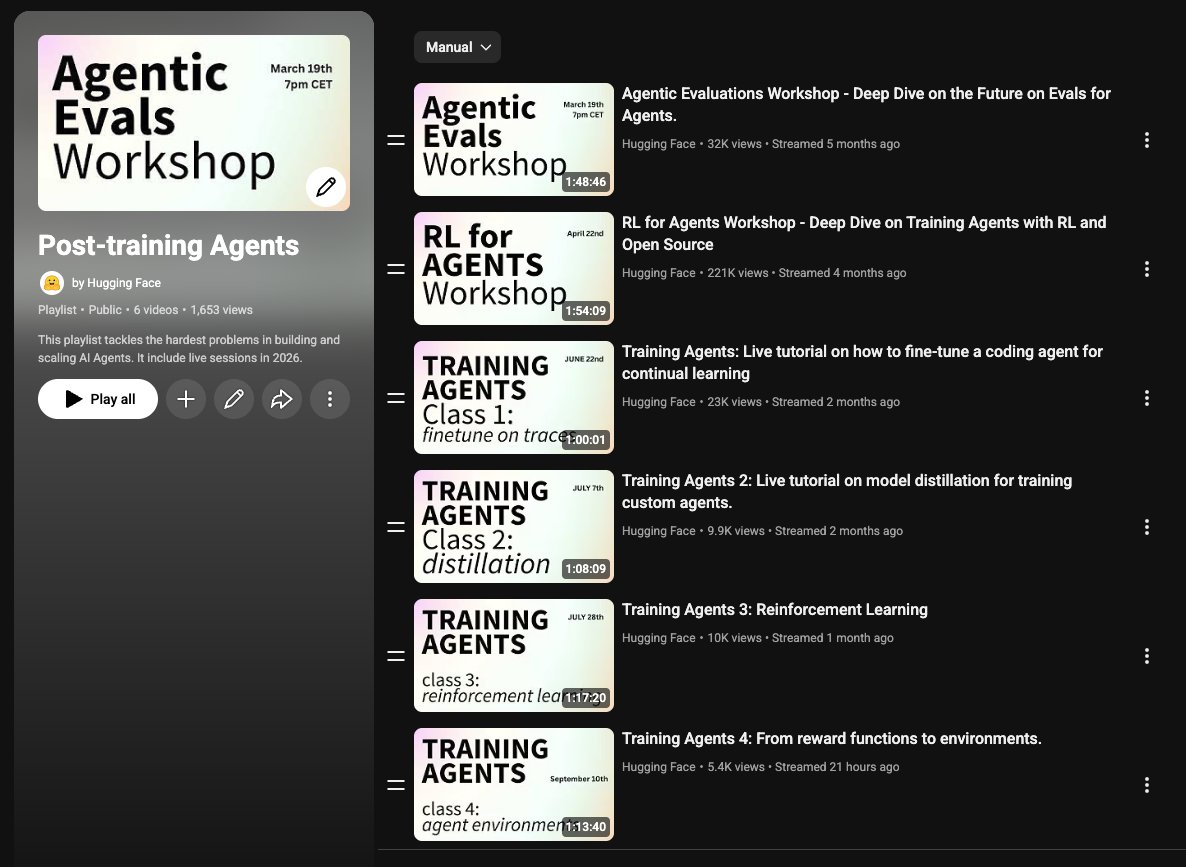
We finished the Training Agents series. Six live sessions over six months, from evaluating agents to training them inside real environments. All of it is on the Hugging Face YouTube channel and all of the code is open. Here's what we did and who made it happen: 1. Agentic Evaluations WorkshopWhere agent evals actually stand, and why benchmark scores don't match what people see in use. With Avijit Ghosh and Nathan Habib (Hugging Face), Arvind Narayanan (Princeton), Pierre Andrews (Meta), J.J. Allaire (UK AI Security Institute) and Mahesh Sathiamoorthy (Bespoke Labs). 2. RL for Agents Workshop Environments, rollouts, reward design and the inference bottlenecks that appear when you move from RL for LLMs to RL for agents. With Lewis Tunstall (Hugging Face), Will Brown (Prime Intellect), Ofir Press (Princeton) and Alex Zhang (MIT CSAIL). 3. Training Agents 1: SFT on agent traces Public coding-agent traces turned into prompt/completion data, a TRL + LoRA fine-tune on Hugging Face Jobs, metrics in Trackio, and an honest look at what the first eval numbers can and cannot tell you. Joined by Sergio Paniego and Quentin Gallouédec. 4. Training Agents 2: Distillation Off-policy, on-policy and self-distillation for moving capability from a teacher into a smaller coding agent. 5. Training Agents 3: Reinforcement learning GRPO after SFT: group sampling, verifiable reward functions, reading the reward/KL/length curves, and three experiments, one of them with a deliberately gameable reward so we could watch the hacking happen. 6. Training Agents 4: From reward functions to environments The reward stops being a function and becomes a place the agent acts in. We walked the reset()/step() contract from Gym to LLM agents, built an OpenEnv environment and pushed it to the Hub, plugged it into TRL's GRPOTrainer, then trained a real coding agent (OpenCode) through Harbor with AsyncGRPOTrainer on Hugging Face sandboxes. The series has passed 300k views. Thank you to every speaker, to the TRL team, and to everyone who showed up live with questions. Playlist: youtube.com/playlist?list=…

This Fall, I'm teaching a new "Hands-on Robot Learning" class at @JHUCompSci A full-stack class where students will get SO-101 robot kits, build robots out, collect data, train and deploy learned policies/WAMs/agents/etc. Materials will be posted here: hands-on-robot-learning.github.io

Stop trying to learn AI from static diagrams. 🛑 You can watch a Transformer process text, see a neural network learn in real time, explore embedding spaces, follow diffusion step by step, and inspect features inside real LLMs. I know the best visual AI resources on the web ↓
Some ideas about how to get started learning about all of this Inference Engines & Topics - vLLM: PagedAttention, continuous batching, prefix caching, CUDA graphs - SGLang: RadixAttention/prefix reuse, speculative decoding, MoE, structured/agent workloads - TensorRT-LLM: NVIDIA peak stack, FP8/FP4, Wide-EP, disaggregated serving - FlashInfer: reusable kernel/operator library for attention/GEMM/MoE/sampling Kernels - Triton tutorials → custom fused kernels - CUTLASS/CuTe → Tensor Core GEMM and Blackwell/Hopper details - FlashAttention papers → attention algorithm/kernel co-design - PagedAttention paper → KV-cache memory management - MoE docs → routing + grouped GEMM + all-to-all - Nsight profiling → stop guessing Do this mini-project sequence 1. Implement RMSNorm in Triton; compare to PyTorch 2. Implement fused SiLU × gate 3. Implement simple FP16 matmul; compare to cuBLAS/rocBLAS 4. Implement paged KV lookup for decode attention 5. Add FP8 KV cache with per-block scales 6. Implement toy top-k sampling on GPU 7. Implement tiny MoE dispatch + grouped GEMM 8. Integrate one custom op into vLLM or SGLang and profile end-to-end
You don’t “run a model” - You run Kernels The model is just a graph The Inference Engine is scheduler / optimizer / executor But the actual work? That happens in the Kernels - MatMul Kernels - Attention Kernels - RMSNorm Kernels - KV cache Kernels - Quantized linear Kernels -

here's every way to get paid in robotics: sell a system: - turnkey work cells: layout, fixturing, end effector, cycle time and programming, at 10-20% of the system budget or $3-16k on a light-duty cell - vision for bin picking: 6D pose estimation and camera calibration, the part that breaks first in production - force-controlled assembly: insertion and mating tasks that position control alone can never do - fine-tuned manipulation policies for one job, one gripper, one product line - sim-to-real pipelines: train it in Isaac, land it on the real cell, and own the gap nobody else wants to debug sell your hours: - teleoperation and data collection: $22/hr and up, no degree asked - contract bring-up and debugging: $30-70/hr, the going freelance band for robotics engineers - functional safety and risk assessment: 66% of robotics projects are delayed by certification, and almost nobody sells this - sensor calibration and vision setup on site: the step every integrator underestimates - on-site commissioning weeks: the travel everyone avoids is the work nobody can skip sell an artifact you own: - demonstration datasets for a task nobody recorded: you get paid per hour of capture, then sell that same hour again - sim environments and digital twins: billed at $30-50/hr, then reused across every client after - grippers, jigs and mounts: design once and print forever, the margin is the file and not the plastic - drivers and ROS packages for hardware the manufacturer never bothered to support - calibration rigs and test fixtures, the boring tools every single lab rebuilds from scratch then own the vertical: - a $35k arm becomes an $80k deployed system once it is actually working - that $45k gap is not hardware, it is engineering, and it is the entire business - rent the cell monthly instead of selling it, so one install pays for years - own the data for one narrow task until nobody can train a better policy than yours - turn the third integration contract into a product and license it instead of rebuilding it all four exist for the same reason: > the models cannot learn manipulation from the internet, so someone has to move a real machine and record it > simulation solved locomotion, but dexterous manipulation still needs 60-80% real data even after strong sim pretraining > which makes even the cheapest seat in robotics one the industry structurally cannot skip AI engineering pays well because plenty of people can do it. robotics pays well because almost NOBODY can and if you want to build your own thing, look at software. a survey of 1,000 robotics developers this year put software architecture as the top bottleneck at 27%, ahead of hardware at 16% you don't have to quit anything or call yourself an engineer to start get a cheap arm as a pet project, give it two evenings a week, and you're on this list before the year ends

why i'd learn robotics over AI engineering for the next 12-24 months: everyone is an AI engineer now... that's the whole problem you can't build a moat out of what a subagent does at 3am for pennies robotics is the opposite: > the models already work, what's missing is

A Mathematical Introduction to Diffusion Models by Jianfeng Lu (2026) is now in @ChapterPal's library. The introduction is a self-contained, proof-oriented mathematical foundation for diffusion models by connecting classical Langevin sampling dynamics to modern continuous and discrete score-based samplers, sampling error bounds, and inference-time control. Learn diffusion models' math with an AI tutor: chapterpal.com/s/b0607e70/a-m…

The defining characteristic that separates the great from the good is PAIN TOLERANCE.

5 个最近讨论比较多的 skill: 1/ eli5 github.com/anthropics/cla… 2/ show-me github.com/humanlayer/ski… 3/ skill-doctor github.com/warpdotdev/com… 4/ retro github.com/mattpocock/ski… 5/ unslop github.com/cursor/plugins…

Đức Minh @cMinh29641246
1 Followers 31 Following
Shuckar @Shuckar9vR9gh
70 Followers 289 Following
Anh Trần Hoàng @Anh_Tran_Hoang
1 Followers 78 Following
Junvildo @Junvildo
0 Followers 125 Following
Pramod Goyal @goyal__pramod
11K Followers 438 Following Trying to change the world one line at a time
lauren @poteto
135K Followers 1K Following Grok @Bot at @SpaceXAI. Shipping with https://t.co/WDB4U1rwmu. React compiler core team, prev cursor, meta, netflix
Yu Xiang @YuXiang_IRVL
7K Followers 1K Following I do research in robotics and computer vision @IRVLUTD, Ex- research scientist @NVIDIA, postdoc @uwcse and @StanfordAILab, phd @UMich, all views my own.
NVIDIA Robotics @NVIDIARobotics
147K Followers 384 Following NVIDIA Robotics inspires visionaries and developers to create the next generation of AI-driven robots and explore the world of physical AI.
Matt Pocock @mattpocockuk
358K Followers 810 Following I teach devs for a living. Author of Total TypeScript and AI Hero. Ex-@vercel. Used to be a voice coach.
max fu @maxxfuu
4K Followers 652 Following
mohit @mohitwt_
8K Followers 325 Following 20, mts @emulated_ai || reinforcement learning & llm inference
gabriel @gabriel1
126K Followers 607 Following co-founder @getenergy_, previously research at @OpenAI & @midjourney solving future of computer work with @getenergy_
Tairan He @TairanHe99
16K Followers 1K Following Researcher @OpenAI. Prev: PhD @CMU_Robotics @NVIDIA @MSFTResearch @sjtu1896 | All Opinions are My Own

YiYi Xu @YiYiMarz
2K Followers 174 Following ML Engineer @HuggingFace 🤗, diffusers🧨 lead, I ❤️ open source

Femke Plantinga @femke_plantinga
14K Followers 610 Following learn with me about AI. growth @SliteHQ
Max Rumpf @maxrumpf
3K Followers 474 Following co-founder/ceo https://t.co/RAAaSu0RMJ | xresearcher @ETH @ycombinator
Zara Zhang @zarazhangrui
89K Followers 2K Following Builder. Make something people want, then make people want it. Harvard’17. GitHub: https://t.co/KCuEajezlL YouTube: https://t.co/8xzbGWtf6w
Ali Hatamizadeh @ahatamiz1
4K Followers 177 Following LLM Tech Lead & Staff Research Scientist @NVIDIA Co-creator of Gated DeltaNet & Gated DeltaNet-2
Peter Holderrieth @peholderrieth
5K Followers 659 Following CS PhD student at @MIT • Prev: Stats/Neuro @OxfordUni• Math at @UniBonn • Former: @NVIDIA, @AIatMeta
Kadir Nar @kadirnardev
2K Followers 1K Following AI Research Engineer 🤖 Building Omni & TTS Models 👨🍳 at Vyvo
Yatharth Sharma @Yatharth3501
926 Followers 8 Following Interested in machine learning, specifically related to speech.
Florian Brand @xeophon
18K Followers 846 Following evals @PrimeIntellect | open models @interconnectsai
Salman // 萨尔曼 @ForBo7_
261 Followers 1K Following 「Open to Projects」 • Dabbler • Learner • Explorer • https://t.co/rMAvL5souA student • https://t.co/7FBysT47M6 solver • Dabbling in Embodied AI • 自学中文 // Teaching myself Chinese
kalomaze @kalomaze
25K Followers 3K Following ML researcher (@primeintellect), speculator • extremely silly jester
ali(gnment) @waterloo_intern
36K Followers 131 Following research, kernels, peer-reviewed shitposts inference @baseten || eng @uwaterloo
SzymonOzog @SzymonOzog_
3K Followers 318 Following Maximizing throughput at @nvidia I like my tea green and my compute parallel Views are my own and don't represent my current of former employers
Sudarshan Kamath @kamath_sutra
22K Followers 4K Following Building https://t.co/CwCpxzKtgM | Trying to do non-trivial things, maybe solve Death | 🌍 citizen
Victoria Slocum @victorialslocum
10K Followers 616 Following learning cool stuff, open source engineer @netbird 🧡
Rémi Ouazan @remi_or_
948 Followers 152 Following transformers maintainer at Hugging Face 🤗 | ex Apple | Inference, GPUs, kernels
Thanh Tran Van Trong @jonnyjackk
126 Followers 429 Following PhD Student @NTUsg | Working on Audio Understanding 🎶
Elliot Arledge @elliotarledge
44K Followers 352 Following @infinity_ai_ https://t.co/82V5vFob7t | made the 12 hr CUDA course | https://t.co/2hzezpo5Hi | @shipfr8 alum
Hieu Pham @hyhieu226
46K Followers 22 Following Something new 🇻🇳 | ex: @openai, @xai, @augmentcode, @GoogleBrain, @LTIatCMU, @Stanford, ACM ICPC, IMO🥈 Opinions are my own.
Benjamin Marie @bnjmn_marie
7K Followers 223 Following Independent AI researcher (LLM, NLP). My blog, The Kaitchup - AI on a Budget: https://t.co/tyXQ2R956t
Andi Marafioti @andimarafioti
9K Followers 716 Following leading multimodal research @huggingface (prev @unity)
Julia Turc @juliarturc
25K Followers 753 Following Explaining AI on YouTube • YC S24 Founder • Ex-Google Research • Eastern-European nihilist & American optimist
AVB @neural_avb
14K Followers 347 Following Neural Breakdown on YT | Read research with AI: https://t.co/Ef6m4nUpcZ | maker of videos, writer of articles, learner of things
Alexia Jolicoeur-Mart... @jm_alexia
26K Followers 2K Following Principal Researcher @ Microsoft 🐱💻 2025 ARC Prize Winner I build generative AI for images, videos, text, tabular data, weights, molecules, and video games.
Linoy Tsaban @linoy_tsaban
6K Followers 1K Following Exploring the world of AI Art as a ML engineer @HuggingFace 🤗
Songlin Yang @SonglinYang4
19K Followers 3K Following pretraining @thinkymachines. Prev. PhD @MIT_CSAIL. INTP 🐱. she/her/hers.

Antaripa Saha @doesdatmaksense
15K Followers 442 Following consulting companies in evals, search, retrieval
Thien Tran @gaunernst
3K Followers 276 Following
Pedro Cuenca @pcuenq
8K Followers 1K Following ML Engineer at 🤗 Hugging Face | Co-founder at LateNiteSoft (Camera+). I love AI and photography.
TensorTonic @TensorTonic
11K Followers 1 Following Infrastructure to run ML & GPU algorithms in cloud-native sandboxes
Jascha Sohl-Dickstein @jaschasd
31K Followers 843 Following Member of the technical staff @ Anthropic. Most (in)famous for inventing diffusion models. AI + physics + neuroscience + dynamics.
Ahmad @TheAhmadOsman
78K Followers 465 Following Founder & CEO @OsmanticAI — Accelerating Opensource & Self-hosted / Local AI Adoption • I moderate GPUs on r/LocalLLaMA
Keller Jordan @kellerjordan0
20K Followers 473 Following CIFAR-10 fanatic Pretraining @OpenAI OpCo LLC. Personal opinion poster

Huaizheng Zhang @zhzHNN
4K Followers 766 Following Learning AGI at AI Lab. ex-founding engineer. PhD @NTUsg. Opinions are my own.

Piotr Żelasko @PiotrZelasko
2K Followers 746 Following AI + Speech @ Nvidia. PhD @ AGH-UST, ex-JHU. My interests: speech processing technology; ML/AI software engineering. Building OSS for Speech AI.
Wei-Ning Hsu @mhnt1580
2K Followers 163 Following Research Scientist @ Meta FAIR / audio generation, self-supervised learning, speech processingTrends for United States
You might like