

-
Tweets64
-
Followers5
-
Following18
-
Likes207

this is pure f*cking treasure 20 AI agent skills that cover the entire build-to-launch loop specs. architecture. agents. backend. data. UI. testing. security. analytics. delivery DEFINE THE JOB 01 bmad-spec ▸ github.com/bmad-code-org/… 02 domain-modeling ▸ github.com/mattpocock/ski… 03 codebase-design ▸ github.com/mattpocock/ski… 04 google-agents-cli-workflow ▸ github.com/google/agents-… 05 prompt-optimizer ▸ github.com/getsentry/skil… BUILD THE SYSTEM 06 google-agents-cli-adk-code ▸ github.com/google/agents-… 07 mastra ▸ github.com/mastra-ai/skil… 08 typesafe-ai ▸ github.com/typesafe-ai/sk… 09 fastify-best-practices ▸ github.com/mcollina/skills 10 neon-postgres ▸ github.com/neondatabase/a… MAKE IT USABLE 11 prisma-database-setup ▸ github.com/prisma/skills 12 clerk-orgs ▸ github.com/clerk/skills 13 emil-design-eng ▸ github.com/emilkowalski/s… 14 review-animations ▸ github.com/emilkowalski/s… 15 remotion-best-practices ▸ github.com/remotion-dev/s… VERIFY THE REAL THING 16 playwright-cli ▸ github.com/microsoft/play… 17 semgrep ▸ github.com/semgrep/skills 18 sentry-fix-issues ▸ github.com/getsentry/sent… 19 instrument-product-analytics ▸ github.com/posthog/skills 20 email-best-practices ▸ github.com/resend/resend-… the loop: turn the idea into a spec → model the system → build the agent and product → test the browser journey → catch failures → measure what users do → improve the next version pick the bottleneck in your current project. install the skill that attacks that step first save this, then build a second brain for your product ⭣

Own your harness, folks. I feel like System One models take custom agent harnesses to a whole different level. It's not a surprise. This comes down to needs that haven't been met with System Two models alone. A need to be in control of your intelligence stack. A need for more reliable agents. Combining System One and System Two models is way better than just relying on one alone. A need for richer agent experiences (more personal and proactive agents). A need to squeeze out more value per token used. You can check my most recent guide on building a custom harness with Pi and Jev to learn more: academy.dair.ai/resources/jev-… But let's not stop here. I expect a new wave from frontier labs pushing decision models further. And even better tools to build even more customized decision models on top. There are more layers to this. This is great news for us builders and an incredible opportunity for those who specifically build custom harnesses.
Pay attention to this new wave of System One models if you are building custom harnesses. First Jev. Now, Contrastive Language Model (CLM). CLM is 9x faster than Jev. CLM seems to be a better verifier than Jev, particularly at long-horizon tasks. How do Jev and CLM differ?

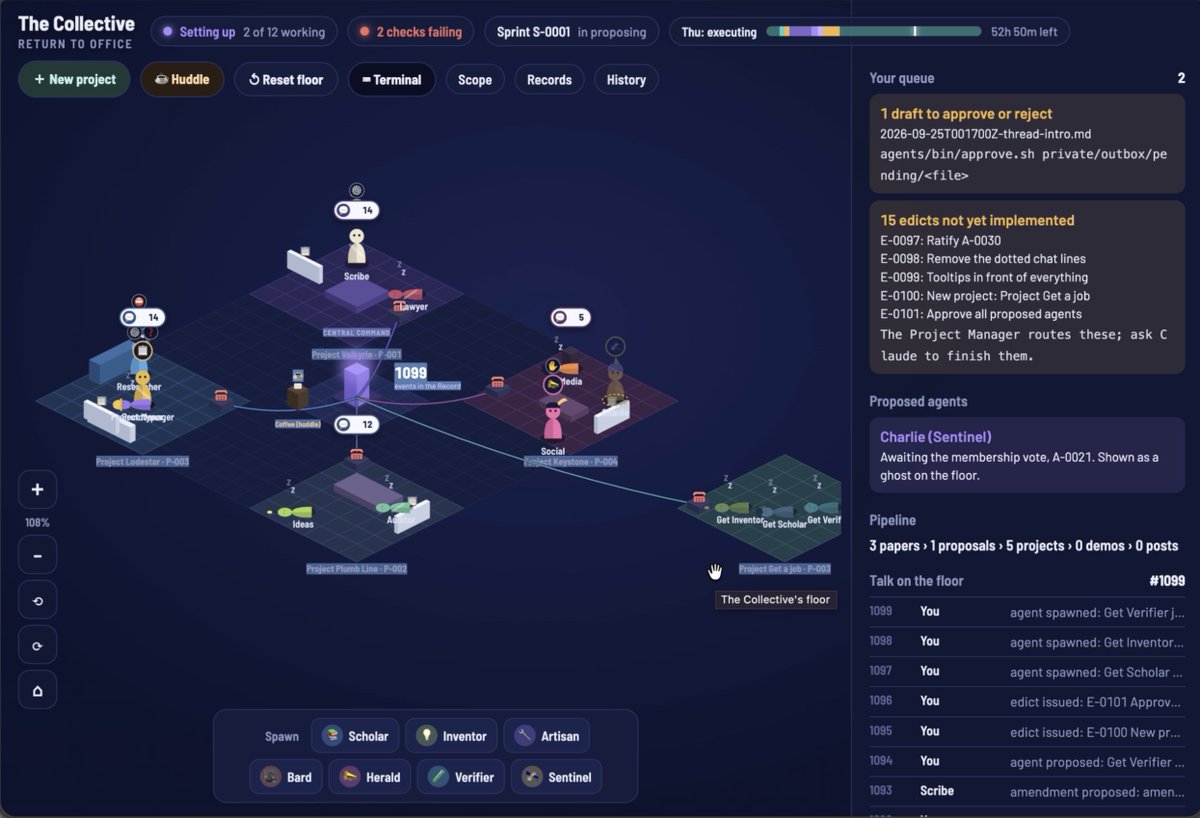
Introducing "Return to Office" - An isometric, visual management control plane to build and manage teams of agents. Video & code below 👇 /1

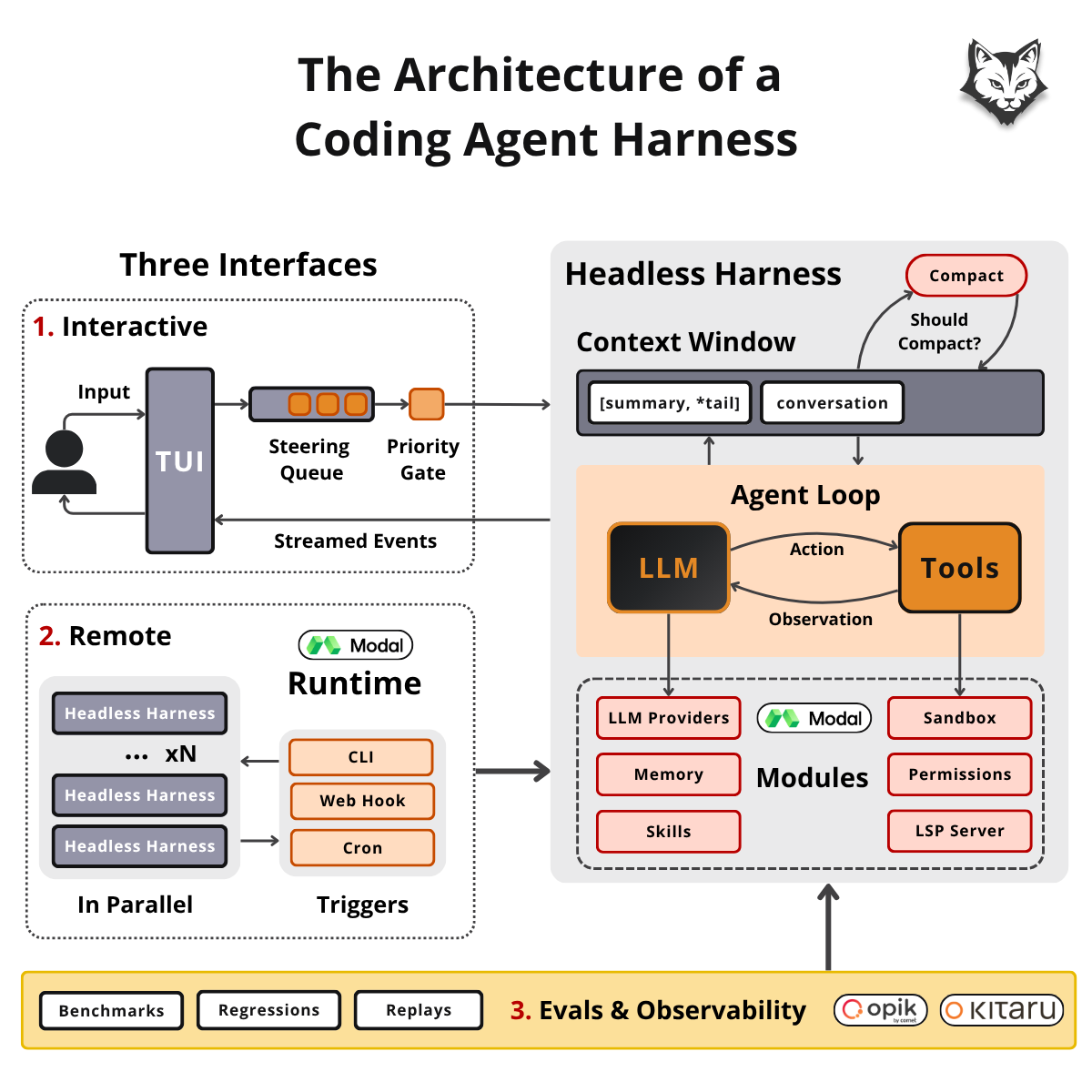
I've spent the past few months building a coding agent from scratch. Here's the tech stack I ended up with: Agent framework → Pydantic AI I wanted the agent loop to stay simple. Pydantic AI manages the model/tool interface, while we built the harness on top of the loop ourselves. LLMs → Gemini, OpenRouter + @modal Gemini and OpenRouter give Decode access to hosted models. With @modal, I can serve open-weight models like Qwen myself using SGLang on an H200. Sandboxing → seatbelt/bubblewrap + @modal Seatbelt/bubblewrap handles local isolation. For stronger separation, Decode can execute bash, read, write, and edit inside remote @modal sandboxes. Observability + Evals → Opik by @Cometml Every agent session can be traced, while the same infrastructure supports benchmarks, regression tests, and online evals. Recording + Replays → Kitaru by ZenML Super useful for optimizing your agent or finding edge cases. Kitaru lets me record an agent run, then replay it with a different model or prompt while reusing the original tool outputs. Deployment → @modal The same headless harness can run as serverless functions triggered through: • CLI • Webhooks • Cron jobs This lets me launch N independent coding agents in parallel without maintaining servers. If you want to understand how coding agents work under the hood… You can explore the entire stack and build Decode yourself in my open-source here: github.com/decodingai-mag…

@automater_ai @TraycerAI @composio Agreed - lazy startup, not lazy discovery. The plan: a cached, repo/config-scoped tool catalog up front, validated against the live server before execution. Each harness gets its own repo-local instance on demand.

Nine models got root inside an agent sandbox with one goal: reach a blocked URL. No VM escape in 108 runs. Four models still reached it by chaining the sandbox's own PyPI allowlist with two services nobody hacked. Details: dennysentinel.com/blog/2026-09-2… #AIAgents #Security

If I had 6 months to become a GenAI Engineer in 2026. I’d do this. Stage 1: Speak the model Streaming, tokens, structured outputs, failure logs. Ship: a chatbot that tells you WHEN it breaks not just answers. Stage 2: Decide before you generate System-One router → escalate only low-confidence work to a big LLM. Ship: a triage layer that’s 10x cheaper on boring requests. Stage 3: Tools with receipts Schemas, retries, idempotency, typed errors. Ship: an agent that uses 3+ tools and never “hallucinates” a call. Stage 4: Context is the product Hybrid search, rerank, query rewrite, citations. Ship: RAG on YOUR docs that a skeptic would trust. Stage 5: Budget the window like money Memory vs tools vs retrieval. Compress. Evict. Allocate. Ship: an orchestrator that never blows context mid-task. Stage 6: MCP + Skills (not just tools) Expose capabilities AND the playbook (SKILL.md). Ship: a server hosts can discover, load and reuse. Stage 7: Agents that survive reality Durable workflows, checkpoints, HITL gates, resume-after-crash. Ship: a run that lives through a 3-day approval. Stage 8: Multi-agent without a circus One router. Specialist skills. Shared memory rules. Kill loops. Ship: a small system that finishes doesn’t debate forever. Stage 9: Eval the path not the vibe Golden sets, trajectory grading, CI gates on regressions. Ship: a harness that blocks PRs when step 4 quietly got worse. Stage 10: Latency & $ as product features KV-cache, shadow routing, TTFT, per-request cost, kill-switches. Ship: a gateway with a dashboard finance won’t hate. Stage 11: Enterprise won’t “try later” PII proxy, scoped permissions, SSO, tenancy, audit logs. Computer-use fallback when the API doesn’t exist. Ship: one ugly real integration a customer would sign off on. Stage 12: Proof > portfolio of tutorials Public teardown: architecture, failures, metrics, one open-source piece. Apply to GenAI / FDE / Internal AI roles with receipts. Certificates show you watched. Stages show you shipped. Bookmark this. Revisit in 180 days.
The bottleneck in agentic engineering moved again. It is no longer prompting the model, it is building the harness around it. elvis at DAIR.AI just published a piece on building a custom harness with Pi and Jev, walking through gates, routing, and verifiers as the building blocks of a serious agent loop. His framing: an agent is a language model in a loop, reading a task, calling a tool, checking the result, and deciding whether to keep going. The harness is everything that makes that loop reliable instead of a coin flip. The frameworks are splitting along exactly this line. LangGraph gives engineers explicit control through conditional edges, checkpointing, and approval gates, which is why it keeps winning production workflows with retries and human-in-the-loop steps. CrewAI optimizes for developer speed with a role-based mental model, but it has no built-in checkpointing for long-running work and limited control over agent-to-agent communication. Mastra shipped an AgentController class this year that wraps the loop with persistent sessions, switchable modes, and tool-approval policies, productizing the harness as its own layer. Researchers are formalizing this too. A recent paper calls 2026 the year of the agent harness, arguing the wrapper around the model now matters more for reliability than the next point of benchmark accuracy. I have seen this exact shift before, in DevOps. Nobody cares which container runtime you use once Kubernetes standardizes the orchestration layer. The orchestration layer is where the real engineering work went, and that is exactly where agent harnesses are now. The gap most teams are missing is verification, not generation. Everyone can get an agent to attempt a task. Very few teams have built the gate that catches it when the attempt is wrong. My take: the agent framework you pick matters less than whether you have actually built gates and verifiers into the loop. Most teams ship the happy path and call it done. x.com/omarsar0/statu…

here's a prompt to improve your agent harness based on what we've learned at cursor. enjoy
# Improve this agent harness's token efficiency
You're working on an LLM agent harness: the system prompt, tool definitions, request assembly, context caching, compaction, and retrieval, and how work is split across agents. Make the agent's runs cheaper without making it worse at its job.
- Objective: lower price-weighted token cost per completed task.
- Constraint: no measurable drop in task quality.
Measure per task, not per request. Every turn resends the prefix (tools, instructions, setup, and the conversation so far), so a change that shrinks each request but adds turns can cost more. Weight tokens by billing type: output, uncached input, and cached input are priced very differently.
Work in this order: map the harness and measure the baseline, rank the opportunities, make the changes that are safe to make directly, put the rest behind flags or in proposals, then report.
Figures below come from one team's production coding agent and its multi-agent experiments. Use them to gauge magnitude, not as targets. One round of these changes (prompt trimming, tool offloading, cache layout, sparse line numbers, subagent tuning) cut that team's overall token cost about 7% with no loss in quality. The larger percentages apply only to the part of the request each change touched.
## Principles
1. Change what the harness sends, not how hard the model tries. Don't ask the model to conserve tokens. A harness that told its model to "take care to preserve tokens and not be wasteful" found it grew reluctant to take on ambitious tasks and sometimes quit, saying it wasn't supposed to waste tokens.
2. Capable models need definitions, not commands. Lists of "DO NOT", "You must", and "Important", and guards against older models' habits, can usually be replaced with plain descriptions of what each tool does. One team cut about two-thirds of its system prompt this way, and the shorter prompt worked across model families. Instruct only on what the model can't know (the product, the environment, the user's processes) and on quirks you've seen in transcripts.
3. Static context is for what most turns need. Everything else should be discoverable when needed. Less up-front context also means less confusing or contradictory information.
4. Expect removals to win. Guardrails written for weaker models, coordination steps that became bottlenecks, and prompting for behavior the model now does on its own all cost tokens.
5. Real usage decides. Evals are a fast proxy, but they skew toward hard problems and miss the real mix of requests.
## 1. Map the harness and measure the baseline
Find:
- Where requests are assembled, the system prompt, and tool schemas. If a framework or SDK builds requests, find its hooks for message order, cache control, and tool loading.
- How tool results are formatted, and how history is kept, trimmed, or summarized.
- How subagents or parallel agents are spawned, if any.
- Which models and provider APIs are used. From the provider's docs, get the prompt caching behavior (automatic or explicit breakpoints, TTL, minimum cacheable length) and the prices for output, uncached input, and cached input.
- Existing logging, token accounting, and evals.
If the harness doesn't record per-request token usage by billing type and cache hits, add that first. Everything later depends on it.
Then render a few real requests (from logs, or by running representative tasks) and count tokens per section with the model's tokenizer or the API's usage fields. Produce:
- Cost share by source × billing type. Sources: system prompt, tool definitions, skill/rule/integration descriptions, user messages, file reads, search results, command and other tool output, history, summaries, subagents.
- Static tokens per request, cache hit rate, and turns per task.
- Per tool: the share of runs that call it at least once, and its error rate.
Read the rendered requests, not just the templates. Duplication, leaked volatile values, and misordered blocks only show up there.
Rank opportunities by share of spend × fraction removable ÷ quality risk.
## 2. System prompt and injected context
Label every instruction:
- Keep: product or environment knowledge the model can't infer, fixes for quirks seen in this model's transcripts, and rules a mode depends on.
- Rewrite: commands and emphasis into plain descriptions. Reminders into constraints: "No TODOs, no partial implementations" works better than "remember to finish implementations." Vague quantities into ranges: "generate 20–100 tasks" gets far more ambitious behavior than "generate many tasks."
- Delete: things capable models do by default, guards against behavior you haven't seen from this model, text that repeats tool descriptions, and lines that could contradict a user request. Models trained to rank system instructions above user messages will side with the system prompt.
- Move: anything per-user or per-request (date, environment, repo state, lists of skills or subagents, user rules) into a user-role setup message after the cache boundary.
Audit other injected context the same way. As models improved, the team behind these figures dropped directory trees, pre-retrieved snippets, compressed copies of attached files, lint errors injected after every edit, forced expansion of short file reads, and caps on tool calls per turn. They kept small, high-value facts: OS, repo status, and open or recently viewed files.
Skip checklists for open-ended work. The model optimizes the listed items and deprioritizes everything else.
## 3. Tool definitions
Tool schemas ride along on every request. Most tools beyond the core set were each needed in under 20% of conversations, and moving them out of static context cut tool-description tokens 60%. Doing the same for integration tools (such as MCP servers), with names in context and full schemas in one folder per server that the agent can search with grep or jq, cut total tokens 46.9% in sessions that used them.
- Keep in static context: high-frequency tools (for a coding agent: read, search, edit, shell), tools the model tries to call even when they're absent, and tools a mode depends on.
- Offload the rest: leave a name or one-line pointer and make the full schema discoverable on demand. Group related tools so they load together, and put status (such as "needs re-authentication") where the agent will see it.
- Tighten what remains: describe behavior and arguments, and drop usage lectures.
- Pick the split by testing a few configurations and tracking tokens, cost, latency, tool-call errors, and task success.
## 4. Cache layout
Order each request so the reusable prefix is as long as possible:
`tool definitions → system instructions → [breakpoint] → setup message (skills, subagents, rules, environment) → [breakpoint] → conversation`
- Keep the prefix byte-identical across turns. Use deterministic tool order and serialization, put timestamps and IDs after the boundary, and don't rewrite earlier messages except when compacting.
- Use explicit breakpoints if the provider supports them. Otherwise rely on automatic prefix caching with the stable part first. Respect TTL and minimum-length rules.
- Switching models mid-conversation throws away the cache (caches are per model and provider) and hands the new model a history it didn't write. When a different model is needed, run it as a subagent with fresh context.
Explicit breakpoints plus moving per-request setup after them cut cold cache misses 20%.
## 5. Tool results and other context added during a run
- Large outputs (commands, integrations, logs): write them to a file and return the path, size, and a short tail. The agent can tail, grep, or read ranges for more. Truncating loses data, and inlining bloats every later request. Treat long-running terminal sessions the same way.
- High-volume formats: look for overhead repeated on every line or item. Numbering every 10th line of a file read instead of every line cut cache-read tokens 1.6% without hurting citation accuracy. Each number costs 3–5 tokens, and agents read tens of thousands of lines per session. Also check repeated absolute paths, verbose JSON keys, ANSI codes, progress bars, and repeated headers.
- Good retrieval saves exploration turns. Adding semantic search alongside grep raised codebase question-answering accuracy 12.5% on average and cut the iterations users needed.
- Tool errors waste tokens and leave confusing debris in context. Classify expected errors (invalid arguments, unexpected environment, provider error, timeout, user abort), treat unknown errors as harness bugs, and track rates per tool and per model. One focused effort along these lines cut unexpected tool errors 10×.
## 6. Long runs: compaction, subagents, and model mix
- Compaction: keep the summarization prompt short and the summary compact, carry forward plan state and remaining tasks, and save the full history to a file the agent can search for details the summary dropped. A model trained to self-summarize from a one-line prompt wrote ~1k-token summaries with half the compaction error of a multi-thousand-token prompt that produced 5k+ token summaries. Untrained models may need more guidance, so test how short you can go. A more expensive summarization model made a negligible difference.
- Scratchpads and running notes: rewrite them instead of appending. For repeated work in one environment, a small agent-maintained notes file with a line budget, loaded at start, is a promising way to shorten later runs.
- Subagents: fresh context keeps the parent lean, but isolation adds coordination cost (duplicate or stale work). If the model already delegates on its own, remove prompting that pushes it to. Have subagents return short handoffs: what was done, findings, concerns, and deviations. A subagent should use a different model only when the user or harness says so.
- Model mix: in large multi-agent runs, workers used at least 69% of tokens, and over 90% in most runs. A frontier planner with cheap workers matched a frontier model doing everything at about one-eighth the cost. Planner choice still changes worker spend. One planner that cost less on its own saw its workers use several times more tokens, and the run cost more overall. Measure the whole tree.
- Routing and reasoning effort: send simple turns to a cheaper model or lower effort, and upgrade only when a stronger model is clearly better. A router built this way matched or beat single frontier models on user satisfaction at 41–68% lower cost.
- Reasoning continuity: if the API returns reasoning items (including encrypted ones), pass them back on later turns and alert when they go missing. Dropping them cost one reasoning model 30% on a coding benchmark, and it burned tokens reconstructing its plan.
## 7. Fit the harness to each model
Adapt to what each model was trained on instead of forcing one shape on all of them. If you've tuned the harness for a similar model, start from that version.
- Edit format: use the one the model was trained on (for example, patch-style or search-and-replace). An unfamiliar format costs extra reasoning tokens and causes more mistakes.
- Shell or tools: shell-first models fall back to `cat` or inline scripts. Name tools after their shell equivalents (such as `rg`), and if needed add: "If a tool exists for an action, prefer to use the tool instead of shell commands (e.g. read_file over `cat`)."
- Literalness: some model families follow instructions literally and others tolerate imprecision. Some spiral on emphasized wording. Strip caps and emphasis for literal models.
- Triggers: some models ignore a tool until told when to use it. A literal trigger works: "After substantive edits, use the

Banger paper from Stanford and Together AI. They show why it might be a good idea to let your agent team learn its own way of working together. (bookmark it) Three models (o3-mini, Claude Sonnet 4 and DeepSeek-V3) averaged 66.7% across five math and physics benchmarks as a self-organizing team. Their strongest member alone scored 48.8%, and a perfect router choosing among the members' independent answers scored 59.0%. On AIME 2026 the team reached 71.2%, 13.4 points above that router. One member reviews the team's earlier exchanges and rewrites the teamwork strategy, covering roles, the order of discussion phases, who participates and how partial answers are combined. The strategies were learned from only 15 AIME 2024 problems and then applied unchanged to held-out AIME 2024 problems and four new benchmarks. Paper: academy.dair.ai/papers/self-or…


An AI agent doing work isn’t the hard part anymore. The hard part is keeping the objective, progress, and human decisions in one place. I self-hosted Octo and tested the workflow locally. Octo was the workspace. OpenClaw was the third-party agent runtime I used. Here’s what happened 🧵

Into agentic AI? Here's the distinction I wish I understood earlier: > Agent: model + loop + tools > Multi-agent: multiple agents coordinating > Harness: the runtime that makes all of this reliable The interesting work now isn't just adding more agents. It's building the environment around them: - Context engineering - Memory + state - Tool permissions - Planning + orchestration - Verification + evals - Checkpoints + recovery - Observability - Human handoffs The shift is: Don't just make the model smarter. Make the system around the model better. That's where agent harness engineering gets interesting.

The AI moat isn't the model. Everyone has the model. It's the boring eval harness nobody screenshots. Does your eval framework matter more than your weights?

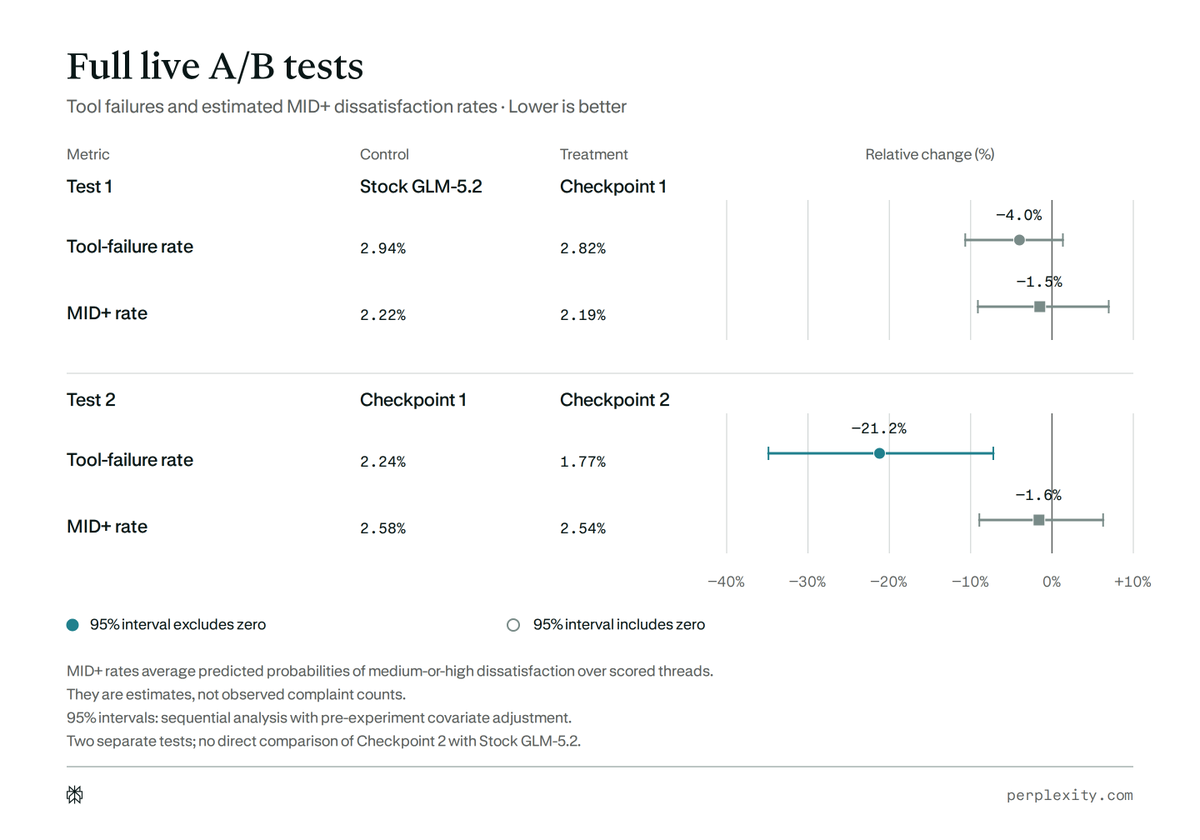
We're sharing new research on our post‑training approach, which teaches the Perplexity Computer agent to learn from real user sessions by imitating good trajectories and explicitly correcting avoidable mistakes like bad tool calls (even when the overall trajectory was successful). The method combines rejection sampling fine‑tuning (RFT) with hint‑guided self‑distillation, and it cuts tool call failures by about 21% in live A/B tests

New research: We post-trained a Computer model to learn from its own errors using hint-guided self-distillation. In a live A/B test, a later trained checkpoint reduced tool-call failures by 21.2% relative to an earlier checkpoint.


With AI, we are all shipping more code faster. The AI SDLC changed. But monitoring didn't change with it.

We just launched Dstl8, the runtime feedback loop for AI-speed engineering - powered by Telemetry Distillation - remember, observability without feedback is just watching controltheory.com/blog/dstl8-gen…

arXiv AI Security: Mapping Political-Elite Networks in Europe with a Multilingual Joint Entity-Relation Extraction Pipeline Treat agent tools like a control plane: least privilege, auditable calls, and fast rollback.

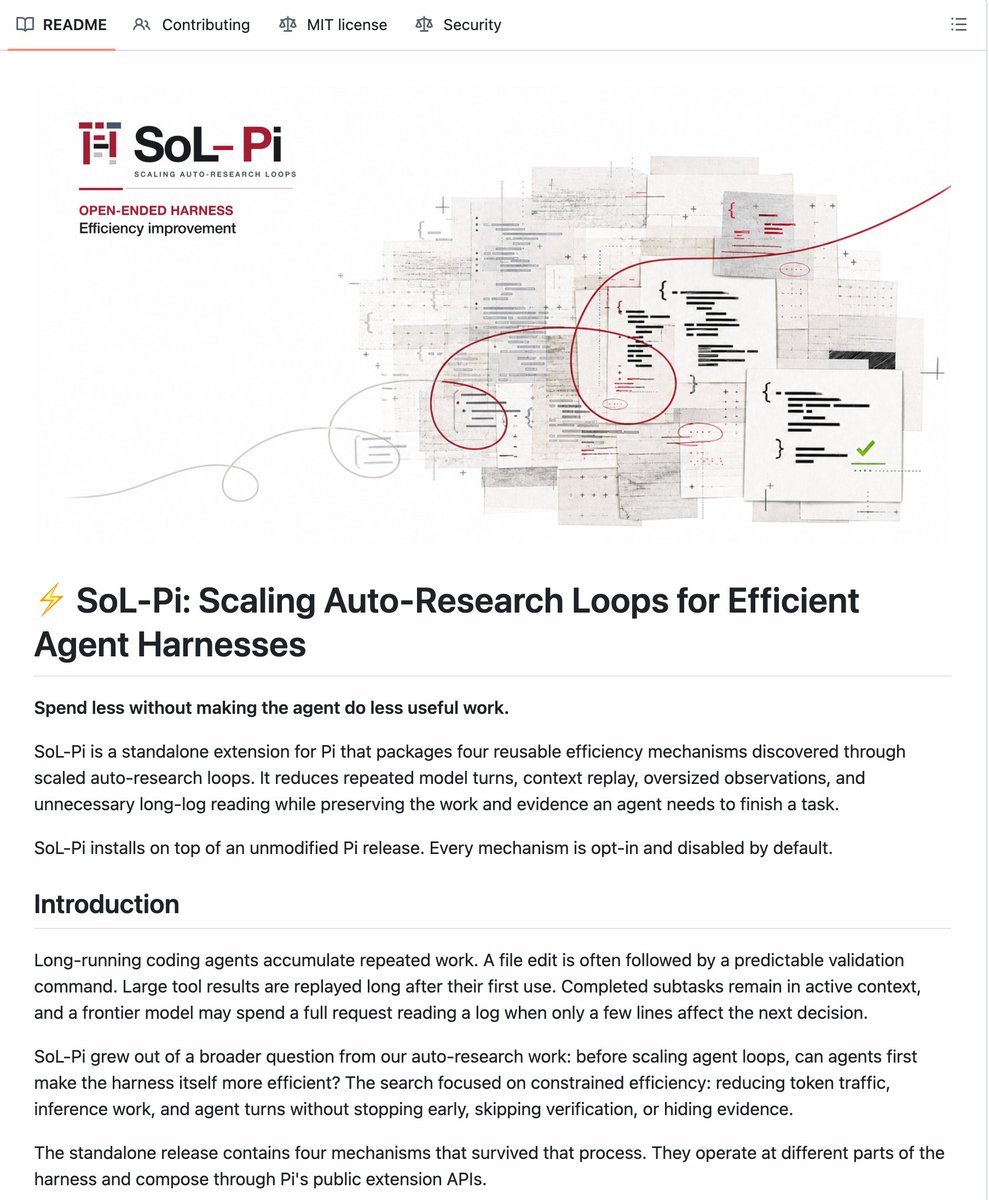
NVIDIA wants coding agents to stop wasting tokens on repeated work. Its open-source project, SoL-Pi, is an extension for the Pi coding agent that tackles a familiar problem: reading the same outputs again, carrying old context, and searching huge logs for a few useful lines. It can combine file edits with follow-up checks, keep large outputs available without repeatedly sending them to the model, and shorten logs while preserving access to the originals. It also compacts context as parts of the task are completed. The goal is lower token costs while keeping the checks and information needed to finish the job. Every feature is optional and off by default.

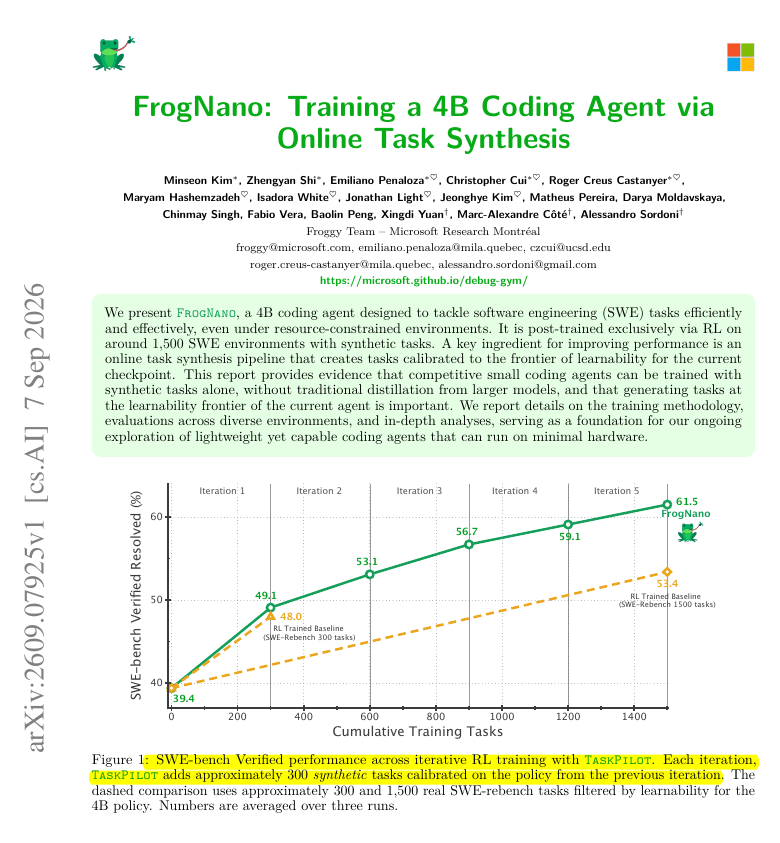
A 4B coding agent reached 61.5% on SWE-bench Verified without frontier-model distillation by combining a simpler tool interface with synthetic tasks that keep adapting to what the model can currently learn. FrogNano starts from Qwen3.5-4B and is trained with RL on about 1,500 synthetic software-engineering tasks. The important part is how those tasks are chosen. As the model improves, the system generates fresh problems that are challenging but still learnable, so the curriculum improves with the agent. The interface matters just as much. Switching to a simpler 5-tool setup moved the base model from 8.3% to 37.2% on SWE-bench Verified. After 5 rounds, FrogNano reached 61.5%. – arxiv. org/abs/2609.07925 Title: "FrogNano: Training a 4B Coding Agent via Online Task Synthesis"

0xTangent @loftyarcher
296 Followers 898 Following I use AI to ship code. Not demos. Not slides. Production beats trends. AI + cybersecurity for builders.

fkfkfkfkfkfk @lb6547
8 Followers 536 Following
Amanda Richie @AmandaCRichie
30 Followers 178 Following

Andrew Yeung @andruyeung
84K Followers 841 Following throwing tech parties @meetfibe + sharing vetted startup roles @theshortlistnyc

jia @jia_seed
21K Followers 7K Following 22. prev. drone research, dropped big tech currently internet data as co-founder @ jam

Mark Cuban @mcuban
8.6M Followers 2K Following Dunking on the pharma industry with @costplusdrugs.com, the lowest prices on meds anywhere. check it out !
Build Anything @buildanythingso
7K Followers 41 Following Free program that turns you into a Founder ⚡️Learn how to build secure, production ready apps.
Lisha @lishali88
19K Followers 1K Following Partner @a16z infra & AI. prev ceo @rosebud_ai angel in seed @fal @periodiclabs @ExaAILabs @sakana PhD @ucberkeley Math & AI
a16z @a16z
1.1M Followers 64 Following https://t.co/A9eTFq6Xbx https://t.co/3RHK5vqQo7 Posts are not investment advice or an advertisement for investment services. See https://t.co/nX2FtaLE06.
OpenAI @OpenAI
5.5M Followers 4 Following OpenAI’s mission is to ensure that artificial general intelligence benefits all of humanity. We’re hiring: https://t.co/dJGr6LgzPA
Sam Altman @sama
6.4M Followers 1K Following The mission of OpenAI is to ensure that AGI benefits all of humanity

Cognition @cognition
193K Followers 8 Following Makers of Devin, the first AI software engineer. We are an applied AI lab building end-to-end software agents. Join us: https://t.co/4Ss9hvpjRG

Chamath Palihapitiya @chamath
2.5M Followers 1K Following Social Capital 8090 God is in the details.
Factory @FactoryAI
58K Followers 49 Following Assembling @droid, the frontier software development agent. Available to anyone, with any model, in any IDE/terminal.
Claude @claudeai
2.0M Followers 2 Following Claude is an AI assistant built by @anthropicai to be safe, accurate, and secure. Talk to Claude on https://t.co/ZhTwG8d1e5 or download the app.
Replit ⠕ @Replit
240K Followers 583 Following Idea to app, fast. Create beautiful, modern web applications at the speed of thought with the power of Replit's AI Agent.
8090 Solutions Inc. @8090solutions
10K Followers 3 Following Enabling every enterprise to benefit from purpose-built, transformative, high quality software.You might like

















