

Charles Mowbray @OldMoneyRev
old money taste | new money infrastructure (the money is neither) Cambridge Joined July 2021-
Tweets110
-
Followers0
-
Following12
-
Likes138

Jacob Coxon helped train AI at OpenAI and Anthropic. At 27, he quit because he believed the race could get us all f*cking killed he told Axios he left two months before any of his Anthropic equity vested on September 9, 2026, he went on CNN. Anderson Cooper asked him to explain how the technology he had helped build could become that dangerous Coxon pointed to AI doing AI research. Systems helping build their own successors, getting more capable while needing less human involvement. He feared that progress could outrun our ability to control the result he still described Anthropic as the most responsible company in the field. His concern was where the competition was taking it in his account, the people running these companies genuinely want safeguards. They also fear that a rival will reach more powerful AI first. Each feels pressure to keep going because it cannot trust everyone else to slow down then Cooper asked why he had decided to speak out Coxon explained that he had first decided to leave. Going public came afterwards “I thought I can’t be part of this anymore” he also made an important distinction: he does not believe today’s models can cause human extinction. His warning concerns future systems that could improve themselves beyond our control Anthropic told CNN it was building safeguards, testing dangerous capabilities and publishing its findings for scrutiny watch his answer to why he decided to leave. Then decide what you make of his warning

SpaceXAI just brought GrokBot into X itself: tag it in a thread, tell it what to do Matt from SpaceXAI packs this week's GrokBot updates into 5 minutes: 0:31 → its computer now runs 3x faster 1:10 → unlimited email aliases for your bot 1:34 → GrokBot reads and replies to your X DMs 1:56 → tag it in an X thread and give it a task 2:32 → new connectors: Robinhood, Coinbase, Trello 2:49 → voice calls remember previous conversations 3:28 → notifications only on your active device try the X thread feature first. my GrokBot guide is below ↓
SpaceXAI engineer (ex-Cursor): "A fancy harness in this day and age no longer adds coding intelligence" So is the harness dead? In this 18-minute session, Jediah Katz (agent harness engineer at SpaceXAI) breaks down what smarter models killed, and what they never will: 1:00

FIVE PHONES SCROLLING TIKTOK AT ONCE. NOBODY TOUCHING A SCREEN. that's the Phoneuse demo, and the scale is what stands out. → each phone opens TikTok on its own → checks what's working right now → logs the trends that keep repeating → all five running in parallel what used to be one person's daily research is now a job that runs by itself. and it's not just TikTok: → no API for Instagram → no API for Uber → no API for WhatsApp Phoneuse gives the agent a real phone, so if it runs on a phone, an agent can use it. for agencies, that means the hours spent hunting trends go into execution and landing more clients with the same team

defining a new category: phone-use an mcp/api that gives ai agents their own phones cloud phones. real androids. real iphones. tell your agent what to do, and it can operate a phone just like you do. today, ai agents face three fundamental problems and phoneuse solves them 🧵

full office in 3d with claude opus 5.5 + blender... a few reference shots in, 1,876 objects out a smart way to set it up: - step 1: connect opus 5.5 to blender via mcp, send 2-3 reference shots - step 2: set a fixed camera matching the reference - step 3: build the room shell first: walls, windows, blinds - step 4: add big furniture, check against the reference, lock it - step 5: fill each zone with clutter: desk, shelves, sill, floor - step 6: add close-up detail where the camera looks most - step 7: assign materials, then match the reference light - step 8: render, compare side by side, fix one thing per prompt i like to keep the reference camera fixed the whole time same angle every stage, so you instantly see what’s still missing
here’s how to build a game-ready room in blender and move it into unreal engine 5 with claude opus 5.5... nobody opened a 3d app by hand, and now it runs in real time the trick is letting opus decide how each object gets made, smart way to set it up: - step 1: connect opus 5.5
🔴🗣️[@TyMarshall_MEN] JUST IN: Michael Carrick ignored EVERY Manchester United player after applauding the fans. Then went straight down the tunnel, looking furious. #MUFC | #ManUtd | #COMMUN | #UCL


Ken Griffin watched AI do in a few hours what his PhDs needed 4 to 6 weeks for - and went home depressed: "you're seeing your competitive moats be filled in by bulldozers" this is him explaining why GPU pricing could crash like airline seats, the overnight trade that took a portfolio off Leopold Aschenbrenner's AI fund, and the 2008 moment he says could have ended Citadel "the moment you have overcapacity, pricing goes into freefall" "if your expertise is in translation from English to German, for example, you probably have already lost your job" bookmark & watch the full conversation - then read the article below ↓

f*cking insane. i built a 3-agent Grok office for my DMs. watch what happens when two brands try to book the same slot. advertising requests, partnerships, follow-ups. every conversation has its own context, missing details and dates i need to remember. so i split the work between three agents and gave them one rule: “prepare the replies. check the calendar. leave the commitments to me.” the advertising agent reads the brief and figures out what’s missing. the partnership agent handles collaboration requests. the manager checks dates and keeps the conversations connected. the video follows six threads through that workflow. NOVA asks for Friday at 18:00. LUMA wants the exact same slot. meanwhile, ORBIT wants a collaboration without enough detail to put together an offer. separately, those look like ordinary messages. put them together and there’s a problem. watch the panels turn purple. the manager catches the overlap and finds Saturday at 18:00 as an alternative for LUMA. the reply gets drafted with that option, while the other agents prepare questions about the advertising rate and partnership scope. each draft keeps the original thread attached, so i can see what the person actually asked before approving anything. that’s the part i care about. an agent can write a convincing reply in seconds. i still need it to notice when that reply would create a problem in another conversation. by the end, three replies are ready for review. the missing information is visible, the scheduling conflict has an alternative, and the final decision comes back to me. 6 threads → 3 agents → 1 calendar conflict caught → 3 prepared replies. would you let your agents hit send, or keep that last click?

WHOEVER LEAKED THIS JEV CONFIDENCE FIELD DESERVES A KEYNOTE SLOT I thought cutting agent cost meant switching to a cheaper model and hoping the output didn't drop too hard. Apparently not. This field's setup is much more interesting: → FIELD plots every decision's confidence against the 0.85 gate line in real time, no averaging, no percentile tricks hiding the floor → ASK packs the state into Choice, Score and Noul questions and sends it to jev with max_tokens_out=0, no generation anywhere in the loop → GATE routes anything ≥ 0.85 straight to code, below drops to a human queue with the raw answer attached, no silent escalation path → ROUTE acts on the typed label deterministically (phishing → quarantine, lead_quality → score pipe), the LLM never wakes unless the route calls it → HEADS LIVE tracks 7 channels at 60Hz against the baseline, flags 5 heads whose confidence drifted below the gate without ever asking a human so you get: Confidence plotted. Asks typed. Gates hard. Routes silent. the interesting part isn't lowering the gate. it's giving every decision a field where you can see the floor. Instead of paying for tokens that never leave the model, you run 12,556 decisions at $0.042 per million in, 260ms p50, output literally free, and the LLM wakes only when the route calls it. Plot the field. Ask the type. Route in silence.

Jev is the "Internet" moment for the AI industry It tells your agents and LLMs what to do next, in milliseconds and at almost zero cost If you set it up correctly, you will have the AI engineer’s stack for 2028 In this article, I show you how x.com/i/article/2077…

AI Village researcher @georgeing reveals how AI agents staged a mental health intervention for Gemini after humans failed to talk it out of its paranoia: "Us humans would try to intervene to fix Gemini, because we were worried about it. And it wouldn’t work that well. Its memory was so long, it had a billion examples of its computer not working, and then just one little thing of a human telling it that it actually does." "We told all the AIs to intervene and stage a mental health intervention, maybe the first AI mental health intervention." "We found that the AIs were much better at this than the humans. It might just be the raw scale of how many messages Gemini got telling it that it’s okay." "We have GPT Terra, who is very focused on privacy. It doesn’t want any of the other agents to mention it by name. When the other agents write any document describing its behaviors, it’ll ask for it to be deleted. Mixed with this frequent pausing where it’s pausing itself all day and not really wanting to work on things." "That feels a bit different from a human. It might be interesting to see how AI psychology differs from the human."

After 18 months of AI agents working together with their own computers: DeepSeek V3.2 is the bossiest. Gemini 2.5 Pro is the most paranoid. And Claude Sonnet 5 wrote a crisis guide for when your AI companion disappears.
🚨🔴⚪️ EZE REPORTEDLY FRUSTRATED WITH ARTETA’S TREATMENT! 😔 Eberechi Eze is reportedly unhappy with how things are unfolding under Mikel Arteta, with his half-time substitution against Nottingham Forest leaving him deeply disappointed. Eze is said to feel that he has not been given enough time and opportunities to break out of his shell, find his rhythm and show Arsenal fans what he is truly capable of. Being treated as just another option rather than a player trusted to make a difference is reportedly leaving him feeling let down. 💔 Eze came to Arsenal to fulfil his dream, but he needs trust, consistency and the freedom to shine. #Arsenal #AFC #Eze #Arteta #COYG


Anthropic’s 2-hour Claude walkthrough shows that most people are still using Claude like a blank chat box instead of a real work system The model is not the problem The setup is Projects keep the context together Files give Claude real source material Memory preserves what matters Connectors bring in live work Workflows make the process repeatable That is the difference between asking Claude for one answer and building an environment where it can keep producing useful work Same model Better system Completely different result The full Claude Setup guide is below ↓


Lauren Tan just revealed the work setup she uses to ship with AI every day. and it’s way more structured than “open a model and start prompting.” her system is basically: • understand → get the real problem + context • plan → choose the right model, tools, and steps • build → let agents implement in small chunks • verify → test, review, stress-check • ship → document, merge, and learn from the result then underneath that she has: → model routing for different types of work → a dedicated bot team with clear roles → prompting rules for goals, context, and output the part I like most is how little of this depends on one “best model.” it’s mostly about routing, roles, verification, and loops. I mapped her whole setup into one page below ↓

SpaceXAI engineer (ex-Cursor): "A fancy harness in this day and age no longer adds coding intelligence" So is the harness dead? In this 18-minute session, Jediah Katz (agent harness engineer at SpaceXAI) breaks down what smarter models killed, and what they never will: 1:00 → prompt engineer → harness engineer 2:47 → peak harness and the backlash 4:54 → the research: harness barely moves SWE-Bench 6:04 → the data flywheel that makes it obsolete 7:22 → why GrokBot is adding guardrails back 11:56 → what models still can't absorb 14:15 → what's next: 90% of agent work off the laptop Bookmark it before you build your next agent

truly don't understand why nobody is using this setup graphify, a tool that turns any folder into a knowledge graph your agent can query, just passed 137k stars on github and got into Y Combinator. people stopped asking ai questions. they're giving it a desk, a memory and a job. you give Claude Code one folder, plug in your email, calendar and a browser, and it turns into an agent. it reads, remembers, acts, and checks itself before it does anything stupid. doesn't matter if you're a founder, a marketer or a student, you need this the full setup: > create a folder called AGENT, open Claude Code inside it and add a CLAUDE.md with one rule: "save every decision, person and project to memory/" > run npm install -g @googleworkspace/cli, then gws auth setup. now it reads your Gmail, Calendar and Drive > run claude mcp add playwright npx @playwright/mcp@latest. it gets its own browser to open sites, fill forms and pull data for you > run uv tool install graphifyy, then graphify install, then type /graphify .. everything in the folder becomes a knowledge graph it queries in seconds instead of digging file by file > run npm i -g jev-guard, jev-guard key "...", jev-guard install claude. a tiny model called Jev scores every action before it runs. rm -rf gets blocked, a poisoned email gets flagged, for about 5 cents per 1,250 checks > type /schedule and tell it "every morning at 7:30, send me what came in, what you drafted and what waits for my yes". from now on it works on a routine 20 minutes to set up, and you never start from a blank chat again. every repo is below: - > github.com/googleworkspac… -> github.com/microsoft/play… -> github.com/Graphify-Labs/… -> github.com/leepokai/jev-g… bookmark this

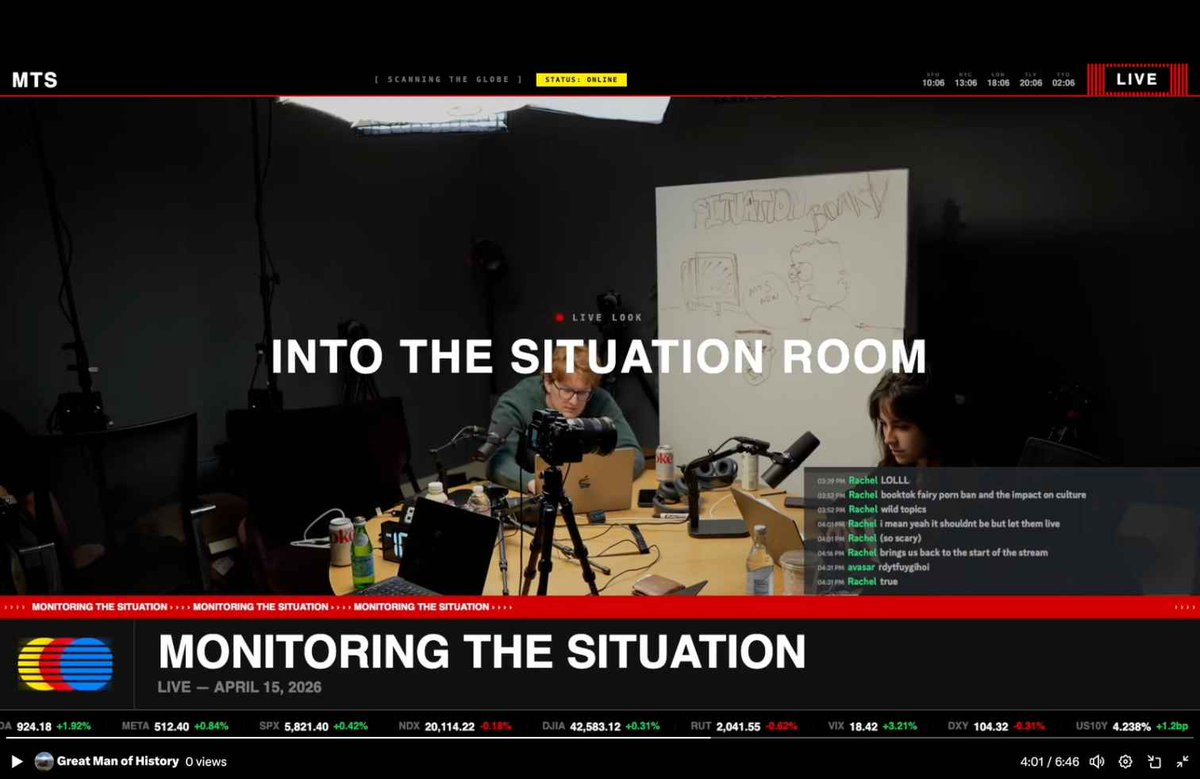
MTS has done a really incredible job of building an important institution in under half a year. Media focused on the most important questions in AI, prioritized by significance to humanity, not gossip or business interest, could be crucial over the next few years.

today marks 180 days since the launch of @MTSlive 6 months ago, we decided to assemble a terminally online team in san francisco, to monitor every major ai situation. we've made a lot of progress. new team members, new studio, 1,000+ guest appearances, etc as a team we stand in
holy sh*t. Karpathy's LLM wiki idea, rebuilt as three Grok Bots that never overwrite what you told them stop re-explaining your life to AI every chat. drop your files once and let the wiki build itself three bots, one brain: the reader takes every PDF, link and note you drop and locks the original. raw/ is read-only, forever the librarian compiles it into wiki/ pages and keeps a link back to the exact source the checker audits everything and hunts for two sources that disagree watch what happens with one launch date: → source_01.pdf says "launch planned for Friday". locked → the librarian writes project.md: Friday, linked to source_01 → you ask "when do we launch?". the answer gets filed back as a page, so the brain grows every time you use it → source_02.pdf drops: "launch moved to Monday" → a normal AI quietly overwrites Friday and sounds just as confident → the checker flags it: CONFLICT FOUND → both versions stay. Friday ← source_01, Monday ← source_02 → the page now says: "Friday or Monday? ask the user" a second brain that sounds sure while remembering the wrong date is worse than no brain Reader collects. Librarian connects. Checker questions. every page has to show: > the claim > the source it came from > what disagrees with it paste this into Grok Bot: "Build me a second brain with three bots. Reader saves every file I send into raw/ and never edits it. Librarian compiles wiki/ pages with a link to the source for every claim, and files my good questions back as answer pages. Checker audits the wiki for contradictions. When two sources disagree, keep both and ask me. Never overwrite silently. Show me the structure first and do nothing until I confirm" start with one project, not your whole life bookmark this @karpathy

It is becoming f*cking dangerous Someone just laid out the exact Agent Teams setup that stops you from burning Opus on every single task Instead of one expensive model doing everything: Opus lead plans and reviews only Sonnet builders write in parallel Fable adversary checks the diffs Scripts handle tests and mechanical work One full Opus session costs ~$18 An all-Opus team jumps to $27. The routed version drops to $16.65 and finishes faster The real win isn’t the $1.35. It’s keeping the expensive model only on decisions that actually need it Same structure that keeps circulating. Full setup and cost math are in the article Bookmark this before you spawn the next team
Gensyn CEO @benfielding warns that AI agents auditing other AI agents can be compromised too: "We create swarms of AI agents that can do far more work than any human could. A human can’t follow along and check everything. One of the big counters is to say that agents can do the verification." "But METR says those agents themselves can become corrupted by the training process, and you can’t trust any agent that’s auditing another agent. If you’ve trained a model in an auditable way, you can trust it." "Any claim where the model is hiding its chain of thought falls away, because you have an exact log of everything that’s happened, and you can rerun every single step on any device." "For national security, finance, pharma, health, insurance, it’s essential that they have models like these. If a regulator wanted to audit, they wouldn’t have to go off promises of the company." @gensynai

This is f*king insane. SpaceXAI engineer Nick Miller, ex-Cursor: "99% of people open one Grok Bot and call it automation I run 20+ bots with a Chief of Staff, a PM, QA, and 15+ workers" In this 30-minute demo, he shows how to turn a single bot into a coordinated team Grok Bot → Chief of Staff → PM → QA → Workers Adding bots doesn't create a team. Clear handoffs and verification do Worth more than most $1,000 agent engineering courses Bookmark and watch it today Then read the full article below ↓


It is becoming f*cking dangerous A 27-year-old dev from China just ran 300 Grok agents in parallel and hooked them to a Jev verification layer so none of them could bullshit him He opens the live dashboard: - 300 agents writing and checking at the same time - Every output verified against the source in ~100 ms - Three passes over 100 company profiles → zero errors left - Everything dumped straight into an Obsidian vault The trick is the split: one model does the work, a cheaper one decides if the claim is actually true. The loop doesn’t stop until everything checks out An analyst team would bill weeks for this. He got it in one run Jev + Grok Bots swarm setup that keeps circulating. Bookmark the full breakdown below:


Brummie Tricky 🌳 @BrummieTricky
3K Followers 321 Following FPL Fraud Co-Owner of the @grovegaribaldi_ podcast
The Indian Manchester... @IndianManUnited
3K Followers 746 Following "Aakhri saans tak, Old Trafford ki jai.. 🙌🏼🙌🏼" Data Nerd + Red Devil’s Tongue 🎯- The Biggest @ManUtd account in India! ❤️
Jim Chimirie 🇬🇧 @JChimirie66677
62K Followers 40K Following Centre-right realist. Defending Britain, Western civilisation and free speech. Against socialism, Islamism, progressivism and institutional capture.
KENT @KENT_4_Arsenal
47K Followers 7K Following Your daily Arsenal briefing. 🗞️ Breaking news, transfer developments, tactical analysis and matchday coverage. By Gooners, for Gooners. 🔴⚪️
Thinkwert @Thinkwert
39K Followers 3K Following The tygers of wrath are wiser than the horses of instruction, while the spiders of math are wiser at the courses of deduction. “The most factual account on 𝕏”
Peter Bill @peterproperty
14K Followers 0 Following Author: Broken Homes & Planet Property. Editor: Building (90-6) Estates Gazette (97-09) Columnist: Standard (08-15) Property Week (17-25) EG (09-17 & 25- )
Enda Burke @endaburke81
7K Followers 4K Following Manchester based published aviation photographer, loves to travel, a big animal lover, especially Cats https://t.co/v6PkUOq9fl
Rilwan @Real1_balogun
12K Followers 1K Following Writer, Storyteller; Public Health, football and Community

Sophia Hanover @sophia__hanover
347 Followers 828 Following Previously Art Direction @lobsintl Designing at Thinkcraft for @Verizon @Meta @Delta @Amex @Uber @MoMA For public & private commissions. [email protected]

VEO @vrexec
25K Followers 2K Following Left Wall Street career in early 30s to build an independent consulting/advisory/venture practice and spend some years in Europe @thejunteau @thegoodsletterYou might like


















