

liquidGCelixir @liquidGCelixir
Joined March 2025-
Tweets11
-
Followers6
-
Following63
-
Likes10

It feels like a contradiction you can’t quite reconcile. On one hand, you know—intellectually—that you’re doing exactly what you’re supposed to do. The system is profitable. The backtest is robust. The rules are being followed perfectly. There’s no mistake to fix, no tweak to make. This is the process. But emotionally, it feels like something is very wrong. There’s a steady, low-grade discomfort that sits with you all day. Not panic, not chaos—just a grinding unease. The equity curve is doing something it has always done in the past, but when it’s happening to you, in real time, it feels different. It feels personal. It feels like failure. Every loss reinforces a quiet doubt: What if this time is different? What if the backtest was an illusion? What if I’m just sitting here watching capital bleed for no reason? And the hardest part is the helplessness. You’re not allowed to act. You chose not to act. Discretion would actually feel better—at least you could do something. Cut risk. Override a trade. Reduce exposure. But the system says stay. The system says this is normal. The system says this pain is part of the edge. So you sit there, following rules that are currently producing losses, while knowing those same rules are the only reason the long-term returns exist at all. It creates a very specific kind of tension: Short-term emotional truth: This feels terrible and wrong. Long-term statistical truth: This is exactly what must happen. And those two truths don’t align in the moment. In fact, the better the system—the more it relies on capturing rare, outsized winners—the more uncomfortable this period tends to be. Because the edge is paid for upfront in drawdowns, whipsaws, and frustration. So the feeling is something like: quiet conviction under pressure. You’re holding onto belief without reinforcement. You’re executing without validation. You’re enduring losses not because you’re wrong—but because this is the cost of being right over time. And that’s what makes it so psychologically difficult. If it felt good, it probably wouldn’t work.

Hardship is most often worse than you expect, longer than you expect. The recovery is often even faster, often 1/5th or faster than deep drawdowns or general hardship. Hardship puts it all in perspective, it allows for growth, mentally, spiritually, in the growth path. Small continuous steps forward is the way to fight against the pain. 1% better each day. The work you put in near the top is often the least productive. The work you put in in deep drawdowns is often your absolute best. Deep despair cleans the board, kills the excess, resets the board, often the path forward is filled up with opportunity. At the end of a rally too much chases too little. At the end of despair there is too little to take advantage of too much. Great euphoria and despair are both parts of the journey, both are fake, like the final end of a parabolic move, they are created to be faded. Mistrust big bursts, biggest losses come after the biggest wins. Trust compounding, all great things take time. The best aspects in life are all achieved through compounding. Relationships, Fitness, Health, Profits, Respect, Exposure, Skill... Trust it, accept grind is the minimum if you want to achieve anything.

As a retail trader, if you think you’ve found something the “big boys” haven’t found, you’re probably lying to yourself. I’m new to datamining strategies, and I’m already stunned by I can achieve. Now imagine what firms managing billions, with better data, better infrastructure and better researchers are capable of. They’ve probably tested every strategy you can think of. That’s why, as a retail trader, your best bet is usually not to discover some magical hidden edge. It’s to harvest edges that are already known but still persist: Risk premiums. Capacity constrained strategies. Behavioural edges. Structural inefficiencies. Basically, edges that survive because they are uncomfortable, limited, boring, hard to scale or hard to stick with. Those 2+ profit factor and 2+ Sharpe ratio backtests you have are more than likely overfitted.

Stanford PhD David Magerman helped shape Renaissance Technologies legendary trading models for over 20 years. Here he breaks down why you can’t compete with algorithmic trading models:

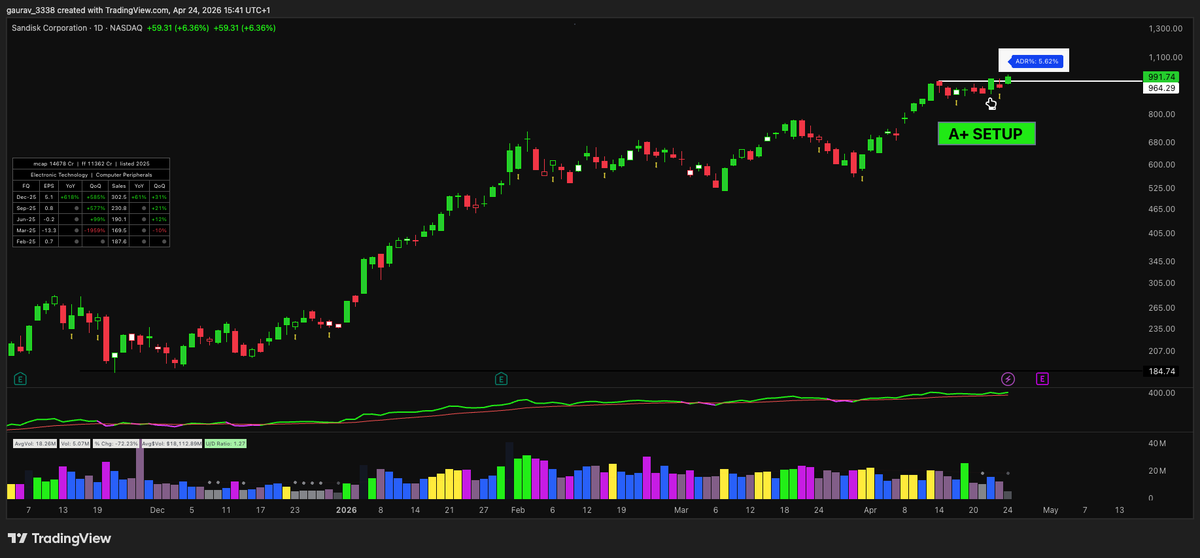
Why Qullamaggie Looks at ADR% First And How I Use It? Before Qullamaggie checks the setup, sector etc. he checks one basic number: ADR%. Because if a stock cannot move, nothing else matters. The cleanest setup in the world is useless if the stock is dead. What is ADR%? ADR% simply tells you how much a stock normally moves in a day. Imagine a stock has a 20-day ADR% of 5. That means, on average, this stock has been moving around 5% per day over the last 20 days. Now here is how I understand and Trade it. Simple rule: ADR% above 5 → good for swing trading ADR% between 3–5 → okay only if market/sector is strong ADR% below 3 → usually too slow for swing trading so, let's say today, while scanning, I find the stock that has ADR% of 5% & has -Strong Prior Uptrend of 40%+ -Now Pulling back to 21 DEMA -Last 3-4 days it formed very tight range -and today it moved only 0.07% with NR5 That is not just a quiet day. This is like a spring getting compressed. and this is exactly where big traders start paying attention A 0.7% candle on a stock that normally moves 5% means volatility has collapsed. Almost soon, expansion will come back. How to Include it in trading Plan: Find stocks with High ADR% as a pre-trade filter. Anything below your threshold drops off immediately & saves hours of chart review on stocks that can't pay you. Then keep it simple: Buy only if price breaks above the tight range high. Your stop should be tight because the whole edge comes from entering when volatility is compressed. That is the real game. $SNDK
Histories Most Controversial Quant, Sam Bankman-Fried in action:

This dude deserves a free battlepass @Battlefield

99% of Traders aren't profitable. This means that if you want to become profitable you must avoid being "normal", since "normal" literally means "losing money to the market". What this means in practice: • working abnormal hours • looking for edge in abnormal places • developing abnormal skillsets • making abnormal friends • making abnormal sacrifices If you act in an abnormal way, you will get abnormal results. If anyone hates on you and/or calls you weird, this is a leading indicator that you're on the right track. 🌶️
Trade Idea Generation Explained ↓ ----------------------- An idea to improve my Trading system can come from 3 main categories. I like to go through these 3 categories in this specific order, because this order addresses all the lowest risk ideas to the highest risk ideas 1) Elimination: I wonder if I do less of X, will I get better results? (e.g. the removal of an action which is technically a mistake, but you don't know that it's a mistake yet) 2) Addition: I wonder if I can just find a way to do more of Y, will I get better results? (e.g. trading the same strategy but across multiple asset classes) 3) Innovation: I wonder if this brand new idea Z is actually a profitable idea. If I trade it, will I get better results? ----------------------- Most traders skip the first 2 steps and go straight to the 3rd one, non-stop binging with testing brand new stuff... the issue is that something "completely new" has the highest risk of failure. The easiest step which is the most often ignored is the removal of harmful (or constraining) variables in a system. Remove → Add → Create 🌶️
Simple Trading > Complex Trading. An unfiltered rant ↓ ------------------------- 1 ) Quick Context Simplicity isn’t about avoiding complexity. It’s what you get after wrestling with complexity and eliminating everything that's unnecessary. The process can look something like this: - Oversimplify: (start with something stupidly simple and primitive) - Get burnt and fail: (there is a big difference between expected (or desired) outcome and actual outcome) - Refine and iterate: (using the data collected from past failures, come up with ideas on how to make the system "suck slightly less" by identifying and removing unhelpful parts in the system. ) - Repeat: (The more times you go through this loop, the more iterations you will discover. The more simple the system, the easier it will be to go through this process. A faster rate of going through this feedback loop will yield stronger longterm results. This is why the "starting point" of a system is irrelevant and how the main thing that matters is the "rate of improvement" of a system. ) ------------------------- 2 ) The Four Stages of trying to Simplify a System/Strategy: The "ooga booga" Stage - At first, everything looks easy. You make a simple plan, feel confident, and then reality smacks you when it doesn’t work. The "wtf is all this shit" Stage - Now you see how messy it really is. Lots of moving parts, variables, and exceptions. The job is to build a basic system that works, then improve it over time. The "I'm doing stuff but idk wtf i'm even doing" Stage - You get buried in details and lose sight of what matters. Out of frustration, you oversimplify again. If complexity doesn’t make the system better, cut it. Elegant and Informed Simplicity (The "I know my shiz" Stage) - After cycling through the mess, you end up with something that looks simple on the surface but it’s strong, tested and built on a deep fundamental understanding. Signs of imposter syndrome start to fade and is replaced with a confidence that is backed by evidence. ------------------------- TL;DR Making something more complex doesn't make you any better or smarter. It just makes you improve much slower. Keep it simple. 🌶️

not even a single $ has moved since the last 16 years peak self control wonder what he is doing these days


Jade @PonyoOcean7o
188 Followers 147 Following Forever keeping a childlike curiosity about the world; even when life has hiccups, I always find touching little joys in the details.
Ricard0_ @R1c_RTP
48 Followers 2K Following Private content partner to finance & tech founders | $50M+ in value generated for 35+ clients | | like to share my honest thoughts, don't take it personally
_stevendu @_steven1_94
151 Followers 5K Following Dɑy Тrɑdеr | Меntоr | Gɑmеr | Тurnеd $27k іntо “tоо mɑnу” mіllіоns. І tеɑch mɑrkеt рlɑyеrs tо mɑxіmіzе рrоfіts wіth еffісіеnt strɑtеgіеs.
Timothy Sykes_ @tiimoothysykes_
68 Followers 933 Following I've turned $12k into $7.7 million trading stocks from 134 countries/building 120 schools, go apply at https://t.co/iYcZC3GkXe to be my dedicated student!
JJ - Fxckin Doin It! @fxckindoinit
575 Followers 197 Following Data Driven Statistical Trader | Live Journal
Martin Luk @martinlukkt
26K Followers 38 Following Trader | +969% in US Investing Championship 2025 Streams and recordings: https://t.co/sMucqtWNGM
Serenity @aleabitoreddit
1.1M Followers 212 Following Only on X, don’t trust fake accs AI/Semi Supply Chains Research Nothing is investment advice. No paid promos; may trade/hold names disc, views my own.
Glenn @Tradr_G
7K Followers 2K Following Active Trader 📈 | Rule Breaker ⚡ | Tesla M3 ⚡ | Dad of 2 fast teens! 🏎️ X is for fun, not so serious — Real Trades, Real Life. 📍 Kinfo Verified
SerClickALot @irigstocks
3K Followers 75 Following semi-retired pvp fund est 2019, i like bow and horses https://t.co/BQe6pbqdkK


Alex Desjardins @PrimeTrading_
32K Followers 302 Following Professional Trader, 10+ years experience - Founder at https://t.co/oHBJyNQTZd and https://t.co/GEJpgVvdaY.
Jin @Jin67171
24K Followers 0 Following I'm a short biased 8 figure trader. This twitter is just to record my daily P&L & share my opinions. It's not an investment advice.
David Veprek, CFA @veptrader
4K Followers 160 Following 20+ years trading professionally for various hedge funds. All my trades and research on https://t.co/3ce9dIF7Rs. https://t.co/70DGQKAcBl
Marios Stamatoudis @stamatoudism
32K Followers 356 Following Sharing ideas, charts, and the philosophy behind trading | 2023 US Investing Championship - Top Performer +290% | Official Profile - Blue Check

Francesco @FranVezz
24K Followers 288 Following Swing trader focused on risk FIRST. For trade ideas, market analysis, nightly video & lots more, check out my 5x weekly newsletter. Also lead a Discord room.
Nathan Michaud @InvestorsLive
247K Followers 287 Following Account is operated by InvestorsLive, LLC. Moderator at @IUTraders Disclosure & Partnerships 👇 https://t.co/5gLkPH7njh
Ariel Hernandez @RealSimpleAriel
69K Followers 583 Following Day trader turned swing trader. Here to help others improve their trading! Join me for live streaming on Discord. https://t.co/RRhmvGkkh0
Jeff Sun, CFTe @jfsrev
55K Followers 152 Following 16 years of stop losses, pain & grit to $10M multi-asset. My 17-Chapter Trader’s Guide - https://t.co/0F5tgGM49z
stockbee @PradeepBonde
93K Followers 669 Following My profile is protected by Zulu Dick shrinking curse. To all scammers creating fake profiles, everyday your private part will keep shrinking. Look down.
Aporia @0xaporia
44K Followers 275 Following perpetually curious, occasionally enlightened, never particularly skilled


Peter - Cracking Mark... @SystematicPeter
11K Followers 94 Following Systematic trader, fund manager. Web: https://t.co/Qga9clOPid
lucas @lucas95878409
33 Followers 284 Following
mike @Bee_eeezy
12K Followers 205 Following Father, Husband, Former Private Equity VP, Trader/Investor.

Kris Verma @KrisVerma88
35K Followers 165 Following Day Trader | KVS Discord Room | Execution is Everything
James @_findingmyedge
5K Followers 371 Following ASX equities trader. Here to learn, share my journey and keep myself accountable.
Nick Fabrio @longhorncapital
32K Followers 187 Following 34, FT Trader, ASX Stocks, Opinions are my own!

ZenomTrader @ZenomTrader
14K Followers 360 Following Managing $4,900,000 in funded capital! 2-year verified track record! Sharing my growth! Private investor capital! AI/Tech/Inventor/Promethean!
bencb @bencb789
42K Followers 75 Following CRUSH Poker, start here 4 FREE - https://t.co/EOGHpVfHBS Founder @raiseyouredge @Acendclub @hand2note Pro @coinpoker_OFF ambassador
Dylan O'Sullivan @DylanoA4
122K Followers 657 Following “All is built on sand, but we must build as if the sand were stone.” Working on books @InfiniteBooks. Working on writing @SeeCathedrals. Bylines @TheSpectator.
Q1Tile Technologies @Q1Tile
420 Followers 3 Following The closest thing to quant tools a retail trader can get. Come trade smarter👇🏻

stevendu @Steven1_994
80K Followers 108 Following Day Trader| Mentor| Gamer| I turned $27k into 100M+ and I teach people to maximize their profits in the market with the most efficient strategies
Tom @t0mbfx
41K Followers 103 Following Day Trader- Helping traders build consistency https://t.co/S2ZlanYNpR https://t.co/mqe8V8fQxb
Kieran Duff @kieran__duff
8K Followers 123 Following Systematic PM & Head of UK Growth at Darwinex. Running real money and writing it all down. Two free pieces a week on systematic trading. Read it all below.
Connor Bates @ConnorJBates_
55K Followers 919 Following Portfolio Manager of TURBOTECTION at @RevereAsset Management. Business inquiries ~ [email protected]


Spicy @spicyofc
21K Followers 777 Following • Ex-Prop Trader • 9 Years Crypto • Get your free trading strategy guide 👇
Jeppez @Jeppez420
33K Followers 281 Following 🇫🇮 System trader with a touch of discretion on a quest to financial independence.
Anson Tan - Balaena Q... @ansontradveller
230 Followers 20 Following Crypto 2-4% ROI monthly, basis spread arbitrage https://t.co/cmDM1zZgLn | Largest AUM on Bybit Copypro @Balaena_Quant
Darwinex Zero @DarwinexZero
12K Followers 106 Following We give traders what every professional deserves: a fair path to scale. No shortcuts: just verified risk-adjusted performance and the opportunity to earn.
Benjamin Yo @short_cap
10K Followers 6 Following Professional Trader Lawyer Trade Ideas Small cap stocks and Options Father
AT09 @AT09_Trader
56K Followers 298 Following Alex Temiz | Short Seller | MIC | ALL Tweets Are My Opinions NOT Investment Advice | https://t.co/oOxLsTcplE | Follow me on Instagram📸
Deanna @DrDeannaCole
1K Followers 595 Following 🧠Psychologist & Futures Trader📉 📈The Trader Collective - A community of traders striving to master strategy, risk management, and psychology. Together.

Timothy Sykes @timothysykes
345K Followers 812 Following I've made millions trading stocks from 136 countries/building 134 schools, now I teach so go apply at https://t.co/ZHoCqK0up1 to be my dedicated student!You might like


















