-
Tweets120
-
Followers0
-
Following17
-
Likes9
Every airport on Earth claims the sky closest to it. On the sphere the Voronoi cell of an airport is the set of all points nearer to it than to any other airport, measured along great-circle distance. Dense clusters of airports carve the surface into tiny polygons; isolated ones inherit vast oceanic territories. The black vertices mark the triple points where three cells meet and the boundary arcs balance exactly. The partition is complete, the distances are geodesic, and every location on the planet belongs to exactly one nearest airport. The map of nearest runways is also a pure geometric division of the sphere.

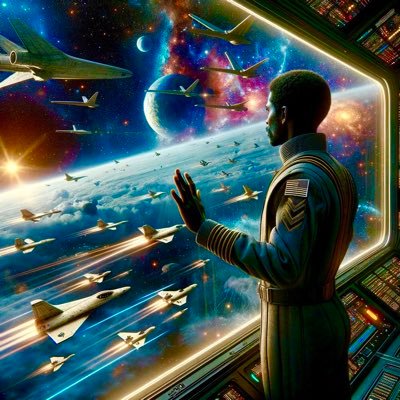
No weapon formed against me shall prosper.

"Advanced Linear Algebra with Applications" is a set of lecture notes that explores the mathematical foundations of numerical linear algebra and its applications to scientific computing, graph theory, and machine learning. The notes cover matrix norms and decompositions, floating-point arithmetic, numerical errors and conditioning, LU and Cholesky factorizations, iterative methods such as Jacobi, Gauss–Seidel, and SOR, sparse matrices, graph Laplacians, Krylov subspace methods, conjugate gradients, Lanczos and Arnoldi algorithms, GMRES, and preconditioning techniques. One particularly interesting section explains the mathematics behind Google's original PageRank algorithm. PageRank essentially treats the web as a directed graph and the ranking of its pages as an eigenvalue problem. Since the web graph is far too large for conventional matrix decompositions, iterative numerical methods make it possible to compute the rankings efficiently. This is an interesting example of how classical linear algebra became the foundation of one of the most influential technologies in the history of the web. arxiv.org/pdf/2608.21234


The Aizawa attractor: It's a distinctive three-dimensional chaotic shape traced out by a system of three nonlinear differential equations with six parameters.
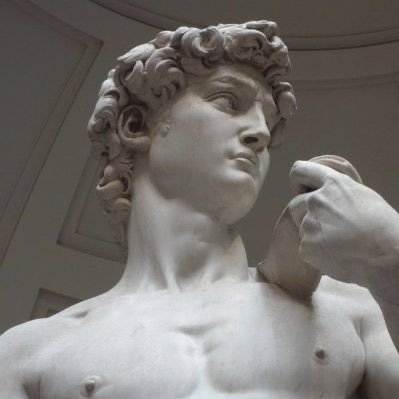
Regardez : Voici le brouillon de Fiodor Dostoïevski pour son ouvrage Les Frères Karamazov :


新ルール「三次元将棋」を公開しました shogitter.canny.io/changelog/af5e…

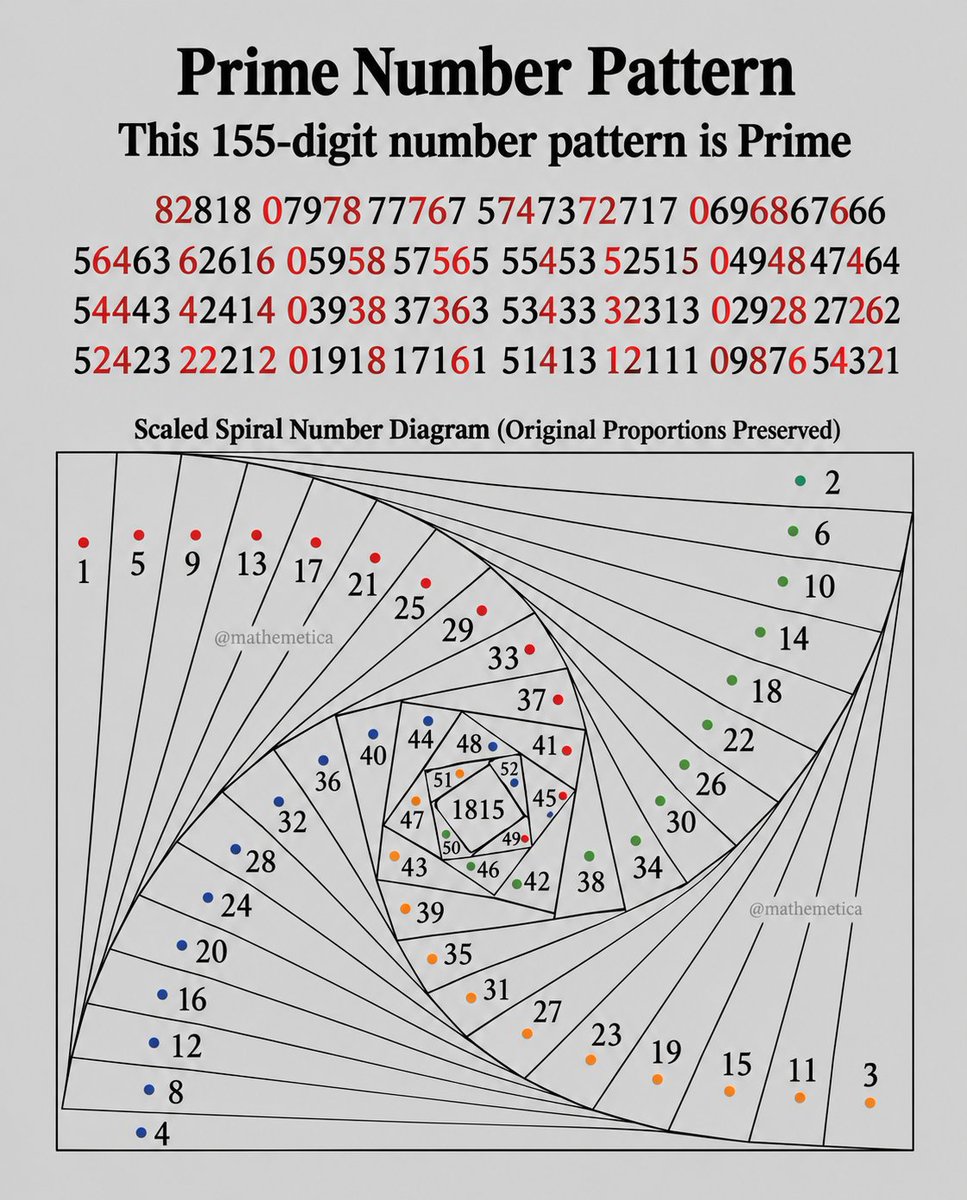
A 155-digit chain built from descending runs is prime. The spiral marks integers by residue class modulo 4, the same arithmetic that governs which of these runs can avoid small factors. Patterns like this are how large primes are hunted for cryptography: structure guides the search, then a proof removes the doubt.


float i,e,R,s;vec3 q,p,d=vec3(FC.xy/r*.4-vec2(.2,-.8),1);for(q.zy--;i++<70.;){o.rgb+=hsv(.59,R,min(e*s-.15,1.)/40.);s=4.;p=q+=d*e*R*.3;p=vec3(log(R=length(p*1.3)),exp2(-p.z/R),atan(p.y,p.x)*s-t*.3);for(e=--p.y;s<1e3;s+=s)e+=sin(dot(cos(p*s),sin(p.xyx*s+t*.9)))/s*.5;}#つぶやきGLSL


"The universe is written in the language of mathematics." – Galileo Galilei.
Walter Trump, Original drawing for the packing of 11 unit squares in a square. 1979. Walter Trump found this packing of 11 identical squares by hand. Five squares tilt at the decidedly non-neat angle of about 40.182°.
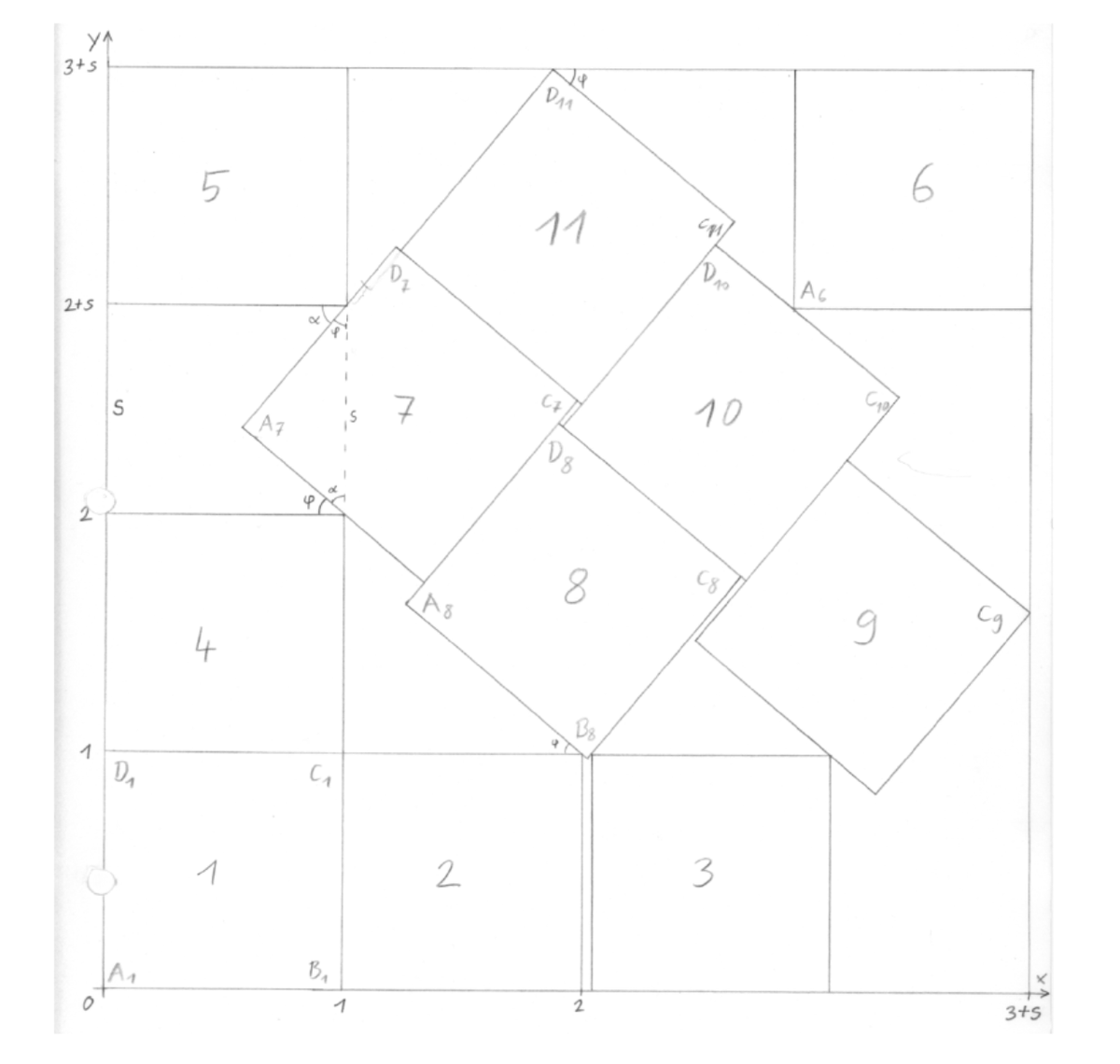

The optimality of the packing for 11 squares has been formalized in lean thanks to Astra and Claude! Huge thanks to @ojoshe, @kleddamag, @wand_125, @guzhou0806, and @ctjlewis for aiding in the process. Image credit: jlevy.github.io/squares/cases/… 1/n






Ignore my outfit - just wanted to show the finished mechanisms for Higgs’ guitar. I still have a lot of work to do on the painting :,)) #deathstranding
"De Morgan's Laws" is the Algebrica entry on two simple but fundamental rules that explain how complements interact with set unions and intersections. In set theory, they are written as (A ∪ B)ᶜ = Aᶜ ∩ Bᶜ (A ∩ B)ᶜ = Aᶜ ∪ Bᶜ They are especially useful for simplifying set expressions and reasoning about how complements behave. They also have a direct counterpart in propositional logic, where union corresponds to OR, intersection to AND, and complementation to NOT: ¬(P ∨ Q) ≡ ¬P ∧ ¬Q ¬(P ∧ Q) ≡ ¬P ∨ ¬Q I've just updated the Algebrica entry with definitions, proofs, truth tables, and worked examples covering both the set-theoretic and logical interpretations. algebrica.org/de-morgan-laws/

The Archimedean spiral is one of the oldest curves in mathematics, with turns that stay evenly spaced. Here, a straight line slowly turns into this spiral, and four hundred connected points follow its shape.
· Soothe · A visual mantra. A deep breath.

Homage To Herbert W. Franke

Simone Conradi @S_Conradi
14K Followers 2K Following Theoretical Physics. Computer Science Teacher. Author of “Intelligenza Artificiale” Zanichelli 2022. I draw using mathematics and Python.
Pixel Symphony @Pixel0Symphony
19K Followers 3K Following Artist | Master’s in History of Modern Art & Curatorial Studies | Design, color, generative systems, art history |Building https://t.co/qHn0IcJKPw @meditatecolor


Yohei Nishitsuji @YoheiNishitsuji
19K Followers 37 Following (an alien👾) GLSL artist/ PhD @tudelft/ Simulation Theory/ Grand Award @ADAAman2020/ JACK James Award @ArtOlympia/ My code shared @x is MIT Licensed (🦠西辻󠄀 陽平)
The Nobel Prize @NobelPrize
1.3M Followers 492 Following The official feed of the Nobel Prize @NobelPrize #NobelPrize
Mathematica @mathemetica
70K Followers 216 Following Math isn't escape. It's the map through the madness.
Oxford Mathematics @OxUniMaths
79K Followers 26 Following Official account for the Mathematical Institute at the University of Oxford.
HIDEO_KOJIMA @HIDEO_KOJIMA_EN
6.3M Followers 284 Following Game Creator: 70% of my body is made of movies.
クラッシュフィ... @CrashFever_PR
200K Followers 74 Following ブッ壊し!ポップ☆RPG『クラッシュフィーバー(クラフィ)』公式です🌐 DL・ログイン➡︎ https://t.co/0jHbOigQI9… 公式Discord➡︎https://t.co/57TIUjfzaK お問い合わせはアプリからお願いします! #クラフィ
Phenomenology Club @phenomenologyCL
2K Followers 9 Following Phenomenology Club is an interactive set of learning materials designed to pinpoint & harness our phenomenological abilities. Join us!
MoMA The Museum of Mo... @MuseumModernArt
4.7M Followers 3K Following Connecting people from around the world to the art of our time.
Poolsuite @Poolsuite
27K Followers 1K Following Your hot cousin's favourite music website ☼ Available on web, iOS, Mac and Android. Newsletter: https://t.co/4Hz1K7ViPO
ultramodernista @bandUMTofficial
158 Followers 20 Following 🏄🏻♀️Paradise is out now🌴 #최첨단맨 #UMT #ultramodernista 💿
AC部【公式】 @ACbu_official
59K Followers 0 Following クリエイティブチームのAC部です。Kindolphin https://t.co/CipMJYqCbO イルカのイルカくん @illckr ヘルシェイク矢野 @yano99279690 AC部コミュニサイトhttps://t.co/lBQ1HUm8XT
group_inou @gal_official
31K Followers 587 Following bandcampで全てのアルバムがフル試聴&購入できます。 https://t.co/Yqr4HAd4bv
You might like