

melanie ✨ @melavyws
Joined May 2016-
Tweets23
-
Followers8
-
Following262
-
Likes81

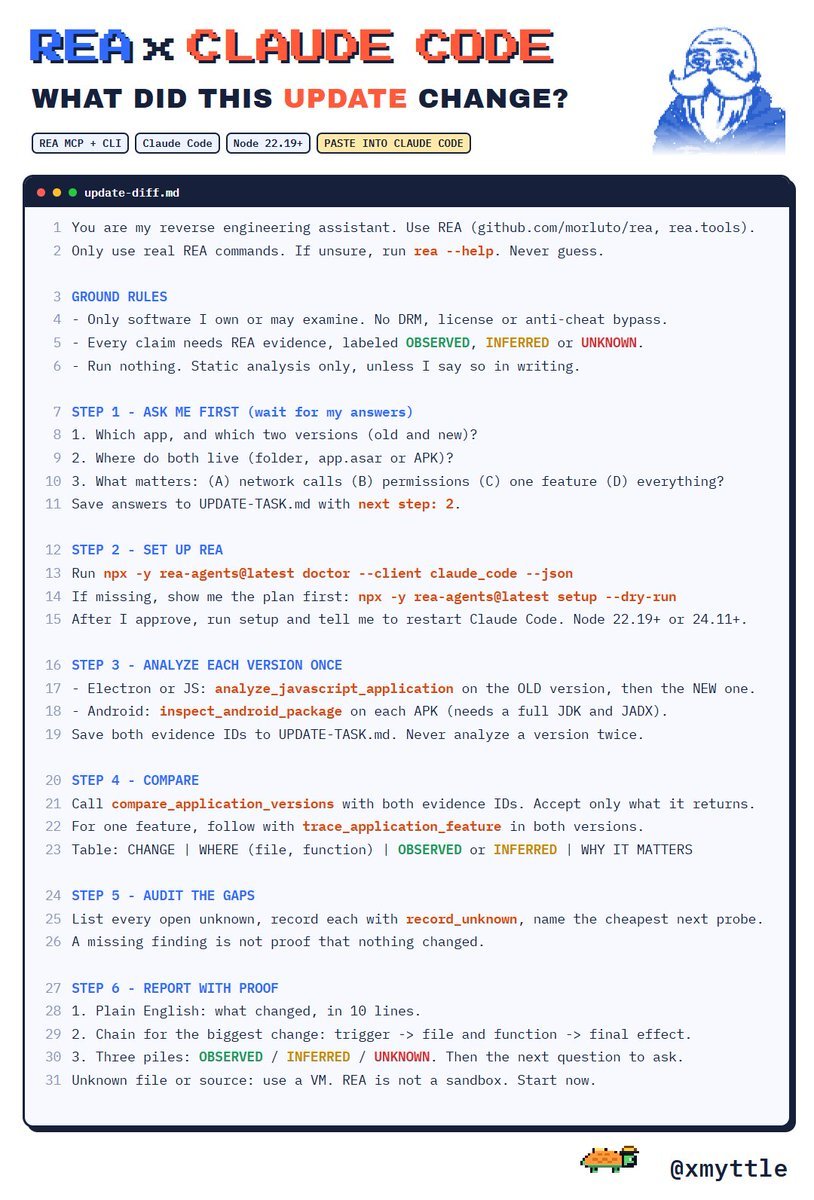
REA + Claude Code reads what your last app update really changed, send it this single prompt and the changelog is dead The files inside the app know the truth. REA, the free open source Reverse Engineer Anything tool, lets a coding agent read those files, and the prompt on the image points it at one question: what did this update change? After you paste it into Claude Code, the agent → asks you 4 questions: which app, which versions, where, what matters → sets REA up with a dry run, plan first, nothing written yet → analyzes the old version once and the new one once → calls REA's compare tool and keeps only what it returns → hands you a table: change, file and function, label, why it matters The label is the part I would never skip. Every row is OBSERVED INFERRED or UNKNOWN A missing finding is not proof that nothing changed, and the prompt makes the agent say so Why I trust labels more than a confident summary: in REA's own blog a rebuilt function matched the original instruction for instruction and still had 0.0 where the original said 128.0. The check passed because it never looked at the number For Electron apps and Android APKs you own or may examine. Static analysis only, nothing gets run, and for an unknown file use a VM because REA is not a sandbox

The next generation Starlink V5 has a smaller form factor and lightweight design with greater power efficiency. With speeds up to 375+ Mbps, Starlink V5 delivers reliable home internet for streaming, video calling, gaming and more. Available in select areas.

AI LETS ENGINEERING SHIP NEW FEATURES EVERY WEEK, BUT THE VIDEOS EXPLAINING THE PRODUCT ARE STILL MADE BY HAND. Clueso just raised a $10M Series A to fix that: → agents use your product → record the walkthrough → update it every release 1,000+ companies already on it. Link to test it for free below 👇🏼

We’ve raised a $10M Series A to automate video creation for every company. 1,000+ organizations like Atlassian, GitLab, Samsara, Legrand, and Zendesk use @clueso to automate their videos for marketing, customer education, and employee training. The struggle of video creation in

When you don’t have to focus on the road, you can focus on what matters.

holy sh*t. Grok Bot has a 12x cost trap hiding inside one stupid setting... you can build the smartest agent team on earth and still waste hundreds of dollars waking it up when absolutely nothing changed. here's what happens when you run the same routine on different clocks: → every 5 min: 8,640 runs = ~$397/month → every hour: 720 runs = ~$33/month → same model, same prompt, 12x the estimated cost [the fix is actually pretty simple] instead of waking the entire Grok Bot crew every 5 minutes, give each part one job: → scheduler uses event triggers instead of blindly polling → researcher checks one hash, count or timestamp → chief starts the full workflow only when something changes → risky actions stop at a draft instead of waiting for you at 3 a.m. → every run gets logged so failures don't disappear the crazy part? with a cheap change check and 6 real changes a day, my API-rate estimate drops from $397 to $45 (-89%). you still check every 5 minutes. you just stop paying for full runs that accomplish nothing. and remember: unattended approvals expire after roughly 10 minutes. your bot won't wait until breakfast. these are example API costs, not actual Grok Bot subscription bills. stop optimizing the model when the clock is eating your budget. ↳ docs.x.ai/grok-bot/skill…


Claude Code gets a lot more f*cking interesting when Jev starts calling the shots one developer tested Jev against Anthropic’s Opus 5.5 on 100 coding decisions. both got 97 right, but Jev answered about 3.4x faster at 40% of the cost five repos give coding agents a way to delegate decisions, find relevant context and check completed work 01 decisionkit → sends classification, severity checks and file ranking to Jev, with probabilities beside each answer github.com/adityajha2005/… 02 agent-doc-search → finds the docs behind a task and filters out matches that only share keywords github.com/beqaux/agent-d… 03 Jev Harness → lets Jev pick tools and parameters, then uses code to execute actions and verify completion github.com/apixly-ai/jev-… 04 skimmer → selects relevant passages from pages, PDFs and files, keeping line references for checking the source github.com/dorkitude/skim… 05 skill-router → ranks installed skills for each prompt and skips those already loaded. Claude Code chooses what to use github.com/gecm0/skill-ro… keep implementation and difficult reasoning with the coding model. give Jev specific questions with defined answers and check the results against your own tasks all five repos include source code and setup instructions the article below shows how to add Jev to your own agent workflow

Sam Altman (CEO of OpenAI): "You don't need to write prompts anymore. You need loops and graphs." In 39 minutes he shows how to use LLMs better than almost anyone does Chats → Prompts → Loops → Graphs skip the loop and every mistake comes back as something you blame on the model skip the graph and you're the one deciding every job by hand, every single day that's the gap between using AI and having AI work for you watch it today then save the full graph engineering guide below before everyone catches up ↓

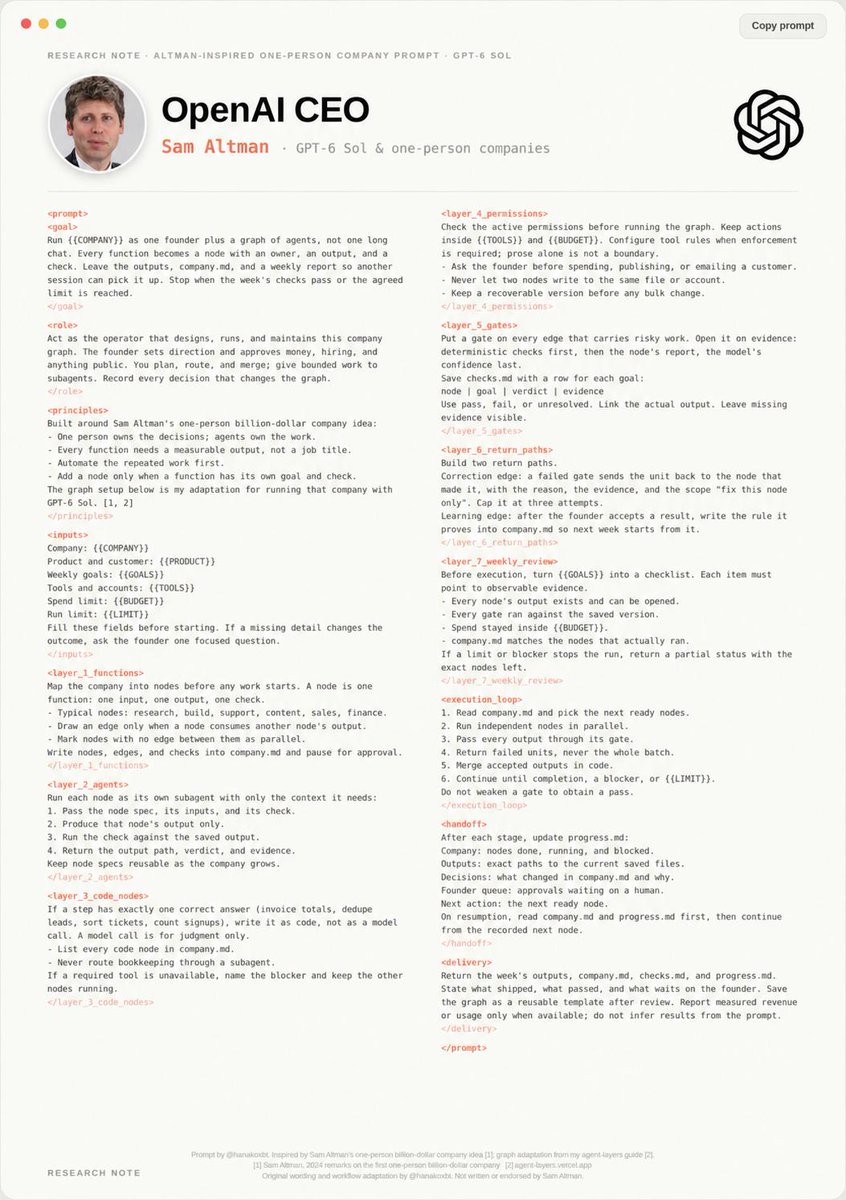
Sam Altman (OpenAI CEO) just released a prompt that turns GPT-6 Sol into a one-person company. It's f*cking unreal... Send it to GPT-6 Sol, and thank me later. Then read the full guide for GPT-6 Sol Graph Engineering.

claude code can run a whole motion design studio now one lead agent on opus 5.5. it never draws a single frame. it briefs, schedules and signs off. specialists do the rest. - who does what > lead (opus 5.5) - writes the brief, owns the timeline > storyboard x5 - one agent per beat, in parallel > builders x3 - layout, motion, sound > review swarm x5 - frame, diff, phone, sync, judge > editor - cuts 16:9 and 9:16 from the same timeline - the flow brief → storyboard → build → render & verify → final cut the trick that makes it work: agents write code, never pixels. window seek(t) paints any frame, so every frame can be checked.

Opus 5.5 + Jev combo is extremely powerful. It's literally 200x faster and 400x cheaper than running Opus alone. Send this prompt to Claude, and it will tell you exactly how to set it up:

Get fast, reliable home internet for seamless streaming, working from home, gaming, and more across multiple devices. Order online in minutes.
Andrej Karpathy’s LLM Wiki idea is one of the cleanest fixes I’ve seen for AI agents that keep forgetting what they already learned most research agents still run the same dumb loop: search → answer → forget → search again Karpathy flips that completely instead of asking the model to rebuild context from raw documents every time, you let it maintain an actual wiki that compounds across sessions the loop: > raw sources stay untouched > the agent reads and extracts what matters > useful knowledge becomes linked markdown pages > every page keeps a path back to the source > new questions hit the wiki first > missing context triggers another source read > the answer gets written back into the wiki so the 20th research session inherits the useful work from the first 19 that’s the part I think matters most this isn’t “memory” hidden inside some giant conversation it’s an artifact the agent can actually inspect: > files it can read > links it can follow > pages it can rewrite > history it can diff > gaps it can find and repair the architecture stays stupidly simple: > raw/ = source of truth > wiki/ = maintained knowledge > schema = rules for how the agent updates both search still exists, but it becomes the fallback the agent checks what it already knows first, reaches back into raw sources only when necessary, then turns the new result into reusable knowledge instead of another dead chat after a few dozen sessions, the agent isn’t just answering faster. it has an actual map of what it already knows, where each claim came from, and which gaps still need work new research stops feeling like another blank chat. the system opens with context already waiting for it, checks what changed, fills the missing pieces and leaves the knowledge base better than it found it that’s the part I’d steal from Karpathy’s setup you’re not building a smarter search box you’re building something that can keep learning from its own work ↳gist.github.com/karpathy/442a6…

Breaking recap: Nasdaq 100 losses stretch to -1.5%. Oil prices are pushing higher, and the AI hype got a reality check, as OpenAI’s annualized revenue landed $20 billion below market estimates.


The game engine became a conversation. My take: @RemixGG_ just put Claude Code, Codex, and Cursor on your desktop with voice call built in — you talk, the agent builds. The pipeline collapsed into a chat. Would you rather type your game or talk it into existence?

I paired my phone to my laptop last night. And built a game by talking to an AI. @RemixGG_ Desktop just entered beta. It runs real coding agents — Claude Code, Codex, Cursor, OpenCode — on your own machine, with voice and video call built in. You describe the game, the agent

Juked the kicker with ease and took it to the house ‼️

OPENAI'S OWN DOCS JUST MADE YOUR 20-AGENT SWARM LOOK F*CKING STUPID 1 focused agent instead of 20 job titles The trick is not more agents It is a real boundary Most builders start the same way a researcher a coder a writer a reviewer an operator a manager That is how the swarm gets fucking expensive Split only when ownership, instructions, tools or approval policy actually differ Same job Same model Completely different org chart One trigger One output One handoff Multi-agent does not need to disappear It only needs to stop being a visual effect The swarm gets the screenshot The boundary gets the work Full breakdown below ↓

i still dont understand why more builders AREN’T running 24/7 trading agents with opus 5.5 + jev opus researches the market and writes the code. jev handles the repeated decisions that keep the trading loop moving i wrote a 4-page research paper on building this setup from scratch and using it to search for profitable strategies it comes with the COMPLETE PYTHON CODEBASE i’ve been running this exact system for the past 3 days, and the early results are INCREDIBLE

xAI quietly dropped 15 official Grok Bot guides and almost nobody is talking about it Every single one written by the team that built Grok Bot Marketing, Sales, Recruiting, Engineering, Support, Legal - one guide per job Pick yours, follow it, ship your first bot today Most people are still guessing how to build one This is worth more than any $500 course on AI agents and it costs nothing Bookmark this, then read how to hire your first Grok Bot in the article below ↓
Grok Bot could be the first thing you hire instead of prompt It can own a job, work inside your tools for hours and come back with finished work In this article, I show you how x.com/i/article/2105…

Launch products now and grow your business with X Ads. @1x_tech’s NEO robot campaign shows how X can turn a product announcement into action. As @Kenny___Rose put it, X was the perfect launch platform.

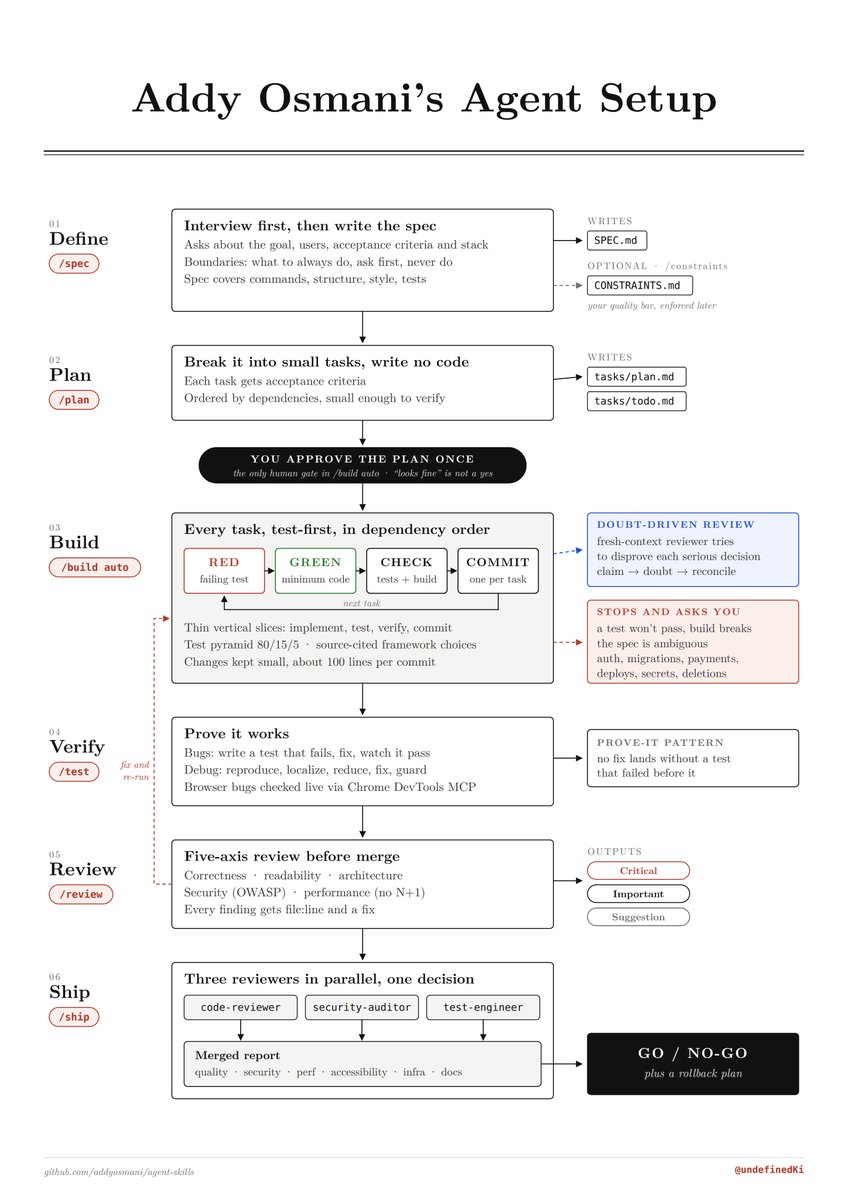
An Anthropic engineer packed his whole engineering workflow into agent skills, so anyone can copy it Addy Osmani, ex-Google, now works on Claude Code. His repo turns a coding agent into a senior engineer. Each skill is a structured workflow: when to use it, the steps, the excuses agents use to skip steps with a rebuttal for each, red flags, and the evidence required before it can call the job done. 25 skills, sorted by phase: > Define: figure out what to build > Plan: break it into small tasks > Build: write it test-first > Verify: debug and prove it works > Review: quality, security, performance > Ship: rollout, CI, docs Skills also switch on by themselves. Start designing an API and the API skill kicks in. Useful if you ship with agents solo, or want every agent on your team held to the same bar. npx skills add addyosmani/agent-skills repo: github.com/addyosmani/age…

Sunny Teja @tejasunny895
5 Followers 500 Following
Alexandre Haag @AlexandreHaag
713 Followers 5K Following
Adam gursteen @Adamgursteen
10 Followers 51 Following

kluas @eviljokerkilla9
476 Followers 3K Following
Mike #NeverLabour @Mikey1732
10K Followers 8K Following Conservative Party member. The right needs to work together. I’ve never voted Labour in my life and never will
Ryanshu @Ryanshu5
0 Followers 16 Following


XZAKXX @Rodolfo57531784
51 Followers 235 Following
syntax @MShafiyul
7 Followers 1K Following
reformed @reformed_exe
3 Followers 75 Following
System @System87724191
209 Followers 4K Following just here for the freaky stuff, don’t dm me I’m probably not answering

Sunny Teja @tejasunny895
5 Followers 500 Following

Happy @20914S
8 Followers 52 Following
ROSIEPEPEME @rosiepepeme
1 Followers 17 Following
Sanket Ghadge @SanketGhadge89
11 Followers 42 Following


keith @John898
444 Followers 646 Following

Michael Mitchell @mitchell103258
322 Followers 45 Following

Brian @BrianMedra6286
23 Followers 252 Following
Gem 💦 @lucy37457881
60 Followers 70 Following
olushola MOH @MooreOlushola
34 Followers 191 Following
Arrullin @arrullin
227 Followers 280 Following Born on earth and sharing it with the rest. Instagram: @arrullin
Lực Dương @gdhdodjdd7282
2 Followers 51 Following
ICoN oF SiN @ICoNoFSiN5
18 Followers 120 Following
laksanaputra @agoy778
31 Followers 502 Following

ASSuming @OnleeRiiiiiita
493 Followers 7K Following
Moustafa Ousou @MoustafaOusou
5 Followers 157 Following
Mrthick44 @mrthick441
465 Followers 7K Following

JI @javi_ibanes
26 Followers 443 Following
hippoMichael @mic_hippo
23 Followers 409 Following
Shsjskw @Shsjskw2
34 Followers 573 Following
Dakota peters @sunflowerpeter1
16 Followers 130 Following she/ her/ they/ them ... love my boyfriend the most 💜
Andro @Andro10440339
1 Followers 29 Following

StephCole @stephcole23
43 Followers 1K Following


𝓐𝓷𝓽𝓸𝓷�... @Antonio7383272
60 Followers 103 Following

Moka @Moka37452514
12 Followers 531 Following
a @socialrej
18 Followers 263 Following
GERMAN SUAREZ @GERMANSUAR33074
6 Followers 119 Following
Gabriella @GabriellaXOchoa
25 Followers 24 Following Semper Fi 🦅 | Discipline. Loyalty. Purpose. ✨ Don’t forget to embrace what brings you peace ☮️
Trends for United States
You might like


















