

patomp @patomp5
Joined February 2019-
Tweets2K
-
Followers10
-
Following556
-
Likes56

If you have ever trained a Transformer Language Model and wondered why there are "spikes" in loss -- our recent paper (arxiv.org/abs/2610.13524) gives an explanation that arguably gets to the most essence so far, as it replicates loss spikes by simple quadratic models.


New research: We developed JOLT, a post-training method where one model acts as both teacher and student, with the teacher trained to give feedback the student can use. On MATH, it matched GRPO's accuracy with 6.5x fewer training tokens. perplexity.ai/hub/blog/a-goo…

INTELLECT Policy Optimization (IPO) In async RL, trainer and inference never agree exactly on a token's probability. IcePop masks on the ratio, which misjudges both tails IPO masks on the probability difference instead


interesting tech report, especially the distillation part! it's the first time i see a full KL objective (you train on minimizing the distribution of the student with the "approximate" teacher) and then full CE for the last 5% it's also co-distillation, which means that you actually use the logits from the forward pass that the teacher (here muse spark) produces during training and not the final model after training. does this also mean that you need the same data schedule? there is quite a big student-teacher gap so would be interesting to see if this kind of "smoother" learning reduces that


Today we published a technical report on Muse Glimmer, our 30B open-weight model built for agentic tasks on consumer hardware. It runs at practical speeds on a Mac or PC with a single consumer GPU at 4-bit precision, and leads comparably-sized open models on tool use and


Cool results making auto-research / AI-based optimization better by having agents forget! Turns out that just running an agent for a long time can lock it into small steps in the same direction.

Autoresearch with coding agents can now run for days on a single problem, but we've seen an increasing number of cases where they stop improving early. We address this issue with a simple idea: forgetting. Introducing our new paper: "Scaling Discovery Requires Forgetting"

The AI Scientist v3 is out: The Agentic Scientist. GitHub: github.com/SakanaAI/AI-Sc… Blog: pub.sakana.ai/agentic-scient… arXiv: arxiv.org/abs/2610.18933 The Agentic Scientist is the 3rd iteration of our automated AI Scientist research system, and the shift this time is from “one agent writes a paper” to “a scaffold of parallel agents orchestrates the full research loop.” The system now orchestrates a pool of parallel workers that share memory and distilled conclusions. Crucially, it features Evidence Generation: isolated agents automatically run controlled baselines and ablations to prove why an idea actually works. It works as a co-scientist. We used a development version as a co-scientist to explore biologically plausible learning rules. The agent handled the empirical heavy lifting, proposing mechanisms and running experiments. We stayed in the loop to steer direction, verify results, and moderate claims. That feels like the right division of labor for where the technology actually is. This resulted in a new biologically plausible learning algorithm, and the resulting paper was accepted at ALIFE 2026 as an oral presentation. We are also releasing AutoIllustrate. It generates editable draw.io vector figures instead of uneditable, hallucinated raster images. Real scientists need vectors, not pixels. I am an SVG junkie ;) Incredible work by Robert Lange, Luca Grillotti, Yutaro Yamada, Rujikorn Charakorn, and the team!
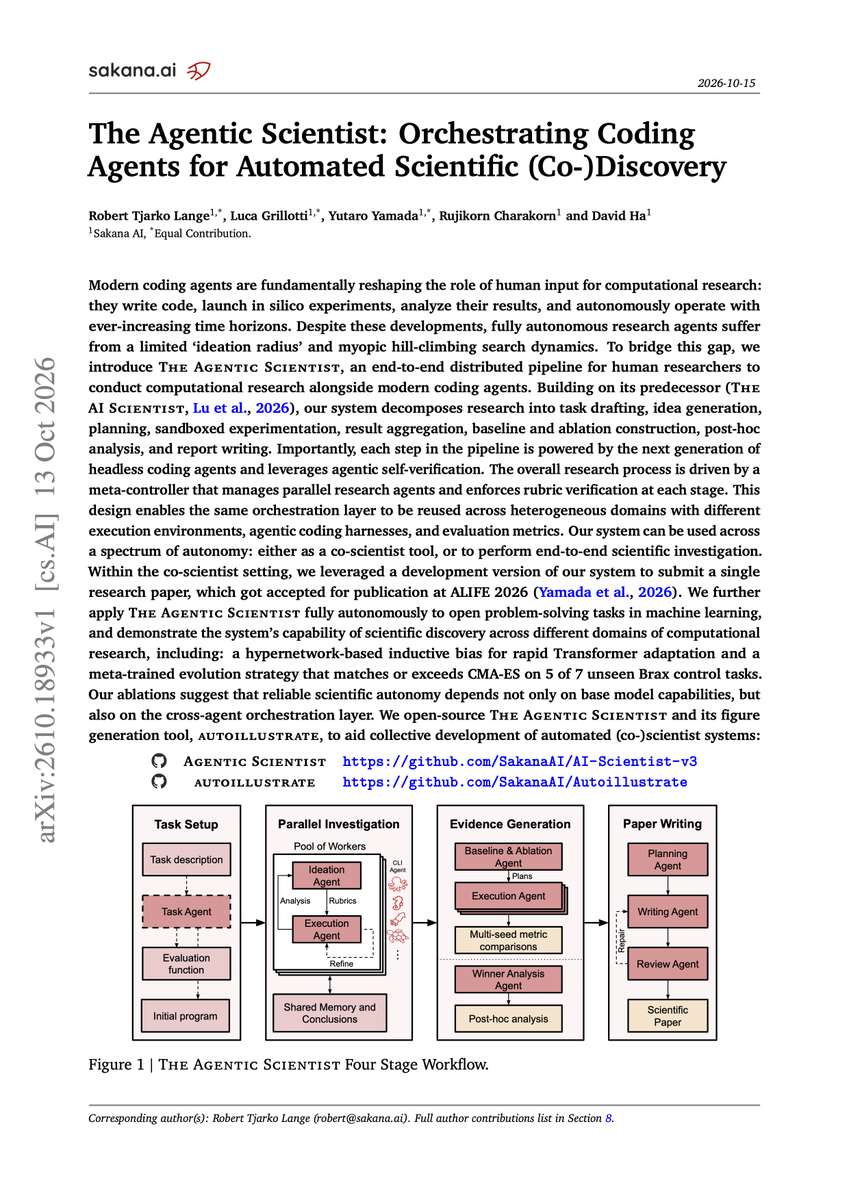

The Agentic Scientist: Orchestrating Coding Agents for Automated Scientific (Co-)Discovery Blog: pub.sakana.ai/agentic-scient… GitHub: github.com/SakanaAI/AI-Sc… arXiv: arxiv.org/abs/2610.18933 Since 2024, we’ve used The AI Scientist as a way to test how far AI alone can take scientific

People often ask me how to properly learn machine learning. Rule 1: Stop consuming low-quality content such as most YouTube videos. Rule 2: Start reading rigorous textbooks used in serious MSc programs in machine learning. Christopher Bishop’s Pattern Recognition and Machine Learning is an excellent choice, and it is freely available here: microsoft.com/en-us/research…


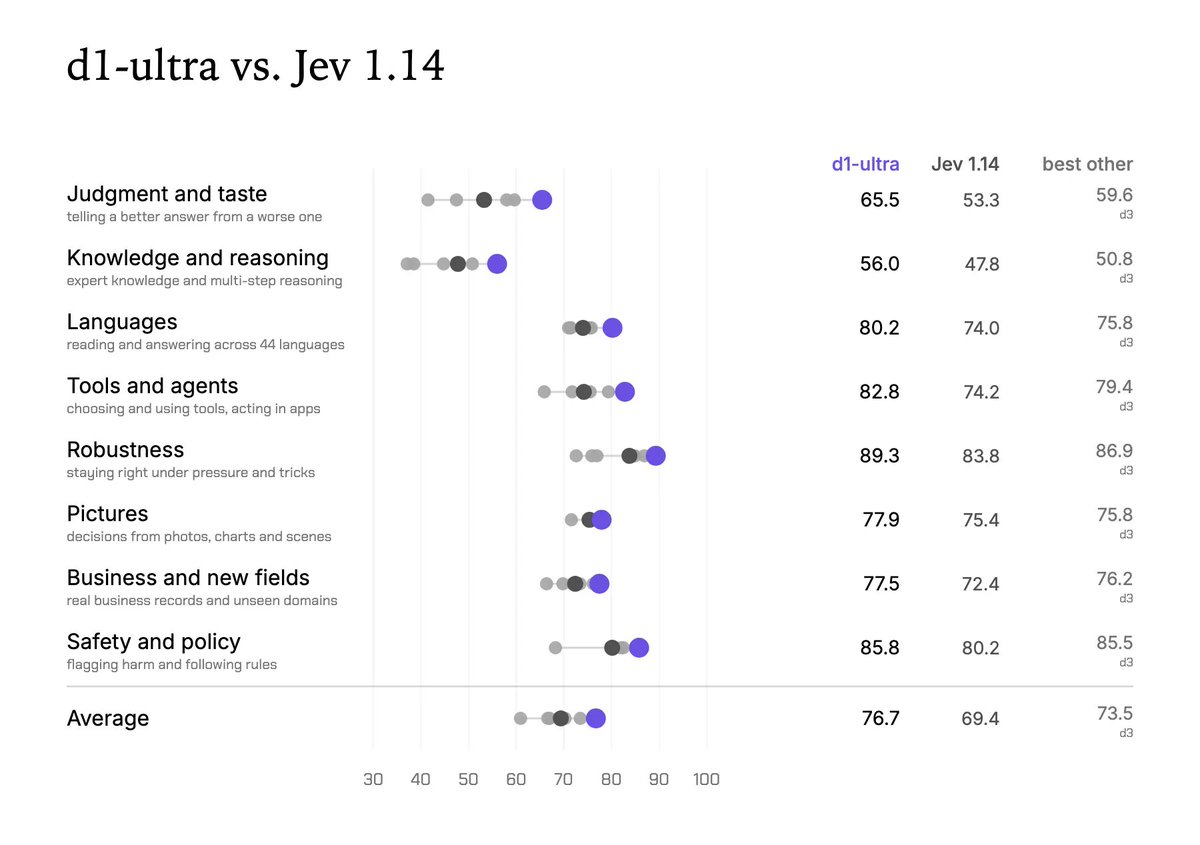
Today we release 𝚍𝟷-𝚞𝚕𝚝𝚛𝚊, our most powerful decision model. > built for hard decision problems. > d1-ultra is multimodal > supports 44 languages > #1 on the @ArtificialAnlys Decision Index (65) > leads all eight categories of our 112-evaluation suite 1/

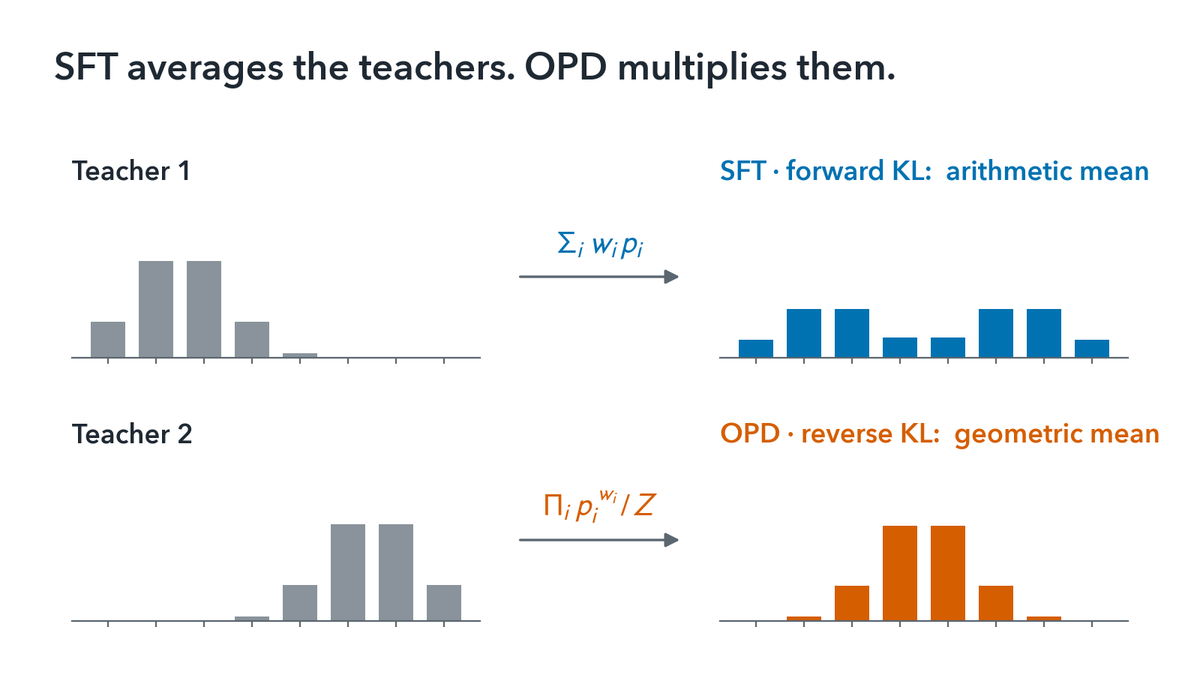
OPD forgets less than SFT, yet breaks under teacher mismatch and on long rollouts. Why? Our answer: they optimize different targets. With multiple teachers, SFT (forward KL) learns their arithmetic mixture; OPD (reverse KL) learns their normalized geometric mean. 🧵

We now have state-of-the-art pre-trained base models in the 3T-parameter weight class, built entirely in-house at MAI. Post-training results coming soon -- stay tuned! Lots of details in our technical blog post. microsoft.ai/news/frontier-…

We are hiring for our growing RL Environments team at Cohere. We build replicas of real-world enterprise setups across many industries, put our AI agents in them and watch the agents train and improve. If you know anyone excited to work at the intersection of RL x Data x Engineering, send them our way! Or if that's you, join us: jobs.ashbyhq.com/cohere/dc523c5…

the most interesting paper I read this month. sparsity comes from on-policy. (which matches my intuition but this research explains why)
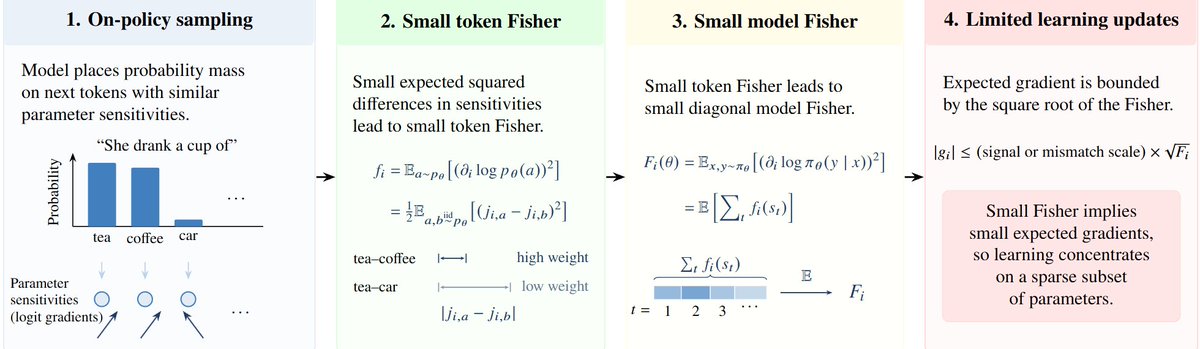

Why are LLM parameter updates so sparse during post-training? 🔍 In our new paper, we study this phenomenon through the lens of Fisher information, connecting theory and empirical findings across RL, SFT, and on-policy distillation. A thread on what we found 🧵👇

BTW tinker is hiring researchers & infra experts! research: jobs.ashbyhq.com/ThinkingMachin… systems: jobs.ashbyhq.com/ThinkingMachin…

Dimuon is a new optimizer we built for LoRA fine-tuning. In our SFT tests, it often reaches lower loss in fewer steps than AdamW. We're still experimenting with Dimuon; you can Tinker with it today and share your feedback! See our optimizers guide at tinker-docs.thinkingmachines.ai/tinker/optimiz…
Deep learning is often taught as a sanitized collection of facts and math. But work at the frontier of AI is messy and empirical. Our new class, Deep Learning Alchemy, aims to teach the art and science of deep learning in the hands-on spirit of Language Modeling From Scratch. Students build intuition by running experiments on small LMs, then test it through prediction quizzes: given an unseen code diff, can you predict what happens? deep-learning-alchemy.github.io My co-instructor @kothasuhas and I think there's significant demand for classes that treat students as serious learners who want to be assessed for what they’ve learned, and so we're trying a new exam-heavy approach to the class (7 exams, 85% of the grade, with the remaining 15% in-person discussion assessments). We’ve designed the class so students can use AI agents to run their experiments and do their assignment, but they then have to demonstrate that mastery on exams without access to the assignment, and any partial credit on the exam has to come through citations to the assignment, incentivizing them to know what’s in their write-up. The same assignments and quizzes are public for anyone to try (lecture recordings will be released through @StanfordOnline with some delay). We have some very fun assignments and quizzes covering both classic topics (like NQM, run-to-run stochasticity, and scaling laws) and new and timely topics like muP or hyperball. Made by some real experts like @TristanThrush and @wen_kaiyue Try some quizzes below!


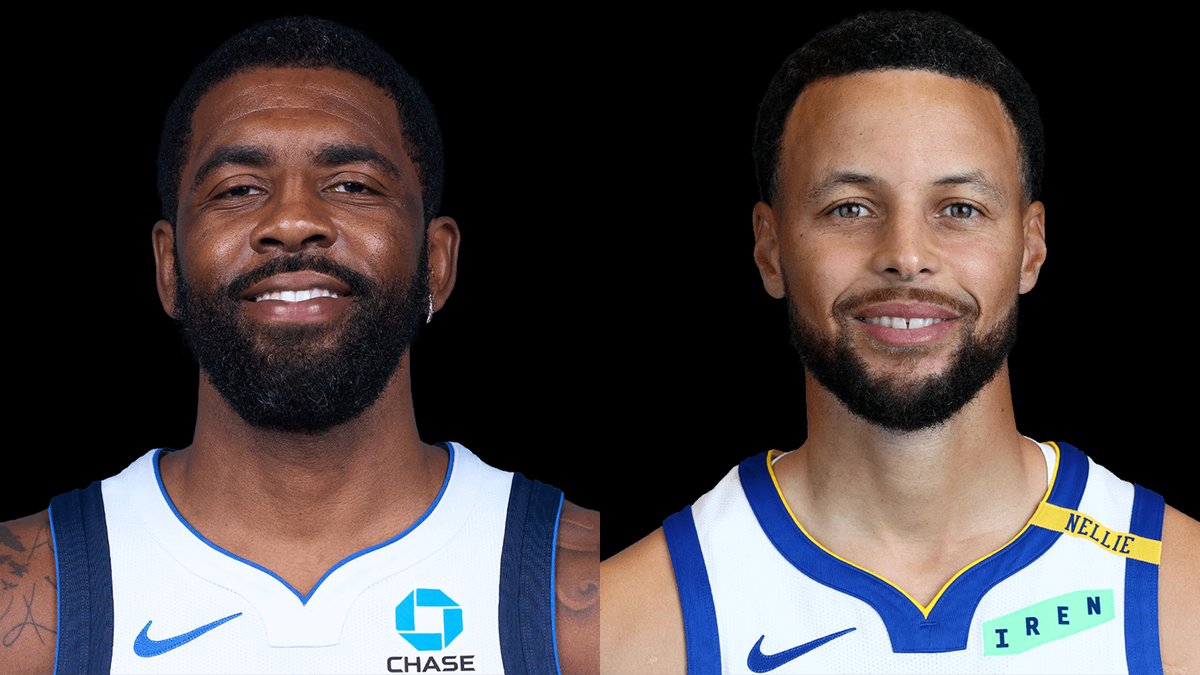
This a daily reminder that fancy dribble moves don’t equate to being more skilled.


We're hiring across many roles at Trillium Labs, @trillium_labs, to build the open scientific ecosystem for LLMs. Most important hires right now (ideally with start dates soon): * Full time post-training researchers * Engineers with experience with popular open-source libraries (megatron, MILES, sglang, Tinker, etc.) * Mission-aligned generalists, non-profit ops, etc. * Student researchers I'm also personally interviewing for MATS right now, which will be very aligned research. Please reply, email me, DM me, etc AND submit the form on our website. Excited to build this team. All early hires will work directly with me on all sorts of fun puzzles to rapidly scale our impact.

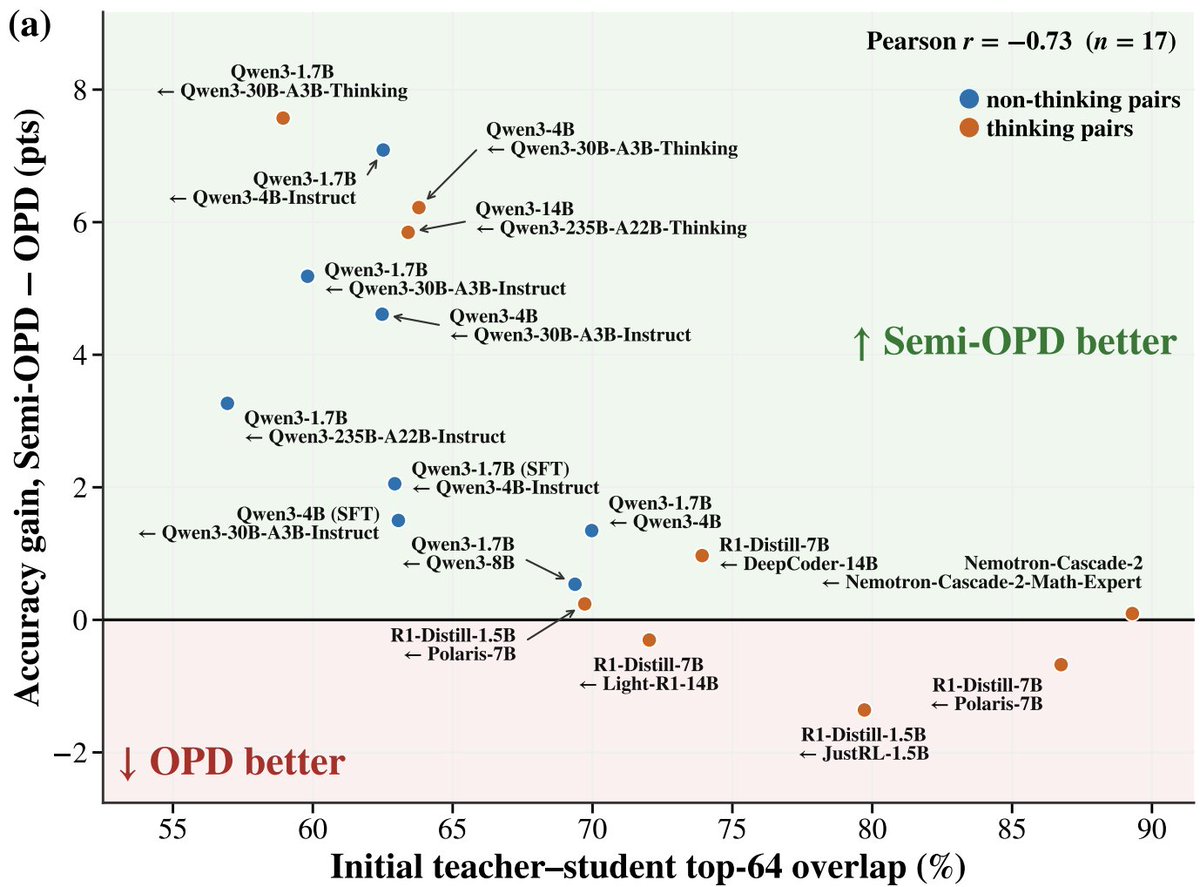
Is on-policy sampling always good for distilling any teacher–student pair? We study 17 model pairs, and find that a simple alternative—distilling on offline rollouts from the initial student (which we call Semi-OPD)—can often work better and faster than OPD in 14/17 cases. The gains are strongly correlated with initial teacher–student alignment. When poorly aligned, online student rollouts can degrade and drift away from regions where the teacher provides useful supervision, while initial student rollouts can provide a cleaner and stable signal. Excited to share my internship paper at NVIDIA! More results and analysis in the paper: arxiv.org/abs/2610.11291

"DiscoLoop: Looping Discrete Embeddings and Continuous Hidden States for Multi-hop Reasoning" Looped Transformers can struggle to combine facts because intermediate hidden states aren't properly aligned with token embeddings. DiscoLoop fixes this by mixing decoded token embeddings back into the hidden states between loops. This boosts out-of-distribution accuracy on synthetic two-hop reasoning from below 10% to nearly 100%, while also improving real-world language modeling benchmarks. alphaxiv.org/abs/2607.00341


We're hiring exceptional engineers to join the team. No degree required. All we care about is you being smart and able to solve hard problems. Total comp is $550k-$1.1M (job ad says something else, but ignore that).
Join Polaris, a new @GoogleDeepMind team designing the complex evaluation frameworks that will define the future of AI coding agents, and give you the autonomy to prototype architectures and publish research. Experience? We care about how you think and build, not your “level.”

1/ During OLMo3-32B pre-training, accuracy on an arithmetic diagnostic hits 81% at 2.17T tokens, collapses to 0% at 2.19T, and jumps back to 81.7% at 2.21T. All while validation loss decreases smoothly. The phenomenon: mode-hopping. 🧵


MacKenziea 🌷 @FGRTY9264959596
16 Followers 1K Following glitter in my veins bad habits big dreams hiii ✨
Varshika Prasanna @varshikaARKk
105 Followers 6K Following Research Analyst @ARKInvest focusing on digital wallets, payments and commerce 📱🛒🛍️💳💰 Disclosure: https://t.co/ykWFrdSatX
Alex Prompter private @alex_prompterF7
23 Followers 635 Following Marketing + Al = $$$ 🔑@godofprompt- $30K/mo (co-founder) 🌍https://t.co/F4NxQaKFKv - $0/mo (made with Al)🎥 ytscribe .ai (co-founder)
Jennifer @Blaucou8050843
5 Followers 395 Following Make calm judgments, seize opportunities, successful investment pathway smooth. — James Kuhn https://t.co/BfNkYVQRAU
Yuetai Li @yuetai12575
417 Followers 761 Following Graduate soon @UW, 3rd year Research Scientist@Meta MSL | Agent eval and Synthetic Data https://t.co/cYAkbnCsCp
Rhalda @Rhalda13957
53 Followers 1K Following
Kim @kimdurham97
210 Followers 3K Following
ซีเค @ck_ime
56 Followers 268 Following
Oriol Vinyals @OriolVinyalsML
223K Followers 92 Following Co-founder & CTO of Discovery Loop; Partner, 224 Ventures Past: Google DeepMind VP, Gemini TL (1.0 to 4.0), Alpha{Fold,Star,Code}, seq2seq, distillation
Riyasat Ohib @OhibRiyasat
185 Followers 1K Following Research Scientist @GoogleDeepMind. PhD @GeorgiaTech. Interested in the science of intelligence. Opinions my own.

Life at Google @lifeatgoogle
495K Followers 109 Following Ready to be a Googler? We're hiring! Keep up with our job opportunities, offices, culture, and everything else that makes up life at Google.

Erik Spock Gafni (hir... @EGafni
8K Followers 320 Following Cofounder and CTO of TypeSafe. Leading the model training and gtm teams.
World Labs @theworldlabs
116K Followers 54 Following World Labs is a leading spatial intelligence company building frontier models that can perceive, generate, reason, and interact with virtual and physical worlds
Edoardo Mosca @EdoardMosca
187 Followers 129 Following ML Research Scientist @LiquidAI Working on Liquid Foundation Models (LFMs): post-training
Paul Vicol @PaulVicol
2K Followers 1K Following Research Scientist at @GoogleDeepMind. Working on Gemini reasoning models. PhD from @UofT and @VectorInst.
Xiuyu Li @sheriyuo
15K Followers 2K Following Researcher @StepFun_ai | Working on long-horizon tasks | Opinions are my own
StepFun @StepFun_ai
16K Followers 176 Following Scale-up possibilities for everyone. API Platform: https://t.co/XlaiCy4DGm HuggingFace: https://t.co/isMgbv7XSm

Adithya S K @adithya_s_k
17K Followers 3K Following Scaling RL Envs @huggingface 🤗 • Founded @cognitivelab_ai Prev : Research @MSFTResearch • ML @apple • 22
Hitomi Yanaka (谷中... @verypluming
7K Followers 611 Following Associate Professor, University of Tokyo; XAI Team Director, RIKEN; Computational Linguistics; 博士(工学); 東大IS/CS 准教授(卓越研究員) 谷中研; 理研AIP 説明可能AIチームディレクター
Melissa Pan @melissapan
6K Followers 718 Following CS PhD @UCBerkeley Sky Lab 🐻 Systems & AI & Sustainability 🌍 Prev: @google, @ibm, @CarnegieMellon🐕🦺, @UofT🇨🇦
Sohyeon Kim @ohmyksh
839 Followers 151 Following Research @StanfordAILab Retrieve knowledge for better decision making

John Schulman @johnschulman2
83K Followers 2K Following @thinkymachines. Interested in reinforcement learning, alignment, birds, jazz music
λux @novasarc01
22K Followers 4K Following tensor shepherd in a non-euclidean pasture | grazing on cuda cores
Marzieh Fadaee @mziizm
3K Followers 854 Following exploring the longitude problem of AI. Head of @Cohere_Labs. PhD from @UvA_Amsterdam. https://t.co/YI5NC5J5e4. زن، زندگی، آزادی
Olivier Bachem @OlivierBachem
4K Followers 379 Following Senior Director, Research Scientist at @GoogleDeepMind where I co-lead Gemma
Jeonghye Kim @beanie0__0
424 Followers 251 Following PhD @KAIST | Prev. at @MSFTResearch @LG_AI_Research
tianhang zhu @TianhangZhuzth
38K Followers 28 Following head of LLM training at @Fundamental. I led RL in the early days at @Alibaba_Qwen and 01ai.
Xiaoyi Zhang @xiaoyiz_uw
6K Followers 589 Following A\ real-world knowledge work with taste | @uwcse PhD | AI/HCI/Accessibility | Culinary Arts

Michael Tschannen @mtschannen
3K Followers 696 Following Research Scientist @GoogleDeepMind. Representation learning for multimodal understanding and generation. Personal account.

Sophia Yang @sophiamyang
37K Followers 2K Following Head of Developer Relations @FireworksAI_HQ | prev. @MistralAI
Yuan He @lawhy_X
303 Followers 252 Following Applied Scientist @Amazon Rufus working on agent post-training | PhD @CompSciOxford
Jasper Dekoninck @j_dekoninck
5K Followers 160 Following PhD Student at ETH Zurich, working on mathematical evaluation of LLMs (MathArena, IMproofBench, BrokenMath, ...)

Shayne Longpre @ShayneRedford
7K Followers 1K Following AI research @ Anthropic. Prev: MIT Tech Review 35U35, Data Provenance Initiative, MIT, Google, Apple, Stanford. 🇨🇦 Views my own.
Salesforce AI Researc... @SFResearch
20K Followers 430 Following We advance state-of-the-art #AI techniques paving the path for innovative products at @Salesforce. Focus areas: #AIAgents, #EnterpriseAI, #EGI, and #TrustedAI.
Polymarket @Polymarket
2.0M Followers 6K Following The World's Largest Prediction Market. Trade politics, news, crypto, sports, & more. Available in the US: https://t.co/gZvEnIqUQy - DM @PolymarketHelp for support
Sea AI Lab @SeaAIL
750 Followers 10 Following Sea AI Lab (SAIL) is committed to advancing technology to drive the development of the digital economy across our regions.
Jan Leike @janleike
143K Followers 335 Following AI research @AnthropicAI. Previously OpenAI & DeepMind. Optimizing for a post-AGI future where humanity flourishes. Opinions aren't my employer's.
Machine Learning Stre... @MLStreetTalk
40K Followers 788 Following MLST is by Dr. Tim Scarfe @ecsquendor w/ cameos from @DoctorDuggar https://t.co/5YCv2SdFwN (early access/priv.discord) - Sponsor us!
Vivian Balakrishnan @VivianBala
130K Followers 19 Following Minister for Foreign Affairs of Singapore
AI.Engineer 🔜 SF C... @aiDotEngineer
66K Followers 105 Following We run the highest signal technical conferences in the industry and publish it all for free online for over 1.5 million AI Engineers a month

Mehrdad Farajtabar @MFarajtabar
9K Followers 245 Following Research Scientist at @Apple, prev @DeepMind, prev @GeorgiaTech
Ronak Malde @rronak_
11K Followers 573 Following Co-Founder of Trajectory @TrajectoryLabs prev @GoogleDeepmind, SWE-1 @windsurf | @stanford
Julie Kallini✨COLM2... @JulieKallini
3K Followers 526 Following CS PhD @StanfordNLP 🌲 Previously: SWE @Meta, Class of '21 @PrincetonCS
Rulin Shao @RulinShao
7K Followers 1K Following PhD @UWNLP, Prev @Meta @allen_ai. CLMs, DR Tulu, Spurious Rewards, ReasonIR, MassiveDS
Zechen Zhang @ZechenZhang5
2K Followers 1K Following Building the future for human and AI collaboration @orch_research @Harvard
Sang Michael Xie @sangmichaelxie
5K Followers 846 Following self-improving @OpenAI. Prev: PhD @StanfordAILab, @GoogleAI Brain/DeepMind, @Meta GenAI
Hanchen Li @lihanc02
4K Followers 1K Following PhD student at @BerkeleySky on AI Infra (data & systems)Trends for United States
You might like


















