marty @Abs_Marty
Proof of learning Joined September 2026-
Tweets28
-
Followers7
-
Following47
-
Likes22
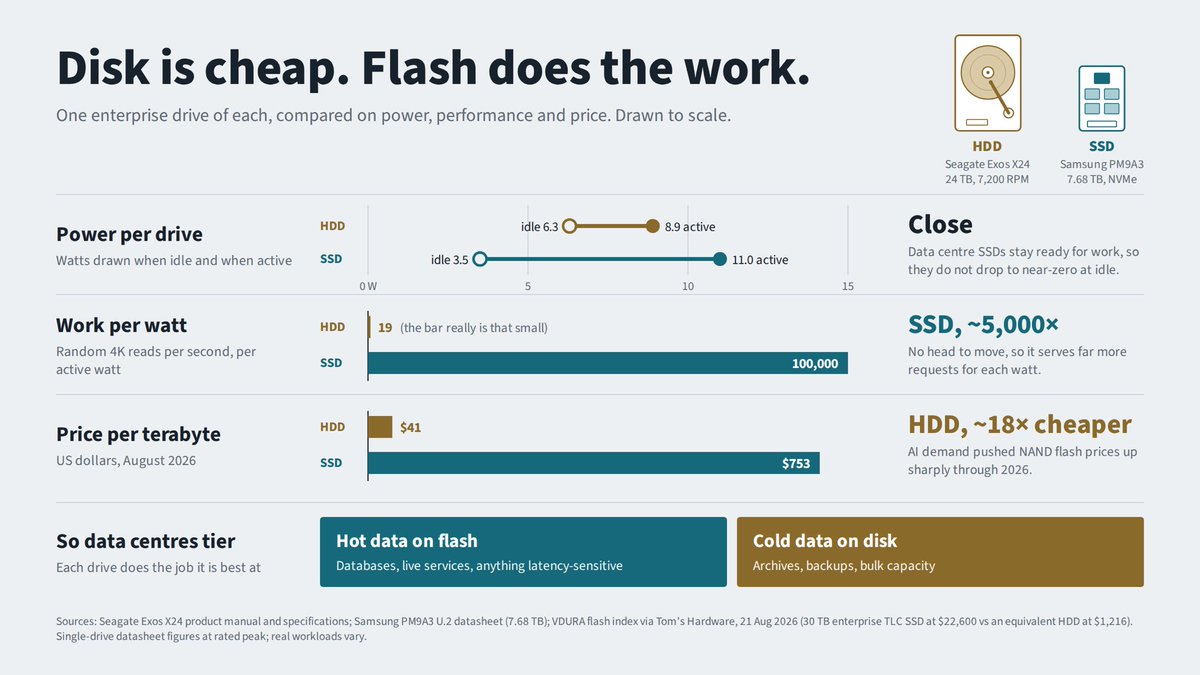
SSDs vs HDDs... the data centre storage tech battle. A hard disk drive (HDD) is electromechanical: it spins magnetic platters continuously at a fixed speed (commonly 7,200 RPM in enterprise drives) and moves a physical read and write head across the surface to locate data. Power is only consumed to keep the platters spinning, whether or not any data is being read (plus additional power for head movement during access). A solid-state drive (SSD) has no moving parts; it stores data in NAND flash cells and only draws meaningful power during an actual read or write operation, dropping to near-zero when idle. The debate here comes from the mechanical versus the electronic distinction that determines power usage: •SATA SSDs draw around 0.04 watts idle and about 3 watts active •NVMe SSDs can peak around 11.5 watts active under heavy load but are also near-zero at idle •Enterprise HDDs draw roughly 4 to 7 watts idle and 9 to 11 watts active... more energy more consistently The tradeoff for this energy? Cost per gigabyte. •HDDs cost roughly $0.02 to $0.04 per GB •SSDs run around $0.10 to $0.20 per GB There is no clearcut winner to the storage battle. Data centres run a tiered strategy rather than decide on one or the other. When performance-per-watt is necessary (latency-sensitive, high-IOPS data): SSDs. When cost-per-GB matters (archival, cold data): HDDs.
A "comatose" or "zombie" server is one that is racked, powered, cooled, and connected to the network, but has done no useful computing work for at least six months. It draws idle power the entire time. In 2008, they were an estimated 30% of total servers. (McKinsey) In 2012, they were an estimated 30%. (Uptime) In 2015, they were an estimated 30%. (Stanford & Anthesis) In 2026... they are an estimated 30%. (Energy Digital) Why?? There's a pretty significant asymmetric risk in decommissioning a server. Server owners cannot allow their IT to go offline - so much of their sales pitch will be based in reliability. The whole system is built around reliability. This means that the possibility of removing a server that is still running, and causing an outage, is just not worth the risk. Unused capacity accumulating costs over time becomes a small price to pay in order to maintain reliability. It's all about reliability. What this means? (Remember that 30% of servers is not 30% of energy usage (cooling, air systems, etc)) Two decades of improvements in the industry - virtualisation, cloud migration, and IT asset management - have not changed the fact that ~10% of the energy use that people complain about goes to nothing at all...

I was thinking back to how I’d go about my a levels with Claude; could be seriously detrimental to learning. I then thought how I was recently studying for my driving theory test and built a Claude artefact to ask me the exact questions that would come up. Took about five minutes to come up with a perfect test replicant. Once you dive into these tools and let go of anachronistic beliefs about what makes learning or working ‘noble’, you can go very far.
Scottish countryside has to be one of the most beautiful aesthetics in nature. Nice mix of engineering ingenuity and highland cows in lots of the views you get too.
@danielnewmanUV ** Meaningfully short on compute and energy
@DAcemogluMIT But but if private corporations don’t move ai forward dangerously quickly we might… lose the ai race?
@user712588888 @unusual_whales Wouldn’t be able to compete in perpetuity if any form of disincentive were put on robotics at the point
The biggest tech Ceos won’t really care about electoral politics as much as they will about those in power in the deep state - nvidia export controls for example will matter so much more than a Newsom versus Vance spat Nuclear founders care only about the nrc (different given it’s a bipartisan issue) therefore have no incentive to align. Makes the Valar atomics overt support interesting for them.
@inyouratmspher3 So worth knowing that working alongside university (if you’re in London this is a must) is so basically a necessity nowadays. Not even just internships but during the year. Equity research is a great option and could probably be done efficiently and pro bono to mutual benefit.
It starts a lot earlier than this too. If you're planning to build or run data centres over the next few years, there are only a handful of ways to actually get Nvidia chips, and most of them go through nvidia's partner network. A lot of those partners basically live inside Nvidia's ecosystem/ work for nvidia: their whole service supports the nvidia stack. Once you pick one, you're locked into the whole stack, and barriers to change become too high to bother.
I'll end this with a conspiratorial take that I thought of whilst writing the piece. We're seeing massive amounts of churn amongst the U.S. military hierarchy. I think that, internally, the military understands it might not be ready to fight a state-of-the-art war with China in a world where Taiwan has become such a crucial geopolitical node. I don't think it's unrealistic to say that, in a world where semiconductors are an ultimate commodity, the U.S. is fully focused on how it will retain connection to Taiwan. I can imagine that, in much the same way that the U.S. looked at its strategic hierarchy, it looked at its ability to defend sovereign land in the Middle East (i.e. Israel) (we can consider Ukraine in this and say that it was a wake up call, especially given Ukraine has now developed a military beyond America abilities to defend itself) as a proxy for Taiwan and thought that churn and iteration would be required. Remember that in the East Pacific, America does not have the same litany of military bases that it does in the Middle East, and Guam doesn't exactly secure it's presence in the region (wrong continent) in the same way that Qatar or the UAE does. This is to say that America did not need to start the war with Iran. It was the result of inevitably failed diplomacy. I wonder if this administration (Hegseth is a less than conventional secretary of defence whom I struggle to see is doing the job further than propagandising) has handed complete strategic sovereignty over to the Pentagon, who, better than anybody, would know what America would have to do in order to prepare to take on their greatest adversary. If that means a (and I hate to use the word because it belittles so much damage and horror into futility) cosmetic war in the Middle East that drives funding and technological iteration, then so be it says the Pentagon. I'll probably write more on my thoughts on this in the future.
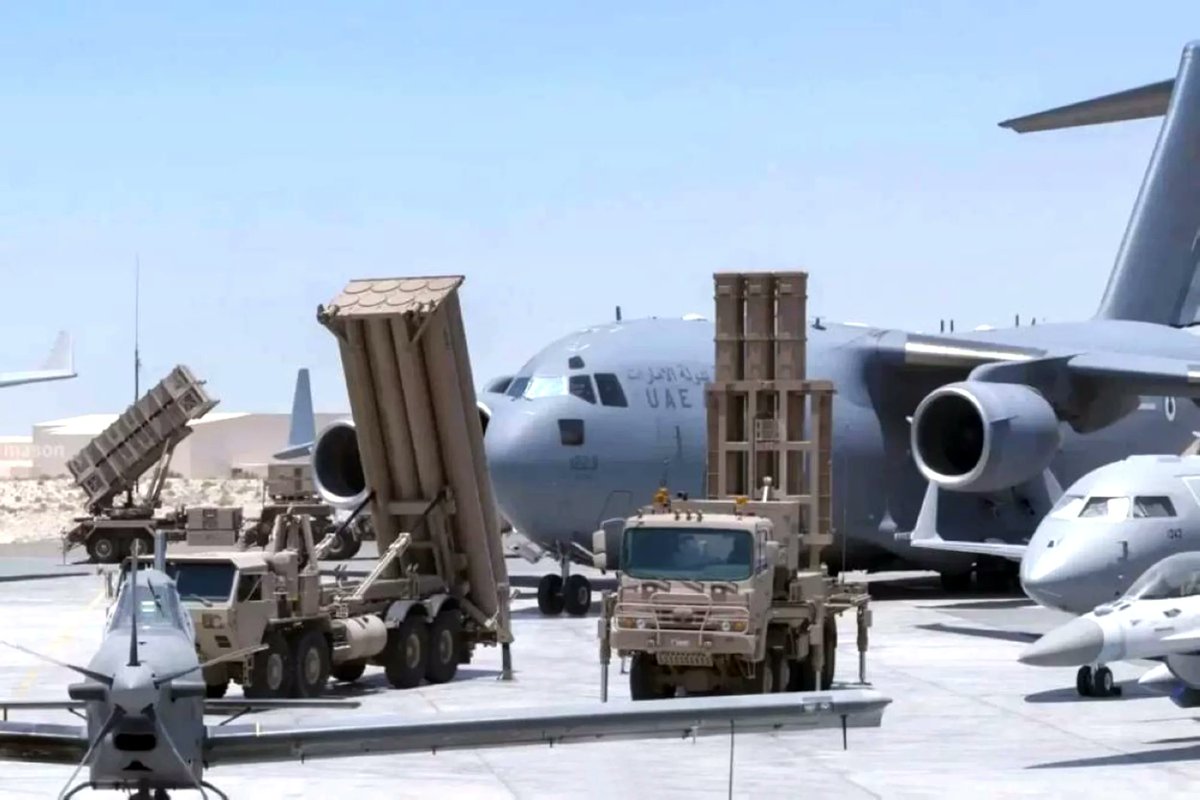
As we move into the 'next phase' of the war in the Middle East, the uniquely over-prepared UAE we saw may now no longer exist. Something that very closesly aligns with the question, 'is America at all prepared to prepare its allies?' What the UAE currently has for air defence is a layered network stitched together from five countries: THAAD and Patriot PAC-3 from the US, Barak-8 from Israel, Pantsir-S1 from Russia, Cheongung II from South Korea, and the domestic SkyKnight (a good product but entirely short-range drone focused). The major stocks of ballistic missile thus far have derived from American and regional American ally purchases; America is running out of missiles... According to an analysis by the Center for Strategic and International Studies, the number of American Patriot interceptors fell from 2,330 at the start of the conflict to fewer than 850 by the end of July. US THAAD stockpiles, meanwhile, dwindled to about 250 from 452. At current projections, following Operation Epic Fury, it will take 8 to 14 years to meaningfully replenish American stockpiles. The UAE needs shit now. Remember, deterrent quality is a function of two factors: the disposition of munitions on hand and the capacity to produce more (Magazine Depth Affordability is a Choice, Alex Oliver). America's deterrence quality has waned - better to be frank (see below). The modern cost exchange has proved too steep and America's dependence on legacy munitions too expensive. Commercial is not always better, but it is decidedly cheaper. In cruise missiles, Convenants, Anthems, and Barracudas will all be priced at about a fifth of the cost of legacy Tomahawks; in ballistics, it's the same as Castellion's Blackbird GL will cost under $500k compared to the Lockheed PRSM Increment 1's $2 - 3m. Does this mean that we will see Anduril churning out missiles for the UAE? I don't know. What I do know is that the UAE will be examining how best to keep itself safe, American or not. Ultimately, why would it care if the missiles that kept the country safe were American or Russian. Why should it care? America is short supplies and so is Russia. Aside from the incredible opportunity this presents neutral defence markets (e.g. South Korea), this means one thing... Independence has to be the next step in the country's journey. For too long it has been a consumer that has lived on trade and foreign labour. It now has a (wealthy) population that has experienced and survived a war. Lean into this. Lean away from trade. America's war time economy has been driving the country forward since the end of the Second World War. I think that given the geopolitical positioning of the UAE, it is entirely necessary that manufacturing independence is built. Use Sharjah as the hub. I will talk much more about Operation 300bn across my posting, this is only an introduction. I think it's going to be a fascinating cog in the country's resurgence (defence is interesting to me, but infra and the robotics supply chain are even more so). Essentially, this post acts as a call to action. I think it'll be worth keeping your eyes on the idea of supply chain independence in the country, quietly so as not to disrupt the American relationship, but with assuredness: it will happen, in the face of war the incentives are too high. How quickly and in what manner will be interesting, though. Will defence startups see the opportunity ahead of them? Will the country push for geopolitical relationships to strengthen defence prospects (South Korean Hanwha will be working with EDGE to build an integrated air defence network)? 2027 will be fascinating as a game theory case study: America will insight further conflict, the UAE will have to protect itself, America may not be able to help as extensively. How does the UAE react?
Messy personal post to really begin this account... Life is about reaching the ultimate end (happiness): for me that's all about glory and adventure. We all know that everything in life is a means to an ultimate end, and since the turn of August I have been complementing a final means (penultimate end). I think for the SF founder type, whether they admit it or not and in whatever definition they choose, achieving glory comes immediately before happiness. To me, glory and adventure must come together. Why do something big if it's been done before. This thinking has lived in my head as Pierrot's excellent video essay title of, 'there is no glory at home' - the defining factor in me deciding to uproot my life post university, leave London, and move to Aberdeen of all places to work for a deep tech startup. Doing difficult, stupid things becomes easy when you romanticise them to yourself... I really believe in glory, and in a very Roman sense. I think it's a concept that can consume a life (for good or for bad). Specifically, I believe in gloria: that one should strive to do something impactful in their life, in the name of public service. More generally it is just associated with doing something big, something industry or generation or world defining. It is glorious to become the President, or build the next great company, or, in a much nicer sense, to improve people's lives (not saying the first two can't be the third...). What's interesting to me is how, in the modern day, the notion of the reluctant hero - the person who has a chance at glory thrust upon them without looking for it - is extinct. One now must search for glory. Anybody doing anything great is searching for glory. To me, that means one thing: the most glory will go to those who put the most on the line. To save a country, you must put yourself in harms way. It's a game of risk. One must operate at the absolute pinnacle of their 'excellent standards' (Pierrot, please watch) for as long as possible, doing the most difficult thing they can, knowing that it could amount to nothing. The idea of the reluctant hero is romantic, yes, but what could be more romantic than putting it all on the line for a chance at glory. It so often goes wrong. For every Cincinnatus there is a Boris Johnson who believes himself to be Cincinnatus (fun reference for those who remember). But for every Travis Kalanick (Atoms will be incredible) for whom it all unravels, there is a Patrick Collison for whom it could not go more right. Glory is all about putting it on the line, knowing it could go wrong, and doing it anyway. Hand in hand with glory is adventure. I believe that adventure must be unique, it must be unknown. One cannot go on a journey that has already been traversed, or else they will be doing it with a roadmap. When guidance is provided (and we have access to guidance in abundance), you are not exploring the King Solomon's Mines or the Misty Mountains, you are hiking a walked trail. That's fine, but why not go down the path untrodden. Why not sail into uncharted waters and do something Christopher Nolan will adapt into a blockbuster hit (Odysseus didn't look for adventure but when the time came he did rise to it; let the analogy live). It's so rare to see genuine adventure these days. I struggle to believe that what I'm doing now is adventurous. I don't see why moving to a new city and starting a new job is particularly unique. Maybe brave, maybe exciting, but not adventurous. This is to say that adventure today is preserved for the few. Only some will have the chance to do something genuinely unique, to voyage into the unknown. I am choosing to think that it is afforded to those who search for it, again it requires intention. I want to believe that after years of self-improvement and preparation, the opportunity arises. When that time comes one (I) will have to be willing to risk it all, knowing that the years spent searching, may come to nothing. What better way to spend a life, though. The common thread here is risk. Pierrot speaks about glory and adventure as risking mortal destruction (I only really mean a sense of personal failure). When the goal is too small, or the path trodden, one cannot put themselves in the face of genuine personal destruction. That begs the question, though: can one really fail, can they really face destruction, if they have truly searched for glory and adventure. This is where I think there might be nothing more romantic. You just can't go wrong (you can, don't be a dick) if you're truly pursuing glory and adventure. 'There is no glory at home' is a great call to both. Worth thinking about when you do something difficult.

Listening to Mark Carney talk about the US-Canada relationship in his forward guidance a few weeks ago. He sets out issues so clearly and so simply; engages with modern mediums of communication (why hasn’t Trump started a YouTube channel? Mamdani isn’t doing simple sit-down longer form content like this); and seems like such a principled person. I imagine the standards he’s demanding from his ministers are insatiable. Young Canadians should be clamouring to try and work for him. I also reckon he’s revelling in the Trump-centric world we live in. He can operate with such decisiveness and his ‘values-based realism’ seems so intellectual relatively. My god how lucky are Canada.
@a16z Power is furthest upstream, then the black space, then grey space. Can someone own all three systematically? Somebody could dominate by connecting all three. Space?
Wondering why would Trump have even tried to have won in 2020? Aside from affording him time, what would winning then have done that winning in 2024 couldn't have done tenfold?
American oligarchs benefit most from Greenland; we aren't going to see a decline in grocery prices. When Trump's done spearheading autocratic rule in America, what happens to technofeudalists? With Vance it stays the same (obvious) but Rubio? Newsom? Osoff? AOC?
And how many do you think there are today in this region?
Best guesses, based on water and air economization, where is the best climate on Earth for a data centre?

Dr. RANA _ Founder, C... @DrRana_Centrist
21K Followers 4K Following Neurologist, Author, Journalist, Founder @CentristCa @ParkinsonsMeds @DrRanaParkinson CANADA NEEDS TO DEVELOP ITS NATURAL RESOURCES & REDUCE THE COST OF LIVING
Private Page @spaceechats
67 Followers 2K Following
Emma Kennan @EmmaKennan5iw6
15 Followers 841 Following
Ivan Alonso @IvanAlonsoBCSen
10 Followers 202 Following Founder, BCSentinel AI. Developing Future Formation Intelligence (FFI). Detecting complex entities & coordinated smart contract bursts on the EVM before public

SixlgmaCapltals° @SixSigm_apital_
29 Followers 1K Following Stock market investor | Emergency physician. Sharing live portfolio updates, practical investing ideas, and market insights at https://t.co/dozjec6yMx.
Palmer Luckey @PalmerLuckey
1.2M Followers 2K Following I am a technology enthusiast, writer, and modder. Founder of @ModRetro, @Oculus VR, and @Anduriltech. Keeping American superheroes safe with autonomous systems.
Yann Le Her @23IS_YLH
1K Followers 52 Following Je suis fondateur de 23IS, Multi Family Office expert en investissement et en structuration patrimoniale. Je publie ici du contenu financier et scientifique.
Dr. RANA _ Founder, C... @DrRana_Centrist
21K Followers 4K Following Neurologist, Author, Journalist, Founder @CentristCa @ParkinsonsMeds @DrRanaParkinson CANADA NEEDS TO DEVELOP ITS NATURAL RESOURCES & REDUCE THE COST OF LIVING
Mark Carney @MarkJCarney
770K Followers 798 Following Prime Minister of Canada and Leader of the Liberal Party | Premier ministre du Canada et chef du Parti libéral
Eric Wallerstein @ericwallerstein
16K Followers 2K Following Chief Macro Strategist, Clocktower Group. formerly at the Fed and White House.
Frenchie @Frenchie_
61K Followers 1K Following Managing chaos & leveraging entropy | Public Equities | Fondamental Maths 🇫🇷 https://t.co/rEyjlS8C1w
Pope Leo XIV @Pontifex
17.9M Followers 47 Following Welcome to the official account of His Holiness, Pope Leo XIV.
Daron Acemoglu @DAcemogluMIT
429K Followers 355 Following Institute Professor @MIT, @MITEcon. Co-Director of @MITShapingWork. Author of Why Nations Fail, The Narrow Corridor, and Power & Progress.
Geiger Capital @Geiger_Capital
366K Followers 315 Following Markets, Economics, Politics Personal Views. Not Investment Advice.
Ivan Alonso @IvanAlonsoBCSen
10 Followers 202 Following Founder, BCSentinel AI. Developing Future Formation Intelligence (FFI). Detecting complex entities & coordinated smart contract bursts on the EVM before public
Carmen 🍫 @calfonsorico
4K Followers 1K Following Backing Killers with a Heart and supporting them as their in-house VC @cocoadotvc 😇❤️🔥
Molly O’Shea @MollySOShea
76K Followers 825 Following Investing & Tech →Newsletter/Podcast @Sourceryy | BIG Fan @brexhq @Turingcom @public @deel @getvcx
Secretary Chris Wrigh... @SecretaryWright
128K Followers 31 Following 17th United States Secretary of @ENERGY

GV @GVteam
514K Followers 813 Following Launched as Google Ventures in 2009, GV supports innovative founders moving the world forward.
Greylock Partners @GreylockVC
297K Followers 1K Following Partnering with early-stage entrepreneurs since 1965. 100+ IPOs. 250+ acquisitions.
Kleiner Perkins @kleinerperkins
306K Followers 2K Following For five decades, we have partnered with founders building enduring companies that make history.
Founders Fund @foundersfund
245K Followers 184 Following technology, science, venture capital // what does the future look like?
benahorowitz.eth @bhorowitz
767K Followers 660 Following
Alex Oliver @DefenseInDepth_
357 Followers 60 Following

SpaceX @SpaceX
41.9M Followers 127 Following SpaceX designs, manufactures and launches the world’s most advanced rockets and spacecraft
Garry Tan @garrytan
1.1M Followers 6K Following President & CEO @ycombinator —Founder @garryslist—Creator of GStack & GBrain—designer/engineer who helps founders—SF Dem accelerating the boom loop
Benchmark @benchmark
166K Followers 505 Following Benchmark focuses on early-stage venture investing in consumer, marketplaces, open-source, AI, infrastructure, and enterprise software.
Sequoia Capital @sequoia
818K Followers 2K Following We help the daring build legendary companies from idea to IPO and beyond.
Y Combinator @ycombinator
1.7M Followers 367 Following We help founders make something people want. Subscribe to our newsletter: https://t.co/sjqjxxBeLc
Sam Altman @sama
6.3M Followers 1K Following The mission of OpenAI is to ensure that AGI benefits all of humanity
Christopher Luxon @chrisluxonmp
82K Followers 345 Following A husband, a father, a brother and a son. Prime Minister of New Zealand 🇳🇿 Auth J de Joux, [email protected]. OIAs: [email protected]
Mehdi Hasan @mehdirhasan
2.3M Followers 5K Following British-American journalist. Editor-in-chief and CEO of new media company @zeteo_news. Subscribe here: https://t.co/sEC1ETzeiV.
a16z @a16z
1.1M Followers 64 Following It's time to build. https://t.co/A9eTFq6Xbx Posts are not investment advice or an advertisement for investment services. See https://t.co/nX2FtaLE06.
Citron Research @CitronResearch
382K Followers 565 Following Citron Research | Since 2001, delivering bold market analysis & investment insights. Led by Andrew Left, empowering informed financial decisions worldwide.


SixSigmaCapital @SixSigmaCapital
57K Followers 784 Following Stock Market Participant | Emergency Doctor For my live portfolio updates, actionable ideas and market memos visit: https://t.co/3G8H0mf4x1
TBPN @tbpn
1.6M Followers 1K Following Technology’s daily show. Hosted by @johncoogan & @jordihays. Streaming live 11a–2p PT weekdays. Sign up for our free newsletter at https://t.co/Nhf5ohjInO.
Object Zero @Object_Zero_
40K Followers 1K Following Doer of the difficult. Champion for talent. Inventor of things. Builder of Machines. North Sea O&G, Nuclear Power, Subsea, Heavy Manufacturing.
Guy Kawasaki @GuyKawasaki
4.1M Followers 506 Following Chief evangelist @Canva 🎧 Host Remarkable People podcast https://t.co/Hout7LwJjC
John Carmack @ID_AA_Carmack
4.2M Followers 295 Following AGI at Keen Technologies, former CTO Oculus VR, Founder Id Software and Armadillo Aerospace
Steve Wozniak @stevewoz
3.7M Followers 91 Following Engineers first! Human rights. Gadgets. Jokes and pranks. Segways. Music and concerts. Gameboy Tetris.
Jeff Bezos @JeffBezos
10.3M Followers 618 Following Six thousand years ago, someone invented the plow, and we all got wealthier. A gentle reminder that all civilizational wealth is driven by invention.
Steve Ballmer @Steven_Ballmer
3.1M Followers 199 Following Lots going on: follow what's new @LAClippers 🏀 and @USAFacts 📊. Also busy with @BallmerGroup.
Bill Gates @BillGates
65.3M Followers 571 Following Sharing things I'm learning through my foundation work and other interests.
Marc Andreessen 🇺�... @pmarca
6.6M Followers 34K Following You’re not talking to someone who woke up a loser. That loser attitude, that loser premise makes no sense to me.
Paul Graham @paulg
5.4M Followers 805 Following
Tim O'Reilly @timoreilly
4.5M Followers 2K Following Founder and CEO, O'Reilly Media. Watching the alpha geeks, sharing their stories, helping the future unfold. Didn't pay for a blue check, cannot make it go away

Michael Dell 🇺🇸 @MichaelDell
8.5M Followers 4K Following Husband, Father, Grandfather, Brother, Founder, Chairman and CEO Dell Technologies Grateful 🇺🇸 #PlayNiceButWin https://t.co/3JiGiLQq1CTrends for United States
You might like