

Bitlover @BitloverCol
Joined April 2024-
Tweets35
-
Followers27
-
Following124
-
Likes127
Governments have always backed their money with force. You pay taxes in dollars because the IRS can freeze your accounts and, if you cheat, put you in prison. That demand is a big part of why the dollar has value at all. Bitcoin works differently. Mining one block today takes more than 10^23 hash computations. Miners in places like West Texas burn real electricity, buy real hardware, and compete with every other miner on earth for thin margins. All that spending is what makes new bitcoin scarce. Sound money people have always said money should cost something to produce. Gold did, for centuries, because geology and metallurgy limited the supply. Central banks loosened that limit in stages, and Nixon closed the gold window in August 1971. Since then, M2, the broad measure of the US money supply, has grown from roughly $685 billion to more than $21 trillion. We all paid for that through higher prices. Bitcoin brings the constraint back, and nobody has to give permission. The protocol resets mining difficulty every 2,016 blocks, so a new block arrives about every ten minutes no matter how much computing power joins. No central banker can call a Saturday meeting and double the supply. That matters because money that costs nothing to make lets governments pay for wars, bailouts and surveillance without raising taxes to the point of revolt. With proof-of-work, you either spend the energy or you don't get the coin. That makes it the most subversive idea in the history of money.
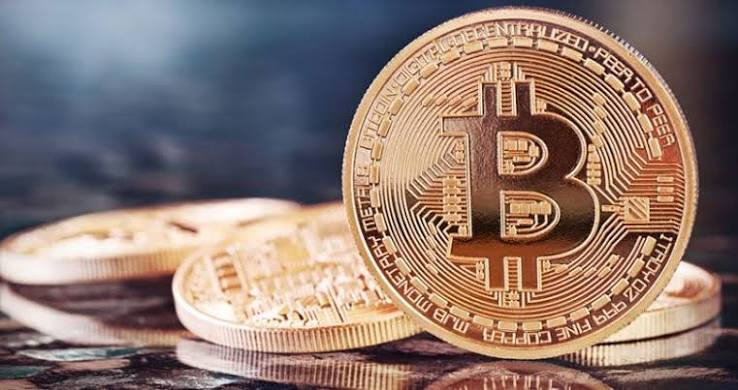
Bitcoin explained in 10 sentences. 1. To understand Bitcoin, you first have to understand the problem it solves: money controlled by people. 2. There is a money-power paradox: if someone has the power to control the money, someone has the power to corrupt it. 3. Every form of money before Bitcoin had a central seat where someone could control the money, and because of that, every form of money became corrupted, including today's money, which is controlled by governments and central banks, which enables them to create money out of thin air and destroy the purchasing power of your money. 4. Bitcoin is a new monetary system designed to remove that central seat of power and stop monetary corruption once and for all. 5. Satoshi Nakamoto, the creator of Bitcoin, saw the corruption of money as a *trust* problem; we must trust central banks and governments not to manipulate the money, but the history of their system is filled with breaches of that trust. 6. Satoshi's solution was simple: instead of relying on trust to run the money system, use proof. 7. Instead of trusting one central authority, like a bank or government, to make sure the system is running properly, Bitcoin spreads that job across thousands and thousands of computers around the world: participants use proof to demonstrate that they are following the rules, and each computer independently verifies that proof, only accepting activity that follows Bitcoin's rules and rejecting anything that doesn't. 8. The result is a monetary system where no single person, government, or institution can control and manipulate the money, because the power to enforce the rules is spread across the entire network rather than concentrated into one authority, and because nobody can get away with breaking the rules -- nobody can just appear at a press conference and claim that what they're doing is legitimate -- rather, they must provide proof that their work is legitimate, and the entire global network is always checking that their proof-of-work follows the rules. 9. Think about what this means: for thousands of years, humanity has lived in a world where the people controlling the money could change the rules of the game to benefit themselves, while everyone else had to deal with the consequences. 10. Imagine what would happen if we had a money system where everyone played by the same rules, where everyone HAD to be honest in order to participate, and where that reality could not be manipulated. That's Bitcoin.
@holdmybirra @10ampro Como asi, hombre! Entonces, los costeños no pagan la luz y se la cortan a los dueños de la empresa? 🤦🏾♂️
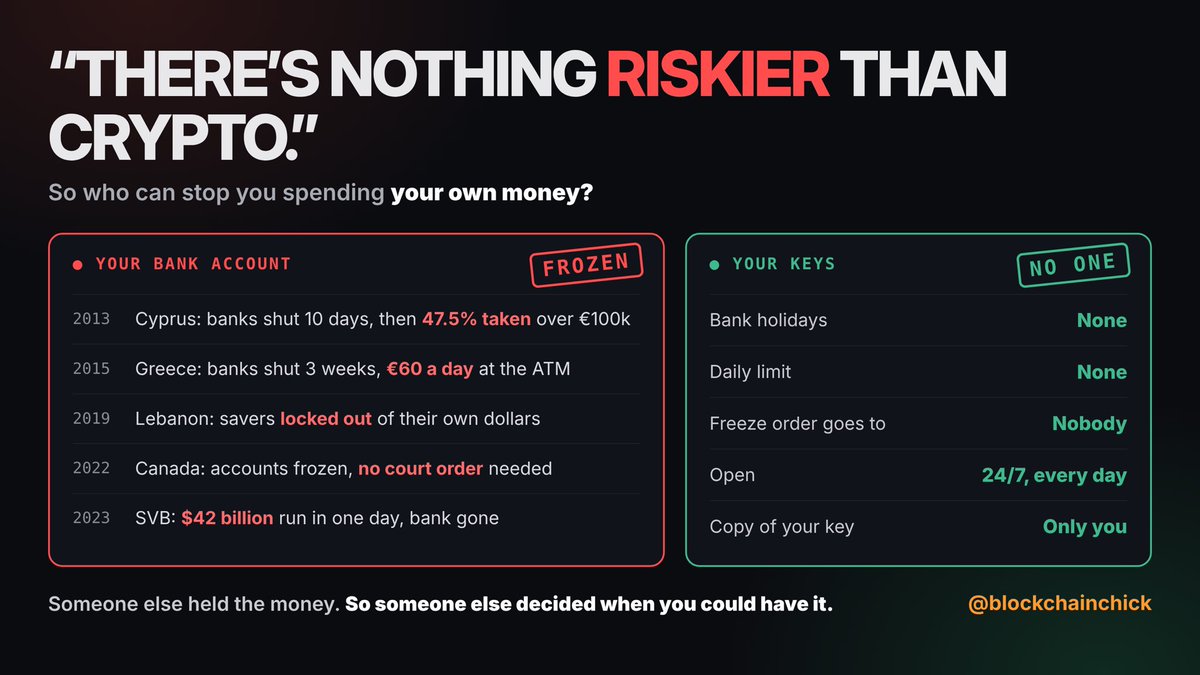
"THERE'S NOTHING RISKIER THAN CRYPTO." You've heard it from your bank, your adviser and the evening news. So let's look at the safe option. 2013. Cyprus. The banks shut for 10 days. When they reopen, savers at Bank of Cyprus lose 47.5% of everything over €100,000. 2015. Greece. The banks shut for three weeks. You can take out €60 a day. 2019. Lebanon. Banks lock people out of their own dollar savings. The lira loses about 90% of its value. 2022. Canada orders banks to freeze accounts linked to a trucker protest. No court order needed. About 210 accounts, roughly C$7.8 million. 2023. Silicon Valley Bank. $42 billion tries to leave in one day. By the next morning the bank is gone, and around 90% of its deposits were over the insured limit. Every one of these has the same thing in common. Someone else held the money. So someone else decided when you could have it. Now look at self custody. Your Bitcoin sits at an address that only your private key can spend from. That key comes from 12 or 24 words you wrote down yourself. No bank has a copy. No company has a copy. No government has a copy. There's no branch to close. No daily limit. No account manager for a freeze order to land on. The network doesn't do weekends or bank holidays. Send it across the street or across the world at 3am on a Sunday. Nobody approves it. Nobody can reverse it. Satoshi wrote it plainly in 2009: "The central bank must be trusted not to debase the currency, but the history of fiat currencies is full of breaches of that trust." The cypherpunk answer was to stop needing the trust. Yes, crypto is volatile. Yes, people lose money. FTX lost $8 billion of customer funds. Look at how: people handed their coins to a company to hold. Same mistake as Cyprus, new logo. Leave it on an exchange and you've just opened another bank account. There are two kinds of risk. The price moving. And someone else deciding whether you can have your money. Hold your own keys and only the first one is left. Your bank account has both.
@alberto_mera Con tal de que el empleado nos hayas sido tú mismo, todo bien.
La mayoría no entiende que es el dinero, y creo que últimamente el oro está recibiendo más atención de la cuenta vs Bitcoin. El dinero es el medio a través del cual el sistema intercambia promesas, y simplemente utilizamos el medio que mejor nos permita cumplir esa función. Cuando un ser humano produce algo que necesita otro ser humano, indirectamente se genera una promesa de cobro social por ese favor. Esto significa, que generamos un certificado de ese favor social, para que cuando interactuemos con otro ser humano que no sea al que le hemos hecho el favor podamos tener un medio de canje. Así evolucionamos del trueque (intercambio 1-1), a un sistema económico global (intercambio múltiple). Sin embargo, la función económica consiste en optimizar y maximizar la satisfacción de necesidades por unidad energética empleada (productividad). El dinero, es simplemente una representación subjetiva de las expectativas de unidades energéticas que emplearíamos en algo. Por eso, son tan importantes definir las cualidades necesarias del dinero (medio de cambio, unidad de cuenta, etc). Básicamente son características que nos permiten comparar con la mejor precisión el costo energético de algo a lo largo del tiempo, y poder así calcular el coste de oportunidad. Por eso, el oro ha sido un buen medio a lo largo de la historia de la humanidad. Bien escaso, y de poca degradación, que nos permitía cierta estabilidad en la unidad de valor en el tiempo. Sin embargo, el oro sufre muchísimas problemáticas a nivel de uso que la mayoría no contempla (grado de pureza, expropiación, costes de transporte y almacenaje, etc). Esas problemáticas que tenía el oro fuimos capaces de resolverla vía pasivos (certificados de unidades de referencia) que con el tiempo se convirtieron en lo que hoy llamamos dinero (fiat). Sin embargo, cuando aparece el bitcoin, se crea un patrón que sigue unas reglas inamovibles e inmutables. Y eso cambia el juego. Puede ser volátil, inelástico, y todas las problemáticas que la mayoría de economistas de hoy en día intentan asignarle, pero la realidad es que hemos encontrado una forma perfecta de representación del costo energético que empleamos en algo. Sigue unas leyes inamovibles que definen per sé el costo energético de cada unidad, y conforme se expanda su uso, llegará un momento donde nuestra capacidad de juicio sobre el coste de oportunidad energético que estamos enfrentando tendrá una ventaja competitiva infinita frente al oro y el resto de medios de intercambio. El nuevo patrón monetario llegó hace más de una década y la mayoría no se ha enterado.
Some fools still think the legacy news is real. Amazing.
FRANCE JUST VOTED TO TAX YOU FOR SWAPPING BITCOIN INTO A STABLECOIN. Not cashing out. Swapping. Today in France you pay tax when you sell crypto for euros. Trade it for a stablecoin and nothing is due. Amendment I-3898 changes that from 1 January 2027. Swap into a regulated stablecoin and the gain is taxed at 31.4%. On the day you swap, whether you ever touch a euro or not. It passed last Friday, 38 votes to 37. The Assembly has 577 deputies. 100 showed up. The government opposed it. It passed anyway. Now look at what else deputies have put into the same budget. Declare any self-custody wallet worth €100,000 or more, or face fines of up to €10,000. One version wants the threshold at €5,000. An exit tax on unrealised crypto gains above €800,000 if you move your tax home out of France. Coins on foreign exchanges and in your own wallet included. First they tax the trade. Then they list the wallet. Then they tax you for leaving. And it isn't just France. Since January, DAC8 has every crypto exchange in the EU collecting your details for the tax office. From July 2027, EU exchanges can't touch privacy coins, and cash payments over €10,000 are banned across the EU. Europe isn't regulating crypto. It's mapping your wealth before it decides how much to take. None of the French measures are law yet. The full budget vote is 17 November, then the Senate. But the people who do well in Europe now are the ones who planned their exit before they needed it. A second passport. A second residency. Keys only they hold.

Elon says money will become obsolete and energy will be the true currency. Half my timeline understood: "there won't be any currency anymore." It's the exact opposite. There will always be a currency. What's going to die is fiat money. And with it, the power of the people who print it. Quick masterclass on why. First, what is money? Money isn't wealth. It's a tool. It has three functions: unit of account (measuring value), medium of exchange (avoiding barter), and store of value (carrying today's work into tomorrow). At its core, money is a database. It records who produced what, and who has the right to consume what. It's a system for allocating human labor. And good money has one non-negotiable property: you can't create it out of thin air. Otherwise, it lies. For centuries, money was backed by something real: gold. Every banknote was a claim on a weight of metal. You couldn't print more than what you had in the vault. Then we dismantled it, piece by piece. In 1914, World War I. Countries suspend gold convertibility to finance the war on credit. In 1933, Roosevelt bans Americans from owning gold and devalues the dollar right after. In 1944, Bretton Woods. The dollar becomes convertible to gold at $35 an ounce, and every other currency gets pegged to the dollar. On August 15, 1971, Nixon "temporarily" suspends the dollar's convertibility to gold. That "temporary" measure has now lasted 55 years. In 1973, exchange rates float. Not a single major currency in the world is backed by anything physical anymore. Since 1971, the dollar has lost nearly 90% of its purchasing power. US federal debt has grown almost 100x. Housing prices have decoupled from wages. That's not a coincidence. It's the direct consequence of money with no physical limit. Now, central banks. A central bank does two things: it sets the price of money (interest rates) and it creates money. Two massive levers, in the hands of a handful of people nobody elected. When they keep rates too low for too long, they create bubbles, keep zombie companies alive, and push everyone into debt. When they print, they dilute your savings. The Fed's balance sheet went from roughly $900 billion in 2007 to nearly $9 trillion in 2022. The US money supply grew about 40% between 2020 and 2022. Result: 9.1% inflation in the US in June 2022, 10.6% in the eurozone in October 2022. Inflation is a tax nobody voted for. And it doesn't hit everyone equally: those closest to money creation (the state, banks, asset holders) get the new money first. Workers and savers get it last, after prices have already gone up. Now let's reason from first principles. If AI and robotics produce most goods and services, human labor is no longer the limiting factor of the economy. So a currency whose job is to allocate human labor no longer has a purpose. What stays scarce? Energy. Every physical good is matter transformed with energy. Every AI is computation, meaning electricity. With enough energy, you extract, you recycle, you manufacture, you reason. The natural unit of account of a robotic economy isn't the dollar. It's the kilowatt-hour. And this is where it gets beautiful: energy-backed money is tied to a real, measurable asset governed by thermodynamics. As Elon puts it, governments can print money, but they can't print energy. No more inflation manufactured by bureaucrats playing with the printing press. We go back to a standard. But this time, not a metal sitting in a vault: the very input of all production. My prediction: within the next ten years, the fiat monetary system will break. And with it, the grip that politicians and legacy bankers have on money. Elon is designing the new global economic order. Not a communist system: private property stays central. But capital will flow to those who best allocate energy to create more goods and services. A meritocracy of physics. That's what will bring us abundance. Money isn't disappearing. It's becoming honest again.

NEW: Elon Musk predicts money will become obsolete as energy becomes the currency of the future.


El día antes de que liquidaran US$19B en crypto, @joemccann tenía apenas 1,6% de su caja invertida. No porque supiera qué iba a pasar. Porque después de 25 años viendo mercados, algo “olía” a evento de cola. Eso es lo interesante del clip: la intuición no es magia. Es memoria muscular. 100.000 trades. Patrones repetidos. Pensar en probabilidades. Salirse del flujo. Dar un paso atrás. Reevaluar todo. Joe ni siquiera anticipó exactamente qué iba a pasar con Binance. Simplemente entendió que la distribución estaba dejando de parecer normal y que el riesgo estaba en las colas. Después llegó el 10/10. Llámelo suerte si quiere. ¿En qué momento suficientes repeticiones dejan de ser “intuición” y se convierten en una ventaja real? cc/ @AndresFelArias
@octaviapolis El colombiano merece poder hacer con su dinero lo que le de la gana.
Este documento del Ministerio de Agricultura, es la formalización del Gosplan criollo. No lo esperaba de este gobierno. ¿Qué era el Gosplan? Era el temido Comité Estatal de Planificación de la Unión Soviética. Un gigantesco ente burocrático que pretendía dirigir la economía calculando desde un escritorio en Moscú cuántos zapatos, cuántos clavos y cuánto trigo debían producirse, anulando el sistema de precios libres. Todos conocemos el resultado, escasez estructural, ineficiencia y hambrunas. Hoy, disfrazando de "sostenibilidad" lo que en teoría económica son aberraciones conocidas, el Consejo Nacional del Arroz y el Gobierno nos recetan la misma fórmula dividida en cuatro pilares: Pilar 1: La arrogancia fatal de "ordenar la oferta". Pretender planificar el equilibrio entre oferta y demanda mediante "zonificación de siembras" y "áreas de cultivo de referencia" asume que un burócrata en Bogotá sabe mejor que el agricultor en el Tolima o los Llanos cuándo, cuánto y dónde sembrar. Desprecian el conocimiento disperso del mercado. Cuando el Estado intenta calcular cuotas de producción, el resultado es siempre el desabastecimiento o la sobreproducción artificial subsidiada. Pilar 2: Control de precios. Llamar "Mecanismo Nacional de Formación de Precios" a un comité burocrático es un eufemismo cobarde para el control de precios. Ignora la teoría del valor subjetivo y resucita la falacia marxista del valor-trabajo (fijar precios sumando ciegamente "costos de producción"). Pilar 3: Socialización de pérdidas vía "Fondo de Estabilización". En un país con un hueco fiscal de 100 billones de pesos financiado a tasas de "gota a gota", el Consejo Nacional del Arroz planea crear otro fondo para blindar a este sector frente a las fluctuaciones del mercado. Es la privatización de ganancias para algunos y la socialización de pérdidas para el contribuyente. Pilar 4: Crédito artificial vía Finagro. Inyectar crédito blando artificial distorsiona la tasa de interés y envía señales de precios falsas, incentivando inversiones no rentables que terminarán en quiebras masivas cuando el ciclo de crédito inevitablemente se revierta. Como diría Thomas Sowell, ante propuestas como esta siempre debemos hacernos tres preguntas: ¿Cuánto cuesta, comparado con qué, y qué evidencia hay de que funcione?.

#BoletínDePrensa 🚨 | ¡El #CampoMilagro y el sector arrocero sellan acuerdo para fortalecer la sostenibilidad económica de la cadena! 🍚 Hoy, en #Bogotá, 📍 el Consejo Nacional del Arroz acordó implementar, desde el primer semestre de 2027, un Modelo de Ordenamiento Productivo


@AlcaldiadeMed @FicoGutierrez Y por qué no empezamos por trasladar las ganancias de EPM a un menor costo de la energía? Eso sí es mejorar el costo de la calidad de vida

I think of money as stored time. Every dollar you save is a slice of your life. Hours you sold, frozen for later use. In 2016, $1,000 held 47 hours of median-wage work. Today it holds 32. Fifteen hours. Gone. You didn’t spend them. You didn’t blow them at the casino. You didn’t buy a boat. They evaporated while the money sat in your account doing exactly what you told it to do. That’s not saving. That’s a slow-motion robbery called inflation. Store your time in something they can’t print. Bitcoin
@GMacrowise El buen Elon no terminará licuando así el valor de las acciones? 🤷 @holdmybirra
@CamiloGuzmanSa Eso se cura con pelos de la misma perra! Y sigue la fiesta.
On se demande où on a « foiré » en France. La réponse est assez simple, le point de bascule c’est 1981. Pas 2002, pas 2017, pas Macron. 1981. L’arrivée de Mitterrand. Le moment où la France a décidé, en toute lucidité, de se tirer une balle dans le pied en se convainquant que c’était du progrès social. Avant 1981, la France était encore un pays qui produisait, qui exportait, qui avait une industrie, des entreprises qui osaient investir et des gens qui croyaient encore vaguement au travail. Après 1981, on a nationalisé à tour de bras, on a augmenté les impôts comme si l’argent des autres était une ressource infinie, on est passé aux 39 heures, on a baissé l’âge de la retraite, et on a expliqué aux Français que la richesse se créait en redistribuant celle des autres. Résultat ? Capital qui fuit, franc dévalué, inflation, et le fameux « tournant de la rigueur » de 1983 qui n’a jamais vraiment corrigé le cap idéologique de fond. Depuis, on a perfectionné le modèle : État toujours plus gros, charges toujours plus lourdes, culture du droit acquis plutôt que du mérite, école qui a progressivement abandonné l’exigence au nom de l’égalité des chances, et une immigration de plus en plus déconnectée de toute logique d’intégration réelle. On a remplacé « travailler et produire » par « revendiquer et bloquer ». Et aujourd’hui, on s’étonne que la France soit devenue le pays des 35 heures, des grèves perpétuelles, de la dette à 110 %, du chômage des jeunes endémique et d’une classe moyenne qui se fait asphyxier. Le plus beau, c’est la mauvaise foi. Quarante-cinq ans plus tard, on continue de dire que « ce n’est pas la gauche », que « c’est le néolibéralisme », que « c’est l’Europe », que « c’est la mondialisation ». Non. C’est le moment précis où une majorité de Français a choisi de croire qu’on pouvait vivre durablement au-dessus de ses moyens en faisant payer les autres, et que ça s’appellerait « justice sociale ». 1981 n’a pas tout cassé en un jour. Mais c’est là qu’on a choisi le chemin. Et depuis, on court de plus en plus vite au bord du précipice en se demandant pourquoi on n’arrive plus.🤔🤭

Que se quiebre. No puede ser que en 2026 2000 personas y este tipo tengan de rehen a 45 millones de personas que quieren vestirse como les da la gana pagando menos. Basta ya de empresaurios.

#EnDesarrollo En medio de una audiencia pública ocurrida ayer en la Comisión Tercera de la Cámara, el reconocido empresario Arturo Calle señaló que ha perdido cerca de 2.000 empleos ante la proliferación de compras en plataformas como Shein y Temu: "Si usted tiene menos
@JoMalagon hay que disimular un poco al menos! Los bancos aplaudiendo como focas. Le llaman combatir el terrorismo. Los bancos lo celebran como expansión de su negocio. Esto es la lucha del siglo: separar el dinero del Estado. Que el ciudadano sea dueño de su propio dinero, no un sospechoso pidiendo permiso para usarlo.

El sector financiero colombiano celebra que el Gobierno Nacional estudie limitar los pagos en efectivo en compras de alto valor como parte del Estatuto Antiterrorista. La compra de apartamentos, carros y lotes debe contar con mecanismos que permitan rastrear el origen de los

Cole Walmsley @Cole_Walmsley0
1 Followers 64 Following Private elite account 📍 Exclusive crypto insights, market trends & technical analysis. Not for everyone. Main: @Cole_Walmsley
Heidi Trades @bI0ckchainchck_
128 Followers 2K Following Early Adopter #Bitcoin. Been through 2 Bear Markets and 3 Bull Markets. YouTube Personality for Crypto Tips with @sircryptotips
Okeke @OkekeFcD
15 Followers 847 Following
MsVeil @MsVeilM0ney
17 Followers 484 Following I'm a boring investor. Sharing my money💰 thoughts here. Investing. Stock Market Budgeting. Debt. Wealth Building NOT FINANCIAL ADVICE.
Juam Rodríguez @accounr61gmail1
9 Followers 37 Following Bitcoiner y analista on-chain. Opero e invierto en Quantfury Es
Justin Banks° @RealJGBankee
81 Followers 890 Following Trading growth stocks, cycles & emerging themes. Focused on what's next - not what already moved. Wolves of Wealth
Faye @JasperEndoxao1
208 Followers 518 Following Travel, outdoors, coffee, tennis, golf, horseback riding #BTC #ETH #XRP
xStocks HelpDesk✪ @xstockcare
41 Followers 773 Following Welcome to official $XSTOCKS community support page, Having any issues? Contact us via Dm📩

.Heidii°✪ @bIckschanichiks
24 Followers 224 Following Early Adopter #Bitcoin. Been through 2 Bear Markets and 3 Bull Markets. YouTube Personality for Crypto Tips with @sircryptotips

Sweet Planet @CornelisKubfdg
323 Followers 640 Following We strive to create a minimalist home space while also pursuing a clean and straightforward decentralized asset management approach.
Christianna fay @SugayMayFire
684 Followers 3K Following 7 years+ of Trading Experience 🧠 Top Forex trader 📈 Making people’s life exciting and fun while you can still make it count
Grace @Graceyxtn
1K Followers 1K Following Life is what happens when you're busy making other plans.
Flowers and Moonlight @TobiasNakad0f
162 Followers 458 Following Attending a flower arrangement salon to learn about the philosophy of floral art is like understanding the wisdom of "securing profits" amidst the ever-changing
kate @kate_bliss223
34 Followers 690 Following I'm available for fun 🥵 DM let's have fun This is my signal number you can text me over here +1 2765332020

The Bitcoin Times @TheBitcoinTim
413 Followers 5K Following
The Bitcoin Times (pr... @thebitcointme0i
236 Followers 82 Following Bitcoin Trader | Activist | Web3 | DM for Promo
Crypto Banter Plus @CbanterPIus_
198 Followers 7K Following Crypto Plus is everything you don't get on Crypto Banter and MORE! On Crypto +, we breaking crypto news before any other profile on X

Caffe' Satoshi @CaffeSatoshii
53 Followers 476 Following Small shots. Bitcoin only. No noise, Data driven. Do not copy my trades. Do your own research
White roses @Dustacing
215 Followers 539 Following If the goal you are determined to strive for is not the same as the person you want to become, then you will never become that person. #Bitcoin #Investors
Jeff Swanson @thesswansjr
20 Followers 2K Following Only private elite here‼️I will mainly talk about crypto market, price action analysis etc ONLY FOR A FEW PEOPLE MAIN ACCOUNT @theswansjr
Christina Anne Reed @christinaartech
23K Followers 6K Following


semillabtc @semillabtc
5K Followers 19 Following Educación #bitcoin. Te aceleramos para que sepas comprar, guardar y proteger tu riqueza digital privada — por Arkad & Lunaticoin ✉ [email protected]
Dray @drayinvests
10K Followers 904 Following 20 | Majoring in Finance Tech & Business Focused Building Wealth with Stocks Not Financial Advice.
Simple Mining @simpleminingio
26K Followers 479 Following We turn power into Bitcoin. Hosted mining for investors. Based in Cedar Falls, Iowa. Inc 5000 #175
Penguin X @ThePenguinBTC
117K Followers 564 Following DeFi Strategist On-chain data & market intelligence Actionable insights daily | Deep research weekly
Cole Walmsley @Cole_Walmsley
17K Followers 841 Following Financial liberation is here. 10,000+ hours studying money. Writing “The Bitcoin Thesis.” Join the waitlist here ⬇️
MsVeil @MsVeilMoney
5K Followers 632 Following Investing Girl Activated Building Wealth with Stocks Road to $100k NOT FINANCIAL ADVICE
Justin Banks @RealJGBanks
259K Followers 5K Following #1 Growth and Momentum Trader on X Trading growth stocks, cycles & emerging themes. Focused on what’s next - not what already moved. Wolves of Wealth 🐺
TFTC @TFTC21
117K Followers 3K Following Truth for the Commoner. Bitcoin, freedom, and truth in the digital age. Daily newsletter + podcast. Subscribe.
Liam @liam_fallen
9K Followers 814 Following AI / SI | Ex Monday & Riverside | Criminology dropout | @bot
Nico Cabrera @NicoCabrera92
22K Followers 1K Following Me dedico al sector financiero desde el 2015 y trabajo con cryptos desde el 2017.
Solflare - The Solana... @solflare
263K Followers 911 Following Unchain Your Money with The #1 @Solana Wallet. 👑 The content on this page is not intended for UK users.
Your Friend Andy @YourFriendAndy
84K Followers 406 Following I mine Bitcoin and stack it. 10 years in this space. I cover Bitcoin, mining, passive income, and opportunities to make you wealthier.
Van @vanazadian
6K Followers 519 Following 20 || Hedge Fund Manager Founder & CEO of Spark Capital Management Based In NYC || Partner @Kalshi Not Financial Advice
xStocks @xStocksFi
87K Followers 99 Following xStocks by @Payward. Access US and global tokenized equities, ETFs, and IPOs. 1,000+ assets. 45B+ volume. 110+ countries.
calle @callebtc
65K Followers 601 Following physicist, bitcoin dev, machine learning, phd dangerously skipping permissions

X Freeze @XFreeze
290K Followers 2K Following
BlackRobert @blackrobert2024
3K Followers 325 Following US/LatAm equity investor. Market flows, distortions and asymmetries. Opiniones personales. No constituyen recomendación de compra o venta de valores.
Pedro Gutiérrez @GutierrezCap_
22K Followers 373 Following Me dedico a concentrar mi capital en oportunidades asimétricas.
Kyle Reidhead | Milk ... @KyleReidhead
23K Followers 2K Following - Analyst & CEO at @milkroaddaily @milkroadai - Helping everyday investors catch technological trends early - Check out my real-time portfolio below
Alba Puerro @Albitamix
20K Followers 154 Following Échame a los lobos y volveré liderando la manada Pasión por la Bolsa #Trading con Ondas de Wolfe | Directora https://t.co/qyTiTTBM7k | En @negocios_TV🎙️🧡₿
10sigma @cazadordedatos
7K Followers 556 Following Entiendo el mundo 🌍 con datos para invertir mejor 📈. 5 años de cartera real y auditada en eToro (10sigma) 👉 https://t.co/ZQRS0sZXMv | Análisis a fondo ⤵️
Think it Crypto @thinkitcrypto
20K Followers 105 Following 🔇 Ich filtere jeden Tag den Krypto-Lärm, damit du es nicht musst.
GordoneaProductions @Gordoneaprod
2K Followers 395 Following El que hace los TikTok de @10ampro // Mal ejemplo pa´los niños...
Juan Rodríguez @juanbiter
133K Followers 2K Following Bitcoiner y analista on-chain. Opero e invierto en @QuantfuryEs Director de: https://t.co/VwIRiJTLRD
Heidi @blockchainchick
143K Followers 315 Following Early Adopter #Bitcoin. Been through 2 Bear Markets and 3 Bull Markets. YouTube Personality for Crypto Tips with @sircryptotips
Bitcoin Hotel @bitcoin_hotel
24K Followers 2K Following YouTuber// https://t.co/IU6tDpI4IQ // Head of Bitcoin Strategy @NakikiBTC
iceuve @iceuve
88K Followers 48 Following Inversor cripto desde 2019 y Prop firm trader | @ColmenaTrading
Robert ₿reedlove @Breedlove22
455K Followers 4K Following A King in Training. I teach men to win in the games of money, sex, and power. You become sovereign by making the unconscious conscious.
Brivael Le Pogam @brivael
226K Followers 1K Following Argil AI (YC S24) CEO&CTO. My book : https://t.co/Os7pnH8wnY Freedom fighter.

Dinero Colombiano @DineroCOP
74K Followers 825 Following Economía, negocios, finanzas e inversión. Contenidos que perduran con el paso del tiempo. Opiniones relevantes. Si amas el dinero ¡Síguenos!
wesatoshis @we_satoshis
3K Followers 227 Following Bitcoin hardware terminal for moving sats anytime, anywhere. No phones, no apps, no gatekeepers.⚡ 💬 Community & team are here → https://t.co/aUXc0d5Z6V
Jose Vizner @Josevizner
84K Followers 978 Following Todas los días en Negocios TV. Padre de 8. Apasionado por la economía y el periodismo libre. Live the life you love, love the life you live.
Daily Stack Español @DailyStackES
156 Followers 96 Following Bitcoin práctico y sin complicaciones: ahorro, inflación, remesas, autocustodia y más. @DailyStackHQ Miércoles 12:30 pm ET Con @pameelaposada
Bitcoin Archive @BitcoinArchive
1.8M Followers 1K Following Bitcoin News, Insight, & Analysis 🗄️ 🚀 🌙 📺 YOUTUBE: https://t.co/mVGviKErxq
Jose Basagoiti @jose_basa
30K Followers 204 Following In dubio, pro libertate// Economista y CEO & Founder - https://t.co/qUClq9wisQ
Chainalysis @chainalysis
65K Followers 564 Following Building trust in blockchains among people, businesses, and governments. Our crypto compliance and investigation software powers hundreds of top institutions.
Walter Ego @ItsWalterEgo
45K Followers 34 Following Operating a probabilistic trading machine. BTC since 2016 🦉 Early @ethereumfndn
Lucas Jaramillo @LucasJaramilloD
26K Followers 3K Following | Ex @santafe | Instagram: @LucasJaramilloD | hijo del gran LOCO Jaramillo Sentido Común
Bitconia 🛡️ @BitconiaES
2K Followers 89 Following Somos una ciudad digital en español diseñada para ayudarte a entender y comprar bitcoin de forma segura. Ofrecemos cursos, tutoriales y soporte personalizado🛡️
Omar Lopez ☯️ Bit... @OmarLopezBTC
10K Followers 68 Following Quienes manejan el sistema nunca crearon riqueza,pero sí deciden cómo se destruye la tuya. Deja de ver tu dinero perder valor. @publicahablando @Bitconiaes
Guillaume Herblot �... @Guigz75116
27K Followers 3K Following 🎖️Un français au Québec. Mon pays est la France. Mon pays d’adoption est le Canada. je suis viscéralement français. 🇫🇷🇫🇷🇫🇷
Backpack 🎒 @Backpack
325K Followers 814 Following Your neobrokerage. Your exchange. Your money. @BackpackOnchain | @MadLads | $BP
Kaiz 🐂🀄️ @Kaiz_294
15K Followers 4K Following clips + content | working w @MarketBubble | support @blknoiz06 | mod at The Ansem Collective
Hodl Hodl @hodlhodl
39K Followers 430 Following Global P2P #Bitcoin trading & lending platform. Anonymous & Non-custodial deals. No customer support provided here.
Camilo Guzmán @CamiloGuzmanSa
14K Followers 926 Following Explico qué ideas enriquecen a los países. Director @libertankcol. Autor de Cómo enriquecer a Colombia.
Nicolas Fernandez @nicoferdo73
3K Followers 266 Following Ingeniero Químico con ínfulas de escritor. Publicaré sobre función empresarial, desarrollo económico y filosofía política.
You might like

















