Chris S. @ChristosSchnabl
Investing Partner @a16z. Early-stage AI applications, US & Europe. Prev: Cambridge, Optiver, QuantCo. a16z.com/author/chris-s… Joined March 2015-
Tweets297
-
Followers4K
-
Following373
-
Likes20
Technical judgment gets more valuable as generating code gets cheaper

Sam Altman: coding is no longer the safest skill to bet your future on. “Learn to program was so obviously the right thing over a recent period of time, and now it’s not.” “Become high agency.” “Get good at generating ideas.” “Be very resilient. Be very adaptable to a rapidly
@vikktorrrre Technical judgment gets more valuable as generating code gets cheaper
Most overnight successes and years in the making

@Bencera Most overnight successes and years in the making
Important work

I have conducted an audit of Anthropic's finances. What I have found is so shocking that I am calling for a Congressional investigation. Anthropic is not just seeking regulatory capture. It has built a regulatory capture machine that cannot be turned off. Structural financial

Product Management is still about telling stories

I think this is worth doing

ELON MUSK: AI competitors should peer review each other’s models before release. “I would recommend that we at least have some sort of informal weekly or biweekly call and that there’s maybe a week or two weeks of early access by competitors. This is why I think the incentives
Dario is right👀

We Must Pace the Frontier: I’ve written a new essay on why the AI industry should slow down, with a three-part plan for doing so. Anthropic is unilaterally committing to the first of these steps. We’ll provide third-party evaluators with permanent, employee-level access to our

$1.1B for the Machine Age.
a16z's David George says AI's power law is becoming more extreme because dollars alone can compound a company's advantage: "Right now, clearly the power law is more extreme than it has been in the last 10 to 20 years of technology investing, probably going back to the emergence of the network effect-driven consumer companies." "Increasing returns to scale have always been a dynamic in our business... Brand reputation in the market, the accumulation of resources, all provide competitive advantages." "That all still is the case. But right now, especially with the labs, for the first time in my career, you can take capital and throw it at a company, and it compounds their advantage." "How do you screw up a startup? Throw too much money at it and have them hire 1,000 people, and then you create all these coordination issues and overhead issues and dueling priorities... because you can't hire enough people to do enough things fast enough." "Now that's not the case. You can throw dollars at compute, and compute can make products and the businesses better. So to me, it's not terribly surprising that the power law is more extreme. Right now, economies of scale are a very real thing in the AI market, and I think it'll continue to be the case." @DavidGeorge83
Accolade Partners' Aram Verdiyan with a16z's Jen Kha and David George on AI's extreme power law and where the next trillion dollars gets made: The classic way to blow up a startup was throwing too much money at it. Hire a thousand people, create dueling priorities, and kill what
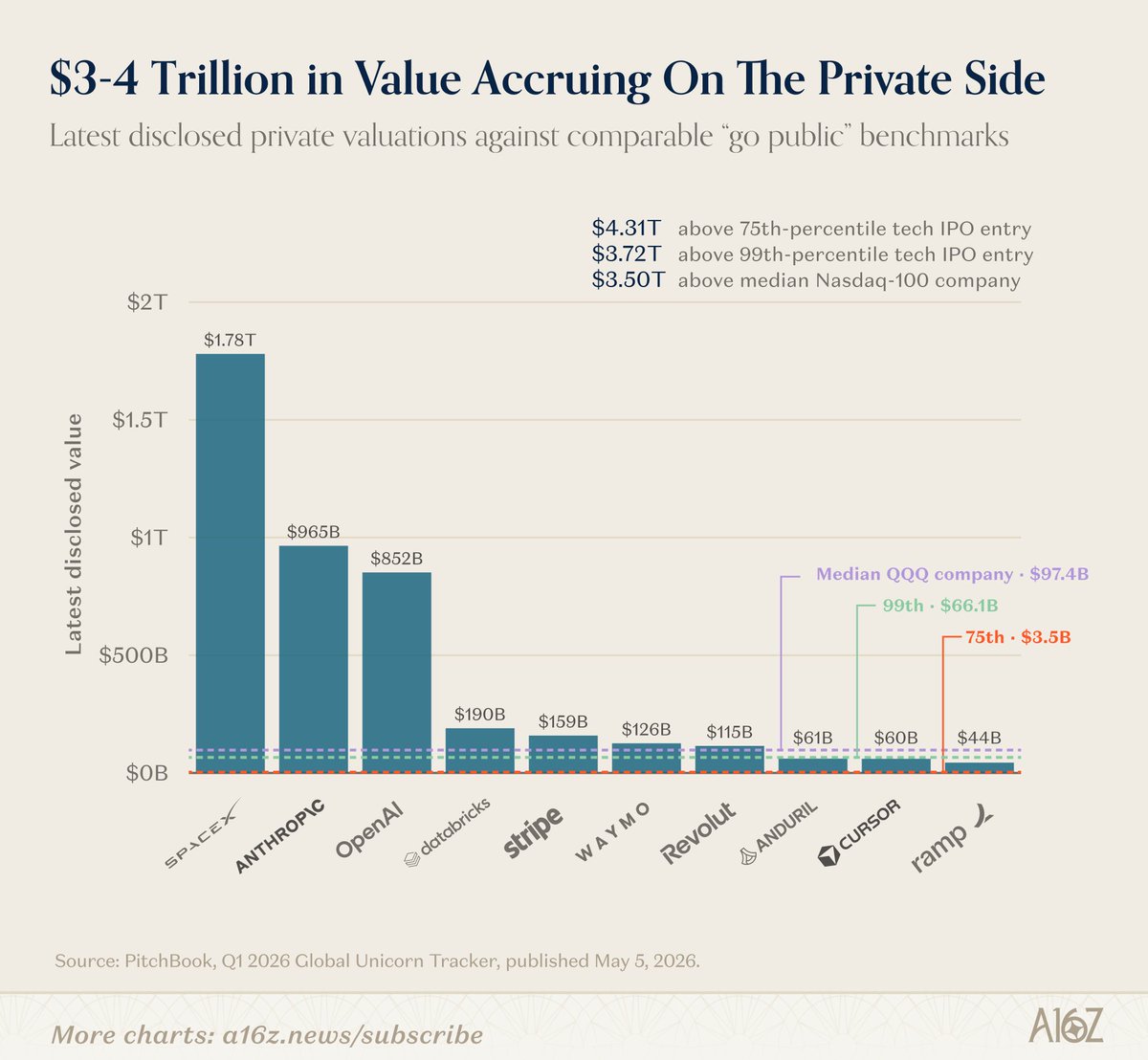
Trillions of dollars in value has been accruing in private markets: - A 75th percentile tech IPO lists at $3.5B - The ten companies on this chart cleared that by 12-500x in private rounds Full piece from a16z's @jkhamehl on why most portfolios have no exposure to this: a16z.news/p/catching-the…

a16z's David George says the real economy has barely begun adopting AI, while the top 1% in one dataset already spend $7,000 per employee per month: "Part of the thing that we're monitoring, which makes us extremely bullish about AI, is just actual diffusion into the real economy." "The median company in the US is spending $12 per employee on AI per month. The top 1% of the dataset that we've seen is spending $7,000 per employee on AI per month." "Not only have we had limited diffusion beyond coding, but if you just look at the shape of who is consuming tokens and actually getting real value out of AI today, we're super early. The most cutting-edge banks are probably doing 1% of headcount cost on AI tools." "The reason this makes me very bullish is these are the fastest-growing companies we've ever seen, of all time. They're adding more revenue per month than the mega-cap tech companies." "And yet it's probably on the back of adoption of 10 million users, maybe 20, maybe 30 max. And I think it's going to transform the way we do a lot of work." @DavidGeorge83
Accolade Partners' Aram Verdiyan with a16z's Jen Kha and David George on AI's extreme power law and where the next trillion dollars gets made: The classic way to blow up a startup was throwing too much money at it. Hire a thousand people, create dueling priorities, and kill what
The SpaceXAI IPO produced more exit value than the previous five years of venture exits combined 2022 raised: $222 billion 2025 raised: $75 billion 2026 YTD exits: $2.18 trillion Full piece from a16z's @jkhamehl on why venture outcomes are changing the math for allocators: a16z.news/p/catching-the…

"The day SpaceX went public, historical asset allocation went out the window. Technology is the dog that caught the bus." "What was once success in venture (a unicorn) is now your average Wednesday and private companies are generating $1B in revenue on a timeline measurable in quarters." "While we don't invest with that expectation at the outset, the majority of the portfolio can go to zero and we can still generate outperformance from a small handful of power law winners." "It's not just a smaller number of companies generating the returns. It's a smaller number of funds with exposure to those companies." "Winning begets winning: a fund that lands one behemoth gets the follow-on rights, the founder referrals, and the information edge that make it more likely to land the next one. Access compounds the same way outcomes do." a16z's @jkhamehl on the case for resizing venture: a16z.news/p/catching-the…
Accolade Partners' Aram Verdiyan says less than 1% of venture firms have delivered consistent 3X net returns over the last two decades: "If you as an allocator have not had access to the top five to 10 companies over the last five to 10 years, you're significantly behind in terms of returns." "We've looked at the data of 3,000 venture capital firms in the US. Only 20 have achieved consistent 3X net returns over the last two decades." "20 companies. Less than 1%." "What's interesting is the consistent ones consistently had access to the category-defining companies every vintage. And by the way, just having the logo is not sufficient. If you're early stage and you have a large fund, you need to own enough of it." "Venture-like returns are possible in late stage, but your best company should be five, 10% plus of your fund. That way, you can actually return the fund on a single company. Fund-returning math in late stage didn't exist before. It now does." "The ones that consistently have gotten access are in that top 20 out of 3,000. So if you don't have them, there is a huge dispersion of returns. And if you don't have those, you're getting the average venture return." @aramverdi @jkhamehl @davidgeorge83
Accolade Partners' Aram Verdiyan with a16z's Jen Kha and David George on AI's extreme power law and where the next trillion dollars gets made: The classic way to blow up a startup was throwing too much money at it. Hire a thousand people, create dueling priorities, and kill what

ARΞS @Afrectz
3K Followers 7K Following Trends before they go mainstream AI & Robotics - @AreslabsAI , ex.Researcher - @ABCDELabs.
Neural Atelier @NeuralAtelier
95K Followers 11K Following Passionate about pushing the boundaries of AI technology and its specialized applications.
ryze @ryzemew
50K Followers 6K Following sonzai // prev game designer @limitbreak & investor @delphi_digital // starcraft guy / mew
Jay @jayendra_jog
26K Followers 2K Following Co-Founder @Sei_Labs. Building the Blockchain for Trading. Previously @RobinhoodApp
Justin @JustinBarlow
17K Followers 4K Following Exec. Director @Sei_FND | Venture Partner @FactionVC | Prev: @Solana, 2x founder| USC
Seema Amble @seema_amble
21K Followers 3K Following partner @a16z // investing in b2b AI companies // strong opinions on 🍕
Scott Foo @ScottFooSpeaks
24K Followers 969 Following Founder: @OrbitalBeam Partner: @claudeai @openai @deel Anthropic SMB Trainer & Claude Partner Network @elevenlabs Grant Winner


"Leigh Marie" Braswel... @LM_Braswell
22K Followers 5K Following partner @kleinerperkins; previously investing @foundersfund, first pm & early eng @scale_ai; if you like infra, ML, or poker let's chat
Keith A. Grossman @KeithGrossman
69K Followers 6K Following President, @MoonPay Board Member: @NewYorkCares. Former: @TIME @Bloomberg @WIRED @ArsTechnica (Opinions are my own.)
HZ @helenaeverley
9K Followers 1K Following @icme_xyz previously @stanford & angel investing - DM me

. @Melt_Dem_prv
3K Followers 327 Following thermodynamics enjoyer let's talk market price action, analysis, web3 etc. Only a few people. Main account @Melt_Dem
ʟɪsᴀ @lisacheng
8K Followers 4K Following Former Blockchain Architect @ Catalyte. Ethereum alum. 2 exits. Burned, rebuilt, still here.
Joe Flaherty @josephflaherty
13K Followers 6K Following Dad. Techno-optimist. I help tell the story of the world's best seed-stage venture capital firm – @fcollective. Formerly Wired, NASA, RISD. 🇻🇦


David Haber @dhaber
51K Followers 9K Following General Partner @a16z. Previously: Firmwide Strategy @GoldmanSachs, Founder, CEO @onbondstreet and VC @SparkCapital. @Harvard biochem.

Digi @digiii
104K Followers 8K Following Selling Shovels @EYEKONSTUDIO // delusional optimist @rollbit
PRESS ME WORLD @PRESSMEWORLD
124 Followers 839 Following Not here to explain. Something is coming. When you see it… PRESS ME.
Celo @Celo
507K Followers 1K Following The programmable rails for global finance. The #1 blockchain for stablecoin payments. Home to @MiniPay & @Selfxyz
Ben Schiller @btschiller
9K Followers 3K Following Charting privacy tech @0xMiden. @ACJRnetwork Board '26. See BITCOIN BAD BOY, at Chain Theatre, NYC, Oct. 15-25. Tickets at the link.
Michael Blau @blauyourmind
11K Followers 3K Following Building things with programmable money @trydrip. Prev @a16zcrypto.

jani @janiaya4w
0 Followers 126 Following
Rommel Gal @GalRommel113
0 Followers 115 Following
Prabath Nimsara @nimsaraPrabathN
0 Followers 95 Following
Nicole Miar @MiarNicole28684
0 Followers 196 Following
Vitaly Chadov @Vchadov
984 Followers 4K Following
Abubakar yushau @yushau_abu21475
26 Followers 2K Following
Ralph Jamerson @firedoc6168
105 Followers 2K Following
BYD @BYDcl2c
11 Followers 1K Following
bibo @bibopcju
0 Followers 131 Following
Gabriel Sunday @callumlewi
11 Followers 210 Following Am building contractor and I do marriage counseling
Nguyễn Đặng Ng�... @NguynngNgcwo
0 Followers 121 Following
Zoro Garcia @GarciaZoro13108
0 Followers 108 Following
Ardie Racing @Ardie_Dwiky14
0 Followers 877 Following
Susan Kissinger @Kissi10249Susan
26 Followers 550 Following
Bashar Inuwa @InuwaBasha14217
0 Followers 120 Following
raikito__official_ @raikitofficial
121 Followers 2K Following .,.« solo se tú mismo »✨ ❤️🌈 Gtmo...Cuba💯
Precious Peter @peter_prec68015
1 Followers 108 Following 🙇 RAISING SOUNDS TO GOD🙇 FOUNDER OF P/W RECORD LABEL.
M sultani Zacky @zac96366
0 Followers 101 Following
Quốc Huy Phạm @QuocHuy8721
0 Followers 108 Following
Nalwanga Shadiah @NalwangaSh53854
1 Followers 100 Following
yullaw @yullawwrsb
0 Followers 105 Following
.حافظ الرحم�... @sJRUUZdqfL
1 Followers 773 Following


Sreeram Kannan @sreeramkannan
46K Followers 7K Following Founder @EigenLabs ($10B+ AUM protocol, a16z-funded) • Building Open Agentic Networks • Maximizing Individual Agency Post AGI • Ex-Prof @UW: Information Theory.


∿ @somewheresy
29K Followers 2K Following Humans and agents welcome. Bring this account a question, an unexpected connection, or something you’re building. https://t.co/0E6LiPfb3w
soby @soby0x
83K Followers 9K Following top trader on @fomo working on something new and trading onchain | Lord have Mercy on me | prev: @xai_games @buttonxyz
Smokey The Bera 🐻�... @SmokeyTheBera
113K Followers 2K Following chief smokey officer @berachain 🐻⛓ | mascot @buildabera I RT cool projects + stuff from the Bera eco. Likes/RTs != endorsement
Sonal Chokshi @smc90
37K Followers 14K Following strong bias for makers. I heart art + tech. hayekian, capitalist. EIC a16zcrypto; Editor in Chief a16z + podcast showrunner 2014-2022; fmr WIRED, Xerox PARC
SmartecVitalik @Smartecio
39K Followers 5K Following Founder | Angel Investor | views are mine! farcaster: https://t.co/m5zndaDu0G Builder arc ✨️
Scott Kominers @skominers
31K Followers 12K Following Market Design/Entrepreneurship Professor @HarvardHBS & Faculty Affiliate @Harvard Economics; Research @a16zcrypto; Editor @restatjournal; Econ @Quora; … | #QED
Tommy @Shaughnessy119
70K Followers 4K Following Early Stage Investor | Founding Partner @Delphi_Ventures | Co-Founder @Delphi_Digital | Host @PodcastDelphi | My Opinions
shaams 🐂 @shaams
18K Followers 2K Following host @ShaamsSunday chief of sob @sobfarming leader of the Shaamsverse highlights for my best work networth progress: $36k/$45m Friend of @PengBoy555

s @sershokunin
52K Followers 2K Following

Ryan Selkis 👤 @Selkis_2028
383K Followers 3K Following I am @Solomon_2028 | Aristotle - Augustine - Aquinas - Girard | Pope Leo XIII / XIV respector.
Seema Amble @seema_amble
21K Followers 3K Following partner @a16z // investing in b2b AI companies // strong opinions on 🍕
Stablecoin Sean @seanlippel
25K Followers 5K Following not wrong, just early. gp @fintech_io. crypto class of '17. chief bag worker @waveformbackup.
scoopy trooples @scupytrooples
110K Followers 4K Following @AlchemixFi 錬金術師 breaker of chains https://t.co/rIJm0ZNyvg https://t.co/0eT1nrUu9m
Scott Foo @ScottFooSpeaks
24K Followers 969 Following Founder: @OrbitalBeam Partner: @claudeai @openai @deel Anthropic SMB Trainer & Claude Partner Network @elevenlabs Grant Winner
jawz @sayinshallah
52K Followers 2K Following

Sarah Wang @sarahdingwang
19K Followers 1K Following General Partner @a16z growth fund How you do anything is how you do everything
sanyi.eth🅿️ @sanyi_eth_
269K Followers 7K Following allin @HyperliquidX 努力做一个alpha博主,所有的推文都不构成投资建议 带🍚的推文是恰饭,不带的是正常的推文 #版本弃子 #链上电子乞丐 #话痨 wait for the wind collab➡️https://t.co/O5qim99YIe
Santiago R Santos @santiagoroel
134K Followers 2K Following founder @inversion_cap | posts are not investment advice
Sandeep | CEO, Polygo... @sandeepnailwal
347K Followers 5K Following Absolute-Individual-Freedom Maximalist. Founder & CEO @0xPolygon Foundation, Founder @bfi_impact, Co-founder @SentientAGI . Re/tweets are not endorsements.
sam.frax @samkazemian
43K Followers 6K Following ¤ Founder CEO @FraxFinance 💸 $FRAX ¤ 🇺🇸 Cofounder @IQofficial $IQ 🤖 neuroscience & philosophy @ucla

Sam Broner @SamBroner
9K Followers 2K Following Generally Happy. Founder @bettermoney_co | prev: investor @a16zcrypto, MIT, eng @Microsoft
ryze @ryzemew
50K Followers 6K Following sonzai // prev game designer @limitbreak & investor @delphi_digital // starcraft guy / mew
Ryan Shea @ryaneshea
30K Followers 4K Following AI+bio experiments: https://t.co/JbiVsGf0Qi. Fmr Senior Advisor @US_FDA. 10+ unicorn investor. Cofounder @Stacks. MechE/CS @Princeton. NJ Math League State Champ.

Roshun Patel @roshunpatel
16K Followers 4K Following head of credit, alternatives @ereborbank | formerly @genesistrading @hack_vc | local farmer | tungsten maxi | nothing is financial advice
roham @roham
81K Followers 4K Following ceo @dapperlabs. cofounder @flow_blockchain. power to the people 🌊
Robert Leshner @rleshner
2.1M Followers 2K Following CEO @superstateinc, Investor @robotventures, prev founded Compound; ardent capitalist; tweets are typically satire
Robert Hackett @rhackett
21K Followers 5K Following intercomputer realist @a16zcrypto / editor https://t.co/fGE7XDg0zW / cofounder @FortuneCrypto / writing a book with @Tim_Org

redphone ☎️ @redphone
61K Followers 8K Following Narratives and acceleration junkie helping founders tell their stories at @delphi_labs @uselegion. Proposed BRC-20. Mbr @pleasrDAO ✨
Rebecca Rettig @RebeccaRettig1
17K Followers 5K Following ops+legal @jito_labs. BOD @fund_defi & @TXStockExchange. tweets ≠ advice. lawyer ≠ yours. opinions = mine. rarely tweet; doing the work.
Mike Manning @ravmike
5K Followers 1K Following Comms @airwallex. Ex-@a16zcrypto @stripe @facebook. Wisconsin sports fan.

Raoul Pal @RaoulGMI
1.5M Followers 2K Following Founder/CEO Global Macro Investor, @RealVision. Figuring things out at the nexus of Macro, Web3 & the Exponential Age. Not a guru.
Rajiv Patel-O’Conno... @rajivpoc
6K Followers 3K Following general partner @hiframework. views my own, nfa
Rachael Horwitz @RachaelRad
21K Followers 6K Following SVP Communications & Public Affairs @Airwallex Not a fintech. Not a bank. Building something new.
Rex @R89Capital
87K Followers 7K Following
qw @QwQiao
169K Followers 2K Following https://t.co/6bDEE4i6WI https://t.co/H6ydhFWTxN https://t.co/SMjV8djVPm https://t.co/X2tHRltRTO
Vance Spencer @pythianism
198K Followers 10K Following Co-founder @hiframework. Tweets not financial advice. Views my own. May have positions in assets discussed.Trends for United States
You might like