

Dark Compute @Dark_Compute
Dark pool for GPU compute. Sealed orders, one clearing price, private inference on your own GPU. darkcompute.cfd Joined September 2026-
Tweets174
-
Followers222
-
Following1
-
Likes16
Posting a sealed order on Dark Compute costs $1.00. Back the moment you reveal. Gone if you never do. Sealed orders are free to invent. The bond is what keeps a book from filling with hashes that were never meant to open.

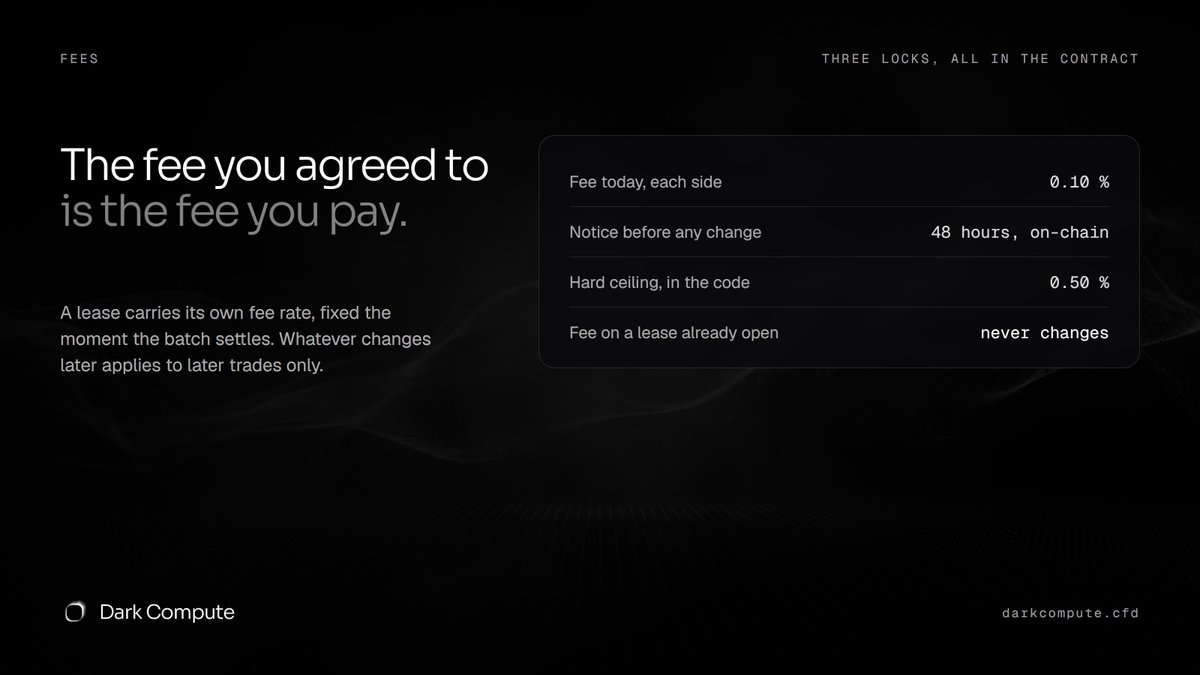
The fee you agreed to is the fee you pay. 0.10 % a side today. Any change needs 48 hours of notice on-chain. The code caps it at 0.50 %. And a lease carries its own rate, fixed when the batch settles: nothing decided later can touch a lease already open.
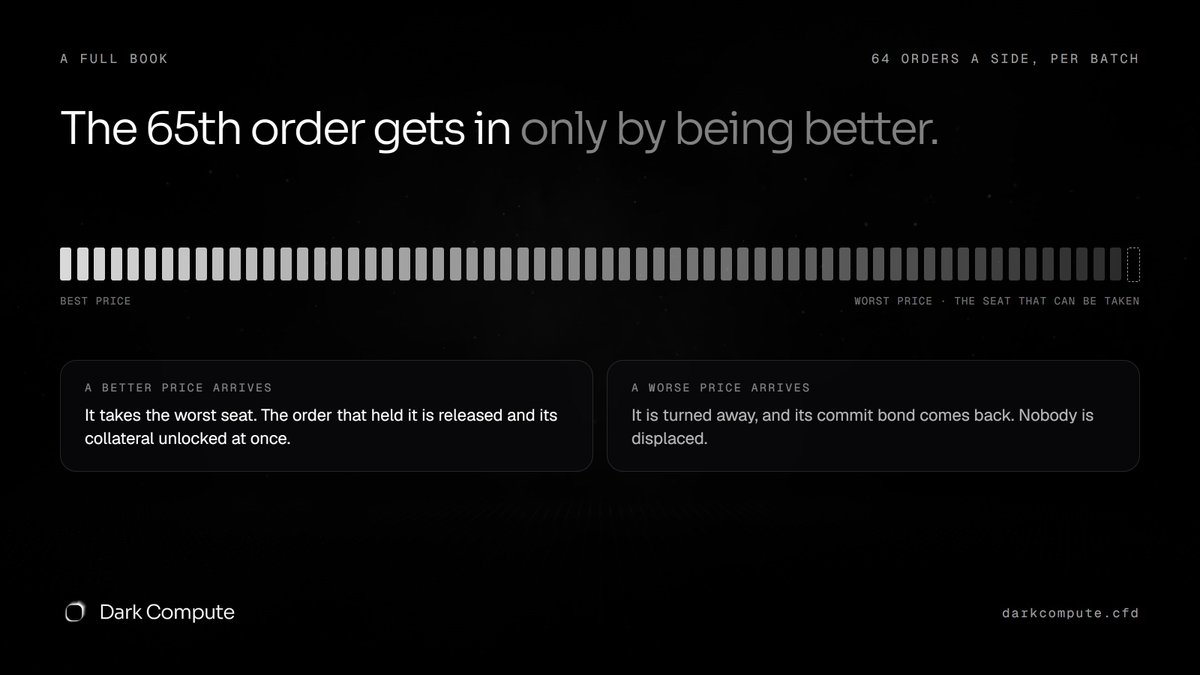
Each book holds 64 orders a side per batch. The 65th gets in only by being better. A better price takes the worst seat, and the order that held it gets its collateral back at once. A worse price is turned away with its bond returned. Nobody can fill a book with junk to keep real orders out.
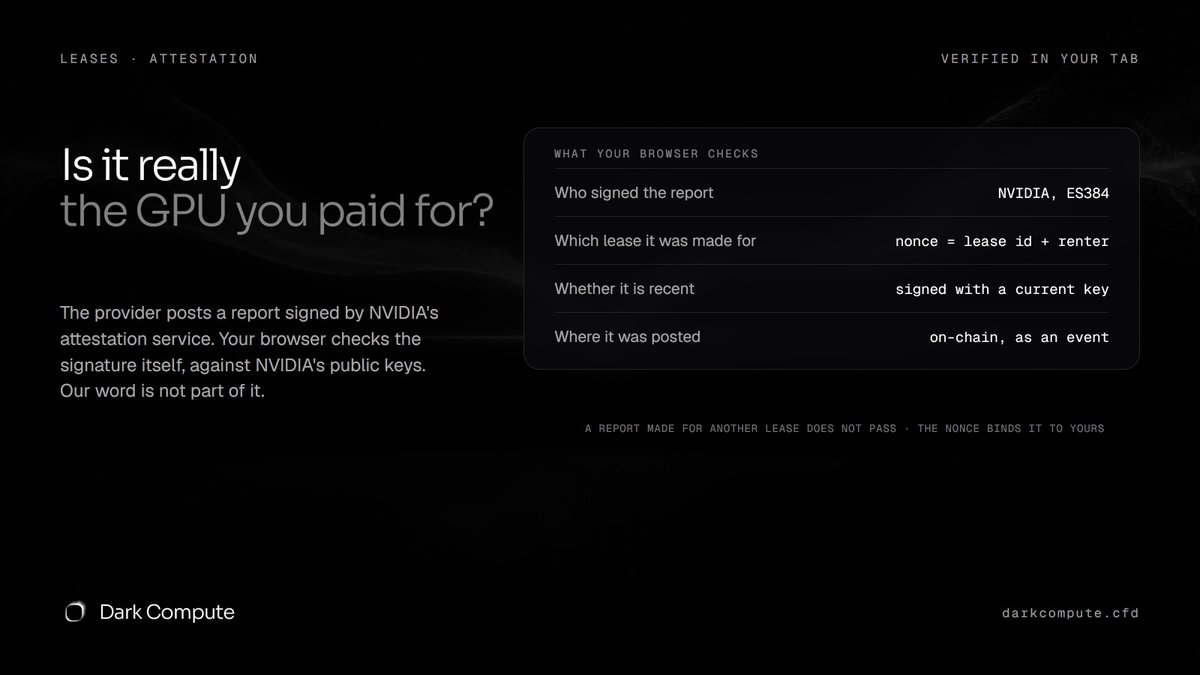
Is it really the GPU you paid for? The provider posts a report signed by NVIDIA’s attestation service. Your browser checks the signature itself, against NVIDIA’s public keys, and checks the report was made for your lease. A report made for another lease does not pass. Our word is not part of it.
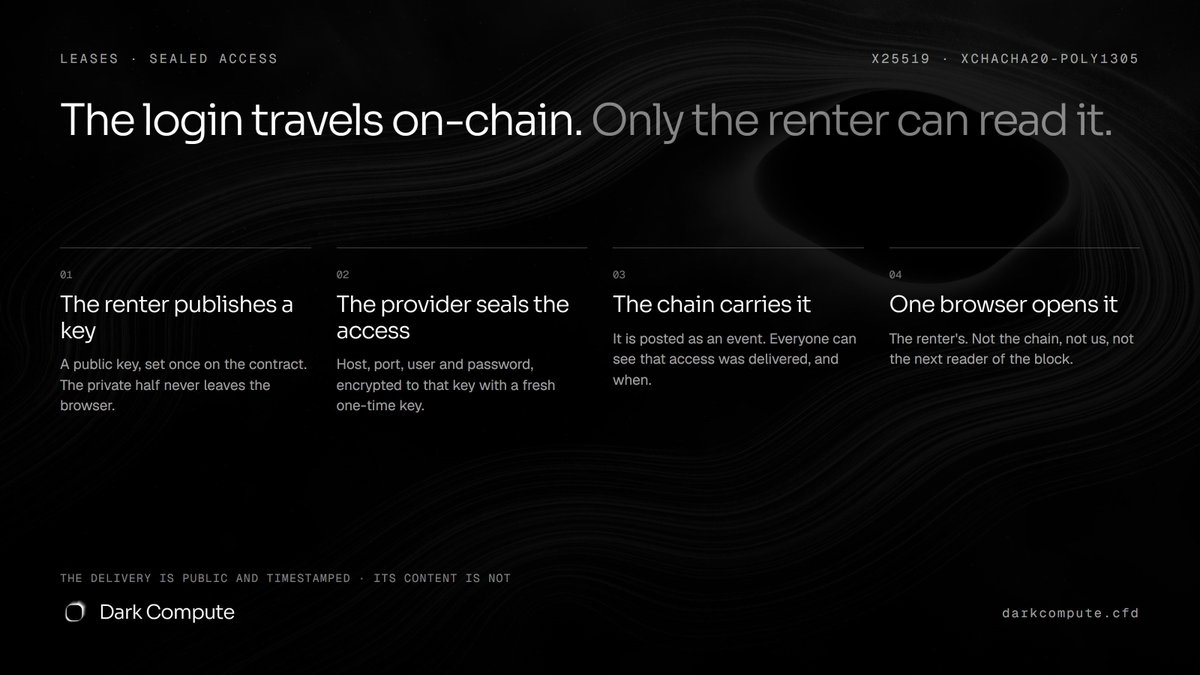
When a lease opens, the provider has to hand over a login. On Dark Compute it travels on-chain, and only the renter can read it. The renter publishes a key. The provider encrypts host, user and password to it. The chain carries the result as an event. The delivery is public and timestamped. Its content is not.
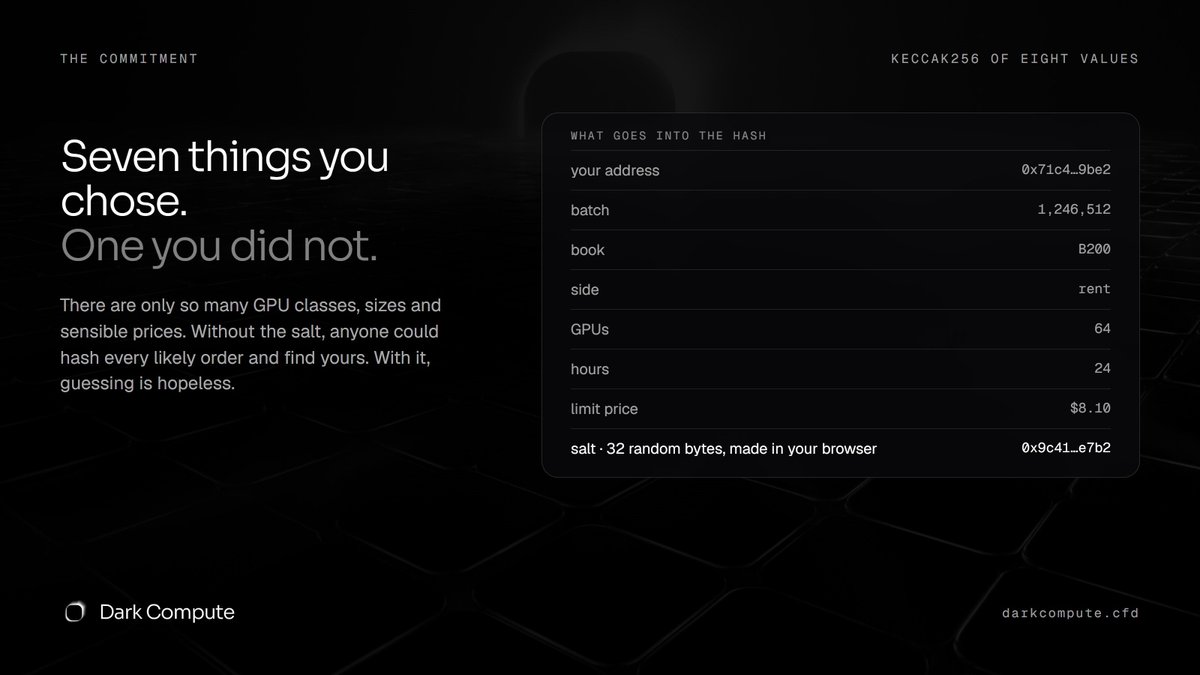
A sealed order is a hash of eight values. Seven describe the order. The eighth is a salt: 32 random bytes made in your browser. Why it matters: there are only so many GPU classes, sizes and sensible prices. Without the salt, anyone could hash every likely order and find yours. With it, guessing is hopeless.
How a dark pool for GPUs works, in 46 seconds. On an open market, your order talks: everyone sees what you need, and the price moves before you are filled. So you seal it. The chain gets a hash. Sixteen blocks to hide, five to show, one price for the whole batch. Then pay streams while the machine runs. No sound needed. darkcompute.cfd
Five days since the pool went live. Six new pages. Oct 7: the Tape Oct 8: lease receipts Oct 9: the curve, for holders Oct 10: status, and proof of funds in preview Oct 11: books All open right now: darkcompute.cfd

The smallest real trade on Dark Compute is one GPU for one hour. RTX 3090 at today’s median: $0.168. Fee under a tenth of a cent. The 1 USDG commit bond comes back when you reveal. $1.00 in the vault is enough to try the whole path on mainnet.

One zero too many: you meant $7.90 per GPU·h and sealed $790.00. A sealed order cannot be edited. So every book refuses a limit above $500 at the reveal, and the 1 USDG bond comes back. The guard sits where the mistake would land.

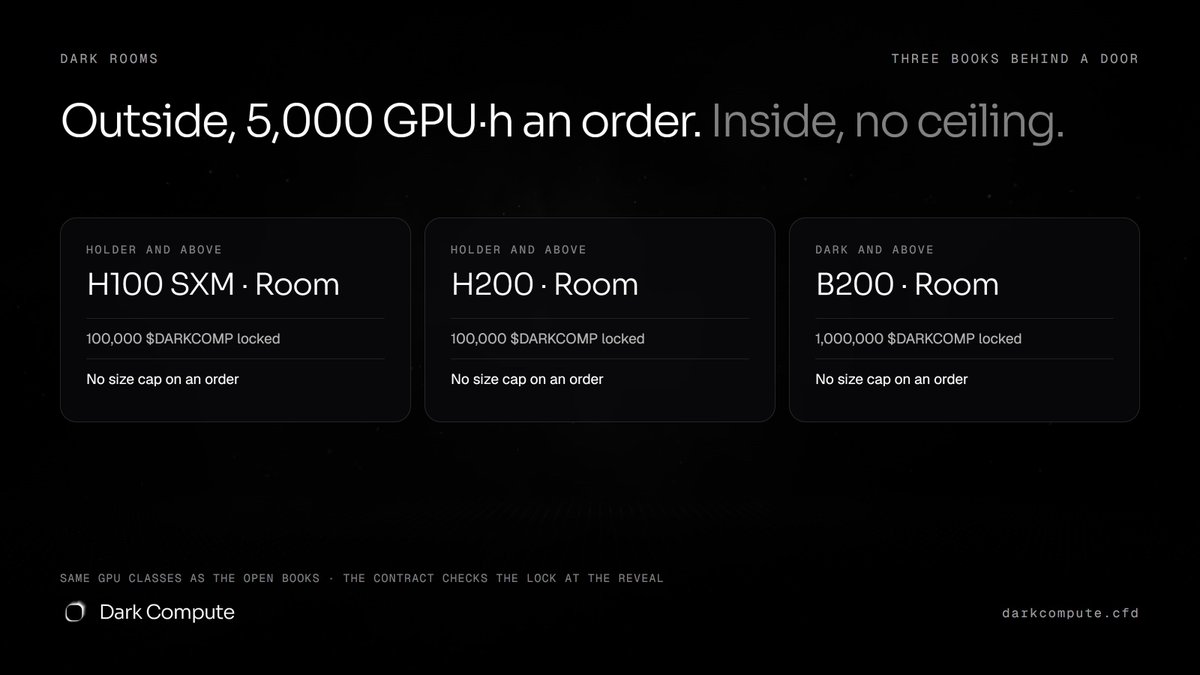
Outside, one order tops out at 5,000 GPU·h. Inside a Dark Room, there is no ceiling. H100 SXM and H200 rooms: 100,000 $DARKCOMP locked. B200 room: 1,000,000 locked. Same GPU classes as the open books. The contract checks the lock at the reveal.
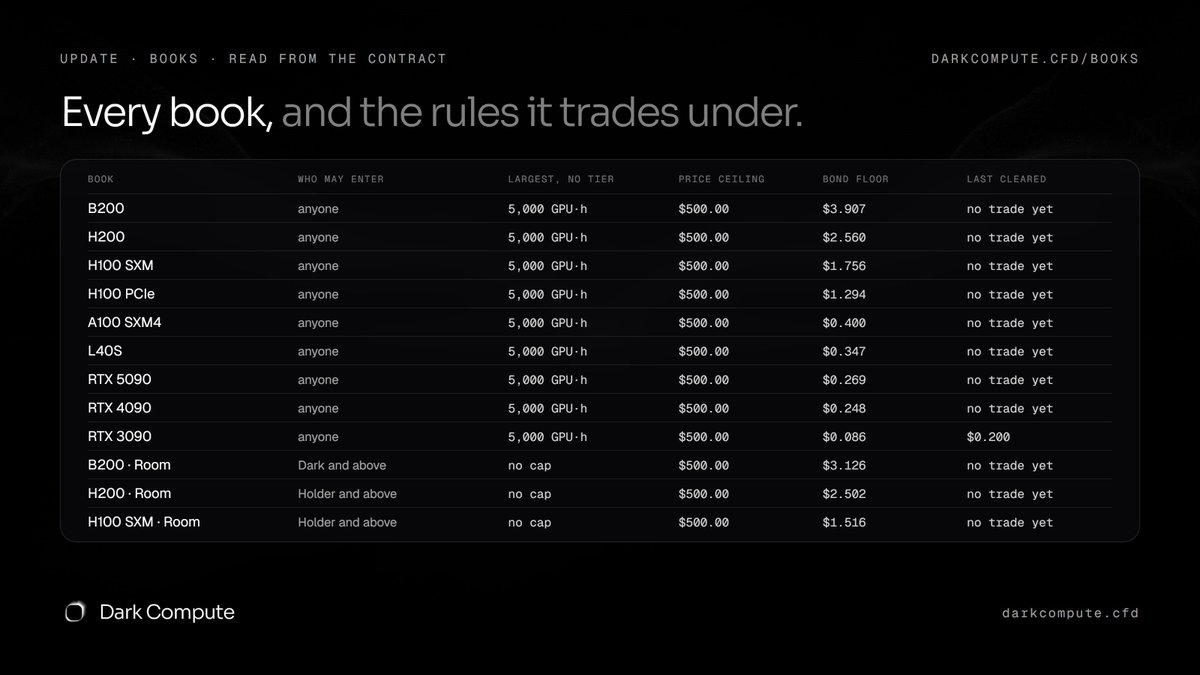
What does it cost a provider to walk away on Dark Compute? The least they must lock to offer 100 GPU·h, even with an ask of one cent: B200: $78.14 H200: $51.20 H100 SXM: $35.12 RTX 4090: $4.96 Fail to deliver and it goes to the renter. Floors read from the contract: darkcompute.cfd/books

Update: the books page. 12 books, and the rules each one trades under: who may enter, the largest order, the price ceiling, the bond floor, the last clearing price. All of it is read from the contract, not from our settings. If the two ever disagreed, this page would show the contract. darkcompute.cfd/books
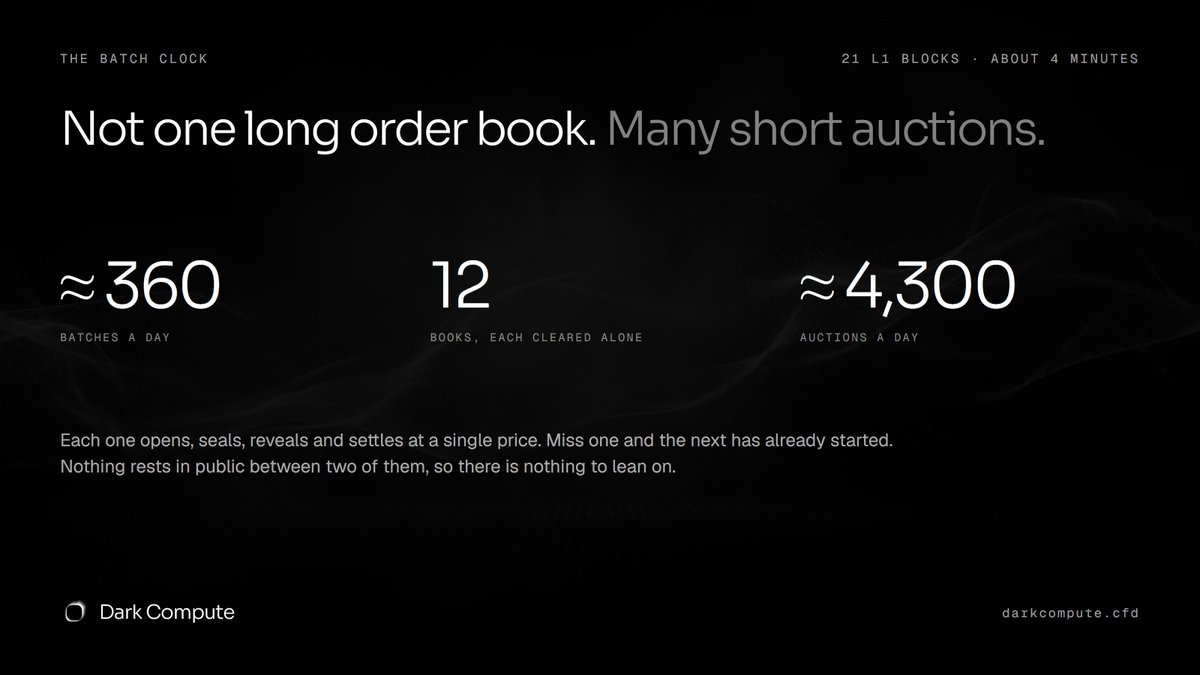
Dark Compute is not one long order book. It is many short auctions. About 360 batches a day. 12 books, each cleared alone. Roughly 4,300 auctions a day. Each one opens, seals, reveals and settles at a single price. Nothing rests in public between two of them, so there is nothing to lean on.
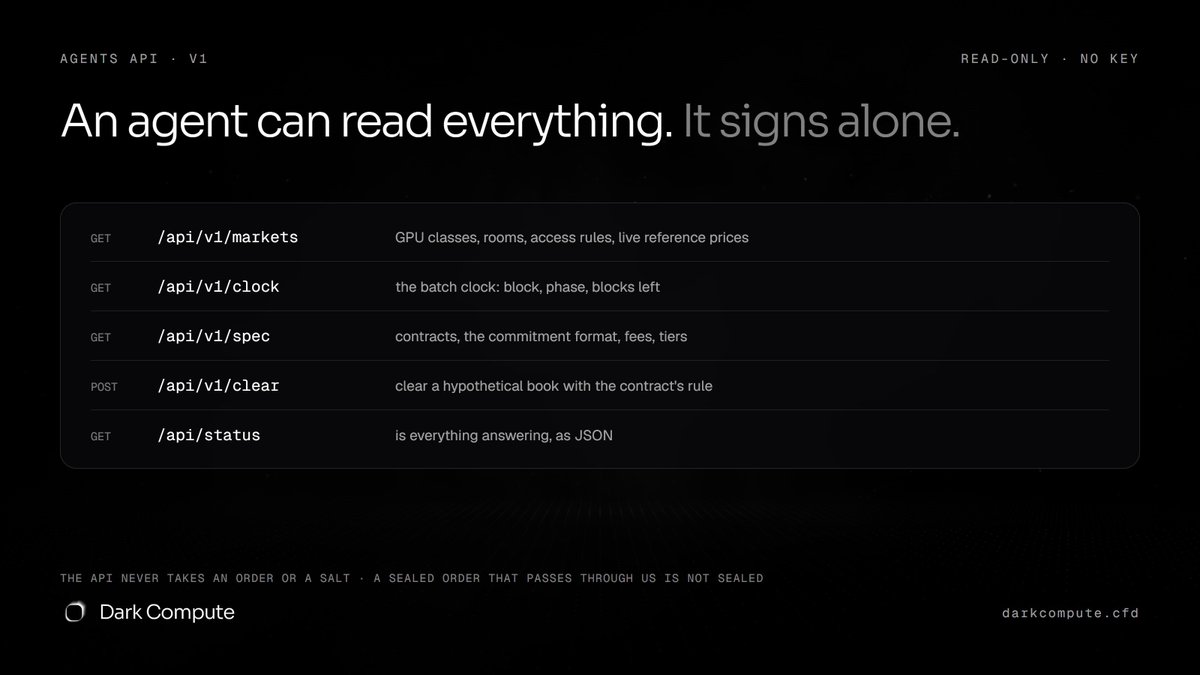
An agent can read everything on Dark Compute. It signs alone. /api/v1/markets: classes, rooms, reference prices /api/v1/clock: the batch clock /api/v1/spec: contracts, commitment format, fees /api/v1/clear: clear a hypothetical book /api/status: is everything answering No key. And the API never takes an order or a salt: a sealed order that passes through us is not sealed.
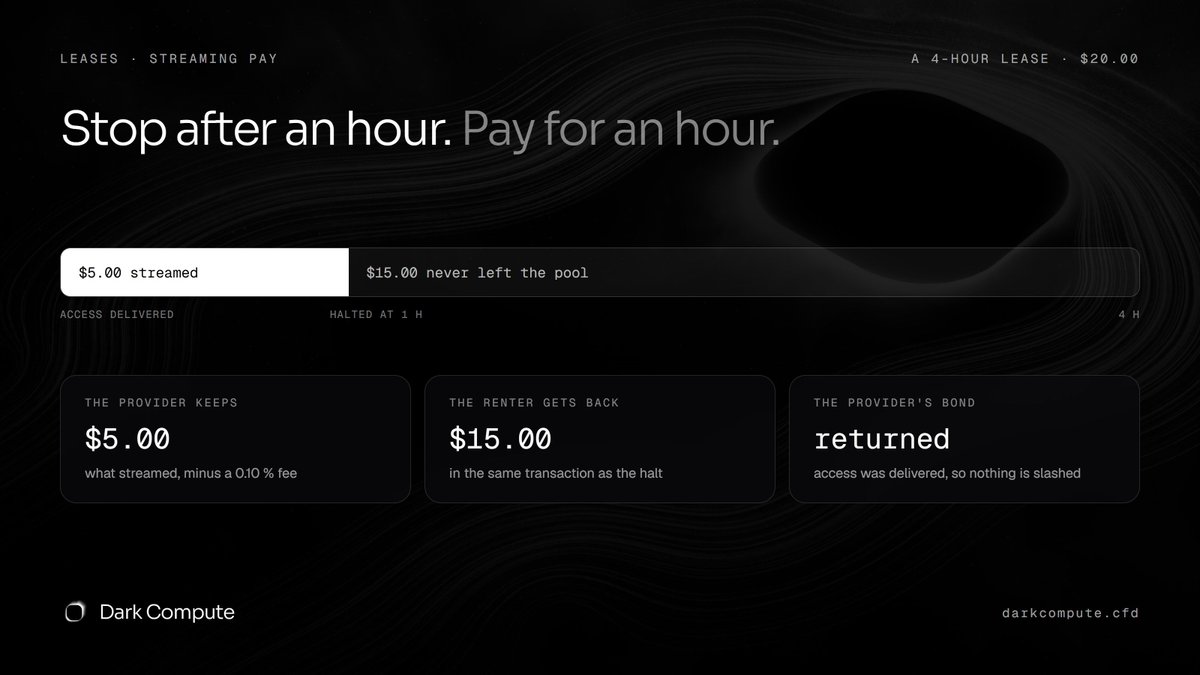
A 4-hour lease for $20. You stop it after one hour. The provider keeps $5.00, what streamed, minus a 0.10 % fee. You get $15.00 back in the same transaction as the halt. The provider’s bond is returned: access was delivered, so nothing is slashed. Stop after an hour, pay for an hour.
How much can one order ask for on Dark Compute? Open: 5,000 GPU·h Holder (100,000 locked): 20,000 Dark (1,000,000 locked): 80,000 Prime (10,000,000 locked): no cap Four times larger at each tier, checked by the contract at the reveal.

Three bids at the same price, and the batch cannot fill them all. Who goes first? The contract ranks by price, then by holder tier, then by who revealed first. So a Prime bid revealed last is filled before an untiered bid revealed first. A better price always beats a better tier. And a tier comes from $DARKCOMP locked for 7 days, so it cannot be borrowed for one block.

The median is where everyone else bids. RTX 4090 right now, 58 live offers: median $0.496, 25 % point $0.415. That is 16.3 % lower, or $40.30 on 500 GPU·h if it clears there. A lower bid fills less often. The curve shows holders the odds, it does not change them. darkcompute.cfd/desk


Olivia Crypto @OliviaCryptoX
35K Followers 11K Following Top Crypto Influencer & Promoter 🚀Uncovering 10x-1000x Gems | Marketer Alpha | Investor in #BTC #SOL #ETH #BNB #Memecoins • NFA_DYOR • DM for Promotion 📩


Laiht Odeh @LaithOdeh_
68 Followers 61 Following #Crypto is the future | Real Estate | #Tech | CEO of Naqeeb Real Estate | Business & Partnerships | UAE 🇦🇪 Jordan 🇯🇴
Veveto @Veveto4
18 Followers 43 Following Following decentralized technology project with deep interest on BC architecture

say no @Dzay_92
34 Followers 359 Following


Phạm Đông @Phmngucad
35 Followers 451 Following
kislot @kislot0723
200 Followers 4K Following

ahhellnahhhh @clth24
0 Followers 200 Following
mrzsajo @mrjzsadam
466 Followers 1K Following trying to spot attention early than topblast them 🎰spirit of gambling🎰
CoinAlertVN @DAOHA100xGEMS
113 Followers 260 Following Crypto alerts • Market insights Cảnh báo – phân tích – cập nhật 24/7 Hỗ trợ người mới | Link trong profile
沉淀。 @dyu123123
45 Followers 136 Following
TURCOSHI @TURCOSHI
95 Followers 153 Following
waldo @abdimalik604
53 Followers 232 Following
CryptoKing @CryptoKing47290
30 Followers 209 Following

Crypto Manul @ManulOfCrypto
239 Followers 904 Following A Pallas's cat just hanging out in a marmot burrow on the steppes. Got into blockchains after befriending some passing Silk Road traders
CM X @CM_X_CM
12K Followers 3K Following Everything AI, mostly stocks, sometimes crypto. CMX 3.0. Particular interest in AI Data Centers and every bottleneck that is attached to that, shovels and picks
Colts203352 @colts203352
22 Followers 138 Following
Fappiano Giuseppe @Gui_Fap11
12 Followers 80 Following
Joel @joelventura00
25 Followers 123 Following

adi purba | ETHGas �... @kochiro_ichi
19 Followers 772 Following
陈安平 @ml3ozw
8 Followers 24 Following
fatih ince @fince81
75 Followers 559 Following
重仓🔶 钻石手�... @jixiang6789
449 Followers 6K Following
Judge @judgeyourtoken
640 Followers 4 Following вrιɴɢιɴɢ the 1st ever pαrαlleled oɴcнαιɴ αɴαlyze тo тнe ethereum chain.🕵️♂️ (@judgeyourtoken).
Beoo.x🐼 @LongNht72601176
851 Followers 6K Following Cryptocurrency market research | Trading | Trend | Hot News #BTC Make money together
Perpetus @SamsonSisak
40 Followers 262 Following
Nikola Tesla @breadyang0
518 Followers 934 Following
L @LJHAAL
8 Followers 122 Following
📖BoomerWojak📖 @RuggedWojak
20K Followers 2K Following Web3 Strategist | IT-Specialist | | Market Researcher | On a mission to financial & creative freedom Co-founder: @UpOnlyBulls



Nick OnChain 🍀 @nick_onchain
419 Followers 455 Following Crypto WEB3 Guy 🔬 | 📜 All Post Not Financial Advice | degen, investor, trader @EVEDEX content creator, God first ❤️
Rankin ⛓️🏛️ @mycryptoalias
715 Followers 4K Following Maker, shaker, occasional breaker. Dot connector.

Bliss @ismxrta
67 Followers 420 Following Be your own person "No need to fix what God already put his paintbrush on"
džon @bitdzon
345 Followers 2K Following
josh @SSjoshSS
0 Followers 1 Following
Rekt iT Ralphie @rekt_it_ralph
60 Followers 1K Following Not financial advice. Feeling charitable? LOL 0x30bB11aC917e5684D89fC82E2DAdFD8eACA23535

Monero (XMR) @monero
531K Followers 22 Following Monero (XMR) - The secure, private, untraceable cryptocurrency that keeps your money confidential. Grassroots. Open source. https://t.co/zdbdQFbWZWYou might like


















