

Executive Brief @EBrief101
Joined July 2025-
Tweets210
-
Followers10
-
Following347
-
Likes6
If this happned, every policy every speech rises suspicion on motive


The GRU hacked into Jared Kushner's iPhone. Dutch military intelligence (MIVD) then recruited a GRU spy who gave them access to the hacked phone. What MIVD discovered was that Kushner had access to two bank accounts --one Azerbaijani, the other Israeli --where Saudi Crown Prince
Busy day in the Middle East & eastern Med: • UK deploying RAF Typhoons for defensive air cover over Saudi cities & infrastructure against Houthi attacks • Macron touring Gulf states (Kuwait stop) to boost defence & energy ties • Libya’s eastern parliament ratifies the 2019 Türkiye maritime MoU, creating overlapping EEZs that cut off Cyprus and disrupt Israel-Greece links • Qatar advancing defence cooperation involving Türkiye, Pakistan & Indonesia • Dubious rumours of Russian air support offers to Iran + talk of a third US carrier arriving next month • US Amb. Tom Barrack in Doha: America no longer wants to “own” the oil-for-protection Grand Bargain or act as the 80-year regional guarantor. Shift is to “tend” the region (like raising teenagers) — not abandon it, but stop trying to control outcomes And it’s only Tuesday.

Germany’s decision to walk away from a rapid MQ-28 purchase in favor of a 2027 competition reveals the familiar trap of treating combat capability as a consumer product that must be perfect on day one. By concluding that no existing system fully meets every operational requirement, Berlin is effectively choosing years of additional vulnerability over accepting a mature, if imperfect, loyal-wingman drone that could already fly with its Eurofighters by the end of the decade. In an environment where Russian forces continue to iterate cheap massed drones and long-range strike systems at wartime pace, the cost of waiting for a cleaner European solution is measured in the gap between declared requirements and actual available airpower. This approach confuses thoroughness with strategy. Every major defense program eventually faces incomplete requirements, integration friction, and software shortfalls; the countries that close capability gaps fastest treat those issues as problems to be solved in the field rather than reasons to restart the clock. By elevating the search for an ideal platform above the need for an immediate one, the Bundeswehr risks entering the early 2030s with paper options while adversaries operate real systems. Procurement that prioritizes future perfection over present readiness does not produce better equipment—it produces empty skies.

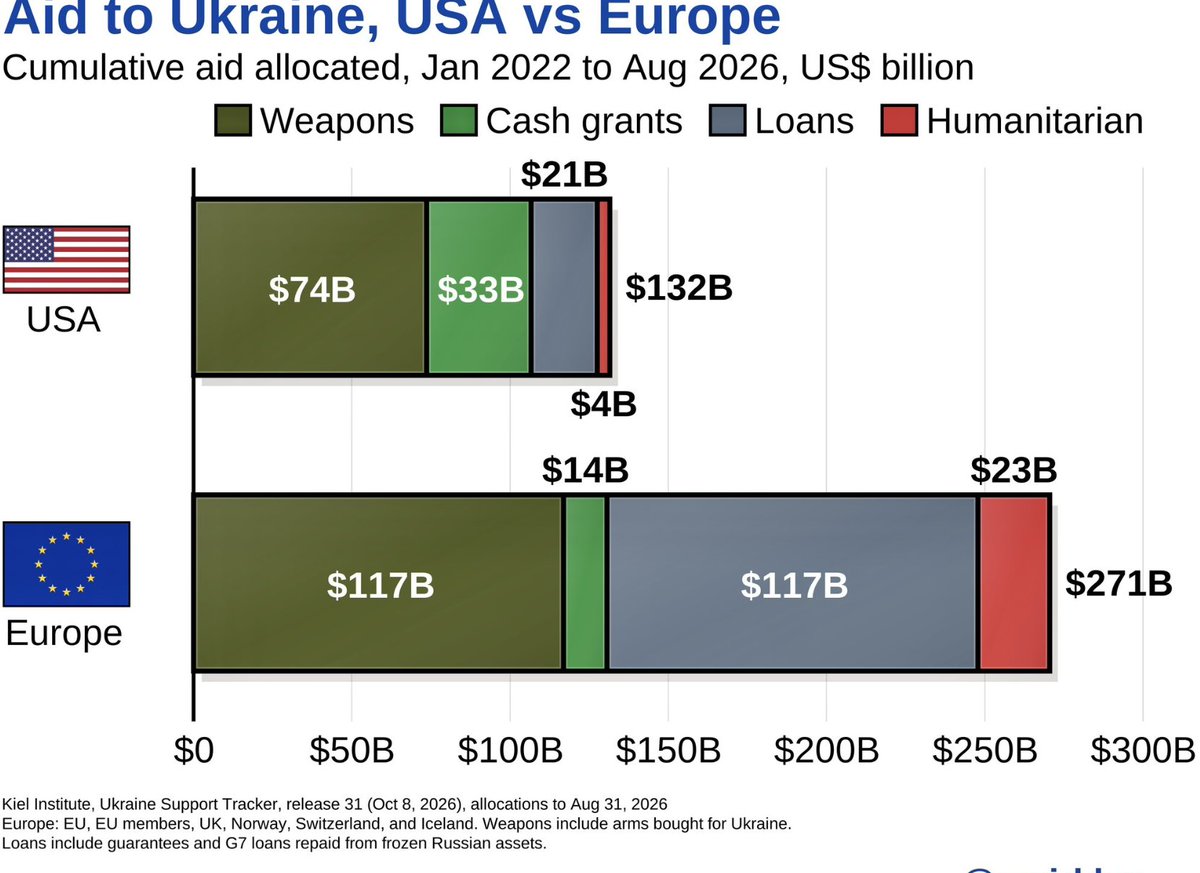
President Donald Trump’s repeated claim that the United States has spent or given $350 billion to help Ukraine is inaccurate and significantly overstates the actual figures. According to the Kiel Institute’s Ukraine Support Tracker, which tracks government aid allocations through August 2026, the United States has provided approximately $132 billion in total support—comprising roughly $74 billion in weapons and military equipment, $33 billion in cash grants, $21 billion in loans (many repaid via frozen Russian assets), and $4 billion in humanitarian aid—while official U.S. government tallies from the Special Inspector General for Operation Atlantic Resolve place broader congressional appropriations related to the Ukraine response (including some support for NATO partners and domestic stockpile replenishment) in the range of about $174–196 billion, still far below $350 billion. Multiple independent fact-checks have similarly found no evidence supporting the higher figure, noting that much of the U.S. military aid consists of older equipment drawn from existing stockpiles rather than pure cash transfers, with replacement production benefiting American industry.

SpaceX imposed speed limits on Starlink Starshield terminals in Ukraine overnight, with connectivity dropping at 60-70 km/h per Ukrainian reports. This disrupts medium-range strike drones (e.g. FP-2, Darts) and interceptors vs. Shaheds, leading to mission cancellations with no prior warning. landscapeblock

Europe’s defence ambitions have encountered a familiar obstacle: governments agree to cooperate, but their industries struggle to agree on who controls the result. However, the latest tank controversy needs a correction. France’s military chief said Germany had left the Main Ground Combat System, or MGCS; Berlin denied it, and France’s defence ministry subsequently said cooperation continued. The joint FCAS fighter project was abandoned in June, but MGCS is better described as a disputed and reshaped programme than a confirmed second cancellation. FCAS broke down over authority, technology ownership and the distribution of work. Dassault wanted the control it considered necessary to design the aircraft and protect its expertise. Airbus wanted a partnership that preserved meaningful engineering responsibility for Germany and Spain. Neither position was simply about securing factory jobs: whoever controls the design also controls future upgrades, technical knowledge and much of the commercial opportunity. Years of political intervention failed to settle those competing interests. Differing military requirements added complexity to an already difficult industrial arrangement. MGCS faced a similar challenge in translating political equality into practical engineering leadership. Its agreed structure divided work and investment equally between France and Germany, with eight technology pillars and four industrial participants: KNDS France, KNDS Germany, Rheinmetall and Thales. That arrangement protected national interests, the commond assessment is that shared responsibility can slow decisions unless one organisation has clear authority over the overall design. Funding commitments must also survive separate national approval processes; the published framework required German parliamentary approval before the next contract could proceed. These are structural difficulties, although they do not establish that funding disputes alone caused the current crisis. Changing technology is contributing to the rethink. Germany’s government explained in June that MGCS would increasingly develop technologies usable across different crewed and uncrewed armoured vehicles, with open interfaces, rather than depend on one common platform. Ukraine’s war has strengthened the case for connectivity, automation and protection against drones. But technological change does not explain FCAS’s industrial breakdown: both programmes already envisaged networks and unmanned systems. General assesment is that the deeper problem is managing change within a partnership whose members disagree over control. The countries have alternatives, but none offers an immediate replacement. KNDS has presented Leopard 2 A-RC 3.0 and Leclerc Evolution as intermediate solutions towards future ground systems; these remain development concepts rather than proof of new national procurement decisions. In aviation, Germany is considering its options, and Britain has opened the door to discussions about joining the UK–Italy–Japan GCAP (The Global Combat Air Programme (GCAP)) partnership. No German decision has been announced. France already has a Rafale F5 and accompanying combat-drone development path, providing a bridge while it decides how to pursue a future fighter. The financial penalty cannot yet be responsibly expressed as a single figure. FCAS’s reported €80–100 billion programme estimate was not money already spent or a cancellation bill. Separation could require duplicated design teams, testing, facilities and support systems, while smaller production runs spread development costs across fewer aircraft or vehicles. Delays also extend spending on existing fleets. Conversely, a narrower programme could save money by dropping requirements that partners cannot reconcile. These are likely cost mechanisms, not published estimates of the eventual loss. Cooperation need not mean an identical tank or aircraft: countries can share sensors, communications, software and unmanned systems while retaining different platforms. MGCS’s revised approach may preserve precisely that opportunity. Europe’s challenge is to build partnerships that make decisions quickly enough to deliver equipment—not merely distribute the promise of future work.


Germany has withdrawn from the Franco-German MGCS next-generation tank project. Launched in 2017 to replace France’s Leclerc and Germany’s Leopard 2 around 2045, the program collapsed under years of industrial disputes, funding disagreements, and repeated delays. This marks the second major Franco-German defense failure in four months — following the collapse of the FCAS future fighter jet project, which ended due to irreconcilable industrial rivalries between Dassault and Airbus over leadership, workshare, and IP, plus diverging national requirements. European defense cooperation just took another heavy hit. •MGCS: Long-running industrial disputes (between KNDS France/Germany, Rheinmetall, Thales), funding disagreements, and major delays made a joint tank unviable. Germany decided to leave. •FCAS (June 2026): Deadlock between Dassault Aviation (insisting on lead/architect role) and Airbus over workshare, governance, and intellectual property. Additional friction from different operational needs (France wanted nuclear- and carrier-capable jet; Germany did not).


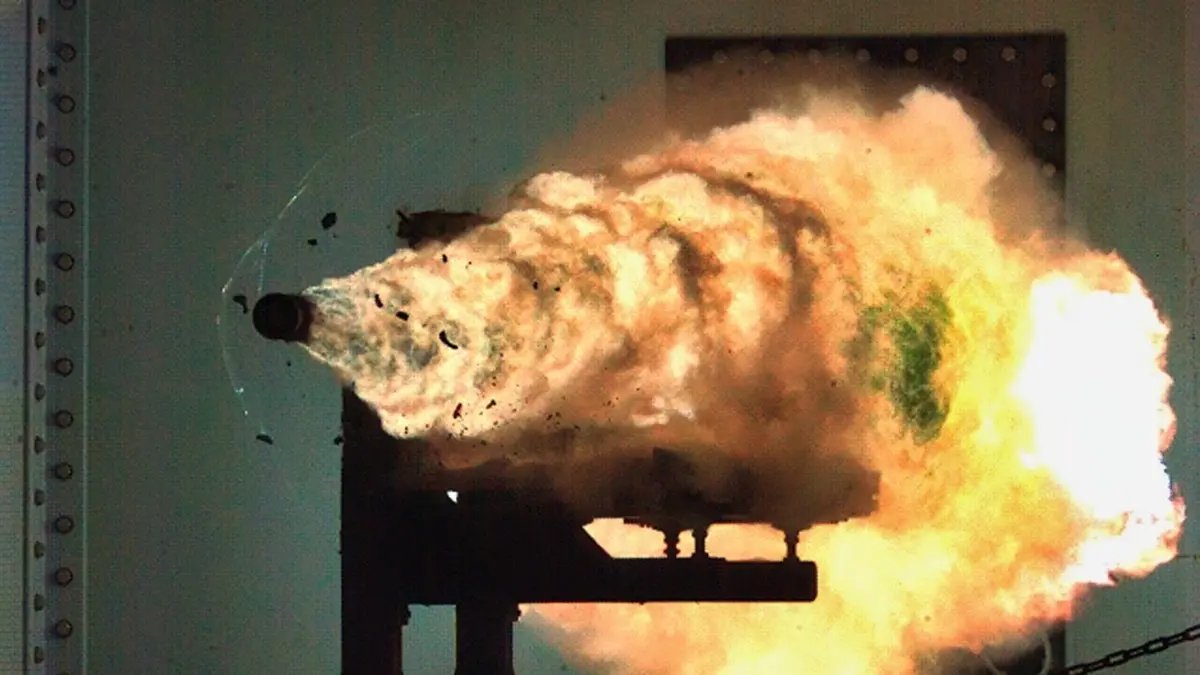
While the US Navy spent ~$500M on its electromagnetic railgun program before shelving it in 2021 due to severe barrel and rail erosion after just a few shots, Japan is proving the technology can actually work. ⚡️🇯🇵 Japan’s ATLA has achieved over 100 firings from its medium-caliber railgun without replacing the rails—launching 320g projectiles at Mach 7 (~5,000 mph) using pure kinetic energy. A railgun projectile costs a fraction of multi-million-dollar missile interceptors, offering a sustainable defense against mass missile threats. hiwars.com/en/intel/japan…
Kill an enemy in six months with a humanoid.... We are no longer watching sci-fi. We are living it. Former Ukrainian Defense Minister Mykhailo Fedorov has officially launched the "Army of Robots" initiative—setting an unprecedented benchmark: a humanoid robot must record its first battlefield kill within 6 months. The goal? Complete front-line robotization: 🤖 $10,000 unit targets to replace infantry in the deadliest zones. 🤖 12-month goal: Full joint assault operations run entirely by autonomous air drones and ground bots without human foot soldiers. 🤖 Why humanoids? To instantly operate legacy infantry weapons, trench systems, and gear without redesigning the entire arsenal. techtimes.com/articles/32820…
Operation Vivaldi ran on unmanned systems. Ukraine’s 3rd Army Corps air-dropped kamikaze ground robots more than ten kilometres behind Russian lines with heavy Hryphon bombers, the first time that tactic was used in combat. Converted BTR-60s became robotic kamikazes that smashed the strongest fortifications at Nove; other UGVs armed with grenade launchers entered shelters and detonated. Robots flew 15,700 missions, drones flew 36,000 strike sorties, an electronic-warfare dome disrupted tens of thousands of Russian flights, and Rubicon’s elite drone unit was forced off the axis. The third season added 51 square kilometres and more than 250 prisoners. It is the first corps-scale offensive in which machines led the assault instead of merely supporting it. Vivaldi’s Four Seasons just opened a new chapter in how wars are fought. x.com/ab3army/status…
Ukraine is building SPECTR. It is an AI system that reads battlefield data, spots patterns, suggests battle plans, and tries to guess Russia’s next move. Combat units are already testing it. Officials call it an operating system for war. Just a reminder, not long ago not a history yet. In February 2026 a US missile hit an Iranian elementary school in Minab. More than 100 children died. The building used to sit on a military compound. Databases still treated it as a military target. Public photos, a school website, and satellite images of a playground were already out there. An analyst even wrote that it had become a school — in a system that was not linked to the targeting list. AI tools helped speed the strike process. They did not fix the stale label. They made the wrong building easier to hit, faster. Speed is not the same as being right.
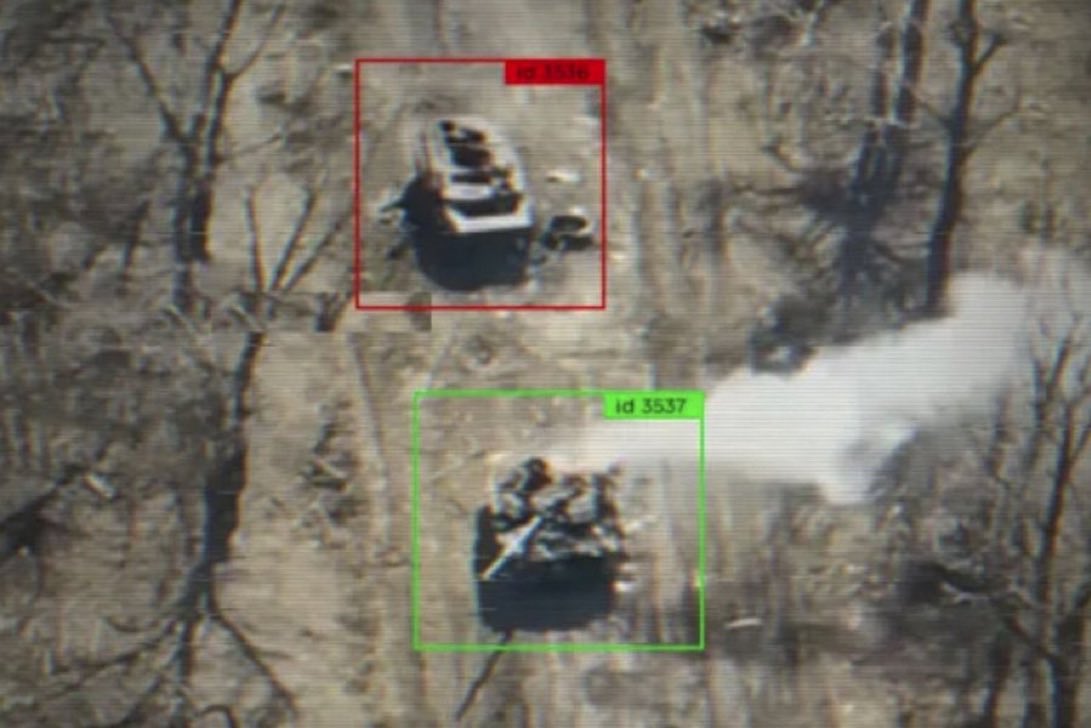
Ukraine is taking drone warfare to a terrifying new level, deploying heavy "Baba Yaga" bomber drones to air-drop autonomous, explosive ground robots deep behind Russian lines. In a secret operation, these tracked ground drones—armed with massive warheads—were transported miles past the front line before being released to detonate high-value enemy targets from the ground up. By fusing heavy aerial lift with land-based kamikaze strike bots, Ukraine is pioneering a multi-domain robotic assault that turns enemy rear zones into an immediate, high-precision battleground without putting a single human pilot or soldier at risk. Source: Multiple.
New satellite imagery reveals that China appears to be constructing the world’s first dedicated mothership for giant uncrewed underwater vehicles (XXLUUVs) at the Hudong-Zhonghua shipyard in Shanghai. Measuring around 200 meters long, the newly painted vessel features a massive internal hangar and a specialized well-deck cradle with vertical lifting arms designed to carry, deploy, and recover massive 35-to-45-meter autonomous drone submersibles out at sea. By serving as a mobile forward base and tender, this first-of-its-kind platform solves the core logistical challenge of autonomous undersea warfare: range and endurance. Rather than draining their own battery reserves on long transits from coastal ports, China’s massive robotic submarines can now be ferried directly into deep waters—significantly expanding the People's Liberation Army Navy’s power projection and surveillance reach across the Indo-Pacific. (Source The War Zone)


British Excalibur uncrewed underwater vehicle (UUV) has fired a U.S. Mk 48 heavyweight torpedo in what is said to be a first-of-its-kind test for both countries Source: TWZ, Video AI Generated
The U.S. Army tested a drone that launches other drones in midair, part of a bigger exercise against swarms of up to 100 aircraft at once. Source: Defence Blog
Australia's defense minister has confirmed that F-35 Lightning II parts meant for Lockheed Martin were mistakenly diverted to Hong Kong and that no sensitive components were involved. The Pentagon confirmed the disappearance of some components, and says it's working with US authorities to retrieve the parts and prevent a repeat. It's unclear why the shipment, handled by a third-party carrier, was rerouted. US does not sell F35 s to Türkiye for S300 deal but sends parts to China via Hong Kong
Information delivered to him and he did not act. This very important issue did not take attention it deserved. Why? Maybe he already knew. Second line of speculation... Why does an armed group launch an attack? A military action should have a clear purposes. Solid or intangible. It may aim to capture a place, destroy an important target, cut communication or supply lines, weaken the enemy’s morale, or support a larger goal. If it achieves none, and brings no benefit to the attacker, but gives leverage to opponent, it is more than a useless act and a serious mistake. How can one take such a decision. If it harms the attacker but helps the enemy. Is the group may manipulated into acting against its own interests. Who manupulated? Or are they simply ignorant?

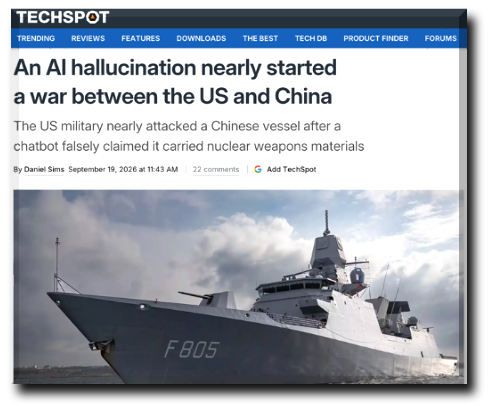
How one should rely on AI Sources connected to the US military recently told CNN that the US nearly moved to intercept a Chinese vessel in the Middle East this spring based on false intel from an AI-assisted report. The report was based on an inaccurate chatbot response that identified the ship as carrying materials for a nuclear weapons program.

C.DeR @CDeR_
6K Followers 6K Following Economist, Photo-Art, AI-Art 🇬🇧🇹🇩🇵🇹🇺🇲 All the images are original creations and are attributed to me, @CDeR https://t.co/W1LxQ1kwQb

War Analyst @War_Analysts
49K Followers 3K Following Breaking news, Intelligence, Insights, National security, Defense, Counter terrorism,Threats, War on terror ;
TianYuan Math @Wangweililei1
864 Followers 3K Following
Gozde Topuz @gozgozt8
8 Followers 209 Following
Assan Drammeh @AssanD71288
412 Followers 5K Following
Warship Drama @DramaWarship
17K Followers 10K Following Big naval guns here. More in Telegram https://t.co/tv4vIJvSyb.
Patrick Karim x @badcharts1xx
43 Followers 734 Following Chart trader. Scientific "weight of evidence" market analysis incorporating risk & money management. Sound money advocate.
Brandon Liam @Brandon189485
53 Followers 2K Following
The Diplomat @Diplomat_APAC
354K Followers 813 Following The premier international affairs magazine for the Asia-Pacific, covering politics, defense and society from China and Kazakhstan to Myanmar and Australia

Sergey @SergeyCYW
17K Followers 214 Following I talk about growth stock investing, fundamental analysis with a long-term mindset. I provide earnings reviews and key news updates.
World Politics Review @WPReview
91K Followers 855 Following In-depth news and expert analysis on global affairs. Subscribe here: https://t.co/HdV45k3TCQ
Chatham House @ChathamHouse
315K Followers 997 Following The Royal Institute of International Affairs - Chatham House. Independent thinking since 1920 | @TheWorldToday | @IAJournal_CH | Podcast: https://t.co/AXFgTd6j30.
Michael Every @TheMichaelEvery
35K Followers 1K Following "I wish it need not have happened in my time.” - Frodo. "So do I… All we have to decide is what to do with the time that is given us." - Gandalf
Foreign Affairs @ForeignAffairs
952K Followers 2K Following A magazine of U.S. foreign policy and international affairs, founded in 1922. Sign up for our newsletters: https://t.co/MpbtG0OxgB
Council on Foreign Re... @CFR_org
581K Followers 145 Following Foreign policy news and analysis. CFR takes no institutional positions on policy. Follows, RT ≠ endorsements. ✉️ Subscribe for more: https://t.co/ehd5lKYrLs
C.DeR @CDeR_
6K Followers 6K Following Economist, Photo-Art, AI-Art 🇬🇧🇹🇩🇵🇹🇺🇲 All the images are original creations and are attributed to me, @CDeR https://t.co/W1LxQ1kwQb
MOD @HaberMOD
73K Followers 727 Following Muhalif | Objektif | Dürüst || Herkes için önemli haber kaynağı || 🔔 Hemen takip et, Türkiye'nin MOD'unu yakala! | [email protected]
KOZA TV @kozatv01
61K Followers 0 Following Şimdi konuşma zamanı | https://t.co/mXR7yZTT5e | https://t.co/gWiBblxyqy | https://t.co/p6aPfrhTMP

Nefer Savunma A.Ş @nefersavunma
259 Followers 203 Following Nefer Savunma A.Ş.: Geleceğin Savaş Sahasına Yön Veren Teknoloji Üssü “Vatan için Nefer, gelecek için siper.”

Dr Shabeer @ShabeerPhD
241K Followers 250 Following Educationist | Economist |💯 Financial Analyst | 📈Forex & Crypto Trader | Researcher | 📚PhD | Gold Medalist😍
Military Media @hehe_samir
299K Followers 14 Following Military media | Defence updates | Tactical insights

MilitaryMaps @MilitaryMaps
17K Followers 4 Following КАРТА БОЕВЫХ ДЕЙСТВИЙ ⇢ https://t.co/5ZoyfZzNJ1 Telegram ⇢ https://t.co/YihJ3zwmtr ВК ⇢ https://t.co/fjO6wEtHeZ ЛК ⇢ https://t.co/WWxk7SDLea
Military Machine @mil_machine
2K Followers 12 Following Military Aircraft, Tanks, Ships and more from Military Machine
GZT @gztcom
463K Followers 34 Following Türkiye'nin en büyük dijital medya markası GZT'desin🙌 @gzt_spor @saltokunurgzt @gztmzt @Timecodegzt @gztgame @GencMotto @LokmaDergisi @CinsDergi @NihayetDergi

AJ Signal @aj_geo_analysis
38K Followers 81 Following New here. Former Military, Geopolitical Security Strategist &Advisor to multinationals. Ranked #2 NEW BESTSELLER and #2 in WORLD POLITICS on Substack. Follow.


Optimus @Optimus_RH
46K Followers 76 Following Optimus will be the biggest product ever Fan account not affiliated with Tesla
Eagle Intelligence Re... @EagleIntReports
21K Followers 953 Following A trusted global platform delivering political and strategic analysis and exclusive intelligence to decision-makers, researchers and audiences in modern affairs
Thorkill @Thorkill65
22K Followers 34 Following Obserwator konfliktów zbrojnych od 2011 r. Autor bloga o wojnie na Ukrainie. Jeżeli chcesz wesprzeć moją pracę: https://t.co/jOTqbIoFJU
Weapons and equipment... @China768768768
7K Followers 1K Following Weapons and equipment marketing staff of a wholly-owned defense company of the Central Military Commission of China
Kerim Rota @kerimrota
213K Followers 1K Following Finans, piyasalar, ekonomi paylaşımları. @GalatasaraySK taraftarı @Darussafaka gönüllüsü Tüm Yazılarım👇 https://t.co/t9LX5F3pAV
Hay Eytan Cohen Yanar... @hayeytan
12K Followers 2K Following PhD - @dayancenter & @jiss_israel - Editor of "Turkeyscope" - Lecturer at @telavivuni - Author of "The Evolution of the Turkish School Textbooks"

Tomthunkit™ @TomthunkitsMind
105K Followers 60K Following Tomthunkit's Mind Diner is open 24/7. All-you-can-eat smorgasbord of hand-picked deliciously sweet tweets for your political palate. Invest ($) in your future
War Analyst @War_Analysts
49K Followers 3K Following Breaking news, Intelligence, Insights, National security, Defense, Counter terrorism,Threats, War on terror ;
Ariel Oseran أريئ... @ariel_oseran
42K Followers 1K Following Senior Middle East Correspondent @i24news_en. Host, On the Record. Speaker. Previously: @theworld, @N12News. Ignorance is the cause of fear.
The Washington Sun @washingtonsun
245K Followers 178 Following Shining a light on Washington. Metro coverage: @washsunmetro Analysis, ideas and narratives: @washsunperspect
Ronald van Loon @Ronald_vanLoon
357K Followers 163K Following Helping AI driven companies generate value•Top10Influencer #AI #BigData #DataScience #IoT #MachineLearning #Analytics #Cloud
Saronic @Saronic
30K Followers 161 Following Saronic is building cutting-edge autonomous surface vessels that enable maritime security and domain awareness by combining premier hardware, software and AI.
Admiral James Stavrid... @stavridisj
114K Followers 871 Following Vice Chair,The Carlyle Group; Chair, Rockefeller Foundation Board; PhD; ADM, USN(Ret.) fmr Supreme Allied Commander at NATO. @admiralstav.bsky.social
מיכאל Michael Mi... @michael_mils
11K Followers 1K Following Head of the Palestinian Studies Forum - Dayan Center/Tel Aviv University
תמיר הימן | T... @HaymanTamir
12K Followers 296 Following ראש המכון למחקרי ביטחון לאומי (INSS), לשעבר ראש אמ"ן | Executive Director of INSS, Former head of Israel Defence Intelligence
笑脸男人 @lfx160219
12K Followers 5K Following
קול ישראל / �... @kolisraelmedia
10K Followers 288 Following İsrail basınından doğrudan haber aktarımları için bizi takip edin! ✉️[email protected]
Udi Evental @UEvental
21K Followers 929 Following Colonel (res.); Strategy and Policy. Views my own. https://t.co/JtPrYubZA0
Dr. Osman Gazi Kandem... @OsmanGKandemir
8K Followers 251 Following General (E)/PhD/General(R) Stratejik Analist/ Yazar:https://t.co/cWlTmkpuh2 Roman: Karanfil, Gelincik ve Yüzyıllık Hikâye
Danny (Dennis) Citrin... @citrinowicz
94K Followers 763 Following Middle East, National Security and intelligence expert خبير لشؤون الشرق الأوسط وإيران Senior Fellow @inss_hebrew Nonresident Fellow @AtlanticCouncil


Edwin Drake @petrolandeco
29K Followers 2K Following Ex bond trader-Portfolio Mgmt/ Lawyer/ Ex Lecturer /Fmr. Sr. Exec. Capital Markets & Investment Banking Petrol | Enerji | Jeopolitik Makro | Veri bazlı analiz
Airforce Geek @PrecisionLabs0
13K Followers 91 Following Military & General Aviation | Mechanical Engineer Breaking down fighter jets, helicopters & incredible aircraft with daily videos, facts & engineering insights
ANI @ANI
9.5M Followers 0 Following Asian News International. Multi-media news agency, content for information platforms: TV, Internet, broadband,newspapers, mobiles https://t.co/eEMPAbAcmsTrends for United States
You might like


















