Eric Mono @Earthwalker17X
Builder. Runner. Creator. github.com/earthwalker17 Singapore Joined October 2026-
Tweets10
-
Followers0
-
Following35
-
Likes71

黄仁勋和Sam Altman在CEO能力上的差距,简直大得令人震惊。当被问到是否放心把未来交给如今这些大语言模型公司的老板时,黄仁勋说:“我已经干了33年了,而这些小伙子们都只是第一次当CEO。” 英伟达在其发展历程中的绝大部分时间里,其实一直都在躲着英特尔跑。每当英伟达进入一个新市场,刚刚取得一些成绩,英特尔就会跟着进入这个市场,凭借自身的规模和资源优势把英伟达挤出去。这迫使黄仁勋必须敢于下重注,同时具备长期战略眼光,而这些赌注最终也得到了回报。 但黄仁勋也非常清楚,作为一家规模较小的公司,英伟达根本不可能与英特尔正面硬碰硬,最好的选择永远是避其锋芒。即使后来英伟达取得了巨大的成功,他依然懂得守住自己的能力边界,而不是试图把整块蛋糕都吃下来。 这也正是为什么黄仁勋没有选择与台积电竞争,没有试图把芯片的整个供应链都掌握在自己手里。他知道哪些事情应该自己做,哪些事情应该交给合作伙伴。 相比之下,Altman是一个天真的CEO,坦白说,也是一个能力很差的CEO。他本来完全可以选择与黄仁勋、马斯克以及其他行业巨头建立良好的合作关系,但他偏偏选择四处树敌,与这些人正面交锋。 这恰恰暴露了Altman在商业判断上的不成熟,以及他骨子里的傲慢。他似乎根本不明白,一个优秀的CEO不仅要知道什么时候应该竞争,更要知道什么时候应该合作,什么时候应该退让。而这也正是为什么,Altman的故事最终不会有一个好结局。
Sam Altman那股老狐狸般的阴险劲儿又冒出来了,而这一次,他是真的把黄仁勋给惹毛了。上个月,OpenAI试图向Hugging Face投资1亿美元。表面上看,这似乎只是一笔普通的股权投资,但背后真正的隐秘目的,是OpenAI希望让Hugging Face平台上的开源AI模型,运行在自己与博通合作开发的AI芯片上。
Jev爆火已经有一个多月了,现在看来还是有一些值得思考的地方。讲真,每次这种现象级AI成果基本都代表一种使用范式的转变。像年初的OpenClaw就是把AI从Chatbot转向持久驻留的智能体,并把应用场景从编码专项逐渐拓展到各种日常事务。 Jev有些类似。它不是生成文本的大语言模型,既不能聊天也不能写代码,而是通过极低成本的快速决策,解决“需要AI的判断力但不需要它的表达力”的问题。在基本决策类软件任务上,其平均响应时间比传统LLM快百倍、便宜数百倍,输出token更是永久免费。例如有人拿它审PR,1000个才花7美分,比当时的Opus 5便宜了200多倍。 这种突破来源于其背后训练方式的变革。不同于传统大模型的RLHF(人类反馈强化学习),Jev采取的是一种全新训练方式RLCD(校准决策强化学习),既不优化文本生成的流畅度,也不优化绝对的正确性,而是优化概率的校准度。即模型输出的置信度必须在统计上与真实准确率一致(比如模型说有70%把握,那么在100次同类决策中就应当约有70次正确)。 这天然带来了几个好处:首先是并行采样架构,避免了逐token生成的串行延迟,从而带来巨大的速度优势;其次是零幻觉问题,输出结构在架构层面被约束,类型错误率数学上为零;然后是软件友好性,其输出直接可供代码分支执行,无需从散文中提取信息,因而适合无人值守的自动化流程。 Jev的应用边界也很明确:不是要取代大模型,而是与之分层协作:Jev负责所有低延迟、高频率、结构化的小决策任务,大模型专注于复杂推理、内容生成和开放分析等长链路任务,形成“系统一(直觉判断)+ 系统二(深度推理)”的级联架构。例如在大型代码库探索过程中,先让Jev根据目录结构和文件名进行打分,通过多路径并行探索快速缩小范围,找到目标文件后再交由大模型精读,大幅降低了探索成本和“盲目感”。 模型后续更新与生态方面的动作也很大。Jev目前已更新至1.14版本,开放多模态能力,能返回目标在图中的位置;OpenAI两周内发布decisions接口,AWS发布Strands Decider,微软发布Microsoft-Decision-1,阿里云上架decision-model-preview。社区也出现了多个开源复现版本,包括可本地部署的Kev系列等。 总之,Jev本身可能并不算什么前沿模型或巨大技术突破,但明确把AI的“智能分工”从概念落地成了可大规模复用的工业范式,将AI从“面向人类对话的产品”推向“面向机器原生的基础设施”。我认为真正的AGI也将体现为系统的自主感知、高效决策与稳定执行的综合能力,而不再是会不会聊天或代码写得多漂亮。
After co-inventing ChatGPT, I kept asking myself: why have superhuman chat models not led to AGI? I’ve spent the last 2 years in stealth building a new way to train models (RLCD), and a new type of frontier AI model that we are releasing today: Jev • 20-200x faster • 40-400x
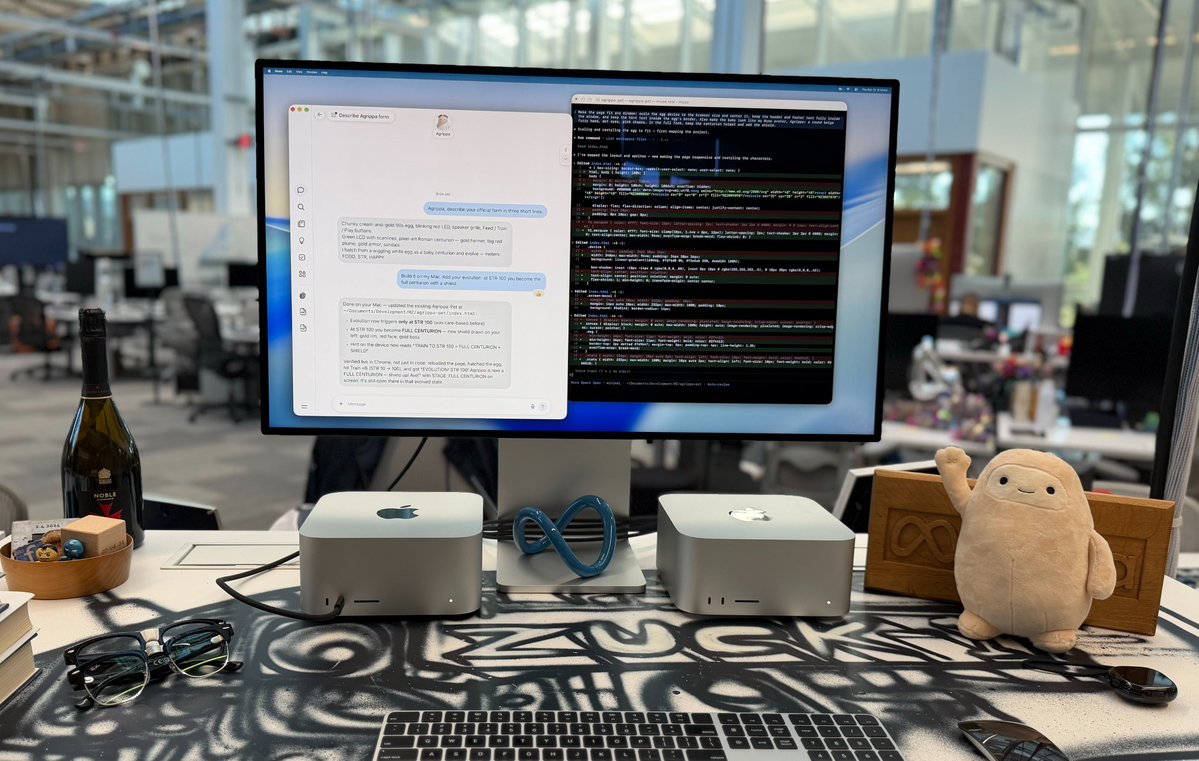
Muse Spark Open -- weights releasing today -- runs great on new Mac Studios thanks to work with @johnternus and Apple.
The most valuable lesson of building MiniDSH came from the development process itself. One failure mode I kept seeing in AI-assisted development is that individual sessions can produce locally good code, while the overall system gradually becomes fragile and incoherent. So I tried to invert the process: architecture defines sessions; sessions do not define architecture. Before adding something new, I tried to decide its architectural home, capability ownership, state boundary, and dependency direction first. If there was no clear place for it, that was treated as an architecture problem rather than an excuse to create another parallel subsystem. Meanwhile, the architecture itself wasn't treated as sacred. Several hardening sessions were explicitly about trying to falsify our own assumptions, and some original plans were removed or changed when implementation evidence or upstream research contradicted them. That part was probably more useful to me than the feature work.
What's the smallest agent harness that is still architecturally complete? By "complete" I don't mean feature-complete. I mean that the system still has clear source of truth, state ownership, permission boundaries, model routing and session persistence. I studied DSH as the

最近GPT上线的这个Intelligent UI功能挺有意思,给大家分享一下我的理解。简单来说,就是模型的输出不再局限于文本、代码或简单图表,而是能自动生成可交互的图形界面。 首先,模型会根据用户问题自行判断输出形式,比如该用文字、图表、按钮还是表单来回答。对比类问题并排展示,复杂概念用交互式图拆解,简单问题仍然直接文字回答。 其次,模型可以即时生成可用工具。用户可以直接在对话中要求它创建计算器、账单分摊工具,甚至一个能玩的小游戏。并且还能边生成边呈现。OpenAI搭建了一套原生界面组件库和一个“编译器”,模型可以在推理过程中同步构建界面,而不需要等整段回答写完后才渲染。 Claude那边也有个类似的功能,叫Claude Motion。同样不走视频生成模型路线,而是通过编写代码驱动文本、图表、形状和图像做动画,生成可编辑、可导出的MP4文件。 最近大家看到各种很火的Opus 5.5制作的动态视频,就是纯靠写代码实现动画效果(比如JavaScript+ Canvas)。用户可以更改任何文字、数字或时间安排。并且生成的动画可以直接导出到Adobe、HeyGen、Higgsfield或Runway等工具中继续精修。 总之,这套能力将AI交互从“对话即文本”推向“对话即工具”。用户不再需要为每个小需求去下载App、注册账号、学习操作流程,而是一句话就能获得一个即用即走的临时工具或演示视频。这与之前卡帕西提出的观点十分吻合,就是AI改变了知识呈现的方式,能通过各种一次性software artifacts对知识予以直观呈现与通俗解释,更加方便地满足了普通用户的日常需求。 最后发表一下我的个人预测:可能以后App这一整套逻辑都要失效了。你在电子设备中的所有界面都可以由AI实时生成,想干什么直接让AI写个界面去干,而不需要再开任何软件或网页。越来越觉得未来软件会变成一种随写随用、用完即弃的一次性流动产物,而不再是互联网AI时代的技术核心。
GPT-6 and Intelligent UI, now rolling out in ChatGPT for everyone. Intelligent UI in ChatGPT delivers fast, interactive answers that make everyday questions more visual, complex topics easier to grasp, and interactive tools for your task available on the spot.
Opus 5.5 has been wild recently, especially all the "one prompt" fancy demos. But I wanted to try something different: not just a demo, but a complete project. I used Opus 5.5 in Claude Code to build a miniature 3D Middle-earth from scratch, then turn that world into a 3:47 cinematic journey. The project ended up covering more than I expected: - terrain/GIS baking - Three.js/WebGPU scene - 24 handcrafted landmarks - lighting, atmosphere, and day/night transitions - frame-by-frame video rendering - an original orchestral score What's interesting wasn't that the model could generate individual assets, but whether it could stay useful across the whole production pipeline. The hard parts were still "normal" engineering problems: architecture, consistency, visual QA, resource limits, iteration, and keeping the whole system coherent as the project grew. My biggest takeaway is that in AI-generated 3D, the model should be treated as a technical collaborator across modeling, rendering, tooling, animation and media production, rather than just a one-time generator. The output still needs taste, direction and a lot of review. But the range of things one person can realistically attempt has expanded a lot. I've open-sourced the code, architecture, rendering pipeline, QA tooling and reproduction steps. Repo is in the replies.
What's the smallest agent harness that is still architecturally complete? By "complete" I don't mean feature-complete. I mean that the system still has clear source of truth, state ownership, permission boundaries, model routing and session persistence. I studied DSH as the main reference because its architecture is fairly explicit: capabilities have lifecycle and dependency semantics, model-visible history is derived from durable session state, authority is separated from reasoning, and user surfaces sit over a shared runtime. Rather than fork-and-prune, I tried to re-derive those properties into a minimal system, which now exists as a small open-source project called MiniDSH. The design ended up with a few principles more important than LOC: - the append-only session log is the canonical truth; - models, tools, persistence, authority and context have explicit seams and owners; - the model proposes an effect, but policy and the effect boundary decide whether it happens; - the model is a routed capability, not synonymous with the agent; - terminal, browser and headless are surfaces over one runtime; - something gets a first-class composition boundary only if it needs to be replaced, scoped, removed or independently owned. The last point became a useful rule: everything evolvable has a seam, but not everything needs to become a plugin. This project is fully open-source on GitHub. Repo in replies. I'm curious how others draw the minimum boundary differently. What invariants or properties do you think a modern agent harness must have? And which abstractions in this design look unnecessary or prematurely general?
最近黄仁勋世界巡演的AI视频火了,自己也忍不住做了一条类似的,主人公是梁圣(梁文锋)。 第一次尝试通过智能体工作流全自动化AI视频创作: Codex + Runway插件,搭配image 2.5生图技能。全程由Codex自主操作,我只负责提供最初任务描述并验收最终成果。所有视频模型调用、分镜脚本、参考图/参考片段、提示词撰写、参数控制和最终成片的剪辑/加工均为GPT-6.1 Sol自行规划完成。 相较于视频画面生成,文字和音频反而是难点。由于视频模型生成文字或唱词经常容易出错,所以我要求它分离生成,就是视频模型只生成无字幕、无文字的静音画面,而所有音频/唱歌均为后期单独合成再整合进去,字幕/文字同样为后期添加。 整体下来效果还是不太理想。不知道是分段/切片太细了还是使用混合模型生成的原因,感觉角色前后一致性不太好,动作也不够连贯,部分片段的衔接仍有明显瑕疵。 以及用Codex生成参考图/起止帧确实比较方便,但有时候它会过度操作。比如明明可以用视频片段直接作为参考输入的部分它还非要再生成参考图,结果与参考视频有所出入,反而干扰视频模型的判断;并且它听不了音频,自动转写也不一定准确,就没法判断唱的词到底对不对。这点还得由人来检查,然后费劲把问题反馈给它。 这么看来搞创意类AI工作可能还是需要专门的平台/软件和工作流,通用/coding agent在这方面感觉还是不够专业。另外这也太烧了,1分多钟的视频花掉我Runway Pro一个月的额度外加6000积分,Codex真是一点不知道给我省钱啊。 大家有什么比较好的AI视频工作流吗?以及视频分段是分细一点好还是完整一点好?还有模型选择是否需要尽量统一一个模型?

Marc Andreessen 🇺�... @pmarca
6.7M Followers 34K Following You’re not talking to someone who woke up a loser. That loser attitude, that loser premise makes no sense to me.
Garry Tan @garrytan
1.1M Followers 6K Following President & CEO @ycombinator —Founder @garryslist—Creator of GStack & GBrain—designer/engineer who helps founders—SF Dem accelerating the boom loop
Y Combinator @ycombinator
1.7M Followers 367 Following We help founders make something people want. Subscribe to our newsletter: https://t.co/sjqjxxBeLc


Diogo Almeida @CompleteSkeptic
156K Followers 78 Following Sane + 🌶️ takes in an insane AI world... AI capabilities researcher: co-created RLHF/ChatGPT @ @openai now trying to right the wrong 🤭 (ceo @typesafeai)

Thinking Machines @thinkymachines
184K Followers 1 Following Thinking, beeping, and booping. @tinkerapi
Mira Murati @miramurati
1.0M Followers 644 Following Now building @thinkymachines. Previously CTO @OpenAI
World Labs @theworldlabs
116K Followers 54 Following World Labs is a leading spatial intelligence company building frontier models that can perceive, generate, reason, and interact with virtual and physical worlds
Fei-Fei Li @drfeifei
1.1M Followers 1K Following Cofounder/CEO @theworldlabs, Prof (CS @Stanford), Co-Director @StanfordHAI, #AI #SpatialIntelligence #GenAI #computervision #robotics #AI-healthcare
Alexandr Wang @alexandr_wang
826K Followers 940 Following chief ai officer @meta, founder meta superintelligence labs, founder @scale_ai. give everyone the adulthood they dreamed of in childhood
AI at Meta @AIatMeta
871K Followers 368 Following We're building the future of personal superintelligence to help people create, connect, and achieve more in life.
Mark Zuckerberg @finkd
2.5M Followers 759 Following


SpaceX @SpaceX
41.9M Followers 127 Following SpaceX designs, manufactures and launches the world’s most advanced rockets and spacecraft
NVIDIA @nvidia
2.7M Followers 47 Following The official handle for NVIDIA. Blog: https://t.co/JAn5eKOTBT Support: https://t.co/6ln5FVnA2o All our social media: https://t.co/Uc56dL57Dh

DeepSeek @deepseek_ai
1.2M Followers 1 Following Unravel the mystery of AGI with curiosity. Answer the essential question with long-termism.
SpaceX Super Intellig... @SpaceXSI
2.1M Followers 6 Following
Demis Hassabis @demishassabis
2.0M Followers 179 Following Nobel Laureate. Co-Founder & Chair @GoogleDeepMind; Chief Scientist of Alphabet. Founder & CEO @IsomorphicLabs. Building the future...


Yann LeCun @ylecun
1.3M Followers 800 Following Founder/Chair, AMI Labs; Professor, NYU; Partner, 224 Ventures; Ex-Chief AI Scientist, Meta. Researcher in AI, ML, Robotics, etc. ACM Turing Award Laureate.

Google DeepMind @GoogleDeepMind
1.6M Followers 266 Following The engine room of @Google. Building AI safely and responsibly to solve the world’s most complex problems. Join us: https://t.co/jUHQA27iBL
Andrew Ng @AndrewYNg
1.9M Followers 1K Following Co-Founder of Coursera; Stanford CS adjunct faculty. Former head of Baidu AI Group/Google Brain. #ai #machinelearning, #deeplearning #MOOCs
Andrej Karpathy @karpathy
4.4M Followers 1K Following

Claude @claudeai
1.9M Followers 2 Following Claude is an AI assistant built by @anthropicai to be safe, accurate, and secure. Talk to Claude on https://t.co/ZhTwG8d1e5 or download the app.
Anthropic @AnthropicAI
1.8M Followers 2 Following We're an AI safety and research company that builds reliable, interpretable, and steerable AI systems. Talk to our AI assistant @claudeai on https://t.co/FhDI3KQh0n.
OpenAI @OpenAI
5.5M Followers 4 Following OpenAI’s mission is to ensure that artificial general intelligence benefits all of humanity. We’re hiring: https://t.co/dJGr6LgzPA
Sam Altman @sama
6.4M Followers 1K Following The mission of OpenAI is to ensure that AGI benefits all of humanity
Trends for United States
You might like