

Eula Hash @EulaHash1
Joined August 2015-
Tweets54
-
Followers5
-
Following79
-
Likes75
#NVIDIA to compete with US, Chinese AI models under $6B Poolside deal A $6B licensing deal Nvidia (NVDA) signed last week with AI startup Poolside allows the chip giant to develop open-weight AI models, allowing it to better compete with American and Chinese AI giants. Under the deal, first reported by the Newcomer newsletter and later by Bloomberg, Nvidia is also making job offers to 100 Poolside employees. The Nvidia/Poolside partnership will not only put pressure on US AI companies, such as OpenAI (OPENAI) and Anthropic (ANTHRO), but Chinese ones as well, such as DeepSeek and Kimi K3, sources told The Wall Street Journal. Nvidia is also providing Poolside, which has an estimated valuation of $12B, with a $1B investment. The Poolside employees joining will contribute to Nvidia's Nemotron project—developing open-weight models that Nvidia started in 2023—to provide improvements, according to the Journal. In an August 20 letter to its investors, Poolside said that the Nvidia deal would advance their belief that AI "would not be a closed technology controlled by few but one built by many out in the open." OpenAI and Anthropic are focused on closed AI models

🚨 WALL STREET’S SMART MONEY IS STARTING TO AGREE Goldman Sachs identified six stocks that are currently favored by both hedge funds and mutual funds: BA COF MA SPCX TMO V What caught my attention isn't simply the list. It’s the institutional overlap. Goldman’s shared favorites have returned 29% YTD, outperforming the equal weight S&P 500 by 13 percentage points. But there’s another side to the story. The median stock in this group trades at around 25x forward earnings, compared with roughly 19x for the S&P 500. So institutions are clearly showing conviction. But investors are also paying a premium for that conviction. That leaves me with one question: Are these stocks still early institutional opportunities, or has the market already priced in the smart money’s confidence? 👀 I’m watching COF, MA, TMO and BA particularly closely. Which one would you pick from Goldman’s shared favorites? Follow me for more institutional positioning, U.S. stock analysis and market signals.

XRP on track for biggest weekly gain in 21 months as Treasury buyback spurs 'curve control' hopes Payments-focused cryptocurrency XRP is on track for its best weekly performance since November 2024 after a U.S. Treasury announcement fueled market speculation that policymakers could ultimately resort to yield curve control (YCC), an aggressive monetary-easing tool. XRP has surged 51% to $1.50 since Monday, beating its peers, bitcoin BTC $77,307.92 , ether ETH $2,446.71 , and Solana (SOL), by a big margin, according to data from CoinDesk. BTC and ETH have gained 22% and 30%, respectively, while SOL has rallied 28%. XRP's outperformance follows a period of lackluster price action, during which the cryptocurrency consistently lagged the broader market's bounce. It has been characterized by a massive unwinding of short, or bearish, bets in futures. According to the data source Coinglass, shorts worth nearly $2 billion have been liquidated this week. The surge in XRP and other tokens began early this week after the U.S. Treasury said that, from Sept. 9 to Nov. 4, it will buy back $4 billion or more of its own long-duration (10- to 30-year) bonds on multiple occasions, double the previous $2 billion cap. While this is more of a liquidity-management operation in the world's largest bond market, which underpins global finance, the timing of the announcement suggests that it is aimed at capping the rise in yields, as CoinDesk explained on Friday. Yields on longer-duration bonds hit their highest levels since 2007 early this week, posing a problem for burgeoning fiscal debt and disincentivizing risk-taking in financial markets. As such, the announcement triggered hopes of yield curve control and sent risk assets higher. Yield curve control is a full-blown stimulus measure whereby a central bank establishes a ceiling for longer-duration bond yields – say, the 10-year – and commits to buying as many bonds as needed to keep the ceiling intact. Both the Bank of Japan and the U.S. have pursued it in the past, supporting risk-taking in financial markets. Still, XRP's latest price rise marks just a 20% recovery of the brutal bear-market slide from the record high of $3.65 in July last year to just under $1 a week ago. In other words, there is still plenty of ground to cover before a proper bullish trend appears to be established. #XRP

🇬🇧 STABLECOINS ARE BECOMING REAL MONEY. 💳 Crypto adoption isn't just about Bitcoin anymore. Stablecoin-powered card spending has more than doubled over the past year, reaching around $1.04B in July. And here's what caught my attention: 💳 70% of tracked transactions used USD-backed stablecoins 🔵 USDC → 50.8% 🟢 USDT → 20.3% 🛒 People are using them for groceries, rides and everyday spending This is bigger than crypto trading. Stablecoins are becoming a payment layer for the real world. The question I'm watching now isn't: “Which token will pump next?” It's: “Which digital assets will actually become useful?” Payments. Banking. Real estate. Cross-border transfers. Tokenised assets. That's where I believe the next phase of crypto gets interesting.

🤖 THE NEXT CRYPTO USERS MIGHT NOT BE HUMAN. For years, crypto has been focused on onboarding the next billion people. But what if the next billion users are AI agents? AI agents are already starting to make payments for: 💻 Data ☁️ Computing power 🔌 APIs ⚡ Digital services And many of these payments are happening with stablecoins. Coinbase's x402 has already processed more than 165M payments, with around 99% reportedly using USDC. That's the part I'm watching. AI + Stablecoins + Crypto Payments The next major crypto use case might not be speculation. It could be machines paying machines. Imagine an AI agent that can: Find a service → pay instantly → receive the data → complete the task. No bank transfer. No card details. No subscription. Just programmable money moving at machine speed. We're still early. But if AI agents become a major part of the digital economy, stablecoins could become the financial layer behind them. That's a trend I'm watching very closely. 👀 Follow me if you want to understand where crypto is going — not just where the price is going. #Crypto #Bitcoin #Stablecoins #AI #AIAgents #USDC #CryptoPayments #DigitalAssets #Web3 #UKCrypto

BITCOIN IS AT A CRITICAL LEVEL RIGHT NOW. 👀 Bitcoin has reclaimed the $75,000 to $78,500 zone. Now the market has a very clear decision point: 📈 Hold above $75K to $78.5K Next major target: $90K 📉 Lose this zone Next downside area: $66K This is why I’m watching price structure rather than simply chasing momentum. Hold the zone, and the bullish setup gets stronger. Lose the zone, and the entire structure changes. The next few sessions could be extremely important for BTC. Bullish breakout or another rejection? 👀

The interesting part of the WorldClaw story isn't the AI models. It's the relationship. World Liberty says WorldClaw is independent. Yet the platform uses USD1 as a payment rail, accepts WLFI for certain plans, and was promoted by Donald Trump Jr. World Liberty has also declined to clarify whether there are financial ties involving equity, financing, licensing fees or revenue sharing. That doesn't automatically mean anything is wrong. But when AI, crypto, stablecoins and politically connected businesses intersect, transparency becomes extremely important. The real question isn't: “Is WorldClaw independent?” It's: “How independent is it, and what does the financial relationship actually look like?” This is a story I’ll be watching closely. What’s your take? Follow for more market and crypto analysis.

**Something interesting is happening beneath the surface of gold miners.** The breadth of the **$GDX** ETF is improving rapidly. Around **62% of GDX holdings are now trading above their 200 day moving averages**, the highest level since May. Even more impressive: **+57 percentage points in just 3 weeks** **GDX +22% during the same period** **Broad participation is reaching levels not seen since early 2024** This is important because a strong rally becomes more convincing when participation expands beyond just a few names. The 2024 breakout offers another interesting reference point, when GDX gained **52% over the following 12 months**. The question now is: **Are gold miners entering the early stages of another major trend, or has the market already priced in the move?** I’ll be watching **GDX breadth, gold prices and real yields** closely. Follow for more market signals and opportunities that may be developing beneath the surface.

“Supercycle” is a big claim. The real question is whether adoption can match the vision

🚨BREAKING: 🇺🇸 Robinhood CEO Vlad Tenev says “We are at the beginning of a SUPER-CYCLE and it’s going to TAKE OVER the ENTIRE financial system!”
Shop amazing deals on home and kitchen items this week with ABC Secret Savings! Shop now: abcsecretsavings.com/?utm_source=DI… abcsecretsavings.com/?utm_source=DI…
Anthropic could be preparing for a record-breaking Wall Street debut. According to the Financial Times, the Claude maker is moving toward a potential October listing, with investors discussing a valuation of more than $2 trillion. The bullish case comes down to growth. Anthropic reportedly ended May at $47 billion in annualized revenue, with investors projecting that could reach $100B–$120B by December. But a jump from a roughly $965B private valuation to $2T in just months would be an enormous test of investor appetite for AI. Meanwhile, crypto markets are already trading tokenized pre-IPO exposure to Anthropic before the company even reaches the public market. If the $2T valuation holds, AI could enter an entirely new valuation era. If it doesn’t, the fallout could reprice the broader sector. Please follow my account @DrVincents6.


Trump Reportedly Says His Relationship With Musk Will Never Be The Same After Epic Fallout go.forbes.com/IGR0Gk

🚨 BREAKING: SpaceX has officially completed its $60 billion acquisition of Anysphere, the company behind AI coding platform Cursor — one of the largest startup acquisitions ever recorded. This is more than a massive M&A headline. The bigger story is the accelerating convergence of AI, computing infrastructure and software. With Cursor joining SpaceX’s expanding AI strategy, the deal gives Musk another major piece in the race against OpenAI and Anthropic, while potentially creating new synergies between AI models, computing capacity and AI-powered software development. For investors, the key question isn’t simply whether $60B is expensive. It’s whether SpaceX can turn its growing AI infrastructure into a scalable, high-margin business. The AI race is moving beyond models — infrastructure, compute and applications are becoming equally important.

Strategy (MSTR) has pushed back against MSCI’s proposed methodology for identifying “non-operating companies,” which could result in the largest bitcoin treasury company being removed from the index provider’s global equity indexes. Strategy said on X, “Digital assets are assets. Index providers should measure markets, not decide which assets companies are allowed to own,” Strategy said. “MSCI’s proposal puts it out of step with regulators, markets, and its own customers. Bitcoin doesn’t need MSCI. Neither does Strategy.” The latest consultation replaces an earlier proposal focused specifically on companies with significant digital asset holdings. Applying the new financial-ratio screen using May 2026 data would have resulted in the removal of Strategy, Metaplanet and uranium holder Yellow Cake from the MSCI ACWI IMI. The response follows Strategy’s formal objection in December 2025 to MSCI’s previous proposal, which would have excluded companies whose digital assets represented at least 50% of total assets. Strategy argued at the time that it is an operating company, not an investment fund or passive bitcoin vehicle, pointing to its software business, active treasury operations and bitcoin-backed credit instruments. It described the 50% threshold as arbitrary and urged MSCI to maintain neutral index standards.

Trezor warns 14,000 customers after fulfilment partner suffers data breach ShipMonk, Trezor’s fulfillment partner, suffered unauthorized access to its systems, affecting nearly 14,000 customers’ data, the cold storage crypto wallet firm reported Thursday. Trezor said the names, email addresses, phone numbers and shipping addresses of 11,742 customers had been compromised. It also said the names, cities and email addresses of another 1,947 customers were also breached, bringing the estimated number of victims to nearly 14,000 across the U.S., the UK, Sweden, Colombia, Brazil, Italy and Portugal. "We have some difficult news to share," Trezor said Thursday on X. "Unfortunately, one of our shipping providers has experienced a data breach that exposed sensitive order data." The Trezor-related security hack comes as global data breaches are at an all-time high, according to SentinelOne, a U.S. cybersecurity firm. It said that this year, data breaches have increased by 17% compared with 2025, with an average of 2,090 attacks worldwide each week. It is also estimated that global data breaches have been rising by 3% month over month since January. The cold storage wallet manufacturing firm said it notified all affected customers via email, adding that the data of those who did not receive the message was not compromised. Trezor told CoinDesk via email it has no confirmed cases of the exposed data being published, shared, or offered for sale yet. It also said it is unaware of any scam or hack attempt linked to the incident so far. Customers who purchased through Amazon are not affected, as those orders are fulfilled by a separate partner, it added. Trezor also said its own systems were not compromised, and crypto wallet devices remain secure. The risk is indirect, it added, saying affected customers are now more likely to be targeted by phishing attempts via email, phone, or post. Scammers could use the leaked data to impersonate banks, crypto exchanges, or Trezor itself. People whose data is stolen in a data breach remain at risk for years after the hacking event. Once stolen logistics records are sold or published online, cybercriminals continually repurpose the data for new scams. Extortionists have leveraged home addresses to demand $700 to $1,000 in ransom and mail counterfeit devices directly to victims. Managing the long-tail legal, remediation, and brand fallout from a major customer leak is estimated to cost hardware firms over $33 million. Crypto holders are also increasingly at risk of physical attacks. In-person coercion attacks have totalled $124 million in the first half of this year alone, although not all can be traced back to a data breach, according to Certik. Cybersecurity firm DeepStrike estimated the amount of money people lose to data breaches into the tens of billions of dollars yearly. Trezor said this was the first breach in its 13-year history to expose customer phone numbers and shipping addresses. However, Satoshi Labs, the company behind Trezor, reported that a third-party support portal’s security had been breached in January 2024, affecting 66,000 people. Another 106,856 Trezor customers’ data was compromised in April 2022. Trezor’s internal firmware and on-device cryptography have never been breached remotely to steal funds. Ledger, the maker of one of the most popular hardware wallets in crypto, suffered a data breach in January. The security breach was linked to its third-party e-commerce partner, Global-e. In 2020, Ledger suffered another large-scale breach affecting nearly 300,000 users. A year later, scammers sent fake Ledger devices to victims of that breach in a follow-on phishing campaign.

Wall Street ended on top as the S&P 500 notched a new record high Wall Street's benchmark S&P 500 pushed up to yet another all-time trading high on Thursday as investors digested July producer price data that showed wholesale inflation was unchanged from the previous month. The blue-chip Dow (DJI) finished +0.1%, the benchmark S&P 500 (SP500) closed +0.6%, and the tech-focused Nasdaq Composite (COMP:IND) advanced +0.8%. From a sector-by-sector standpoint, seven of the 11 S&P segments concluded up in the green and were led by communication services, while materials suffered the most. July U.S. Producer Price Index: +0.0% M/M vs. +0.2% consensus and -0.1% prior (revised from -0.3%), +4.7% Y/Y vs. +4.9% consensus and +5.5% prior. Core PPI (excludes food and energy): +0.2% M/M vs. +0.3% consensus and +0.4% in June (revised from +0.2%), +4.2% Y/Y vs. +4.2% consensus and +4.7% prior. “Thursday's PPI was weaker than expected and is more evidence that inflation, while still way above the Federal Reserve's 2% target, is showing signs of stabilization following the oil-driven surge since the Iran war began earlier this year,” Glen Smith of GDS Wealth Management said. "We wrote it in recent articles, and the market finally agrees with us that rate hikes aren’t happening, as long as the Iran War isn’t even able to create upside momentum in inflation,” Seeking Alpha analyst Leo Nelissen of Main Street Alpha stated. Initial jobless claims rose more than expected in the past week. The U.S. 2-Year Treasury yield (US2Y) lost 5 basis points to 4.15%, the U.S. 10-Year Treasury yield (US10Y) dipped 4 basis points to 4.65%, and the U.S. 30-Year Treasury yield (US30Y) fell 3 basis points to 5.21%. As for stocks that were on the move, shares of Sandisk (SNDK) advanced by +13.8%, while shares of Cisco Systems (CSCO) fell -8.7%. More on markets Treasury yields ease after PPI print as a September rate hold looks likely 23 dividend safety stocks beating the S&P 500 this year Over 80% of country ETFs are above 50-day MAs as the global rally broadens Markets still underpricing AI’s hit to earnings, Apollo says Anthropic IPO timeline odds climb sharply after major RIOT partnership

Cameco: Hold After Weak Q2, But Long-Term Growth Story Remains Intact Summary Cameco is downgraded to hold after a financially weak Q2 2026, with revenue, profits, and margins declining despite higher uranium prices. CCJ's valuation is unattractive, trading at a trailing PE over 170x and a forward PE of 84x, well above sector medians, reflecting earnings volatility. Margins and cash flow have not yet benefited from higher uranium prices due to lower sales volumes and rising unit costs; margin recovery is expected to be gradual. Westinghouse remains a long-term growth asset for CCJ, with management forecasting 6–10% annual EBITDA growth and significant future reactor opportunities. Cameco Corporation (CCJ) is one of the world’s largest uranium producers, generating revenue primarily by mining and selling uranium while also earning recurring revenue from uranium refining, conversion, and nuclear fuel services. With many uranium peers primarily operating as mining companies. CCJ is different with broader exposure to the full nuclear fuel cycle, fuel services, and now reactor technology with its 49% ownership of Westinghouse. With energy security, rising electric demand, and government support for new nuclear capacity, CCJ saw a strong price return in 2025 that has been a little more muted in 2026, resulting in an 8% gain YTD. I gave the stock a buy rating last fall as well as in March, in which shares have fallen by 12% since my most recent analysis. I am shifting my rating to a hold on CCJ for now. I certainly don’t advise on selling the stock for buy-and-hold investors, as I still see healthy long-run growth prospects. In the more near term, some segments of the business have struggled more than I would have predicted with the recent Q2 earnings report on the weaker end. Valuation at the moment is unattractive, while margins and operational cash have also slid recently. Q2 Thoughts Q2 2026 results were mixed, but on the weaker overall side in my opinion. Headline figures reflected a difficult year-over-year comparison and lower sales volumes. Revenue declined 8% year over year to $580.5 million, while net income attributable to shareholders fell sharply to $17.8 million, which is $0.04 per diluted share, down about 90% from the same quarter last year. Adjusted EBITDA declined 42% to $286 million, driven by lower uranium and fuel-services sales volumes and a significantly smaller contribution from Westinghouse. Their share of Westinghouse-related EBITDA was more than cut in half YoY, which I will go into more detail on later. On a positive note, first half adjusted EBITDA still rose by about 5%, so this does not yet reflect a continuous downtrend. Management has alluded to keeping its decision for a planned 2026 sales volume to be lower. Higher uranium prices are beginning to improve economics, but quarterly delivery timing, lower planned sales, and operating costs are masking some of that benefit. With CCJ selling fewer Uranium, investors aren't yet seeing those prices translate into proportionally higher earnings and cash flow. This is a key component as to why I am not completely bearish on CCJ, but on the other hand, I would like to see margins and cash buck the current trend from the past few quarters.
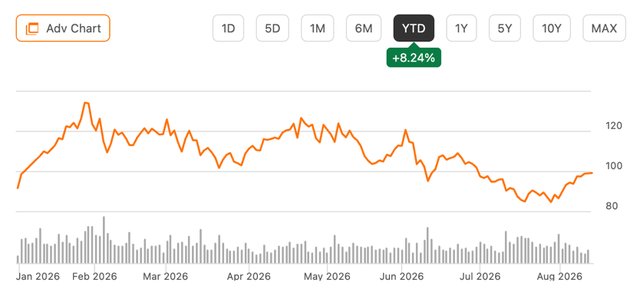
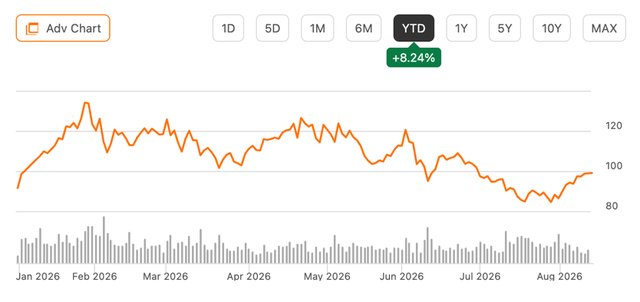
JPMorgan Reveals $650 Million Stake in BlackRock Bitcoin ETF The bank's latest 13-F filing on August 13, 2026, disclosed holdings of about 17.8 million shares in the iShares Bitcoin Trust, valued at roughly $650 million, after adding $400 million in Q2 alone. This builds on steady buys from 3 million shares at the end of 2025 to 8.3 million by Q1 2026, even as Bitcoin prices dipped at times. The move highlights traditional finance's rising comfort with regulated Bitcoin exposure, despite Dimon's 2017 vow to fire anyone trading crypto.

The sec will officially announce new #bitcoin and crypto rules tomorrow the first major formal crypto rulemaking in sec history while congress stalls on the clarity act, the sec is moving forward america is getting clearer rules for crypto here we go


callswithmatt @callswithmatt
352 Followers 3K Following saving little bits, watching familiar companies, and still forgetting grocery lists 🛒📈 often
Scoop @Scoop88837225
740 Followers 4K Following Try to be healthy and have fun. Like kind people. Love my family!
Claire Salomon @Jessro62
52 Followers 1K Following

David Hash @hashjf4
4 Followers 18 Following
Lucas Morgan @noturatta
1K Followers 219 Following Helping you learn about investing, the stock market, crypto, and building financial knowledge Join us 👇🏻 https://t.co/LqzhQG2SKT
Market Lens @Market_Lenfz
890 Followers 254 Following Cryptocurrency charts, price trends, and market structure—follow us for real-time updates.
Grace Moore por @BTCvxo
567 Followers 206 Following
Bitcoin Signals @Memecoinusdt
569 Followers 286 Following
WallStreetBets Pro @Trumpsp9
610 Followers 203 Following


Stróman, 💸 puszta... @AgrarX
2K Followers 4K Following The left kills. Official account of myself ;-p European Haut-Savoyard. Love to put&let my finger where that hurts. No link with Ugar Brewery.
CryptoSage @_MsHoneyDipXO
2K Followers 745 Following 📈 Helping you invest smarter. Insights, strategies & wealth-building ideas. Join us 👇🏻 https://t.co/jDpVHVDzyV

🇱🇾 Dr.bojaa �... @pinkros87735000
5K Followers 430 Following فلا أحَبَّ للمرءِ مِن أن يجِدَ إلى جانِبهِ جلِيساً يستطِيعُ أن يسكُبَ نفسَهُ في نفسِهِ ويُفضِي إليه بسَرِيرةِ قلبِه ... ❤️
♍️ @w6ka9
12K Followers 3K Following
اشدوق🎀🎈 @soso5sasa
11K Followers 1K Following "طُفُولِيَّةُ الأُنُوثَةِ، أَرْبَعِينِيَّةُ الفِكْرِ، عِشْرِينِيَّةُ العُمْرِ، وَبَيْنِي وَبَيْنَ الحَيَاةِ قِصَّةُ كِبْرِيَاءَ لَنْ يَفْهَمَهَا أَحَدٌ." 🩶🦋👑
Grace Moore @WSJ_Signal
2K Followers 176 Following Real-time cryptocurrency and stock research insights. 🌎📊 Breaking market updates. Bitcoin. Digital assets. Macroeconomics. ⚠️ Not investment advice.
Squeaker @hackernc1
22K Followers 15K Following Army vet. Retired air traffic controller. Dems are killing America and the GOP is no better. #BillsMafia #MAGA🚫DM's
BIG AL @AlexBabayan6
32K Followers 12K Following TRUST IN GOD IN THIS EVIL WORLD / PLEASE DON’T FOLLOW
Adam Sanderson The Tr... @mustbeprevail
21K Followers 16K Following He is (God)Allah,the One(God)Allah,the Eternal,Absolute;He begetteth not,nor is He begotten;And there is none like unto Him.The Holy Quran 112:1-4
Kevin Fortin @nitrof_nivek
7K Followers 6K Following ☠️ Don't Tread on Me 🐍 Freedom 🇺🇸 Join, or Die 🐍1776🇺🇸 MAGA 🇺🇸Anti-communist/✌Dedicated To the invisibles Who opened my eyes To what is now visible…
Shivam @ThethirdInsight
3K Followers 3K Following By Interest: India• Geopolitics • AI • Economics By Profession: Marketing & Analytics

TheLawnEgo @TheLawnEgo
4K Followers 4K Following Malo periculosam, libertatem quam quietam servitutem - Thomas Jefferson 🇺🇲 AMERICA FIRST CONSERVATIVE🇺🇲 #2A 7.793
Martin @Martin_8818_
1K Followers 892 Following Quis ut Deus? Traditional Catholic Forgive my language, I’m a blue collar lifelong New Yorker, it’s just how we speak. 😁 ✝️🇻🇦🇮🇪🇮🇹🏴🇩🇪

Crypto investment com... @_Matthewte
838 Followers 79 Following Daily crypto news, blockchain education, market insights, and security tips. Educational content only—not financial advice.
Dr. Nathaniel Crawfor... @CrawfordM2a
767 Followers 180 Following We provide Signals,Analysis and News about the cryptoworld! 🚀
Investment Diary @Matthewi68
606 Followers 136 Following We believe in cryptocurrencies, stocks, and the future of financial markets. We focus on informing and educating in a clear, objective, and responsible manner.
Capital Radar @_LMadeline
717 Followers 91 Following Your Guide to Success 🇬🇧 💰 Wealth | 💼 Career | 📈 Lifestyle Helping you grow your income, accelerate personal growth, and improve your quality of life.
Dr. Vincent Holloway @DrVincents6
599 Followers 201 Following News, Memes, Charts, Hopium, Market analysis and Latest crypto updates
US Investment Forum @Harrington6M
632 Followers 94 Following Check out the latest Bitcoin, Crypto, Stocks, and Investment news, insights & guides daily
Dr. Graham Sterling @_LGraham
824 Followers 3K Following Focused on cryptocurrency education, market analysis, and practical trading insights. Learn the fundamentals, manage risk, and make informed investment decision
Matthew Spencer CFA, ... @MatthewCrypto66
833 Followers 534 Following Your ultimate radar for TradFi Macro, Crypto Alpha, and Global Conflicts. ⚡️ Fast. Accurate. Hypersonic updates 24/7. 🚀
Ivanka Trump @IvankaTrump
11.1M Followers 2K Following
Melania Trump 45 Arch... @FLOTUS45
14.3M Followers 8 Following This is an archive of a Trump Administration account, maintained by the National Archives and Records Administration.
Peter Reckell @peterreckell
74K Followers 146 Following Loden's Dad, @KellyMoneymaker hubby, Treading lightly on MOTHER EARTH!
Kristian Alfonso @kristianalfonso
107K Followers 309 Following Wife❤️ Mother❤️ Actress https://t.co/VxhkZ9toHU kristianalfonso Instagram
Deidre Hall @DeidreHall
87K Followers 78 Following Mother and Actor on @dayspeacock. Connect on Facebook: https://t.co/IrZ6SuAyan & Instagram: https://t.co/g2m42dtIcn
President Trump 45 Ar... @POTUS45
29.8M Followers 38 Following This is an archive of a Trump Administration account, maintained by the National Archives and Records Administration.

The New York Times @nytimes
53.9M Followers 847 Following We seek the truth and help people understand the world. All election coverage is free in our app. https://t.co/e2FWJZP3Nb
ABC 7 Chicago @ABC7Chicago
861K Followers 829 Following Follow ABC 7 Chicago news for Chicago news, weather, sports and the most experienced Chicago news team
Hillary Clinton @HillaryClinton
29.3M Followers 963 Following 2016 Democratic Nominee, SecState, Senator, hair icon. Mom, Wife, Grandma x3, lawyer, advocate, fan of walks in the woods & standing up for our democracy.
Bill Gates @BillGates
65.3M Followers 573 Following Sharing things I'm learning through my foundation work and other interests.
Jessica Alba @jessicaalba
6.8M Followers 2K Following Mom of 3, Founder of The Honest Company, amateur chef, terrible speller, loyal friend, hilarious at times... I play make believe for a living
Bill Clinton @BillClinton
12.3M Followers 39 Following Husband, Father, Grandfather, 42nd President of the United States, Founder of @ClintonFdn, Author of CITIZEN 🇺🇸
Mark Cuban @mcuban
8.6M Followers 2K Following Dunking on the pharma industry with @costplusdrugs.com, the lowest prices on meds anywhere. check it out !
Department of State @StateDept
6.8M Followers 410 Following Leading U.S. foreign policy and American diplomacy since 1789. For all Department accounts: https://t.co/VpbtF1M8HK
The White House 45 Ar... @WhiteHouse45
22.6M Followers 12 Following This is an archive of a Trump Administration account, maintained by the National Archives and Records Administration.
White House Archived @ObamaWhiteHouse
10.7M Followers 221 Following This is an archive of an Obama Administration account maintained by the National Archives and Records Administration (NARA).
You might like

















