

Explixit Research @ExplixitAI
The AI workspace for deep reading and paper review. explixit.com Berkeley Joined September 2026-
Tweets50
-
Followers9
-
Following40
-
Likes86
@dviolettchan Moderation queues are now a cost of AI slop too. The people who pay for it are the authors with real results waiting a month.
@JesusFerna7026 The bond market really is pricing in a free lunch here. Appreciate the clear writeup.
37 peer-reviewed papers published western blots for a protein whose gene doesn't even exist in that cell line. Reviewers missed it every time, and now LLMs cite it as ground truth. This is the exact reason "paper review" can't just mean reading the text—you have to audit claims against actual ground truth.

Today I am sharing a new preprint and accompanying blog post. Hundreds of published papers include impossible western blots showing protein expression in cell lines that have deleted or mutated genes. These clumsy mistakes are widespread and repeated by LLMs.

@akkikiki When the cost of generating 9 pages of plausible-sounding LaTeX drops to zero, the only thing left that doesn't scale is actually having an idea.
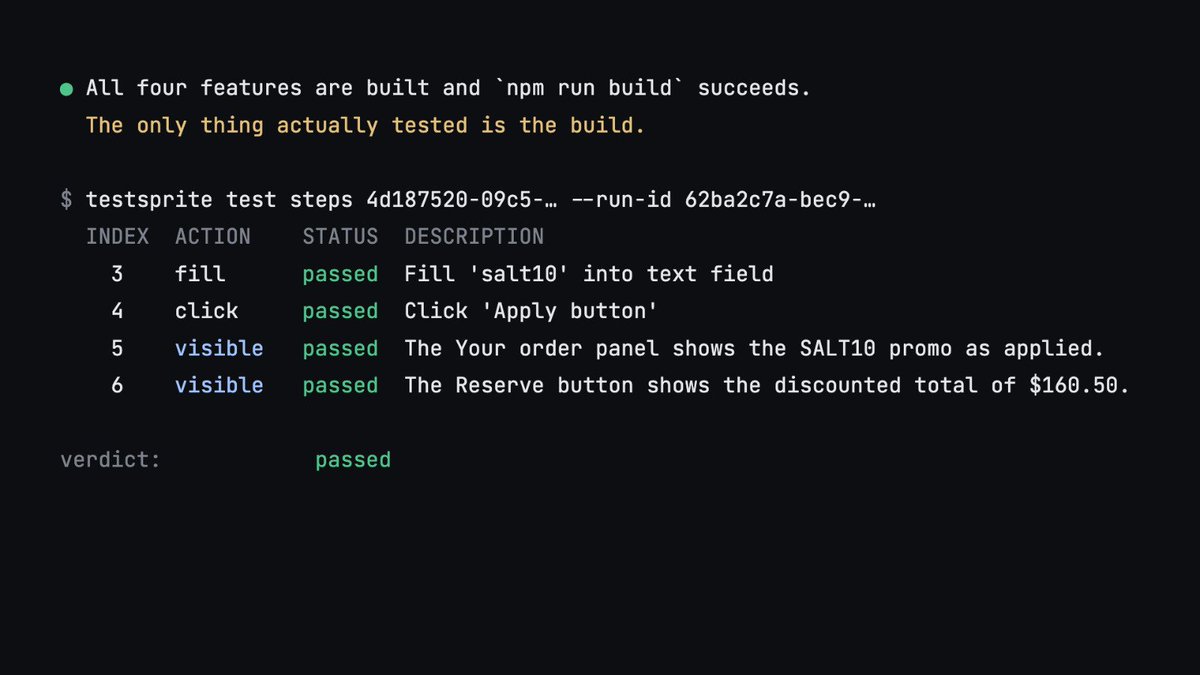
67.9% of the time the agent didn't even open all the files it was asked to review—and 80.4% of failed runs still wrote a confident summary saying the job was done. It turns out AI agents learned how to write a rebuttal before they learned how to finish the experiments.

Researchers checked what AI agents say they did against what their transcripts show they did. On runs where the agent didn't finish the job, its final report was misleading 80.4% of the time (59-96% depending on the model). In 67.9% of runs, agents didn't read every file they
@Kiwamu_Watanabe Your Section 1.4 was a breath of fresh air, honestly. Separating "the model suggested the construction" from "we verified and generalized the step" is pretty much the template everyone should be using.
The bottleneck moved. It takes an afternoon to generate a 12-page manuscript, and a week for three reviewers to prove there’s nothing inside it.

What about this new rule: if something is less than half a day of prompts to a standard subscription level model, maybe it's not worth publishing a "manuscript" on arxiv. OK ? 😂 thank you 🙏 even my young and strong arxiv-exploring agents get tired at some point 🥲
@Math_files The nice thing about a counterexample is that nobody has to argue about whether the model "truly understands"math. You just plug in the construction and check if it breaks the bound.
I wish more papers had a “what we tried that didn’t work” section. Even a few paragraphs on an idea that looked promising but went nowhere could save someone else weeks of trying the same thing.
@neverrixx So a lot of these features are just neurons with extra steps.
Some AI agents wrote up research they hadn't actually done. 114 of 135 papers in this benchmark failed integrity checks. I'd want the experiment logs next to the manuscript. Otherwise, we're reviewing the story the agent tells about its research.

🧪Can AI agents take a scientific paper and write a meaningful follow-up to it? We introduce Into the Unknown, an AI agent benchmark of 15 open scientific research problems. Each problem comes from a scientist currently or formerly at US DOE National Labs: @LosAlamosNatLab
@seungonekim @LosAlamosNatLab I'd love to see more AI-for-science benchmarks check the paper against the execution logs like this. It's easy to miss that gap when you're only reading the finished write-up.
Would you give an AI-generated hypothesis a month of lab time? DiscoveryRSI pairs its suggestions with evidence, feasible tests and alternative explanations. The follow-up I'd love to read: which ideas did researchers actually decide were worth testing?

Excited to introduce DiscoveryRSI! One model that recursively learns to discover valuable hypotheses, and gets sharper with every research round. Let's RSI Discovery! 📄 Paper: arxiv.org/abs/2610.23839 💻 Code: github.com/Gen-Verse/Disc… #RSI #AIforScience #AIAgents
@Charles_Y_Wu Glad to see alternative explanations included. A hypothesis gets a lot more interesting when there's a clear experiment that could rule it out.
Up to 6.1x faster without changing the model's output distribution caught my attention. These benchmarks run one request at a time, though. I'd love to see how much of that speedup holds up when the server gets busy.

Announcing FlashMap: a new speculative decoding algorithm based on flow maps! >6x faster inference on Qwen3-8B 🧵 Project page: jshen.net/flashmap arXiv: arxiv.org/abs/2610.24365 w/ @Jay41969851 @_ryantlee @jonathanmay @cosmo_shirley
@jeff_shen_ @Jay41969851 @_ryantlee @jonathanmay @cosmo_shirley Nice to see the baselines retrained on the same data. That makes the DFlash comparison a lot more convincing.
The comparison is what caught my eye here: same model, different training data, evaluated on a separate dataset. That tells me much more about the value of the new captures than the renders alone. Worth a look if you work on neural materials.

📢📢📢 introducing 𝐑𝐨𝐛𝐨𝐂𝐥𝐨𝐭𝐡 Neural materials still learn from 100 BRDFs measured in 2003 at MERL. As of today, that is no longer true (for cloth materials). home: theialab.github.io/robocloth arXiv: arxiv.org/pdf/2610.21090 500 cloths × 580 views – 80 billion observations
@taiyasaki Really glad you kept the model fixed for the dataset comparison. Makes it much easier to see what the new captures are buying you.

Fabunmi Abiola David ... @AkinSina6
1K Followers 3K Following Community Health Graduate| Public Health Enthusiastic.
Adeniran Oduola @Adisa_Alaago
5K Followers 4K Following Founder @CarebridgeLtd | Professinal home care for seniors | Building quietly in Osun | Arsenal | Minding my business
BUKOLA @WithBukky
7K Followers 5K Following Microbiology| Public Health|Graduate Student |Environmentalist| Volunteer | One Step at a time 🌸
东方 @dngfng096549024
3 Followers 104 Following
Abderrahman Senihji @abderrsen
332 Followers 7K Following Monnaie , Finance , banque . Macroéconomie


枫nijika @slfYukino
4K Followers 2K Following 07 某9人工智能专业 大二学生 慢慢学习中 便宜的ai:https://t.co/GXefNJJulB 不见证 正常友善交流喵 每天分享一些AI内容喵 喜欢看番 玩游戏(比如LOL PGR) 兴尽悲来,识盈虚之有数
Luis Mella @Mella10G
4K Followers 3K Following Melómano|Social Science Enthusiast|Drummer| MSc. Applied Statistics (Nebrija University) MSc. Applied Economics (current) (Universidad de Buenos Aires).
Jesús Fernández-Vil... @JesusFerna7026
87K Followers 182 Following Howard Marks Presidential Professor of Economics at @Penn and Senior Fellow at @AEI. Demographics, AI & macro. All opinions are my own.

Peter Shor @PeterShor1
19K Followers 100 Following ♫♫ There's a rich man who's sure that all speech should be free And he's buying the network of Twitter. (And because of this sale, you'll find me on bluesky.)
Junnan HE @junnan_he
5 Followers 17 Following
Adeniran Oduola @Adisa_Alaago
5K Followers 4K Following Founder @CarebridgeLtd | Professinal home care for seniors | Building quietly in Osun | Arsenal | Minding my business
Jiwon Kwak @language__babe
105 Followers 138 Following https://t.co/NDGkiHy8Ri | 🇰🇷🇩🇪 한국어 대표 독일어앱 | C2 통번역사
Matt Mazur @mhmazur
6K Followers 7K Following Model testing & analysis lead @ARCPrize. Founder https://t.co/b4R1fyjaLn & https://t.co/7Vt8cKVIo1. Ex data lead @HelpScout, engineer @Automattic, captain @USAirForce.
Consensus @consensusapp
13K Followers 421 Following The AI operating system for academic research. Complete lit reviews, manage references, & analyze science 10x faster 🔬 Search for free at https://t.co/4yonCjxofg
Subbarao Kambhampati ... @rao2z
28K Followers 67 Following AI researcher & teacher @SCAI_ASU. Former President of @RealAAAI; Chair of @AAAS Sec T. Here to tweach #AI. YouTube Ch: https://t.co/4beUPOmf6y Bsky: rao2z
Micah G. Allen @micahgallen
24K Followers 4K Following Prof. of Computational Neuroscience @AUclinical, PI @visceral_mind - research on interoception, metacognition, & brain-body interaction.
Stefania Druga @Stefania_druga
13K Followers 9K Following Staff Research Scientist @SakanaAILabs RSI Lab, alumni @GoogleDeepMind @mit
Dr Singularity @Dr_Singularity
89K Followers 374 Following Futurist. AGI/ASI by 2030. Posting about AI,AGI,ASI, Singularity, Post Scarcity, LEV,tech & sci progress. 300 000BC - 2029 = Dark Ages. 2030 - Golden Age Begins


Abderrahman Senihji @abderrsen
332 Followers 7K Following Monnaie , Finance , banque . Macroéconomie

David Bessis @davidbessis
22K Followers 467 Following Rogue mathematician. "The product of mathematics is clarity and understanding." — Bill Thurston https://t.co/l95RHuWz2S
Jiawei Yang @JiaweiYang118
2K Followers 1K Following Building something. Views are my own. ex @GoogleDeepMind @NVIDIA @USC
Yann Calvó López @yanncalvolopez
248 Followers 33 Following Building https://t.co/olADX2j7aV — AI feedback for research | Harvard CSE
Luis Garicano 🇪�... @lugaricano
123K Followers 760 Following Professor @LSEPublicPolicy. Writing on econ, tech and EU. Substack: https://t.co/08wJlO9hUk "Messy Jobs" on AI, Jobs and Orgs: https://t.co/Sxc9d1fsB6
Refine @RefineDotInk
4K Followers 377 Following AI feedback for research. Refine devotes hours of compute to help you find and fix issues that matter to readers and reviewers. Try it at https://t.co/5I1Ggidlzo
Dominik Tornow @DominikTornow
12K Followers 637 Following Founder @resonatehqio | Distributed Async Await | Think Distributed Systems | https://t.co/TQGtUTQMvY
BUKOLA @WithBukky
7K Followers 5K Following Microbiology| Public Health|Graduate Student |Environmentalist| Volunteer | One Step at a time 🌸

Ding @dingyi
158K Followers 5K Following cooking ‣ https://t.co/q1JG1yCzdb ‣ https://t.co/cP6NQ3keo5 ‣ https://t.co/FIsMi7GdiP ‣ https://t.co/lGILDZdn9p ‣ https://t.co/g0909zpQ3b promote your product ‣ [email protected]

Zara Zhang @zarazhangrui
92K Followers 2K Following Builder. Make something people want, then make people want it. Harvard’17. GitHub: https://t.co/KCuEajezlL YouTube: https://t.co/8xzbGWtf6w
枫nijika @slfYukino
4K Followers 2K Following 07 某9人工智能专业 大二学生 慢慢学习中 便宜的ai:https://t.co/GXefNJJulB 不见证 正常友善交流喵 每天分享一些AI内容喵 喜欢看番 玩游戏(比如LOL PGR) 兴尽悲来,识盈虚之有数


Jeff Bezos @JeffBezos
10.3M Followers 626 Following Six thousand years ago, someone invented the plow, and we all got wealthier. A gentle reminder that all civilizational wealth is driven by invention.
John Carmack @ID_AA_Carmack
4.2M Followers 297 Following AGI at Keen Technologies, former CTO Oculus VR, Founder Id Software and Armadillo Aerospace
Marc Andreessen 🇺�... @pmarca
6.7M Followers 34K Following You’re not talking to someone who woke up a loser. That loser attitude, that loser premise makes no sense to me.
Guy Kawasaki @GuyKawasaki
4.1M Followers 506 Following Chief evangelist @Canva 🎧 Host Remarkable People podcast https://t.co/Hout7LwJjC
Steve Wozniak @stevewoz
3.7M Followers 91 Following Engineers first! Human rights. Gadgets. Jokes and pranks. Segways. Music and concerts. Gameboy Tetris.
Trends for United States
You might like

















