

Hanner @HannerExe
Tech | AI | Gaming Joined February 2025-
Tweets52
-
Followers74
-
Following0
-
Likes502
Capcom confirmed unauthorized access to CAPCOM ID that affected 11,774,247 records worldwide. The main data exposed is email addresses plus system identifiers such as account creation time, last login time, login count, and the IP used on the last login. Of those records, 43 also included date of birth, gender, country or region, and nickname. Capcom said credit card information was not involved. It also confirmed that passwords were changed without authorization on 196 accounts. Those have already been reset. The company has not confirmed that any original customer set passwords were compromised. Services that use CAPCOM ID remain available. Capcom is warning users to watch for phishing emails that could use the leaked addresses.

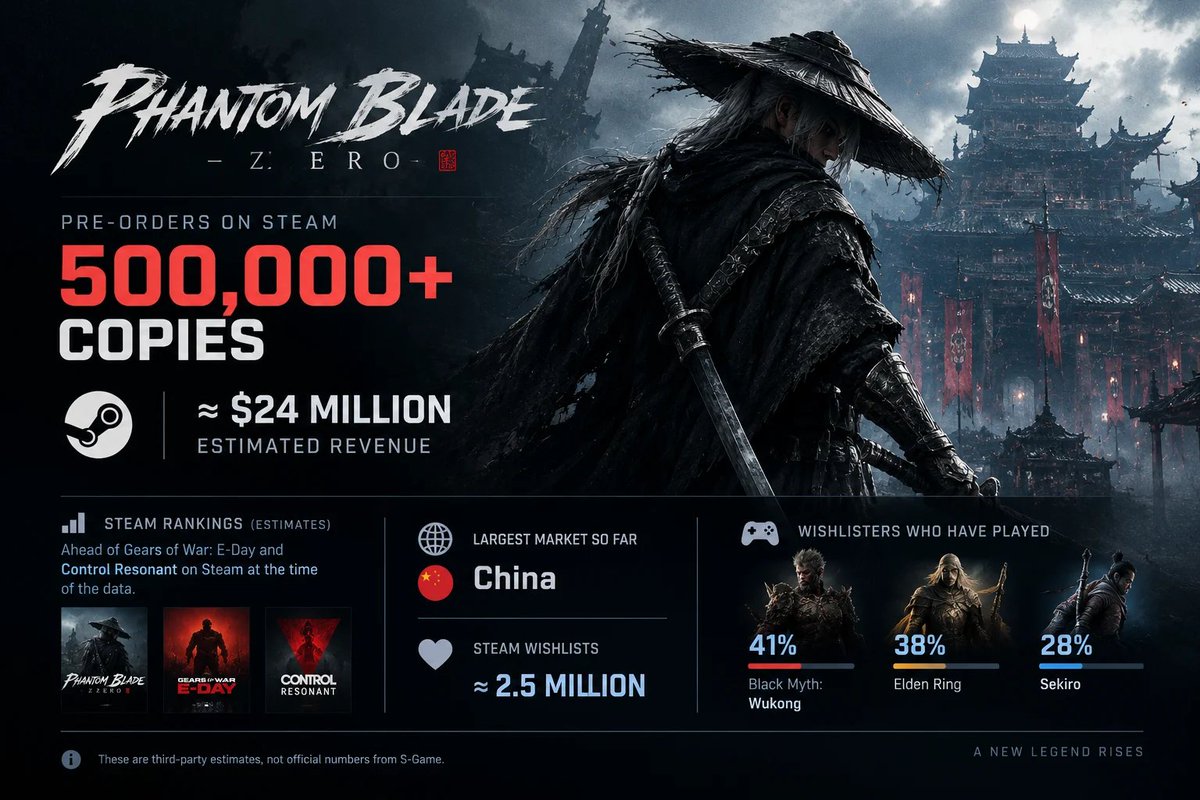
Phantom Blade Zero has already moved an estimated 500,000 copies on Steam through pre-orders, according to Alinea Analytics’ Rhys Elliott. That works out to roughly $24 million in revenue before the game is even out. The same estimates put it ahead of Gears of War: E-Day and Control Resonant on Steam at the time of the data, with China as its largest market so far. It also sits at about 2.5 million wishlists. Among those wishlisters, roughly 41% have played Black Myth: Wukong, 38% have played Elden Ring, and 28% have played Sekiro. These are third-party estimates, not official numbers from S-Game. Still, a Chinese action game clearing half a million Steam pre-orders days before launch is the kind of early signal that usually gets attention.
Modern Warfare 4's DMZ mode is only a couple of days old, and one unlockable trait is already dominating the conversation. Possum lets a fully killed operator self-revive once per match. You return to Last Stand with full health, then have to get yourself up. The whole process takes roughly ten uninterrupted seconds, and you lose the loot you were carrying. It is not the same as the normal downed-state revive that every player starts with. That single change means a body you just finished can still be a threat. Players and creators have already called it broken for an extraction mode, where the usual assumption is that a finished fight stays finished. Whether it gets tuned, limited, or left as a high-risk high-reward option is the open question.
@MrIrrevant05 There is no specific date announced yet. It is scheduled to release "in the days to follow" its main launch.
Cyberpunk 2077's 2.5 update went live with the expected Edgerunners 2 hooks: new quests, cyberware styling, cross-platform mods, and a Double Trouble perk that lets V dual wield Power pistols and revolvers. What the patch notes left out is a quiet package of Witcher 3 items that players found in V's apartment after a text from Ariadne. The set includes the Sihil sword, a Boar Carver knife, the Professor's spectacles, and Ursine jacket and pants based on Bear School gear. None of it was highlighted in the official notes. It's the second time CD Projekt Red has slipped Witcher themed gear into Night City, and this batch requires no extra ownership or account linking.

Arkane Lyon has three weeks to find a buyer. Microsoft set a hard November 13 deadline. 217 people, plus whatever is left of Marvel's Blade, are waiting on the answer. If you've spent time in Dunwall or Blackreef, this one lands differently.
EA closed the BioWare and cancelled the next Mass Effect. A day later an internal trailer for Mass Effect: Universe leaked. Known: pre-production assets, bar scene, Liara appears. Still unclear: how far the project actually was. Worth watching if you ever cared about the series.

For years, Battlefield had been associated with large-scale combat on PC. On October 24, 2005, Electronic Arts brought the series to console players with Battlefield 2: Modern Combat, released for the PlayStation 2 and original Xbox. The challenge was not simply shrinking a PC experience onto a television screen. Console players needed a game designed around a different control scheme, while the developers still wanted to preserve the chaos of large battles involving infantry, tanks, helicopters, and other vehicles. One of its most distinctive ideas was a feature called "hot swapping." In the single-player campaign, you could switch control to another friendly soldier on the battlefield. Pinned down by enemies? Take control of an ally in a better position. Facing a tank? Switch to a soldier equipped to counter it. Rather than treating the battlefield as a place occupied by a single character, the game encouraged players to think across multiple units and perspectives. Its multiplayer mode also supported battles of up to 24 players, bringing team-based combat to console audiences. Today, game developers build on far more sophisticated networking, simulation, and AI systems. But the underlying design challenge remains familiar: making complex, dynamic worlds feel responsive and intuitive to the person holding the controller. Battlefield 2: Modern Combat was a reminder that bringing a game to a new platform can require more than a port. Sometimes, it means rethinking how the experience should work.
In 2001, carrying a thousand songs meant something very different from opening a music app on your phone. On October 23, Apple introduced the original iPod, a portable music player with a 5 GB hard drive that could store up to 1,000 songs. It weighed just 6.5 ounces, offered up to 10 hours of battery life, and cost $399. For the first time, an entire music collection could fit into a device small enough to slip into a pocket. But storage was only part of the story. Apple paired the hardware with iTunes and a simple syncing process. Connect the iPod to a Mac, and your music library and playlists would transfer automatically. Its scroll wheel made navigating hundreds of songs practical without a complicated interface. The iPod was not the first MP3 player. Its achievement was making digital music feel convenient and accessible. It helped establish the product experience that Apple would later build on with the iTunes Music Store and, eventually, the iPhone. Today, we carry millions of songs in streaming libraries and ask AI to recommend what to hear next. The iPod belongs to an earlier era, but its central design lesson still holds: technology becomes powerful when it makes something complicated feel effortless.
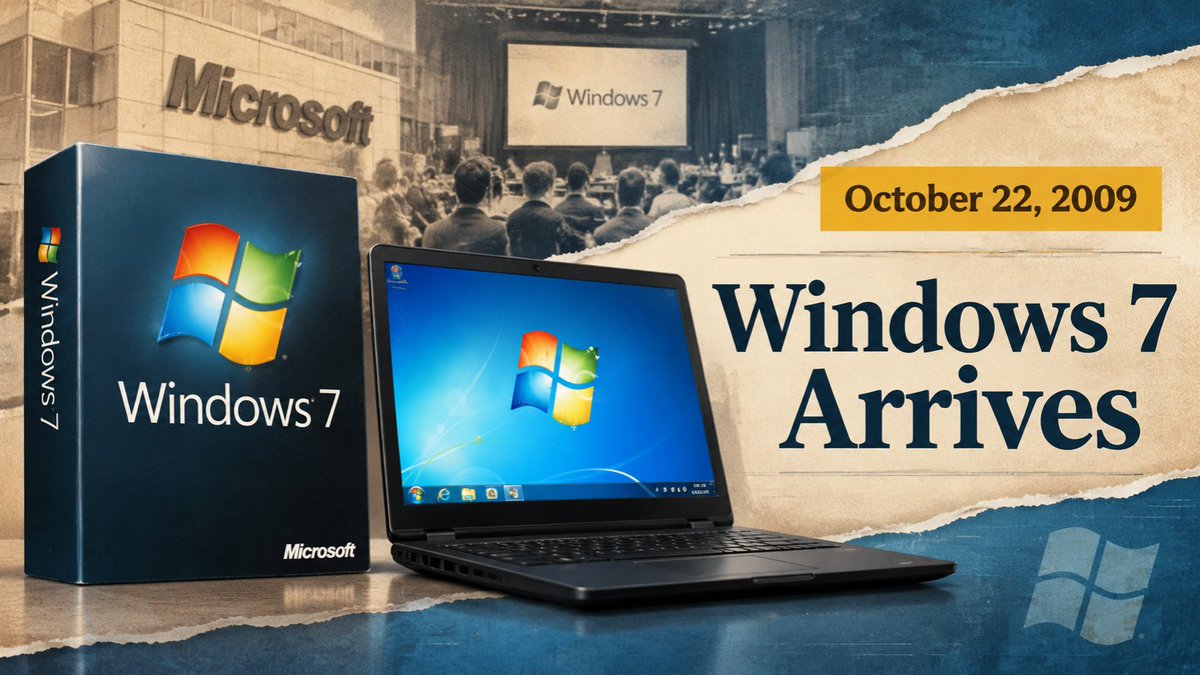
Sometimes, the most successful software upgrade is not about adding more features. It is about making the computer feel right again. On October 22, 2009, Microsoft released Windows 7 worldwide. It arrived after Windows Vista had attracted criticism over performance, compatibility, and the overall user experience. Microsoft needed an operating system that felt more responsive and dependable, without forcing people to relearn how to use their PCs. Windows 7 focused on refining the everyday experience. Its redesigned taskbar made it easier to manage open applications, while features such as Snap simplified arranging windows on the desktop. Performance improvements, broader hardware and software compatibility, and a less intrusive approach to User Account Control helped address practical frustrations. The development process also reflected a lesson in product design. Microsoft said feedback from millions of customer sessions and eight million beta testers had helped validate its research into simplifying everyday tasks. The release was a collaborative effort involving engineers, designers, developers, hardware partners, and users. Windows 7 eventually became one of Microsoft's most enduring desktop operating systems. Its extended support ended in January 2020, closing a remarkable chapter in personal computing. Its legacy offers a useful reminder for today's AI industry: powerful technology matters, but so does the experience of using it. The products people keep are often the ones that make complicated things feel simple.
On October 21, 1824, a bricklayer from Leeds, England, received a patent for a material he called Portland cement. His name was Joseph Aspdin, and his invention would become an important milestone in the history of modern construction. Aspdin's process involved heating limestone, mixing it with clay and water, drying the mixture, firing it in a kiln, and grinding the resulting material into a fine powder. When mixed with water, it could be used to produce an artificial stone. He named it Portland cement because the hardened material resembled Portland stone, a prized building limestone from Dorset, England. But there is an important distinction. Aspdin's original cement was not quite the same as the Portland cement used today. Later improvements by his son William and other manufacturers helped develop the stronger, more familiar material. Over time, cement became fundamental to the construction of buildings, bridges, roads, tunnels, and water systems. Today, even the data centres powering cloud computing and AI depend on the physical infrastructure made possible by modern construction materials. A patent granted two centuries ago helped mark the beginning of an industry that continues to shape the world around us.

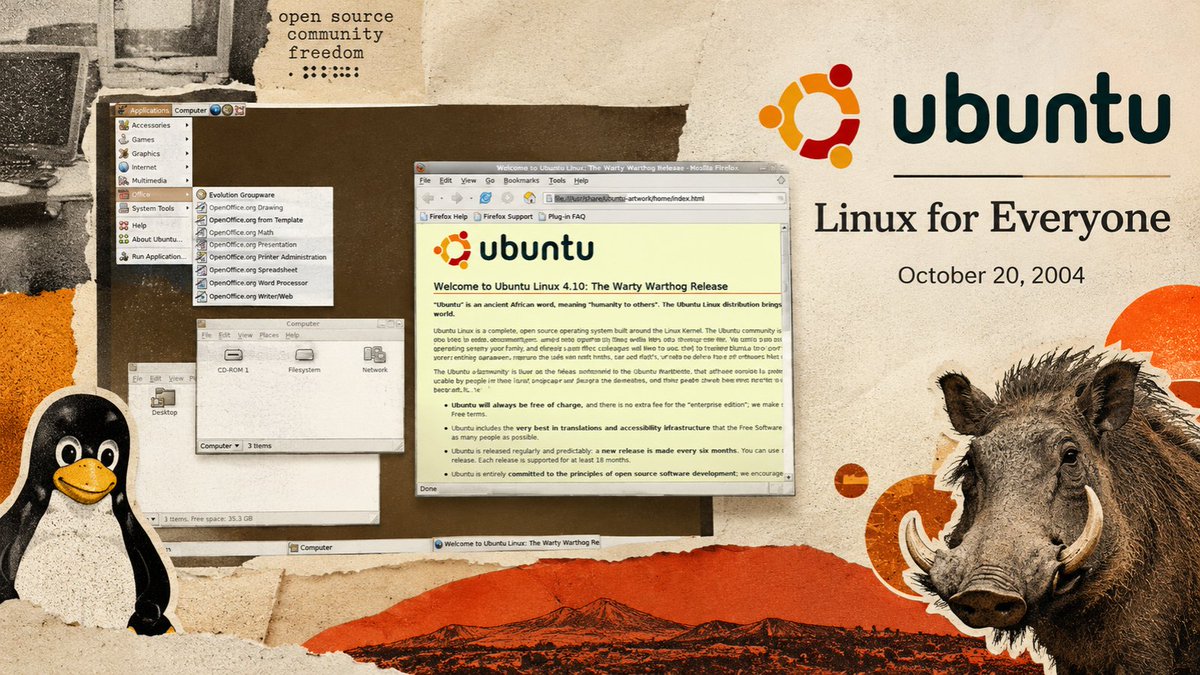
In 2004, using Linux often meant being comfortable with technical details that could discourage newcomers. Ubuntu set out to make the experience simpler. On October 20, 2004, Mark Shuttleworth announced the first public release of Ubuntu, version 4.10, known as Warty Warthog. Built on Debian, it combined a streamlined installation process with a carefully selected collection of software, including GNOME 2.8, Firefox 0.9, OpenOffice(.)org 1.1.2, and Evolution 2.0. But Ubuntu's ambitions went beyond packaging software. The project committed to being free of charge, providing regular releases every six months, and offering 18 months of security and technical support for each release. Users could even request installation CDs by mail at no cost. That approach helped make Linux more accessible to people who wanted an alternative to proprietary operating systems without having to assemble every component themselves. Ubuntu also demonstrated how a commercial organization and a global community of contributors could work together on a shared operating system. Today, Ubuntu runs on desktops, servers, cloud infrastructure, and systems used by developers building AI applications. Its original release was not the beginning of Linux, but an important step in making the open-source desktop more approachable. Sometimes, expanding access to technology begins with making it easier to use.
In 1948, electronic computing was still an emerging technology. The machines were expensive, difficult to build, and in short supply. Researchers and government agencies were beginning to discover how much scientific work could benefit from calculations performed at electronic speed. On October 19, the US National Bureau of Standards authorized the construction of the Standards Western Automatic Computer, or SWAC. The machine would be built at the Institute for Numerical Analysis in Los Angeles, where the National Bureau of Standards was working with the University of California, Los Angeles. The project was designed to deliver practical computing power using existing technology. Its eastern counterpart, SEAC, had a different emphasis: testing computer components and systems while also performing useful calculations. Designed by Harry Huskey and his team, SWAC was dedicated in August 1950. It went on to support scientific research and military computations, helping researchers tackle problems that would have been painfully slow to solve by hand. The decision to build SWAC reflects an important stage in computing history. Progress depended not only on inventing new components, but also on turning promising technology into machines that scientists could actually use. Today, AI infrastructure faces a related challenge: making powerful computing systems available for real research and practical work.

Every time you type a website address, you rely on a system most people never think about. The internet runs on numerical IP addresses, but remembering strings of numbers for every website would be impractical. The Domain Name System (DNS) solves this problem by connecting familiar names, such as example(.)com, to the numerical addresses computers use to communicate. As the internet expanded, coordinating these names became an increasingly important responsibility. In 1998, the Internet Corporation for Assigned Names and Numbers (ICANN) was established to help coordinate the internet's unique identifiers and support a stable, globally interoperable network. Its role is more limited than many people assume. ICANN does not own the internet, control everything published online, or decide which websites people are allowed to visit. Instead, it coordinates critical parts of the naming and addressing systems that help billions of devices find one another. That distinction matters. The internet is not governed by a single organization controlling every layer. It depends on technical standards, distributed infrastructure, and cooperation among many participants. One of the internet's most important achievements is not just connecting the world. It is making that connection work across systems run by different people, organizations, and countries.

Before IMDb became the place to settle arguments about actors, films, and forgotten credits, it began as one movie enthusiast’s attempt to remember what he had watched. Col Needham had started recording films in a paper diary before building a database on his home computer. As he connected with other film enthusiasts through early internet discussion groups, they began pooling their information and expanding their collections of movie and cast details. On October 17, 1990, Needham published the first version of IMDb software online. It used Unix shell scripts to let people search collections of movie information, turning scattered lists into something far more useful: a searchable, shared resource. The World Wide Web had not yet become the public platform we know today. IMDb grew through contributions from volunteers around the world. It later moved onto the web, incorporated as a company, and was acquired by Amazon in 1998. The interesting part of this story is how little the original problem has changed. We still need reliable ways to organize information, connect related facts, and find the right answer among millions of records. Today, AI can help us explore that information conversationally. But useful answers still depend on the quality of the knowledge underneath. IMDb began with a simple idea: movie information becomes more valuable when everyone can search it.

In 1959, a new computer arrived from a company that wanted to challenge the established giants of the industry. On October 16, Control Data Corporation (CDC) introduced the CDC 1604, a transistorized computer designed by Seymour Cray. It was among the most powerful computers of its era, built for demanding scientific calculations, real-time data processing, and military applications. The timing mattered. Computers were moving away from vacuum tubes toward transistors, which made it possible to build machines that were more practical for sustained, demanding computation. The CDC 1604 helped establish Control Data as a serious force in scientific computing. But the machine's significance went beyond its launch. Cray would later become one of the defining figures in supercomputing, pursuing a question that still drives the industry: how much computing power can engineers extract from a machine? That same question shapes today's race to build faster AI accelerators, larger computing clusters, and more efficient data centers. The hardware has changed beyond recognition. The underlying challenge has not. On October 16, 1959, the CDC 1604 marked an important step in the journey toward modern high-performance computing.

In 1957, computers were still expensive, specialized machines, and the people working with them came from very different professional backgrounds. Engineers, scientists, mathematicians, and business specialists were all exploring what these machines could do, but there was a growing need for a common place to exchange knowledge and experience. On October 14, 1957, the British Computer Society (BCS) was formally incorporated. Its origins lay in the merger of the London Computer Group with an association of scientists. The aim was practical: bring people together, share information, discuss emerging techniques, and help a young field develop. Maurice Wilkes, the Cambridge computer pioneer who became the Society’s first president, later explained that its original purpose was primarily to create a forum for sharing information and experience. Professional recognition came later, as computing grew and more people entered the field. That evolution matters. Computing was becoming more than a collection of machines and technical experiments. It was developing into a discipline that needed education, professional standards, and a way to consider its wider effects on society. In 1984, BCS received a Royal Charter, formalizing its role in advancing computing for public benefit. Today, as AI systems become more capable, the same underlying questions remain: How do we share expertise, establish responsible standards, and ensure that technological progress serves people? The machines have changed enormously since 1957. The need for a responsible computing profession has not.

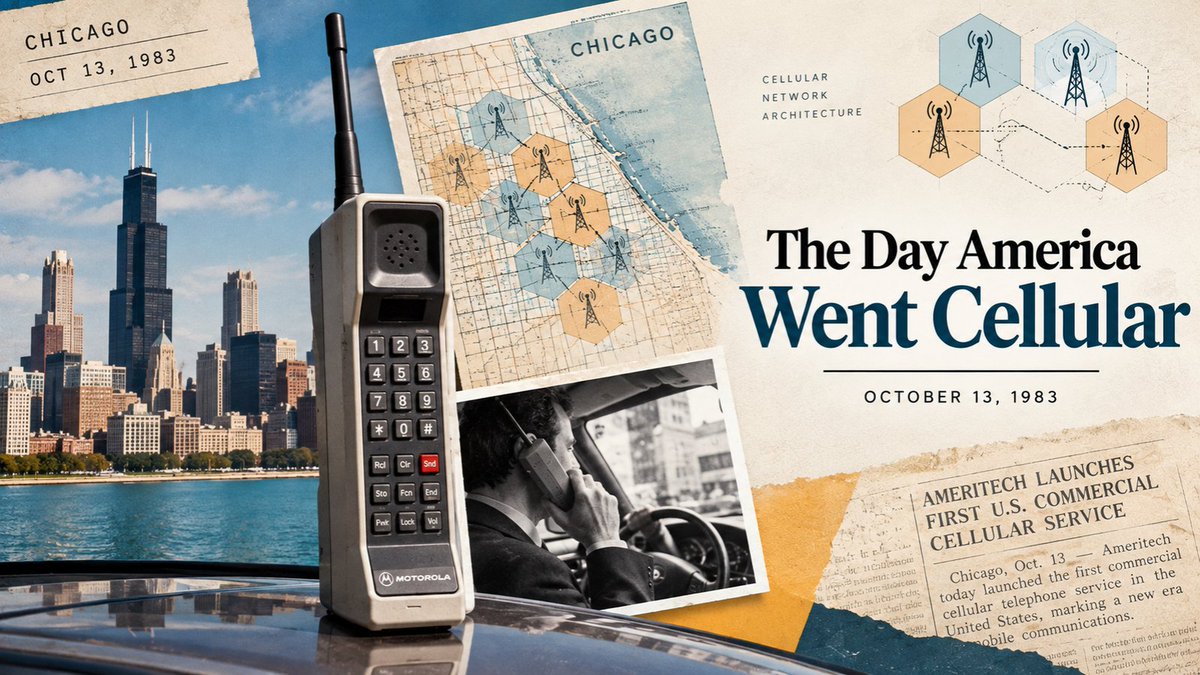
On October 13, 1983, Chicago became the starting point for a new era in American communications. Ameritech launched the first commercial cellular telephone service in the United States. The phones were bulky, the costs were steep, and the service was initially aimed at people who needed to stay connected while away from their offices. But the important innovation was not simply putting a telephone in a car. It was changing how mobile calls could be carried across a city. Older mobile telephone systems relied on powerful transmitters serving large areas, with a limited number of channels available for calls. Cellular networks took a different approach. They divided a region into smaller cells, each served by a lower-power transmitter. As a vehicle moved between cells, the network could transfer its call to another transmitter. The same radio frequencies could also be reused in different cells, allowing the system to handle more conversations. The economics were very different from today's mobile plans. Contemporary reports put the cost of buying and installing a phone at around $3,000, with substantial monthly service fees. These were expensive tools, not everyday consumer gadgets. Today, we carry phones that connect us to people, information, maps, cameras, and AI assistants. That transformation took decades of engineering and investment.
The $6,500 Computer That Helped Build the Web On October 12, 1988, Steve Jobs unveiled a computer that looked unlike almost anything else on the market. The NeXT Computer was a sleek, black magnesium cube, priced at $6,500. It was ambitious, beautifully engineered, and far too expensive for most consumers. But its most important contribution may not have been what people could do with it. It was what developers could build on it. The NeXT combined a magneto-optical disk drive, a digital signal processor, and NeXTSTEP, an object-oriented operating system designed to make software development more productive. While its commercial success was limited, its software environment proved remarkably influential. In 1990, at CERN, British scientist Tim Berners-Lee used a NeXT computer to develop the first web browser and web server. The machine hosted the world's first website, created to explain the World Wide Web itself. There is a striking irony here. A computer that struggled to find a mass market became part of the foundation of a technology that would reach billions of people. Sometimes, a machine's legacy isn't measured by how many people buy it, but by what becomes possible in the hands of the people who use it.


J @jarodXVII
58 Followers 278 Following
kirek @princekirek
0 Followers 2 Following

nqt93 @luiscola2
38 Followers 4K Following
Jeremy588 @Jeremy5882
10 Followers 81 Following

Mirko Monti @MirkoMonti8
5 Followers 190 Following
Benjamin James @packman0104030
79 Followers 255 Following

Fabu @ntagwabirafabu6
3K Followers 3K Following Then you will know the truth and the truth will set you free
KNIGHT @arc_knight_
6K Followers 4K Following Crypto Knight clips & memes web³ explorer AI & tech nigga building cool stuffs
Bendgs @BenoitDgs
25 Followers 368 Following
Loïc_K 🇨🇲 ☥ @L_Kmer237
4K Followers 4K Following je rêve d'un cameroun meilleur ... #EndAnglophoneCrisis Sapiosexuelle🧠

The Kidew @ithekidew
4K Followers 4K Following THE KIDEW 🤍🦅 🧠 Mindset • Discipline • Growth 💸 Financial Freedom & Ambition 🌑 Silent moves. Powerful results. 🎥 Creator | Building my legacy
Donelle Gebon @DonPstar
326 Followers 761 Following Father, Writer, Film Afficianado, Armchair Director, Gamer, Deep Thinker, Part Time Cynic, Gif Master, “Son Of Darkness. Heir Apparent To Lord Vader...”
Ella @ella_iwuozor
8K Followers 7K Following Bsc Public Health👩🎓♥️Lifestyle • Beauty • Good vibes 🥰 Lover of pretty things, soft life and good energy♥️. Meme lover 💯
Papa Genesis @genesis_papa
11K Followers 10K Following Umubyeyi nyawe akwiye kurerera u Rwanda rw'ejo hazaza. Tuvuge #Ikinyarwanda neza. Culture/Language/Parenting. Ibitekerezo byose ntanga hano ni ku giti cyanjye.
J.O.E.L Humble Chepte... @mulangirajoe
3K Followers 3K Following Living. Learning. Growing. Becoming the man I’m meant to be.

Jan @issnsnickers0
3 Followers 298 Following
Antin @Antin_Elz
12 Followers 177 Following


RJmain @jmain_r
4 Followers 109 Following
Mark “Danger” Bar... @MarkBarTweets
1K Followers 1K Following Wrathful critic. Philosophy, fiber art, sincerity enjoyer. MZT Maoist. Union worker. USCPFA. ☭ 📕🥀
Greg Villanueva @GregVillan1997
0 Followers 163 Following

EddieMunson99 @Johnsmith9906
59 Followers 714 Following
Ryco @michaelfal_1
4K Followers 7K Following

Twin Tulips @TwinTulips
31K Followers 19K Following Top 100 Content Creator of the Year 2025 Binance | Community Builder | AMA Host | Binance Affiliate | | 250K+ followers | Collabs & AMA: TG @OfficialTwinTulips
Graciassam @graciassam_
8K Followers 7K Following Graphics & Design | Endtime_Punter 🏀 ⚽️ [email protected]
ABDVL @_Abdvl1
6K Followers 4K Following ⚽ Football Lover | 🎵 Music | 🍿 Entertainment 🐐 CR7 | 🤍 Hala Madrid | 🎶 Seyi Vibez × Burna Boy
CHIKWADORONWA♥️ @CHIKWADORONWAA
6K Followers 6K Following Building quietly. Growing daily. Becoming unstoppable. MANCHESTER UNITED ❤️
Bella Rose🌹 @Mudahogorayj
3K Followers 4K Following Bélla🌹_Silent moves, big dreams. ✨ | Becoming the best version of myself.
Smilekid📊🇨🇦 @Smilekidfrank
6K Followers 6K Following Hot takes🔥-Software Dev🧑🏼💻-Lifestyles🛥️💭💡Trade-views📊-Football🏟️⚽ The only guy that can disown anything even LOVED ONES❤️🥷🏼⚔️💥🔔📢
Kevin Muyira @TendoKevin
18K Followers 9K Following Gunner @Arsenal | Football Stats | Football News | Football Banter
Davies @Aniekvibe
1K Followers 2K Following MD | Social Media Growth Expert| Author of Drop of Tears | Liverpool Fan | Premium+ Account | Lover of African proverbs| Health coach| for Paid Promotion

Emmanuel Uchenna Achu @Achu83119
5K Followers 5K Following IT Support Specialist Tech • Football • Humor • Career Growth Sharing lessons, observations & occasional hot takes.
Blakeshelton @KorgorenKib24
493 Followers 859 Following
NBA Solana @NBASolanaIns
3K Followers 932 Following NBA SOLANA, LAUNCHING ON SOLANA PUMPFUN SOON. BIG LAUNCH, BIG INSIDERS. TG: https://t.co/Q9uBbU15nB
ᴜʏɪ @uyi0zaofx
6K Followers 5K Following AI Biz dev • Video Creator • Web3 community growth strategist. 📧 [email protected]

Asifa Khan @HaseenZindgi2
4K Followers 7K Following The World is beautiful.We should keep value of it.
Fx Queen 👑🧑�... @PrincessElendu
14K Followers 7K Following Swing Trader || Partnership Manager @fundedverse || IB @OctaWorldwide
HON. PRINCE ENYINNA A... @SPACOJOE
11K Followers 9K Following Aspirant, House of Reps Ahiazu/Ezinihitte 2027 | Convener, #43MillionYouthsForPO2027 | Service • Accountability • Development. Join us. https://t.co/Y3wSwpFTWj
Ę🍟👾 @Quaygoo
7K Followers 7K Following Acount Growth || Follow and Turn on post notifications||No DM🚫⠀⠀Trends for United States
You might like


















