DataCops @JoinDataCops
No-Code server-side conversion API for Meta, Google, LinkedIn, and more. Server-side Google Tag Manager alternative. joindatacops.com London, United Kingdom Joined April 2024-
Tweets63
-
Followers11
-
Following9
-
Likes35
ChatGPT ads, are they worth it? I tested them. 15 hours. 13 visitors from chatgpt. com. 2 humans. 11 bots. Everyone's arguing whether OpenAI boosts advertisers' organic traffic. Nobody checked if the traffic is human.
ChatGPT ads, are they worth it? I tested them. 15 hours. 13 visitors from chatgpt.com. 2 humans. 11 bots. Everyone's arguing whether OpenAI boosts advertisers' organic traffic. Nobody checked if the traffic is human.
We shut @SayBriefly down last year. Knew it wasn't ready. 17 years as a creative and I still fell for it every time. A friendly email, a quick Figma comment, a "shouldn't take long" on a call. Said sure, did the work, never got paid for it. Built this for every creative who's been there. A few hundred of you tried it anyway, sent feedback, stayed patient. Thank you for that. We're back. ✌️ 🔊
I am relaunching @SayBriefly this week, after a year of building and stress-testing its scope creep detection with real clients for HustleJar. It has already saved us $32k across projects that would've otherwise bled out to "can we just add this real quick?" Happy to share more. Here's a video snippet for now.
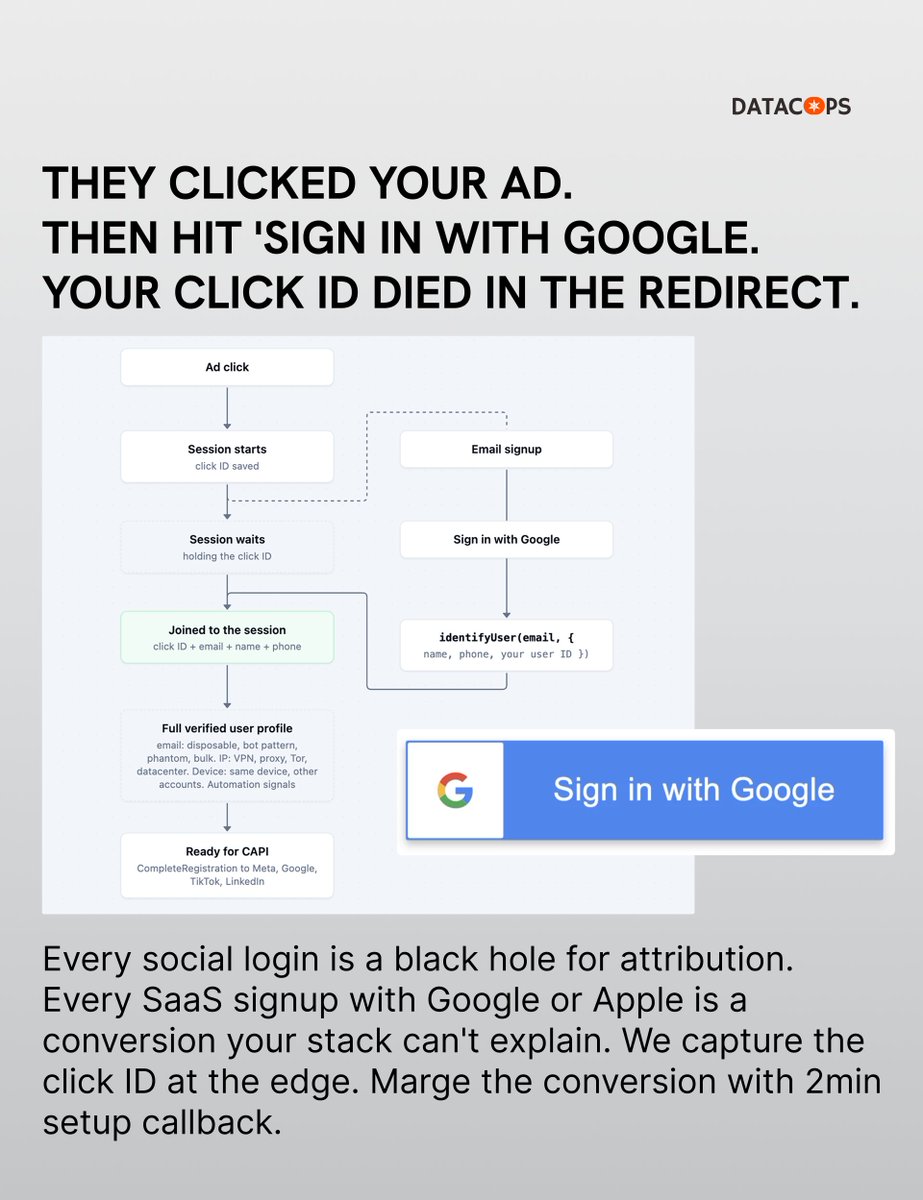
No more missing click ID
I've been building @JoinDataCops for four years. In that time I haven't seen one GTM tutorial cover Sign in with Google. Cookies, yes. Cookie lifetime, yes. CAPI delivery, a hundred times. That button? Nothing. This is wild to me. Google handles 3 in 4 social logins on the
We're live today on X Conversions API. If you run ads on X, you already know the story. You spend, and you're never fully sure what actually happened with that money. If you've got VC money behind you, maybe that's fine. You can afford to spend blind for as long as you want. But if you're solo, bootstrapped, working with a tight budget, every single click costs you something real. You can't afford to waste it. Here's what DataCops does. We catch that click at the network level, before the browser can blcokit it or a bot can fake it. We check if it's a real person or a bot right there. When that person actually converts, PixelCops catches the event. Then we send it through to the Conversions API, so the ad platform can go find more people who look like that real customer. For X specifically, that means the click ID travels with the conversion. X finally sees the whole picture, click to sale, not just half of it. No code. No developer. No container to configure. You connect it from your dashboard in about five minutes and it just runs. If you're spending your own money on ads, this is why it matters. You're not just tracking sales anymore. You're teaching the algorithm who your real customer actually is.

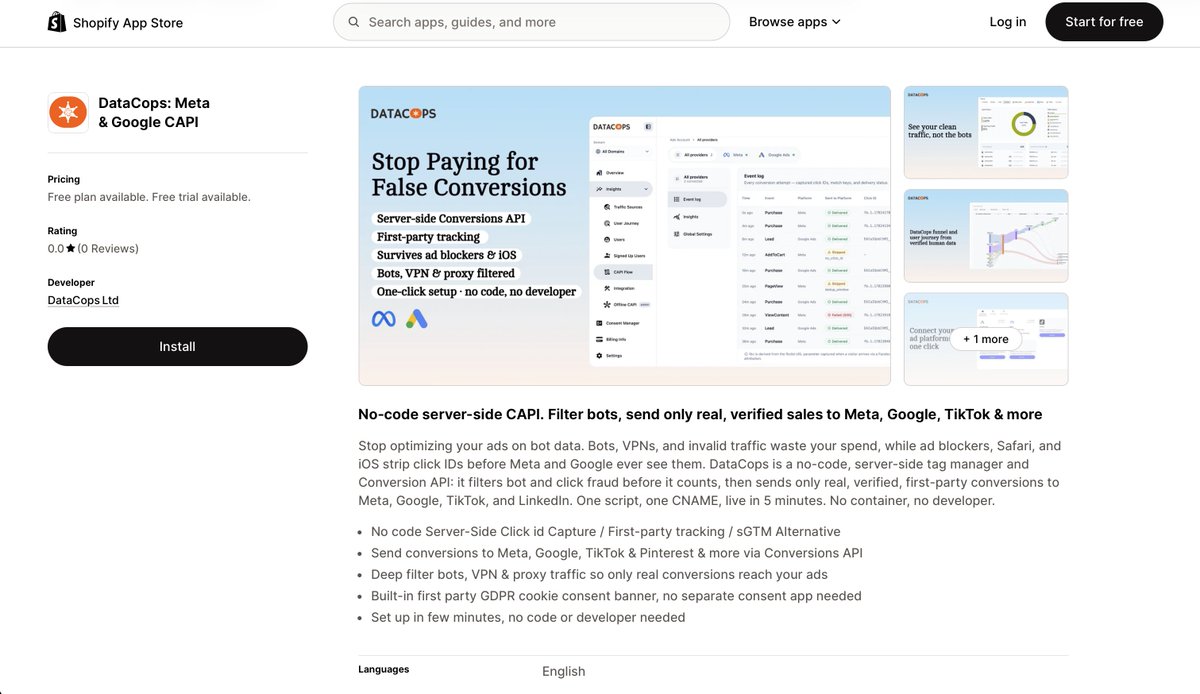
We're live on the @Shopify App Store 🎉 Quick thing every Shopify store owner should know: ad blockers and iPhones are hiding your real sales from Meta and Google. You're running ads, making sales, and the platforms just... don't see it. That's why your ROAS looks worse than it actually is. The fix is server-side tracking. It works great. Setting it up is the problem. Normally you're looking at a server-side GTM container, which means hiring a developer, renting a server, and manually wiring up every single event. 1-2 weeks of work. $5k - $24k. Honestly most stores start this and never finish it. We built DataCops to skip all of that. No server. No container. No developer. Add one script to your store, point a CNAME, and you're tracking properly in about 5 minutes. If you want the full server-side setup, there's a Cloudflare Worker you can copy-paste in we made a 3-minute video walking through it. Same result as server-side GTM. Way less pain getting there. Checkout: apps.shopify.com/datacops
Quick question for anyone running Search, Shopping, or Performance Max: has your cost per conversion been sitting comfortably below your target CPA lately? If so, you're about to see why that mattered more than you thought. On August 17, Google changed how budget-capped campaigns behave. Before this, if your daily budget capped your spend before it ever hit your target CPA, you just kept the difference. Target was $10, budget only let you spend down to $5, you kept the $5. Nobody complained about that. Now Google actively pushes that number up toward your target. Same budget, same total spend, but each conversion costs more, so you walk away with fewer of them. Sit with why a target CPA exists in the first place. You set it as a limit, the most you're willing to pay. Landing under it was never a mistake, it was the campaign doing its job well. Google has decided that outcome needs correcting. It's not one-directional either. Target ROAS campaigns get the same treatment in reverse. If your return was beating your goal, expect that number to drift back down toward target instead of staying high. The scope: Search, Shopping, Performance Max, Demand Gen, and Travel. Hotel, Display, App, and video campaigns are untouched. Here's the part that makes this genuinely hard to catch. Google is also killing campaign-level language targeting and launching AI Max conversion, both landing in September. Three separate changes, hitting the same accounts, inside the same few weeks. If your numbers shift, good luck proving which change actually did it. What I'd do right now: pull your target CPA and target ROAS campaigns and check which ones were beating target by a wide margin. That gap is closing over the next 30 to 60 days whether you touch anything or not. Don't overreact and slash your targets immediately, give it a full conversion cycle to settle. But watch cost per conversion specifically, not total spend, because total spend is going to look completely normal while your actual efficiency quietly erodes underneath it. The bigger takeaway that applies past this one update: any number a platform hands you is only as trustworthy as the definition sitting behind it, and that definition belongs to the platform, not you. It can change without a press release, exactly like it just did here. (DataCops is a no-code server-side tag manager. It validates each conversion at the source and filters out bot traffic before it reaches Meta, Google, LinkedIn, TikTok and more.)

YouTube just made every video's view count go up starting August 24, and not one extra person actually watched anything Starting August 24, 2026, every video format counts a view the moment it starts playing. First frame, instant count. YouTube says this brings all formats in line with how Shorts already worked. Here's the part that made me stop and actually think about it. Just a few weeks earlier, YouTube redefined what counts as a "qualified view," which is the number that decides whether a creator actually gets paid. That definition got stricter. Ad views don't count anymore. Views under a certain watch time don't count. Views on unlisted or deleted videos don't count. Now the public view count, the number sitting right under every video that everyone actually sees and judges creators by, is getting looser. It counts the instant someone hits play. No watch time required at all. So one YouTube number just got harder to hit. A completely different YouTube number just got easier to hit. Most people are going to assume these are the same number, because they're both called "views" on the same platform. They're not the same number at all. Think about what this actually does to the numbers everyone sees. Picture a video that used to need a few seconds of watch time before the public view counter would even move. After August 24, that same video's counter moves the instant someone clicks play, even if they immediately close the tab. Nothing about how people actually watch YouTube changes on that date. The number displayed on every single video just goes up, everywhere, all at once. If you evaluate creators, plan influencer campaigns, or compare channel performance using the public view count that's displayed on the platform, that number is about to look bigger for reasons that have nothing to do with actual audience growth. Here's why I think this matters beyond just YouTube specifically. This is the exact same pattern I keep running into across ad tech lately, just showing up on a different metric this time. A platform changes what a number means under the hood. The number moves as a result. Most people reading that number have zero idea the definition shifted underneath them, because nobody announces "hey, this number you've been trusting for years now means something different." If you're comparing creator performance from before August 24 to after it, you are not comparing real growth. You're comparing two completely different counting methods that happen to use the same word. If you're running influencer deals priced off view counts, know that the counter just got a lot easier to move without any actual change in real audience behavior behind it. The bigger lesson here, and I think this is the part worth actually sitting with, is that any number a platform shows you is defined entirely by that platform, on terms that platform controls and can change whenever it wants. View counts, click counts, conversion counts, engagement rates, all of it. Every single one of these numbers is only as trustworthy as the definition sitting behind it, and that definition can shift without much warning at all. (DataCops is a no-code server-side tag manager. It validates each conversion at the source and filters out bot traffic before it reaches Meta, Google, LinkedIn, TikTok and more.)

Saw a report from DataBeat in June that I keep thinking about. AI agents buying digital ads take part in 86% fewer auctions than regular buyers, and they pay 13.4% less per thousand impressions. First read, that sounds great. Smarter buying, better prices. Once you dig into why, it's a different story. Programmatic advertising exists to check every single ad sale. One impression, one bid, one price, all verified in the open market. That's the entire point of the system, it's what made it different from old-school ad buying. AI agents are skipping most of that. Instead of bidding on individual impressions, they're locking in bulk deals ahead of time. Fixed price, fixed volume, agreed in advance, no auction involved at all. That's literally how TV ads used to get sold. A buyer agrees on a price for a chunk of audience months ahead of time, and just trusts the number both sides agreed to. Nobody's checking each individual ad that runs. The whole system works because everyone agrees to trust the same shared number. Programmatic was built specifically to fix that problem, to make every single ad sale checkable instead of trusted on faith. Now the AI agents running programmatic buys are quietly rebuilding the exact same trust-based system, just automated instead of a guy on the phone. Here's the part that made me actually worried instead of just curious. In July, IAB Tech Lab, the industry body that writes the rules for this stuff, added something called a pricing provenance field to their standards for these buying agents. It exists specifically so an AI agent can't just invent a price when it doesn't have real market data available to check against. Sit with why that rule had to exist. In a normal auction, a price literally can't be faked, because other real buyers are bidding against it in real time. That's what keeps the whole system honest without anyone having to police it. Take the auction away, and prices stop being able to check themselves. Now the price has to be written down and trusted, instead of proven by competition. That's not some small technical footnote. That's the entire model quietly flipping from "we can verify this actually happened" to "we're all agreeing to trust this." And here's the thing, this isn't hypothetical. It already happened once, on streaming TV. CTV ads moved onto programmatic pipes over the last couple years, but a lot of the old TV-style trust came along for the ride too. Nobody was checking individual ad plays as closely as the system was actually designed to allow. The results are already public. One study this year found only 40% of CTV bid requests carry real, usable data about what show an ad actually ran next to. Another found 43% of CTV buyers straight up don't know where their ads actually played. DoubleVerify checked and found 34 out of every 100 CTV ad plays it monitored ran somewhere completely different than the streaming content they were supposed to be attached to. CTV fraud is up 140% year over year on top of all that. That's exactly what happens when you build a system meant to verify everything, and then quietly stop actually verifying it. You genuinely don't need to have an opinion on whether AI buying agents are good or bad to see the risk sitting in this. If agents are doing more bulk pre-agreed deals and fewer real auctions, they're automatically skipping the per-impression checks that used to catch fraud and wasted spend. CTV already showed exactly what moves in to fill that gap once the checking stops. The same exact logic applies to conversion tracking, which is honestly the part of this that hit closest to home for me. A platform reports a number to you, nobody independently checks whether that number is actually real, and that's precisely how bad data survives and compounds over time. Doesn't matter if it's an ad auction price or a conversion count sitting in your dashboard. If nobody's actually verifying it, you're trusting it blind, whether you realize that's what you're doing or not. The smart move here isn't avoiding AI buying agents entirely. It's asking, for literally anything they touch on your behalf, who is actually checking this number, and how are they checking it. If the honest answer comes back as nobody, we're just trusting it, that's worth knowing now, before your budget finds out the hard way. (This is exactly why we built DataCops. Trusting a platform's number isn't the same thing as verifying it. We check conversions before they ever reach Google, Meta, LinkedIn or TikTok, so what you're actually spending against is real, not just reported to you.)

Only you can make the final decision regarding your goals. I would consider this a qualified conversion. If you submit this profile to an advertising platform, the algorithm will filter out the noise and hyper-target those qualified individuals who have the same profile and are capable of making final decisions.
YouTube Just Redefined What Counts as a Real View. Most Advertisers Still Haven't Done the Same for Conversions. How YouTube's "qualified views" change exposes a blind spot in conversion tracking, bot traffic, and influencer marketing measurement. YouTube made a bunch of changes to its Partner Program this month. New creators now need 8,000 watch hours to get paid, double what it used to be. Shorts creators need 20 million qualified views instead of 10 million. Most of the coverage has focused on that number. There's a smaller change buried in the announcement that matters more for anyone spending money on ads. YouTube quietly redefined what a "qualified view" actually means YouTube renamed "valid public views" to "qualified views." And they narrowed what counts. Views that happened while a video played as an ad don't count. Views under an undisclosed watch-time minimum don't count. Views on unlisted or deleted videos don't count. Think about what that means. YouTube looked at its own numbers and decided a lot of what shows up as a "view" isn't real enough to base a creator's payment on. So they built a filter. Not for advertisers. For themselves, to protect creator payouts from watch time that doesn't represent a real person actually watching. That's the whole story right there, and it applies far beyond YouTube. The question advertisers aren't asking about their own conversion data If YouTube doesn't trust a raw view count enough to pay a creator, why do so many advertisers still trust a raw conversion count enough to pay Google or Meta? Same logic. Same underlying problem. Different side of the transaction. A view can look completely real and not be real. It gets counted, nothing flags it, and it still isn't a person. Conversion tracking works exactly the same way. A bot lands on your page, fires your pixel, the event posts successfully, and it shows up in your dashboard as a sale. Nothing errors. Nothing looks wrong. Nobody was actually there. YouTube spent real engineering effort building a filter to protect its own creator payments from this. Most advertisers running Google Ads or Meta campaigns have never built the equivalent protection for their ad spend. Why this matters for influencer marketing and creator campaigns specifically This isn't only a YouTube ad tech story. It's a warning sign for anyone running influencer or creator marketing budgets. As it gets harder to hit YouTube's new monetization bars, more creators are going to lean on brand deals and sponsorships instead of straight ad revenue. That corner of the creator economy already has the least measurement and the most fraud. Industry estimates put average fake follower rates around 37 percent, and brands lose close to $4.8 billion a year to influencer fraud. That's not a rounding error. That's a large share of marketing budgets going toward audiences that don't exist. So two things are happening in the same news cycle. The platform is tightening what counts as real on its own side. And ad spend is quietly shifting toward the part of the ecosystem with the least protection. If you run influencer or creator partnerships and you've never checked who's actually behind the engagement, you're carrying the same exposure YouTube just patched for itself. How to apply YouTube's "qualified" standard to your own ad spend You can't fix YouTube's algorithm or its definitions. You can fix your own conversion tracking. Check what "valid" or "qualified" actually means on every platform you spend on. Google has its own definition of a valid click. Meta has its own definition of a valid conversion. These definitions don't match each other and most aren't fully public. Don't assume a platform's default validation is protecting your budget. It's built to protect the platform's numbers, not yours. Audit influencer and affiliate partnerships for engagement quality before you pay, not after. Fake followers and bot engagement are detectable if you're actually looking for them. Measure what percentage of your reported conversions are real humans versus bots and invalid clicks. Most advertisers running paid campaigns have never actually checked this number. Once measured, it's usually higher than expected. YouTube just proved that even the largest platform in the world doesn't fully trust its own raw numbers. That's worth remembering the next time you look at your own conversion dashboard. DataCops is a no-code server-side tag manager that filters bot and invalid activity before conversions reach Google, Meta, LinkedIn or TikTok. If a platform the size of YouTube needs to filter its own numbers to know what's real, your ad account probably needs the same layer.

Demandbase put out a number this month that's been going around. ChatGPT referrals to B2B websites are up 303% in a year. From 645,000 monthly visits to 2.6 million. Sounds huge. Then you look closer and it shrinks fast. That 2.6 million sits inside a dataset of over 11 billion total visits measured across their platform. AI referrals are still a rounding error of total traffic. Percentage growth on a tiny base always looks dramatic. Usually isn't. But there's a different number in the same body of research that I think matters a lot more than the headline, and almost nobody's talking about it. Similarweb found that only 8.8% of AI-influenced visits show up in your analytics as a direct AI referral. The other 56% show up as branded search instead. Here's how that happens. Someone asks ChatGPT about your product. ChatGPT tells them about it. They open a new tab and Google your company name directly. Your analytics logs that as branded search. Nothing in the data says AI had anything to do with it. Sit with that for a second, because it changes what the whole 303% conversation means. If you're checking your AI referral numbers and concluding AI traffic is small and not worth worrying about yet, you're only seeing about 9% of what's actually happening. The other 56% of AI-driven traffic is sitting in your branded search bucket right now, dressed up as something else entirely. And on top of that, some more of it is probably landing in your direct traffic bucket too, since a lot of AI assistants don't reliably pass referrer data, so those sessions show up with no source at all. This is the same shape of problem I keep running into across ad tech lately, just showing up in a new place. A platform reports a number. The number is technically accurate as far as it goes. And the number is also nearly meaningless on its own because most of what you actually care about is happening somewhere that number can't see. YouTube just did this with view counts, quietly redefining what counts as a "qualified view" for creator payouts. Meta did this with reporting breakdowns that started returning empty rows with a 200 status code, so dashboards looked fine while showing nothing. Now AI referral tracking is doing the same thing with attribution. Different mechanism every single time. Same underlying problem. The number that's easy to measure and the number that's actually true are not the same number, and most people are making real decisions off the easy one. For anyone in B2B this matters more than it sounds like it should, because LinkedIn's own research found 94% of B2B buying groups use an LLM at some point before they ever talk to a sales rep. That's not some small side channel you can ignore. That's most of your pipeline touching AI before you're even aware of it. If your only visibility into that is a referral count that's catching roughly 9% of the actual activity, you are making budget and channel decisions almost completely blind to what's really happening. What I'd actually do with this. Stop treating your AI referral number as a complete picture. Treat it as a floor, not a total. If your dashboard says AI sent you 50 visits last month, the real number of visits AI actually influenced is almost certainly several multiples of that. Most of it is just landing somewhere else in your reporting, mislabeled. Go check whether your branded search and direct traffic have been climbing at the same time your AI referral number has been climbing. If they're all moving together, that's a pretty strong signal AI is quietly feeding your other channels and just not getting credit for it anywhere in your dashboard. If you're on Google Analytics specifically, know that GA4 only added a dedicated AI Assistant channel in May 2026. Before that date, and honestly still today for a lot of assistants that don't cooperate, AI-sourced visits were landing as plain direct traffic with zero way to separate them out. Any historical data you're looking at from before that date is undercounting AI activity by default, not by some mistake on your end. And here's the bigger point sitting underneath all of this, because it's bigger than just AI referral tracking. Every platform you depend on for measurement is reporting the number that's easiest for them to report, which is not automatically the same as the number that's true. That's true of view counts. That's true of API status codes. And it's clearly true of referral attribution too. The gap between what gets reported and what actually happened is exactly where marketing budget quietly goes to waste, because you end up optimizing for a metric that's only telling you part of the real story. One more thing worth flagging while we're on this topic, because it's moving fast. ChatGPT isn't just influencing traffic on other people's sites anymore. It's now an ad platform in its own right. ChatGPT Ads Manager went self-serve for all US businesses back in May 2026, cost-per-click bidding, no minimum spend required. Then in June 2026 OpenAI added conversion-optimized campaigns, meaning the system can now bid toward an actual purchase or signup instead of just clicks. That runs through a pixel called OAIQ, plus a server-side Conversions API that works a lot like Meta's, built specifically so tracking survives ad blockers and browser privacy restrictions. Here's the part I think matters most for anyone testing this early. I went through OpenAI's own setup documentation for the pixel and the Conversions API, and there is no mention anywhere of bot filtering or invalid traffic protection. Nothing about fraud detection. Nothing about verifying that a conversion event actually came from a real human before it gets used to train the bidding algorithm. That's not really a knock on OpenAI specifically. Every ad platform launches this way, Meta didn't have mature invalid traffic filtering on day one either. But it does mean that right now, in the earliest days of ChatGPT PPC and ChatGPT ads conversion tracking, whatever conversion data you send in is going straight into the model with no independent check on whether any of it is real. If you're testing ChatGPT ads or thinking about running ChatGPT PPC campaigns, the same rule from everything above applies here too. The conversion number the platform shows you is the easy number to report. Whether that number is actually made of real people is a completely separate question, and right now nobody's answering it for you. (We built DataCops around exactly this gap, just on the conversion side instead of the referral side. It's a no-code server-side tag manager that captures first-party conversion data before it gets lost in the space between what ad platforms report and what actually happened. That already applies to Meta, Google, LinkedIn and TikTok, and it's going to apply to ChatGPT ads the moment more advertisers start feeding it conversion data.)


Meta turned off three reporting breakdowns last week and the API still returns 200, so most dashboards are showing zeros and nobody has noticed yet x.com/i/article/2088…

Alex @AlexBlogerman
4 Followers 30 Following former exec. now building products, services and businesses from scratch in spain. sharing the real numbers and expensive lessons
LinkedIn Outreach Spe... @_LinkedinExprt
746 Followers 3K Following LinkedIn Outreach Specialist with 200+ reviews ⭐⭐⭐⭐⭐| Targeted Connections | B2B Lead Generation | Helping professionals expand their network & increase sales
DesignCircuit | DTC L... @DesignCircuit01
244 Followers 4K Following Helping DTC & eCommerce brands increase revenue with high-converting landing pages and static ads Shopify .Replo .Instant. Figma .Ai tools
Nahean @0xalnahean
6 Followers 205 Following
STAR AGENCY (SEO) @seostaragency
362 Followers 809 Following STAR IS GROWWING SEO AGENCY Specialist in field of SEO (On/Off) page. [email protected] WhatsApp: OUR TEAM PARTNER PORTFOLIO ↙️ https://t.co/GNERVp5vCs

Legalify @uselegalify
0 Followers 30 Following Scanning EU ad copy for GDPR risks & Meta/Google rejection triggers —before campaigns go live. Built by a solo founder | 7-day free trial
J @Jdolla4242
10 Followers 544 Following
Md Sulaiman Hosain @sulaimanh71
1 Followers 25 Following Frontend Engineer UI architecture & performance Angular • React

Simul S. @SimulS007
376 Followers 354 Following Founder @joindatacops. NoCode Server Side Conversion API for Meta, Google, LinkedIn & more, Google Tag Manager no-code alternative | Co-founder @SayBriefly
SayBriefly ✏️ - T... @SayBriefly
163 Followers 46 Following Every email, call, and Figma comment turned into tasks and tracked against your brief. So you always know what was agreed and what just changed.
Alex @AlexBlogerman
4 Followers 30 Following former exec. now building products, services and businesses from scratch in spain. sharing the real numbers and expensive lessons
Nahean @0xalnahean
6 Followers 205 Following
Bitmedia.io @bitmedia_io
21K Followers 595 Following Bitmedia - Ad network for Finance, Web3, Gaming, AI, and Mobile Apps. Self serve campaigns with multiple ad formats and conversion tracking.
Jonathan Fix It @JonathanFix_It
1 Followers 17 Following I help Shopify merchants spot margin leaks: COGS, discounts, refunds, fees and inventory risk. Building Margin Sentinel. DM me your messy profit question.
Md Sulaiman Hosain @sulaimanh71
1 Followers 25 Following Frontend Engineer UI architecture & performance Angular • React
Jamayal @Jamayal
2K Followers 555 Following ☻ Designer Founder @HustleJar (Brand Design Studio) ✎ᝰ. @SayBriefly (try now, it’s free!)
Simul S. @SimulS007
376 Followers 354 Following Founder @joindatacops. NoCode Server Side Conversion API for Meta, Google, LinkedIn & more, Google Tag Manager no-code alternative | Co-founder @SayBriefly
You might like