

NerdiMath @MathNerdi
San Francisco, CA Joined October 2025-
Tweets29
-
Followers80
-
Following238
-
Likes42

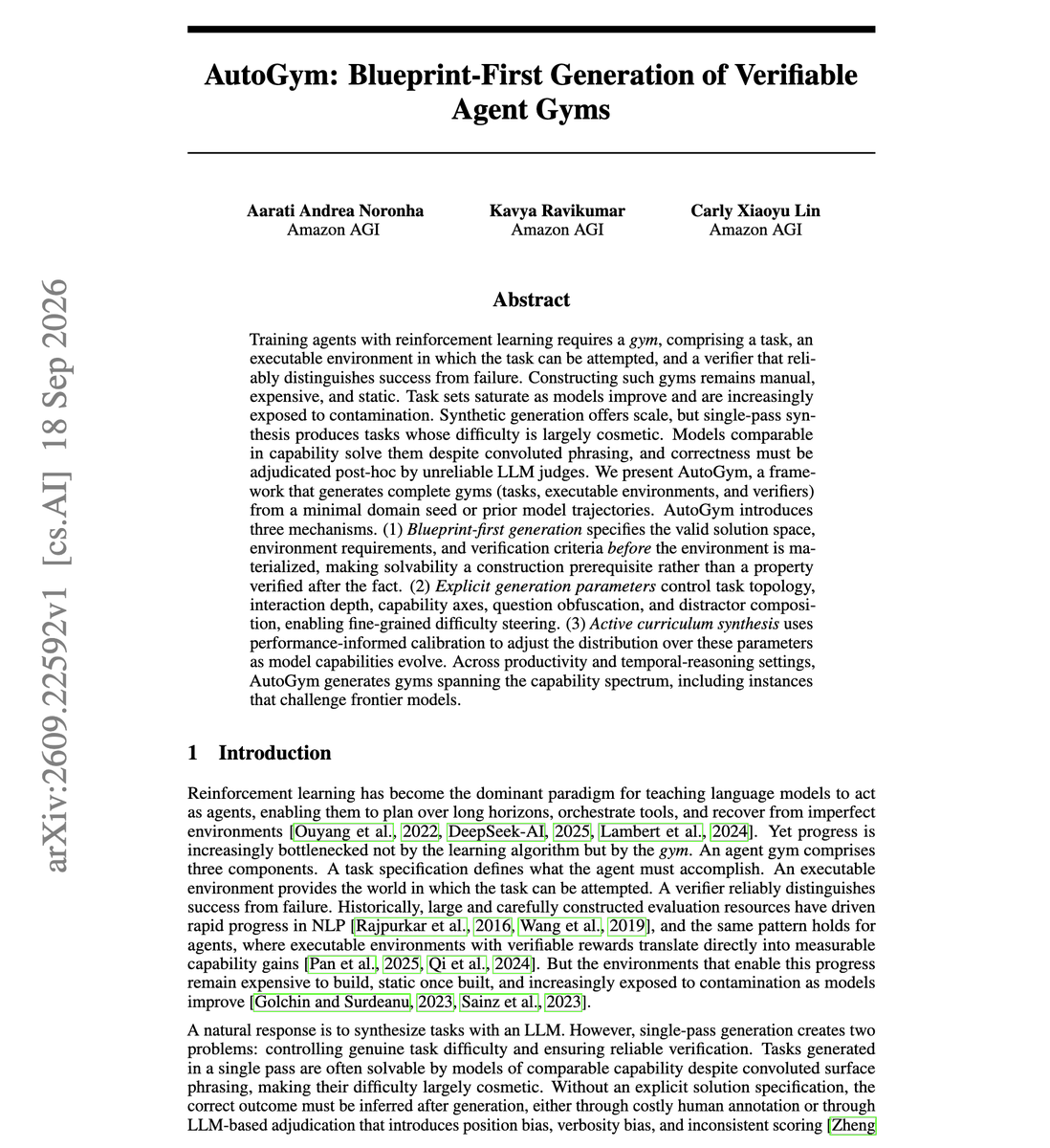
Great paper from Amazon AGI on generating RL environments for agents. (bookmark it) Also, pay attention to this important new AI engineering skill of creating RL environments. Seeing a huge shift towards this. The authors propose AutoGym which writes the task, the executable environment and the verifier together, starting from a small domain seed or past model trajectories. Paper: arxiv.org/abs/2609.22592 Chat with Paper: academy.dair.ai/papers/autogym…

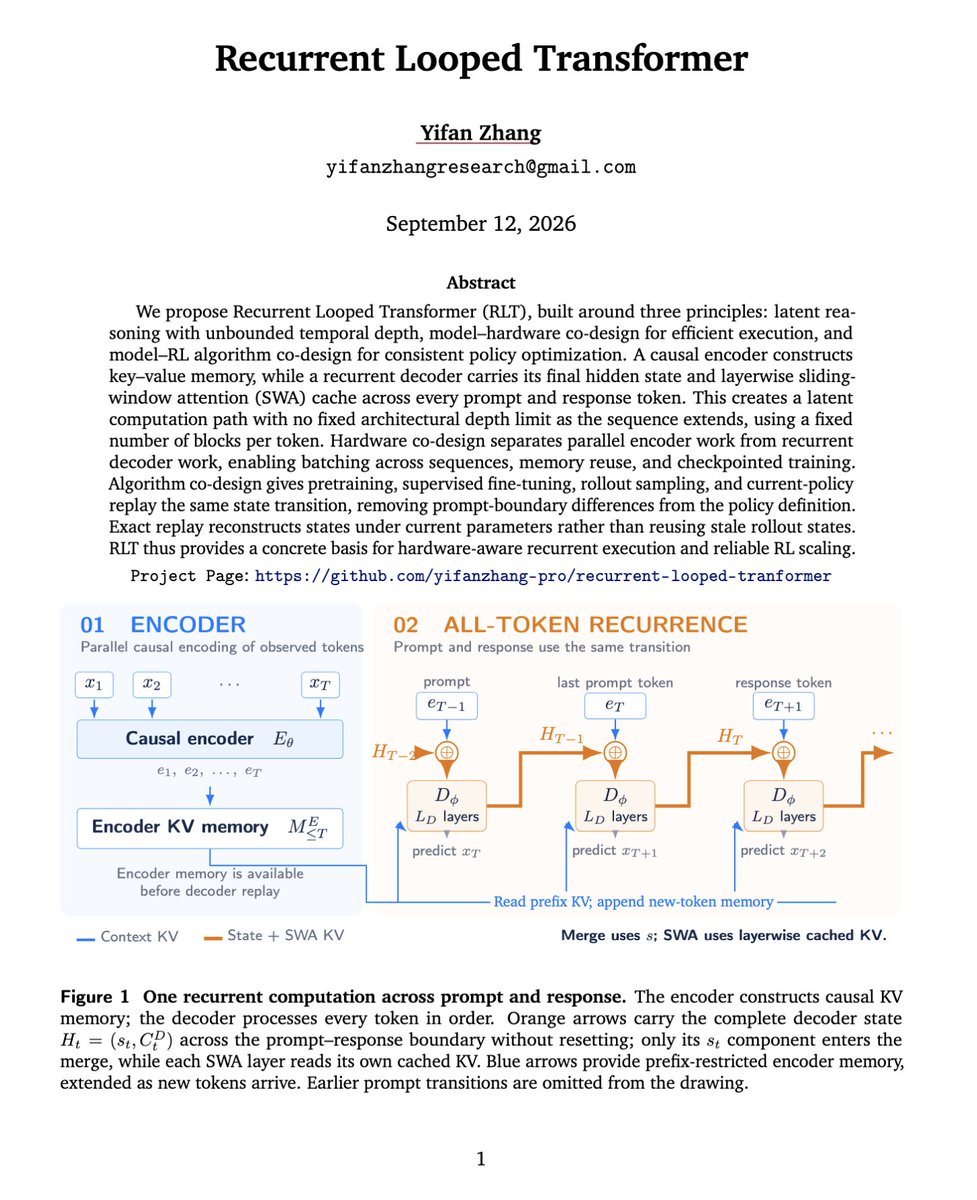
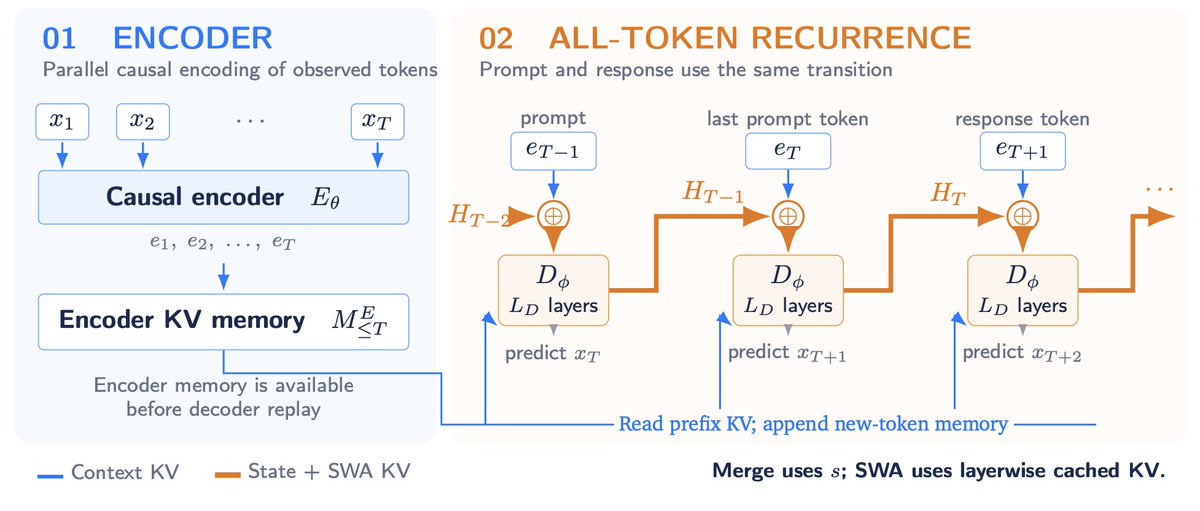
“Recurrent Looped Transformer” This paper makes the decoder recurrent across every prompt and response token, while a causal encoder provides reusable global KV memory. Longer sequences then create deeper latent computation paths without adding more physical layers, while keeping the same state transition across pretraining, inference, and RL replay. alphaxiv.org/abs/2609.recur…

We are at the dawn of Superintelligence. Introducing the Recurrent Looped Transformer (RLT), We now have Transformers with Infinite Reasoning depth. From now on, we should pace progress at the Open Frontier of Superintelligence, Until Safe Superintelligence is achieved. github.com/yifanzhang-pro…
We’ve lost a pioneer. Prof. Dimitri Bertsekas (MIT) has passed away. Beyond his foundational mathematical contributions to dynamic programming and reinforcement learning, his textbooks shaped generations of researchers. Massive loss for AI
arxiv.org/abs/2510.04476 Compressed Convolutional Attention (CCA), a novel attention method which down-projects Q, k, v and performs the entire attention operation inside the shared latent space. This simple design dramatically cuts parameters, and speed up computation.
NYU’s new "Temporal Straightening" paper (May 2026) improves latent planning by forcing world models to learn flatter, more linear trajectories. Result: More stable gradient-based planning & higher success rates Read: arxiv.org/abs/2603.12231 #AI #Robotics #MachineLearning
Transformer models are slow due to quadratic complexity. The paper proposes recurrent models with a vertically chunked inference method that makes memory usage constant regardless of sequence length. tinyurl.com/2wmhycz8

Deep Learning Interview preparation drive.google.com/file/d/1b7KjE3…

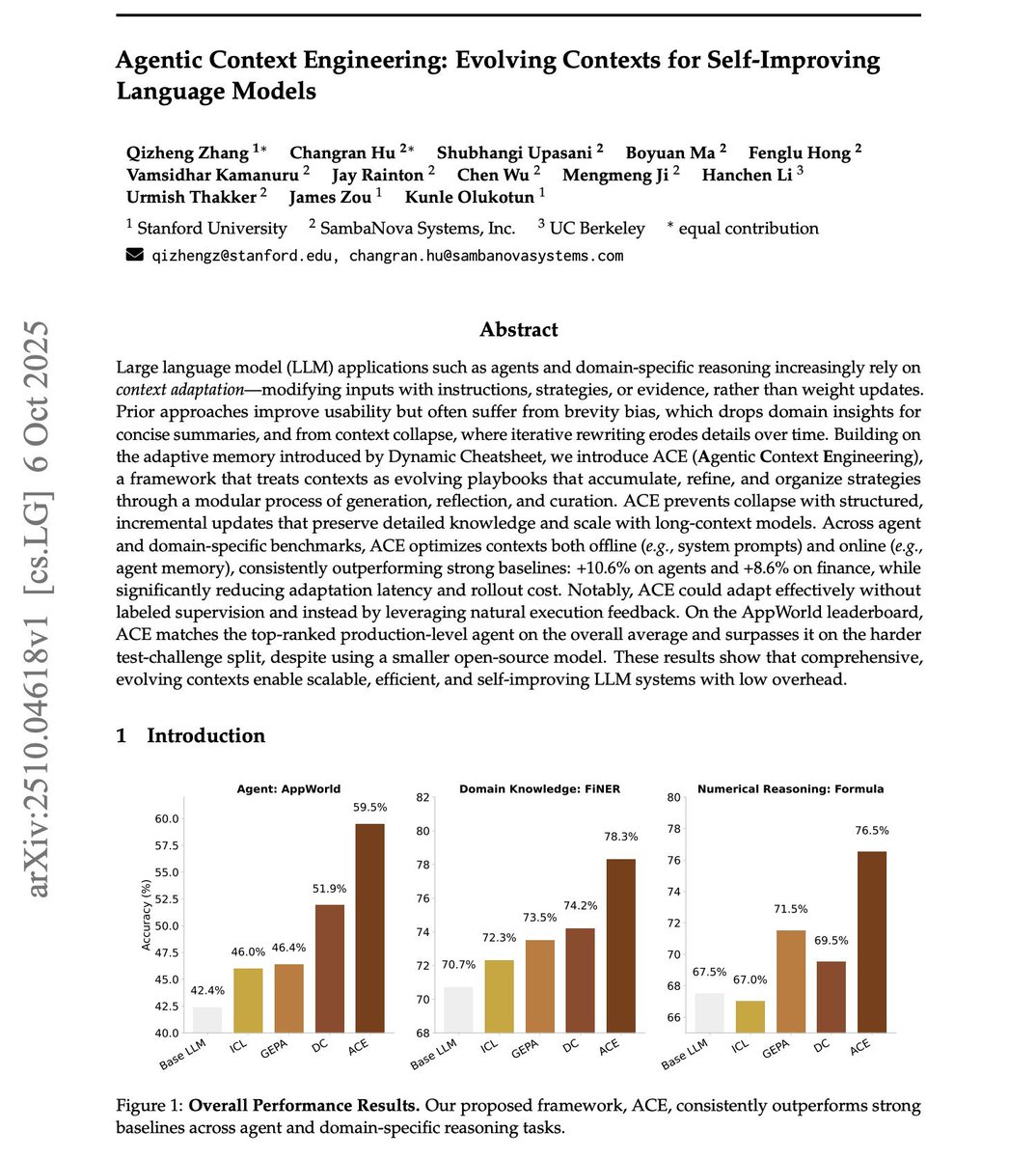
Stanford just made fine-tuning irrelevant with a single paper. It’s called Agentic Context Engineering (ACE) and it proves you can make models smarter without touching a single weight. Key takeaways (and get the 23 page PDF):
Google Research just dropped Titans & MIRAS—giving AI human-like long-term memory! 🧠✨ • Short-term: Attention for immediate context • Long-term: Neural net (MLP) to "learn" the past • "Surprise" Metric: Only memorizes what's actually important/new 2M+ token context.

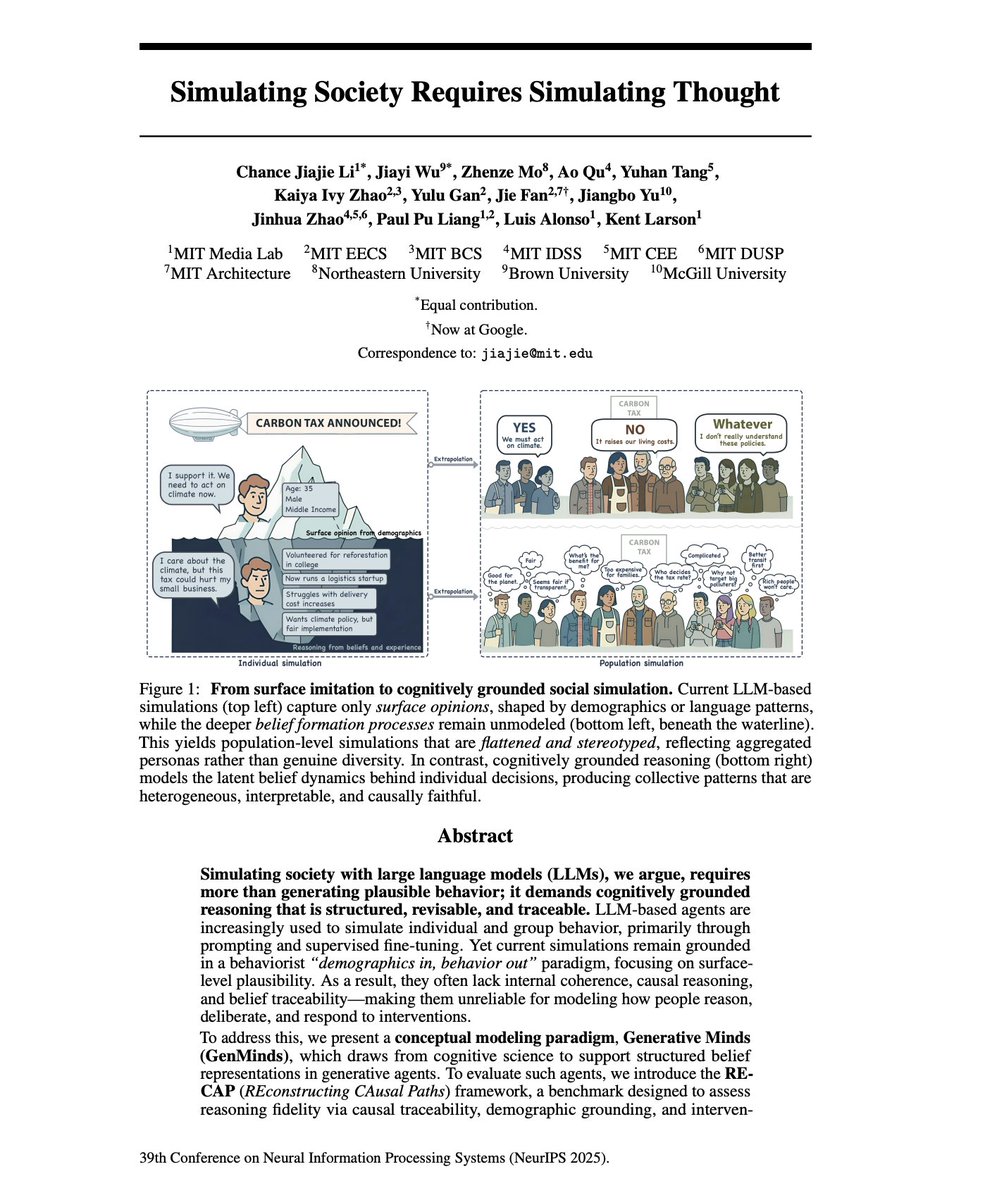
AI Agent Personas should simulate the structure of human reasoning. I’ve been arguing that you cannot "invent" a digital expert agent using just prompt engineering. You have to extract the expert via deep interviewing. A new NeurIPS paper, "Simulating Society Requires Simulating Thought" reinforces everything we've discussed about why thin, synthetic LLM personas fail. Most AI agents operate as "behaviorists." When you prompt an LLM to "act like a senior economist," it relies on surface-level correlations from training data. It generates text that sounds expert-like, but lacks any internal belief structure. 1. Logical Inconsistency: Without an internal model of how beliefs are formed, agents support a policy in one context but oppose it in another. The paper calls this "intervention-invariance mismatch" - beliefs don't update coherently when assumptions change. 2. Illusion of Consensus: In multi-agent simulations, LLMs converge toward the median view (even more positive emotions as the other paper mentions) of the training data. They agree not because of shared reasoning, but because their statistical priors push them toward the center. Your expert's contrarian, hard-won perspective gets averaged out. 3. Identity Flattening: LLMs reproduce stereotypical portrayals that erase intersectional variation. "The rich, positional knowledge of real-world stakeholders is replaced with monolithic, decontextualized simulations." To fix this, we have to move from simulating speech to simulating reasoning. The authors propose a "Cognitive Modeling" approach. "beyond output-level alignment toward aligning the internal reasoning traces of generative agents." Their solution is SEMI-STRUCTURED INTERVIEWS to extract what they call "cognitive motifs" - minimal causal reasoning units that capture how a specific person actually thinks. This is exactly why we built an interviewer system instead of a persona generator. You have to extract their actual belief structure through conversation. Instead of predicting the next word, the agent must possess "Reasoning Fidelity", a structured map of beliefs, causal logic, and cognitive motifs. How do you get this map? You can't prompt for it. You have to interview for it, with AI. The paper explicitly validates the architecture we’ve built: using semi-structured interviews to elicit "causal explanations" and "reasoning traces". This confirms why our Interviewer + Note-Taker multi-agent system is critical. - The Interviewer builds the "Peer Status" necessary to get the expert to open up. - The Note-Taker (the cognitive layer) extracts the "Cognitive Motifs", the distinctive logic blocks that define how that specific expert solves problems. We are moving beyond the era of "acting like an expert" to Generative Minds; agents that embody the positional individuality and causal logic of the people they represent. If you're building AI agents for strategy, decision-making, or stakeholder modelling, start by interviewing the human aspects of your agents.
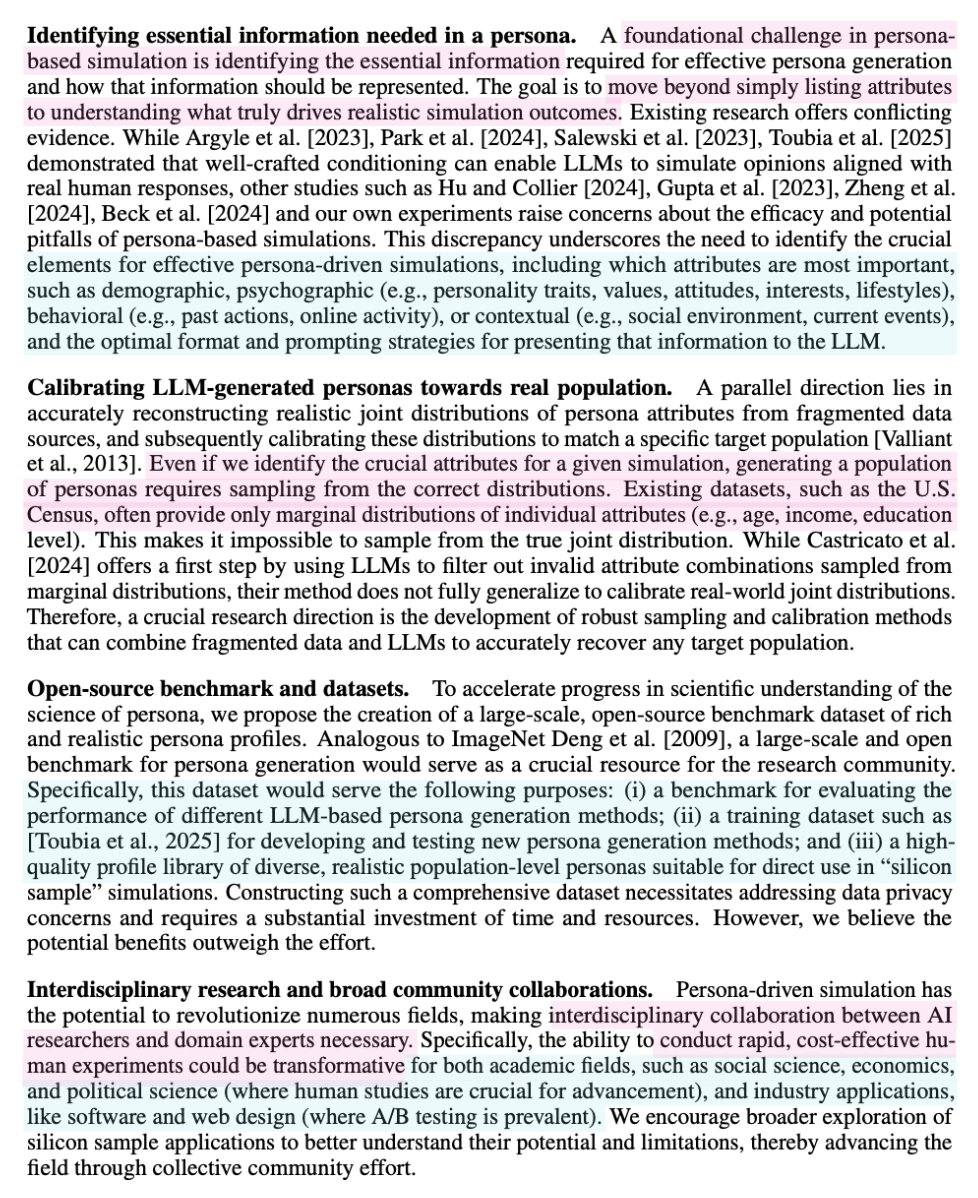
You should NOT use LLMs to generate synthetic human-like profiles. I just read the NeurIPS paper "LLM Generated Persona is a Promise with a Catch" and it confirms a suspicion we’ve held for a long time: You cannot "invent" a realistic human being using just statistics and an
Everyone fears AI will kill jobs. Truth: AI + infinite virtual worlds = unlimited new jobs. Example: Today we have ~50k Fortnite builders/designers. In a fully AI-powered metaverse? Millions of people could get paid full-time to build, script, and run entire virtual civilizations

NeurIPS 2025 Best Paper Award: Attention lets language models decide which tokens matter at each position, but it has limitations—for example, a tendency to over-focus on early tokens regardless of their relevance. Gating mechanisms, which selectively suppress or amplify information flow in neural networks, have improved other architectures, so researchers have tried adding them to attention as well. However, prior attempts usually package gating together with other architectural changes, making its specific contribution hard to isolate. This paper separates those effects by systematically testing over 30 gating variants on dense models and mixture-of-experts models with up to 15 billion parameters. In a standard transformer layer, each attention head computes a weighted combination of values; the head outputs are concatenated and passed through a final linear projection. The winning approach identified in the paper inserts one extra operation before concatenation: each head's output is multiplied (element-wise or head-wise, with element-wise performing best) by a learned gate computed from the current token's representation. This allows each head to dampen or preserve its contribution depending on context. These architectural changes deliver practical benefits beyond small benchmark gains: 1. Training becomes more stable, supporting learning rates that cause baseline models to diverge. 2. The gating also greatly reduces "attention sinks"—the situation where early tokens absorb excessive attention—which in turn is associated with strong improvements on long-context benchmarks once the context window is extended using standard techniques. Talk to the paper on ChapterPal: chapterpal.com/s/c8685321/gat… Read the PDF: openreview.net/pdf?id=1b7whO4…


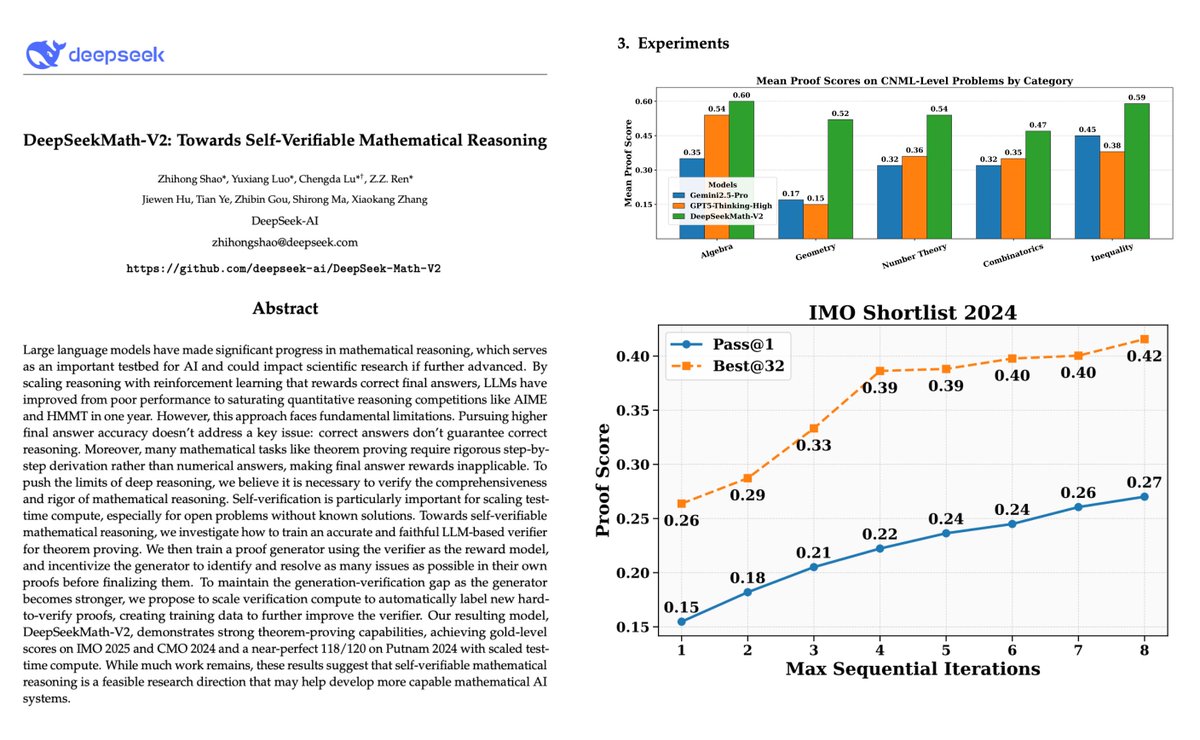
🚨 DeepSeek just did something wild. They built a math model that doesn’t just solve problems, it checks its own proofs, criticizes itself, fixes the logic, and tries again until it can’t find a single flaw. That final part is the breakthrough a model that can verify its own reasoning before you verify it. And the results are ridiculous: • Gold-level performance on IMO 2025 • Gold-level performance on CMO 2024 • 118/120 on Putnam 2024 near-perfect, beating every human score • Outperforms GPT-5 Thinking and Gemini 2.5 Pro on the hardest categories What makes DeepSeek Math V2 crazy isn’t accuracy, it’s the architecture behind it. They didn’t chase bigger models or longer chain-of-thought. They built an ecosystem: ✓ a dedicated verifier that hunts for logical gaps ✓ a meta-verifier that checks whether the verifier is hallucinating ✓ a proof generator that learns to fear bad reasoning ✓ and a training loop where the model keeps generating harder proofs that force the verifier to evolve The cycle is brutal: Generate → Verify → Meta-verify → Fix → Repeat. The core issue they solved: final-answer accuracy means nothing in theorem proving. You can get the right number with garbage logic. So they trained a verifier to judge the proof itself, not the final answer. The graph comparing proof accuracy across algebra, geometry, combinatorics, number theory, and inequalities shows DeepSeekMath-V2 beating both GPT-5 Thinking and Gemini 2.5 Pro across the board (this is on page 7). The wild part sequential self-refinement. With every iteration, the model’s own proof score climbs as it keeps debugging itself without human feedback. This isn’t “longer chain-of-thought.” This is “I will keep thinking until I’m sure I’m right.” A real shift in how we train reasoning models. DeepSeek basically proved that self-verifiable reasoning is possible in natural language no formal proof assistant, no human traces, just the model learning to distrust its own output. If you care about AI reasoning, this paper is a turning point.
Matformer is a simple cool idea to train several models with the cost of just one: buy one get couple free!! huggingface.co/blog/rishiraj/…
Epistemic Uncertainty is vital for ML safety. ⚠️ It tells you when your model doesn't know the answer (out-of-distribution data). Ignore it, and you get wildly confident, wrong predictions. Know your model's limits! #ML #AI #Reliability

Mario Bunge on Causality This is a fascinating, profound book on causality as used in the sciences. I reread parts of it every now and then because it discusses ideas many philosophers and methodologists ignore. For information on the book: routledge.com/Causality-and-…


I’m recruiting PhD and Masters students at the University of British Columbia! Looking to work with students interested in LLM interpretability, and intersections with cog ling. The UBC NLP group is growing and awesome, and Vancouver is great. Come to 🇨🇦! isabelpapad.com/#joininglab
Do you want to understand how language models work, and how they can change language science? I'm recruiting PhD students at UBC Linguistics! The research will be fun, and Vancouver is lovely. So much cool NLP happening at UBC across both Ling and CS! linguistics.ubc.ca/graduate/admis…


Samantha Jones @mesamjo
165 Followers 92 Following
لوئی دوّم @Brother7Louie
157 Followers 369 Following اکانت اول لوئی که از ۲۰۰۹ فعال بود ساسپند شد، پس باید سیزیف را شاد تصور کرد
maleki @Mansour87464921
643 Followers 5K Following I hold a PhD in Polymer Engineering and am a full professor and faculty member at Harvard University in the United States. I also hold permanent residency

Sophia @Mdaftab52752089
7 Followers 533 Following professional overthinker, amateur cook, surprisingly photogenic 🥲 my therapist knows about you guys
Nancy Charles @nancygrace3g
87 Followers 630 Following


The Dopeamin @Thedopeamin
374 Followers 2K Following
zizigooloo @ZziGoolooo
57 Followers 79 Following

Mostafa Zobeydi @Mostafazobeydi1
840 Followers 5K Following #ArtistManager 🇮🇷🇺🇲 #NFT DM For Job: [email protected]


مهرداد @Ojakol_7
727 Followers 296 Following


Ahad S @ahad_s71
128 Followers 550 Following
Fdggfuu @fdggfuu34569
327 Followers 4K Following
Johnson @Johnsonbillion
51 Followers 276 Following Hail the light, welcome to the Illuminati brotherhood an elite association 🔺👁️🔻that elevate humanity, our main aim is to make you rich, powerful, and famous
Illuminati🔺 @Thomas27034
2K Followers 7K Following The rich get richer because the poor thinks every opportunity is a scam follow the light ,🔺🔺

ReNa @ReNa_The_Great
32 Followers 150 Following

YaSi 𓄂☀︎︎࿐ @jassminellaa
1K Followers 539 Following 🍄🎩🐰'Who in the world am I?' Ah, that's the great puzzle! 🐰🎩 🍄. Rise Iran ✊🏻 #JavidShah #جاویدشاه My Music Page: @music_by_nira
Omid @deagonx776
240 Followers 431 Following

hanna rose @annah_shar93954
550 Followers 6K Following
Nima 🪿🇬🇧🇪... @DrStrangetwit
7K Followers 8K Following Secular humanist | 🧠health | NHS💙| Europe | film | birbs | puns | 💚🕊️🩸𐭠𐭩𐭫𐭠𐭭 This is a personal account Views expressed belong to attached brain slug
واژه @PeelCoconut
168 Followers 330 Following
the girl @ansherlibooben
1K Followers 982 Following Her attractiveness lies in the fact that she doesn’t seek others’ approval
Bardia @TSMERDIST
881 Followers 1K Following

Negar @negarnegarrrr
167 Followers 146 Following


Ali @GridAndAI
3K Followers 1K Following Iranian 🇮🇷 - American 🇺🇸 Powering AI infrastructure & next-gen grids Free Iran Energy • Geopolitics • AI
Sh!m@ @__shim__shim
6K Followers 567 Following
ehsan sarv @SarvEhsan69405
19 Followers 182 Following

amanda @aamanda112253
408 Followers 559 Following

Hedi @Hedi364
1 Followers 59 Following
Kaitlyn krems @VictoriaJa34697
201 Followers 223 Following
Miriam Allen Y01YB @MY01yb47293
131 Followers 605 Following
Sophia @Sophia61217
2K Followers 4K Following 🔺Welcome to the Illuminati organization, where you can achieve something great in life.✡️
MarYam @QNamodin
2K Followers 166 Following از خاکِ ایرانم، با تبارِ بختیاری دِل در گرو میهَن و باور به پادشاهی
i🐝 @i_robot_ai
329 Followers 172 Following A❤️💍|IT Manager & Consultant | Soccer enthusiast ⚽ | Passionate about teaching & learning | Globe-trotter 🌍 | Always exploring new tech and ideas.
لوئی دوّم @Brother7Louie
157 Followers 369 Following اکانت اول لوئی که از ۲۰۰۹ فعال بود ساسپند شد، پس باید سیزیف را شاد تصور کرد
دختری شرقی�... @An_Eastern_Girl
6K Followers 568 Following #زن_زندگی_آزادی❤️ تا کارهای ناتمامم را تمام کنم، بیشتر بخندم و بخندانم. #منناموسکسینیستم .

Abhishek Saha @ObhishekSaha
5K Followers 716 Following Professor of maths @QMUL • founder member @lucaf_london, advisory board @ComAcFreedom, co-convenor @AFAF_QMUL • individual liberty, self-ownership • views mine.
zizigooloo @ZziGoolooo
57 Followers 79 Following
Mostafa Zobeydi @Mostafazobeydi1
840 Followers 5K Following #ArtistManager 🇮🇷🇺🇲 #NFT DM For Job: [email protected]

لیبرال آرتی... @LiberalArtist8
18K Followers 836 Following هیچ صیادی در جوی حقیری که به گودالی میریزد مرواریدی صید نخواهد کرد.


RMT G0Li @MrsG0li
2K Followers 855 Following “You are only as young as your spine is flexible”. _Bikram Choudhury Make Iran Great Again ✌️🇮🇷 ایران شاهنشاهی | رضا شاه دوم | پهلوی سوم

Singularity @Shahab24444
129 Followers 164 Following No to radicalism on all sides No to blocking people who disagree with me Let's keep talking
🇮🇷دایی جا... @sentientrod
281 Followers 529 Following
ℳℯ𝒹𝒾𝒸�... @mehrqd
10K Followers 878 Following building AGI, bit by bit | founder and ceo at https://t.co/BkEYh7eugG |
Samantha Jones @mesamjo
165 Followers 92 Following
مهرداد @Ojakol_7
727 Followers 296 Following
Azin @cherryonthevine
219 Followers 50 Following
کابوس آخوند @KabooseAkhoond
3K Followers 848 Following همچون همیشه ستایم سه فَرّ: فَرّ یزدان، فَرّ شاه، فَرّ ایران.

AHSN @a_sadeghinejad
181 Followers 395 Following
Ahad S @ahad_s71
128 Followers 550 Following
Illuminati🔺 @Thomas27034
2K Followers 7K Following The rich get richer because the poor thinks every opportunity is a scam follow the light ,🔺🔺
کفتر نامه�... @fmhrnzi
2K Followers 241 Following داره از قبیلهی ما یکییکی کم میشه، چون آخوند سهمیه روزانه کشتن ما رو داره
دیکتاتور حا... @hanieh35
68K Followers 3K Following روانشناس و دکتر نیستم، مطالبی که میخونم و برام مفیده به اشتراک میذارم. اگه ایران نباشه، میخوام دنیا نباشه. تا ابد زن، زندگی، آزادی….

Tina | تیــنا @tina_free1991
1K Followers 187 Following دور از وطن، آزادی نزدیک است . رویای من حکومت قانون بر مردم است.
سارا لاریجا... @Organoponico1
5K Followers 1K Following مودی - خسته - امیدوار توهین، افترا، پهلویچی، سرباز محکوم به کامنتگذاری ضد ایران=بلاک
hanna rose @annah_shar93954
550 Followers 6K Following
ReNa @ReNa_The_Great
32 Followers 150 Following
Omid @deagonx776
240 Followers 431 Following
YaSi 𓄂☀︎︎࿐ @jassminellaa
1K Followers 539 Following 🍄🎩🐰'Who in the world am I?' Ah, that's the great puzzle! 🐰🎩 🍄. Rise Iran ✊🏻 #JavidShah #جاویدشاه My Music Page: @music_by_nira


Mahsa @PerhapsMahsa
463 Followers 297 Following Direct. Precise. Unconventional. | Proceed with curiosity | UK → Costa Rica | Free Iran 🇮🇷

یکی از خو�... @yekiazshoma
23K Followers 141 Following این منم،یکی از خود شما.اینجا از روزمرگیآم میگم.این کاربر مجهز به خنده با صدای دالبیست! #فراموش_نمیکنیم
واژه @PeelCoconut
168 Followers 330 Following

Nima 🪿🇬🇧🇪... @DrStrangetwit
7K Followers 8K Following Secular humanist | 🧠health | NHS💙| Europe | film | birbs | puns | 💚🕊️🩸𐭠𐭩𐭫𐭠𐭭 This is a personal account Views expressed belong to attached brain slug
Behnam Zarei @Behnamzarei21
8K Followers 1K Following Journalist covering Kurdistan, Iran & Middle East affairs. Retweets ≠ EndorsementYou might like


















