

Math-Research @MathResearchCom
Exploring mathematical research. math-research.com Joined October 2026-
Tweets26
-
Followers2
-
Following15
-
Likes11
The question everyone is asking. Is AI taking over? On Math Research, we want to find ways to publish mathematical research that is relevant for mathematicians and society.

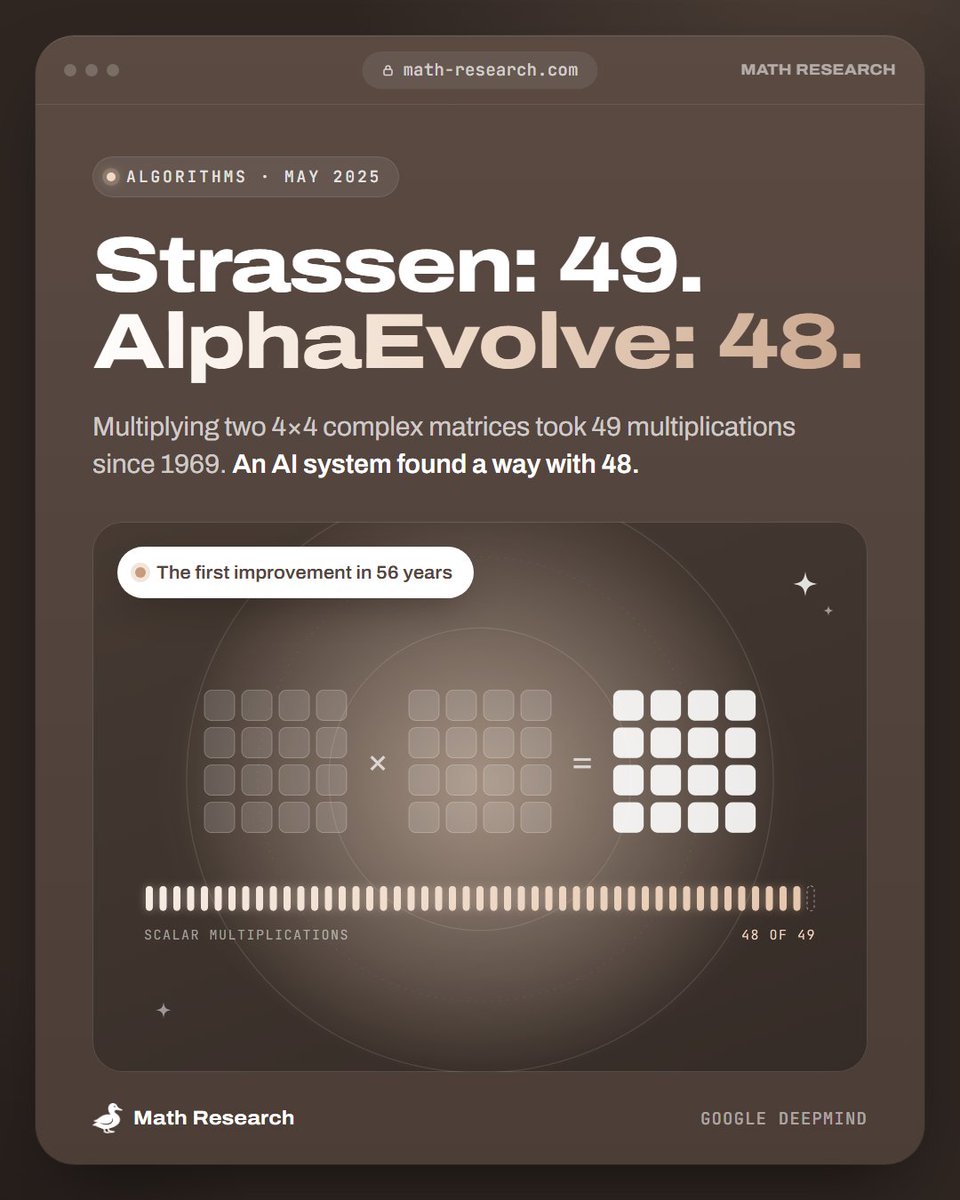
Since 1969, the best way to multiply two 4×4 complex matrices used 49 multiplications, thanks to Strassen. In 2025 Google DeepMind's AlphaEvolve found one that needs 48.
@Math_files Could be fun to teach function transformations, you may consider it for -f(x), f(-x), f(x-c), etc.
Paul Erdős left hundreds of open problems. Google DeepMind's AlphaProof Nexus settled 9 of the 353 still open, plus 44 OEIS conjectures, every proof checked in Lean and now published in Science. Reviewers check proofs too, usually for free, on Math Research they are paid.

@janarhertz At Math Research, we're exploring a related idea through public comments on published articles while maintaining double-blind peer review. We're building an open-access mathematics journal, free for both authors and readers.
@Deniz_Genlik I know you can cook some theorems, don't feel discouraged. If you do, allow us to deliver what you create 😋
@nasqret The question is. Assume it could generate any proof per request, is there going to be a neccesity to learn how to make proofs anymore? We could learn so much more with the advancements and the progress, but there will be a shift towards building the next generation of technology.
@Quasilocal Sometimes progreess is different from what we expect. Some of the research (even when poorly understood) can become something valuable later. It will take time to digest what AI solves. It could lead to further technological advancements.
@pozsgaybalazs You can also post a preprint on our journal:) It's free to read and free to publish. The review process might take longer but we can guarantee it will be properly reviewed and commented if there's anything wrong with it.
Everything is a Diophantine equation, except Diophantine equations, which are Turing machines.
everything is linear algebra, except linear algebra, which is representation theory of the trivial group
AI is taking down the hardest problems known to mathematicians. Are we going to be able to keep up with the pace to understand what the future research yields?

@AtariCollector @mathemetica It has a trick. Take a = n/e. Then square a repeatedly to get a², a⁴, a⁸, a¹⁶ and finally compute a¹⁶x a⁴= a²⁰. This takes exactly five multiplications to get a²⁰. The main advantage is that each squaring doubles the exponent, this saves many multiplications for a large n.
@Quasilocal If you want to publish a preprint you can do so under our math journal:) we are starting so you can avoid a lot of the early judgments from an unfinished article unless you want to expose it. It's free to publish and free to read.
@GeorgeE33179 @billionsmustliv @letonyo They have sufficient training data for explanations. Users who make repeated questions for a given explanation are indications of an incomplete explanation. Polished articles can be ranked for clarity, I'm sure it's something that can be continuously improved but not prioritized.
@billionsmustliv @GeorgeE33179 @letonyo We do. Many books have the format of leaving proofs for the readers, hard exercises with stars. They are well suited for students, not optimized for AI. Articles omit steps for clarity/length. That's the hardest part when reading articles without being experts on the subject.
@Math_files At some point we will probably have Lean verification for all published math to be considered valid. Given that we fix some Lean issues. Interesting times.
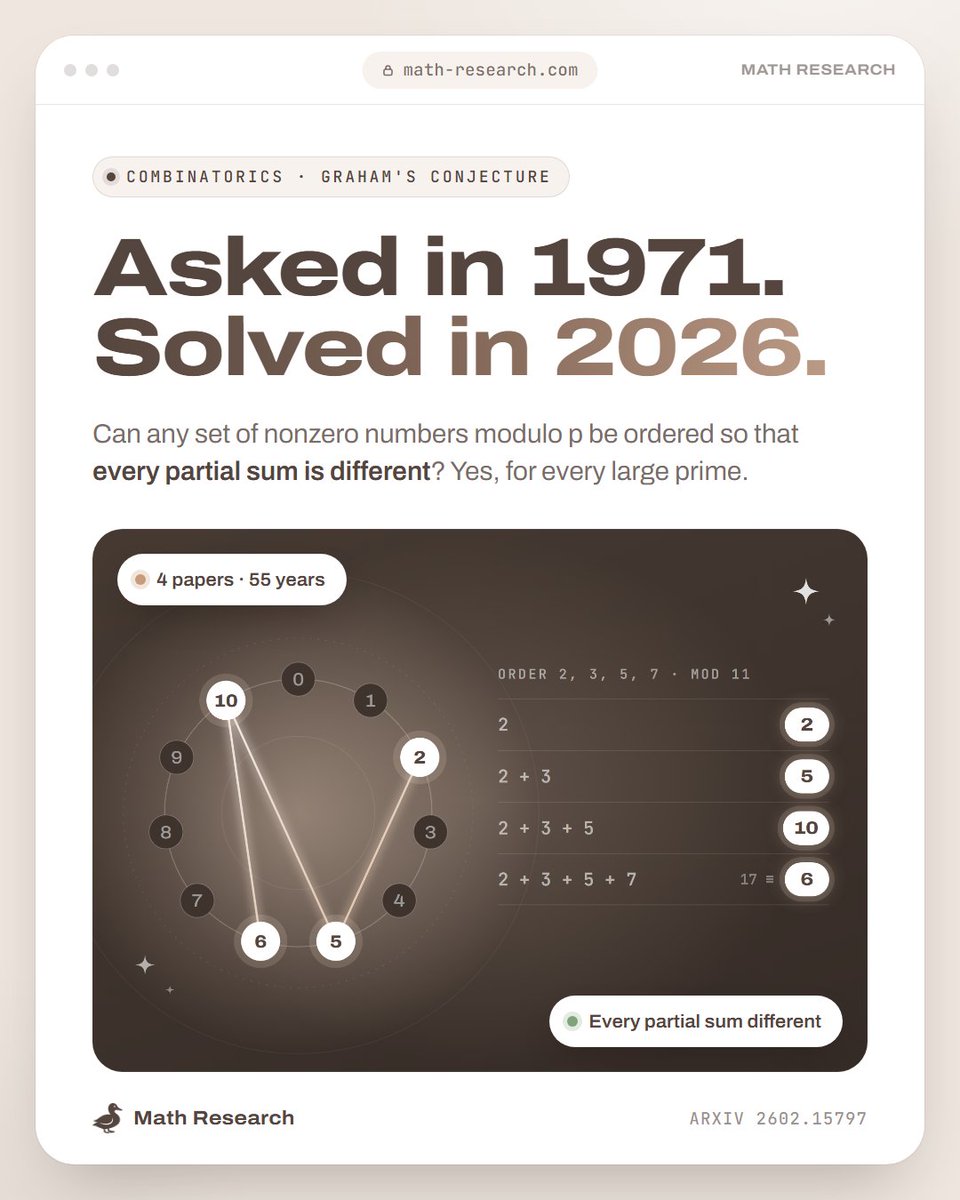
It took four papers by different groups to settle the problem for large primes. Results like this are built by many people over many years, and none of them are paid for the papers they write or the papers they review. That's the reason Math Research exists.
@rperezmarco It's becoming a tool, just like calculators and software assistance (mathematica/wolfram alpha). Mathematicians can make a poor job at making sense of the AI findings, but that should be handled within journals to make the best of the results, nothing against the authors.
@zesenhuang It can produce some PhD level work, however, it's particularly bad at finding new valuable conjectures, explaining the proofs, making a coherent/entertaining text. Regarding problem solving, my belief is not all proofs are equal, and is not finding the best ones yet.
@billionsmustliv @letonyo Because their current goal has been to train it to solve harder problems. I would argue mathematicians have been historically lazy at writing their proofs as well (using "obvious" as an argument, "follows" from X/Y but not how, etc). Wait until they feed it educational data.

orandom @orandom82
1 Followers 37 Following
Miringua @malboroclavogrl
81 Followers 187 Following 𖥔 ݁ ˖✧˖°.✶₊ ⊹ soltar, tiempo y confianza𖥔 ݁ ˖✧˖°.✶₊ ⊹
Mira @_Mira___Mira_
12K Followers 2K Following
Jana Rodriguez Hertz ... @janarhertz
25K Followers 2K Following Mathematician. Professor at @SUSTechSZ. Not against AI. 🇦🇷🇺🇾

arXiv.org @arxiv
56K Followers 184 Following News from https://t.co/enurGFxpcS, a free distribution service and an open archive for scholarly articles. For help with arXiv, see https://t.co/LcWuhM0BOl
Balázs Pozsgay @pozsgaybalazs
2K Followers 124 Following Researcher in mathematical physics, interested in the use of AI. ELTE, Budapest, Hungary. https://t.co/OMALx4gHPV
Steve McCormick @Quasilocal
9K Followers 365 Following Mathematician (Math.DG / gr-qc). +3 Fire damage.
Oxford Mathematics @OxUniMaths
79K Followers 26 Following Official account for the Mathematical Institute at the University of Oxford.
Anthony Bonato @Anthony_Bonato
31K Followers 34 Following Math prof and award winning author at @TorontoMet. Nine books including Dots and Lines and The Sky Took Us. Math and math memes. I won’t grade you. Much.
Julian Schiavo @_julianschiavo
5K Followers 2K Following 🇮🇹 from 🇭🇰 in san francisco, engineering @bitrig, previously @apple swiftui/ai & uiuc cs & wwdc scholar my own strong opinions, weakly held
Fermat's Library @fermatslibrary
793K Followers 4 Following A platform for illuminating academic papers. We annotate and share a paper every week. Save, annotate and share papers with anyone: https://t.co/0o2Pls3jmo
The Math Flow @TheMathFlow
89K Followers 55 Following Mathematics insights presented through animations, formulas, pictures, graphics, quotes, books, history, and memes. Open DM.
Mathematica @mathemetica
70K Followers 216 Following Math isn't escape. It's the map through the madness.
MatLab crashes @memecrashes
332K Followers 264 Following currently working on our PhD (imaginary issues no one cares about except a really really really specific audience)

Trends for United States
You might like


















