

Maximilian Hartinger @MaxHartinger
Stock Trader | Value Strategy & Technical Execution | Head of Research @TradencyRS research.tradency-one.com Joined December 2023-
Tweets5K
-
Followers3K
-
Following7
-
Likes10K
Sentiment aligns. Liquidity flows align. Seasonality aligns. This is why our cash position is currently capped at 10%.
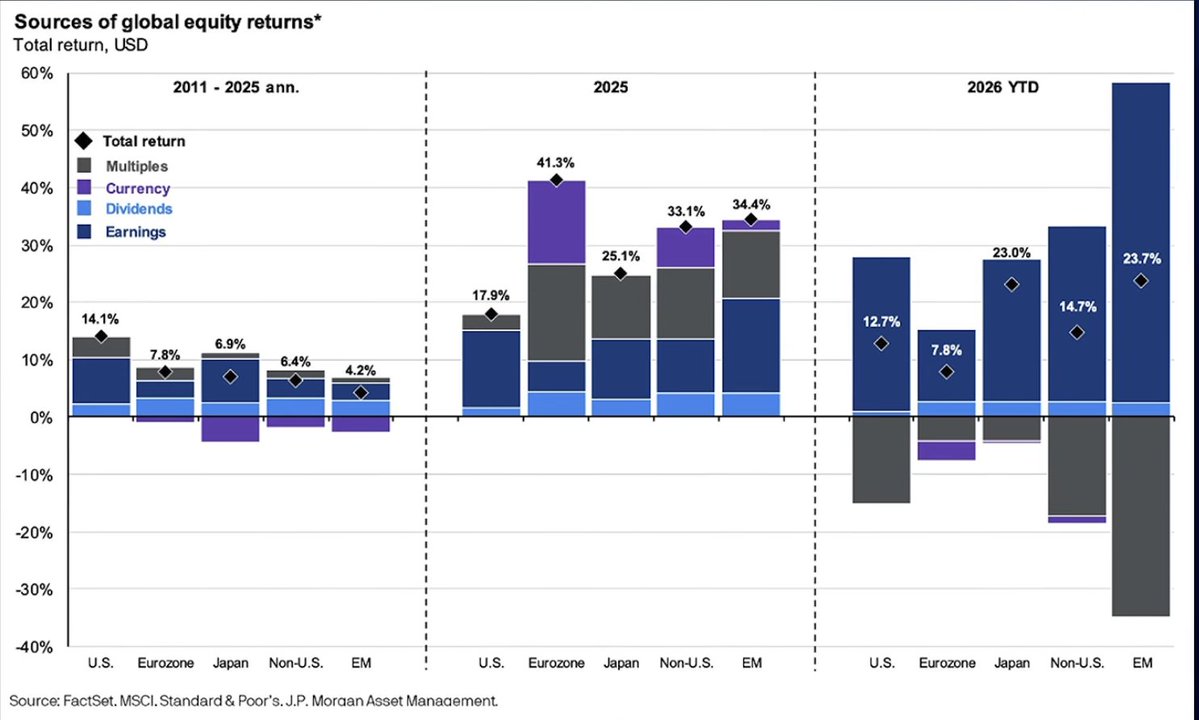
Global equity returns are currently driven almost entirely by earnings growth, not multiple expansion. Unlike 2025, where multiple expansion drove a significant portion of global performance, 2026 YTD marks a structural shift. Severe multiple contraction is actively squeezing
Harmlessness is not morality: It is simply powerlessness. Europe serves as a case study in this misstep. By prioritising moral posturing and regulatory overreach over industrial competitiveness in almost every area, it actively erodes the engines driving its own wealth. While other global powers operate on ruthless economic pragmatism, Europe risks remaining a passive liquidity provider for foreign growth. Without economic leverage, high moral standards do not make you a leader, they make you an underwriter for everyone else.

I have just concluded a highly successful discussion with President Vladimir Putin, of Russia, wherein it was agreed that Russia will immediately supply over 300,000 Tons of Diesel Fuel to the American and Global Marketplace, another 500,000 Tons during the month of November, and
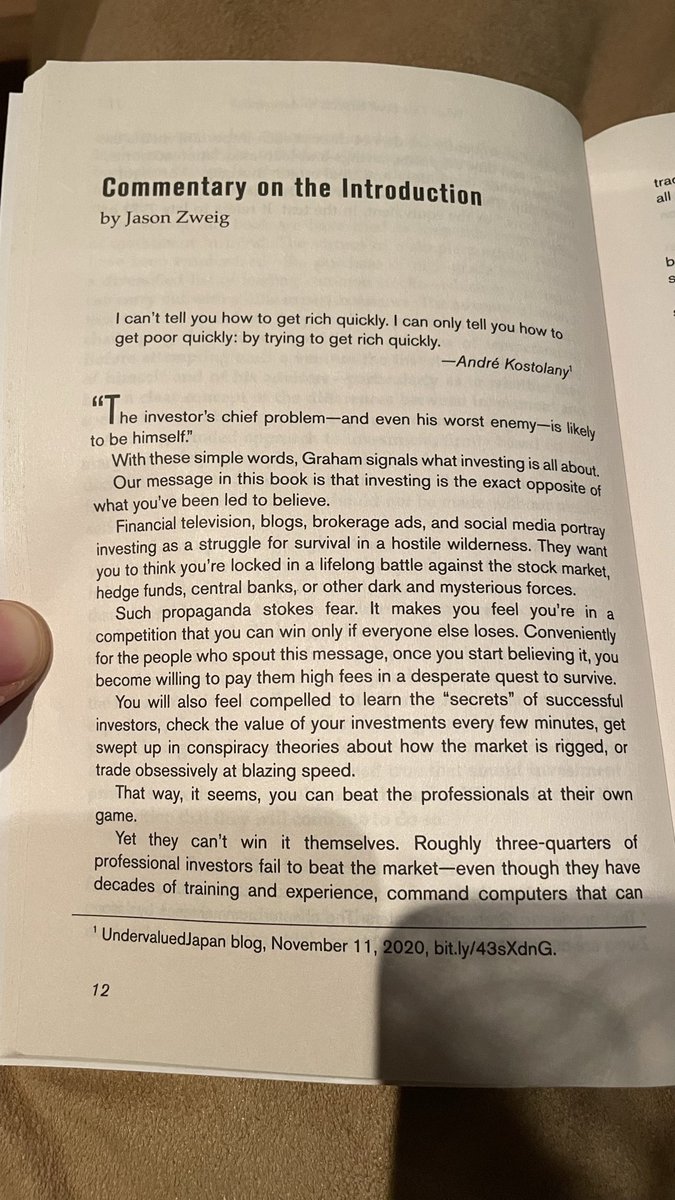
@Yogi81dutch The intelligent investor. Third Edition.
While certain arguments hold merit, much of the underlying logic is fundamentally flawed. Adverse events are an inevitability of market history, total risk elimination is an illusion. Furthermore, "too big to fail" does not guarantee immunity from collapse, it merely triggers systemic intervention, the ultimate success of which remains unproven. Aggressive market drawdowns are largely driven by forced liquidations among overleveraged participants, a structural dynamic no government intervention can prevent. For the vast majority, active trading is inefficient due to a poor time-to-return ratio. While its purpose is to outperform baseline market returns (~8%), few achieve this, making it a “waste of time” for most indeed. Sharp corrections do not signal a broken stock market or economy. They are simply the natural mechanics of every market and cant be avoided. Ultimately, this echoes classic "new paradigm" rhetoric.
You will always get complete honesty and transparency from me. I have nothing to hide, nor will I sell products that offer no real value. I have completely shut down my online operations for a while and relaunched my tree climbing business here at home. This allows me to generate sustainable cash flow through meaningful work without drawing down my investment capital. I will never monetise demand that I know lacks genuine utility. I would rather step away from the public sphere entirely. I wish you a great weekend as well.
Our exposure to Bitcoin and digital assets is currently 0%. Targets for Bitcoin are clear. Because they have not been reached, there is no rationale for establishing higher-timeframe exposure at this point. Sub-$40,000 levels represent tactical accumulation, not based on fundamental value or intended as a long-term hold, but to exploit structural volatility, sentiment and its current integration into global markets. Fundamentally, there is no justification for emotional positioning or fear of missing out. Bitcoin has failed to deliver on its foundational promises. The "digital gold" narrative remains unproven, furthermore, physical gold itself is merely an asset to be traded cyclically, as it frequently fails to serve as an effective hedge during acute crises. Far from being an anti-establishment asset, Bitcoin has been further compromised by over a decade of regulatory lag. Going forward, large-scale profitability is limited to early entrants and those capable of executing precise market timing. The broader crypto ecosystem has delivered even greater disappointment. Since 2021, most tokens have suffered persistent downward trajectories. Yet market participants continue to chase the temporary euphoria of 2021, the fantasy of rapid financial independence. That promise has proved false, leaving retail traders chasing diminishing returns for nearly five years. From a fundamental standpoint, expecting predictable, sustainable returns from this asset class by mistaking anecdotal clues for genuine analysis borders on strategic delusion. Ultimately, this sector has destroyed significant capital and ruined prospective investors. The psychological baggage and destructive habits acquired in crypto prevent participants from building sustainable wealth within established asset classes. Many are now pivoting toward technical trading, a discipline that can be highly lucrative when executed with institutional rigour, but remains unprofitable for the vast majority. The entities that exploited retail inefficiencies during peak mania, exchanges, promoters, and insiders, have shifted their focus to monetising the surge in technical trading interest. They continue to extract value by selling false certainty, capturing fees, and distributing remaining holdings into exit pumps. If your objective is to build enduring wealth, direct your capital elsewhere.
For the majority of market participants, value investing remains the most practical framework due to constraints on time, energy, and objectives. However, value investing continuously evolves. Markets adapt as consensus understanding shifts: It is structural imbalances that generate opportunity. While specific tactics utilised by figures like Warren Buffett over past decades may appear outdated, the core tenets endure. In an era dominated by algorithmic execution and high-frequency flows, traditional valuation metrics frequently yield to pure price momentum. Outperformance remains a game of adaptation and counter-adaptation. Fluidity is rewarded, but core market mechanics never change.
I take no issue with the skepticism, I would be suspicious too. But there is no reason to be. Every change was made publicly, nothing was deleted or hidden. I simply used this break to recalibrate and determine how I or if want to operate publicly moving forward. Until now, I shared my journey in an unstructured manner. Attempting to integrate that into daily life became exhausting. Navigating social media without a structured plan is unsustainable, which is why I am executing with a concrete framework from here on. I shifted my language and focus to attract a different demographic. I am no longer interested in catering to the retail trading crowd. While lucrative, and an approach I pursued for a time, years of observation demonstrate that it fails to help participants at scale, instead steering most down a path they are ill-equipped to navigate. Individuals possess distinct strengths, and active trading is not suited for everyone. Structured long-term investing, however, remains the far more viable approach and, when properly executed, yields significantly higher time-adjusted % returns. It is tiresome to repeatedly answer the same questions for individuals who rely entirely on third-party opinions. This is why I ceased selling products to this crowd months ago. Closing the free Discord server was the logical next step, nothing signals retail speculation and signal more than a Discord community. Moving forward, communication will transition exclusively to structured platforms and professional interfaces. Over the past 1.5 years, I built a team with whom I regularly exchange on market analysis. We recently launched @TradencyRS and will soon release the Tradency Satellite Terminal, which displays all positions in real time. This terminal serves as proof of work and a practical demonstration of how a professional portfolio should be managed. This explains the shift to "we". Market analysis and strategic ideas do not originate solely from me. I want to attribute some credit to team members who choose not to engage with the public exposure of social media. I am leaving the retail (crypto) trading space behind permanently for those reasons. Even legitimate educators fail to deliver real value to the masses, simply because trading is not suited for everyone and crypto is a unpredictable scam for those that don't have access to insider information. 95% of participants would be far better off shifting toward long-term investing via a core-satellite strategy as i have talked about many times before. Yet, through my previous public positioning and language, I attracted the exact opposite: Gamblers, riddlers, signal-chasers, and certainty seekers. I understand if many decide to unfollow. That is expected and precisely what this recalibration is designed to achieve.
Streaming platforms like Netflix serve as powerful mechanisms for narrative construction. Masked by high production values and curated "expert" commentary, they frequently stream selective or misleading information. The broader audience accepts and shares this content due to a lack of technical domain expertise and a vulnerability to visual polish. Distinguishing truth from bias becomes exceptionally difficult when valid data is strategically blended with narrative engineering over a long time horizon. While these tactics are far from novel, they have now fully saturated modern media formats, including podcasts and digital streams.
A common trait among polarising figures is the cultivation of an us-versus-them mentality. In politics, it is locals versus outsiders. In financial markets, it is retail versus institutions, whales, or billionaires. Tribalism is weaponised to manufacture trust and bias. The moment you identify with a group, objectivity disappears and the creation of manufactured adversaries secures compliance. Your primary enemy in the markets or for success in life in general is your own psychology. Anyone relying on an us-versus-them narrative or language is exposing an immediate red flag.
Unpopular opinion: The assets you trade or invest in must have intrinsic value and operate within a regulated framework. Otherwise, market distortions such as wash trading and insider dealing make any attempt at price prediction a statistical gamble. If an asset lacks intrinsic value, generates no productive utility, and solves no real-world problems, categorising it as an investment is fundamentally flawed anyway.
Highlighting isolated single-position P&L or large and fast absolute dollar gains without context is the easiest way to lure retail speculators. A $5,000 gain on a $10,000 account represents a 50% return. On a $5 million portfolio, that exact same amount is mere statistical noise and not even worth the time and paperwork. Context is everything. Public market commentary is always commercially driven. The distinction lies between those who sell polarising illusions to the masses and the select few who choose to educate with objective reality to a much smaller audience.
Trading educators and gurus continuously lure retail participants into an environment they are ill-equipped for. Active trading suits only a tiny fraction of market participants. To monetise the remaining majority, influencers sell the illusion of certainty. In an inherently uncertain environment, certainty is the easiest product to sell and the biggest lie. Even institutional market participants operate under inescapable residual uncertainty. Your objective is not to eliminate uncertainty, but to manage it through probabilistic thinking, dynamic scenario assessment, and fluid positioning. These truths do not sell well to a retail audience, neither does the reality of portfolio outperformance. Generating consistent alpha over extended time horizons, measured in years, not isolated trades or unverified accounts, is exceptionally difficult. There is a reason professional fund managers rarely outperform broad market indices consistently and it's not just size. Selling dreams of unrealistic returns remains lucrative, yet it is the primary reason most retail participants fail to capture even basic beta performance in their attempt to outsmart the market. Even when a strategy is legitimate, though it rarely delivers on its promises, the primary bottleneck remains execution: Whether you can adhere to it under pressure and endure the lifestyle demands it imposes. Everything comes with a price.
After years off the grid, I almost forgot the true value of genuine, high-caliber connections.
When a blue-chip company consolidates sideways for over a year while expanding revenue and improving/maintaining fundamentals, it isn't stagnation, it's a time correction. Valuation resets through time, not just price.
TP 30% on $META after momentum broke. Reallocating profits into $GOOG and $AMZN.
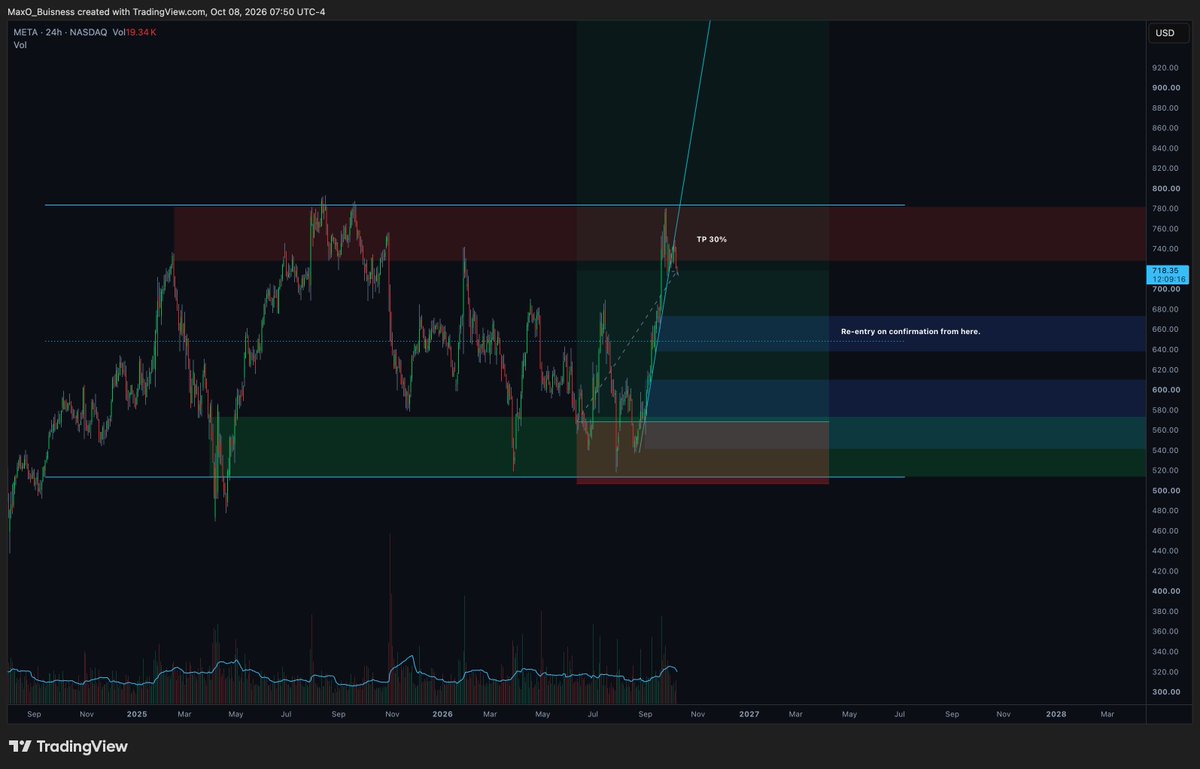
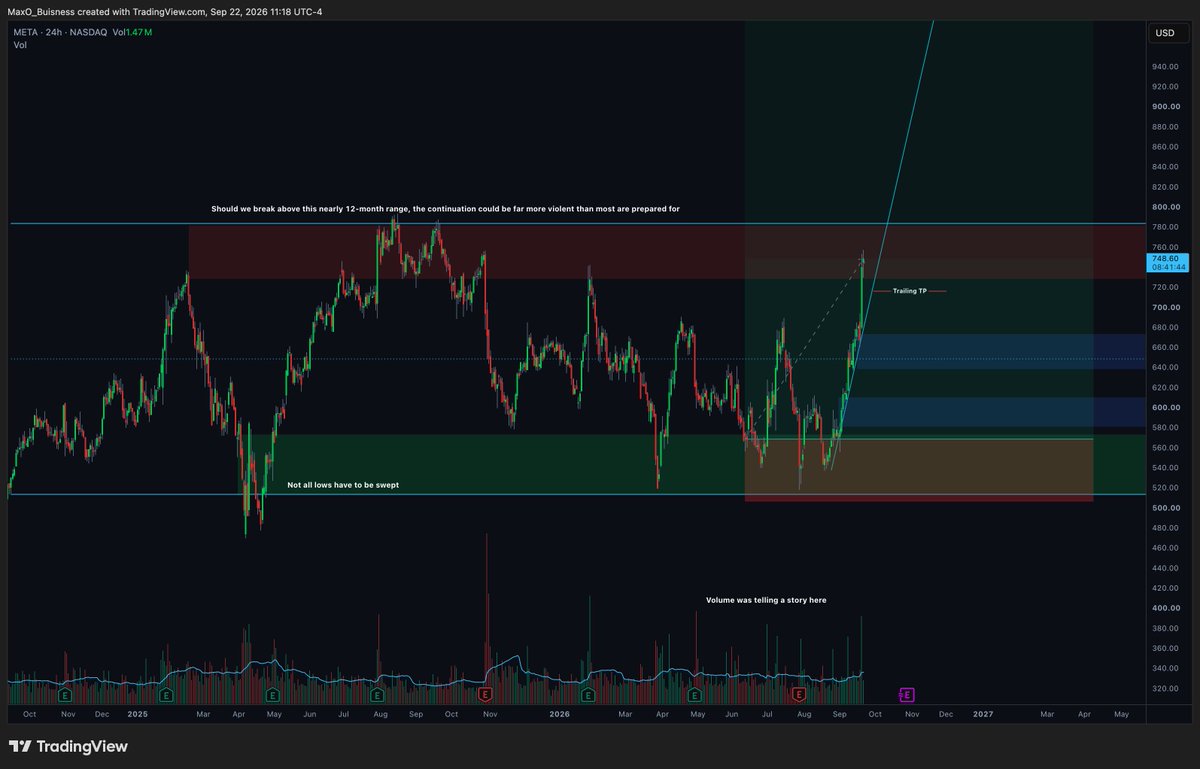
After accumulating throughout the summer, $META has become my largest position. Trading at ~24x P/E, -30% from USD ATHs and with 20%+ YoY growth, META was systematically undervalued. Whenever sentiment sours on Zuckerberg, it historically yields the ultimate contrarian buy
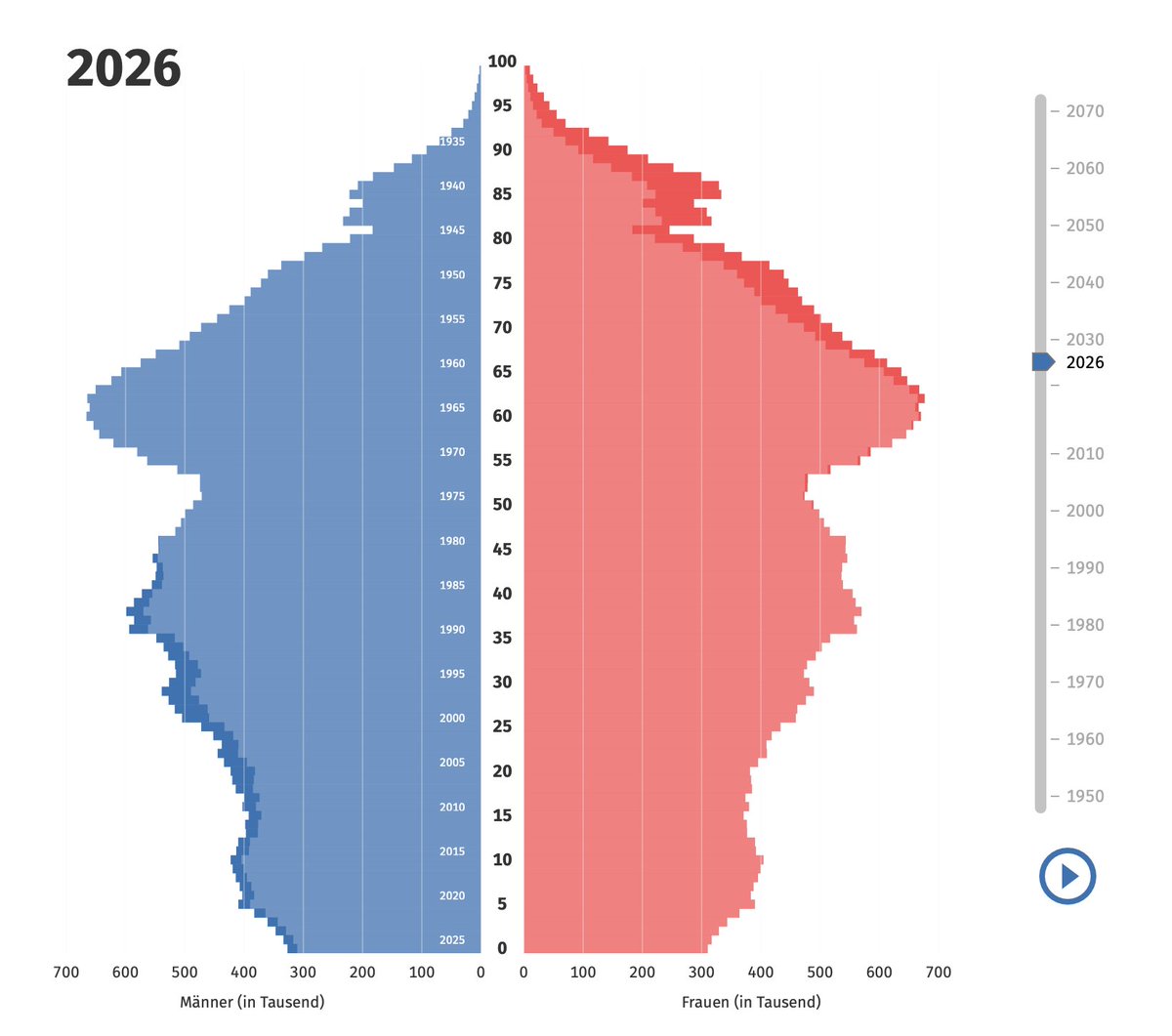
Yes, this is a key driver behind why prices remain relatively stable. Speaking primarily for Germany, where I gather most of my data, the total population remains stable despite declining birth rates. This acts as a stabilising factor for the residential housing market and other population-dependent sectors.
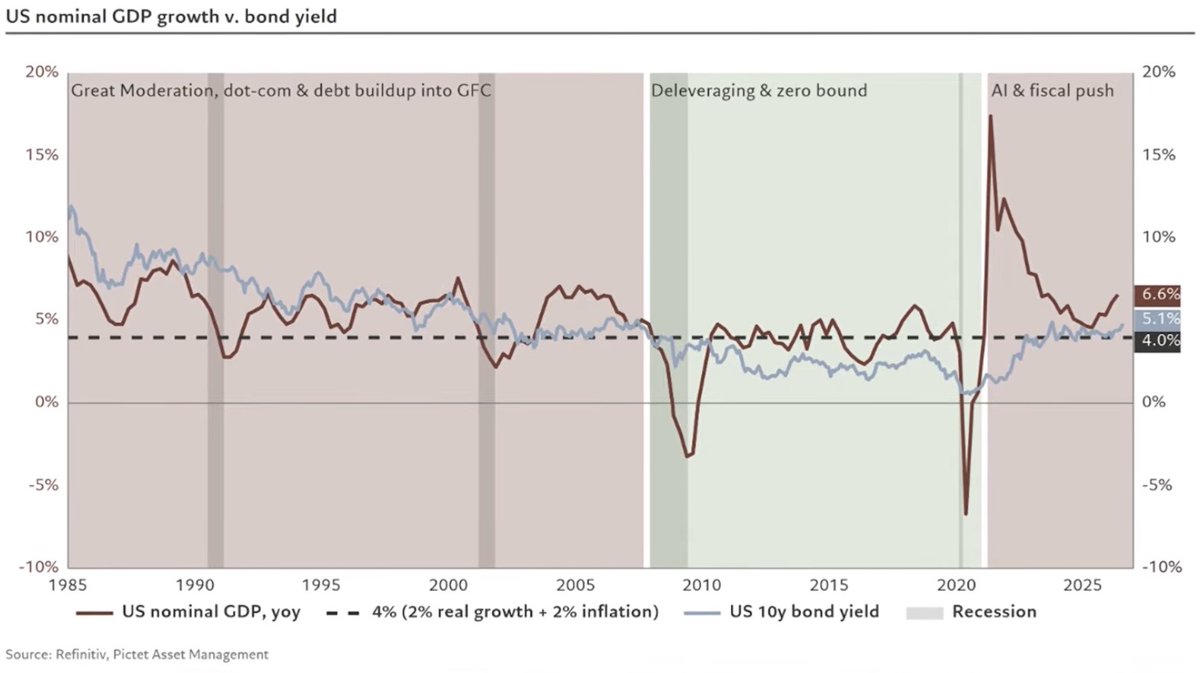
Yields at 5.1% aren't breaking equities as long as nominal growth holds at 6.6%. We remain fully invested, treating yield spikes as accumulation zones rather than exits.
US nominal GDP growth (6.6%) continues to outpace the US 10-Year Treasury yield (5.1%), demonstrating that the economy generates sufficient expansion to absorb a higher cost of capital. While both metrics sit above the 4.0% baseline (2.0% real growth + 2.0% inflation target),
Rare and high-value real estate with unique use cases behaves differently from commercial assets or standard residential housing. The high-end luxury segment remains largely decoupled from the broader market, while agricultural and alpine land follow distinct supply-demand dynamics, with grassland drawing particularly strong interest across many regions. Nevertheless, neither is fully immune to macro headwinds.
The 2031 debt-refinancing cliff will collide directly with peak Boomer demographic liquidation, driving an unprecedented structural repricing across Western real estate.
Demographic shifts are set to reprice residential real estate across Western economies. With fertility rates remaining structurally below replacement level, the cohort of active market participants is contracting. As the Baby Boomer generation transitions into retirement and


Tradency Research @TradencyRS
70 Followers 39 Following Data-driven macro and quantitative market intelligence. Empirical research focused on institutional market structure.
Shivam gupta @Shivamgupta3457
2 Followers 19 Following
Upper Hand Sports @UpperHandSports
148 Followers 710 Following SPORTS SELECTIONS DAILY. Ranked Top 5% in Las Vegas Circa Contest 2022.
JonBoi @FlyWieEinVogel
13 Followers 115 Following
Steven Cao @StevenCao_BDM
1K Followers 6K Following BD Lead @BitunixOfficial | SEA & Global | Best partner terms | VIP+1 | Exclusive cashback for VIP/whale traders @BitunixOfficial | #Bitunix #BTC

DixieNormous @DixieNormousOG
73 Followers 68 Following
Al_fd @dneprfreek
43 Followers 45 Following
Harsh @Harsh45605853
157 Followers 1K Following i am here to earn ,learn and grow.| Everyone is good in its own way .| am pursuing for financial freedom via crypto.|

Smart Brain 🤔 @SmartBraineih4
828 Followers 6K Following
Jess @JustQueenJess
1K Followers 1K Following
MP @MysticT0mato
22 Followers 45 Following





k073k_ @k073k_
40 Followers 26 Following Stacking Ls like they're NFTs since 2017 Rekt across the multiverse X is my journal
Nestor the Hippo @NestorHippoX
8 Followers 30 Following Welcome to my watering hole. Nobody stopped me from making every mistake. Now I stop you. My losses. Your lessons. 🦛
JustCrust @just_crust
20 Followers 90 Following Join my Stream or Follow me on socials :) https://t.co/nDoEPK12TM
William Song @swairsupply
50 Followers 762 Following

Primario @ilprimariogia
113 Followers 170 Following Entrepreneur at heart. Music, design and technology.



Johnson Williams @JohnsonWiljwp
115 Followers 678 Following I'm a straight guy with a bi side🌈👷 we can also contact WhatsApp +447477495052

Jesse Babatunde @babatunde_jesse
26 Followers 17 Following
Limit @LimitlessCT02
5 Followers 26 Following
Rft @rft0004
170 Followers 91 Following
zxc @zxc85662511
15 Followers 117 Following
Anton Gitschel @s78y965cwz
9 Followers 41 Following
Constantin Olteanu @colteanu121
6 Followers 14 Following
Mr.N @MrNazir777
95 Followers 329 Following
Julie Kestlová @j_kestlova
10 Followers 11 Following


Domenico Sbicca @Domenico_Sbicca
81 Followers 614 Following Managing Director at Gingko Independent & Gingko People
Nick @BTCC_Nick
318 Followers 1K Following Head BD in NA at BTCC Exchange | KOL partnerships | Crypto, Derivatives, Stocks, Indexes | Telegram @btcc_nik
A @FinestAl
54 Followers 327 Following
affan @AffanKakar23974
213 Followers 97 Following learning TA from the best trader, a teacher n mentor of 1000’s. the one n only @moneytaur_

Lance @Sync1445
117 Followers 723 Following Teacher, Truth Seeker, Sync Master, Quantum Activist, Crypto Junkie
FSO @wittegnoom
10 Followers 24 Following
Carla Gomes Correia @CarlaGomesCorr2
3 Followers 55 Following
Tradency Research @TradencyRS
70 Followers 39 Following Data-driven macro and quantitative market intelligence. Empirical research focused on institutional market structure.

Tight and Liquid (spr... @AlgoJobbin
20 Followers 50 Following Pony Market Made Me Do It ☦︎ 🇬🇧 Now Retail, Personal Journal
Barncore @barnc0re
3K Followers 383 Following Studying @Moneytaur_ + Exploring AI 🌐 I'm no trading expert, this is just a public journal, my goal is to document the journey from "noob" to "profitable"

Hoodstock @hoodstock_80
2K Followers 52 Following “The privilege of a lifetime is to become who you truly are.”
Trends for United States
You might like


















