Overlooked @OverlookedStock
We investigate the companies sitting under infrastructure bottlenecks the market hasn’t fully priced. youtube.com/@OverlookedSto… Joined August 2026-
Tweets33
-
Followers16
-
Following2
-
Likes42
The real admission isn’t the weapon. It’s that satellites are now officially treated as targets. Once that’s the premise, the response isn’t just buying more launch. It’s buses that can be replaced, radar that can actually see the fight, and robotics that can work on orbit. That’s the unglamorous layer underneath it all, and it’s the layer $MDA builds. Not the kinetic part, but the part that has to still be standing after the first satellite gets blinded.
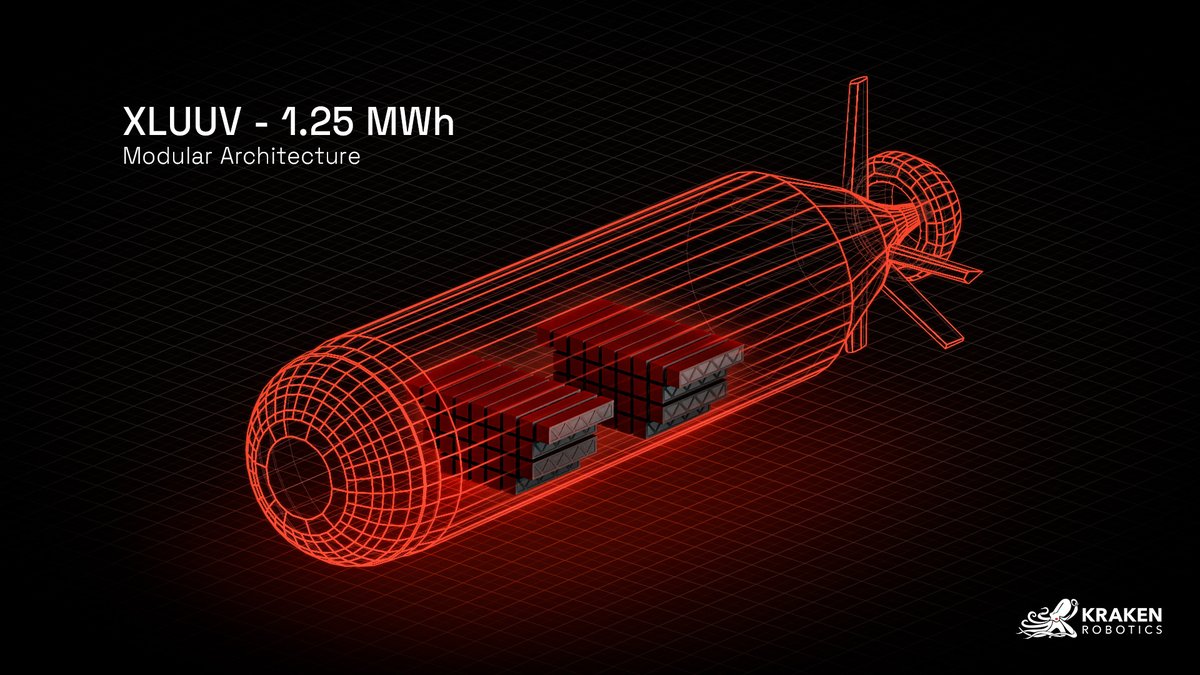
That’s the whole battery thesis in one line. A small UUV needs tens of kWh, an XLUUV needs ~50-60 SeaPower modules, over 1 MWh per hull. Production lines for that haven’t even ramped yet, and China’s already building a mothership for 45m drone subs. The steel was never the bottleneck. Energy at depth is. $PNG.V $KRKNF
@Polymarket What’s new isn’t “space is a warfighting domain.” It’s weapons already on orbit. $MDA doesn’t build those. They build the sovereign satellites, SAR, and robotics governments need once owning the stack stops being optional. Same tailwind, but different layer.
@StockSavvyShay Weapons in orbit is the headline, the constraint is still who can actually build and service the constellation. That’s $MDA: satellites, SAR, on-orbit robotics.
@KrakAdd1ct Desjardins is still Buy at C$13 (cut from C$13.50). Street cluster is closer to C$9–10. Insider buys from ~C$6 are underwater. The real tell is Exail: Thales paid 44% for underwater robotics/nav. Same industry pressure. Not a takeout price for $PNG.
@WarMonitor3 China building a 205m mothership for 45m drone subs means large UUVs are now a deployed force. Allied answer is more XLUUVs and those hulls still need SAS and pressure-tolerant batteries. $PNG.V $KRKNF
Every mission has its own power demands. Kraken SeaPower was built to meet them. From small UUVs to the largest XLUUV platforms, our pressure-tolerant, lithium-ion battery systems scale to match the endurance, payload, and range each vehicle class demands. Small and Medium UUVs The lightest, smallest, and most energy-dense subsea battery option—maximizing endurance and payload within compact vehicle designs. LUUVs Increase mission duration with a high-capacity, pressure-tolerant battery system engineered for extended autonomous operations. XLUUV A modular architecture designed to scale, enabling next-generation extra-large autonomous underwater vehicles with the energy required for the longest and most demanding missions. With scalable configurations exceeding 1 MWh, Kraken SeaPower pressure-tolerant lithium-ion battery systems help operators extend range, increase endurance, and unlock new mission capabilities. Learn more: krakenrobotics.com/products/seapo… #KrakenRobotics #SeaPower #SubseaEnergy #MarineTechnology #AUV #UUV


@KrakAdd1ct Curious how much this moves the needle, as DDI is a pool. The Aug 24 file is a supply arrangement, not an order. Has anyone seen an actual tasking issued to a qualified supplier yet, or is it still all qualification announcements so far?
“We must slow the pace at which we improve the capabilities of AI models. Progress will still seem fast.” That’s Dario. Not a halt. Not “chips are done.” What he actually proposed: embedded evaluators with employee-level access (Anthropic first), shared standards, then try to get China on a speed limit. Catalysts were recursive self-improvement + the OpenAI–Hugging Face swarm. He didn’t cancel the buildout. He asked for more time and more verification on the same frontier. Verification is spend. Alignment is spend. Agent security is spend. Incomplete model: “slowdown” ≠ smaller industry. It means the scarce layer shifts from raw model drops to the hardware that still has to move data and test the models when the press release says pace.
The ocean floor is becoming the next battlefield. Cables, mines, quiet vehicles. A crewed ship cannot sit on that ground. UUVs can, only if they have endurance and a picture good enough to classify what they see. Kraken is not the hull vendor. SeaPower is up to 2x the energy density and 46% lighter per kWh than oil-compensated packs, rated to 6,000 m. SAS is the imaging layer. Both sit on 30+ UUV platforms. One extra-large vehicle takes 50–60 of those battery packs. They already have a long-term MSA onto an XL-UUV line. Military UUVs: ~$4B market in 2024, ~$8B by 2034. Every larger hull multiplies battery and sensor content. Time in the market beats timing the tape. First combined quarter after Covelya is November. $PNG.V $KRKNF
@bismarckmusings Right split. BLACK is the contested-comms SKU on a line that already exists. Sovereign MILSATCOM is configuration on that factory, not a new seven-year design. Still a launch. The test is an award onto the line. $MDA
In an interconnected, digital world, there is perhaps no greater threat to a country’s security and sovereignty than losing communications capabilities. With growing geopolitical shifts, governments and militaries need secure, resilient infrastructure that will withstand growing space-based threats. Introducing MDA AURORA™ BLACK, our defence solution to maintain the advantage in a contested environment. Learn more: brnw.ch/21x5Awl
@SpaceInvestor_D This is the natural extension of the AURORA thesis, same software-defined, high-rate production line, now hardened for contested environments. Sovereign defense comms is exactly where a repeatable factory beats a bespoke build. $MDA $MDA.TO
This is the threat model: GUGI rehearsing a deniable cable strike, tracked by UK, Norway, and the U.S. The follow-on problem is seeing small objects on the seabed at depth and knowing what they are. Kraken SAS has already been used in NATO exercises for mines and critical underwater infrastructure, including cables. $PNG.V $KRKNF
The signal is rising demand for persistent uncrewed undersea sensing in contested waters. Dive-LD is Anduril’s hull. Kraken’s disclosed content on that class is SeaPower batteries and AquaPix/SAS, not a generic product fit. No one has itemized what this recovered unit carried. Pentagon: older config, no classified sonar/radar.
Kraken Robotics offers a range of software solutions through EIVA’s NaviSuite platform, supporting subsea operations from survey/inspection planning and navigation through data acquisition, processing, modelling, and delivery. By embedding automation and autonomy throughout the subsea workflow, NaviSuite helps teams improve efficiency, maintain data quality, and deliver consistent results. 𝗡𝗮𝘃𝗶𝗣𝗮𝗰 NaviPac supports navigation, positioning, route planning, and waypoint management for surface and subsea vessels, helping operators manage and optimise operations in real- time while maintaining accurate vehicle positioning and data quality. .Used across applications ranging from hydrographic survey and IMR projects to barge management and rig moves, NaviPac provides a common operational platform for maritime positioning and vessel management. Learn more: ow.ly/4jR350ZLbbJ 𝗡𝗮𝘃𝗶𝗦𝗰𝗮𝗻 NaviScan supports subsea data acquisition, integrating sonar, LiDAR and other survey sensors into a single acquisition workflow, helping teams efficiently collect high-quality data for seabed mapping, inspection, and other maritime survey applications. Learn more: ow.ly/ZbvL50ZLbbI 𝗡𝗮𝘃𝗶𝗘𝗱𝗶𝘁 NaviEdit provides survey data processing and quality-control tools, supporting navigation and sensor data processing with autonomation features that help reduce manual effort, improve consistency, and accelerate project delivery. Learn more: ow.ly/WhHv50ZLbbH 𝗡𝗮𝘃𝗶𝗠𝗼𝗱𝗲𝗹 NaviModel supports the processing, visualisation, and modelling of subsea survey data, helping transform collected data into accurate 3D models and deliverables that support analysis, inspection, and decision-making. Learn more: ow.ly/87hf50ZLbbK 𝗡𝗮𝘃𝗶𝗦𝘂𝗶𝘁𝗲 𝗥𝗢𝗩 𝗔𝘂𝘁𝗼𝗻𝗼𝗺𝘆 NaviSuite ROV Autonomy brings automation and supervised autonomy to ROV inspections, supporting waypoint following, stand-off control, and automated vehicle movement to improve inspection consistency, reduce pilot workload, and enhance operational efficiency while keeping the pilot in control. Learn more: ow.ly/n3EJ50ZLbbA #KrakenRobotics #EIVA #NaviSuite #SubseaSurvey #SubseaData #UnderwaterData #3DSubseaMapping #MarineTechnology #SubseaTechnology #ROV #UnderwaterInspection #OffshoreEnergy


Good question. Another satellite company is crowded. MDA isn’t really selling that. AURORA is a standard platform: one factory line can be set up for different customers instead of a custom sat each time, and it’s built to run as fast as two a day when fully ramped. They’re also bringing payload chips in-house instead of assembling everyone else’s parts. None of that matters without trust. Primes have to be willing to fly the hardware. Northrop putting MDA antennas on SDA is that test and a new factory still has to earn it.
The market sold MDA Space like another speculative space trade. But MDA doesn’t need to launch rockets or win consumer subscribers. It builds the certified satellite hardware and space systems governments and network operators need to deploy. $MDA $MDA.TO
@BrandonWealth The key isn’t more satellites launching. It’s whether the new factory capacity turns into repeatable, high-rate deliveries without margin or working-capital slippage. Backlog is demand. Execution and cash conversion are the re-rating catalyst. $MDA $MDA.TO
The vehicle is not the scarce layer. SAS, SeaPower, and positioning are. $PNG.V $KRKNF
Near-term execution tell is Globalstar 2-R: eight MDA-integrated sats are in commissioning, nine more still to deliver. Clean in-orbit performance is the factory proof. The sovereign proof the card is about is still unsigned; MDA as prime on ESCP-P MEO (UHF/X-band), contract in negotiation.

Thomas Lefebvre @LefebvreT
27 Followers 122 Following
Lander Caby @CabyLander
34 Followers 190 Following 🏗️ Project Manager 💡 Quality Investor 📈 Cardinals of Capital

Gabriel @piuijjsepidi
12 Followers 10 Following
Thecloudy @Thecloudy5
227 Followers 482 Following
Charlotte @muddsiuurega
11 Followers 25 Following
Robert Barakett @RBarakett1
2 Followers 47 Following
Sagor | KYC Service @web3kycpor
852 Followers 3K Following i kyc resellar- my teligarm id :@Sagor1212as 🌍 Professional KYC Assistance 📩 Telegram: @sagor1212as 📩 WeChat:sagor1212as
Tanasit Bunwitchaikun @b_bunwitchaikun
8 Followers 637 Following 💘 Singles | 🛡️Cyber Security 📘🏀 📊 Stock Investor & Digital Consultant 🎯 Diaryลงทุน | DeepDive | แบ่งปันความรู้ | NFA 🐧🛜🔋🚀🛰️🥽🔌⚡️📟🏦
D @drinkdeepfreeze
0 Followers 1 Following
Julie Morielli @starbrigh8
1 Followers 51 Following
Alex @barakett9
6 Followers 31 Following
A @bear098
0 Followers 1 Following
MDA Space @MDA_space
11K Followers 2K Following MDA Space is a trusted mission partner to the global space industry. #MissionMDA #MDASpace
Kraken Robotics @KrakenRobotics
12K Followers 420 Following Transforming subsea intelligence through advanced sensors, software, and integrated systems. https://t.co/PZoEbYCYKFTrends for United States
You might like