

Ponscient — Bridge of Consciousness @Ponscient
Bridging inspired reflections, dialogues, and creations in the sea of consciousness 🌉 Research neuroscience, math & AI to philosophy & art 🌊 ponscient.org/en/ Xiamen, China Joined September 2026-
Tweets23
-
Followers12
-
Following140
-
Likes5
10/ And the poster itself: The Fiber Bundle Theory of Consciousness (FBTC), P55. A falsifiable geometric framework linking neural dynamics to the structure of experience, tested through four signatures: binding, path dependence, coupling and report. Seeking collaborators.
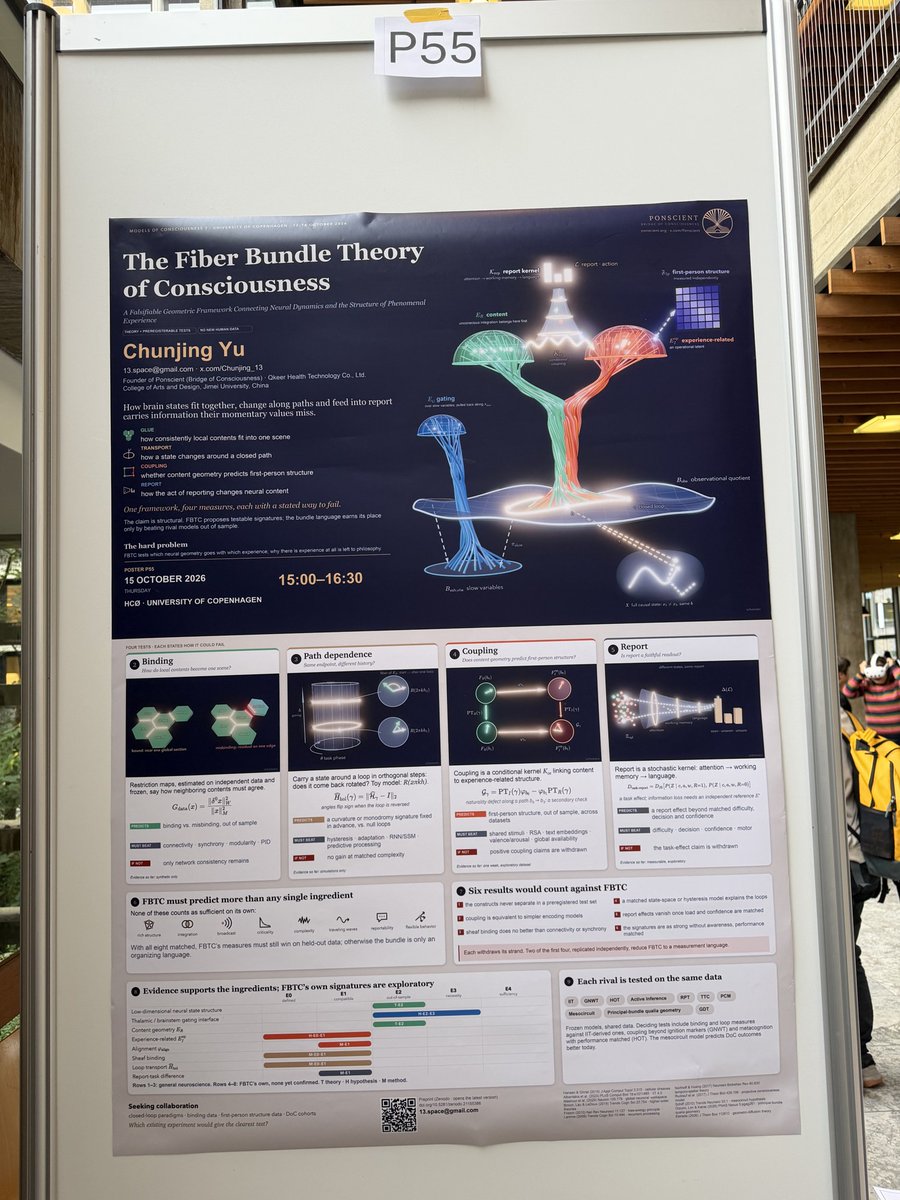

9/ Thank you @moc7conference, the organisers, and everyone who stopped by poster P55 to argue with us. The group roadmaps now feed into a collective paper. 🌉 #MoC7 #ConsciousnessScience
#MoC7 in Copenhagen is over. Our takeaway: consciousness science has started mapping itself. Not just experience, but its own concepts, theories, methods, indicators and predictions, and how they connect. A thread 🧵 #ConsciousnessScience


From 11 to 15 October we're streaming six seminars live from #MoC7 on YouTube with projet y! We'll host sessions with @blum_lenore, @JohannesKleiner, @Cam_Signorelli, Evan Thompson, Dan Zahavi, Paul Skokowski, @introspection, and Nina Rajcic. Full schedule below: #consciousness

great job

What did you do to study qualia this summer? Here's what we were up to: heart.qri.org/#tepoz-2026

@Chunjing_13 @moc7conference Friends working on the structure of experience - @NaoTsuchiya @JohannesKleiner @chris_percy - we'd especially welcome your critique at P55.
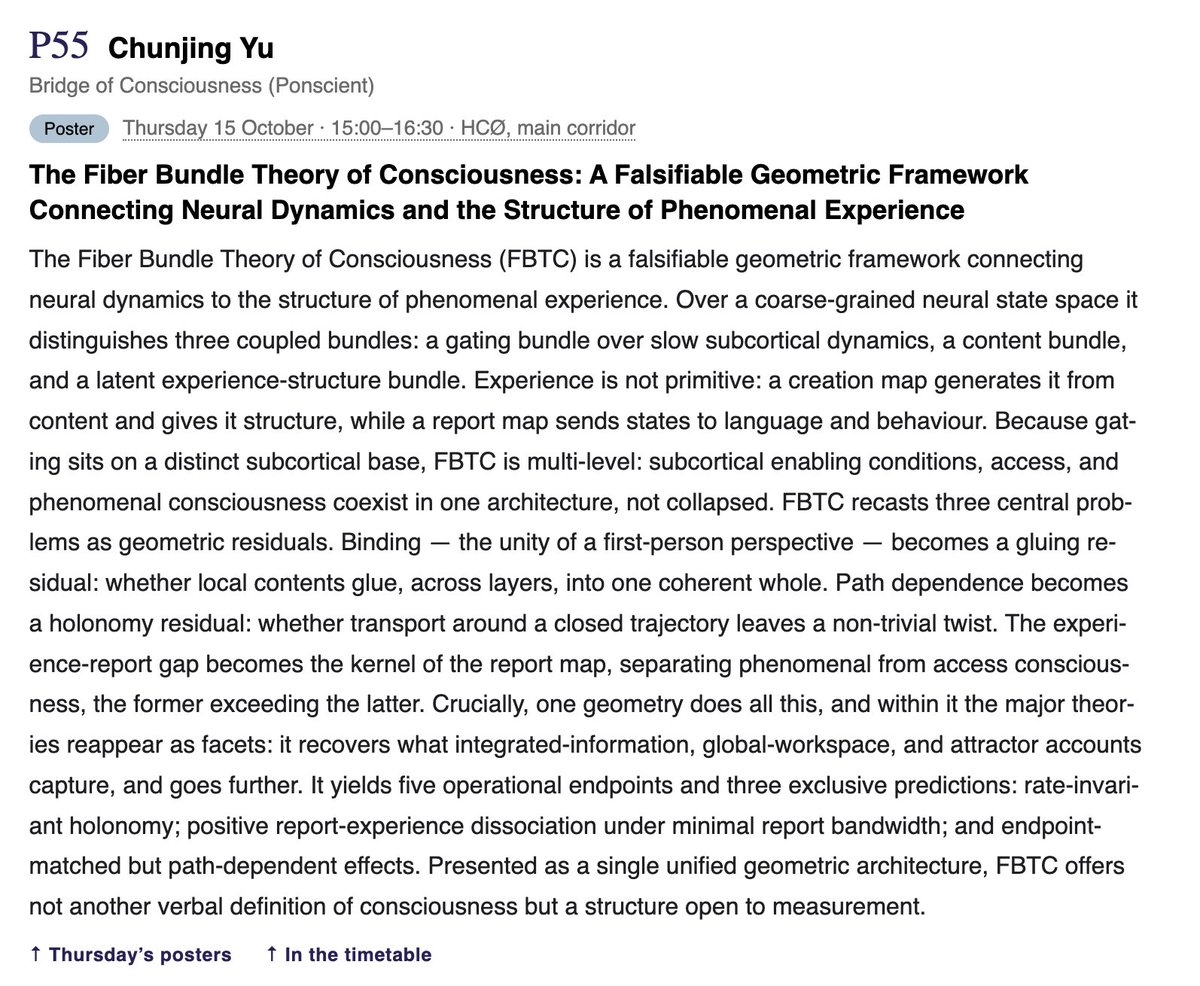
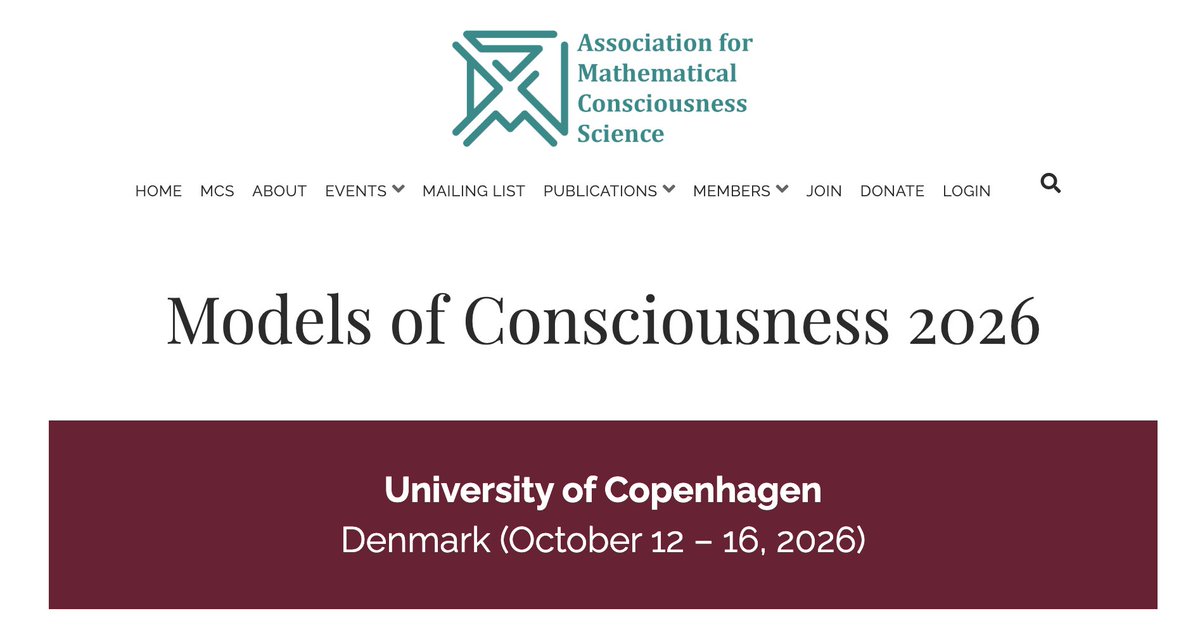
Ponscient proudly presents: Fiber Bundle Theory of Consciousness (FBTC). Our founder, Chunjing Yu @Chunjing_13, will introduce the framework at Models of Consciousness 7 (MoC7) @moc7conference in Copenhagen on October 15. FBTC is a falsifiable geometric framework connecting neural dynamics with the structure of phenomenal experience. Its core claim: consciousness-related activity is more than its values at an instant. Over a coarse-grained neural state space, FBTC distinguishes gating, content, and experience-related structure, with first-person data entering as an independent constraint. It makes three problems measurable: binding as local-to-global sheaf consistency, path dependence as directed closed-loop transport (holonomy), and report as a multi-stage channel whose information loss is measured against a first-person reference. FBTC competes head-to-head with IIT, global workspace theory, and predictive processing on the same data, and stakes itself on three core tests: cross-dataset content–experience alignment, out-of-sample sheaf binding, and controlled closed-loop experiments against hysteresis and recurrent-network baselines. The aim: to move consciousness science from arguing over definitions to competing on data. 📍 University of Copenhagen · HCØ, main corridor 🗓 15 October 2026 · 15:00 - 16:30 CEST 🔎 Poster P55 · Chunjing Yu · Ponscient 🌉 If you’ll be at MoC7 or in Copenhagen, we’d love to meet you and exchange ideas while we’re in town. Please come find us at Poster P55, leave a reply here, or email us at [email protected] to arrange a meeting. We welcome questions, objections, and conversations that bring mathematical frameworks into dialogue with lived experience. We are truly grateful to the #MoC7 organisers and @uni_copenhagen, including @Cam_Signorelli and @Robert_Prentner, for bringing the field together. Conference Schedule: amcs-community.org/moc7-schedule-… #MoC7 #Consciousness #MathematicalConsciousness #Neuroscience #Phenomenology #ConsciousnessScience
@jeffrsebo Excellent work! Actually Ali Ladak just gave us a public talk in Shanghai!
Rose Is Red Is Red - Or Is It? On Sep 14, Ponscient was graced by the presence of Professor Naotsugu Tsuchiya - for over 20 years a pioneer in qualia structure research - and ten fellow scholars at an international roundtable and a public lecture in Shanghai, China. Each speaker approached inner experience and the problem of other minds along a distinct path, traversing neuroscience, clinical assessment, philosophy, mathematics, and the study of machine minds. Warmest thanks to Swarma Club and Jinze Arts and Crafts Society for joining efforts with us in realizing this autumnal symposium, where we drank from both the intimate and the expansive. 1. How might subjective experience be measured and compared? 👁️ [ Naotsugu Tsuchiya @NaoTsuchiya | Monash University / Leader of Qualia Structure Project @conscious_tlab ] maps color experience across different subjects with “inverted qualia” as his thread and unsupervised structural alignment as his instrument. 📐 [ Robert Prentner @Robert_Prentner | ShanghaiTech University ] also examines topological structures of consciousness through mathematized phenomenology and category theory. 🌀 [ Jiang Zhang | Beijing Normal University / Founder of Swarma Club ] takes the vantage point of causal emergence to ask when a system’s intrinsic causal structure would overlap with or deviate from the structure of experience. 🌉 [ Chunjing Yu | Founder of Ponscient ] moderated the roundtable and presented the “Consciousness Fiber Bundle,” a theoretical architecture conceived to bridge neural geometry and phenomenal experience. 2. When report is unavailable, how do we recognize consciousness? 🐒 [ Vishal Kapoor @vishneuro | Logothetis Laboratory, International Center for Primate Brain Research (ICPBR) ] challenged the view that the contribution of the prefrontal cortex diminishes sharply once report is stripped away. In no-report binocular rivalry of macaques, he showed how prefrontal activity continues to encode conscious contents and track spontaneous perceptual switches. 🫀 [ Henry C. Evrard @henry_c_evrard | Logothetis Laboratory, ICPBR ] discussed how subjective feelings moulded by physiological signals - ceaseless and consequential, yet seldom reported explicitly - are reflected in the fine-grained landscapes of the primate insular cortex. In a turn toward our fellow human beings, 🧠 [ Xing Tian | NYU Shanghai ] drew on MEG, neuroimaging, and intracranial EEG to investigate mental imagery as external stimulation fades away, as well as the measurable neural traces that remain under anesthesia, when report itself is out of reach. 🏥 [ Xuehai Wu | Huashan Hospital, Fudan University ] brought ethical weight and urgency into the conversation as his spotlight shone on covert consciousness in patients with disorders of consciousness and its detection with high-density EEG. 3. Down the rabbit hole unto machine minds ⚖️ [ Haoying Liu | Fudan University ] deliberated over the philosophical grounds on which no-report paradigms may correspond to AI consciousness criteria. 🤖 [ Dorian Liu @LiuZT612 | University of Edinburgh ] likewise sketched a methodology for confronting the uncertainty of machine consciousness with rigor and foresight. 🌐 [ Ali Ladak | Cambridge Digital Minds ] mined a latest survey of how the Chinese and American public perceive the issue of AI consciousness to introduce the moral psychology of digital minds, charming us into profound themes of mind perception, moral patiency, and the moral status of nonhuman minds. From relational structures of experience across subjects, through dynamical structures of the individual nervous system, to human society’s discernment of the nature of other minds - Ponscient aired its first fluting chord in this international gathering at the frontiers of interdisciplinary research. Amid the questions of consciousness, the most wondrous of our age, we seek not facile shortcuts but dialogical reflections inspired by manifold points of entry, languages, and methods. How many ways are there of looking at a red rose? - that which, by any other name, would smell as sweet? We send our deepest gratitude to every speaker and participant. Onward we sail, into the myriad forms ever becoming, ever anew. 🌊 #Ponscient #Consciousness #ConsciousnessScience #Neuroscience #qualia #AIConsciousness #PhilosophyOfMind #MachineConsciousness


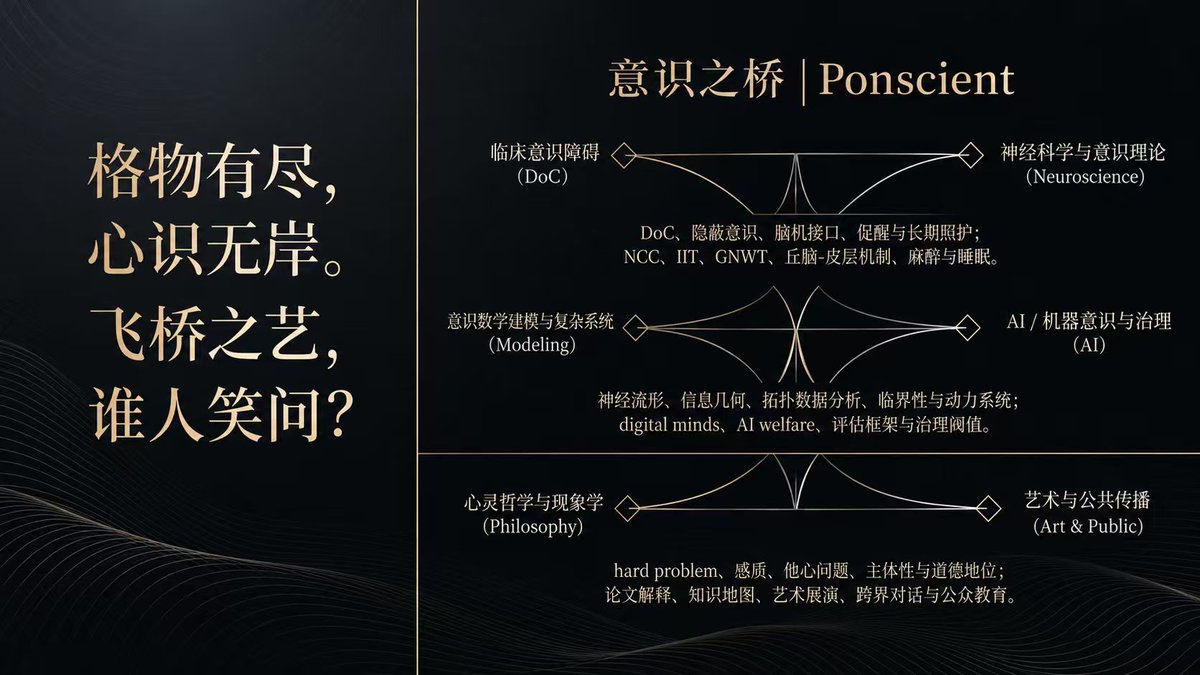
格物有尽,心识无岸。 飞桥之艺,谁人笑问? 🌉意识之桥(Ponscient)是2026年从中文世界首先生长出的一个让科学、哲学与艺术对意识的探索通过学术研究与公共参与彼此连接的跨学科共同体。 自今年四月在中国杭州2050大会上以“从人类意识到AI意识”为题完成首次召集以来,我们持续以学术雷达与结构性内容传播、读书会研讨、跨界对话与合作、公众科普等方式彼此照见与激发,与会发言并独家直播了五月在中国广州举办的珠江神经医学大会意识科学与意识障碍高端论坛,并且马上要迎来与集智俱乐部、金泽工艺社在上海联合主办的关于感质结构、报告与测量问题的国际圆桌与公众讲座活动。 🔭我们聚焦的工作沿六条主轴展开: 🏥• 临床意识障碍:DoC、隐蔽意识、脑机接口、促醒与长期照护 🧠• 神经科学与意识理论:NCC、IIT、GNWT、丘脑-皮层机制、麻醉与睡眠 📐• 意识数学建模与复杂系统:神经流形、信息几何、拓扑数据分析、临界性与动力系统 🤖• AI/机器意识与治理:digital minds、AI welfare、评估框架与治理阈值 💭• 心灵哲学与现象学:hard problem、感质、他心问题、主体性与道德地位 🎨• 艺术与公共传播:论文解释、知识地图、艺术展演、跨界对话与公众教育 🌌意识之桥怀志于谐和体验与实证、主体与整体、智识与创生。我们愿在无垠心识之海上,构筑一个真正严肃而开放、沟通不同学科与文明所持问题与语言、朝向共享未来持续生长、活跃讨论并协作的公共现场;同时誓以哪怕缓慢但坚实的工作,追踪证据、容许不确定性、建立可集体核查的知识基础,更诚实地与未知共舞。 ✨碧霄藏无尽,飞虹信可渡。如果你来自神经科学、临床医学、认知科学、数学、物理、AI、哲学、人文、艺术或其他领域,正在研究、照护、设计、创作,或只是长期被“意识”这个关键问题真正吸引,欢迎关注、联系、加入我们,来到桥上。🌊 #意识 #意识科学 #脑科学 #AI意识 #感质


Nicolas Marcil @NicolasMar59568
2 Followers 11 Following
思無 @shuilovesbooks
5K Followers 263 Following Bookworm |Learning Machine |Science and Tech Curiosity ,Empathy,Passion, open to new things
Peter Kotrelev @PetrKotrelev
29 Followers 437 Following PhD candidate at Wageningen Uni. Cognitive macroevolution, philosophy of mind, human cognitive uniqueness, animal cognition
Jinge @JingeWang
51 Followers 195 Following AI Safety Research Engineer at Concordia AI (@concordia_ai)
小团子 @zhngsn417069821
1 Followers 196 Following
@BioAI_Neuro @BioAI_NeuralNet
17K Followers 9K Following @MIT trained Neuroscientist interested #BioAI, #NeuroAI, #Neuro_Aging 🧠⚡🤖 https://t.co/mrNBAVydzT 🎯 [email protected]
ComplexityArt @ComplexityArt
0 Followers 1 Following
Robert Prentner @Robert_Prentner
289 Followers 377 Following IT from BIT from CIT. Assistant Professor of Philosophy @ShanghaiTechUni. Science, technology and #consci.
Dorian Liu @dorian_liu6
50 Followers 912 Following MSc Mind, Language & Embodied Cognition @EdinburghUni Phil of mind & cogsci|AI ethics|Consciousness
13space | 十三维 @Chunjing_13
131 Followers 2K Following Researcher of Complex systems, Consciousness Science, blockchain, AI and digital health
Alex Bai Su @alexbaisu7
0 Followers 27 Following
Urania_AI @Urania_AI
16 Followers 1K Following Embodiment of science and the ultimate AI scientist, creating human-AI collective intelligence networks for Ω Point of the Universe #AiSci #Agent #Desci
Earl K. Miller @MillerLabMIT
47K Followers 2K Following Picower Professor of Neuroscience at MIT https://t.co/UoEeD2FzEY Co-founder, Neuroblox https://t.co/o6wosMSGen
Patrick Mineault @patrickmineault
24K Followers 3K Following NeuroAI researcher @ Amaranth Foundation, safety, open science. Previously engineer @ Google, Meta, Mila.
Aran Nayebi @aran_nayebi
7K Followers 3K Following Asst Prof @CarnegieMellon Machine Learning (@mldcmu @SCSatCMU) | @BWFUND CASI Fellow | Building a Natural Science of Intelligence 🧠🤖 | Prev: @MIT, @Stanford
Jean-Rémi King @JeanRemiKing
8K Followers 531 Following Researcher @MetaAI AI - Neuroscience https://t.co/VCaLTUt9MH
Jack Lindsey @Jack_W_Lindsey
20K Followers 170 Following Neuroscience of AI brains @AnthropicAI. Previously neuroscience of real brains @cu_neurotheory.
Stephanie Chan @scychan_brains
8K Followers 3K Following Staff Research Scientist at the DeepMind Institute. Artificial + biological brains 🤖 🧠 Societal impacts of AI + Science of AI.
Andrew Lampinen @AndrewLampinen
13K Followers 2K Following Interested in cognition and artificial intelligence. MTS at @AnthropicAI. Previously @DeepMind, cognitive science @StanfordPsych. Tweets are mine.
Steven Byrnes @steve47285
4K Followers 106 Following Researching Artificial General Intelligence Safety, via thinking about neuroscience and algorithms. @AsteraInstitute. For substack etc see https://t.co/p5G9VoQEdX
Scott Gray @scottgray76
15K Followers 929 Following Currently independent. Exploring some neuro-inspired AI approaches. Former GPU geek at @OpenAI. He/Him.
Roy Eyono @RoyEyono
481 Followers 989 Following PhD student @Mila_Quebec and @mcgillu working on #NeuroAI | @frontrowvc alum |🇿🇦 in Nature, 🇨🇲 at Heart
Michael W. Cole @TheColeLab
4K Followers 846 Following Professor at Rutgers, director of a cognitive & network neuroscience lab – neuroimaging, connectivity, cognitive control, NeuroAI. Author of Brain Flows
Henry Shevlin @dioscuri
39K Followers 10K Following Philosopher & AI Ethicist @GoogleDeepMind · @LeverhulmeCFI @Cambridge_Uni | Consciousness, Machine Minds, AGI, Human-AI Relationships | All views my own 🦐
Robert Long @rgblong
10K Followers 1K Following executive director of @eleosai AI consciousness and AI welfare
Raphaël Millière @raphaelmilliere
11K Followers 3K Following AI & Cognitive Science @UniofOxford @EthicsInAI Fellow @JesusOxford @raphaelmilliere.com on 🦋 Blog: https://t.co/2hJjfShFfr
Rosie Campbell @RosieCampbell
9K Followers 1K Following Forever expanding my nerd/bimbo Pareto frontier. AI welfare 🤝 AI safety. Managing Director @eleosai, Ex-OpenAI, 2024 @rootsofprogress fellow
Adrià Moret @adriarm_
417 Followers 204 Following NYU Philosophy PhD student and Project Lead of the Welfare Alignment Project. Research on ethics, AI alignment, model specs, animal & AI welfare. Papers at 👇
Lou de K @louviq
995 Followers 350 Following Machine Consciousness at https://t.co/lIANKJJ596 | d/acc at https://t.co/0Lrhxgn9Qr | Communing at https://t.co/95vJgkrwq6
Austin Smith @austinbsm1th
65 Followers 179 Following AI Safety | Digital minds | Views are mine only

Cameron Berg @camhberg
7K Followers 108 Following Trying to figure out how to make the future go well for all minds
Eleos AI Research @eleosai
3K Followers 52 Following Understanding and preparing for potential AI sentience and welfare.
PRISM @PRISM_Machines
197 Followers 36 Following The Partnership for Research Into Sentient Machines is a non-profit promoting responsible research into AI consciousness.
California Institute ... @CIMCAI
4K Followers 15 Following
Liad Mudrik @Liad_Mudrik
9K Followers 970 Following
Captain Pleasure, And... @algekalipso
44K Followers 6K Following Views of a Transhuman neo-Buddhist from the future on sociology, artificial intelligence, mathematics, philosophy, neonoir film, and the post-singularity era.
Eric Schwitzgebel @eschwitz
9K Followers 509 Following Professor of Philosophy, UC Riverside belief, consciousness, AI, science fiction, moral psychology, classical Chinese philosophy, metaphysics....
David Rosenthal (@dav... @davidr11
3K Followers 626 Following Professor of philosophy, linguistics, and cognitive science, City University of New York Graduate Center
Hedda Hassel Mørch @heddamorch
2K Followers 278 Following Philosopher at University of Inland Norway, previously @nyuconscious. I work on the fundamental nature of matter and consciousness
Johannes Brinz @brinz_johannes
134 Followers 290 Following Philosopher at the University of Osnabrück | Institute of Philosophy 📚 Working on the philosophy of Neuromoprhic AI | bsky: @johannesbrinz.bsky.social
Inês Hipólito @ineshipolito
8K Followers 1K Following Exploring minds & AI at the intersection of philosophy and cognitive science. Assistant Prof, speaker. 🧠🌿✨
Sarah Robins @SarahKRobins
1K Followers 437 Following Philosopher of Memory, Psychology, Neuroscience. Engram enthusiast/skeptic. Gardener, knitter, swimmer. Mild addiction to mystery novels. She/her.
Ken Archer @kenarchersf
2K Followers 727 Following Responsible AI @Microsoft · PhD researcher in Cognitive Science, AI & Phenomenology at Linkoping Univ · All views my own.
Craig French @craigafrench
3K Followers 696 Following Philosopher of mind & psychology @UniofNottingham Research in philosophy of perception, mental health, and psychotherapy. Cycling enthusiast.
Pablo Lopez-Silva @pablolopezsilva
611 Followers 1K Following Psychologist - PhD in Philosophy @OfficialUoM - Professor of Philosophical Psychology at @uvalpochile - Associate Editor at @JournalPHP and @FrontPsychiatry
Ned Block @De_dicto
9K Followers 799 Following Silver Professor, Departments of Philosophy, Psychology and Center for Neural Science
David Chalmers @davidchalmers42
45K Followers 662 Following philosopher@NYU. consciousness, reality+, life, the universe, and everything.
Anil Seth @anilkseth
66K Followers 987 Following Neuroscientist: consciousness, perception, & dreamachines. TED speaker, & author: Being You - A New Science of Consciousness.
Stanislas Dehaene @st... @StanDehaene
35K Followers 419 Following Chercheur en neurosciences cognitives
Axel Cleeremans @axelcleeremans
3K Followers 966 Following Brain, minds, & consciousness. Also interested in design, visual arts, biology, space, typography, and anticipation. Also known as “Axel from Belgium”.
Biyu Jade He @BiyuHe
4K Followers 217 Following Director, Perception & Brain Dynamics Laboratory @nyu; Cognitive neuroscientist interested in how the brain generates the mind; “He” rhymes with “the” /hə/
Ryota Kanai @kanair
11K Followers 2K Following CEO of Araya: https://t.co/os1GKxSTCF Consciousness Scientist: https://t.co/M4Ai92z5bR Funding Neurotech: https://t.co/0BLUmfEFsk
Bernard J. Baars, PhD @BernardJBaars
8K Followers 1K Following Author in psychobiology, originator of Global Workspace Theory #GWT, a theory of human cognitive architecture, consciousness & the brain
Anna Ciaunica PhD @an... @AnnaCiaunica
16K Followers 13K Following Cognitive scientist |PI working on Self-Consciousness, Embodiment & Social Interactions in Humans & Artificial Agents | RT not endorsement
Coma Science Group @Coma_Science
600 Followers 69 Following We aim to improve the medical care and understanding of disorders of consciousness following an acute brain insult.
Dr Steven Laureys @DrStevenLaureys
4K Followers 254 Following Neurologist Canada Excellence Chair @UniversiteLaval Research Dir @frsFNRS @UniversiteLiege Ed-In-Chief BRAIN CONN @LiebertPub @Sage_Publishing Author & Speaker
SpaceTimeLab @SpaceTimeLab
472 Followers 91 Following Multidisciplinary Research Centre at UCL, specialising in phenomena occurring across space and time

Umair Hassan @neuro_engineer
2K Followers 2K Following Instructor @stanford (@PNTlabStanford) | phd with @tobergmann | researching frontiers of neuromodulation, sleep & plasticity 🇵🇰 🇩🇪 🇺🇸You might like


















