

Repairpicks @Repairpickscom
Honest picks for home repair materials, sealants, and fixes. repairpicks.com Joined January 2023-
Tweets65
-
Followers2
-
Following13
-
Likes9
@AskTOH Joint width matters as much as the pattern. Each polymeric sand product states a joint width range on the bag, and it needs a dry window to set, since early rain causes haze or washout. Worth checking both before picking a layout.
The full cost guide, DIY vs pro: repairpicks.com/cost-to-repair…
Wood rot around a window: probe it first. Under about 20 percent of the sill, epoxy works. Sinks in along the full length, replace the sill. Into the frame, call a carpenter. A pro epoxy repair is the weakest value per year.

The full guide to rotten wood repair with epoxy: repairpicks.com/rotten-wood-re…
Epoxy on rotted wood: soak first with a thin penetrating coat, fill second with thickened epoxy, 12 mm per layer at most. And it does not kill the rot, so fix the leak first.

Full guide by repair size: repairpicks.com/best-self-leve…
Self-leveling concrete is not one product. Skim coat for dips, flexible patch for cracked subfloors, poured underlayment for whole rooms. Per their data sheets, all three are interior products. Guide in the reply.

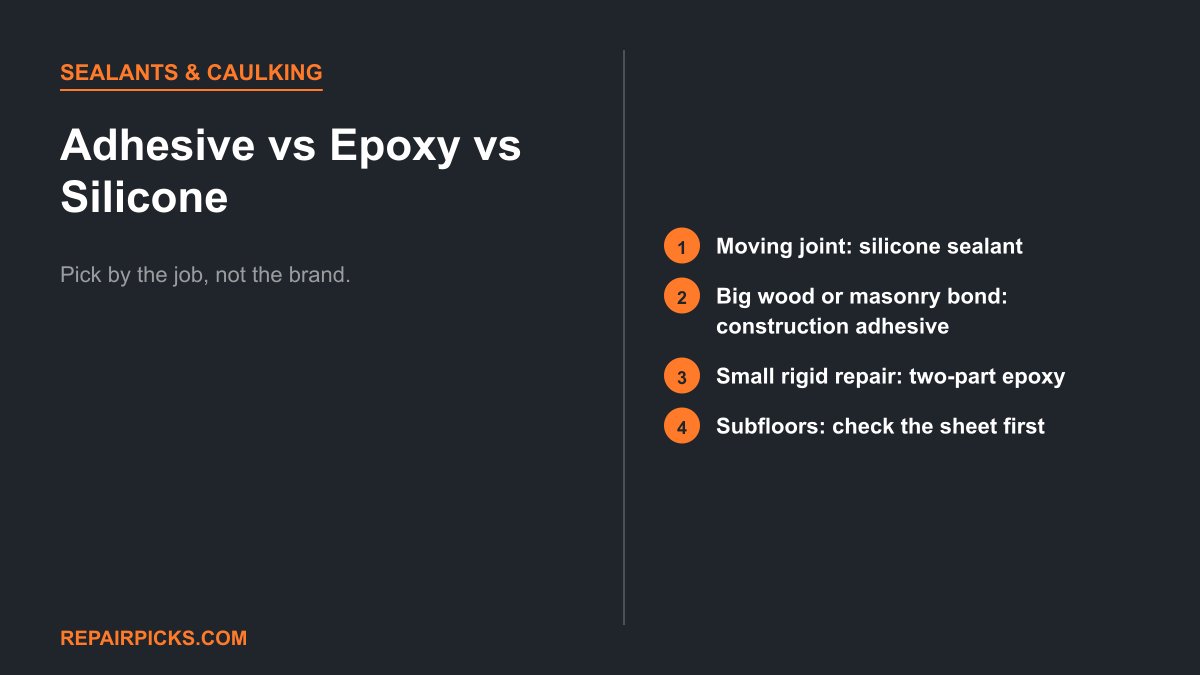
The full guide to construction adhesive vs epoxy vs silicone: repairpicks.com/construction-a…
Construction adhesive, epoxy or silicone? Moving joint: silicone. Big wood or masonry bond: adhesive. Small rigid repair: epoxy. And Liquid Nails' own sheet says LN-903 is not for subfloors.
Two exterior window caulks can look the same and be rated for very different joint movement. GE silicone and DAP AMP: plus or minus 35 percent. DAP siliconized latex: plus or minus 12 percent. Updated guide, link below.

The full guide to polymeric sand set time: repairpicks.com/how-long-does-…
Polymeric sand has three clocks. Rain-safe in 15 minutes to 24 hours, walkable in about 24 hours, and Sika says 72 hours before a car where Alliance Gator says 24. Cold nights stretch all of it.

The full guide to removing polymeric sand from pavers: repairpicks.com/how-to-remove-…
Polymeric sand haze on pavers: the maker says hot water at 180 F or more reactivates the polymer so it strips off. A white film may be efflorescence instead. Failed joints need the old sand out to 1 1/2 inches.

@Family_Handyman The one that matters most is watts divided by volts equals amps. A 1,800 watt heater on a 120 volt circuit pulls 15 amps, which is already past the 12 amp continuous limit on a standard 15 amp breaker, so it should not share that circuit with anything.
The full paver joint sand guide: repairpicks.com/best-sand-for-…
Polymeric sand is not always the answer. Labels start at 1/8 inch joints and want an inch or more of depth. Tight joints and heavily textured pavers do better with plain jointing sand.

@Family_Handyman A lot of the worst inspector photos start as small moisture problems nobody tracked: a failed caulk line, a clogged gutter, a missing flashing. Catching those early is usually the cheapest repair on the whole house.
The full efflorescence on stone guide: repairpicks.com/efflorescence-…
White powder on stone is salt, not a stain. Granite, slate and concrete can take an acid cleaner. Limestone and marble cannot. Start with a dry brush, then water, then a poultice, and test a hidden patch first.


Luna 🌼🌞 @latteposy78
3 Followers 387 Following Come say something that makes me melt — I’m soft for charming people ✨
GetProofShot @getproofshot
5 Followers 282 Following Jobsite photos in, bid-winning before/afters out. For contractors. Packs from $29 👇 https://t.co/T6KNIZ3lOA
QUIKRETE @QUIKRETE
2K Followers 599 Following Since 1940, QUIKRETE has served the construction and home improvement industries as the most respected and trusted brand of cement and concrete products.
Ace Hardware @AceHardware
129K Followers 3K Following #TheHelpfulPlace with the best brands and everything you need for your everyday home project. Get inspired at #AceHardware.
Lowe's @Lowes
286K Followers 11K Following Lowe’s knows no matter what you’re doing, it’s easier to get it done when you’ve got the right people, the right products, all at the right price. 🔨

The Home Depot @HomeDepot
421K Followers 8K Following What are you working on? Visit @HDCares for Customer Care support.
BobVila.com @BobVila
793K Followers 180 Following Tried, true, trustworthy home advice from the team at https://t.co/y9vcQKnjx3. Get our newsletters: https://t.co/1SKAsZnYYW
Ask This Old House @AskTOH
70K Followers 532 Following 🧰 Making home improvement house calls in all 50 states! 📺 Catch us on @PBS and @TheRokuChannel.
Family Handyman @Family_Handyman
26K Followers 183 Following Family Handyman is the #1 brand for DIY homeowners, offering expert step-by-step projects, useful buying advice, and clever project ideas.

This Old House @ThisOldHouse
256K Followers 684 Following 🔨 Trusted home improvement advice since 1979. 📺 Catch us on @PBS, @TheRokuChannel, & our free app!
The Grout Doctor @TheGroutDoctor
509 Followers 755 Following The Grout Doctor® is in the business of renewing existing grout and tile to its original beauty.
Home Rapid Repair �... @HomeRapidRepair
505 Followers 287 Following Larry here, I'm a licensed Contractor / Inspector for nearly 3 decades. Now growing my YouTube channel. All questions welcome
Home Renovation Blog ... @ecoluxehawaii
3 Followers 27 Following Bloggers and house flippers on the Big Island of Hawai'i, with a love for interior design, DIY & home renovation projects | modern minimalist farmhouse styleTrends for United States
You might like


















