

Patrick Salisbury @SalisburyNotes
https://t.co/duJJo2KaDd linkedin.com/in/patricksali… Boulder, CO Joined June 2026-
Tweets5
-
Followers13
-
Following10
-
Likes1
@kate_rouch This is so correct, so ridiculous and so changeable today! There is a better way to approach cancer care and trial/approvals with the sequencing technologies and llm models now available.
What accessing frontier cancer care looks like in 2026: -Go through 1-2 years of standard of care (poison/slash/burn - original poster forgot radiation and hormone suppression). You’re only a good candidate for a vaccine if you are cancer free or have minimal residual disease. -Hire PhDs / Lawyers to fight with your hospital for your tumor tissue, which is likely stored in a way that makes sequencing it hard / impossible -Pay $50K+ to sequence your tumor tissue -Pay $1M+ for a custom immunotherapy / vaccine with no efficacy or safety info -Find an oncologist and medical setting to sponsor this plan, the biotechs that made you the drug can’t administer it and you’ve likely alienated your actual oncologist by now -Hire lawyers: Petition the FDA for an n-1 clinical trial or relocate to Germany (or maybe Montana) to take vaccine series -Take the series. You won’t actually know if it worked (no data) so you monitor all your markers constantly with ctDNA and other testing to search more therapies and to see if the vaccine activated your immune system and worked. There’s a lot of promise here and people who can access frontier cancer care are so fortunate. Every cancer patient wants every chance they can get. But it’s bs to say we’ve solved cancer in 2026.
cancer treatment in 2025: find the tumor, cut it out, poison the rest with chemo, hope the patient survives cancer treatment in 2026: sequence the tumor's DNA, identify the exact mutations driving it, design a treatment built around those mutations specifically, train the

Man can’t get the drug for brain cancer that might save his life in time because the ethics board at his hospital only meets once a month. Is anyone checking the ethics board for whether stuff like this is behaving ethically?
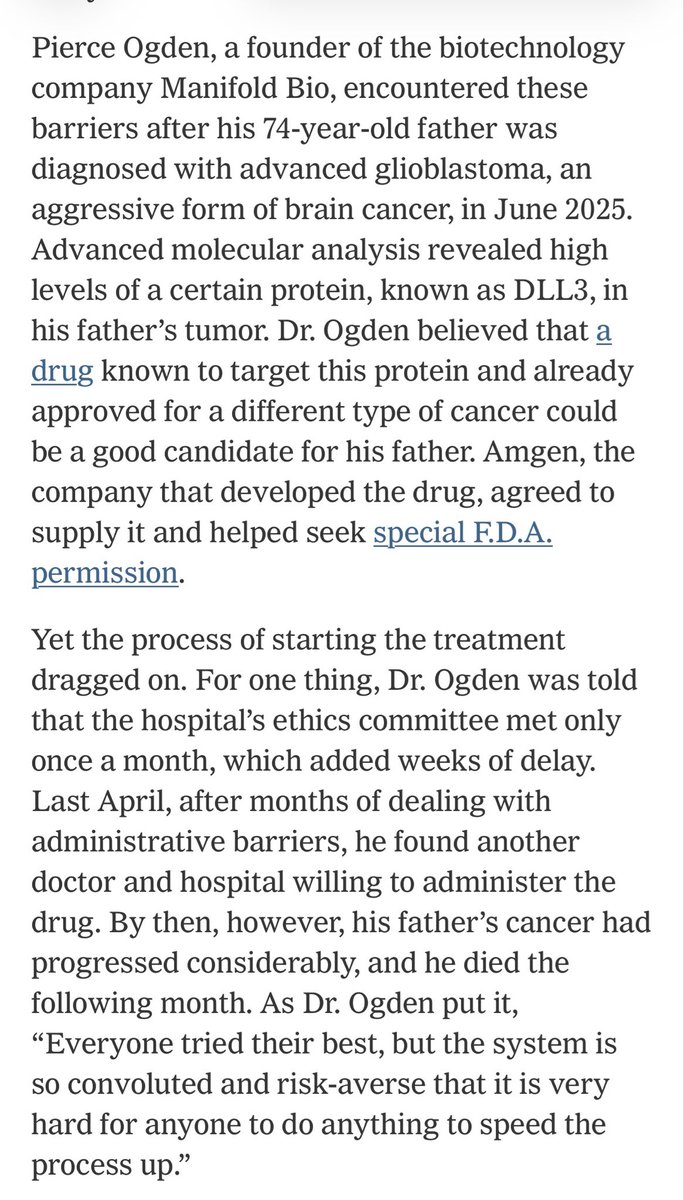
@RuxandraTeslo @nytimes Thank you @RuxandraTeslo for taking the time to tell our story so thoughtfully
Thank you, @RuxandraTeslo, for telling this story—and for working to improve treatment access and drug development for all patients. We are entering an era of personalized medicine that will transform cancer care, but our regulatory frameworks were not built for it. Will we slow it down, or lead?
We are on the cusp of a wave of new therapies for some of the worst diseases. But the world won’t benefit unless the US fixes its drug regulatory system. My new essay for @nytimes, on how slow clinical trials are now the biggest obstacle to curing cancer. nytimes.com/2026/09/04/opi…

Carine @Carine7b7
2 Followers 125 Following
Webb @WebbrV4v
0 Followers 140 Following
Shannon Mcshane @smcsmc1234
11 Followers 274 Following
Ron Alfa @Ronalfa
8K Followers 3K Following CEO & Co-founder @NOETIK_AI Using AI to actually solve cancer.
Abraham Trueba @CRISPRKING
11K Followers 7K Following Building open-source pipelines to prove drug targets are real. AI × Bioinformatics × Chemical Biology × Medicine.
Jessica Sacher, PhD @JessicaSacher
6K Followers 2K Following Scientist @Stanford | Cofounder @PhageDirectory | Host of Podovirus 🎙🇨🇦

Georgelemental @georgelemental
236 Followers 2K Following 🇺🇸🥇, ☨ (gaullist), 🇵🇸🕊️🇮🇱. Buchanan (was) Right
Pigeon Feathers (Alph... @PigeonFeatherz
5K Followers 5K Following Philosophy student on hiatus, freelancer, call centre survivor, odious child of the Eurasian persuasion. Beleaguered mother of the cutest despots in the land.
Shabby Tigers @shabbytigers
720 Followers 4K Following biopharma brand strategist. bodily autonomy, urbanism, language. NYC➡️Berlin. would know yet more.
Dear Dr. Researcher, ... @corrie_painter
5K Followers 2K Following Scientist and innovator working with a sense of urgency to help keep people alive and well. Proven track record of puns.
Ruxandra Teslo 🧬 @RuxandraTeslo
32K Followers 3K Following Writer @WorksInProgMag & @Stripe | Clinical Trial Abundance | long-form https://t.co/ipFMYGuR84

Charlie Petty @incredutility
3K Followers 2K Following intercept + public goods @stripe / toddler alignment researcher @raebanay
Derya Unutmaz, MD @DeryaTR_
343K Followers 9K Following Professor scientist, immunologist, biomedical engineer & Biohacker. ALL IN ON AI, SI & ROBOTICS! #Longevity #BioAI #Codex #Space #Scifi #Singularity #trekkie 🖖
Mukund Iyengar @mukundiyngr
2K Followers 310 Following Building @jori_health | AI x Data-infra in precision oncology | PhD in Comp. Sc. | Cancer's cartographer at Jori.
Kate Rouch 🛡️ @kate_rouch
17K Followers 3K Following Using breakthrough creativity to help founders + the people they serve. First CMO, OpenAI & Coinbase 🚀. Cancer survivor. Proud mom.
Ron Alfa @Ronalfa
8K Followers 3K Following CEO & Co-founder @NOETIK_AI Using AI to actually solve cancer.
Dear Dr. Researcher, ... @corrie_painter
5K Followers 2K Following Scientist and innovator working with a sense of urgency to help keep people alive and well. Proven track record of puns.
Rex Salisbury @rexsalisbury
27K Followers 2K Following Founder & GP @ Cambrian VC (pre-seed/seed in fintech). https://t.co/sf8DhZK8Y3. ex Partner @a16z fintech. +1 @amdulin.
Ruxandra Teslo 🧬 @RuxandraTeslo
32K Followers 3K Following Writer @WorksInProgMag & @Stripe | Clinical Trial Abundance | long-form https://t.co/ipFMYGuR84
You might like


















