Stepan Braginskiy @StepanVC
Financial logistics for AI compute infra cobursa.com Amsterdam | Tokyo Joined August 2025-
Tweets8
-
Followers21
-
Following348
-
Likes6
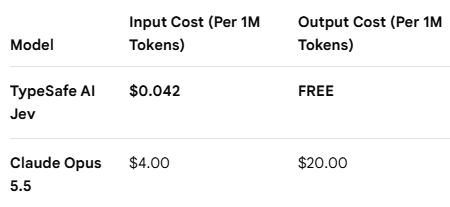
At Jev's release on September 15, @typesafeai was valued at $200 million in its seed round. Now, according to the Financial Times, investors are offering funding that would value the company at $10 billion. If you compare prices, Jev's "System One" decision model is 95 times cheaper per input token than Opus 5.5. Output tokens are free. It didn't take long for competition to start eating into Anthropic's and OpenAI's crazy margins. It just reminded me that OpenAI and Anthropic make $100M per 1MW of compute capacity in inference API revenue, compared to Neocloud's $12M/MW in 5-year average IaaS revenue, i.e., they are 8 times more expensive than running AI workloads on GPU bare metal, as SemiAnalysis reported in August. That leading labs' pricing advantage will only last until developers and enterprises switch to more cost-efficient, use-case-based models like TypeSafe AI. Will Anthropic's and OpenAI's IPOs hold up?
Keep hearing that mid-market neoclouds face limited funding options and are on the lookout for equity. It is true that sub-institutional capital has not yet fully arrived to match the mid-market financing demand. But family offices and private credit will not pass on a good deal that yields more than comparable risk assets they invest in. The bottleneck is: (1) distribution — accessing the right investors, and (2) structuring — offering a deal that clears IRR hurdles under stress assumptions. No one signs a deal on assumptions that are hard to justify.
The scarcest asset in mid-market AI infra isn't power or GPUs. It's an offtaker a lender will underwrite. Last month Lambda closed a $926 million GPU loan rated investment grade. Lambda is a private company. The investment-grade name in that deal is the customer. Hut 8, a former bitcoin miner, sold investment-grade bonds to build a data center. Google stands behind the rent. Both borrowed on their customer's credit, not their own. The hardware is collateral. The offtake contract is what repays the loan. Mid-market operators can buy the same GPUs and build the same site but often cannot get an offtaker of that quality. That raises the cost of debt from single digits to the mid-teens when it is available at all. That makes the offtake the first problem to solve, not the last. Who is signing your offtake, and for how long?
Thanks for the correction! Saw @sfcompute enter into multi-year offtake commitments. Congrats! I have a question - does this offtake sit in a book that your compute providers use to underwrite hardware debt for new builds, or does it only count as their revenue against existing capacity? I'd really love to hear how you are solving the bankability of mid-market demand problem. Please DM if you are open to a quick chat.
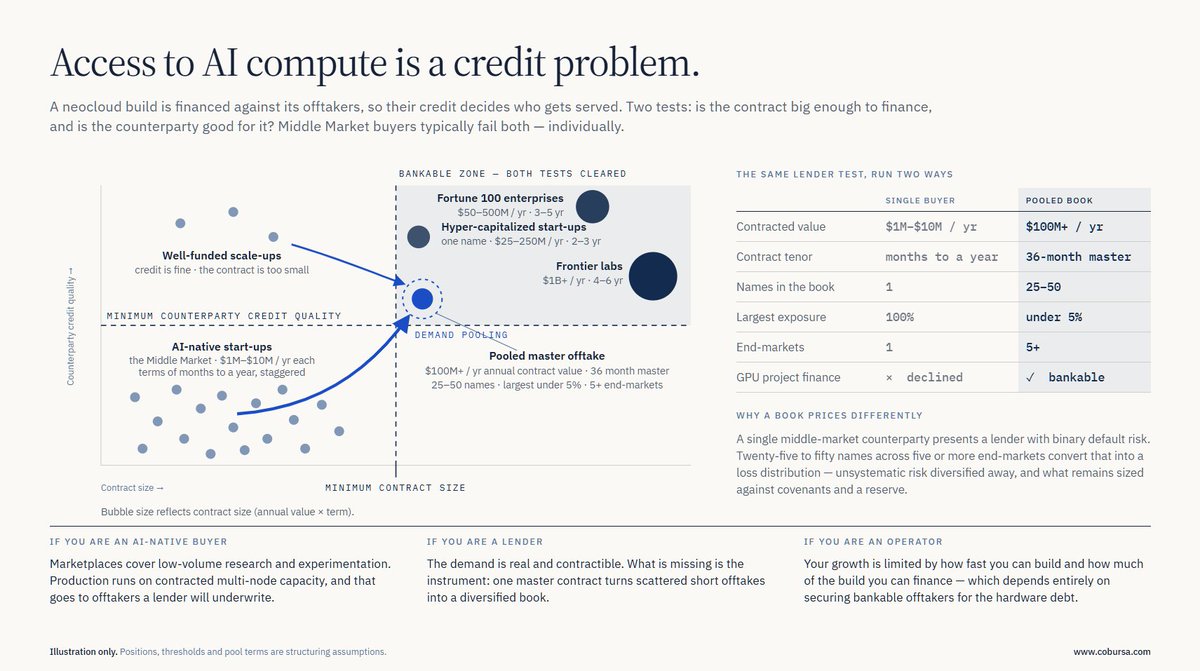
Mid-market access to AI compute is a credit problem A few days ago, Nebius Group CEO Arkady Volozh noted that demand for AI compute is "unlimited", with customers reserving capacity into 2028. Yet Nebius's growth is constrained by how quickly it can build and how much construction it can finance. The same story holds for almost every major neocloud today. Neoclouds prioritize allocating capacity to frontier AI labs, large enterprises, and hyper-capitalized startups. These customers can afford multi-year, take-or-pay offtake contracts. More importantly, their balance sheets or backing (VC, strategic, sovereign) are strong enough for neocloud lenders to underwrite the underlying GPU debt, allowing neoclouds to bring more capacity online. This leaves a long tail of demand from early- to late-stage AI-native startups severely squeezed. The immediate result has been the rise of compute marketplaces like @sfcompute , @vast_ai , @runpod , and others. They scoop up idle compute capacity from the market and resell it in smaller increments at a margin. This helps developers and startups cover their compute needs for experimentation and validation. But marketplaces offer little for AI natives graduating their workloads to production. These mid-market buyers need reliable, multi-node GPU clusters at a cost that makes unit economics work. This capacity is rarely available on demand. Marketplaces partially solve the allocation problem. They do not solve the capacity problem. And capacity is a credit problem. Mid-market buyers have sizable AI compute needs and improving credit profiles. They can afford offtake contracts spanning months to a year. Individually, however, their standalone offtake size and risk profile are unlikely to qualify for the project-finance debt required to underwrite GPUs. Consequently, operators allocate primary capacity to those who qualify. The solution requires a capital markets primitive: demand pooling. When aggregated, a single master contract qualifies not just by total volume, but by an improved credit profile. Pooling introduces diversification, reducing unsystematic default risk for infrastructure lenders. That turns mid-market demand into bankable borrowing capacity. Operators get the offtakers they need to finance new GPU hardware, and mid-market buyers get the primary AI compute capacity they are locked out of today. If you are scaling AI workloads to production right now, how are you balancing the premium of on-demand compute against the rigid balance-sheet liabilities of long-term offtakes?
I counted the companies building market structure for AI compute: indices, venues, desks, exchanges, credit and insurance around the GPU-hour, not the clouds that sell it. I got to 58 in seven boxes, starting from the @socialgraphvc primer and the @0xfishylosopher essay, and I am fairly sure the real number is higher. Price discovery. @Silicon_Data runs the H100 and B200 rental indices that CME's October futures are designed to settle on, @OrnnExchange publishes OCPI and a volatility index and has ICE as its futures partner, @ComputeDesk puts IOSCO-compliant indexes built from private OTC transactions on Bloomberg, NATIVX normalises GPU prices to an energy unit, and @SemiAnalysis_ tracks contract prices and runs the ClusterMAX census of 209 GPU clouds. Spot venues, auctions and aggregators. @sfcompute runs an order book where contracts can be resold, @computeexchange auctions reserved capacity for one to 36 months and opened a used-GPU secondary market in July, @getcomputable sells dedicated H100 nodes by the calendar week in sealed-bid auctions, and @stoaexchange discovers clearing levels for the hardware itself. @mithrilcompute, @shadeformai and @get_hydrahost aggregate other people's clouds into one buying surface, and Hydra raised $100M in June for that, with an offtake network attached. NVIDIA's DGX Cloud Lepton does the same from the top of the stack, while RunPod, Vast.ai, TensorDock, Salad and Clore run the spot layer. Decentralised networks. @akashnet, @ionet, @AethirCloud, @rendernetwork, @nosana_ai and @spheron match GPU supply and demand with on-chain settlement, @fluence_project started auctioning reserved GPU clusters in August with 6,000 GPUs across 13 countries, @PrimeIntellect and @GensynAI come at the same market from distributed training, and Hyperbolic, Golem, Theta EdgeCloud, Aleph Cloud, Lium and Targon fill out the box. A large share of this whole map is crypto-native, which the primer also noticed. Desks and brokers. @itomarkets quotes a single fixed GPU-hour rate with an SLA and stands as principal, @intheanera runs a forward capacity market for deliverable inference and calls itself a clearinghouse for AI risk, and the incumbents have arrived: @BGCGroupInc opened an OTC desk for secondary compute and memory capacity in June, and @FalconXGlobal dealt what it calls the first OTC swap on the forward price of compute, referencing Ornn's H100 index. Exchanges and derivatives. @CMEGroup, @ICE_Markets and @NodalExchange have all announced GPU futures this year, Nodal on Compute Desk's indexes next to its power contracts. @Architect_Fi builds GPU and DRAM perps with a bridge into physical delivery, @liquidcompute is going the CFTC exchange and clearinghouse route, @MNX_fi runs H100 perps and lab valuation futures, Hyperliquid already trades H100 perps, Kalshi and Polymarket run GPU price markets, and @castle_tech_ builds markets for the exposures a data center cannot hedge today, permits first. Credit. @USDai_Official lends up to 70% LTV against tokenised warehouse receipts on the hardware, @gaib_ai and @Compute_Labs turn GPU financing and GPU ownership into yield-bearing tokens, @cysic_xyz does the same for mixed hardware, and @gpufinancing writes plain GPU equipment loans and leases. More than $20B of GPU-collateralised loans are outstanding, and in my experience the borrowers below investment grade still mostly sit outside that number. Insurance, collateral and plumbing. @amcompute1 writes declining residual value floors for up to three years, @PRINCEPSdev turns SLA terms into coverage carriers can bind, Barkr issues Munich Re-backed warrantied valuations of GPU collateral, @Aravolta_X25 monitors the collateral through telemetry, and @netbackyard does the metering and billing that turns capacity into a tradable unit. And the incumbents moved faster than I expected: CME, ICE and Nodal announced GPU futures between May and September, and BGC opened its desk in June. If you are building in any of these boxes and you are not on the map, reply with what you do. If I put you in the wrong box, pls say so. There is also a WhatsApp group for people building in compute markets, so DM me or @jessiedong_ if you want to be added.

Would agree. Offtakers must be credit-scored to ensure the pool has acceptable default risk. Operator credibility also matters because execution risk is high, even if they bring reliable offtake to a lender. Interesting that usd.ai admits first-time operators on paper but enforces a liquidation trigger on the GPUs if the operator misses a payment by 30 days. Why would any first-loss equity sponsor accept that structure? Analogy: a retail investor trading on leverage, getting wiped out by a margin call.
I'm 40. VC turned founder in Tokyo. Looking to connect with people building in AI infra and compute markets.

I'm 38. Solo founder from Germany. Looking to connect with more builders & indie hackers!


Paul Prager @PaulBPPrager
1K Followers 7K Following Founder & CEO @TeraWulfInc | @NavalAcademy | #Bitcoin | Pursue Justice | All tweets are mine.
Ashleyyyyy @Caihui__yang
331 Followers 4K Following Bitdeer Marketing @Bitdeerofficial | North American Collaboration
Sam Tabar @SamirTabarr
24 Followers 255 Following Only private elite here, I will mainly talk about the crypto market, price action analysis, etc. ONLY FOR A FEW PEOPLE, MAIN ACCOUNT @SamirTabar
Lee Roach Trades @leevaluroach
1K Followers 544 Following I'm interested in post bankruptcy, NAV, and undervalued micro and nano cap stocks. Margin of safety over everything. I write about cheap stocks.
Andrew Akhiezer @andrew_akhiezer
17K Followers 18K Following IT Entrepreneur, Founder, Investor, Advisor
SHAY BO @stocksavyshs
41 Followers 2K Following Chief Market Strategist FuturumEquities | Regular on Reuters, YahooFinance, Bloomberg, FoxBusiness, SchwabNetwork & Forbes | NIA

Niche trader @OLeksa_trader
7K Followers 4K Following • Your favorite on chain gambler.📊 —— THE APP EVERYONE ASKS ME ABOUT —— FOMO-MEMECOIN TRADING 👇🏻
Wærrën Piëş° @War_renPies
20 Followers 1K Following Founder @3F_Research | PM $RAA | $FCTE | Formerly with Ned Davis Research | Recovering Attorney (step 4)

Dragan Pavlovic @DefiDragans
5K Followers 3K Following Threador | Not Financial Advice | Rock Climber | Advocate of DeFi Here to onboard you to @HyperliquidX @BasedOneX
CarIos Dominggo (Secu... @CarIosdominggo
181 Followers 806 Following Founder and CEO https://t.co/9wV9rxvuOO. Managing director https://t.co/KlQH0A4qUi. Startup investor. Author.
Coffee House Stocks @TomAlbrechisei
3 Followers 276 Following Only private elite here. I will mainly talk about the crypto market, price action analysis, etc. ONLY FOR A FEW PEOPLE MAIN ACCOUNT @CoffeeStocksGuy
morrow @0xm0rrow_
2K Followers 3K Following tomorrow's move is already printing | tokenization nerd | RWA rabbit holes | assets want software
bernie @berniebiased
363 Followers 99 Following Credit backstops to finance GPUs faster - https://t.co/q5YkzLczQ3 and https://t.co/qTO6nWWpVH
Yao Yang @yang_yao
7 Followers 44 Following
Stani Korostelev @AmusingVentures
420 Followers 2K Following financial logistics for AI compute infra
Hot Aisle @HotAisle
6K Followers 5K Following do you need secure fast compute? | https://t.co/bo8RCjhIEa
JustDæriø 🏊 @DarIo_C_px
61 Followers 3K Following Co-Founder & COO at Synnax | Clearpool | Focused on crypto, value investing, macro, and facts. All research available at https://t.co/AsF9372rwi
_JustDario🏊 @_DarioCpx0
11 Followers 656 Following Synnax Co-Founder & COO | Clearpool | Crypto, Value, Macro and Facts. All my research on https://t.co/uIWZffqv7u
Boost Run @BoostRunGPUs
752 Followers 3 Following Compliant, secure bare metal GPU infrastructure. SOC2 Type 2, HIPAA & ISO certified. API + WebUI access for enterprise AI workloads. Nasdaq: $BRUN
QumulusAI @QumulusAI
542 Followers 3 Following QumulusAI is on a mission to universalize access to AI compute with an end-to-end, fully integrated solution.
Narendra Sen @narendrasen
946 Followers 1K Following Building an AI inferencing cloud. Founder @neevcloud_IN, @rackbank
NeevCloud @neevcloud_IN
253 Followers 20 Following - AI Supercloud made in India for the World - Democratizing Cloud access for all - Unlock limitless possibilities! #CloudForAll #DeskKaCloud
Darshan Hiranandani @DarshanHira
2K Followers 58 Following Founder Yotta Data Services, H-Energy, Tarq Semiconductors and Tez Platforms

Yotta Data Services P... @YottaInfra
1K Followers 87 Following Datacenter Colocation | Cloud Services | Managed IT Services | Network & Connectivity | AI |
【公式】さくら... @sakura_pr
20K Followers 961 Following クラウドコンピューティングサービスを提供する、さくらインターネット株式会社の公式アカウントです。IT情報や当社のサービス・企業情報など、さまざまな情報をお届けします! サポートについては専用アカウントもありますので、ご利用中のお客さまやご検討いただける場合はぜひ @sakura_ope もご覧ください♪
Indosat Ooredoo Hutch... @indosat
42K Followers 443 Following Semua jadi lebih baik dengan satu pilihan. #Lebihbaikindosat

Joongi Kim @achimnol
1K Followers 783 Following Lablup Inc. CTO & Co-founder, Ph.D@CS KAIST, Needlworks & TNF @[email protected]
Jeongkyu Shin @inureyes
1K Followers 291 Following 머신러닝을 위한 분산처리 시스템을 만드는 래블업 주식회사 대표. 두뇌 및 사회 시스템의 의견형성동역학을 연구하는 쪼렙 물리학자. AI/Cloud GDE. 오픈소스 옹호자. 텍스트큐브 개발자. 꿈꾸는 사람. https://t.co/zDBbJCHQDw
Lablup Inc. @lablupinc
56 Followers 2 Following Developer of https://t.co/DJ4C7ppt5d and its ecosystem.
Jaeman An @ajmbell
16 Followers 21 Following CEO @ VESSL AI / MLOps, LLM, Agent Enthusiast / Run your 100+ AI models and agents on any clouds

SK telecom @SKtelecom
173K Followers 460 Following SK텔레콤 공식 X 입니다. Welcome to the official X of SK telecom, Korea's Leading AI Company.
BytePlus @BytePlusGlobal
20K Followers 61 Following Official API access to Seedance, Seedream, Seed and more. Enterprise AI and cloud, powered by ByteDance. Built for businesses scaling with AI.
Alibaba Cloud @alibaba_cloud
1.2M Followers 993 Following Computing for the Value beyond Computation

razmig hovaghimian @razmig7
2K Followers 225 Following 🌱 co-founder/ceo @firebirdcloudai, founder/ceo @playtime, @viki (acq by @rakutenjp), @hoodline (acq by @nextdoor), minority owner @washspirit 🤖⚽️🇦🇲✊
Firebird AI @FirebirdCloudAI
532 Followers 11 Following
Mistral AI @MistralAI
209K Followers 2 Following Frontier AI in your hands. Get work done with @MistralVibe at https://t.co/JsGnCVMUFq.
TELUS Digital @TELUS_Digital
6K Followers 2K Following TELUS Digital crafts enduring customer experiences in the moments that matter, weaving data and technology with the promise of humanity.
JP- Jeffery Potvin @JefferyPotvin
68 Followers 15 Following https://t.co/uKLeH0rfme - https://t.co/UcbbdTO7eX
Arc Compute @ArcCompute
75 Followers 32 Following Arc Compute delivers end-to-end GPU infrastructure for AI and HPC, combining expert design, procurement, and deployment to accelerate outcomes and cut costs.
BluSky AI Inc. @BluSkyAI
105 Followers 415 Following BluSky AI Inc. delivers modular, scalable data center solutions for AI and HPC, ensuring speed to market, and cost efficiency while driving digital innovation.
Highrise AI @Highrise_AI
22 Followers 16 Following The AI Compute Cloud for Builders. A @hut8corp company.
Data Centre News & Up... @andydavisdc
786 Followers 517 Following The latest news from around the world of data centres.
Corvex.ai @corvex_ai
95 Followers 0 Following AI infrastructure that delivers more. More security. More speed to value. More success.
Tareq Amin @TareqAmin_
17K Followers 108 Following CEO of HUMAIN – building the AI full-stack across infra, cloud, models & apps. Tech leader with 20+ yrs in AI, telecom & digital transformation.
HUMAIN @HUMAIN
51K Followers 8 Following Empowering the future of AI, from leading AI infrastructure, to advanced intelligence. A Global AI Powerhouse.
Jared Quincy Davis @jaredq_
2K Followers 1K Following Founder and CEO, Mithril (@mithrilcompute). Orchestrating Compute. Fmr Research Scientist @GoogleDeepMind, Deep Learning Team. CS PhD @Stanford ML, Systems


Salad Cloud @SaladTech
2K Followers 397 Following The world's most affordable #GPU cloud for #AI #ML Inference at scale. From $0.02/hr. Get more inferences/images per dollar #cloudcomputing #cloud
Salad @Salad_Chefs
11K Followers 123 Following https://t.co/t2wyOLgGGW turns idle PC time into real life rewards. Score game codes, gift cards, hardware, and more at the Salad Storefront.


Akash Network @akashnet
129K Followers 291 Following The world's premier decentralized compute marketplace • $AKT Deploy on Akash Console today → https://t.co/faq8eqlVjn
paulthind @paulthind
1K Followers 669 Following GTM/Sales. Entrepreneur, Executive and Founder @Triggerspot. Mobile/Online Games, Blockchain, AI, DePIN, Mixed Reality.
Mark @MRRydon
345K Followers 2K Following Cofounder @AethirCloud | Building Global GPU Infrastructure

OVHcloud @OVHcloud
69K Followers 2K Following Global hyper-scale #cloud provider. Innovative services focusing on private, public, hybrid cloud & bare metal. For technical support, contact @ovh_support_en.
Tarun Dua @tarundua81
3K Followers 3K Following Chief of Entropy Reduction at E2E Networks. Building accelerated computing platform from India for the world at https://t.co/AH3v0I7BHG . Tweets Personal.
E2E Networks @e2enetworks
3K Followers 790 Following Sovereign AI Factory of India https://t.co/aoiUIXERzO https://t.co/S9AxQhT74o

Youssef El Manssouri @yoemsri
7K Followers 1K Following Co-Founder & CEO @SesterceGroup - Co-Founding Advisor @uma_robots - first principles, small teams, simple systems.

Mark Fidelman @markfidelman
76K Followers 30K Following Exascale Labs marketing leader | AI infrastructure, data centers, chips and robotics | Author of Agent Shock™Trends for United States
You might like