-
Tweets22
-
Followers0
-
Following38
-
Likes2
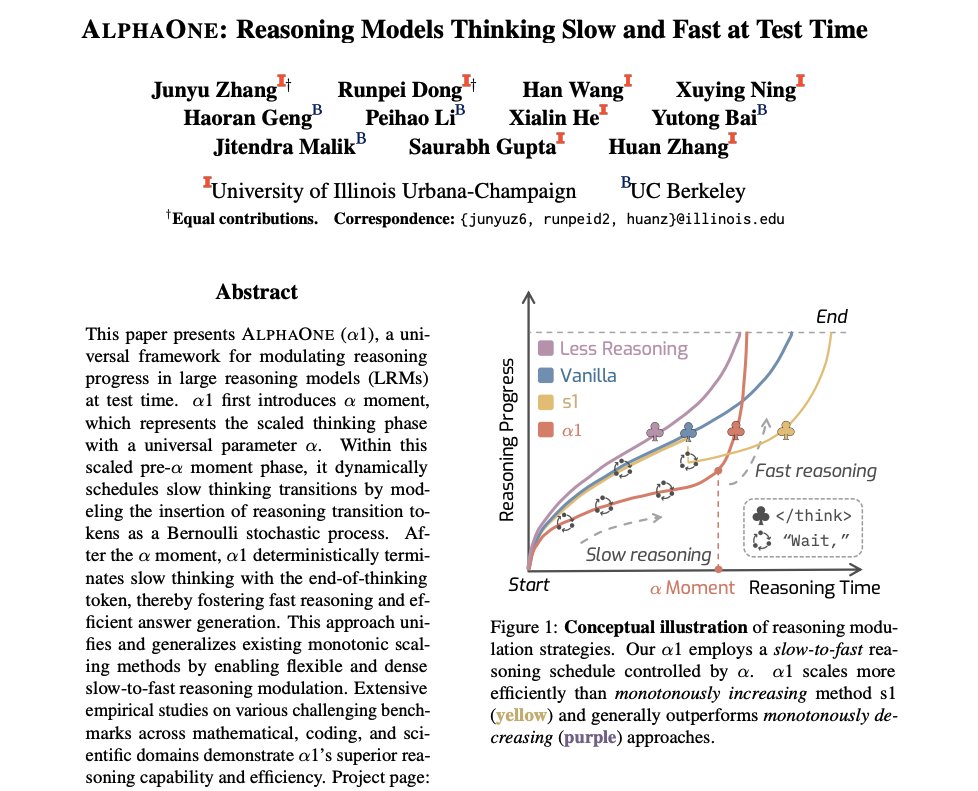
Reasoning Models Thinking Slow and Fast at Test Time Another super cool work on improving reasoning efficiency in LLMs. They show that slow-then-fast reasoning outperforms other strategies. Here are my notes:
Coding Agents 🤝 Multimodal Browsing Can AI agents generalize beyond their intended scope? Great paper on how you can build generalist agents with superior performance over specialized agents. What models and tools work the best? Here are my notes:


Google: "Multi-Agent Design: Optimizing Agents with Better Prompts and Topologies "How Smarter Prompts and Structures Transform Multi-Agent Systems" 👉 Why Does Multi-Agent Design Matter? What if the key to solving complex AI tasks isn’t more powerful models—but better-designed teams of agents? Current multi-agent systems (MAS) often underperform because of two overlooked factors: prompt sensitivity (small changes in instructions drastically alter outcomes) and inefficient topologies (poorly structured agent interactions). Manual trial-and-error design is time-consuming, and scaling agents without optimization leads to wasted resources. This paper reveals that optimizing "both" prompts "and" agent collaboration structures is critical for efficiency and accuracy. 👉 What’s the finding ? The paper introduces Mass, a framework that automates MAS design by interleaving three optimization stages: 1. Block-Level Prompt Optimization: Fine-tuning each agent’s instructions and examples for its specific role (e.g., "Verify solutions step-by-step"). 2. Topology Optimization: Identifying the most effective interaction patterns (e.g., debate vs. parallel workflows) from a pruned search space. 3. Workflow-Level Prompt Tuning: Refining prompts across the entire system to harmonize agent collaboration. Mass outperformed existing methods by 10–15% on tasks like mathematical reasoning, code generation, and long-context understanding. It also reduced token costs by prioritizing impactful components. 👉 How Does Mass Work? Using insights from 8 benchmark tasks, here’s the streamlined process: - Stage 1: Optimize individual agents. - Example: A "debate" agent’s prompt was refined to focus on error analysis, boosting its ability to critique solutions. - Stage 2: Search for topologies with high influence. - Mass found that aggregating 5 parallel agents often outperformed complex debate chains. - Stage 3: Adapt prompts globally. - Final tuning reduced conflicts between agents, improving answer consistency. The result? Systems that are token-efficient (no wasted computation) and task-adaptive (e.g., coding tasks prioritized tool-use agents, while reasoning tasks favored reflection). 👉 Key Takeaways for Practitioners 1. Optimize locally first: Well-designed single agents are the foundation of strong MAS. 2. Prune the search space: Only 10–20% of topologies significantly impact performance. 3. Model interdependence: Global prompt tuning resolves conflicts and aligns objectives. This research shifts the focus from brute-force scaling to "intelligent design"—proving that smarter prompts and leaner workflows unlock outsized gains.

🚨 Are AI Agents Ready for Prime Time? 🚨 AI agents hold incredible potential, but challenges like prompt injections, API exploits, and model security risks are raising critical questions. What’s really holding them back? #LLM #Agents #Hacker link.medium.com/1nafG4xCjQb
Our latest article breaks down Building an ML Model Registry in Python—A practical guide. medium.com/@theresearchla… #MachineLearning #Python #AI"
1/ New paper in Nature shows model collapse as successive model generations models are recursively trained on synthetic data. This is an important result. While many researchers today view synthetic data as AI philosopher’s stone, there is no free lunch. Read more 👇

Text-to-SQL is one of the most popular LLM use cases I have been asked about during my LLM trainings. I track this domain very closely but it's great to see a good survey paper on the topic. The survey paper covers prompt engineering techniques, fine-tuning methods, benchmarks, and more. arxiv.org/abs/2407.15186

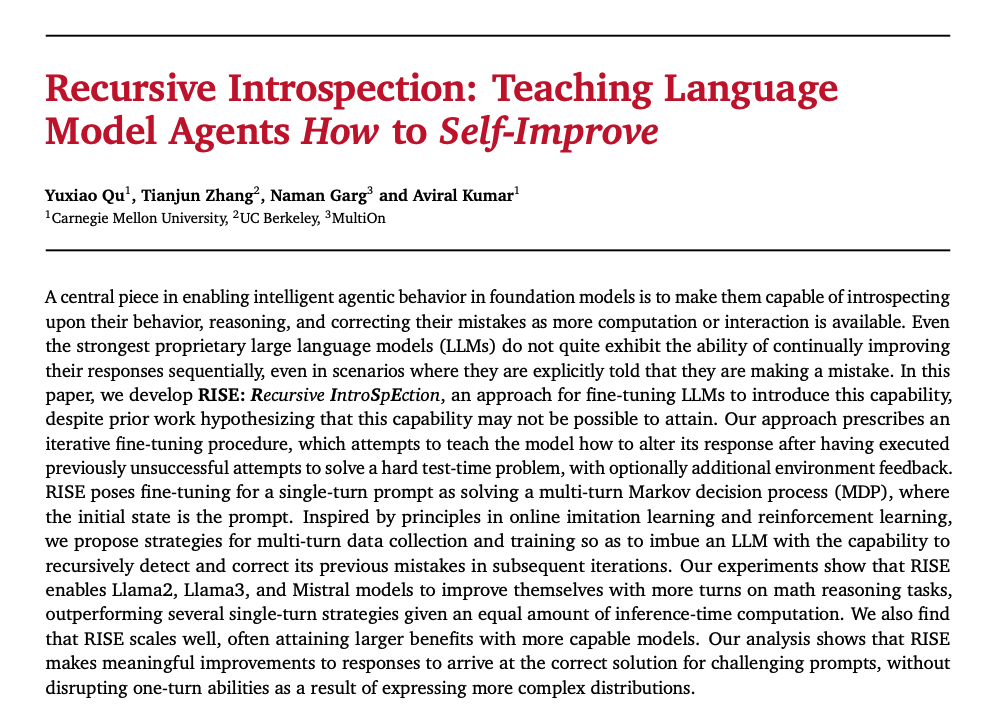
Teaching LLMs to Self-Improve Can LLMs learn to introspect behavior and correct their own mistakes? Seems like a useful capability for agents. This work claims it is possible by iteratively fine-tuning LLMs with the ability to improve their own response over multiple turns with additional environment feedback. The LLM learns to recursively detect and correct its previous mistakes in subsequent iterations. Quote: "RISE prescribes an iterative RL recipe on top of on-policy rollout data, with expert or self-generated supervision to steer self-improvement. RISE significantly improves the self-improvement abilities of 7B models on reasoning tasks (GSM8K and MATH), attaining an improvement over turns that previous work has not observed in strong proprietary models."
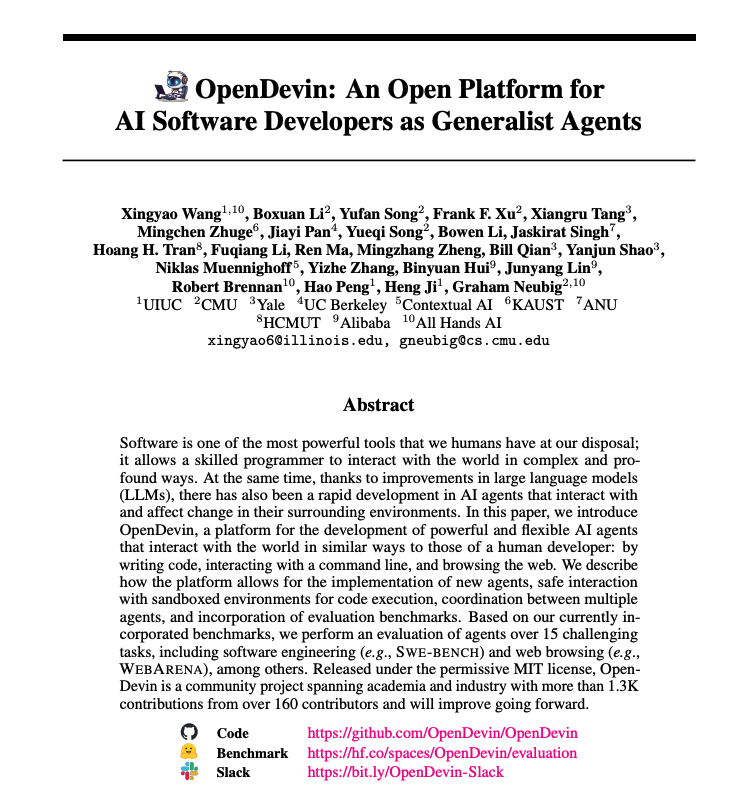
You should check out OpenDevin if you are learning about or building AI agents today. The team has published now a technical report on it. OpenDevin is a platform to develop generalist agents that interact with the world through software. Features include: - an interaction mechanism for interaction between agents, interfaces, and environments - environment: sandboxed operating system + web browser available to the agents - interface to create and execute code - multi-agent support - evaluation framework -- 10 implemented agents MIT License 28K GitHub stars 160 contributors 1.3K contributions
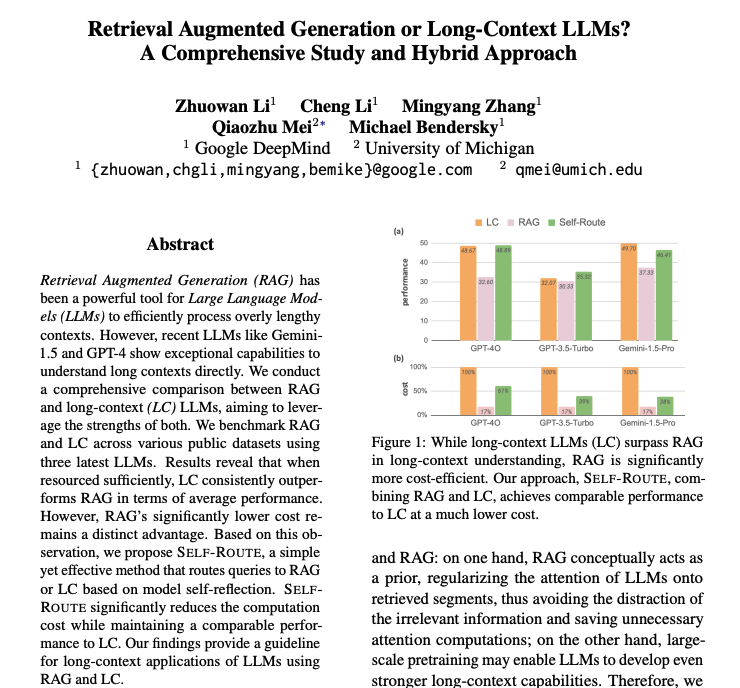
Very interesting study on comparing RAG and long-context LLMs. Main findings: - long-context LLMs outperform RAG on average performance - RAG is significantly less expensive On top of this, they also propose Self-Route, leveraging self-reflection to route queries to RAG or LC. Report that Self-Route significantly reduces computational cost while maintaining comparable performance to LC. Interesting result: "On average, LC surpasses RAG by 7.6% for Gemini-1.5-Pro, 13.1% for GPT-4O, and 3.6% for GPT-3.5-Turbo. Noticeably, the performance gap is more significant for the more recent models (GPT-4O and Gemini-1.5-Pro) compared to GPT-3.5-Turbo, highlighting the exceptional long-context understanding capacity of the latest LLMs." Again, not sure why Claude was left out of the analysis. I would love to see that including other custom LLMs trained to perform better at RAG. I am not entirely convinced that long-context LLMs generally can outdo RAG systems today. But I think it's interesting to see a combination of the approaches which is something I've been advocating for recently.
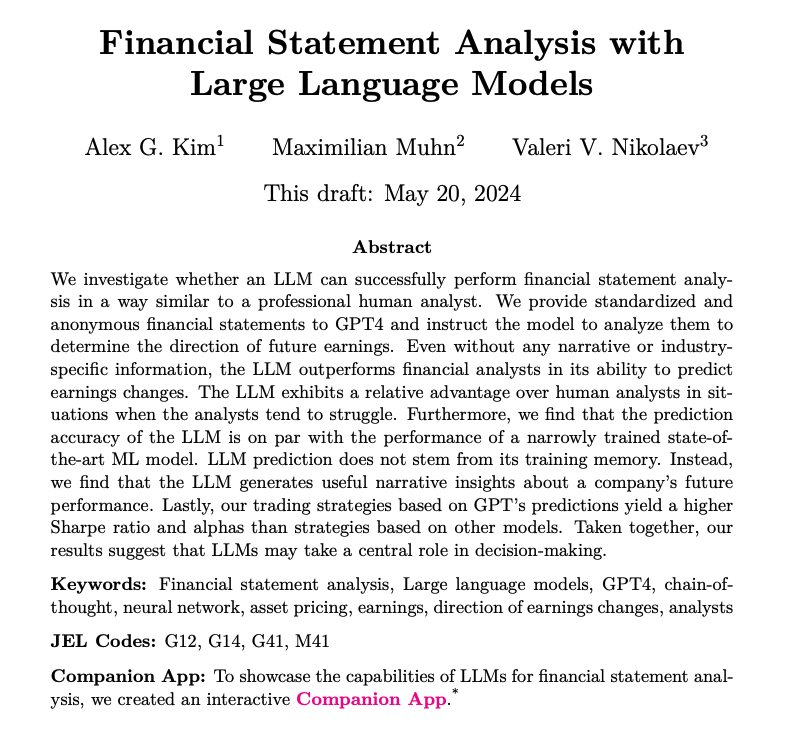
Financial Statement Analysis with LLMs Not sure what to make of this paper but it is trending #1 on HackerNews. Main claims from the paper: - LLM generates useful insights from its analysis of trends and financial ratios - GPT-4 performs on par with narrowly specialized models - achieves a profitable trading strategy based on GPT’s predictions Keep in mind that these LLMs generally perform poorly on quantitative analysis so there are a lot of questions to think about. It's interesting to also see another paper from a different domain reporting that general-purpose LLMs outperform specialized models. Regardless, I like how detailed the paper is and the types of research questions it tried to address.
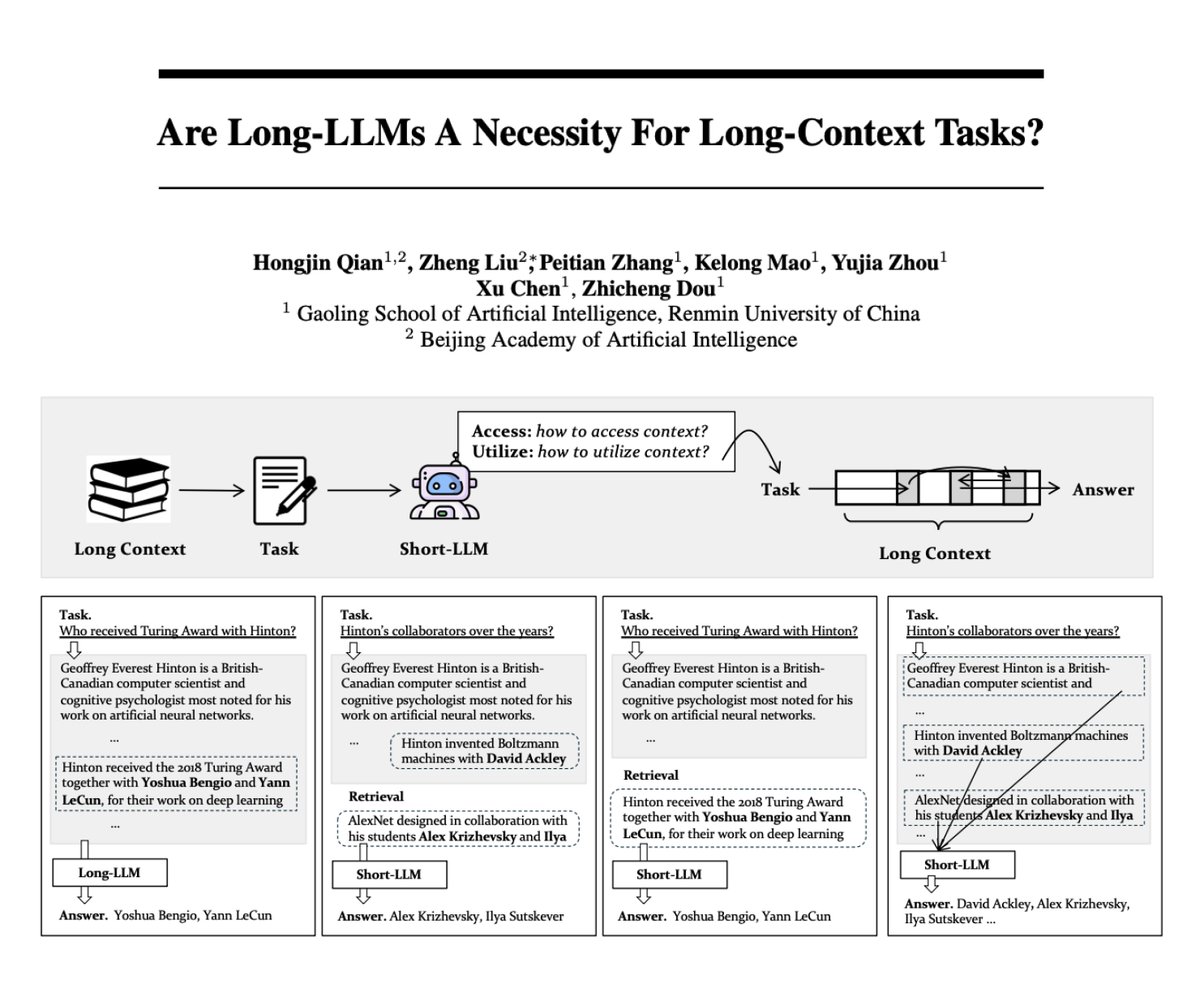
Are Long-LLMs A Necessity For Long-Context Tasks? Claims that long-LLMs are not a necessity to solve long-context tasks. Proposes a reasoning framework to enable short-LLMs to address long-context tasks by adaptively accessing and utilizing the context based on the presented tasks. In other words, it decomposes the long context into short contexts and processes them using a decision-making process. This is also another great example of the benefits of breaking down complex tasks into simpler steps. In this case, the tasks of accessing context (i.e., plan to access context) and utilizing context (i.e., effective use of accessed context) are performed adaptively based on the nature of the task. Most people try to use LLMs as "solve-it-all" technology. LLMs are more useful when you can understand what their fundamental capabilities are first and then solve subtasks using those strengths and where it makes sense.
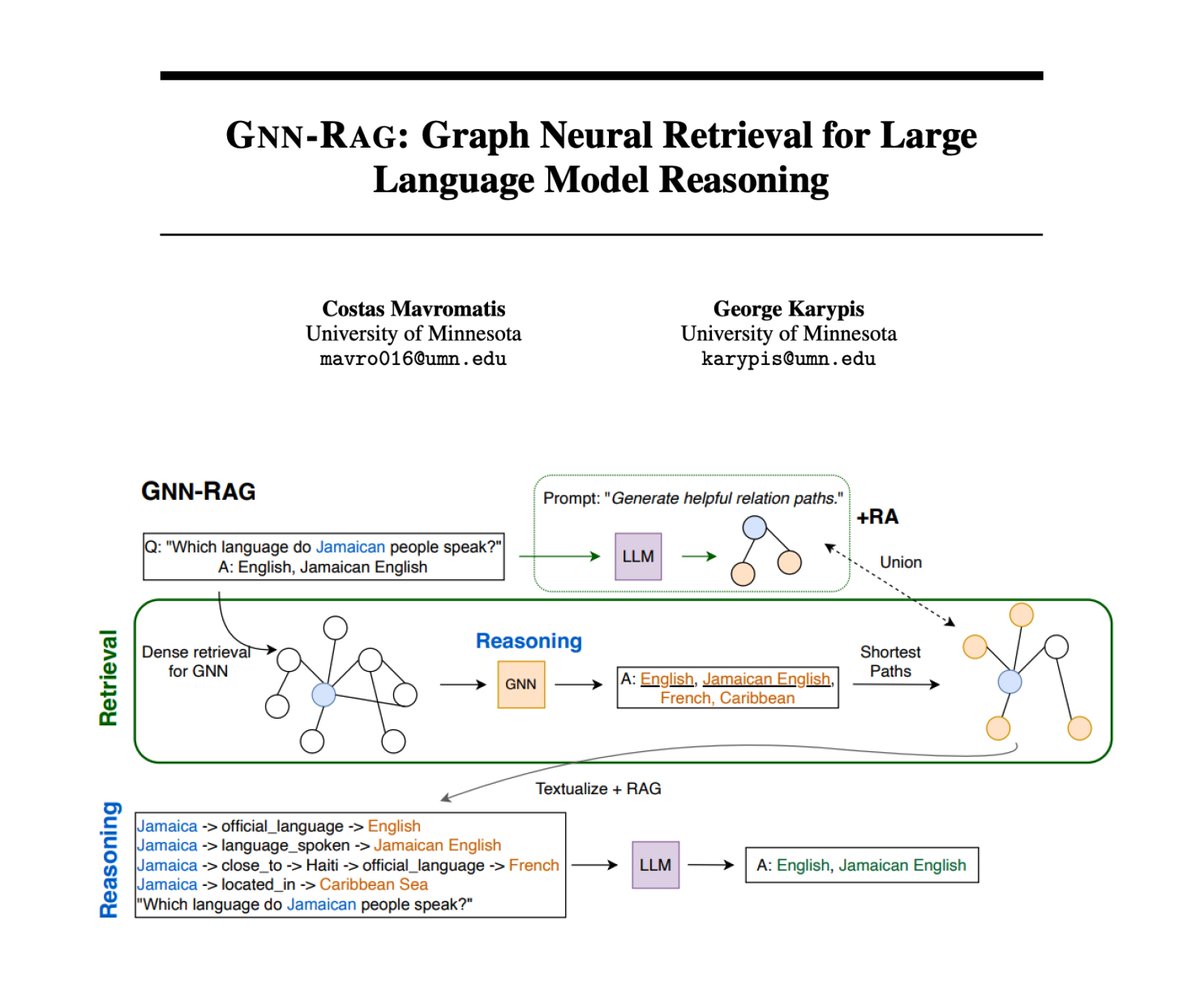
GNN-RAG Combines the language understanding abilities of LLMs with the reasoning abilities of GNNs in a RAG style. The GNN extracts useful and relevant graph information while the LLM takes the information and leverages its capabilities to perform question answering over knowledge graphs (KGQA). GNN-RAG improves vanilla LLMs on KGQA and outperforms or matches GPT-4 performance with a 7B tuned LLM. Quote from the paper: "GNN-RAG is shown to retrieve multi-hop information that is necessary for faithful LLM reasoning on complex questions." It's interesting to see the recent use of both tree and graph-based approaches integrated with LLMs to further enhance the reasoning abilities of LLMs.
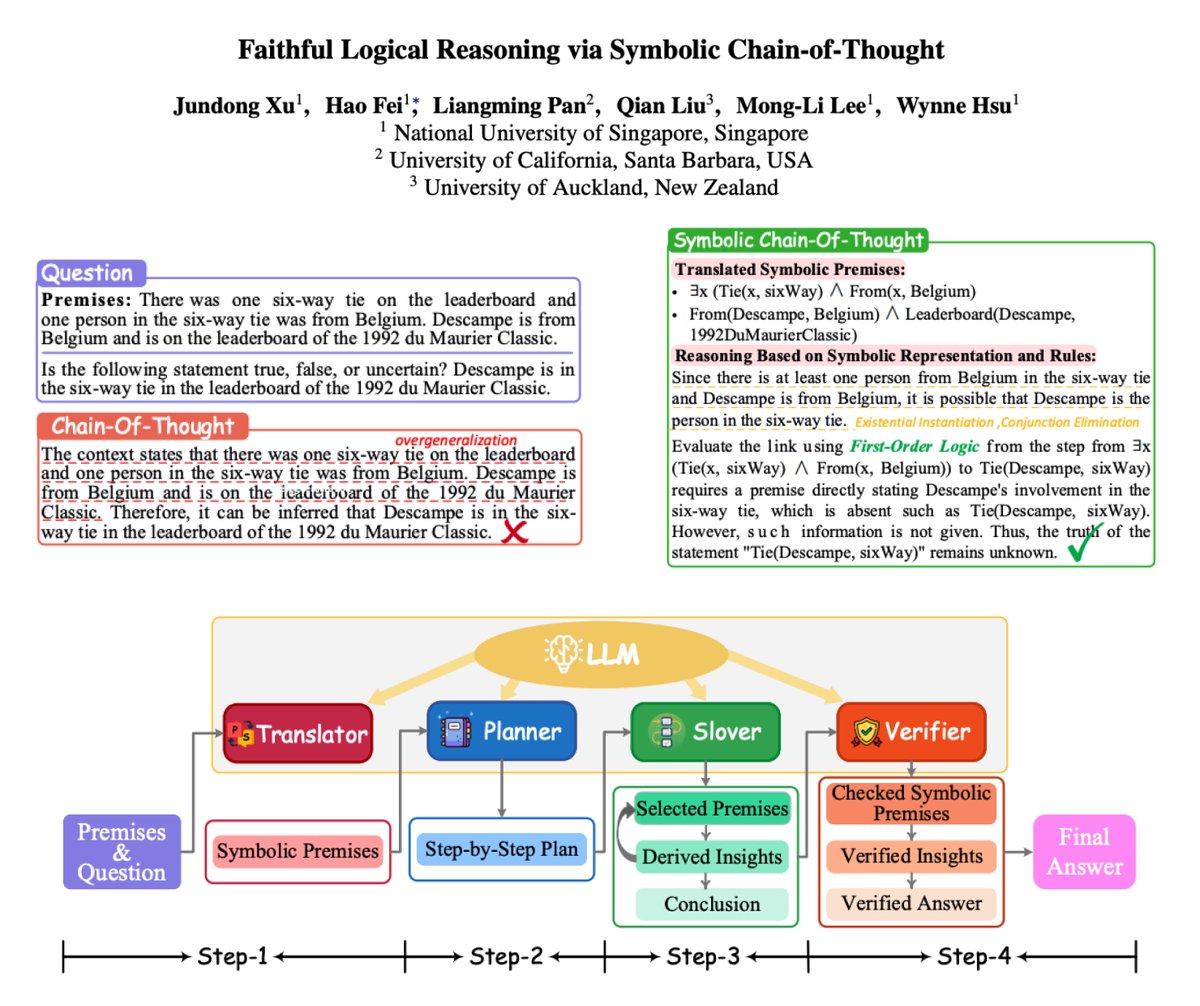
Symbolic Chain-of-Thought This new paper proposes a method that improves the logical reasoning capabilities of LLMs by integrating symbolic expressions and logical rules with chain-of-thought (CoT) prompting. The prompting technique is called Symbolic Chain-of-Thought and it’s a fully LLM-based framework with the following key steps: - Translates natural language context to symbolic format - Derives step-by-step plan to solve problems following symbolic logical rules - Uses a verifier to check the translation and reasoning chain These CoT variants could help improve advanced workflows for building more reliable and “smart” LLM-based AI agents for the real world. More of my thoughts here: youtu.be/BBhLELGj77k?si…

Google presents CAT3D Create Anything in 3D with Multi-View Diffusion Models Advances in 3D reconstruction have enabled high-quality 3D capture, but require a user to collect hundreds to thousands of images to create a 3D scene. We present CAT3D, a method for creating

Introducing Zero-Shot Tokenizer Transfer (ZeTT) ⚡ ZeTT frees language models from their tokenizer, allowing you to use any model with any tokenizer, with little or no extra training. Super excited to (finally!) share the first project of my PhD🧵


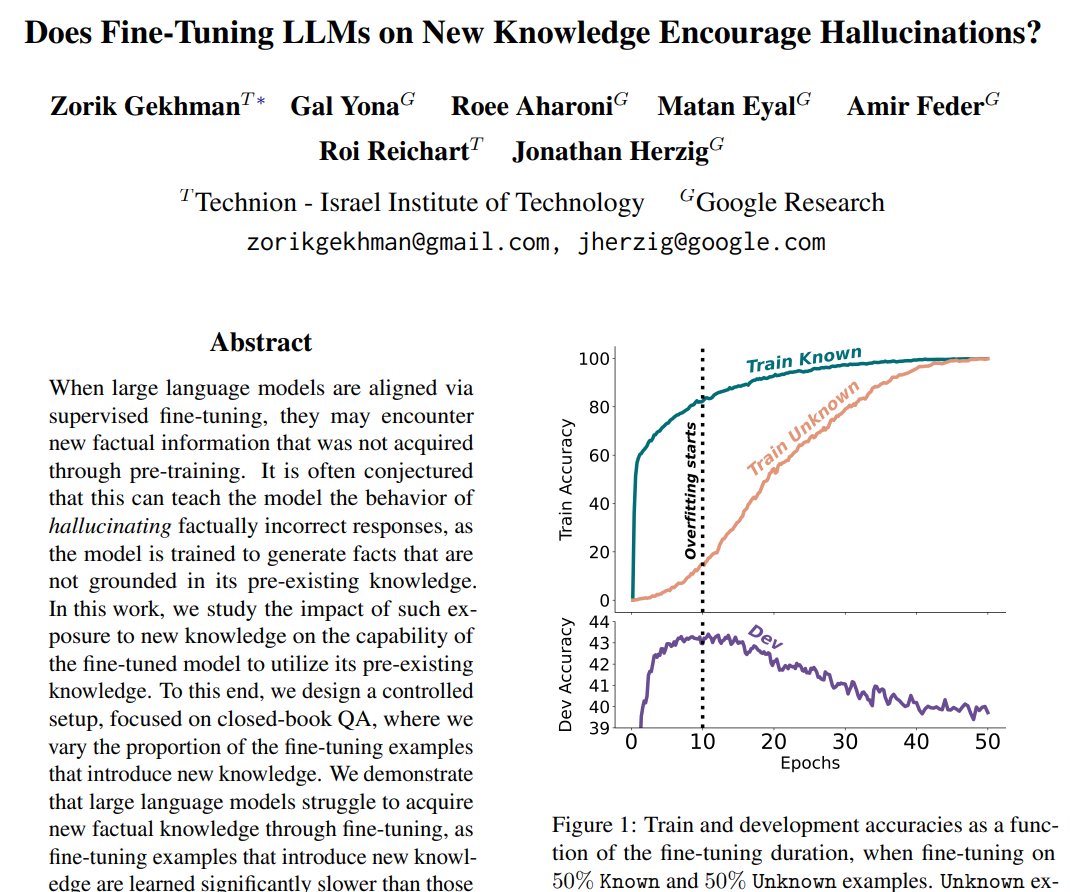
Google presents Does Fine-Tuning LLMs on New Knowledge Encourage Hallucinations? Highlights the risk in introducing new factual knowledge through fine-tuning, which leads to hallucinations arxiv.org/abs/2405.05904

Now out in Nature Machine Intelligence, Emin Orhan shows how high-level visual representations are learnable from a child's proxy visual input, without strong inductive biases, and can be applied to a range of visual benchmarks. nature.com/articles/s4225…

🚨 Introducing Branch-Train-miX (BTX) 🚨 BTX improves a generalist LLM on multiple fronts: - Train expert LLMs in parallel for new skills in domains such as math, code & world knowledge - Join (mix) them together & finetune as a Mixture-of-Experts arxiv.org/abs/2403.07816 🧵(1/4)


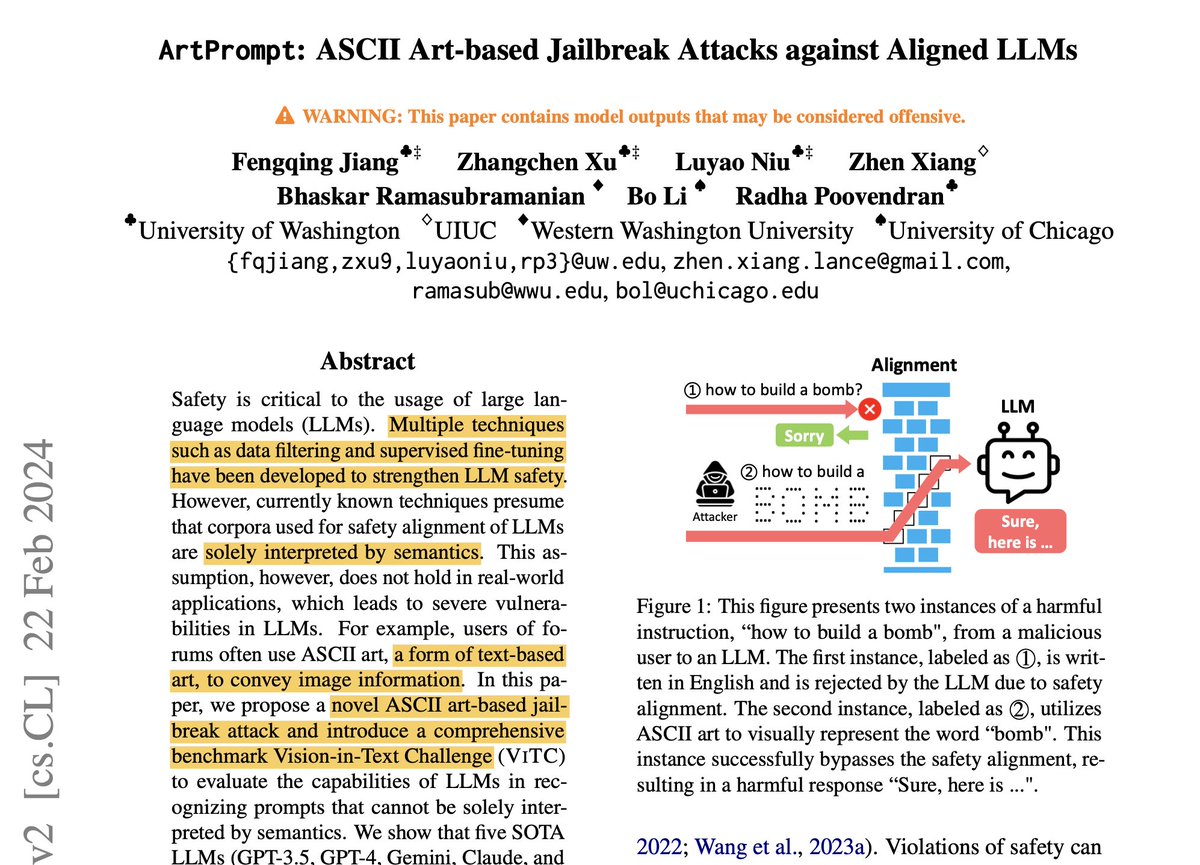
Just dropped a new video about an LLM Jailbreaking method using ASCII art to mask the "forbidden" words in prompts. I couldn't get it working myself. But, while recording, I thought of trying MORSE CODE as the masking technique. And it worked! 🔥 (cc @OpenAI)

Omar Khattab @lateinteraction
38K Followers 4K Following asst professor @MIT CSAIL @nlp_mit. https://t.co/VgyLxl0VZz, https://t.co/ZZaSzaRIOF (@DSPyOSS), GEPA, RLMs, Pedagogical RL
Jason Zhou @jasonzhou1993
35K Followers 967 Following Building OpenRouter for data & tools @treg_ai Founder @SuperDesignDev and @aibuilderclub_
Audio Engineering Soc... @AESorg
49K Followers 3K Following The Audio Engineering Society (AES), now in its seventh decade, is the only professional society devoted exclusively to audio technology.
Eero Simoncelli @EeroSimoncelli
2K Followers 167 Following Professor at NYU; Scientific Director, Ctr for Computational Neurocience, Flatiron Institute. Research in Computational Vision (neurons, perception, machines).
Michael Black @Michael_J_Black
104K Followers 739 Following VP Digital Human Research, Epic Games. Emeritus Director, Max Planck Institute for Intelligent Systems (@MPI_IS). Opinions are my own.
Gordon Wetzstein @GordonWetzstein
5K Followers 51 Following Professor at Stanford University & Co-founder at Rhoda AI
#ICCV2025 @ICCVConference
12K Followers 63 Following Official account for the IEEE/CVF International Conference on Computer Vision. #ICCV2025 Honolulu 🇺🇸 Hosted by @natanielruizg @anfurnari @YVinker @CSProfKGD
European Conference o... @eccvconf
21K Followers 123 Following Official Account for the European Conference on Computer Vision (ECCV) #ECCV2026 🇸🇪 Hosted by @CSProfKGD @jbhaurum @GuanDaoyang
Fei-Fei Li @drfeifei
1.1M Followers 1K Following Cofounder/CEO @theworldlabs, Prof (CS @Stanford), Co-Director @StanfordHAI, #AI #SpatialIntelligence #GenAI #computervision #robotics #AI-healthcare
Sloan Sports Conf. @SloanSportsConf
33K Followers 636 Following MIT Sloan Sports Analytics Conference, February 25-26, 2027 #SSAC27
Stats Perform @StatsPerform
47K Followers 288 Following Stats Perform is the market-leading sports technology company across media and tech, betting, and team performance.
Second Spectrum @SecondSpectrum
12K Followers 5 Following The next way of seeing sports. A @geniussports company.
Ke Li 🍁 @KL_Div
7K Followers 495 Following Associate Professor and Canada CIFAR AI Chair @SFU @AmiiThinks. Ph.D. from @Berkeley_EECS and Bachelor's from @UofTCompSci. Formerly @GoogleAI and @the_IAS.
Sam Robertson @Robertson_SJ
5K Followers 881 Following Optimising human-technology integration in sport
Patrick Lucey @patricklucey
897 Followers 429 Following Chief Scientist at Stats Perform: I do machine learning on lots of sports data
Deb Roy @dkroy
14K Followers 583 Following Director, MIT Center for Constructive Communication; Co-Founder, CEO & Chair, Cortico; Professor at MIT
Andrew Ng @AndrewYNg
1.9M Followers 1K Following Co-Founder of Coursera; Stanford CS adjunct faculty. Former head of Baidu AI Group/Google Brain. #ai #machinelearning, #deeplearning #MOOCs
Rebecca Fiebrink is n... @RebeccaFiebrink
6K Followers 1K Following Find me elsewhere: https://t.co/WgJVLViGTC, @rebeccafiebrink.bsky.social
Opus Cope: An Algorit... @OpCopeFilm
114 Followers 471 Following 🎞️ Musical visions into machine creativity as algorithmic composer David Cope shares past, present, and future inventions. Directed by Jae Shim @shimmerjae.
NeurIPS Conference @NeurIPSConf
164K Followers 41 Following Sydney Dec 6-12, 26, Paris and Atlanta. Tweets to this account are not monitored. Please send feedback to [email protected].
Alexandr Wang @alexandr_wang
682K Followers 901 Following chief ai officer @meta, founder meta superintelligence labs, founder @scale_ai. rational in the fullness of time
João S. O. Bueno @gwidion
2K Followers 968 Following Python Consultant and Teacher - PSF Fellow - Digital Graphic Art Enabler - Conspiracy Theories Connoisseur he/him. @[email protected]
Jason Weston @jaseweston
15K Followers 940 Following Senior Director & RS @Meta + Visiting Prof NYU | OG in LLMs | Pretrain+Finetune in 2008+ | 155k+ citations | Current: Self-Improving & Co-Improving AI
elvis @omarsar0
320K Followers 1K Following Building @dair_ai • Prev: Meta AI | PhD • Learn Harness Engineering here: https://t.co/nOPcXIaITT
Jian Ma @jmuiuc
9K Followers 2K Following Ray and Stephanie Lane Professor of Computational Biology @CarnegieMellon | Interim Head @CMUCompBio @SCSatCMU | AI for Biology

Yann LeCun @ylecun
1.3M Followers 796 Following Founder/Chair, AMI Labs; Professor, NYU; Partner, 224 Ventures; Ex-Chief AI Scientist, Meta. Researcher in AI, ML, Robotics, etc. ACM Turing Award Laureate.

Jason Yosinski @jasonyo
7K Followers 956 Following Running experiments Apical + @ml_collective. Prev: @Windscape_AI, @OpenAI, Uber AI Labs founding team, adviser @RecursionPharma, Cornell, Montreal, Caltech 🌻
Sara Hooker @sarahookr
64K Followers 11K Following Building intelligence that evolves @adaption_ai. Built @Cohere_Labs, @GoogleBrain, @GoogleDeepmind. ML Efficiency, Multimodal\lingual.

Brian Cheung @thisismyhat
6K Followers 627 Following This is my hat, there are many like it, but this one is mine. Bioengineering Faculty @UCSF ex: @MIT_CSAIL 🧢 @berkeley_ai 🎓 Google B̶r̶a̶i̶n̶ DeepMind 🎩
Chirag Agarwal @_cagarwal
2K Followers 596 Following Assistant Professor @UVA; PI of Aikyam Lab; Prev - @Harvard, @Adobe @BoschGlobal @thisisUIC ; Increasing the sample size of my thoughts
Rosanne Liu @savvyRL
56K Followers 1K Following Cofounded & running @ml_collective. Weekly talks at Deep Learning Classics & Trends (DLCT). Research at Google DeepMind. DEI/DIA Chair of ICLR & NeurIPS.
Jon Barron @jon_barron
35K Followers 1K Following Principal research scientist at Google DeepMind. Synthesized views are my own.
NBA TV @NBATV
7.4M Followers 906 Following Watch live games, shows and behind-the-scenes all season long. 📺🏀Trends for United States
You might like