

Veenode Learn @VeenodeLearn
A world-class AI & Cybersecurity Institution. Go deep in one track, intern, publish & get seen globally. Empowering the next generation of tech leaders. veenodelearn.com Montréal, Québec Joined June 2025-
Tweets235
-
Followers253
-
Following3
-
Likes475

A useful AI project begins with a business problem you can explain clearly. For example, a support team might spend time turning long customer messages into short internal summaries. That is a specific workflow to investigate. “We need to use AI” is not yet a definition of the work. First, understand the current process. How long does it take? Who checks the summary? Which mistakes create extra work or affect a customer? Record a baseline before introducing a new tool. Then run a limited pilot with representative examples and an appropriate review step. Agree on the data the system may use, who owns the decision and what result would justify continuing. Include difficult examples as well as straightforward ones. Measure the whole task. Time spent checking and correcting an AI summary still counts. Track quality, operating cost and the effect on the people using the output alongside any time saved. Use the results to decide whether to expand, adjust or stop. A simpler change to the existing process may be the better option, and a pilot should help you discover that too. Plan an AI workflow around your business needs with Veenode Technologies at veenode.ca. #Veenode #AIConsulting #BusinessAI




Day 20 of our 50-day AI/ML Challenge Build a Baseline Model with Python | DummyRegressor & MAE | AI/ML Lesson 20 youtu.be/YVkSMOkkwxo
Two weeks in. 158 mentees admitted. 86 still in the program. Our Cybersecurity Foundation Mentorship progress so far is a reminder that getting an opportunity is only the beginning. Free doesn't mean valueless. Take the opportunity, and the work that comes with it, seriously. To those still here: show up, do the work, and make it count. Your growth is the goal. Don't just occupy a spot; use it to become better. #Cybersecurity #Mentorship #Cohort4 #TechTalent #YouthInTech #CybersecurityMentorship #VeeNode #TheVictorAkinodeFoundation #FutureLeaders


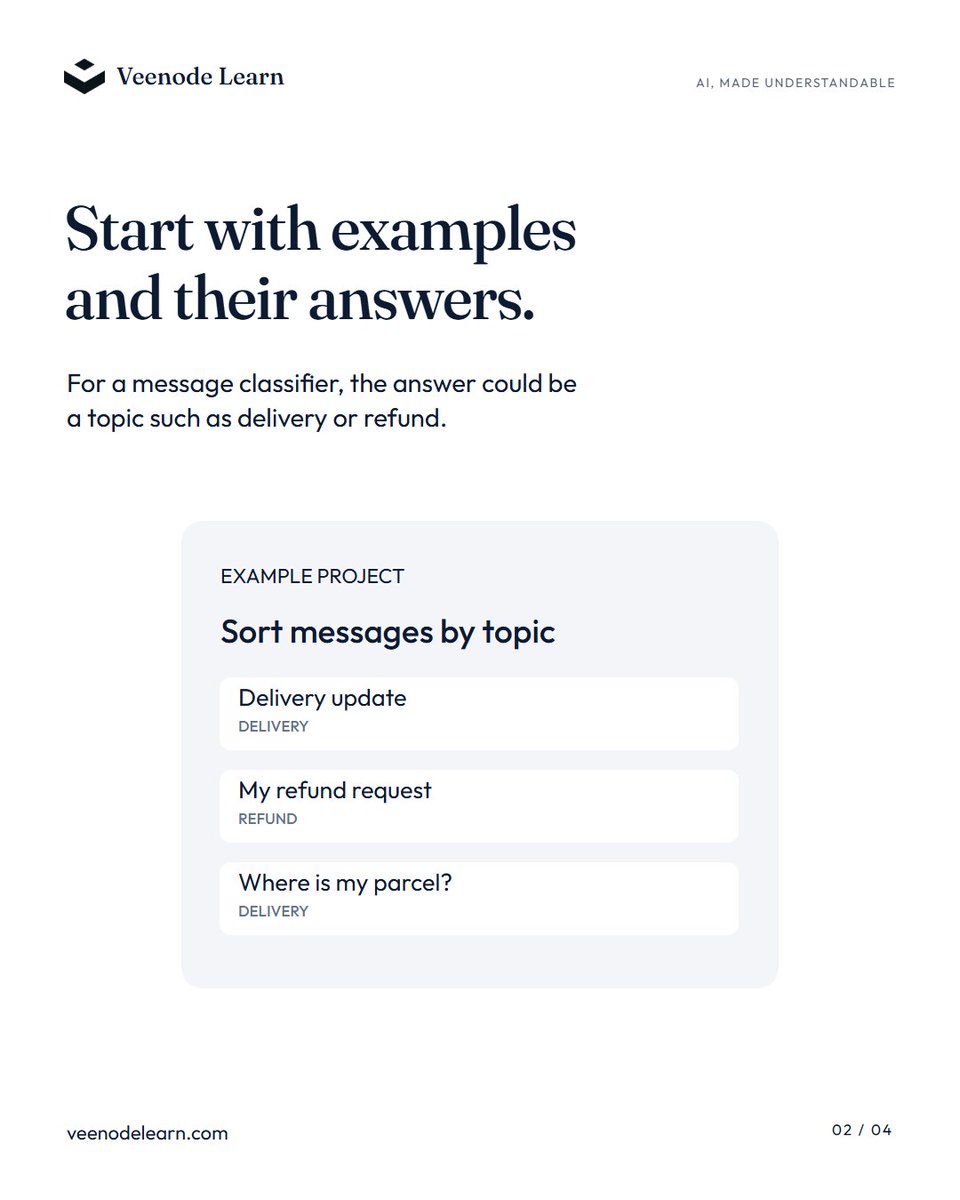
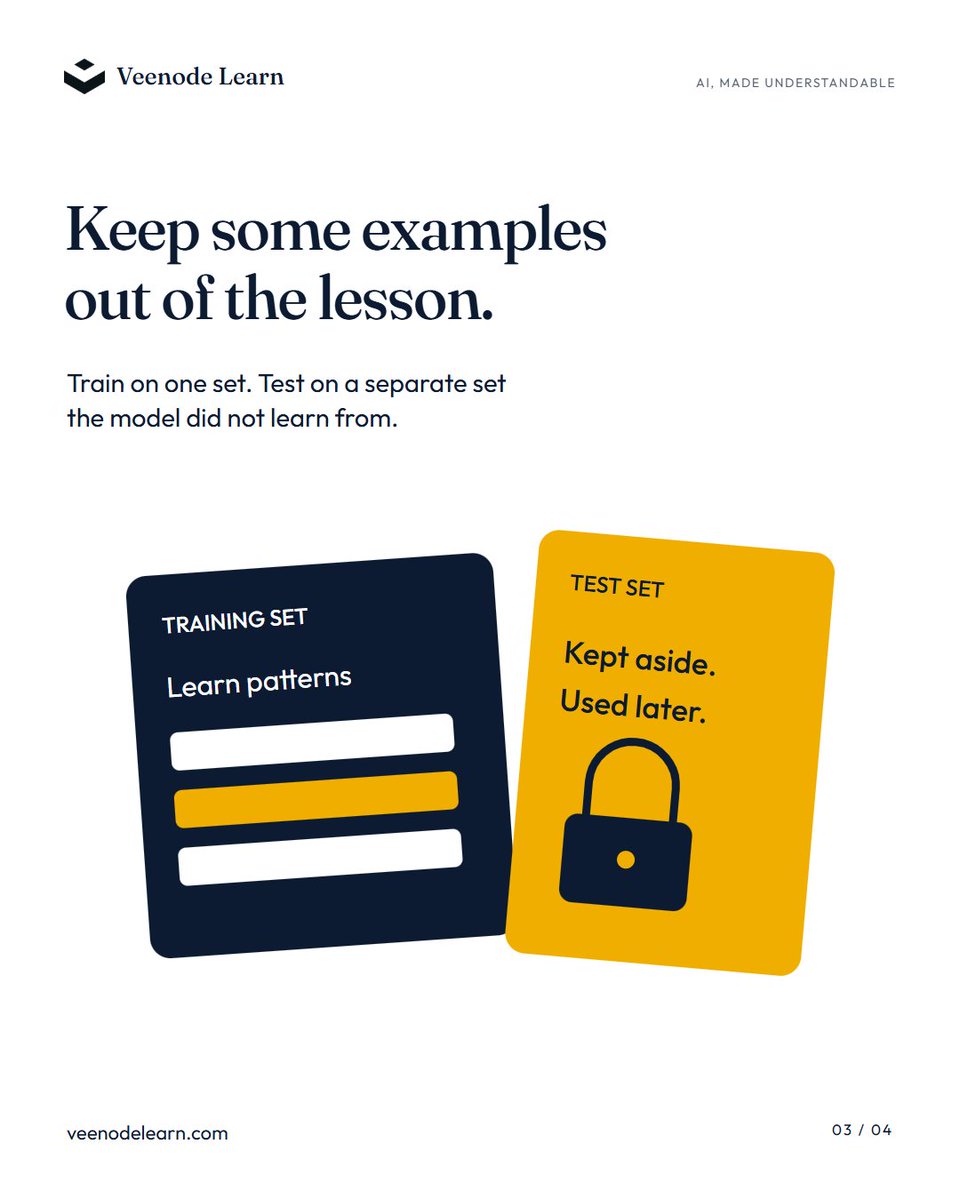
A model can do well on examples it has already seen and still struggle with new ones. One basic check is to keep separate training and test data. Train on the training set, then use the test set to evaluate how the model handles unseen examples. Avoid letting test information influence training. The message labels in this carousel are a simplified teaching example. In a real project, you also need clear labelling rules, suitable metrics and checks for data leakage. Start learning AI at veenodelearn.com and practise at veenodelabs.com. #VeenodeLearn #MachineLearning #LearnAI


A useful lab note does not need to be long. Record the task, what you tried, the result and your next question. Add enough detail that you can return later and understand your own work. Keep practice inside authorised labs, and remove credentials or private information before sharing screenshots or notes. Your notes can help you explain your thinking, ask a clearer question and spot what changed between attempts. Practise at veenodelabs.com. #VeenodeLearn #VeenodeLabs #LearningByDoing

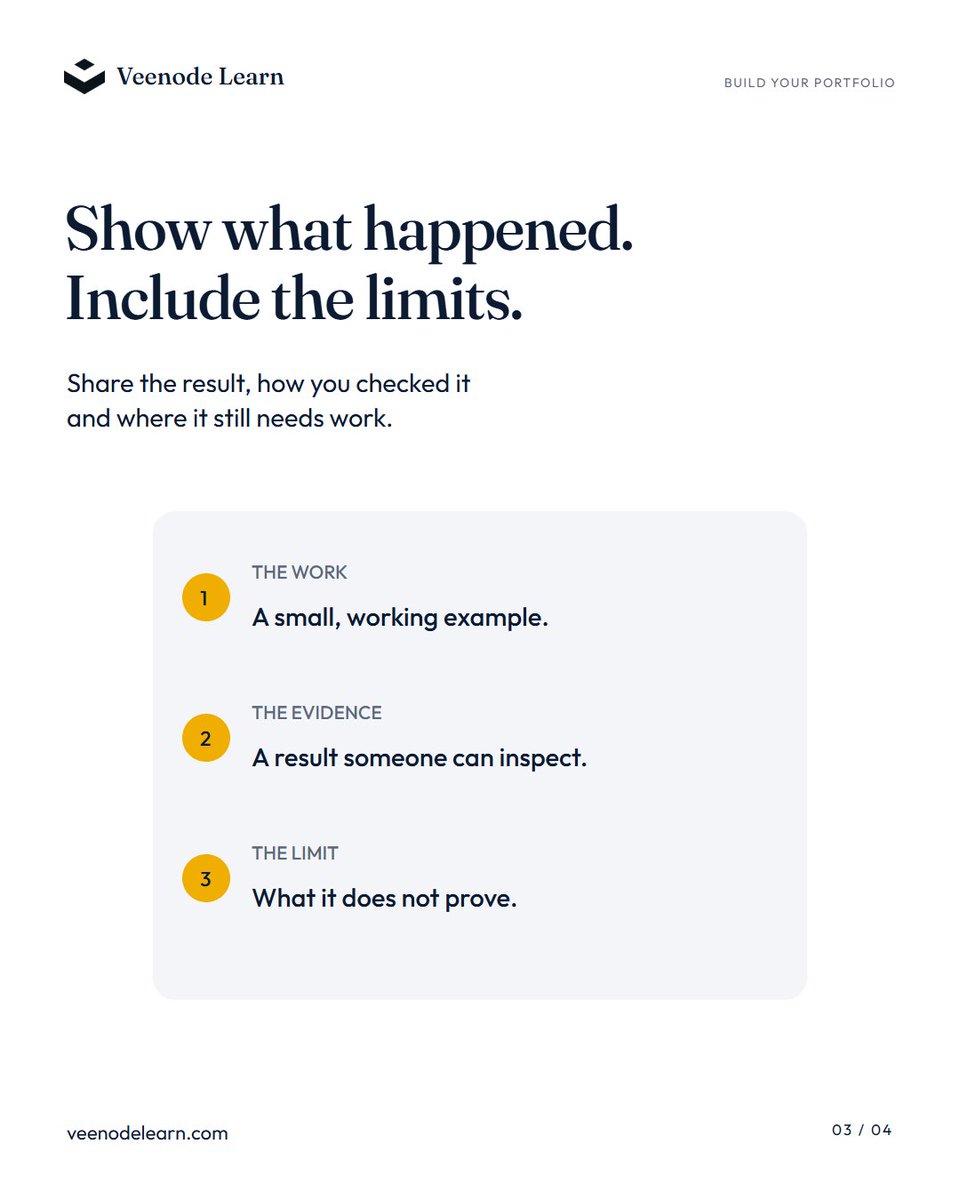
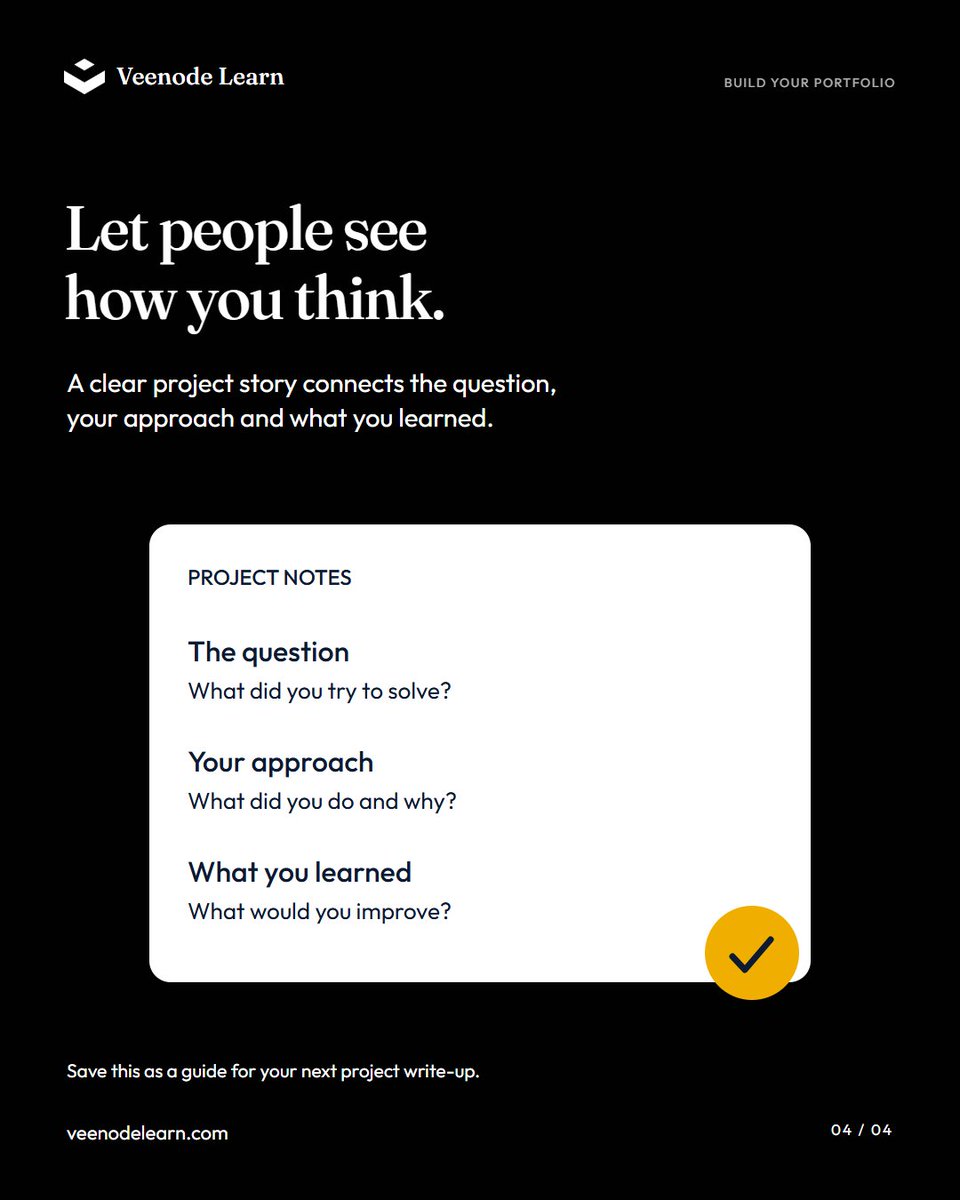
A portfolio project becomes more useful when someone can understand the decisions behind it. Explain the question you started with, the approach you chose and the result you obtained. Include how you checked the result and what the project does not prove. For an AI project, that might include data choices and evaluation. For a cybersecurity lab, it might include observations, supporting evidence and a proposed fix. Use authorised environments and share only material you have permission to publish. Start small. Document honestly. Give your work a clear story. veenodelearn.com | veenodelabs.com #VeenodeLearn #TechPortfolio #AI #Cybersecurity


Learning cybersecurity includes learning where you have permission to practise. A website being publicly accessible does not mean you are allowed to test its security. Start in an authorised practice lab and read the instructions before you run anything. Identify the exact target and the actions the exercise allows. Permission to test one application does not automatically extend to another system you can reach from it. If a boundary is unclear, clarify it before continuing. As you work, keep notes that explain the finding. What action did you take? What happened? What evidence supports your explanation? Why would that behaviour matter? In a training exercise, for example, a screenshot of a fictional user’s invoice may show the result. Your notes should also explain which test account accessed it, why that access was unexpected and what control could prevent it. Keep credentials and private information out of anything you share. Finish by following the lab’s cleanup instructions. Then write a short summary of what you learned and what you would check differently next time. These habits help you turn an exercise into a useful explanation of a security problem. Completing the task matters, and being able to explain it makes the lesson easier to carry forward. Explore hands-on learning at veenodelabs.com. #VeenodeLearn #VeenodeLabs #CybersecurityLearning




When your code does not work, you do not have to rewrite everything. Start by finding one small input that still produces the problem. Write down what you expected and what actually happened. That difference gives you something specific to investigate. For example, suppose a script should add two prices, 2 and 3, but returns 23. Try those two values on their own. Check the types of the values and the operation being applied. You now have a much clearer question than “Why is my whole program broken?” Remove unrelated code gradually, while checking that your small example still shows the issue. If the problem disappears, look at the last thing you removed. It may help you understand what the behaviour depends on. Change one thing at a time and run the example again. Keep the result visible so you can tell whether your change helped. This approach also makes it easier to ask for help. Share the smallest relevant example, the expected result, the actual result and any error message. Leave passwords, tokens and private data out of it. A smaller problem gives you room to think. You can build the rest back in once you understand what went wrong. Explore hands-on learning at veenodelabs.com. #VeenodeLearn #LearningToCode #Debugging

Before you train a model, spend some time getting to know the data. Start with a few rows. Find out what each column means, how the records were collected and what you want the model to learn from them. Suppose an age field is blank. That might mean the age was never recorded. Filling the field with zero would give it a different meaning, so first decide how missing information should be handled for this task. Next, you notice two records for the same customer, each showing a $30 purchase. They could be an accidental copy or two separate purchases. Check the available context before deleting either one. Labels deserve the same care. If you are sorting support messages into refund, delivery and other categories, write down what belongs in each group. “Where is my order?” is straightforward. “My order arrived damaged” may need a more specific rule. Keep a record of the changes you make and why. When you use data-driven preprocessing, fit it on the training data only, so information from the test set does not leak into training. For your next practice task, choose a small dataset and write down three questions you would answer before training. Explore AI learning at veenodelearn.com. #VeenodeLearn #MachineLearning #DataQuality




You can understand a technical idea before you feel comfortable saying its name. Imagine helping a small business sort customer messages. One person asks where an order is. Another wants their money back. You put the first message with delivery questions and the second with refund requests. You have already understood the basic idea of classification. The technical word gives a name to the task of assigning something to a category. Now explain that example in the language you know best. Use words you would use when helping a friend. Once the meaning is clear, connect your explanation to the technical term. Then try a less obvious message, such as “My order arrived damaged.” Would you call it a delivery issue, a refund request or something else? Discussing that choice helps you see why the categories need clear definitions. The aim is to connect understanding with vocabulary, so you can explain the idea and recognise its name when you meet it in a lesson, a tool or a conversation. That connection matters when you are learning AI or cybersecurity. A new concept is easier to work with when you can relate it to something familiar. Which technical term became clearer after someone explained it differently? Explore multilingual learning at veenodelearn.com. #VeenodeLearn #MultilingualLearning #LearnAI

A phishing message does not have to look suspicious to be dangerous. It might use the name of a service you know, copy its logo and tell you that your account will close in ten minutes. The request feels important, so you reach for the link before checking who is asking. That pressure is a reason to pause. An urgent deadline does not prove that a request is genuine. Read the full sender address and consider what the message wants you to do. Is it asking for your password, a payment or a verification code? A familiar display name, correct spelling or convincing logo cannot establish that the sender is trustworthy. You can check the request without following its link. Open the official app or use a website address you already know. If you still cannot confirm what is happening, contact the organisation using contact details you trust, rather than the number in the message. For a workplace account, report the message through your organisation’s reporting process. You do not need to investigate it alone. Learning to recognise phishing begins with a useful habit. Give yourself time to verify a request before acting on it. Explore cybersecurity learning at veenodelearn.com. #VeenodeLearn #Cybersecurity #PhishingAwareness



Sometimes the hard part is the concept. Sometimes it is the language being used to explain it. You should have room to ask questions, connect new ideas to familiar examples and explain what you have understood in your own words. That is the purpose behind multilingual learning at Veenode Learn and hands-on practice at Veenode Labs. Explore veenodelearn.com. #VeenodeLearn #MultilingualLearning #AI #Cybersecurity


BD @Bode_OG
4K Followers 4K Following 'We might be locked in a world not of our own makings, but we have a claim on how it is shaped, we have responsibilities.'
Rano😎 @FadareVincent
267 Followers 394 Following
Fernando Manzanarez @FernandoMa61306
15 Followers 4K Following
Miracle Zimpita @Veyron621
0 Followers 1 Following
Abdurrahman Nasir @Abdurrahmap9p9
0 Followers 8 Following
Panshak @_Gopep_
808 Followers 985 Following Cybersecurity Analyst, Cloud Savvy... *Stay Hungry*...😎😎
Valentine John Ogoshi @ValentinoKingz
590 Followers 3K Following Cybersecurity - ISC² & CCEP Certified | Software Testing & QA Engineer | SGDs Advocate | Politics•Lifestyle•Football•Relationship Talks
AJDaniel @AJ_Daniel6
5K Followers 5K Following Building my Cybersecurity career 🛡️ | Learning from scratch 💻 | Sharing the journey, lessons & progress 🇳🇬
Ifunanya Promise Adin... @Digitalpromise0
62 Followers 102 Following Cybersecurity Aspirant | Ethical Hacking Enthusiast | Networking & Protocols | Threat Detection | SOC Operations.
Northman | DevOps ∞... @PhilipInsights
1K Followers 2K Following Cloud DevOps Engineer | AWS | Azure | CI CD | Terraform | Docker | Kubernetes | Automation & Monitoring | Web3 enthusiast | Microbiology to Computer Science.
Hugo Keyz @hugokeyz
108 Followers 882 Following Cybersecurity Enthusiast l Pianist/musicians | Lover of God | Musician | Entrepreneur!!🔥🔥💪 | Dog Lover/Breeder🐕|
İsmail Polat @smailPo90763640
10 Followers 614 Following

ManuelDCyberSPeaks! @DrIPloRd190
135 Followers 193 Following #SON OF PANTOCRATOR ||# A CYBERSECURITY ENTHUSIAST || A FOREX TRADER |DFIR tycoon ||ASPIRING SOC ANALYST || FUNAAB STUDENT ……
Emeka @moonlight_sira
2K Followers 1K Following starting my journey in cybersecurity I love anime, comic, ororo Monroe & manga.

Emmanuel Nwabuokei @securethestack_
1 Followers 9 Following Software, Games, Cybersecurity, AI. Building, Breaking, Securing and having fun with AI
SPEEZY ADAMS🇺🇬 @AdamSpeezy
2K Followers 5K Following Tech Leader | CEO, AIC Technologies| Founder, @islamfaithfuls | Lead @Redefined Casual Drip | Building secure & scalable innovation | Fashion • Deen . |@mancity
Benjamin Kelvin @_trinity_930
49 Followers 228 Following Photography| Movie freak| Aspiring cybersecurity analyst | Learning in public with @VeenodeLearn, Coursera | Sharing daily lessons, wins & mistakes

ICO TECH @Ico_techlab
30 Followers 89 Following Building cybersecurity skills one lab at a time | Kali • Networking • Security awareness | Learning and sharing the journey

Yaps @Yaps_bo
4 Followers 55 Following

Adéìfé Dáramólá @ajeropikin
876 Followers 632 Following Christian | Quality Assurance | Cybersecurity Enthusiast | Liverpool FC | Ekiti | Once a Publisher - always a Publisher
Ayon Man @ayon_man1
329 Followers 580 Following Free as a bird..... Always keeping the spirit high.... Cool, gentle, loving and kind...... IFB🇳🇬
Ola-Yinks @olaman2sure
309 Followers 456 Following CCNA Network Engineer | Web2/Web3 | AI Explorer | Tech breakdowns + sports takes | Real Madrid til I die | Caitlin Clark WNBA GOAT
Francis Muokwe @FrancisMuokwe
10 Followers 42 Following
Emmanuel @Emmanuel_E17
119 Followers 129 Following I'm a boy helped by GOD || I'm Emmanuel a passionate web designer focused on creating visually captivating and user-centered digital experiences.
Doo Visioneers @Dolapomid
17 Followers 115 Following Beloved of God💜|| RN • RM • BNSc || Creative Designer🎨|| Tech & Media Enthusiast 💻🚀|| Nursing + Design= NurDesigner|| DM for designs and collaborations.📩
Joseph Edem @Teddi_Joe
1K Followers 5K Following Certified Google Technical Support , Data entry specialist, Data Analyst, frontend Web Dev, Certified SDGN Advocate. Open for remote jobs in any field.

Sanusi Saheed @sanusisaheed411
173 Followers 1K Following Aspiring soc analyst and penetration testing, HND industrial maintenance engineering
Ancelot @Ancelotr
44 Followers 94 Following Funded Trader| Trading XAUUSD & Major Pairs Focused on execution, discipline & long-term consistency.
Nana @Mercyoluwaseun_
372 Followers 327 Following
sunday steve @sunnythriller
31 Followers 315 Following
CyberAlfa @FulaniOsun
2K Followers 3K Following Husband | Father | Aboo Musteqeem | Cyber Security enthusiast | Aspiring Ethical Hacker | Unilorin Alumni.
Akin • RhodeZ @RhodeZ33
96 Followers 161 Following Tech brought me here❗️Cruize made me stay. 100% Patriotic Nigerian
Faatimah @_Faati_mah
25 Followers 211 Following
Ogbodo Faith @Faitl6rr
0 Followers 66 Following 🚀 Tech enthusiast | AI & Software 💻 Learning, building & exploring the future 🌍 Young mind. Big ideas. Building with purpose. ⚡
The Divinity💎 ✨�... @lionking7070
93 Followers 151 Following A Surrealist Artist and Poet | Football club: FC Barcelona 💙❤️l Cybersecurity: Ethical Hacker| Pen-Tester
Ogundowo Morakinyo @his_will_i_am
3 Followers 83 Following
Lawrence @only_Lawrence
326 Followers 428 Following Learning cybersecurity | Blue Team path Documenting the journey to SOC Analyst | Learning in public
Khodijah Adeyemo @KhodeejahA16750
10 Followers 88 Following Proudly Muslimah, Cyber security Newbie, Graphic design, Fronted web development.
THE LINCOLN💐(Ø,G) @M_Zayyyad
374 Followers 757 Following Gone.. Blockchain curious | Starting my Web3 journey | Citizen @Onboard3___ | Let's learn together 💡

erler omry @OmryErler
289 Followers 2K Following Life is a bet,live it fully. constructive critism is allowed.
Mutiat Temitope Lawal @lawal_temitee
4 Followers 77 Following A graduate of BSc computer science, MSc Information Technology. PhD invview
Big Fish 👑 @theonly_ayomide
626 Followers 428 Following • Web3 • OG @hangoutDao_ • Footy • Soul connection with @ChelseaFC • Funny sometimes • Learning
Esther Layor @EstherLayor
54 Followers 342 Following Cybersecurity Building skills for a safer digital world 🌍
Victor Akinode @VictorAkinode
2K Followers 279 Following AI Safety, Ethics & Transparency @Mila_Quebec |MSc. @mcgillu | Building @VeenodeLearn & @veenodetech Cybersecurity Course Creator & Instructor @AltSchoolAfrica
The Victor Akinode Fo... @VAInitiatives
435 Followers 5 Following Building Careers. Changing Lives. With 3,000+ learners trained, we help you go from "Zero Knowledge" to Cybersecurity, AI Expert through mentorship & community.You might like


















