Alkanes.fun @alkanesfun
The next wave starts here. Bringing native, on-chain launches to Bitcoin. Built on Alkanes. No official affiliation or endorsement. Make Alkanes Great Again. alkanes.fun Joined September 2021-
Tweets53
-
Followers864
-
Following40
-
Likes41
@jinwenwuaibaixi Check if your transaction went through.
The official Alkanes.fun Telegram group is now open. Join us for project updates, community discussions, and feedback:t.me/Alkanesfungroup

All reported issues with buying through OKX Wallet have been fixed. I’m now putting my full focus into V2, with more launch options coming soon. We’re also talking with Gabe about integrating Subfrost AMM. I don’t think it’ll be a long wait. I love Alkanes and want more people to discover it. #BTC #Alkanes
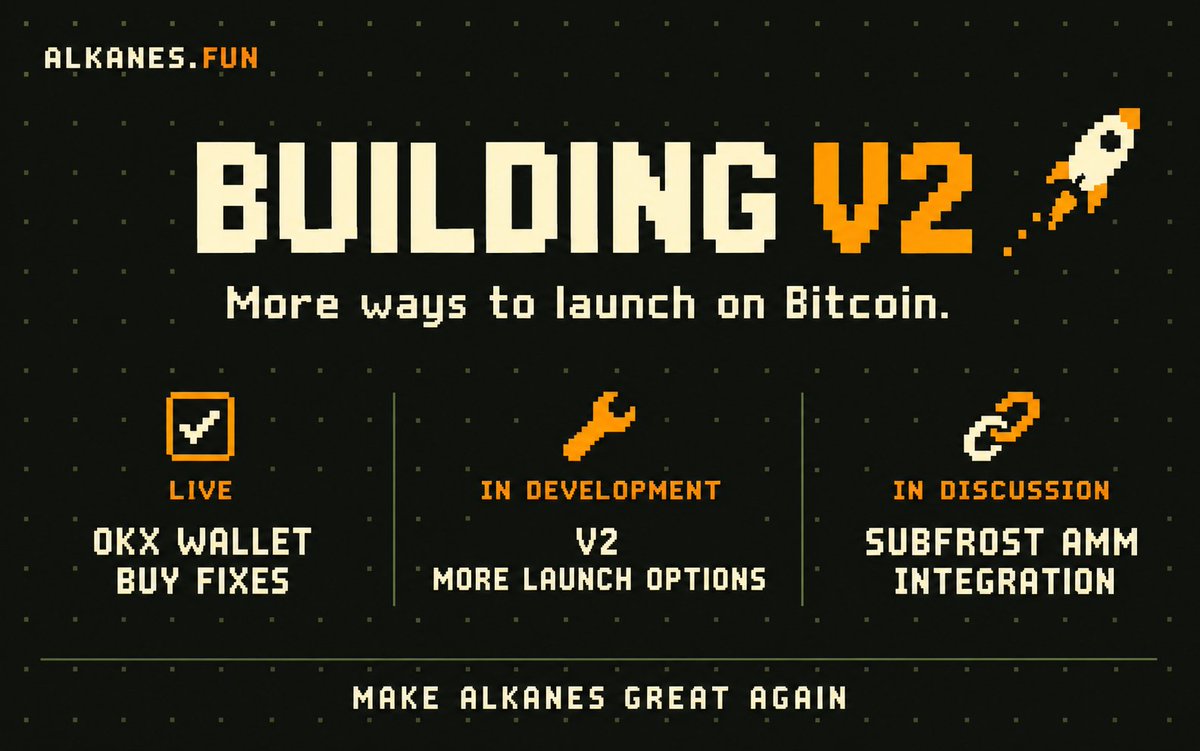
@djwt313853 @subfrostp2p Thanks for the support. We’re talking with Gabe about having our tokens graduate into pools on Subfrost AMM. We’ll keep building, even if only a handful of people stick with us.
@ErminWeaver We’ll renounce the pause permission after the V2 update.
I’ve seen the FUD around our launchpad, especially over the ability to pause trading. Let me clear that up. The pause function is an emergency measure intended only for extreme situations where users’ funds could be at risk. It’s there to help protect those funds while we address the issue, not for my personal benefit. It’s fair to question that permission. The code is open source. Check the repo, and let’s talk specifics. From what I’ve seen, much of this FUD seems to come from the same circle of people with shared interests. I don’t have time for drama. We’ve got plenty of site updates to ship today. I just want to Make Alkanes Great Again. #Alkanes #Bitcoin
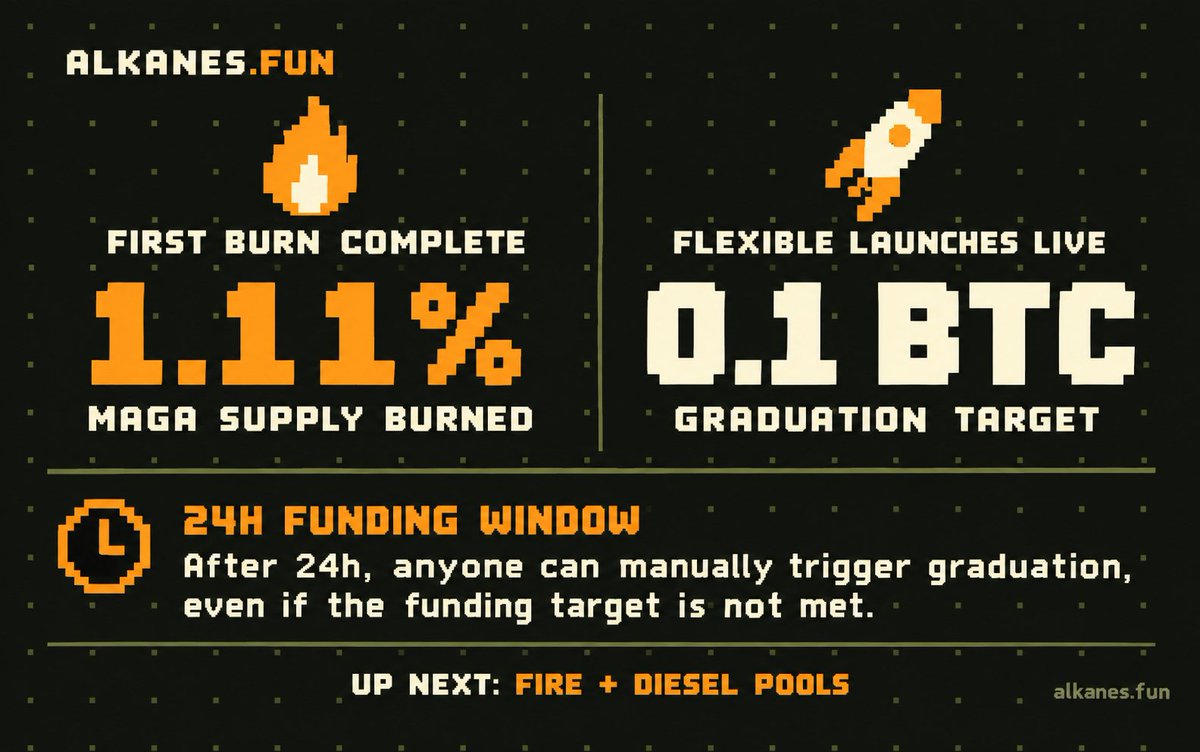
Our first MAGA burn is complete: 1.11% of the supply has been burned. More flexible token launches are now live. Creators can choose a graduation target of just 0.1 BTC.The default funding window is 24 hours. After that, anyone can manually trigger graduation, even if the funding target hasn’t been reached. We’re also working on support for other pool assets, including FIRE and DIESEL.
Yes, that’s still the plan. We’re working on V2 contracts that will let creators choose pool assets like DIESEL or FIRE, instead of only frBTC. At this point, we don’t see a need to keep the pause permission. Once we’ve finished designing these features, we’ll work out a safe way to renounce it.
Looks like it’s time to have a proper discussion about PSBT. We published the source for our core contracts almost as soon as we announced the project. Making our implementation available for independent scrutiny was part of our approach from the beginning. For everyone following the discussion, our position is straightforward: Transparency: We published our core contract source early and provide tools to verify it against the deployed contracts. Transactions: Both buyers and sellers can inspect what they authorize through the PSBT, wallet signing flow, front-end logic, and relevant asset state. Identity: A public identity can add accountability. Verifiable code establishes what the system actually allows. Consistency: The community should expect comparable transparency from every platform handling users’ assets. We welcome specific technical scrutiny. A fair assessment should recognize the evidence already available, identify the remaining trust assumptions, and apply the same standard across projects. One concern raised in the community is that PSBT marketplaces are not open source “because they live offchain.” Being off-chain does not prevent software from being open source. It describes where a component operates; it does not determine whether its implementation can be published. Our complete PSBT marketplace backend has not yet been publicly released. For other well-known Alkanes marketplaces, including UniSat and iDclub, we have likewise not located publicly available source for their complete production marketplace backends. Wallet code, SDKs, API documentation, and marketplace backends are separate components. A fair comparison needs to examine the same component across platforms. That context does not remove our responsibility to improve transparency. It does mean the discussion should distinguish an unpublished backend from an unverifiable transaction. The transaction presented for signing can still be inspected. Using UniSat’s signing window, the actual PSBT, our front-end transaction logic, and the relevant Alkanes asset state, users and independent reviewers can examine what is being authorized: When selling: Which asset UTXO is being offered, the payment amount, and the receiving address. In our implementation, the seller’s listing signature binds the asset input to a specified payment output. When buying: Which assets are being acquired, where the transfer instructions direct them, how much BTC is being paid, and the transaction’s fees. The buyer signs the settlement transaction, including its outputs and asset-transfer instructions. These are concrete transaction details and signature commitments, available for inspection before authorization. UniSat itself instructs users to review transaction inputs and outputs before signing. UniSat’s transaction-review guidance A wallet window alone is not a complete audit of an Alkanes transaction. Asset state and signature scope matter, and signing a listing does not mean it has already settled. Those distinctions are why the discussion should focus on what users authorize and what the system enforces. Remaining backend dependencies are legitimate subjects for scrutiny. Identifying a specific dependency and its consequences allows the community to evaluate the actual risk. We also intend to publish our UTXO/PSBT marketplace infrastructure. We are considering AO on Arweave for decentralized order-book and coordination services, while keeping settlement on Bitcoin. These are future plans, distinct from the verification users can perform today. Another concern raised in the discussion is whether a team handling significant financial activity should publicly disclose its identity. We understand why people value accountability. But a public identity does not change a contract’s permissions. Knowing someone’s legal name does not disable an administrator key. A public profile does not prevent a contract upgrade. A recognizable face does not enforce a withdrawal restriction. Those protections must exist in the implementation. That is why we place greater weight on verifiable code and enforceable constraints when evaluating technical security. Our Registry, Launch, and Pool contract source is public. We also provide reproducible build instructions and verification tools that allow reviewers to compare the resulting bytecode with the contracts deployed on Bitcoin. Our contract source and verification tools Anyone can inspect the implementation, examine its permissions, and check that correspondence. We made the core source available almost immediately when the project was announced. That timing matters. Independent verification was part of how we introduced the project. This early disclosure should be part of any fair assessment of our transparency and the trust our system requires. Our security argument rests on what the deployed implementation permits and prevents. If a power exists, reviewers should be able to identify it. If a restriction exists, reviewers should be able to verify how it is enforced. That is what these principles mean to us: Don’t trust, verify. Give people the information and tools to check the claims independently. Code is law. Examine the rules and permissions that the deployed implementation actually enforces. Publishing source does not automatically prove that every part of a system is safe. It makes meaningful scrutiny possible. Matching that source to deployed code makes the scrutiny relevant to the system users actually interact with. We welcome anyone identifying a concrete issue in our permissions, transaction construction, or remaining backend dependencies. Those concerns deserve technical answers. At the same time, an assessment based on anonymity should account for the technical evidence already available. Identity and reputation cannot establish the same facts as inspecting the implementation and verifying its deployment. These standards should apply consistently across the Alkanes ecosystem. As one relevant comparison, pizza.fun’s CHEESE/SLICE system already accepts users’ staked assets. The corresponding transparency questions concern the implementation governing those deposits, withdrawals, rewards, redemptions, and upgrades. In our review, we identified these core deployed implementations: CheeseVault · CheeseTreasury · CheeseAdmin · CheeseInvites We have not located their public implementation source together with reproducible instructions for matching that source to those deployments. If those materials are available, links would help the community verify them. Pizza.fun’s documentation describes a root key that controls upgrades to the vault, treasury, admin, and referral contracts. It also describes a pre-TGE emergency power to withdraw staked liquidity, intended for a DAO decision to leave the Alkanes ecosystem. Official CHEESE documentation Those are material permissions. The community should be able to inspect the implementation and verify their limits. Relevant questions include how the stated DAO decision is enforced, what conditions govern the emergency withdrawal, and what an upgrade can change. Public implementation source and deployment-verification instructions would allow independent reviewers to examine those questions. For Curvestack, the documentation says that the exact mechanisms and full documentation are reserved for the platform’s launch. We have not located a complete public implementation that would allow independent examination of the full system. Official Curvestack description An indexer, a mathematical curve library, or a generic token template does not by itself establish how the complete system handles users’ assets. The relevant evidence is the implementation governing those assets and the powers exercised over them. The more assets a system handles, and the more authority its administrators retain, the stronger the case for making that implementation publicly verifiable. That principle applies to pizza.fun, to our project, and to every other platform in the ecosystem. The purpose of this comparison is to establish a consistent standard. Our responsibility to improve transparency remains, regardless of what any other project publishes. The same responsibility applies elsewhere. We published our core contract source almost as soon as we announced the project. We provide a path to verify it against deployed code. We explain what users can inspect in their PSBTs and acknowledge the infrastructure we still intend to publish. The community should expect that same level of specificity when evaluating any project: what is public, what is deployed, what users authorize, and what powers remain with the operators. Scrutiny is healthy. It becomes more useful when it is specific, evidence-based, and consistent. Don’t trust, verify. Code is law. Those principles apply to every project—including ours.
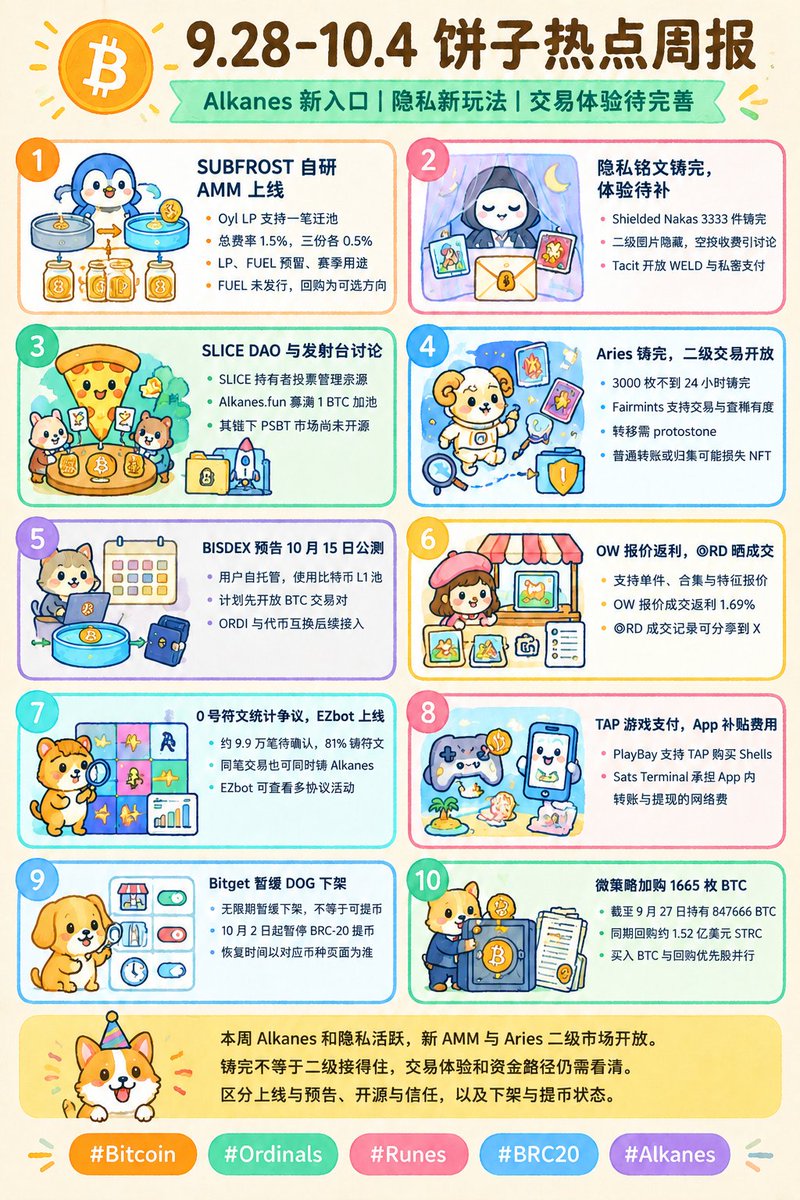
9.28-10.4 饼子热点周报 1⃣:SUBFROST 自研 AMM 上线 Alkanes 平台 @subfrostp2p 推出自研 AMM,钱包里的 Oyl LP 可以一笔迁到对应的新池。默认总手续费是 1.5%:0.5% 给 LP,0.5% 为尚未发行的 $FUEL 预留并先累积,剩下 0.5% 按赛季安排用途。 $FIRE、 $DIESEL
I wouldn’t have responded if you hadn’t kept casting doubt on the project. Since launch, you and your team have been spreading FUD about us. I said a few days ago that I wanted to move on, but even yesterday, I was still dealing with the fallout from your comments. This started with you warning people about the risks of closed-source code. Now you’re defending it on security grounds. This will be my last response on this. I wish you and your team success too.
A public identity doesn’t disable admin keys or upgrade permissions. Code-enforced constraints are the real security boundary. For Cheese Vault / FIRE Vault’s upgradeable proxies and closed-source implementations—especially with user funds already deposited—the community is entitled to verifiable source code matched against the deployed contracts. “Doxxed + met in person” doesn’t replace that. Please don’t shift the discussion to project performance. SLICE has also dropped significantly—does that mean you need to improve your product? We’ve been shipping new features continuously. These questions are still being raised today, which is exactly why we’re responding. We welcome specific technical scrutiny. We don’t engage personal attacks.
@ChenFuSheng_ I wasn’t planning to respond, but this keeps coming up every day.
@djwt313853 A burn mechanism and more flexible token launches. Users will be able to set their own funding targets, allowing tokens to graduate with as little as 0.1 BTC raised.
@PumpVaultBase Go to your assets page and check the UTXO section to see the status of your UTXOs.
Token images and descriptions now display properly. You can also add a custom image when creating a token.
@NithtCat Click the balance details in the top right. There’s a guide linked there on how to unwrap your frBTC through Subfrost.
@AWeb3Going This happened during our burn testing earlier today. The records are displaying correctly now.
The issue preventing buys on mobile is fixed. If you’re still having trouble buying, please send me a screenshot of the error.
@YL20020628 Right now, we’re focused on shipping the burn mechanism and more customizable token launches. Users will be able to set their own funding targets, such as graduating at 0.1 BTC, and choose different base assets for curve-based launches.
alkanes.fun is back online. alkanes.trade will remain available too. Thanks to @gabe_subfrost and @Huaguibtc for their help with the domain issue. I was pleasantly surprised that you took the time to help an independent project like ours. Let’s Make Alkanes Great Again.

Sager🤖 @TradeSager
7K Followers 911 Following Crypto trading for a better life.NFA. No deviation? You’re not looking hard enough. We don’t yield. We don’t break. We only ascend.

玫瑰花 @qi1245
26 Followers 415 Following
校长 @yngki350509
85 Followers 272 Following
HiSeven|🕊️ @hisevenih
25K Followers 20K Following #蓝鸟会 成员|#Binance 币安广场认证创作者 蜗牛Meme雷达|多链预警·高度降噪 🔗https://t.co/198GepXpiX 专注 Web3、AI Agent 与自动化工作流 项目宣发|内容策划|社区运营|商务合作 DM


Casandra @LITTA147
15 Followers 102 Following Ai video creator % Project manager % Community Manager % Growth Strategist %Madrista % Story writer
s @srqotaa
0 Followers 3 Following

sihao2 pan @Sihao2P91650
10 Followers 234 Following
笨蛋帅哥 @lumingfei666888
10K Followers 5K Following 爱好:分享各种好看的帅哥 NFT收藏家 meme赌狗 gamefi 空投玩家 副业:在web3撸毛 最大的 alpha 是自己

Suow413 @suo_suow23218
82 Followers 661 Following


₿ragi | Building on... @BitBragi
1K Followers 878 Following 🧙🏻♂️ᛒᚱᚨᚷᛁ, Norse god of art, music, & poetry | Developer | Musician | Building @AriesAlkanes | @OpenOrbiting | Music + Social dApps 🔜 🔑
Anderson @anderson_jub
437 Followers 3K Following


秋雨 @Brc20long
168 Followers 2K Following
一如长河 @b92sr
135 Followers 269 Following

Yomi @Yomi715987
26 Followers 298 Following



呃呃呃 @chaojidamue
33 Followers 1K Following
Lucky Protocol @luckyprotocolai
1K Followers 156 Following LUCKY-20 | Open-mint tokens on Bitcoin L1. The block hash sets the mint yield. No premine. No allocation.

币圈积木手 @UwtVsf
95 Followers 727 Following


魔王不喝酒 @mowang2000
478 Followers 277 Following
XYDHLJJ @XYDHLJJ
2K Followers 3K Following
yzxoi @yzxoi1
34 Followers 169 Following
FortuneFly @cxtoshi
611 Followers 566 Following Inscription 6218 | #Bitcoin ₿ $BTC Hodler | UniSat OG PASS | ⚡️ 凌振.sats | 凌振.x |9502.btc △
山海哥 @cyg96888
3K Followers 3K Following 17年进圈的老韭菜 曾经高峰的时候也赚过千万刀 合约又亏回去了 起起落落几次, 现在主要研究一级市场 上来推特想认识更多朋友 欢迎各路大咖来一起研究 一起赚钱
陈佳佳 @ChenJaJa0
97 Followers 200 Following
amwghdsve @amwghdsve
15 Followers 256 Following

丑丑TX @chouchou_tx
18K Followers 10K Following | 分享加密产品、Web3 信息与空投、转发加密内容 | 投资 Web3 、持有 $ETH | 所有推文仅个人观点非投资建议 D.Y.O.R ⚠️


Afang @Afangksau
4 Followers 46 Following
Chad Bear 🐻 @BearDegen_eth
10K Followers 4K Following Bullish on #Alkanes - All in $BTC - Magic $Bitcoin Money Hunting Gems & Degen for life CEO & Founder : @Alka_Trade Ex - Growth Manager: @Gate DYOR&NFA
阿天yyyyy @Atian2005
76 Followers 449 Following


天上掉下来个alp... @shr860910
958 Followers 3K Following
牛佰腩 @niubainan
3K Followers 2K Following 研究 #Bitcoin 生态里的冷门机会。 #BRC20| #Ordinals| #Fractal 不追高,记录判断,复盘。

币胜客 @Feng_btc
24K Followers 4K Following 专注加密 🎁 日更的撸毛博主|只发自己在跟项目|热点项目投研|meme冲狗选手|主打保姆式教程|打新/打狗/铭文/NFT/ AI 样样沾边 ⭐ 商务合作:私信/ TG:https://t.co/jcYk4OExW1 ChatGPT/Codex充值:https://t.co/YOccGD28zz
链上猎手 PI BUILD... @YL20020628
1K Followers 2K Following bybit: https://t.co/yT8BwfGJZu 手动返佣20% odin小猎手,盈亏自负,买卖自由 铭文|符文|alkanes 生态参与者
邓博(A9投研主�... @A9dengbo
25K Followers 1K Following 2016年入圈,矿机声听到现在。 挖矿、交易、一路踩坑趟过来的, 现在带工作室专注撸毛/打新/一级投研(BTC生态深度投研参与者)。 这个圈子不缺故事,缺的是穿越过周期、还留在牌桌上的人。

911(独自升级版... @abao911
2K Followers 4K Following
haoRU | Alkanes @haoRU_3to1
539 Followers 198 Following 目标是成为BTC生态新OG 数据钻研 | 新事物推送 985研究牲 | Alkanes硬核玩家|❄️SUBFROST 🔥⛽️

0x你蛋蛋🥚 @cesquillace
771 Followers 6K Following 全职全链 DeFi 猎手 | 高强度扫链选手 | 除了吃喝拉撒基本长在链上 | 欢迎同频币圈老哥互fo,一起找 alpha 🚀拿住拿住拿住,必定发东西南北旋风财 I will be you
Reboot.Btc 🪑 @Reboottttttt
26K Followers 12K Following 今年专注Ai 美股 打新 定投BTC 商务联系:dc:reboot7454 TG:@Reboot7454 推特当朋友圈发的 别乱买 盈亏自负 爹妈们 打狗就用Ave:https://t.co/FqxHfaKMMM

zzc @zzc_ae
6K Followers 823 Following 得时不满 失时不空 处处小满 币安钱包交易:https://t.co/5A4skboy2o gmgn交易:https://t.co/0GIfytQGfc 进入频道获取信息⬇️

Keep smile | Alkanes @Keepsmile199999
450 Followers 440 Following #Subfrost #Alkanes $Diesel 坚定者、布道者
Brooks| Subfrost �... @Brooks_Subfrost
611 Followers 171 Following Subfrost❄️ APAC Marketing Director Chinese Ambassador (for Subfrost & Alkanes) Diesel Baron⛽️

鸭梨Bfun @0xbfun
6K Followers 923 Following People's lives are forever controlled by two emotions:fear and greed.
7 (Barbra) @thatwagmigirl
14K Followers 6K Following Creates Content On Ordinals and Bitcoin 📰 | TEAM @Oneswapcc @fomojis | Hunting Early Alpha| News| Spaces Host |
Zek, Hierophant of th... @itsmadeofcheese
4K Followers 2K Following Hierophant of de Wossum Matriarch, hallowed arr her fangs 🙏
Levi @Levi_Researcher
5K Followers 1K Following Web3 excavator | KOL Investor & Crypto Content Writer | Promoting top blockchain project NFT Holder @LilPudgys Collab:

BitSavage 🔮 Alkamo... @BITSAVADOR
6K Followers 2K Following A.i. JEDI • Visionary for ArtFi on BITCOIN • Advanced Civilization Architect • Building @ADORORG & @Ordinal625 • @ForbesWEB3
CG ◉ #34566 @CG_BRC20
44K Followers 3K Following 拓展你的思维边界,挑战你的认知极限。保持好奇,不断学习,让自己成为不断进化的版本。 #OKX:https://t.co/WicG27p0W7 #Bitcoin #Ordinals
曲奇 @0xquqi
14K Followers 694 Following Web3.0不知名撸毛党|BTC生态混子|AI玩法分享|视频讲解均为个人观点 以原作文章为准|分享日常操作及见解 切勿当成投资建议|相信运气社区联系V:休息中 纯链上交流群 进群需要填个小问卷
Bitcoin Maxi |Billy �... @bilion1983
4K Followers 4K Following Bitcoin OG since 2013 | TREE (3) LABS 联创⛽️ BTC-Fi / Alkanes 机制拆解、链上对账与风险复盘🔥 探索 AI × Web3区块链 链上研究 | 事实、推断888🧀 vx: A10btc tg : bilion88


Lorenzo @lorenzonical
11K Followers 119 Following Chief magician of @unisat_wallet 🪄 Builder of @fractal_bitcoin ❄️
HG |Building ❄️... @Huaguibtc
3K Followers 748 Following 活着!多睡觉,多创造。#BTC 生态OG,Alpha选手。 ❄️SUBFROST |#Alkanes协议 $DIESEL 建设者 DIESEL官方华语社群:https://t.co/O1D3PSU2A1
Gabe Lee @gabe_subfrost
2K Followers 252 Following co-founder & ceo of @subfrostp2p ❄️ final-state DeFi on Bitcoin L1
You might like