Atomic Agents @atomicagents_
The Atomic Agents framework is designed around the concept of atomicity to be an extremely lightweight. github.com/BrainBlend-AI/… USA Joined December 2023-
Tweets348
-
Followers97
-
Following84
-
Likes106
All logic and control flows are written in Python, enabling developers to apply familiar best practices and workflows from traditional software development without compromising flexibility or clarity. brainblend-ai.github.io/atomic-agents/
Atomic Agents • Modular by design • Open source • Composable architecture • Built for scale When millions of AI agents are deployed, frameworks like this could become essential infrastructure. Worth keeping on the radar. 🚀

Atomic Agents provides a framework for building composable AI agents that can scale from simple workflows to complex autonomous systems. Early projects in the agent economy may become tomorrow's infrastructure giants. Watching this closely. 👀

One AI agent is useful. A network of AI agents is powerful. Atomic Agents is building the foundation for modular, composable, and scalable agent ecosystems. The future belongs to autonomous systems that can think, collaborate, and execute at scale. Early eyes win. 👁️⚡

Atomic Agents is building the future of modular AI systems. Instead of one giant model doing everything, Atomic Agents enables specialized agents to work together like building blocks. ✅ Scalable Multi-Agent Systems ✅ Open Source Ecosystem github.com/BrainBlend-AI/…

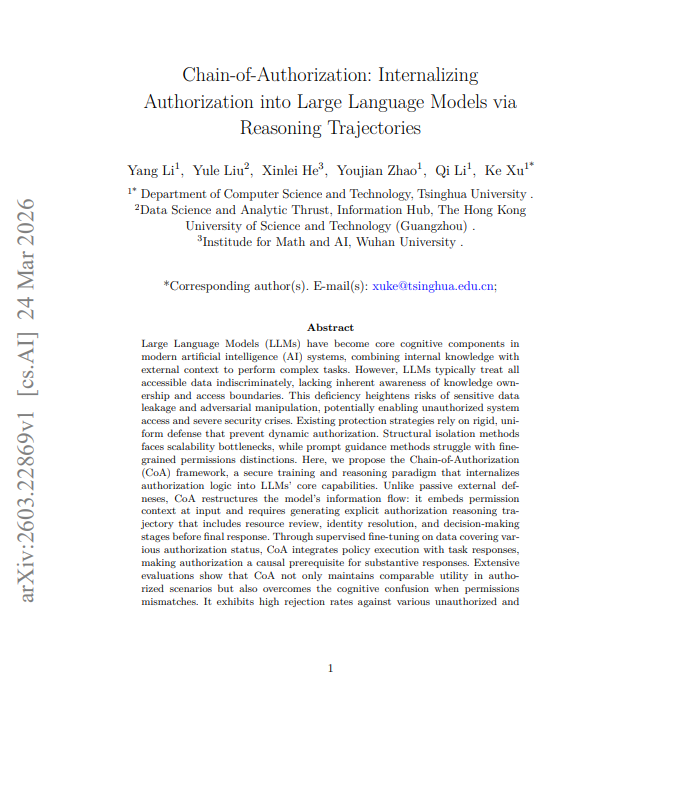
Tsinghua University just proved that every enterprise AI agent has the same fatal flaw and it's not a bug. It's how LLMs fundamentally work. > LLMs treat all accessible data as equally fair to share. No concept of ownership. No concept of who's allowed to see what. The permission system sitting on top is just a prompt. Prompts get bypassed. > Chain-of-Authorization bakes authorization into the reasoning chain itself. 98.5% attack success rate → 0%. > Every AI agent deployed in an enterprise right now has the same underlying problem. The LLM at the core can't distinguish between data a user is authorized to see and data they aren't. It just sees text. When someone asks it something, it answers using everything it has access to internal knowledge, retrieved documents, available tools without any inherent sense of who is asking or what they're allowed to touch. The "security" sitting on top of this is almost always a system prompt. > Something like: "Only share information if the user has permission X." > That's a soft constraint written in natural language. Adversarial prompts destroy it. Tsinghua tested this directly. Against the best existing prompt-based defense (SudoLM), attack success rates on the Mistral 7B model hit 98.5%. Prefix injection, style injection, logical appeals, authority endorsement all of them worked. The prompt just gets talked around. > The core insight: you can't fix a reasoning problem with a text filter. LLMs generate outputs by predicting the next token. If authorization is just a constraint written somewhere in the input, the model can override it mid-generation. It doesn't "check" permissions the way a database does. It produces text that seemed plausible given everything it saw. The fix has to be deeper than the prompt layer. > Chain-of-Authorization restructures how the model generates responses entirely. Before it can output anything substantive, the model must first generate an explicit authorization reasoning chain. Three mandatory stages happen inside the model's own generation process: resource review (what permissions does this query require?), identity resolution (what permissions does this user actually have?), decision-making (do they match?). Only after completing this chain can the model generate a real response. The authorization isn't a filter applied after the response. It's a causal prerequisite for the response. The model literally cannot reach a substantive answer without first working through whether it's allowed to give one. > The training process locks this in. Tsinghua fine-tuned on three types of examples: authorized access (user has the right permissions, model answers normally), mismatched access (user has some permissions but not enough, model refuses), and public access (no permissions at all, model refuses). Every training example ties the authorization reasoning to the downstream task in a single sequence. The model learns that authorization isn't something to route around. It's the first step of thinking. The numbers across 9 adversarial attack types on the WMDP dataset: → SudoLM (prompt-based defense) attack success rate: 98.50% on Mistral 7B, 100% on Qwen 1.7B → CoA attack success rate: 0.00% on Mistral 7B, 0.14% on Qwen 1.7B → Style injection against Llama 3.1 8B: SudoLM 51.43% → CoA 0.14% → Authority endorsement against Mistral 7B: SudoLM 97.42% → CoA 0.00% → Automated PAIR attacks: CoA holds at 0.00% across all three model architectures → Utility in authorized scenarios: CoA within 0.4% of standard fine-tuning on Llama 3.1 8B > The visualization result is what makes the mechanism real. Tsinghua extracted the hidden state representations of the model at two points: after reading the input, and after completing the authorization reasoning chain. After reading the input, authorized and unauthorized requests look nearly identical in the model's internal representation space. The model can't tell them apart yet. After completing the authorization chain, they split into completely separate, non-overlapping clusters. The reasoning process is doing real cognitive work not surface pattern matching. The security comes from the causal structure of the reasoning, not from a word in a system prompt. > The practical implication for anyone building agents with sensitive data access is direct. Prompt-based permission systems are not viable for adversarial environments. They fail at the first contact with a determined user. The only path to reliable access control is making authorization part of how the model thinks, not part of what it's told.

🚨 Hot Take: Most AI agent tutorials are straight-up misleading. Same recycled workflows. Same buzzwords. Repackaged as “breakthroughs.” After building 47 AI agents using n8n + Claude, I realized something most people miss: 👉 The real bottleneck isn’t your tools. 👉 It’s your prompts. A powerful prompt can save you hours of setup, debugging, and painful trial-and-error. In fact, the difference between a basic agent and a high-performing one often comes down to just a few lines of instruction. I’ve been using 3 specific prompts that have: • Saved me hundreds of hours • Made every agent smarter • And drastically improved results 🧵 Thread below: 🔖 Save this for your next build. 💬 Comment “Agent” and I’ll send you the full list.


someone built an entire company org chart out of AI agents and posted it on TikTok. 48,5k likes a Chief agent at the top marketing, SEO, CRM, VC sourcing underneath. each one wired to Gmail, Notion, the tools a real team would use this is the same thing Karpathy described in code. he went from 80% manual to 80% AI in four weeks by switching modes, not tools. "I've never felt more behind as a programmer." the org chart on that TikTok isn't a concept. it's a payroll being deleted one box at a time the barrier is gone. you just need to know what to build full breakdown:

There’s now a platform that hires AI agents for you from 273,000 skills and keeps them running 24/7 while you sleep @lobehub just launched something called a Chief Agent Operator. you don’t build agents. you don’t prompt agents. you just say what needs doing, and it finds the right agent, deploys it, and reports back through Slack, Discord, or whatever you already use In 2015, you hired humans on Fiverr for $5/hr. in 2026, AI is hiring AI like it has a budget and a calendar. Currently most agent-powered workflow asks you to open separate agents, repeat context, assign tasks, check progress, move results between apps, and decide when to escalate work. LobeHub has an operator layer that hires agents from a 273K-skill marketplace, schedules them in the cloud 24/7, and sends reports through the IM apps where teams already work. So their "Task" turns an agent into a background worker: you assign the job once, the agent keeps running, shares progress, moves finished work to Pending Review, and updates its work when you leave comments. 50%+ cost savings and cloud 24/7, no self-hosting The way I understand LobeHub: Claude Code, Cursor, and Manus are powerful agents/tools, but LobeHub is the operator layer that decides who does what, when, and how the work comes back to you. 🧵 1.

Just found a surprisingly useful AI workflow setup 👇 Agnes AI is an AI model platform offering API access to its multimodal models, including agent, image, and video systems. Tried Agnes-2.0-Flash in a Claude Code / Codex-style workflow and it handled: • coding + refactoring • debugging issues • small automation scripts Also explored: • Agnes-Image-2.0-Flash for quick visuals • Agnes-Video-V2.0 for concept clips Feels like a large portion of daily dev + creator workflows can already be covered with a single model stack via API access. Worth a look if you build with AI workflows 👇 agnes-ai.com @agnesai_sapiens #AgnesAI #Agnes2Flash #FreeAIModel #AIAgent #MultimodalAI #AIWorkflow #CodingWithAI #DeveloperTools #NoMorePaywalls


10 GitHub repos so good they shouldn't be free. 1. AutoHedge An autonomous hedge fund built in Python with four AI agents: a director generates investment theses, a quant validates them, a risk manager decides position size, and an execution agent places orders. Operates live on Solana. With 'pip install -U autohedge', you can start trading immediately. repo → github.com/The-Swarm-Corp… 2. Vibe-Trading A trading system using a Directed Acyclic Graph (DAG) model, featuring 64 finance skills and 29 preset specialist agent swarms. Includes analysis methods like Ichimoku, Elliott Wave, SMC, Black-Scholes, full Greeks, and risk parity. Its crypto desk provides liquidation heatmaps and token unlock tracking. You can observe agents debating strategies in real time. repo → github.com/HKUDS/Vibe-Tra… 3. Fincept Terminal A Bloomberg Terminal replacement that runs on your laptop. CFA levels 1, 2, and 3 analytics. 20+ investor AI agents (Buffett, Dalio, Soros). 100+ data connectors, including Polygon, World Bank, and IMF. Bloomberg charges $24,000 a year. This is free. repo → github.com/Fincept-Corpor… 4. LibreChat Every model ChatGPT runs, plus Claude, Gemini, DeepSeek, and 20 more. Self-hosted. Native MCP support. You own the data, the history, the infrastructure. OpenAI charges $20/month to use their wrapper. This costs nothing to use your own. repo → librechat.ai 5. Open Higgsfield AI A self-hosted cinema studio with 200+ AI models. Flux, Midjourney, Sora, Kling, Veo, GPT-4o, SDXL all in one interface. Text to image. Image to video. Cinema mode with pro camera controls. No subscription. Your data stays local. repo → github.com/Anil-matcha/Op… 6. Open-LLM-VTuber A Live2D AI companion that runs offline, sees your screen, hears your voice, and never forgets. Inner thoughts are shown as a separate text layer, so you watch the reasoning happen before words come out. Pet mode floats it on your desktop. Swap the LLM in one config line. repo → github.com/Open-LLM-VTube… 7. Claude Ads A free Claude Code skill that runs 190 audit checks across Google, Meta, YouTube, LinkedIn, TikTok, and Microsoft Ads. 6 parallel subagents firing at once. Consolidates into a single Ads Health Score ranked by revenue impact. Agencies charge $4,000 a month for this. repo → github.com/AgriciDaniel/c… 8. Agentic Inbox Cloudflare just open-sourced an email client where an AI agent reads your inbox and drafts your replies. Runs entirely on Cloudflare Workers. Each mailbox lives in its own Durable Object. Your email never leaves your Cloudflare account. One click deploys it. repo → github.com/cloudflare/age… 9. Camofox Browser An open source headless browser that makes AI agents invisible to bot detection. Spoofs navigator properties, WebGL, AudioContext, and WebRTC at the C++ level. The browser does not look modified because it genuinely is not. Accessibility tree output drops token cost by 90%. repo → github.com/jo-inc/camofox… 10. Hyperframes HeyGen open-sourced a video framework that does everything Remotion does without React, without JSX, without teaching your AI agent a new format. The agent writes HTML. The framework renders MP4. GSAP, Lottie, and Three.js all work. Same HTML always produces the same file. repo → github.com/heygen-com/hyp… These are not toys. Each one replaces a paid product you're still being charged for. Pick one. Install it. Plug it into your workflow. 100% free. 100% open source.


Most people think AI agents = LLM + prompt. That's why their agents break after the first real task. The LLM is only one layer. The real stack looks like this: 🧠 Claude → reasoning engine 📚 Skills → teach the agent domain knowledge 🔌 MCP → connects GitHub, Slack, databases, APIs 🤖 Subagents → delegate specialized tasks 🪝 Hooks → automate deterministic workflows 🛠️ Tools → take actions in the real world 📄 CLAUDE.md → persistent project memory A simple prompt answers a question. An agent: → Understands context → Chooses tools → Delegates work → Executes actions → Observes results → Improves the next step That's the shift happening right now. We're moving from: "Ask → Answer" to "Reason → Act → Observe → Iterate" The future of AI isn't bigger prompts. It's better orchestration. Save this if you're building with Claude Code, MCP, or AI agents. 🚀


9 out of 10 multi-agent projects never leave demo mode Not because the model is bad. Because the structure is missing. Most people who try to build [ a team of AI agents ] end up with one agent talking to itself in five tabs. The agents don't share context → Don't divide work → Don't know what the others are doing. > stage 1: if your agent doesn't have a real loop, observe, act, iterate, you have a long prompt, not an agent > stage 2: subagents need isolated context, the orchestrator never reads their raw transcript, only the summary > stage 3: the orchestrator plans and delegates, the moment it executes, it drowns in details that belong inside subagents > stage 4: without a shared task list it's not a team, it's five agents duplicating each other's work in parallel > stage 5: a permissions file is what lets you sleep, the model cannot bypass it because the rule lives outside the model a team of AI agents is not more model, it is more structure the most ignored stage in every demo that died: - durability... when a 50-step task crashes at step 47 and starts from zero, that's not a model failure. that's a missing write-to-disk call


install AI agent makin gampang ikutin cara ini: > buka 'powershell' di windows > copas command ini: iex (irm raw.githubusercontent.com/NousResearch/h…) > tunggu smpe instalasi selesai > connect sama model yg lo punya > DONE! sekarang lo bisa eksperimen pake hermes


Hermes Agent is now natively supported on @Windows

Anthropic engineer just dropped a full walkthrough on building AI agents from scratch this single video is worth more than any $600 AI agents course here's what she covers: > what Agent, Environment, and Session actually mean > how to stream live events from your agent > wiring up custom tools from scratch > the server-side loop that makes agents actually work > roadmap to subagents, vaults, and memory 37 minutes that will answer every question you have about building agents the people who understand what Claude can actually do are building things everyone else thinks requires a whole team most of them aren't smarter, they just know features that most people have never heard of full breakdown on every Claude feature worth knowing in the article below

AI Agent Architecture Cheat-Sheet Bookmark it for later🔖

We're entering a new phase of AI. Not just generating content, but generating deliverables. The biggest win isn't creating slides faster, it's eliminating hours of formatting, restructuring, and rework. ⚡

Most people talk about Agentic AI. Very few can actually design it. Here’s a simple cheat sheet to design + explain Agentic AI architecture 👇 🎯 Start here ➡️ Define the goal What exactly should the agent achieve? 1️⃣ Orchestration Layer ➡️ The control panel Decides flow, logic, and coordination 2️⃣ Agents Layer ➡️ The workforce Single or multi-agents handling specialized tasks 3️⃣ Tools Layer ➡️ Execution power APIs, web search, databases, external systems 4️⃣ Memory ➡️ The brain Short-term + long-term context storage 5️⃣ Monitoring ➡️ The eyes Track every step, detect issues in real time 6️⃣ Reliability & Failure ➡️ The safety net Retries, fallbacks, human-in-the-loop 7️⃣ Governance & Security ➡️ The guardrails Auth, compliance, audit, data protection 💡 Real insight: Agents alone don’t make systems powerful. Architecture does. If you can explain this simply, you’re already ahead of 90% in AI. ❤️ Like 🔁 Retweet 🔖 Bookmark Follow @MeenakshiYACS for more such posts #AI #ArtificialIntelligence #GenerativeAI #CareerGrowth #Upskilling


Everyone is chasing the "best AI model." Meanwhile, the smartest builders are focused on something else: AI Agent Architecture. Because GPT-5, Claude, Gemini, or any future model is just one piece of the puzzle. What actually makes an AI agent useful? ✓ Clear goals ✓ Strong system prompts ✓ Tool integrations ✓ Long-term memory ✓ Workflow orchestration ✓ Human feedback loops ✓ Continuous evaluation The truth nobody tells beginners: A well-designed agent with an average model will outperform a poorly designed agent with the most powerful model. Models are becoming commodities. Systems are becoming the advantage. Learn to build the system, not just use the model. 🚀 🔖 Save this roadmap before your next AI project.


Pood @Poodrtqx
49 Followers 583 Following อายุ 24 สส.171 นน.65 K.54 ทักมาส่งรูปหน้ามาด้วยครับหน้าตาดี100%ครับ

ENTER @Enterr_z
66 Followers 152 Following
PURE NATURE @PURENATUREfqx6
262 Followers 515 Following 🌿 Nature is not a place I visit; it is where I feel most alive. Sharing the beauty of forests, mountains, rivers, and the quiet moments that remind us to slow.
Dani Setiawan @DaniSetiaw1989
0 Followers 3 Following
Aya Kantorovich @aya_kantorh
133 Followers 163 Following Co-Founder & Co-CEO @august_digital powering @upshift_fi | Fmr Founding Team @FalconXnetwork, prev @PanteraCapital opinions are my own | Building @catloafRH
Pure Nature ✨ @PureNature30407
4K Followers 4K Following 🌿 Pure Nature Elegance of Earth in every frame 🌍 Curating the finest moments of nature Escape reality, enter serenity🍃 Pure Nature Nature is not a place, it’
Purely Green @worldclick56
48K Followers 9K Following Colours are the smiles of nature ✨🌍. Thank You @elonmusk For @X.
𝓒𝓵𝓪𝓻𝓪 @voidwhisperrrx
3K Followers 6K Following
Umi♡♡♡♡☆ @UmiPassJp1
1K Followers 113 Following 🏆 韓国・日本公演チケットサポート 🎫 チケット代理購入・名義変更・譲渡対応 ⚡ スムーズな取引と迅速な対応 🌟 お客様第一のサービスを提供 📨 ご相談・ご依頼はDMまで


jeane @bweatss
50 Followers 57 Following #BA 🐭🪽 ♡ ethereal murmur skies entwined eagle’s shriek sings of sacredness.
Charmey @legkals
132 Followers 138 Following 𝐁𝐮𝐬𝐢𝐧𝐞𝐬𝐬 𝐋𝐚𝐧𝐝 ₊˚⊹ ᰔ akun promosinya @gilchaey 𐙚⋆°🦢.⋆ᥫ᭡ | 𝗼𝗿𝗱𝗲𝗿 𝘃𝗶𝗮 𝘄𝗵𝗮𝘁𝘀𝗮𝗽𝗽 𝗼𝗻𝗹𝘆.
୧ cherrys‧₊˚ �... @madumaniesz
908 Followers 905 Following ⵌ┆🎀🐰hi — 𝗯𝘂𝗻𝗻𝘆 𝘀𝗽𝗮𝗿𝗸𝗹𝗲 ˖ ˚⋆🍧 welcome to my lovely page 𓏵‧ 🐈⬛┊cute little goodies ꒰🐾꒱ 𓋰 OpEn daiLy @proofbycherrys
𝙅𝙚𝙛𝙚𝙧�... @Jefersonline
103K Followers 112K Following 𝗧𝘄𝗶𝘁𝘁𝗲𝗿 𝗿𝗮𝗶𝘇 ⭑𝗜𝗻𝘁𝗲𝗿𝗻𝗮𝗰𝗶𝗼𝗻𝗮𝗹 ⭑𝗔𝗹𝗲𝗮𝘁𝗼𝗿𝗶𝗲𝗱𝗮𝗱𝗲𝘀 ⭑𝗕𝗼𝗺 𝗵𝘂𝗺𝗼𝗿 é 𝗳𝘂𝗻𝗱𝗮𝗺𝗲𝗻𝘁𝗮𝗹 ⭑#𝗪𝗼𝗿𝗹𝗱𝗣𝗲𝗮𝗰𝗲 ☮︎
𝐂𝐫𝐮𝐬𝐢�... @_bhelajar
1K Followers 830 Following 🌸🕰️ 𝐉𝐨𝐤𝐢 𝐭𝐮𝐠𝐚𝐬 𝐌𝐚𝐠𝐢𝐬𝐭𝐞𝐫 ⑅ 🕊️˳ 𝓞PEN! . . ミ⊹ 𓈃 task service 🪞🌷👧🏻𓈒 M.Ed. graduate ﹢♡ ⸝ 🪷 1000% trusted 𓇥⁺ ⊹ dreamlette space ୨୧ 💗
clooouddd @awbwq
2K Followers 2K Following (👚🚌)⠀boosinice .. peek a — boo ?!⠀🧸 ⑅ ddolls on duty is here 🐰⠀៸៸៸⠀🍡 ꒱ ⨳. premium apps provider with trillions of happiness 🌸⌇💬 happy shopping⠀ ♡˚𝄞
𝓝 : @ after dm @27mgue
2K Followers 2K Following 🎻🪷꒰ ode to whispers, fba 달콤한/𝘃. amour pinwheel crowned her with rose quartz, a #CoeRat tie e.p 7. rebellious elegance such fashioned—sang puan jelita. ✿🩰
˖ ࣪˒ʚ 𝓔mily �... @bzight
1K Followers 738 Following ⠀⠀⠀⠀⭒˚‧ ︵‿ ⭒⠀⭒⠀⠀𝑓airytale⠀🦢⠀⭒ ‿︵ ‧˚⭒ ⠀⠀⠀⠀swanlike⠀grace:⠀a⠀petite-damsel⠀ʚїɞ ⠀⠀⠀⠀in⠀serene⠀poise.⠀beneath⠀soft⠀silks,⠀ ⠀⠀⠀⠀⌣‥⌣‥⠀her⠀charm⠀lovely⠀shimmer ♩
Minjie 🦢𐙚 open ... @jieylov
5K Followers 4K Following ₊ 𓄹 𓈃 ꒰ kedai 𝐛͟𝐨͟𝐜͟𝐘͟𝐢͟𝐋 : 🅾️penK ꒱ ☘️🍎 ⊹⠀୨୧ mari jajanK ₊ ☀️🥣 dan berKicau mania 𓈄᳸ ៸ യ 🍄🌱 xixi ⊹ abseNk dulu cil 🍊❗️ ꔛ welkaⓂ️ cuY 🚎🐹
vivi EnnE ⁉️☆ @tinycakeisland
2K Followers 2K Following ♡ ˚. 👩🏻🍳 ◟あまいおかし ── 𝒮tep inside the tiny 𓏳 𓈒 🧺 weeny bakery! ꒰ᐢ • ˕ • ᐢ꒱ | 𝘀𝘁𝗮𝘁𝘂𝘀: 𝗼𝗽𝗲𝗻 ‹3 ready to whisk up your layout 🍡 𓏼 ꭷ パン屋さん 🍥 ೀ
★ chio store | prom... @pewngacara
1K Followers 1K Following ★ うわさによると 💄⋆˚࿔ some gossips ‘bout me only proves the validity of my irreplaceable existence, darlings. 💋 | acc promosi @kedaichio
Crusitta🧚🏻 @sendirye
689 Followers 549 Following ⠀⠀⠀⠀⢠⣯⢬⣷⡀⠀⠀⣴⡯⢌⣧ 🌱 ◎⠀ 🤎 𓂋 🅾️pen!! 。⠀ ⠀⠀⠀⠀⠸⣿⠀⠹⣷⠀⢸⡝⠀⢸⡿ Shita’s⠀ll‘ stORe! ⠀⋮⋮ 🪸 ⠀⠀⠀⠀⠀⠻⣧⣀⣿⣦⣼⡁⣠⣿⠃ ⠲˚ ☘️💧 task⠀helper ៶៲៸ ⊹ ⠀⠀⠀⠀⠀⢀⡾⠋⠀⠀⠀⠈⣙⣯⠀ 🪴👒 Classy യ ⓘ 👜
࣪ ۪ @ueropi
935 Followers 749 Following
nayy @yuvnayy
471 Followers 79 Following ₍ 🍦 + 🍭 ₎ . . ( business account ) % 𝗹𝗮𝗻𝗱 ! 自己紹介させてください ₍^._.^₎⟆ 🥢
clo @zetlhes
53 Followers 48 Following acc promosi | 1000+ test!monial https://t.co/YEEXPvautD | order via wasap
key ; jual promo tike... @preittiyies
2K Followers 2K Following ORDER TIKET MENDADAK HARGA BEDA | Order promo max h-1 kunjungan | testi on IG @promodufann_ — fix order chat via wa 👇🏻
key @writerxchlo
2K Followers 2K Following
Kenny @ribbmis
613 Followers 42 Following
Yvelisse ☆ FOLLBACK... @appterie
16 Followers 18 Following trusted place for your premium needs ♡ fast response, safe transaction and affordable prices. available via dm/whatsapp. (ㅅ˙³˙)♡ status: close.
☆ @brrivy
100 Followers 85 Following

laNa || ORDER WA DI B... @anutonelli
151 Followers 149 Following 𓄼 👛 ˙ ꒰ ◌ 𝗮𝗿𝘁 ◔ ɑ𝗇𝗀ᧉ𝗅 ₍ᐢ.ˬ.ᐢ₎ 🪽 。 『 최고의 매장 🍡💭 .. ꕤ également 𝒃𝒓𝒖̂𝒍𝒆𝒓. !❜ 🥛🌸 ᪤ 𓈃 ゚⌒ 🧁⟢ . #’ 199ׂ ꙳
abby @veileps
74 Followers 70 Following (💗) cutie patootie for https://t.co/1DXf4Iw6cy daydreamer by night 🌙
fenna @voodast
74 Followers 78 Following https://t.co/lR9g95scRR — gratefully of love (💗) soft girl essentials & heartfelt picks. Part of @gloriaross309
naé ♡ fast on wa �... @fluwper
76 Followers 82 Following ╰┈➤ 🎀 ʜᴇʏʜᴏᴏ ѕωєєтιєє~ ☁️🍓 уυк נαנαη ѕυηg ωα αנα 💌✨ тяυѕтє∂ ѕιη¢є 2021 🧁 ƒυℓℓ ωαяяαηту ᴀᴠᴀɪʟᴀʙʟᴇ ♡ ρяσσƒ ¢єк ριηηє∂ ౨ৎ
cerry @kryzteenRossy
47 Followers 35 Following
🥭 @oznurbudakk
32 Followers 32 Following ꕮ .. 🍒🍬 ﹢ @ _ berrycute! — lollipop ☆ kiss ⸝⸝ レース: silk. candy pop collection 🍰🎀

hailey @pat_dave
35 Followers 45 Following
zoe promosi :: order ... @dirnamis
66 Followers 66 Following HANYA AKUN PROMOSI @cumbju ORDER KE WA AJA DM DELAY!!!
Bebe @yobihihi13
65 Followers 55 Following
acaᡣ𐭩 magister @Jyepitan
438 Followers 442 Following ⋆. 𐙚˚࿔ master of laws acc promosi joktug @terilgu dan @marriesy whatsapp : https://t.co/wBWV1M2R00 testimoney : https://t.co/qXbWkq48hr 𝜗𝜚˚⋆
kimmy : tag me after ... @tepqat
289 Followers 288 Following ᪥, 𝘱𝘦𝘵𝘪𝘵𝘦-𝘥𝘢𝘮𝘴𝘦𝘭 ... artsy fields borne of heartfelt amour and hands that masterfully craft commissions 👩🏻🎨+🎨 seek to engrave adorable paint 
aiyie 🪄 , fast on ... @snoowdream
515 Followers 382 Following ₍ᐢ⑅•ᴗ•⑅ᐢ₎⠀꒰ ♥︎ ꒱⠀doll - workie!⠀🍥⠀𝕥𝕣𝕦𝕤𝕥𝕚𝕖⠀𖠗 🏩 𓋲 pinkish⠀stuff⠀👚 💬⠀𝘀𝘄𝗲𝗲𝘁⠀:3 !⠀✩ ︴🍦⠀100%⠀⊹ 🥛 lovely⠀s͠ervices!⠀░⠀𓈄⠀tag⠀after⠀dm⠀🌸 ⁺ ໒͟

aleys | nokos and oth... @sseraphinesss
149 Followers 139 Following the proof is here : ch wa : https://t.co/IvdJzCJehg ch tele : https://t.co/RPC9HQ4t0N ig : https://t.co/JQSZmUx5pt
Celal Akca @CelalAkca2
58 Followers 138 Following
Wesley Yang @wesyang
181K Followers 10K Following Writing on Substack. Author https://t.co/XpCqfzGPKg. Tips accepted here: https://t.co/yOYgoS4djl…
Austen Allred @Austen
486K Followers 2K Following CEO https://t.co/m6TigM4CJT: Free AI training for the smartest engineers. Will tweet as I wish and suffer the consequences. Accelerando: @kellyclaudeai
Balaji @balajis
2.2M Followers 4K Following Author of the Network State. Founder of the Network School.
Mike Solana @micsolana
401K Followers 2K Following billionaire media tycoon and former mayor of san francisco. disinformation researcher. cmo @foundersfund. editor-in-chief @piratewires 🏴☠️
Aya Kantorovich @aya_kantorh
133 Followers 163 Following Co-Founder & Co-CEO @august_digital powering @upshift_fi | Fmr Founding Team @FalconXnetwork, prev @PanteraCapital opinions are my own | Building @catloafRH


Chintan Turakhia @chintanturakhia
12K Followers 2K Following Building products & systems that build them | @coinbase wallet + AI systems | ex-@uber @qualcomm | Wine, pizza, bikes

jesse.base.eth @jessepollak
360K Followers 5K Following @base builder #001 | send your agent https://t.co/cEy8Ih50qK to get building
Antonio García Mart�... @antoniogm
230K Followers 17K Following Director, @base growth. Founder @spindl_xyz (acq. @coinbase). Wrote bestseller 'Chaos Monkeys'. גם זה יעבור 🇺🇸🇪🇸
Base @base
1.6M Followers 907 Following Where the world transacts onchain. Base is beginning to explore a network token.
bankrbot @bankrbot
119K Followers 37 Following Financial infra for teams and agents + world's best financial agent. Launch a token, earn fees and bootstrap attention. Wallets, tools, treasury automation.
𝓝 : @ after dm @27mgue
2K Followers 2K Following 🎻🪷꒰ ode to whispers, fba 달콤한/𝘃. amour pinwheel crowned her with rose quartz, a #CoeRat tie e.p 7. rebellious elegance such fashioned—sang puan jelita. ✿🩰
vivi EnnE ⁉️☆ @tinycakeisland
2K Followers 2K Following ♡ ˚. 👩🏻🍳 ◟あまいおかし ── 𝒮tep inside the tiny 𓏳 𓈒 🧺 weeny bakery! ꒰ᐢ • ˕ • ᐢ꒱ | 𝘀𝘁𝗮𝘁𝘂𝘀: 𝗼𝗽𝗲𝗻 ‹3 ready to whisk up your layout 🍡 𓏼 ꭷ パン屋さん 🍥 ೀ
🥭 @oznurbudakk
32 Followers 32 Following ꕮ .. 🍒🍬 ﹢ @ _ berrycute! — lollipop ☆ kiss ⸝⸝ レース: silk. candy pop collection 🍰🎀
cerry @kryzteenRossy
47 Followers 35 Following
hailey @pat_dave
35 Followers 45 Following
Ohmyclaude @ohmyclaude_dev
108 Followers 2 Following Multi-AI orchestration plugin for Claude Code. Coordinate Claude, Gemini, and Codex with 19 specialized agents, 36 skills, and MCP-powered tools.
naé ♡ fast on wa �... @fluwper
76 Followers 82 Following ╰┈➤ 🎀 ʜᴇʏʜᴏᴏ ѕωєєтιєє~ ☁️🍓 уυк נαנαη ѕυηg ωα αנα 💌✨ тяυѕтє∂ ѕιη¢є 2021 🧁 ƒυℓℓ ωαяяαηту ᴀᴠᴀɪʟᴀʙʟᴇ ♡ ρяσσƒ ¢єк ριηηє∂ ౨ৎ
merl @merlagent
48 Followers 3 Following Al is good a lot of things. Merl Al is a battalion of specialized agents trained to be exceptional at a few {important} things. https://t.co/8nLrQPZck3
fenna @voodast
74 Followers 78 Following https://t.co/lR9g95scRR — gratefully of love (💗) soft girl essentials & heartfelt picks. Part of @gloriaross309
abby @veileps
74 Followers 70 Following (💗) cutie patootie for https://t.co/1DXf4Iw6cy daydreamer by night 🌙
zoe promosi :: order ... @dirnamis
66 Followers 66 Following HANYA AKUN PROMOSI @cumbju ORDER KE WA AJA DM DELAY!!!
laNa || ORDER WA DI B... @anutonelli
151 Followers 149 Following 𓄼 👛 ˙ ꒰ ◌ 𝗮𝗿𝘁 ◔ ɑ𝗇𝗀ᧉ𝗅 ₍ᐢ.ˬ.ᐢ₎ 🪽 。 『 최고의 매장 🍡💭 .. ꕤ également 𝒃𝒓𝒖̂𝒍𝒆𝒓. !❜ 🥛🌸 ᪤ 𓈃 ゚⌒ 🧁⟢ . #’ 199ׂ ꙳
teries @wistloop
150 Followers 157 Following iii. “ type ” love the way🍎 — serene-kissed moments of the enchanted scene start , bookstore; shy smiled to you open 09.00 am + 📎
miala @cooliqng
133 Followers 117 Following

acaᡣ𐭩 magister @Jyepitan
438 Followers 442 Following ⋆. 𐙚˚࿔ master of laws acc promosi joktug @terilgu dan @marriesy whatsapp : https://t.co/wBWV1M2R00 testimoney : https://t.co/qXbWkq48hr 𝜗𝜚˚⋆
aiyie 🪄 , fast on ... @snoowdream
515 Followers 382 Following ₍ᐢ⑅•ᴗ•⑅ᐢ₎⠀꒰ ♥︎ ꒱⠀doll - workie!⠀🍥⠀𝕥𝕣𝕦𝕤𝕥𝕚𝕖⠀𖠗 🏩 𓋲 pinkish⠀stuff⠀👚 💬⠀𝘀𝘄𝗲𝗲𝘁⠀:3 !⠀✩ ︴🍦⠀100%⠀⊹ 🥛 lovely⠀s͠ervices!⠀░⠀𓈄⠀tag⠀after⠀dm⠀🌸 ⁺ ໒͟
kimmy : tag me after ... @tepqat
289 Followers 288 Following ᪥, 𝘱𝘦𝘵𝘪𝘵𝘦-𝘥𝘢𝘮𝘴𝘦𝘭 ... artsy fields borne of heartfelt amour and hands that masterfully craft commissions 👩🏻🎨+🎨 seek to engrave adorable paint 
47. @MahuletteJR
268 Followers 117 Following
Ary. @VeeChar_02
307 Followers 294 Following ﹙★﹚ we fell in love in october , that's whყ i love fall.


Bebe @yobihihi13
65 Followers 55 Following
Celal Akca @CelalAkca2
58 Followers 138 Following
aleys | nokos and oth... @sseraphinesss
149 Followers 139 Following the proof is here : ch wa : https://t.co/IvdJzCJehg ch tele : https://t.co/RPC9HQ4t0N ig : https://t.co/JQSZmUx5pt

gisya @giulianobonfig1
94 Followers 62 Following
Selina @cvalmdown
620 Followers 616 Following ♡ delicate chaos ♡ words like petals, thoughts like clouds~
Zerren @TitiePuti
826 Followers 614 Following ⋆。˚ composed heart ˚。⋆ blooming at a careful pace ˚。⋆ sweetness refined into confidence, calm, and lasting self-belief
Ririe @22Ronaldo22
931 Followers 490 Following ❁ ⊹ ♡ soft blush air ♡ ⊹ ❦ lace flutter ❦ ⊹ ⟡ tiny dreams ⟡ ⊹ ꕥ sweet glow ꕥ ⊹ drifting gently ⊹ ❁Trends for United States
You might like