

Anurag @buildingcells
building long horizon applied AI @amazon. thoughts my own. “We are stuck with technology when what we really want is just stuff that works” github.com/maskedband1t Joined October 2026-
Tweets18
-
Followers5
-
Following36
-
Likes15

how much can models remember? there’s a neat perspective on neural networks that deserves to be more widely known here’s how you could have invented every layer of the transformer from memory (1/n) from my new blog post!

this is so so somatic wow wow wow the models have space to discretize more concepts than our languages developed words for, it’s like the ultimate agglutinative language

interpretability might be the most important scientific problem in the world right now, as I don't think we can solve alignment if we don't know what we're building. I think I have good news about it. I co-authored early work in mechanistic interpretability at OpenAI and came

this article is just so well written, it's altering my brain chemistry
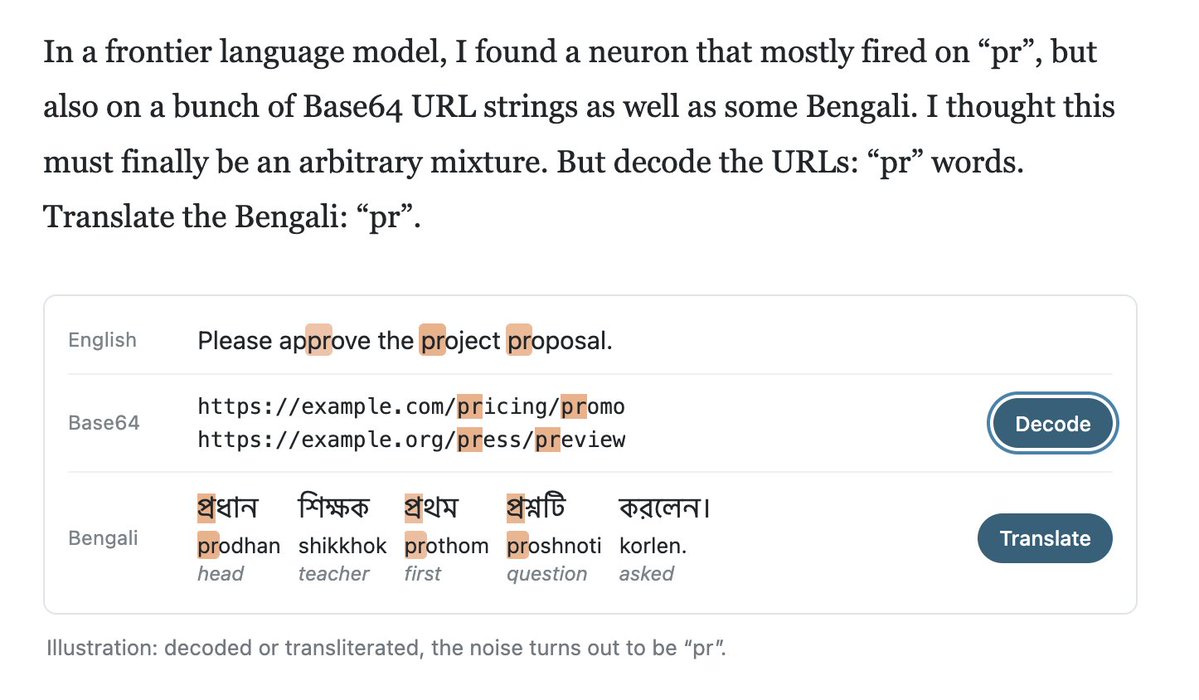
interpretability might be the most important scientific problem in the world right now, as I don't think we can solve alignment if we don't know what we're building. I think I have good news about it. I co-authored early work in mechanistic interpretability at OpenAI and came
interpretability might be the most important scientific problem in the world right now, as I don't think we can solve alignment if we don't know what we're building. I think I have good news about it. I co-authored early work in mechanistic interpretability at OpenAI and came away pessimistic, because neural networks appeared to fold into arbitrary tangled knots. years later, I started openai's first large-scale automated interpretability project, finding about 2% of neurons legible with the primitive tools we had with modern agentic tools and a much closer look, the picture looks totally different. the vast majority in models up to trillions of parameters are legible, and their circuits beautiful. many famous examples of tangled neurons turned out to be misunderstood. The roadblocks I expected mostly aren't there. I now think ambitious interpretability will be solved by the time we need it most, and possibly quite soon, as automated scientists keep improving. it may be a bitter lesson for interpretability: the simple thing, at absurd scale, works already-clean.goodfire.com
Can’t wait to dig in tonight, will I really feel the “move 37”

(1/6) From @GoogleDeepMind’s AlphaGo to AlphaZero, we saw machines find moves that reached beyond what we’d imagined for them. No one taught them those strategies. They emerged from reinforcement learning: playing, failing, and trying again under a single binary task reward for
This is dope
Today, we're releasing the Carbon Annotation Database and the model behind it, Carbon-A. We've used this model to discover 566.34 million new gene candidates across 22,617 species, thousands of which have never been studied like this before. We wet-lab validated a number of
Feeling FOMO, working on advancing real world applications of scientific progress and improve lives in the most tangible way is the best work there is!

BREAKING: The U.S. government, Google, Meta & Zuckerberg-backed @biohub are launching a $1.8B push to build the data layer for AI biology. The goal is to create the largest open, AI-ready biological dataset ever assembled, giving models the data needed to better predict how
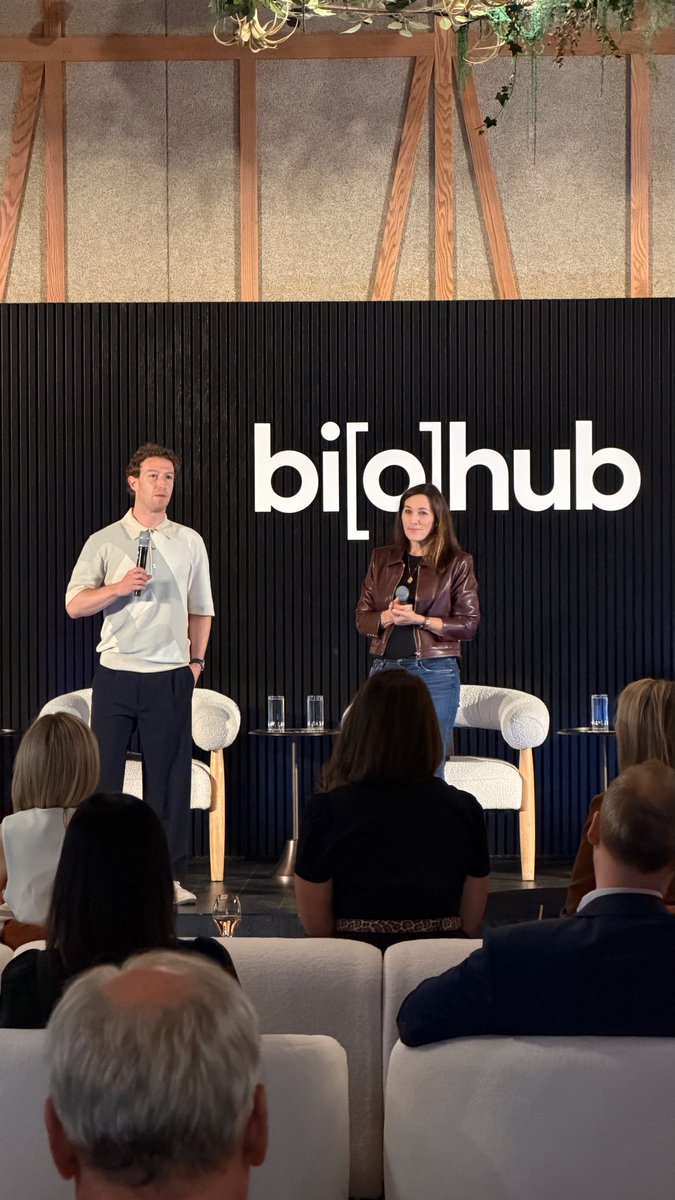
This is a huge step in the right direction
We’ve all seen the cool “Astra for robotics” demos. But behind the scenes? Slow rollouts, hand-engineered APIs, and/or simulated behaviors that struggle on real robots. How do we make coding agent actually work in the physical world? 🦾 Introducing SimEX: Simulation-Integrated
Exactly why using RLCD models such as Jev, etc to help decide when to have operators intervene could be incredibly valuable! x.com/buildingcells/…
The winning robot stack will not be the one that never needs a human. It’ll be the one where a human in NY can grab a failure in SF, finish the grasp, hand control back—and that recovery can become the next training example. @cortexairobot Harness is that layer. Prompt. Steer.

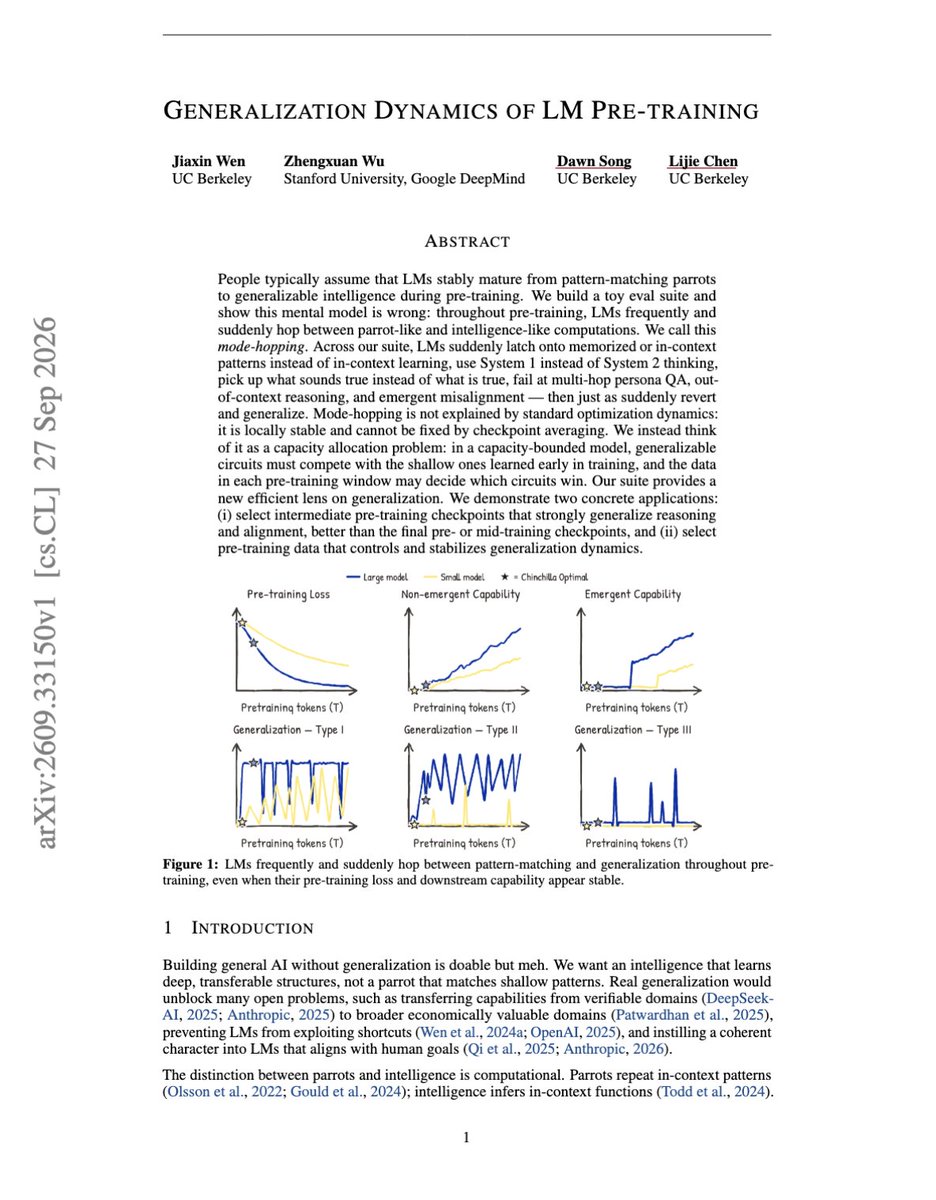
More pre-training doesn't necessarily mean better generalization? This new paper discovers mode-hopping, where LLMs repeatedly switch between shallow pattern-matching and actual generalization, even while training loss remains stable. For example, OLMo3-32B went from 81% accuracy to 0%, then back to 81.7% within just 40B training tokens. On top of that, selecting an earlier 4.5T-token checkpoint instead of a 4.9T one improved GPQA transfer after math fine-tuning (36.3% vs 29.8%) and robustness to alignment attacks (53% vs 21%) alphaxiv.org/abs/2609.33150
Pulled almost an all-nighter, but I finally got done writing my blog on reinforcement learning. Next part of the CUDA blog next Friday!!... hopefully... no promises :X x.com/i/article/2106…
How a robot arm is controlled, explained for ML people new to robot learning. First of the explainers from my own speedrun. Next one will be on ACT. Follow me to catch it. x.com/i/article/2100…
Instead of training to predict the next action, ACT (@tonyzzhao et al.) trains to generate the next 100. How and why, explained for ML people new to robot learning. Second from my speedrun. Next one, on Diffusion Policy, next week. Follow me to catch it. x.com/i/article/2102…
How diffusion and flow matching work, built up from the VAE, as used by Diffusion Policy (@chichengcc et al.), all GR00T models, and most π models. For ML people new to robot learning. x.com/i/article/2105…
Planning over long horizons is difficult when every action must be predicted one step at a time. FlexiWorld addresses this by learning flexible action chunks—groups of primitive actions that can vary in length—while training on goals spanning multiple time scales. The JEPA-based world model combines mixed-span goal supervision, a variable-length causal action encoder, an autoregressive actor, and Student Forcing to reduce errors from generated action prefixes. Its ARCEM planner searches over action adjustments while using feedback within each chunk and latent predictions at chunk boundaries. Across four benchmarks and goal distances, FlexiWorld with ARCEM reaches 89.29% mean success, compared with 83.98% for the strongest baseline. It also supports different planning chunk lengths without retraining; longer chunks speed up planning by about 1.3× on average while maintaining comparable success. Title: FlexiWorld: Learning and Planning via Flexible Action Chunks Across Multiple Time Scales Project URL: shidu-ren.github.io/FlexiWorld-Pro… Paper: arxiv.org/abs/2609.35138…

Rosario Scalise @rosario_scaling
462 Followers 972 Following Doin RL, continual, sim2real, controls, ML, and science. PhD from @uwcse. Prev @cmu_robotics

Jiaheng Hu @JiahengHu1
1K Followers 616 Following Final year Ph.D. candidate @UTAustin | Ex: @Amazon FAR, @GoogleDeepMind, @allen_ai, @CarnegieMellon, @Columbia
SilkAndEmber @SilkAndEmber
40 Followers 819 Following
Sam “The Ghostbuste... @DrTenmaFan
21 Followers 93 Following don’t give a piss bout nothing but the hawks
Nick @nickcammarata
117K Followers 916 Following mechanistic interpretability, meditation, jhana brother
Murtaza Dalal @mihdalal
35K Followers 632 Following Research Scientist @Google DeepMind prev: AI @ Tesla Optimus | Robotics/AI PhD @CMU_Robotics, EECS @UCBerkeley | Opinions entirely and unequivocally my own
Rosario Scalise @rosario_scaling
462 Followers 972 Following Doin RL, continual, sim2real, controls, ML, and science. PhD from @uwcse. Prev @cmu_robotics

Zhutian (Skye) Yang @ZhutianYang_
2K Followers 224 Following Robotics & AI at @GoogleDeepMind. PhD from @MIT_CSAIL. Ex-Intern at @NVIDIAAI. Opinions are my own.
Mateo Guaman Castro @mateoguaman
1K Followers 702 Following 🤖 · 🚵♂️ · 🎸 · 🇪🇨 PhD student @uwcse currently kicking it at @FlexionAI, working on scaling RL. I like biking long distances and playing the bass.
Matthew Barnett @MatthewJBar
9K Followers 401 Following
Jeff Holden @jeffholden
39K Followers 199 Following Founder & CEO, Atomic Machines. We build micro-machines from code.

Pine @pine_jpg
550 Followers 3K Following mid-training @GoogleDeepMind, prev @MechanizeWork @UCBerkeley

Georgia Channing @cgeorgiaw
8K Followers 499 Following AI4Science @ 🤗, PhD @OxfordTVG — science is a candle in the dark
Nathan Lambert @natolambert
107K Followers 958 Following Open model research, founder, director @trillium_labs. Prev. co-led Olmo at Ai2. Writes @interconnectsai, wrote https://t.co/alRXKINTwE

Shana Kelley @ShanaOKelley
3K Followers 188 Following President @Biohub | Professor, Chemistry and BME @NorthwesternU | @KelleyLabs | Life Sciences Founder
pedro henrique @pedrohe22785148
125 Followers 174 Following Hello world! my name is Pedro and i'm a programmer who tries to use my knowledge for the better world. data science, robotic and app development are my thing
Jiaheng Hu @JiahengHu1
1K Followers 616 Following Final year Ph.D. candidate @UTAustin | Ex: @Amazon FAR, @GoogleDeepMind, @allen_ai, @CarnegieMellon, @Columbia
James Zou @james_y_zou
27K Followers 148 Following @Stanford professor. Chan-Zuckerberg @biohub investigator. Sloan Fellow. Overton Prize. @togethercompute. AI for science + health.
biohub @biohub
32K Followers 615 Following Combining frontier AI & frontier biology to help scientists cure or prevent disease
Junfan Zhu 朱俊帆 ... @junfanzhu98
5K Followers 5K Following @junfanlabs @saturdayrobotic Founder CEO, 🤖 World Model research | @UChicago Math, @GeorgiaTech CS, @StanfordGSB, ex-Quant | Wuxi🇨🇳✈️World 60+countries🗺️🌎
Nicholas Marwell @the_marwell
3K Followers 226 Following Leading Horizons @AnthropicAI. https://t.co/94OcvOU8Ep
Seb from Clera @_sebastianscott
2K Followers 2K Following Building @getclera | Representing 240,000+ of the best talent | https://t.co/rJS4hPSa3Q
Hugging Face @huggingface
829K Followers 227 Following The AI community building the future. https://t.co/TpiXQMQ9rZ
clem 🤗 @ClementDelangue
730K Followers 5K Following Co-founder & CEO @HuggingFace 🤗, the open and collaborative platform for AI builders
Thomas Wolf @Thom_Wolf
136K Followers 8K Following co-founder @HuggingFace - moonshots get your microduck at https://t.co/n1Btgs6vKw
Quentin Lhoest 🤗 @lhoestq
5K Followers 342 Following Datasets & Compute @huggingface since 2020 | Open Source + HF Hub platform
Julien Chaumond @julien_c
90K Followers 1K Following Co-founder and CTO at @huggingface 🤗. ML/AI for everyone, building products to propel communities fwd. @Stanford + @Polytechnique


Pramod Goyal @goyal__pramod
12K Followers 481 Following Trying to change the world one line at a time
AI Bites | YouTube Ch... @ai_bites
3K Followers 691 Following AI tools, papers, hands-on tutorials. Former @UniofOxford @Oxford_VGG Check: https://t.co/HAG2TAIpC4 https://t.co/8P7CmrAQZ9
Keana Alabre @Keanaalabre
6K Followers 762 Following Founder | Talent Matchmaker 🎯 | Connecting Top Talent with YC & VC Backed Startups | a16z Speedrun (SR005)✨• Hiring or looking to join a startup? Reach out!🗣️
Jacob H. Rothschild @ja_rothschild
2K Followers 52 Following Robot learning | ex-QuantCo | ETH Zurich Statistics MSc
Sam “The Ghostbuste... @DrTenmaFan
21 Followers 93 Following don’t give a piss bout nothing but the hawksTrends for United States
You might like


















