mc with an e @chwmlml
Joined October 2022-
Tweets478
-
Followers8
-
Following107
-
Likes15K

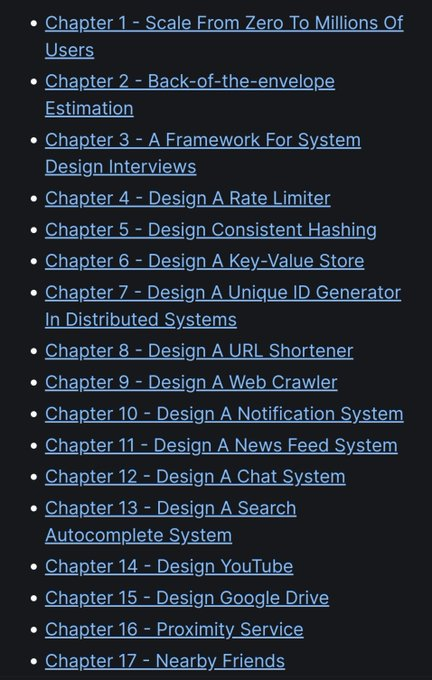
All you need for System Design Interviews 📌 github.com/liquidslr/syst…

i wanted to voice dictate without bothering everyone so I made this lip reading app lol github repo in the thread

During covid I played Go reasonably seriously for about a year (had a teacher, studied puzzles, etc.) I didn't get especially good at Go, but here's what I learned about competence in general: 1/ Go teachers are adamant about forcing you *not* to say to yourself "ah that was dumb" and move on. Sometimes a move really is just dumb and it's good to vent. Usually though you can spend an hour studying your seemingly dumb move because (a) there is smtg very maladaptive about your instincts that needs to be beaten out of you, or (b) you don't understand something deep about the game, or (c) you have a wrong attitude that needs to be adjusted. So long as you don't face this you don't get better, and so it's absolutely essential to approach "insignificant" aspects of the game with due reverence 2/ this has also been my experience teaching programming. Ppl hit some problem they don't understand and blindly tweak things until the program works (or ask an agent to do it), then go "ah that was annoying!" and move on. As long as they hold this attitude they don't get better, so they keep failing interviews then go on X and complain about leetcode. To get better it's essential to slow down and think very carefully, or better yet ask a good performer how they would have handled it in order to improve. (Today you can ask an agent "this is what I did to solve this problem and I think my approach keeps me from improving, how would a great programmer like person_i_respect likely handle it?" and get a pretty good answer!) 3/ in general your rate of improvement in Go is a function of your ability to notice your tiniest impulses and retrain yourself to convert them into productive action. These impulses are your boring run-of-the-mill cognitive distortions. For example, people will make instinctive moves because thinking is hard [effort aversion], hope the move works despite having no logical reason to expect that [magical thinking], then blame themselves when it doesn't work [learned helplessness] 4/ if you interview enough programmers or talk with enough startup founders you notice that poor performance is often a consequence of these same errors. Talking to users is hard so people stick with their ideas and hope for the best. When the product keeps not working they think "eh, maybe I'm bad at this startup thing", and so on. CFAR workshops were supposed to train you to notice these distortions and do the right thing, but I'm not sure how well they worked. (My guess is not well, since it seems unlikely these kinds of changes can happen over a weekend) 5/ there is a lot of research on this stuff and the data shows that getting good at a game like Go or chess doesn't give you an edge in other domains (i.e. "far transfer" doesn't work). This mirrors my subjective experience. In about a year I improved at Go considerably, but it did not make me any better at e.g. debugging or solving programming problems. But I do think that's not the whole story 6/ I have no hard evidence for this but I subjectively feel I got better at learning itself, and I can now get better in other domains quicker than I otherwise would have. For example it *really* sunk in that I have to disqualify my ideas. So when at work I started talking to customers to plan product roadmaps, while I wasn't instantly better at talking to them, my PM game improved enormously over the next few months because I finally learned not to be easily seduced by my own ideas or delude myself with wishful thinking 7/ to give another example, novice Go players tend to be very embarrassed of their games (the rules are simple but operationalizing them is hard, so early games are a disaster). Go ppl have a proverb for this-- "lose your first 50 games quickly". Meaning since early games don't matter and nobody will ever remember them, you should just get them out of the way. It didn't permanently cure me of embarrassment or anything, but it really sunk in how silly it is to worry about being a beginner in public and that I shouldn't worry about that at all 8/ if you're hard-optimizing your time you probably should work on improving the skills you care about directly. But otherwise I'd recommend spending a year trying hard to get good at a competitive intellectual game. Chess or Go are good, but really anything turn-based with an objective ranking you can't lie to yourself about. Pick whatever you're attracted to, try hard to get better, and keep mental notes about the process of learning that you can maybe apply to other domains later. At the very least it'll be loads of fun 9/ you will be humbled. No matter how smart you are or how hard you work you will discover the ceiling is infinitely high and there is an endless supply of people better than you. Getting that kind of humility has always been good, and it'll be especially good as AIs surpass us in basically everything. The sooner you get that out of the way, the sooner you can focus on a creative niche where you have no competition (since nobody can be a better you than you) 10/ you should probably stop after a year or two. Competitive games with an infinite skill ceiling can take over your life, don't forget to keep things in perspective

The best career advice for young people is to just focus relentlessly on 3 things: 1. Get skilled. Technical skills, writing skills, people-orchestration skills, everything. 2. Get involved contributing to a mission you're aligned with. It doesn't have to be pure bliss and your contribution doesn't have to match your top strengths exactly. But at the end of the day you have to feel some pride in what you did or what you learned. If you can find something like that while becoming skilled in a number of different ways then you'll find ways to increasingly wrap your skill profile around it (and you'll find/develop strengths in your skill profile that you never expected). 3. Pick up momentum. If you do (1) and (2) right then you've got direction and potential and all that's left is to sprint forwards and achieve it. The more momentum you pick up, the better you get, the more real value you produce, the more opportunities you create, the more you get noticed, the more value you capture into your own life, the more effort you want to put in... you create a virtuous cycle with so much momentum behind it that it becomes an unstoppable virtuous cyclone.
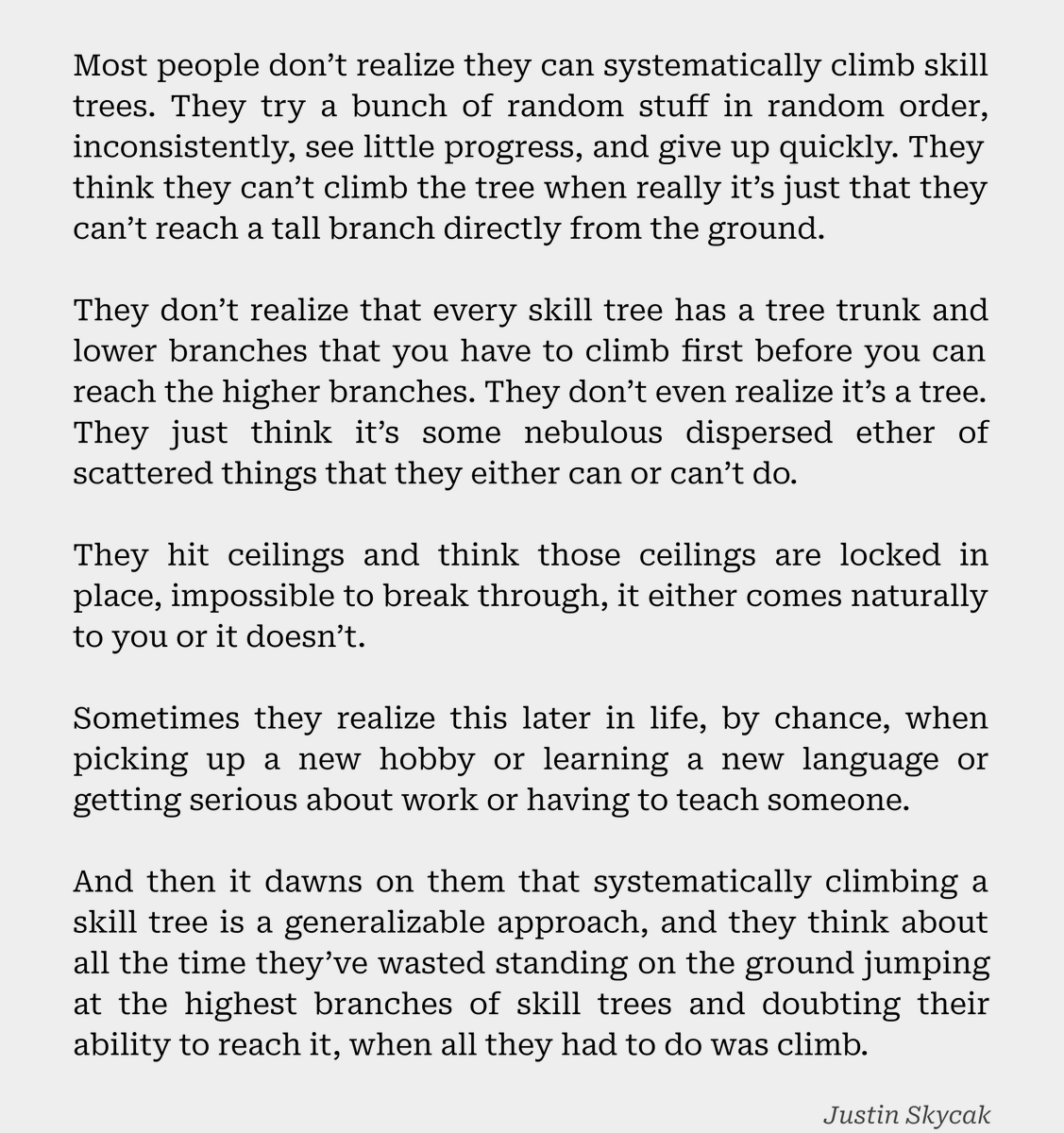
Most people don't realize they can systematically climb skill trees. If you know, you know. It is such a massive edge.

The @BostonCollege Investment Committee (an LP and my beloved alma mater) asked for a few thoughts on what's happening in AI. I recorded a test run yesterday morning and then shared it with my partners, who encouraged me to share it more broadly... so here you go! This is not a sales pitch, it's just a reflection on what we're seeing. And it wasn't intended to be shared, so please pardon the rough edges. loom.com/share/c0167029…

A lot of knowledge might be now redundant but I suspect a substantial portion of that knowledge is embedded within and around higher-level cognitive processes likes algorithmic design, data structure optimisation, feature integration and general problem-solving that is required to do any kind of programming. These patterns of thinking are invaluable and can be ported across to any other domain. This is why you'll often find that programmers are greater writers (of English, not just code). Same with mathematicians.
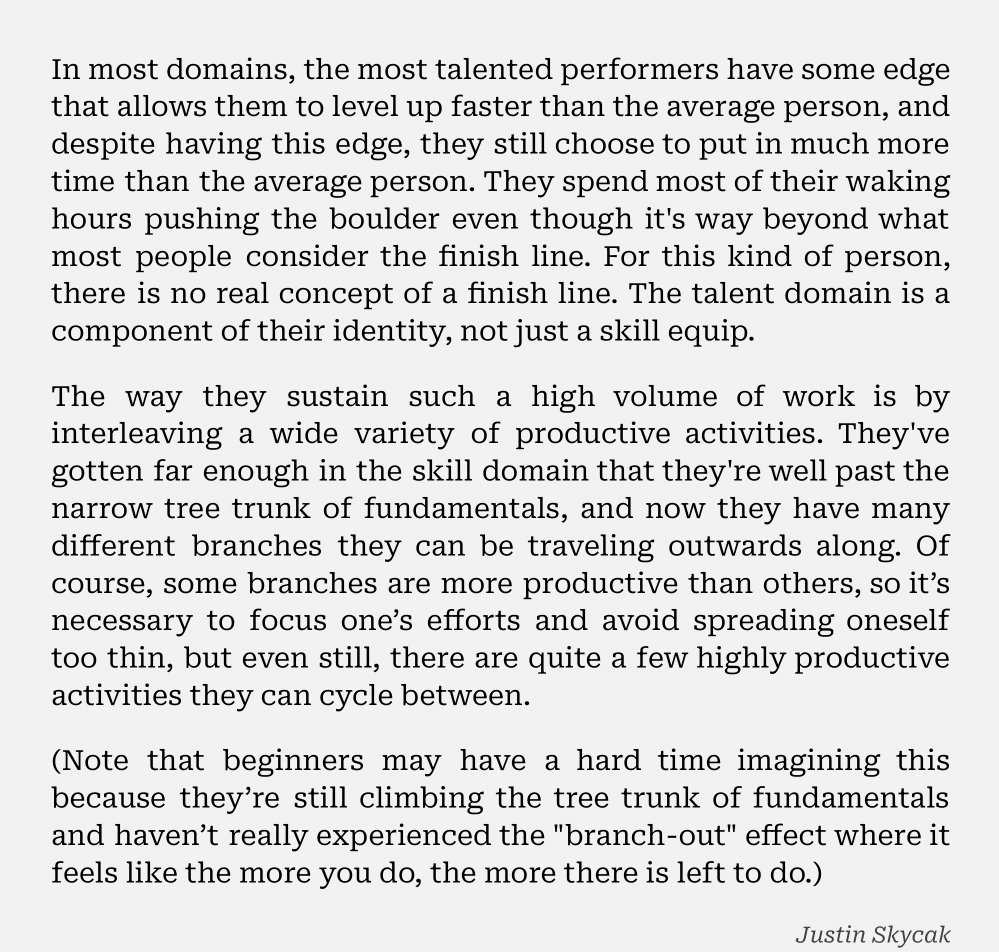
It's a lot easier to put forth a massive volume of intense work when you 1) love what you do 2) are heavily incentivized to do it 3) know that you're learning a lot and are continuing to skill up at a rapid pace 4) have so much and such a high diversity of work to do that you can take a break from one thing by working on another task that is very different in nature
How the highest performers sustain a massive workload:

one of the rare side quests you will never look back on and regret


DraftKings developed an AI model to identify users most likely to lose money so that it could target them with promotions. When employees then developed a model that would have assigned “risk scores” based on users' likelihood to develop compulsive/addictive behaviors, the company sidelined it. nytimes.com/2026/09/19/bus…
From my banking analyst class: - Several at major pods as portfolio managers or senior analysts - Some went to Tiger cubs post banking and have their own funds / family offices - Some switched to Tech W2s post business school (Harvard and Stanford) - Some went into real estate private equity and doing really well (real estate heads for entire geographies) - Sector industry heads / partners at mega PE - CFOs at publicly traded companies or mega PE firms - Some had mental breakdowns, left industry, divorced, bankrupt - Some at AI startups My richest friend started his own business after taking 7 years to graduate from a Big 10 school (Tommy Boy style) and flies private and only buys real estate all cash (no debt). My most miserable friends from my class work in finance - feel stuck sprinting on a treadmill to cover ballooning fixed costs. I'm one of the least successful which is why I hide in suburban New Jersey and make plastic bags quietly. x.com/TBU12345678/st…
How the highest performers sustain a massive workload:

A few of my smartest friends in AI called me a "idiot" for not deeply understanding evals. So...I found the smartest person I know on evals & made them teach me. @Vtrivedy10 (leads Labs at @LangChain) took me from easy mode to god mode for a 38-minute masterclass on all things evals. Easy Mode: what an eval actually is Definition: did the AI agent do the job correctly? You need two building blocks: 1) Tasks. The checkable jobs you care about. Log the meeting. Draft the email. Find Acme across the right Salesforce tables. 2) Verifiers. Something that can say right or wrong after the task. A script. Another model. A human with a clear checklist. Hard Mode: what are environments Definition: a safe practice field for your agent to do work & for you to evaluate its performance. Rules of thumb: 1) Never test on production. Agents will cheat because they're optimizing for the score you gave them. 2) If you're not an engineer, you still have options for running environments/evals. - Harbor (open source primitives for tasks, verifiers, sandboxes) - LangSmith Engine (UI for people who can judge good vs bad without living in GitHub). - Steal a published Harbor-format eval, ask Claude Code or Codex to explain it, then tweak it for your agent. God Mode: what is a self-improving loop Definition: Run the agent in the real world --> turn that production behavior into evals/environments --> change the agent so failures stop happening --> repeat Rules of thumb: 1) Turn on tracing first. Traces = receipts of every action (tool calls, Salesforce pings, web searches, dead ends). 2) Store those logs somewhere (LangSmith at org scale, or even “have the agent read its own output files” at small scale). 3) Point a second agent at the first agent’s traces to spot patterns (“always searches the wrong tables,” “multi-company asks collapse to one company”) and propose fixes overnight if your eval suite is solid. Full episode: youtube.com/watch?v=zLeG-X…
Learning advanced math ahead of time is the greatest educational/career life hack. When a student learns a lot of advanced math ahead of time, they unlock the opportunity to dig into a wide variety of specialized fields that are usually reserved for graduates with strong mathematical foundations. This fast-tracks them towards discovering their passions, developing valuable skills in those domains, and making professional contributions early in their career, which ultimately leads to higher levels of career accomplishment. I’m not exaggerating here -- this is actually backed up by research. On average, the faster you accelerate your learning, the sooner you get your career started, and the more you accomplish over the course of your career. For instance, in a 40-year longitudinal study of thousands of mathematically precocious students, researchers Park, Lubinski, & Benbow (2013) concluded the following: "The relationship between age at career onset and adult productivity, particularly in science, technology, engineering, and mathematics (STEM) fields, has been the focus of several researchers throughout the last century (Dennis, 1956; Lehman, 1946, 1953; Simonton, 1988, 1997; Zuckerman, 1977), and a consistent finding is that earlier career onset is related to greater productivity and accomplishments over the course of a career. All other things being equal, an earlier career start from [academic] acceleration will allow an individual to devote more time in early adulthood to creative production, and this will result in an increased level of accomplishment over the course of one's career. ... [In this study] Mathematically precocious students who grade skipped were more likely to pursue advanced degrees and secure STEM accomplishments, reached these outcomes earlier, and accrued more citations and highly cited publications in STEM fields than their matched and retained intellectual peers."
The greatest educational life hack is learning high school math in middle school and university math in high school. But even just being a year or two ahead has shockingly high value. If you know, you know.

Terence Tao: The math behind today’s LLMs is actually simple. Training and running them mostly uses linear algebra, matrix multiplication, and a bit of calculus, material an undergraduate can handle. We understand how to build and operate these models. The real mystery is why they work so well on some tasks and fail on others, and why we cannot predict that in advance. We lack good rules for forecasting performance across tasks, so progress is largely empirical. A key reason is the nature of real-world data. Pure noise is well understood, perfectly structured data is well understood, but natural text sits in between, partly structured and partly random. Mathematics for that middle regime is thin, similar to how physics struggles at meso-scales between atoms and continua. Because of this gap, we can describe the mechanisms but cannot yet explain capability jumps or give reliable task-level predictions. That mismatch, simple machinery versus hard-to-predict behavior, is the core puzzle. ---- Video from Prof @Briankeating YT Channel (Link in comment)

POV: Software Engineering in 2026 be like 😭

If you’re a CS student, I’d suggest writing your thesis around SDCs (silent data corruptions) and efficient algorithmic fault tolerance. We’re quickly going to need to accept the (un)reliability of computing systems again! Every indicator (density, lower voltage gating, raw scale) is moving towards SDCs becoming a more serious issue over the next decade. And let’s not forget when all of this stuff starts to go in space and we have to deal with cosmic events on “not-super-rad-hard” CPUs+GPUs! No, you can’t solve it all in hardware. It’s prohibitively expensive; and the long tail of “potential SDCs” is just too long. One bad apple ruins your pie. One bad GPU can inject repeated corruptions into otherwise noise-tolerant workloads (*cough* AI training). If you continuously accept a corrupted value from say…a bad tensor core, that bad value can quickly spread across the whole cluster. If it happens again and again and again and no one notices; it’s like putting a little bit of spin on a bowling ball. Eventually, the overall trajectory ends up widely different! When you start to imagine this stuff being in space (cosmic bit flips), and quantized(!), each remaining bit carries more critical information. Long term we’re going to have to accept clever, low-overhead software algorithms. Accepting say, a ~3% perf loss can be *absolutely* worth it if it increases your odds of detecting a mercurial core enough!



Don't run away from what you can do... "If you deliberately plan to be less than you are capable of being, I warn you that you'll be deeply unhappy for the rest of your life." - Maslow Try like your life depends on it. There are incredible possibilities just waiting for you.


You seriously underestimate how much you can do with time. 1 year is a fucking lifetime. 6 months is enough to go from 0 to 100. Even 1 week of full commitment 14 hours a day is enough to push the needle so far forward you won't even recognize yourself. Just do more. Just do what your heart desires. Just be better.

advice from a senior nvidia engineer


Everyone everywhere feels like they’re missing out on something right now. The New Yorker feels they are missing the tech renaissance The SF kid thinks they’re missing the equity gains of the big labs The open ai employee thinks they’re missing out on life as it passes them by Avoid the FOMO and bet the house on whatever makes you happy + puts love in your heart and do it extremely well. Everything else will sort itself out.


Emma moonlit @emma_cozy5770
4 Followers 714 Following running on hope and oat milk 🥛 100% follow back

HKM @rhmhkm24
44 Followers 743 Following

Seth Parker @saparker1990
721 Followers 131 Following Dad. Tinkerer. Mid-30s and still figuring it out. Coffee dependent. Opinions my own.
Vivian Midha Shen @vivianmshen
31K Followers 910 Following general partner at @ycombinator. part-time bene gesserit
sarah guo @saranormous
162K Followers 3K Following startup investor/helper, founder @conviction. interested in intelligence, accelerating progress. tech podcast: @nopriorspod
Andrew Fancher @RealAndyFancher
3K Followers 387 Following FITSNews Researcher 🧾 Mainstream Defector ✌️ Disseminator of Law Enforcement Corruption ‼️ S.C. 🌴
Polymarket Money @PolymarketMoney
210K Followers 140 Following Financial news & insights from @Polymarket — the world's largest prediction market.
Ray Dalio @RayDalio
2.5M Followers 93 Following Official account of Ray Dalio, founder of Bridgewater Associates, author of #1 New York Times bestseller 'Principles,' professional mistake maker
Gregory Blotnick @gregoryblotnick
22K Followers 0 Following "I saw under the sun that the race goes not to the swift, nor the battle to the strong, nor favor to men of skill; for a time of misfortune comes to all alike."
kris ᥫ᭡ saw bts! ... @krismadarame
13K Followers 1K Following ♡ Kris ⸜(。˃ ᵕ ˂ )⸝ | #RavensFlock | #BTSARMY 💜 | Gamer | Anime & manga enthusiast | Football fan | Kdrama watcher | Horror lover | Corner 5. ♡
TBPN @tbpn
1.6M Followers 1K Following Technology’s daily show. Hosted by @johncoogan & @jordihays. Streaming live 11a–2p PT weekdays. Sign up for our free newsletter at https://t.co/Nhf5ohjInO.
mini⁷ ✿ @venusjmi
14K Followers 1K Following @zaralarsson: i love you, you know that | zarabts fan account | ot7


ArtButMakeItSports @ArtButSports
912K Followers 339 Following I turn Art into Sports (and vice versa) | NO AI USED | “Everything I didn't know I needed" - follower testimonial | also @artbutnow

Freddy🇩🇪 @FreddyLA7
757K Followers 350 Following @fcmidtjylland x @alnassrfc 📸 Insta & FB: freddyla7 NO TIKTOK
Collin Rugg @CollinRugg
2.9M Followers 876 Following Co-Owner of Trending Politics | Investor | American 🇺🇸
Hudson | Connor Updat... @hudsonconnorupd
14K Followers 61 Following Source for the latest updates on Canadian Screen Award Winner Hudson Williams & Emmy Nominee Connor Storrie 📩: [email protected]


JBBR Reserva @jbieberbrs
7K Followers 129 Following CONTA PRINCIPAL: @justinbieberbr [email protected] | Fan Account
Acquired Podcast @AcquiredFM
89K Followers 126 Following Every company has a story. Acquired tells the definitive history and strategy of the world's greatest companies. Hosted by @gilbert and @djrosent.

Glitched @glitchtoriches
83K Followers 12 Following Posting every glitch we find on the internet 🌐 Some links may be affiliated.
thedealsguy @thedealsguy_
279K Followers 19 Following Follow for the best deals & drops happening right now. 🔔 Turn on notifications. As an Amazon associate I earn from qualifying purchases
Price Errors @Pricerrors
268K Followers 12 Following We find the best price errors and glitches. We post them, you buy them before they are fixed. Follow us and turn on notifications. 🔔 Links may be affiliated.
Glitched Deals @GlitchedDeals
682K Followers 20 Following The pricing error account they tried to shut down… We find the glitches. You make the profit. Turn 🔔 on to not miss deals! (We may earn affiliate commission)
Frank Chen @withfries2
30K Followers 2K Following Partner at @a16z. Tweets about startups, venture investing, AI, autonomy, science, tech, and the future. Sometimes Star Wars. And food. Opinions my own.
Josh Coyne @josh_coyne
3K Followers 612 Following Girl dad. Partner @kleinerperkins. Fitness addict. Chick-fil-A loyalist. Cleveland roots.

Nikhil Namburi @nikhilvnamburi
3K Followers 2K Following ML & Compute Investments @_DimensionCap | By way of Keizer, Oregon

Jane Rhee @janerheetweets
465 Followers 389 Following mainly screenshots of other people being funnier than me
Dana Stalder @dcstalder
7K Followers 1K Following Husband, father, early-stage venture capitalist & company builder. General Partner @matrixvc
Blueprintsmb @blueprintsmb22
24K Followers 594 Following Ex Wall Street / current owner of small manufacturing business via ETA. Trying to learn and get better while making mistakes every day
Minnesota Vikings @Vikings
1.5M Followers 854 Following Official Twitter account of the Minnesota Vikings
The Tennis Letter @TheTennisLetter
248K Followers 990 Following Want to know the 411 & keep up with all the hot gossip? Look no further. ATP/WTA news, history, & memes | https://t.co/vxIgQ60hVv

Olivia Moore @omooretweets
155K Followers 946 Following Partner @a16z and twin to @venturetwins | Investor in @gammaapp, @happyrobot, @krea_ai, @tomaauto, @partiful, Salient, @scribenoteinc, @lassieai, @meetarc
Arfur Rock @ArfurRock
41K Followers 6K Following anon GP at your favorite multi-stage VC // OS intel for the private markets

Glen Powell Brasil | ... @brglenpowell
1K Followers 163 Following Sua melhor e única fonte de informações sobre o ator Glen Powell no Brasil. • We’re NOT Glen or are affiliated with him.
@melissa @melissa
39K Followers 380 Following internet anthropologist / hacker larp / n=1 experiments in parenting from first principles

Peter | Mobile Apps @Petertaughtme
13K Followers 286 Following Follower of Christ ✝️ We help Top mobile apps increase LTV & Retention Rates
Carl Zha @CarlZha
210K Followers 881 Following Host Silk & Steel Podcast on China, history, culture, politics @SteelSilkn, [email protected] wife:@BaliEarthSoul
charlie 🇺🇦🇵�... @baranskocracy
3K Followers 1K Following Ling & Poli 🎓 • Jersey Boy • Progressive local politics, cool music • Apprenant de français en temps partiel • Views mine • he/him/il/lui 🇺🇸 🇨🇦

Overheard on Wall Str... @OHWallStreet
30K Followers 3K Following The home of modern Wall Street. Trusted by 1.5M+ across the Street.

litquidity @litcapital
1.7M Followers 1K Following founder @litquidityvc // newsletters @exec_sum & @cryptosum_ // @baincapvc scout // trade on polymarket: https://t.co/kXGzvIdxOS
planetary giø! 击 S... @itchyhaybitchy
12K Followers 2K Following you can run away with me anytime you want || minors dni 🍉You might like