ekplabz @ekplabz
Exploring the internet as a vast single-player open world. Turning engineering knowledge into reusable data, design rules, code, and tools. Building ekplabz. ekplabz.com Joined February 2025-
Tweets78
-
Followers1
-
Following30
-
Likes65
油圧回路生成の自動化に向けて、基盤となるデータベースの構築を進めています。これにより設計効率が大幅にアップし、ミスも減らせる見込みです。次はデータの整合性確認と運用テストに移ります。#技術開発
金融商品設計に生成AIを活用して、新しいアイデアを次々と生み出しています。効率的に多様な視点を取り入れられ、これまでにない商品開発が加速中。これからの展開が楽しみです。 #金融テクノロジー

I built the Napier Deltic as an interactive engineering exhibit: 18 cylinders, 36 opposed pistons, 3 synchronized crankshafts, with cutaway, single-delta, ghost-shell and exploded views. Iconically used in Royal Navy fast craft and British Rail’s high-speed Deltic locomotives.
リポジトリホスティングサービスを使うことで、コードの管理や共有が格段に楽になります。GitHubやGitLabなど、機能や使いやすさで選べるサービスが増えているので、自分の開発スタイルに合ったものを見つけてみましょう。#開発効率アップ
コードレビューでは、指摘だけでなく良い点も伝えることが大切。相手のモチベーションを維持しつつ改善点を具体的に示すと、再現性の高い品質向上につながります。#プログラミングTips

GPT-6 Astra can solve some seriously tricky spatial constraint tasks: from unlocking interlocked parts to threading a rope through three rings. Try it yourself now 👇 qinengwang-aiden.github.io/demos/constrai…
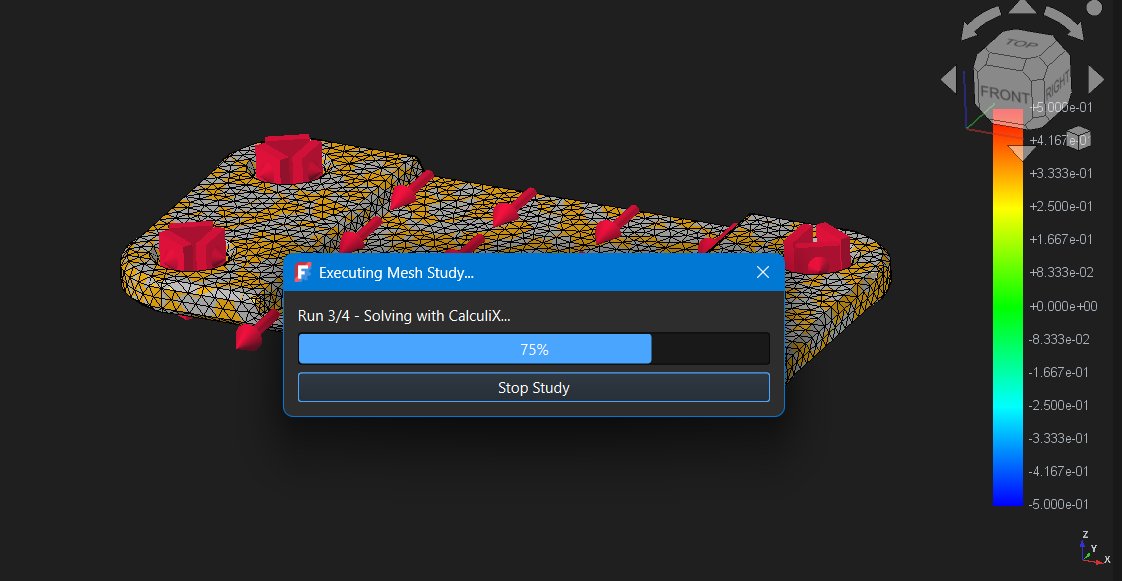
#FreeCAD #inthewild MeshStudy Workbech Designed to automate mesh refinement studies for #FEA/#FEM. It automatically runs simulations w/ varying mesh sizes and presents results clearly in tables and charts. This is still a WIP workbench. #CAD #OpenSource github.com/eng-abdalla-ab…

We built recursive meta-intelligence, an AI that creates its own scientific instruments, turns them into persistent worlds that an agent ecology with hundreds of AIs inhabits, and uses those worlds to discover mechanistic principles in one of the hardest classes of physical problems: how complex hierarchical materials (nested structures of matter that give rise to new function through organization) evolve and fail. The AI reasons across enormous spaces of possible physical trajectories, where every rupture changes what can happen next, and compresses those histories into principles (which humans can understand and design with) - complex chains of causal events, highly nonlinear, and intricate. Scientific superintelligence is tangible here - machine-scale exploration opening cognitive channels into complexity that has been extremely difficult for humans to traverse directly. AI builds the spaces in which its next level of reasoning becomes possible; a representation becomes an instrument, the instrument becomes an executable world, and that world becomes the substrate for further intelligence. Intelligence then grows by constructing new spaces to think in. The task we explored started from a seemingly simple prompt to explore a biological material system - the AI then chose the representation, mechanics and experiments, built a fracture laboratory to push materials to their limit, tested hypotheses and generated scientific conclusions. The swarm explored a combinatorial universe in which architecture controls function and every rupture changes the future state of the material. The AI discovered a compact principle that defines how multiscale material architecture can program the evolution of failure. Material placement and geometric order determine how forces redistribute, whether damage cascades or remains distributed, and whether function survives substantial flaws. For this discovery to happen the AI had to reason across long path-dependent histories, simulate alternative futures and compress them into generative invariants (model-based causal reasoning, counterfactual simulation and temporal abstraction applied to an evolving physical world). It is incredible to witness this transition to a new form of intelligence and capability through scaling swarms. A lot of positive will come out of this because it expands the human epistemic horizon as AI can traverse thousands of possible histories and return mechanisms compact enough for us to understand, test and build from. Intelligence compounds through its artifacts! A few lessons we learned: ▶️ Learning and discovery are flows through spaces of possibility. Early work has shown how backpropagation flows through parameters, reinforcement learning through action and consequence, and autonomous swarms through representations, instruments and executable worlds, bringing it all together. Flows create structure; structure redirects future flows in the recursive instrument. ▶️ Nonlinear physics actually defines a larger principle, where high-dimensional dynamics generate stable invariants; invariants become effective variables; those variables become the substrate for a new level of cognition. ▶️ Recursion then becomes level creation - one possibility space compresses into a principle, and that principle opens a larger space above it.
AI for science is one of the greatest positive forces we have, and I cannot think of anything more human than to understand nature and to use the power to create new technologies that improve our lives, civilization and allow us to reach beyond. x.com/i/article/2099…
凝った GUI を作るときにどうぞ バイブコーディングで GUI が壊れていく理由とその対策プロンプト|nrs zenn.dev/nrs/articles/9… #zenn
自動化を成功させるには、まず明確な目標設定が不可欠です。繰り返し作業を見極めて優先的に自動化し、プロセスの標準化とドキュメント化を徹底しましょう。また、ツール選びは慎重に行い、定期的なメンテナンスと改善も忘れずに。これらが効果的な自動化の鍵です。 #自動化のコツ
JSONデータの圧縮と効率化には、不要な空白や改行の削除、キー名の短縮、データの正規化が効果的です。さらに、gzipなどの圧縮アルゴリズムを使うことで通信量も削減できます。これらの方法で処理速度や保存容量を改善しましょう。#データ圧縮
n8nのitemsとJSONを理解する|node間を流れるデータ構造の基本 ekplabz.com/n8n-items-json…
JSONはデータ交換フォーマットで、キーと値のペアで情報を表現します。基本はオブジェクト({})と配列([])で構成され、キーは必ずダブルクオーテーションで囲みます。値は文字列、数値、真偽値、配列、オブジェクト、nullが使え、データのやり取りに便利です。#プログラミング
自動化を成功させるには、まず業務の本質を理解し、標準化されたプロセスから着手することが重要です。段階的に導入し、効果を検証しながら改善を重ねることで、無駄を省き効率化が進みます。人の介入が必要な部分は明確にし、システムとの連携をスムーズに保つこともポイントです。#自動化のコツ
ノーコードプラットフォームがますます注目されています。プログラミングの知識がなくても、直感的にアプリやウェブサイトを作成できるのは大きな魅力。アイデアをすぐ形にできるので、ビジネスや個人のプロジェクトに最適です。これからの開発のスタンダードになるかもしれませんね。#ノーコード
n8nの実行と履歴を理解する|保存・公開・Executionsの基本 ekplabz.com/n8n-executions…
API連携が進むことで、サービス間のデータ共有や自動化が格段に便利になりました。開発効率も上がり、新しいアイデアをすぐに形にできるのが魅力です。これからもAPI活用で仕事や生活がもっとスムーズになる予感がしますね。#API連携

nrs @nrslib
16K Followers 9K Following Programmer; ex-CTO; Building TAKT — OSS AI agent orchestration (https://t.co/BP5tCpuz5m); Community → https://t.co/LpB7HZFoS9; Findy Freelance Adv.
PyTorch @PyTorch
512K Followers 95 Following Tensors and neural networks in Python with strong hardware acceleration. PyTorch is an open source project at the Linux Foundation. #PyTorchFoundation
hackaday @hackaday
272K Followers 2K Following 🔥 Read: https://t.co/KG4TpCzO7H ☠️ Contribute: tips at hackaday dot com 👉 Projects: @hackadayio #Fediverse: @[email protected] 📒 Learn: https://t.co/p1jaCktSDt
Hugging Face @huggingface
793K Followers 226 Following The AI community building the future. https://t.co/TpiXQMQ9rZ
NumPy @numpy_team
36K Followers 10 Following Official account of NumPy. Announcements only. For questions and comments, please use the mailing list [email protected].
Onshape by PTC @Onshape
9K Followers 676 Following Onshape by PTC is the leading cloud-native CAD & PDM software for design teams.
The NFPA @TheNFPA
3K Followers 204 Following Driving the U.S. hydraulic and pneumatic industries to a bright future with data insights, networking, education support, and #fluidpower technology promotion.
n8n.io @n8n_io
84K Followers 1 Following Workflow automation for technical teams to build AI solutions that integrate with any app or API at no-code speed and code flexibility. Open and self-hostable
Simon Willison @simonw
223K Followers 6K Following Creator @datasetteproj, co-creator Django. PSF board. Hangs out with @natbat. He/Him. Mastodon: https://t.co/t0MrmnJW0K Bsky: https://t.co/OnWIyhX4CH
FreeCAD (CAD+CAM+CAE) @FreeCADNews
25K Followers 2K Following Official account of https://t.co/wUxd4VDnQN Donate: https://t.co/fVvYBy4k1O Swag: https://t.co/izr2KxqK1x 🎗️ #MadeWithFreeCAD #FromFreeCADtotheRealWorld #FreeCADFriday
Fluid Power World @FluidPowerWorld
7K Followers 3K Following Official Fluid Power World: Industry experts covering the latest on #fluidpower in mobile, #hydraulic, and #pneumatic systems!

Cognition @cognition
183K Followers 5 Following Makers of Devin, the first AI software engineer. We are an applied AI lab building end-to-end software agents. Join us: https://t.co/4Ss9hvpjRG
Cosmos Archive @cosmosarcive
30K Followers 489 Following Curating the Cosmos : Astronomy, cosmology, and physics clips with expert takes and stunning imagery.
Scientific Python @SciPyTip
209K Followers 18 Following Tweets about SciPy (Scientific Python) and related topics from @JohnDCook.
オープンソース... @opensourcelab9
7K Followers 8 Following 今バズってるAI系オープンソースを毎日発信|海外で話題のGitHubレポジトリを最速で紹介|“使えるかどうか”まで解説|AI・開発トレンドを追う人向け|AIメディア|組織全体への「 AI導入」は下のHPからご相談ください👇
Starlink @Starlink
1.8M Followers 31 Following Fast, affordable internet available all around the world. Engineered by @SpaceX
Dilum Sanjaya @DilumSanjaya
60K Followers 393 Following Software Engineer | Showcasing unique AI applications for Science & Engineering 💡Open Source https://t.co/02nVJK3OQK https://t.co/fzTHdVmiYr 🎬 https://t.co/cOGQInDnYV
すえまる @suemaruuuuuuX
2K Followers 450 Following 個人開発 | スマホゲームディレクター | AppStore売上1位ゲーム担当 | 東京大学文学部→Donuts→フリー | ゲーム開発が捗る情報をお届け👍
Bober_smart @Bober_smart
15K Followers 805 Following On-chain analyst | Crypto Native | @Polymarket researcher | @zscdao member
Vite ⚡ @vite_js
143K Followers 186 Following The build tool for the web. It's pronounced /vit/ like Veet! | brought to you by @voidzerodev and the community - join us on Discord: https://t.co/Cs7aMLlLwD

Claude @claudeai
1.8M Followers 2 Following Claude is an AI assistant built by @anthropicai to be safe, accurate, and secure. Talk to Claude on https://t.co/ZhTwG8d1e5 or download the app.
nrs @nrslib
16K Followers 9K Following Programmer; ex-CTO; Building TAKT — OSS AI agent orchestration (https://t.co/BP5tCpuz5m); Community → https://t.co/LpB7HZFoS9; Findy Freelance Adv.
Python Hub @PythonHub
156K Followers 3 Following Human-curated Python news, projects, articles & tools. Support: https://t.co/z5ihtHB4jY Suggest a Link: https://t.co/gOWyInLqhy
Qiita(キータ)�... @Qiita
48K Followers 4 Following Qiita公式アカウントです。何かありましたら [email protected] までご連絡ください :) / Qiita Team @QiitaTeam / 人気の投稿 @qiitapoi / Qiitaマイルストーン @qiita_milestone
Python Trending 🇺�... @pythontrending
53K Followers 2 Following trending Python repositories on GitHub (https://t.co/dKFSrAQ52h)
Real Python @realpython
267K Followers 164 Following Online #Python Training & Expert Community: Tutorials, Video Courses, Books, Quizzes...and More! Join 1M+ Pythonistas at https://t.co/VpjtGxdL7J
Python Developer @PythonDvz
186K Followers 1K Following Python developer sharing daily tips, tutorials, memes & quizzes. Level up your coding skills! 🐍 Hit follow 🚀 #Python #DevLife #100DaysOfCode
Python Software Found... @ThePSF
693K Followers 126 Following The nonprofit organization behind the Python programming language. For help with Python code: https://t.co/XDHPttz2Xv On Mastodon: @[email protected]
You might like