

Esco @escodotfun
The routing layer for stock tokens. Swap smarter across liquidity pools on Robinhood Chain. CA: 0x17c63a297a76bed7e96a96bcf5f566de1efdd1fc escova.fun Joined October 2026-
Tweets56
-
Followers72
-
Following7
-
Likes16
One swap. Every stock. ESCO is building around a simple idea: make stock-token swap routes easier to discover across available liquidity pools on Robinhood Chain. If you have been following the development of onchain financial infrastructure, take a moment to explore the product and understand the role $ESCO is intended to play in the ecosystem. Don't buy a ticker you haven't researched. Understand the project, verify the details, and decide for yourself whether it belongs on your watchlist.
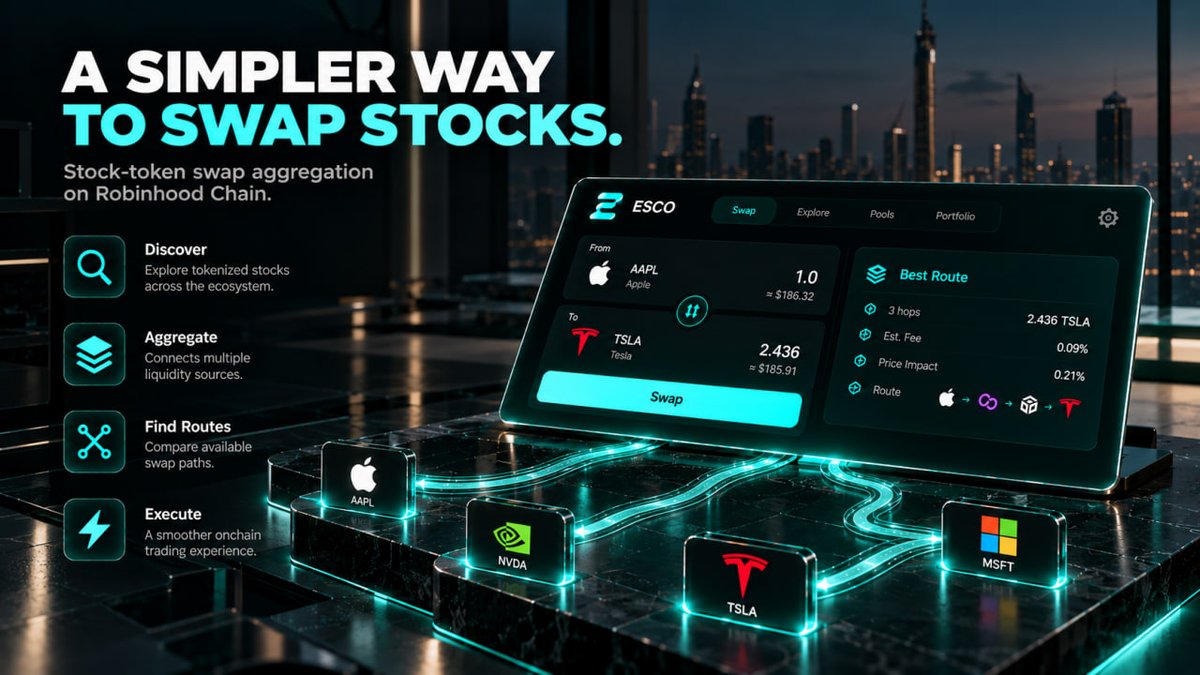
The best way to approach an emerging crypto project is to understand what it is trying to build before deciding what it might be worth. In a market where attention can move quickly and narratives can change overnight, taking the time to understand the underlying product is one of the most important steps any participant can take. Instead of focusing only on price movements, short-term hype, or what other people are saying, start with a more fundamental question: What problem is the project trying to solve, and why does that problem matter? For ESCO, the starting point is its focus on stock-token swaps and liquidity aggregation on Robinhood Chain. As onchain markets continue to develop, the infrastructure connecting assets, liquidity pools, and swap routes becomes an important area to understand. Bringing assets onchain is one part of the equation, but making the process of discovering available liquidity and navigating swap opportunities more straightforward is another. This is what makes ESCO an interesting project to research from an infrastructure perspective. Its stated direction provides a concrete starting point for examining the product, understanding its intended purpose, and evaluating how it fits into the broader development of decentralized finance and tokenized markets. But understanding the narrative is only the beginning. A project's long-term relevance depends on more than a compelling idea. Product development, actual functionality, transparent communication, verifiable information, and the ability to make meaningful progress toward stated goals are all factors worth considering. If you're researching ESCO, take the time to explore the platform directly. Understand what is currently available, distinguish existing functionality from future ambitions, and look for evidence that supports the project's claims. Review official documentation and announcements, investigate the token's contract address through verified official channels, and use reliable blockchain explorers to examine relevant onchain information where available. It is equally important to understand the risks. Emerging crypto projects can face technical challenges, limited liquidity, market volatility, changing conditions, and uncertainty about future adoption. A project's presence in a growing ecosystem does not guarantee its success, and a useful concept does not automatically translate into token value. That is why independent research matters. Don't rely exclusively on promotional posts, community sentiment, or the expectations of other market participants. Build your own understanding, ask questions, verify what can be verified, and be willing to reconsider your assumptions when new information becomes available. If ESCO's focus on stock-token swaps and liquidity aggregation aligns with your own research, and you believe its direction fits your investment thesis and risk tolerance, $ESCO may be worth considering further. Ultimately, the goal is not to follow the crowd or make a decision based on hype. It is to understand the product, evaluate the available evidence, recognize the uncertainties, and make an informed decision based on your own judgment. Explore ESCO and conduct your own research: escova.fun The strongest investment decisions begin with understanding what you're looking at, knowing what you can verify, and being honest about what remains uncertain. The research is yours. The risk is yours. The decision should always be yours.
Different pools can offer different paths between assets. The challenge is finding a route that fits the trade. ESCO is built around aggregating available liquidity routes for stock-token swaps, bringing the routing process into a more connected experience on Robinhood Chain. As always, users should review quoted output, fees, and slippage before executing a swap. Better decisions begin with better information.

As onchain financial products evolve, the supporting infrastructure needs to evolve with them. Better asset discovery, clearer swap routes, and more connected liquidity can all contribute to a more usable market experience. ESCO is focused on one part of that challenge: stock-token swap aggregation on Robinhood Chain. The category is worth watching, and the product is worth evaluating on its actual results.
Every crypto project comes with a thesis. The important question is whether the product can support it. The thesis behind ESCO centers on stock-token swap aggregation: making available liquidity routes easier to discover and navigate on Robinhood Chain. For anyone evaluating $ESCO, the next step is to investigate the product, the token's actual utility, the supply structure, and the risks involved. Do the research. Build your own conviction. Never invest on a slogan alone.
Onchain markets are made up of more than individual tokens. They depend on the infrastructure connecting assets, liquidity, and users. Swap aggregation is one way to make those connections easier to navigate. ESCO is building around this idea on Robinhood Chain, with stock-token swaps at the center of its product narrative. Explore the concept and follow the project's development.

Verification does not stop at the contract address. Every transaction deserves a closer look before you sign it. Review the transaction details, the assets involved, the amount, and any token approvals or permissions being requested. If something is unclear or unexpected, pause and investigate rather than proceeding automatically. It is also important to understand that blockchain explorers and onchain data can help verify specific facts, but they do not guarantee that a project is safe or that an investment will perform well. Separate what can be independently confirmed from what is simply being claimed. That distinction is essential when navigating DeFi and tokenized markets.
One of the most important habits is checking contract addresses against official, trusted sources. A token's name, ticker, and logo are not enough to establish that it is the correct asset. Unrelated tokens can use similar names or branding, which makes it important to confirm the exact contract address before buying, swapping, or approving a transaction. Whenever possible, cross-check the address through the project's official channels and a reputable blockchain explorer. Be cautious of unsolicited links, impersonation accounts, and messages urging you to act quickly. A few moments spent checking the details can help prevent mistakes that are difficult or impossible to reverse.
In onchain finance, verification should be part of the routine, not an afterthought. The decentralized ecosystem gives users more control over their assets, but that control also comes with responsibility. Every interaction requires users to pay attention to what they are accessing, which assets they are handling, and what permissions they are granting. A polished website, a convincing announcement, or a popular social media post does not automatically make a project or transaction safe. Before interacting with any onchain platform, take the time to verify the information independently. Good habits can help reduce avoidable risks in an environment where transactions may be irreversible.
ESCO's core idea is easy to explain: aggregate routes across available liquidity pools for stock-token swaps on Robinhood Chain. That focus creates a straightforward way to understand what the project is building and which product milestones matter. As you follow ESCO, pay attention to actual product improvements, supported assets, routing quality, and verifiable progress. Strong narratives become more meaningful when supported by execution.
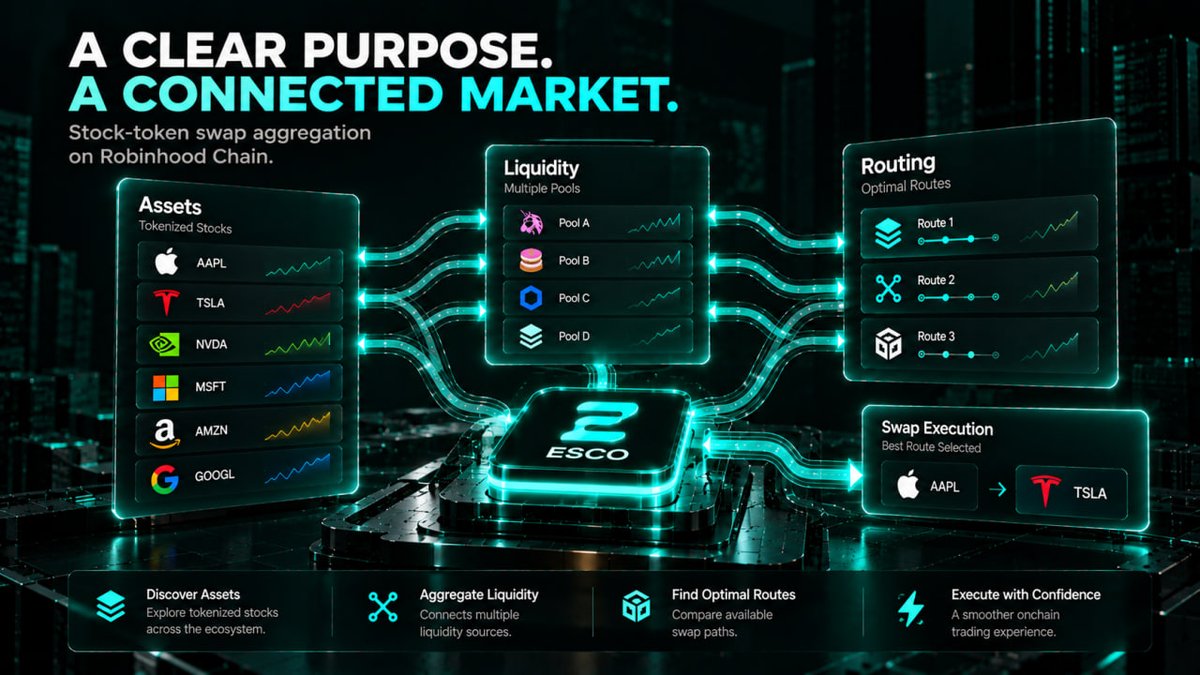
A ticker can start a conversation, but a product gives you something meaningful to evaluate. With ESCO, the central question is whether stock-token swap aggregation can provide a useful experience for people navigating liquidity on Robinhood Chain. If you are considering $ESCO, look beyond the chart. Explore the application, verify the token details, understand the risks, and form your own view of its potential.
In fragmented markets, the path between two assets can matter just as much as the assets themselves. As onchain markets continue to evolve, liquidity is not always concentrated in one place. Different pools can offer different routes, and navigating those options can add complexity to what should be a straightforward swap. This is where swap aggregation becomes important: helping users discover available routes and bringing liquidity opportunities into a more connected experience. Of course, finding a route does not automatically guarantee the best outcome. Liquidity depth, transaction fees, price impact, and changing market conditions can all influence the final execution. Better routing is about helping users navigate those factors, not eliminating the risks that come with onchain trading. ESCO is focused on bringing this routing approach to stock-token swaps on Robinhood Chain, addressing a practical infrastructure challenge as tokenized markets continue to develop. Because as the ecosystem grows, the tools connecting assets, liquidity, and execution may become just as important as the assets themselves. Understanding how liquidity moves is an important step toward understanding where onchain finance is heading. Explore ESCO: escova.fun
A clean interface is only one part of a useful DeFi product. Behind the experience are liquidity sources, possible swap routes, execution considerations, and the information users need before making a transaction. ESCO's focus is on connecting those elements through stock-token swap aggregation on Robinhood Chain. The product deserves to be evaluated on how well it solves that problem.

If you follow the development of Robinhood Chain, ESCO is worth adding to your research list. Its focus sits at the intersection of stock-token markets and DeFi infrastructure, with swap aggregation intended to connect available liquidity routes. That gives the project a specific problem to address and a clear product narrative to evaluate. Explore the platform, investigate $ESCO, and decide whether the thesis makes sense for you.
ESCO is bringing stock-token swap aggregation to Robinhood Chain by connecting available liquidity routes through routing infrastructure designed to help users navigate pools more seamlessly and understand the technology powering a more connected onchain trading experience.
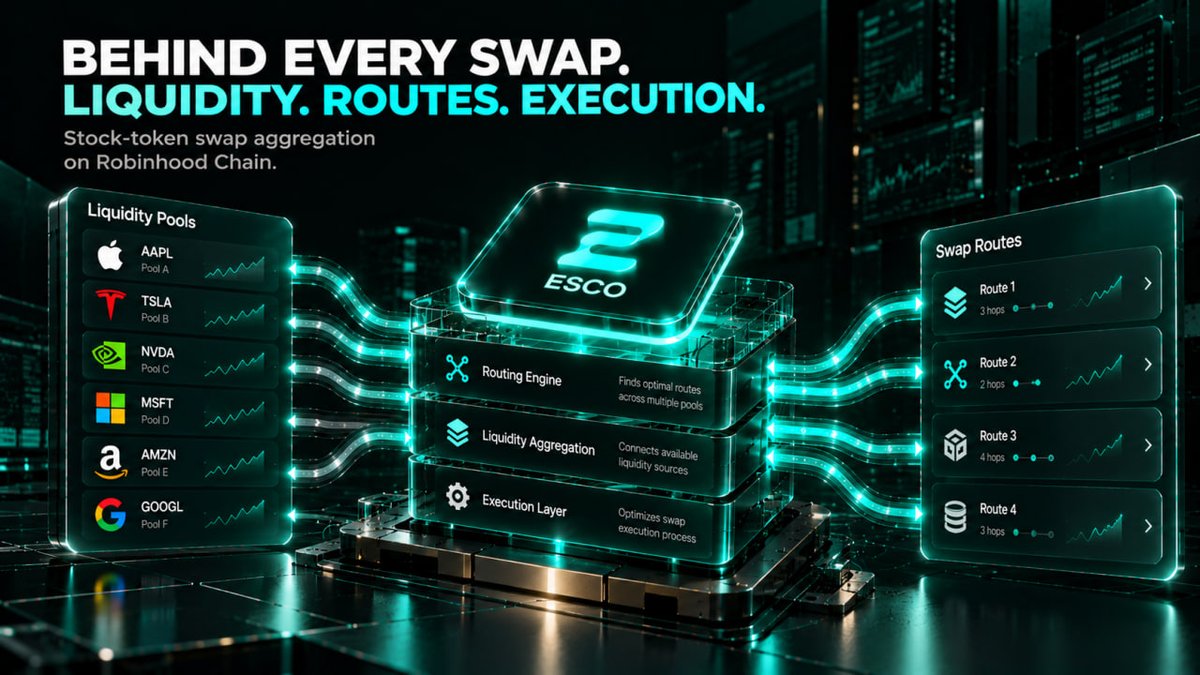
Complex infrastructure does not have to mean a complicated user experience. For a swap aggregator, clarity matters: understanding the assets involved, reviewing the route, and knowing the expected output before confirming a transaction. ESCO's focus on route aggregation addresses an important part of that experience. Good infrastructure should make the process easier to understand, not harder.
ESCO is built around this idea on Robinhood Chain. The project focuses on bringing available stock-token swap routes together, exploring how liquidity discovery and routing can contribute to a more connected trading experience. As the onchain ecosystem develops, the tools connecting liquidity sources may become just as important as the assets themselves. Better-connected infrastructure can play a meaningful role in how users explore and interact with emerging tokenized markets. The opportunity is not only about individual assets or trading pairs. It is also about the systems that help connect them. That is the space ESCO is working to serve.

Different assets. Different pools. One connected experience. As onchain markets continue to evolve, liquidity can be distributed across multiple pools and routes. For users, navigating those options and understanding how different routes connect becomes an important part of the swap experience. This is where infrastructure matters. Beyond simply bringing assets onchain, the ecosystem also needs tools that help users discover available liquidity and navigate swap opportunities more efficiently. Swap aggregation is one approach to addressing that challenge by bringing route discovery into a more unified experience. The goal is to make the path between a user's intent and an available swap route easier to navigate.
The evolution of onchain markets is about more than putting assets on a blockchain. Users also need ways to discover liquidity, compare routes, and interact with the assets available to them. This is where infrastructure projects can play an important role. ESCO is building around stock-token swap aggregation on Robinhood Chain, contributing to a broader conversation about how onchain markets can become more connected.
The most interesting crypto projects are not always the loudest. Sometimes, the opportunity lies in the infrastructure connecting an emerging market. ESCO is positioning itself around stock-token swaps, liquidity aggregation, and routing on Robinhood Chain. If that intersection fits your interests, take time to understand the product, the token's role, and the project's onchain details. Research first. Make your own decision.

Itab33 Thaqeb13 @ltab33
8 Followers 219 Following
popo @popoco0n
13 Followers 566 Following

Bull Crypto Team @BullsCryptoTeam
395K Followers 4K Following BULLISH BY VISION • BUILT FOR THE FUTURE. Web3 Marketing Expert • X Promotion • Strategy • Content • Growth. DYOR, NFA. For business & partnerships - DM 📩📩
Leo 🐙 @MKTGWeb3
253K Followers 29K Following Degen / Alpha Caller | @pastelalpha Driving growth & innovation through data-driven marketing strategies. Helping brands connect, engage, and thrive 🐙
Sol Pumpfun @SolPumpFunTiger
75K Followers 36K Following Helping crypto projects get real exposure 📈 Twitter + Telegram promo 🚀 Active audience 💎 | Serious collabs only 🤝 DM open #Binance 🔶 #MEXC #BNB 🔶 #BTC #ET
Darky ⭐ @Darkysol4
37K Followers 38K Following Marketing Advisor | #Crypto Web 3 Art Collector | CM | Full time Degen & Caller 🫧 Doodle 🫧 #Memes
BRAIN WAVE AI 🧠 @Zin_iia
39K Followers 38K Following AI Explorer |Ai projects Collabs Welcome 📈 Ai Marketing | Web3 Promos | Fast & Organic Reach | for paid collaboration 💌 [email protected]
Dylan ✨ @DylanCrypto77
58K Followers 51K Following CoolCats #289 ✨ Alpha Caller • 27 Sold Out Projects • Marketer / Builder / Investor / Degen / Collabs #NFT #Crypto • ✨
Woolly @SethInvestz
63 Followers 104 Following HAMMERWING IS FOR THE WORTHY. 4D2TVwWu5NtEoMhoFNJgk3T4jYF4dWbTdBgnnfQ91fns
🐋WHALE OF MOON🌙 @1R3TR_
48K Followers 34K Following 🐋 𝐖𝐇𝐀𝐋𝐄 𝐎𝐅 𝐌𝐎𝐎𝐍 🌙 Crypto • Web3 • Memecoins 🚀 Premium Promotion 📩 𝐃𝐌 for Collabs
Whale Legacy @influencer2255
51K Followers 7K Following #Investor & #Trader. Altcoins & Memecoins. DMs open for partnerships & collaborations. NFA - DYOR
SOLANA EMBASSY @RovercryptoE
121K Followers 81K Following Crypto Marketing Expert || DM for business and projects promotion 🚀
𝑹𝑬𝑩𝑬𝑳�... @relrebell
5K Followers 3K Following Project | Community Manager • Writer • Growth Strategist Degen | Professional Gamble Loser 😂 Building, growing & pushing projects
Crackers @Crackersqa7k
4 Followers 97 Following
Crypto_Craft ✝️ @Onchain_Pilot
3K Followers 3K Following Crypto Alpha & Airdrops | AI & Tech Insights | Web3 Marketing Helping Web3 & Tech projects scale to 10k+ Community users || DM for Partnerships👇🏾
Mr boss | Official @MrbossOfficiial
232K Followers 24K Following 🚀 Building Hype Around Crypto | 🔥 Viral Growth Strategies | 💼 Partnered with Top Web3 Projects | 📩 DM for Business
Oscar Defi @OscarDefii
124K Followers 134K Following Visionary crypto host 🚀 Driving DeFi, NFT & Web3 projects with global impact and communities shaping the blockchain future.

Degen Joe @DegenJoeX
17K Followers 610 Following Helping creators tokenize their products and hunting alpha in degen land. @TheCartelFNF | https://t.co/prbkB9u1ZK
Jason Crypto @1YA50
29K Followers 20K Following Crypto Influencer & Promoter | NFA - DYOR | Investor in #BTC #BNB #ETH #SOL #MEMECOINS | DM for Business📩⠀⠀
ThunderIris ⚡ @urphv89126934
256 Followers 251 Following Undisturbed by praise, unmoved by criticism.
Olivia Crypto @OliviaCryptoX
35K Followers 14K Following Top Crypto Influencer & Promoter 🚀Uncovering 10x-1000x Gems | Marketer Alpha | Investor in #BTC #SOL #ETH #BNB #Memecoins • NFA_DYOR • DM for Promotion 📩
RH Gems💎 @88i90_
30K Followers 27K Following RH Gems | Crypto Influencer | Community Builder Hunting the next crypto gems DM for promotions & collabs

QueenFi-Crypto @simon_fisher2
113K Followers 44K Following Crypto Market insights & early narratives• On-Chain data• Trends• DYOR• DM open for collabs
Visionary WEB3 @VisionaryWEB3_
10K Followers 1K Following Building brands that define Web3. Strategy • KOLs • Growth • Community Connecting projects with the people who move markets. Partnerships & enquiries
Crypto League @Crypto_league1
16K Followers 1K Following 🐋 Marketing & Growth 🚀 Amplifying Reach. Building Influence. 🤝 Strategic Promotions & Partnerships 📩 DM Business Inquiries & Collabs
Vitalii P @vitpavlov844
72 Followers 588 Following
Niazi aka RUN MUREED @burger804
2K Followers 5K Following Taliban - I’m Osama Bin Laden- Wardaat daal k side pe hojana khamoshi se kesay hota mujh se seekhain- Phuppo- Piddumoosewala


Jaxon Crypto @mody_basma
134K Followers 8K Following Crypto Enthusiast | Web3 Marketing Expert Hunting the next 100X gems | DYOR | DM for business 📥
Kayla Crypto @cry_pto347
100K Followers 3K Following Web3 Marketing | Crypto • DeFi • Emerging Projects | Building visibility across the space | DM for collaborations ✨

Kaith Crypto @m97HR
90K Followers 46K Following Crypto Influencer & Marketing Expert | Hunting the next 100X gems | DYOR | DM for Business
David @DMX7227
263 Followers 2K Following
DEEVINE 🕊 @DEEVINEinc
766 Followers 1K Following C.E.O of DOVINE. Project Builder and manager Degen 🧑🍳
Arthur @Lqrp92
94 Followers 873 Following

Whale RH Tribe @WhaleRHTribe
40K Followers 17K Following Top Tier Influencer | Blockchain marketing Expert | NFA | DYOR |DM for collab 🫶 #Pumpfun
Isabella D. Evans @IsabellaDEvans
2.0M Followers 21K Following Growth Marketing Manager | Crypto lover & investor | DM me for performance marketing/advertisement ❤️🔥
Nikmi DeFi @BangBorscs
193K Followers 3K Following ₿Crypto & Web3 Influencer 🦎 || Marketing NFTs/DeFi/Memecoins || Growth Partner Exchanges & Web3 Projects 📩 Promotions & Strategic Collabs #BTC #ETH #SOL
Theana Crypto @Theana174
96K Followers 5K Following Tier-1 Crypto Influencer. NFA - DYOR. DM for Business Inquiries!
Crypto Professor Pr.�... @3__ij
28K Followers 22K Following Crypto Promoter 🚀 & influencer || Gems finder all type of Crypto currency 💵 Official #Binance #BNB Open DM 💌 For Business inquiries 🔥
RH Bull Alerts @2i5jji
36K Followers 20K Following RH BULL ALERTS 🐂🔔 Crypto Alerts • Market Insights NFA | DYOR • DM for Business 🤝@TrenchClaws
Lena Crypto @0o20_
155K Followers 129K Following Riding the Bitcoin wave 🌊 | Crypto exposure 🚀 | Web3 • Growth | Serious collabs only • DM
Crypto Elite @AureliaNayza
146K Followers 30K Following Crypto lover || Passionate about Crypto & Web3 projects || Marketing that delivers real impact 🚀 || DM for Collab 🤝
RH Alpha Calls @RHAlphacalls
50K Followers 3K Following 💎 Alpha Calls 🚀 100X Gem Hunter | Early Alpha 📈 Find Early. Catch Big. DYOR. DM me for collaboration/Promotion Not affiliated with @RobinhoodApp
Uniswap @Uniswap
1.5M Followers 172 Following The largest onchain marketplace. Buy and sell crypto on Ethereum and 22+ other chains.

Ozzy | 奥兹 🅿️ @MEADGod
74K Followers 2K Following Pushin’ 🅿️ at @ponsdotfamily Nothing on my profile is financial advice. Opinions are my own. RTs and QTs != endorsement.
Robinhood Crypto @RobinhoodCrypto
650K Followers 200 Following The home for onchain crypto & institutions.

Vlad Tenev @vladtenev
1.1M Followers 895 Following CEO and Co-Founder @RobinhoodApp 📈📱Executive Chairman and Co-Founder @HarmonicMath 👁️🗨️👨🏫
You might like


















