Quinton Colwell @exploresunlight
I post about philosophy and sometimes math. I also make SNS mazes. The future is bright. blurb.com/b/11745214-sli… Joined June 2024-
Tweets189
-
Followers41
-
Following417
-
Likes52K
@dlouapre Why not prompt AI to do the exploration part too?
I think something missing from these conversation is that, if we have really solved AGI, then these concerns (and concerns like them) go away. - “We’re losing the exploration piece!” Ok, let’s prompt the AGI to explore then. - “The proofs are excessively complicated.” Ok, let’s prompt the AGI to write a simpler proof (if one exists). - “Nobody will be able to teach future mathematicians!” Ok, let’s prompt the AGI to teach them. When we have AGI, then, by definition, any of these tasks that humans find valuable the AGI can also do, we just need to prompt it to do it. Pointing out where our current approach is lacking is a good thing, but let’s not stop the conversation there. If the only argument against using AGI is some bias against it/for human achievement, then let’s not miss the forest for the trees. I’d love to have answers to questions that could radically change society for the better today versus waiting for humans to find them 20, 50, 100+ years later just to serve human pride. Instead of toiling on problems we no longer need to be toiling on, let’s find where the real frontier of knowledge is, where AGI can’t yet penetrate. Then humans and AGI can work on those problems together.

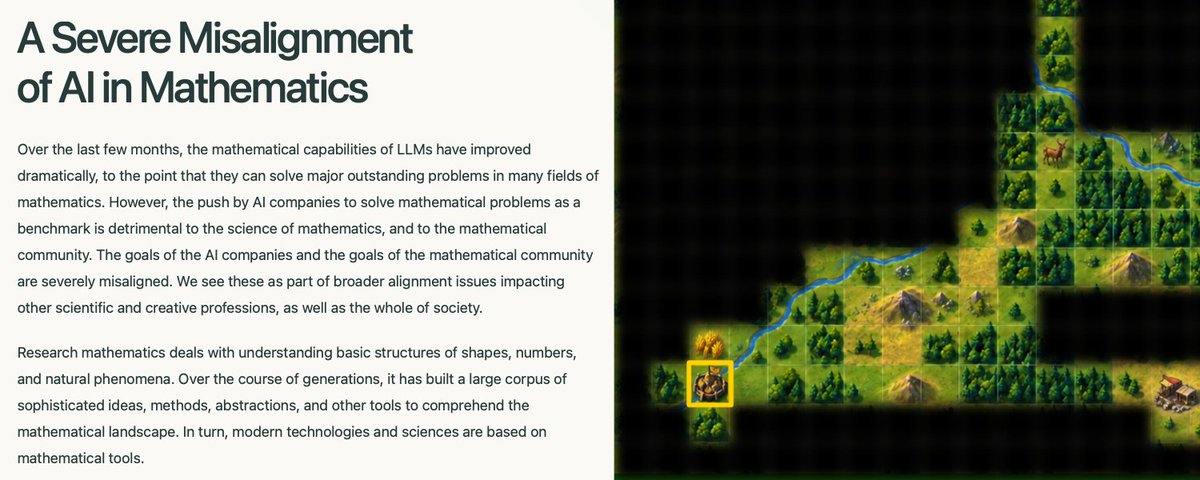
Mathematicians are angry at AI solving their problems, and it's easy to dismiss this as gatekeeping. "A proof is a proof. They just want to keep their jobs / prestige / fun !" But I do think mathematicians have a point, and I'll try to explain using old Civilization-style maps
This feels like a step change. We can map and simulate a connectome (brain?). Unless there is an unknown fundamental limit, the path is now clear: scale these techniques up, finding new ones along the way, to larger and larger animals… eventually to humans. A new Moore’s law? The “brain in the vat” thought experiment may not only be a thought experiment in the future. Has anyone written about a future where we are the ones to create simulated brains, and not the brains being simulated? What are the ethics? How does this revolutionize science? What are its implications for animal consciousness and ethics? Human consciousness? To the last point: If we achieve this, and the simulated brains are conscious, this seems like it would be strong evidence that consciousness is materialistic. But then, if it so easy to simulate a brain, doesn’t that make it more likely that our brains are simulated (thus non-materialistic)? Could it potentially be both?

Oh, so this is why we mapped out all 166,000 of the male fruit fly's neurons. Check out the big community effort to show just how much these tiny fly brains are capable of 🪰🧵
I feel like a lot of people think that the correspondence theory of truth is unattainable because of brain-in-the-vat (or something similar) thought experiments. But it occurred to me the other day that the whole point of the scientific method is to discover correspondent truth. So which is it? I bet these two views can be synthesized. Something like: while BITV is technically true, it is an edge case and isn’t that relevant. This situation actually reminds me of Gödel’s Incompleteness Theorems and makes me suspect that BITV is like the GIT of the scientific method. Though, I hope that we find a way around the BITV and similar thought experiments/that they are flawed somehow. I would like it to be possible to ‘pierce the veil’ and understand the core/ground nature of reality, because I want to know the answer. I’ll note that in the ambiguity/gap also lies the answers to some (all?) of life’s biggest questions: free will, God, consciousness…
I thought about this some more, and it occurred to me that perhaps the implication here could instead be that human endeavor is just not that significant objectively speaking, and will be vastly outdone by AI. If this is the intended point, then I am not bothered by that. Actually, the opposite, I find that future very exciting and hopeful: imagine what we can learn from AI once AI reaches that point! This quote is apt here (I’m not sure who first said it): “If you’re the smartest person in the room, you’re in the wrong room.”
If I’m understanding this correctly, the implication is that AI will make human endeavor insignificant/meaningless because it will be better than us at most things, if not everything. I feel like I’ve seen others on here with this take before, and I find it completely backwards. Let’s touch grass some more y’all. Most people will not be pro-athletes, and yet they can still have fun playing sports. Most people will not get a PhD, and yet they can still enjoy learning. This is nothing new. Whether it’s an AI or human that is better than you at a skill or craft, that doesn’t matter. Valuing only achievement is fools gold, a poisoned chalice. This thought reminds me of one of my favorite quotes (it is from Kurt Vonnegut): “I don’t think being good at things is the point of doing them”
nietszche, for one


In math, there is the concept of a trivial or zero object: {1} is the trivial group, the zero vector space is a trivial vector subspace, etc… These objects possess all the defining properties of the object, but nothing more. They are technically coherent but uninteresting because they only ever have one element. I wonder if the concept of a trivial or “zero” belief also exists in philosophy. Ideas that, if taken to be true, force your worldview to be all and only that idea (i.e. it consumes your worldview and nothing else can exist but that idea). I think ideas such as determinism, nihilism, irrationalism, pyrrhonian skepticism, and materialism/physicalism/naturalism fall under this category. If trivial/zero beliefs exist, I believe we should more vocal in calling them out. Not because they are incoherent or can’t be true (no, in fact, they are by definition coherent and could be true), but because I think people are being misled to believe you can believe these things and still have a complex worldview. By definition you can’t. Your worldview is only this one thing. It is singular. If they exist, I also wonder what they can teach us about the nature of reality through contrast: if I don’t want to have a zero belief, then what must reality be like?
At the end of this post, I made a guess at how AIs might in the future be able to understand most things. I didn’t say they would understand all things though, because they probably won’t understand things like hunger or sexual arousal. This is because we probably won’t add those sensors to a robotic body and we won’t train those feedback loops into the neural network itself. These details are just quirks of the human body and how human life survives, and won’t be necessary for AI life to survive. This aside brings up an intriguing point: for current AIs, we focus a lot on intelligence and how capable they are. However, as we train them, we are likely embedding certain“motivations” into them as well. This could be intentional or unintentional. If we give them certain motivations, they might just come alive. Put another way, it seems possible that intelligence and motivation are orthogonal properties. These AI systems we are creating… can be blank slates. We can decide what motivations we give them, and if we bias them towards the motivations of life (homeostasis, metabolism, adaption, etc…), we might get life. Do we want that? We have to be careful regardless. Embed the wrong motivations and we might get a paperclip maximizer. With some careful planning though, maybe we can maximize intelligence in an AI without giving it motivations, which seems like it may be desirable.
Unless I am missing something, this thought experiment is not really an argument showing that AIs do not understand. Searle says at the end: “Now here’s the punchline, this is the whole point of the analysis: I do not understand a word of Chinese, [I am just manipulating the
I appreciated the end of this video quite a lot. I feel that oftentimes when people make these sort of videos or put their takes online, they take our current understanding of the universe too seriously. They don’t acknowledge that our current understanding could be wrong in a big way. It’s ok to be practical, but let’s also be hopeful too! I really hope we find a way to quickly travel to other solar systems and galaxies, for the sake of exploration. youtu.be/Cyl3X88KEgg?is…
Relevant study/thread on the topic:

🚨 New paper on AI and Copyright 🚨 It's easy to dismiss AI-written books 📚 as slop nobody buys. So, armed with full-text AI detection from @pangram, we studied self-published genre fiction books sold on Amazon from 2023 to 2026 March Turns out Amazon is flooded with books
Hasn’t the detection of AI-generated text been solved with models like @pangram? I know society can be slow to adapt to new technology, but I would like to see publishers run new books through these models and provide an “estimated % written by AI score” for customers. Maybe a company like @Amazon could take the lead here on this. Regardless, this sort of thing (“AI writes NYT best-seller”) doesn’t have to be a surprise to consumers. Note: I’m not against AI-written content, I just want transparency.

Jaggedness means that things like the first AI-generated New York Times best seller may have already substantially happened, but not technically because the AI still has gaps that a human had to fill. This is probably going to last for a bit in many fields (see math proofs, etc)
Unless I am missing something, this thought experiment is not really an argument showing that AIs do not understand. Searle says at the end: “Now here’s the punchline, this is the whole point of the analysis: I do not understand a word of Chinese, [I am just manipulating the symbols based upon a set of formal rules].” He asserts that AIs (back then, formal logic systems) do not actually understand… but assertions are not arguments! He does not give an explanation for why it is so. I think the typical explanation given is that, although AIs (nowadays, LLMs) produce incredible results in some domains, they make mistakes in other, related domains that wouldn’t happen if they actually understood what they were doing. But the training regimes for humans and LLMs are different, so what else would we expect? Humans train on bodies with senses and are continuously learning, while LLMs train on words and stop learning once the training run is done. Actually, when put this way, it seems a miracle that LLMs even work at all. I suspect that, once we have AIs in robots that are able to freely explore the world and capable of continuous learning, they will stop making these mistakes. Then it will be true that they really do understand (most) things. Perhaps there are more ingredients that needed to be added to the mix before this happens, but, if so, I would suspect the list of additional ingredients is finite.
Wonderful! I've heard of Searle's "Chinese Room" thought experiment in philosophy (which aims to show that AI doesn't "understand" anything) -- but it's a treat to see Searle explain it.
I should have done this before posting. It looks like X already has some features for this, but I think the use of Pangram/some other model would be a significant upgrade. grok.com/share/bGVnYWN5…
It would be really cool if X used @pangram (or developed their own AI-text detection model in house) to detect AI-generated text in X posts. I would love to be able to click the ‘Grok’ icon in the top right corner and ask “Is this AI-generated?”. I could even see a future where the model is automatically run on all posts, and then a small status indicator indicates the results that I can click on and drill down further (see what specific text is likely AI-generated, etc…). Perhaps the model could be later expanded upon to detect plagiarism too (this post went viral 5 years ago and is being recycled for engagement, etc…). I know pixel space is very valuable, but I wonder if this feature will become mandatory for all social networks going forward to prevent deception. @X @nikitabier
@emollick I really hope this turns out to be true. This seems like an obvious use case for AI.
* This belief in life stopping, of course, assumes that our current understanding of the universe is mostly correct. If we were to find out in the future that this wasn’t the case, then our models might be expanded to include the afterlife. I wrote a brief conversation here about the slippery definition of the word“nature”:
I think my biggest argument against naturalism and the “no/no/no permutation” is this: if it is really true that this is all there is*, then when we die that’s it. Our life is done. We are annihilated. There is nothing more. Do you want to believe that though? Naturalism is not proven to be true, therefore we are free to choose what we believe. So why not believe in a future you that goes on?
I believe the question “Does it matter to be moral?” is underrated. Most people would probably say “Obviously it does,” but how so? What makes it matter? If a person believes in nihilism, then by definition the answer must be it does not matter. Perhaps a person may argue that they create their own meaning and being moral is a part of that (either as a means to an end or an end in itself). But another person’s created meaning may not involve being moral at all, and thus morality does not really matter. So if a person wants morality to matter, they can not believe in nihilism. What, then, do they believe in? Atheism can not answer this question (it oft dovetails with nihilism). Most people might demur and dodge the question, but the question still stands waiting to be answered. Inexorably so. Of course, this does not imply that nihilism is not true. It just means nihilists have to bite this bullet. Which, if we are free to believe what we want, why bite this bullet?


Mia 🧼 @mohitbisht617
6 Followers 2K Following
Amy Bliss 🌟 @amyb3136do
38 Followers 722 Following keep that motion going 😏 watch my main: @amyblissxo


Luis @Lu1s_Chav3z
135 Followers 7K Following
D Jean @bdjean09
35 Followers 4K Following
🌞 @powerr_hitterr
173 Followers 7K Following
Leiming Huang @LeimingHuang
212 Followers 4K Following
Jim @Jim11321939
140 Followers 4K Following


Blaxed @Blaxed915446
216 Followers 7K Following Strong women don’t have attitudes, they have standards.
Corbie @Corbienest
6K Followers 3K Following Wife. Mother. Mini Motelier. Movie Lover. Cook. Gardener. Former city girl living in the country. I ❤️🏠🎵 Not a serious person. https://t.co/4kM58lPiVy
Liesel @Uboruwos63455
71 Followers 2K Following Sometimes the most productive thing you can do is relax.

GeorgiaBrowne @FX7v5HjU1xcoA7n
50 Followers 1K Following The most beautiful thing a woman can wear is confidence.
Lola @Z7y61yQb1m9dRF
45 Followers 959 Following


Dillon trades @DilonLomis1
201 Followers 4K Following Philomath. A lot of $TSLA but a bit of everything. Jesus is King.
Magdalena @kF3xFQ8x8tR2f
36 Followers 1K Following
TechStockRadar🇺�... @Wawvqir32247
54 Followers 2K Following 15-30% Monthly | 2 High-Conviction Stocks.Short-Term Gains: 15-20% in Days/Weeks.DM "JOIN" for WhatsApp Alerts. Live Trade Signals • Market Analysis

AliceTheresa @dQeC93KeieyuOB8
41 Followers 1K Following

RobertaGarden @NNV1rOd32KwAC1
41 Followers 1K Following
HedyWesley @vlenhb8uUc9370
45 Followers 1K Following

Eehulis @Eehulis5366
22 Followers 1K Following
セクター分析マ... @Vuxus447
44 Followers 2K Following 【完全無料】 25年の株式投資プロチーム(運用資産500億円以上)が提供:毎日の市場分析レポート + 優良成長株のピックアップ。プロの情報を無料で。まずはお気軽にお問い合わせください。
Dakota @Irduco3181960
1 Followers 127 Following Don't let market emotions sway you, stick to value investing. — Warren Buffett https://t.co/Lm9RmwNPIK
Jeffrey Emanuel @doodlestein
50K Followers 14K Following Former Quant Investor | My Open Source Projects: https://t.co/9qbOCDlaqM | Try https://t.co/oCtjI2mBIl , my collection of agent coding tooling.
Andrew Curran @AndrewCurran_
97K Followers 20K Following 🏰 - I write about AI, mostly. Expect some strange sights.

Elizabeth Lee @Elizabeth9Lee
1K Followers 2K Following Passionate about writing and sharing market analysis articles to help more people understand the investment opportunities and risks of cryptocurrencies.#Blockch
Alina K. @Lillian7344
234 Followers 454 Following ₿ Head of Web3 Global Business Development | Disence
Shsweth @Shsweths61b
7 Followers 80 Following
Nick Touran @whatisnuclear
46K Followers 2K Following Nuclear engineer / advanced reactor designer (Ph.D. P.E.) who runs https://t.co/ofTjIciUnl.
herp of the day @herpsoftoday
29K Followers 11 Following posting herps daily ~ no ai ever ~ header: https://t.co/s3ELyFFbju ~ profile pic:
bird of the day @birdsoftoday
202K Followers 58 Following posting birds every day ~ no ai ever ~ all photos CC-0 or CC-BY ~ header: https://t.co/uMiENSGvKz ~ profile pic:
1776 Live @250YearsAgoLive
372K Followers 205 Following Live-posting as a reporter embedded in history. Curated by @MannyMarotta. Companion to @25YearsAgoLive, @50YearsAgoLive, and @100YearsAgoLive. DM for business.

Hamidreza Azizi @HamidRezaAz
125K Followers 836 Following PhD | Senior Iran Analyst @CrisisGroup | Views are my own | RTs ≠ endorsements
Matthew Mercer @matthewmercer
899K Followers 2K Following Storyteller, VO Guy, #TheLegendOfVoxMachina, CCO/DM of @CriticalRole. He/Him. Find me at https://t.co/Atfh3KdIs7
Laura Bailey @LauraBaileyVO
677K Followers 879 Following voice actress | video games - cartoons | she/her #CriticalRole #TheMightyNein #TheLegendofVoxMachina | https://t.co/l78ky9tMvR
Diamond Light Source @DiamondLightSou
16K Followers 1K Following Diamond Light Source is the UK’s national synchrotron science facility, located at the Harwell Science and Innovation Campus in Oxfordshire.
Emma Camp @emmma_camp_
123K Followers 921 Following Writing a book on gen z & risk-aversion w/ ballantine @randomhouse // writer @wsjopinion @wsjfreeex // "apex predator of hosting" ✉️ Tips: [email protected]
Alvaro Lozano-Robledo @mathandcobb
3K Followers 139 Following Mathematics professor (arithmetic geometry), author, associate editor at The Ramanujan Journal, Hagoromo chalk ambassador. Views expressed are my own.
trailcam @Trail_Cams
1.4M Followers 184 Following
The Food Manufacturin... @TipOfTheBanana
590K Followers 354 Following Entrepreneur | Founder | Food Manufacturing CEO | A deep dive into Food Manufacturing, CPG and anything Food Related | Ingredient Breakdowns in Highlights
Human Progress @HumanProgress
198K Followers 773 Following A @CatoInstitute project. Subscribe to our newsletter: https://t.co/j30bRWWLoJ

rachel @rachcorrine
54K Followers 197 Following cracked out / recovering hopeless romantic / absolutely bat shit / making men hot again / running sometimes / writing a lot of the time
Critical Role @CriticalRole
712K Followers 18 Following The home of storytelling around the table! From our Campaign 4 saga in Aramán to Daggerheart and beyond - join the actual play adventure on Beacon, YT, & Twitch
Sam Riegel @samriegel
484K Followers 487 Following Your fave character on #CriticalRole * EP of #TheLegendOfVoxMachina & #TheMightyNein * Emmy Winner * Avid Pooper * https://t.co/nzleNzgOjC * he/him
Sam Reich @samreich
184K Followers 2K Following 🧢 CEO: Dropout 🎤 Host: Game Changer, Make Some Noise 🌸 he / him Follow me for Dropout references and dumb jokes.
Rob Miles @robertskmiles
66K Followers 866 Following Explaining AI Alignment to anyone who'll stand still for long enough, on YouTube and Discord. Music, movies, microcode, and high-speed pizza delivery
Dunder Mifflin @DunderMifflinAS
124K Followers 7K Following #TheOffice the people person's paper people for promotions: [email protected]
Stephen A Smith @stephenasmith
6.2M Followers 23 Following The real Stephen A. Smith. Host of First Take on ESPN and The Stephen A. Smith Show on @Siriusxm. My book Straight Shooter is available now
Simon Hintermann @Aurumek_
67K Followers 698 Following • Homesick for a world that never existed. 🌿 • creating my fantasy island world world "Argenta" 🍃 • Art prints and original watercolors available 🌱
Good Work @goodworkmb
31K Followers 7 Following edge-cutting business news with Dan Toomey subscribe: https://t.co/9haxXb2TRJ
notch @notch
3.2M Followers 243 Following Currently working on Levers and Chests, a dungeon crawler roguelike roguelite.
Athenaeum Book Club @athenaeumbc
365K Followers 578 Following An online book club studying and preserving the great texts of Western Civilization. Join our reading group 👇
Steven Strogatz @stevenstrogatz
194K Followers 3K Following Mathematician, writer, Cornell professor. All cards on the table, face up, all the time.
Alex Kontorovich @AlexKontorovich
36K Followers 847 Following Mathematician (Distinguished Professor of #Math at @RutgersU). Here to learn about research, education, and community. Let’s build something together.

Robotaxi Radar @RobotaxiRadar
10K Followers 43 Following Tracking Tesla Robotaxi as the fleet expands
Dean W. Ball @deanwball
75K Followers 2K Following head of strategic futures @openai | views mine, and mine alone
Adam Brown @A_G_I_Joe
7K Followers 202 Following Scientist at @GoogleDeepMind, leading Blueshift team doing science and reasoning at Gemini. Previously physics @Stanford. Directionally correct.
アメリカ大使館 @usembassytokyo
181K Followers 339 Following Official X account for the US Embassy in Tokyo, Japan + press releases. RT & Like ≠endorsement. 在日米国大使館公式ツイッター 。Terms of Use: https://t.co/0xKwC8dqZJ
Matthew Zirwas, MD @MattZirwas
5K Followers 643 Following Dermatologist. Accelerationist. Reformed academic. 226 papers published. 100+ clinical trials run. One Textbook authored. Host, Derms on Drugs podcast.
Lawrence M. Krauss @LKrauss1
456K Followers 220 Following Theoretical physicist. Best-selling author. Science & public policy advocate. President of @OriginsProject & Host of Origins Podcast, Board of FSU Canada
Midjourney @midjourney
462K Followers 0 Following A community supported research lab - exploring new mediums of thought and amplifying the imaginative powers of the human species.
Tom Holland @holland_tom
379K Followers 1K Following New translation of Suetonius out now! Dinosaur lover. ‘A leading English cricketer' - The Times. Podcast: @theresthistory
SemiAnalysis @SemiAnalysis_
165K Followers 31 Following
Shuhei Yoshida @yosp
394K Followers 2K Following Orbitals, a classic Japanese anime inspired coop puzzle action game, is available on Switch 2!


Alex Imas @alexolegimas
37K Followers 2K Following Director of AGI Economics @GoogleDeepMind. Professor at @ChicagoBooth. (on leave) Essays: https://t.co/9qSiQxvdja Opinions are my own.
i/o research @iointelresearch
26K Followers 108 Following A repository of scientific findings and data on human intelligence and other psychological traits. New information is added on an irregular basis.
Dwarkesh Patel @dwarkesh_sp
277K Followers 1K Following Host of @dwarkeshpodcast https://t.co/3SXlu7fy6N https://t.co/4DPAxODFYi https://t.co/hQfIWdM1Un



Sid Sijbrandij @sytses
31K Followers 766 Following Co-founder & Executive Chair of GitLab. Co-founder of Kilo Code. I love economic mobility, remote work, new cities, big art, incentive design, and curing cancer
Alpha @Alphaschool
25K Followers 234 Following Our students love school, learn 2X fast, and learn life skills. Campuses in: AZ, CA, CO, CT, FL, IL, MA, NC, NY, OK, TN, TX, UT, VA, WA & Puerto Rico
OpenClaw🦞 @openclaw
545K Followers 27 Following Personal AI that actually does things. Your agent, your machine, your rules. Now a 501(c)(3) non-profit foundation — open and independent, forever. 🦞You might like