

Nick @hodnick
Real-world AI & forward-deployed engineering at Microsoft. Sharing what I’m building and learning. Dad, gamer, tinkerer. Views my own. linkedin.com/in/hodnick Joined October 2026-
Tweets10
-
Followers4
-
Following261
-
Likes27

If you learn AI Infrastructure Engineering, you will never be unemployed again. Stage 1: Systems & GPU Foundations - Learn: C++, Rust, CUDA memory hierarchy, PCIe vs NVLink, thread blocks and warp scheduling. - Practice: Write a custom CUDA kernel for matrix multiplication from scratch and profile it against cuBLAS. - Why: You cannot optimize what you do not understand at the silicon level. Stage 2: Transformer Inference Physics - Learn: Prefill vs Decode phases, arithmetic intensity, memory bandwidth bottlenecks, KV-cache math. - Practice: Profile a HuggingFace model with Nsight Systems to identify the exact memory bottleneck during token generation. - Why: LLM inference is almost always memory-bound, not compute-bound. Stage 3: Modern Serving Engines & Batching - Learn: vLLM, SGLang, PagedAttention, continuous batching, chunked prefill. - Practice: Deploy a 70B model and tune chunk sizes to maximize throughput without starving decode requests during long-context prefills. - Why: Naive batching leaves 60% of GPU VRAM wasted. PagedAttention fixes this. Stage 4: KV-Cache & Memory Optimization - Learn: Prefix caching, KV quantization, CPU offloading, multi-turn cache reuse. - Practice: Build a routing proxy that directs requests with identical system prompts to the same replica to share KV blocks. - Why: Reused cache is free speed. It can slash Time-To-First-Token (TTFT) by 80%. Stage 5: Quantization & Compression - Learn: FP8, INT4, AWQ, GPTQ, Sparsity, TensorRT-LLM calibration. - Practice: Serve a model in FP8 vs FP16 and benchmark the exact perplexity drop against the latency and VRAM gains. - Why: Quantization is the only way to fit frontier models on edge GPUs and protect your margins. Stage 6: Kernel-Level Engineering - Learn: Triton, FlashAttention, CUDA graphs, operator fusion. - Practice: Write a fused Triton kernel for RMSNorm or Softmax and benchmark it against the native PyTorch implementation. - Why: Python overhead kills inference. Fused kernels save milliseconds that compound at scale. Stage 7: Distributed Inference & Parallelism - Learn: Tensor parallelism, Pipeline parallelism, Expert parallelism (for MoE models). - Practice: Shard a 405B parameter model across 8 nodes and measure the communication overhead between GPUs. - Why: Single-GPU inference is dead for frontier models. You must master the shard. Stage 8: Speculative Decoding - Learn: Draft-target models, Medusa heads, acceptance rates, n-gram drafting. - Practice: Build a pipeline where a local 3B model drafts tokens for a cloud 70B model to verify in parallel. - Why: 2x decode speed at zero quality cost is the closest thing to a free lunch in inference. Stage 9: Multi-Node & Hardware Interconnects - Learn: NCCL, RDMA, InfiniBand, NVLink, Disaggregated Prefill/Decode architectures. - Practice: Set up a multi-node cluster and profile the network latency of tensor parallelism across nodes vs within a single node. - Why: Network latency is the new GPU bottleneck. Disaggregating prefill and decode is the 2026 meta. Stage 10: Cluster Orchestration & GPU Scheduling - Learn: Kubernetes GPU operators, Ray, Slurm, MIG (Multi-Instance GPU) partitioning, KEDA. - Practice: Build a queue-based autoscaler that spins up spot GPUs based on pending inference requests and drains them when empty. - Why: Idle H100s burn $3+/hr. FinOps and scheduling are now core infra responsibilities. Stage 11: AI Gateways, Routing & Observability - Learn: TTFT/ITL SLOs, semantic routing, DCGM metrics, OpenTelemetry for LLMs. - Practice: Build a gateway that routes simple queries to a quantized local model and complex reasoning to a frontier API based on prompt complexity. - Why: Routing protects your margins and DCGM metrics tell you when your GPUs are silently throttling. Stage 12: Public Benchmarks & Teardowns - Learn: Reproducible methodology, latency/throughput Pareto curves, cost-per-token analysis. - Practice: Publish a teardown comparing vLLM vs SGLang vs TensorRT-LLM on your specific hardware with full configs. - Why: Public proof of hardware mastery gets you hired instantly by top AI labs. Wrappers are a commodity. AI Infrastructure is the physics of scale. The modern AI Infra Engineer builds the silicon nervous system for global intelligence. Bookmark and Repost!

Don't waste 2 years learning to become an AI agentic engineer in 2026. Andrew Ng, the godfather of AI, gave the complete playbook to become one from scratch. 1 hour course. Free: • 00:00 - AI agent basics • 12:12 - AI Agentic workflows & design patterns • 53:27 - Practical tips for building AI agents • 1:20:30 - self-improving AI agent loops • 1:30:19 - multi-agent AI systems I watched it last night. Halfway through, I realized I could get into Anthropic in weeks, not years. Bookmark now. Watch it. Then build your own AI agent

Dusting off this tweet from April because this gap in shared understanding of LLM capability is *widening*. It's now less "two groups of people speaking past each other" and more a sharp funnel. - Napkin math somewhere around 6B people (~75% of the population) have barely come in contact with LLMs at all. - Around 1-2B (~20%) are casual and infrequent users of free-tier ChatGPT-like products. This group sees derpy chatbots and treats them a bit like a better Google search, a writing aid, or etc. Maybe an agent tries to book you a flight. I have non-tech friends who (reasonably, imo) say they have not much use for it at all. Even many professionals outside of math&code are in this tier. For example, execs and many other functions spend a lot of their time talking to other people, so while they understand what is happening intellectually, it is still second-hand and a bit abstract. - Now we get to professional use of frontier-grade LLMs in math&code. Somewhere around 20M people (0.2%) see first-hand that large, complex projects that used to take them weeks/months can now be completed by agents with a prompt. Building apps, copying apps, translating apps, decompiling apps from binaries... This has all happened very quickly and recently - less than 1 year ago, I was writing code manually by hand, typing memorized computer code commands into a code editor character by character, occasionally pressing Tab to autocomplete a little chunk of code. - And finally we get to the ~5,000 people (~0.00006%) with access to frontier-grade systems internally. The external world has seen the preview. It looks like swarms of thousands of agents collaborating over weeks on software mega projects: minting zero days, running cyber attacks and defenses at machine speeds, discovering new science, advancing the frontier of mathematics. Things that would have taken top professionals in the industry years of work. Meanwhile, human review and comprehension are starting to fall behind. For example, people are still involved in the "archeology" of the OpenAI-HF incident from many months ago. Mathematicians may be poring over the 722 manuscripts on frontier mathematics for a while. The funnel is driven by a combination of factors: 1. The impact scales with ambition, problem size, and horizon. A question with a paragraph answer barely stresses the system. You need a reservoir of big, difficult problems that you really care about. This aspect drives the consumer / professional dimension of the funnel. 2. The jaggedness of the system (which I have written about a lot separately). Capability peaks in domains that are digital, verifiable and economically valuable. This is because LLM capability emerges from reinforcement learning on verifiable rewards on a curated environment mixture driven by revenue potential. This aspect primarily drives the area (e.g. math&code) dimension of the funnel. 3. Access. Free-tier, paid-tier, internal. So this is the weirdness of the moment. The general public has mostly not interacted with these systems. When they have, it looks like a derpy chatbot. The majority of professionals still see only a modest uplift. And a small sliver of professionals are experiencing the vertigo of the curve going vertical. And it is all happening at the same time.
Judging by my tl there is a growing gap in understanding of AI capability. The first issue I think is around recency and tier of use. I think a lot of people tried the free tier of ChatGPT somewhere last year and allowed it to inform their views on AI a little too much. This is

joder, GitHub está lleno de cosas gratis que casi nadie está usando. los 10 repos que están explotando este mes, de lo más fácil a lo más técnico: lo que puede usar cualquiera 1. VoiceStudio: clona voces, dobla vídeos y transcribe en 646 idiomas, gratis y sin salir de tu ordenador (57K ⭐) github.com/debpalash/Voic… 2. ppt-master: le pasas un PDF o un Word y te devuelve un PowerPoint de verdad, editable y con animaciones (59K ⭐) github.com/hugohe3/ppt-ma… 3. gods-eye-view de @bilawalsidhu: un simulador de satélite espía en tu navegador, con aviones, barcos y cámaras reales sobre un globo 3D (50K ⭐) github.com/bilawalsidhu/g… 4. REA: le enseñas a tu IA una función de otra app y te explica cómo está hecha, sin tener el código (65K ⭐) github.com/morluto/rea 5. diagram-design de @cathrynlavery: pides un diagrama con palabras y te lo dibuja con tu marca, 44 tipos (49K ⭐) github.com/cathrynlavery/… 6. paperclip: como tener tu propia empresa de agentes autónomos trabajando para ti, la app open source para dirigirlos como si fueran tu plantilla (99K ⭐) github.com/paperclipai/pa… para que Claude Code trabaje mejor 7. skills de @mattpocockuk: las que usa a diario un ingeniero de verdad, pequeñas y fáciles de adaptar (284K ⭐) github.com/mattpocock/ski… 8. ECC: skills, memoria y seguridad en un pack para Claude Code, Codex, Cursor y OpenCode (276K ⭐) github.com/affaan-m/ECC 9. andrej-karpathy-skills: un solo archivo con 4 reglas sacadas de lo que Karpathy dice que hacen mal los modelos programando (218K ⭐) github.com/multica-ai/and… 10. claude-mem: guarda lo que hizo tu agente, lo resume y se lo pasa a la siguiente sesión, para que no empiece de cero (99K ⭐) github.com/thedotmack/cla… compártelo si te ha parecido interesante ♻️ y guárdalo antes de perderlo 🔖

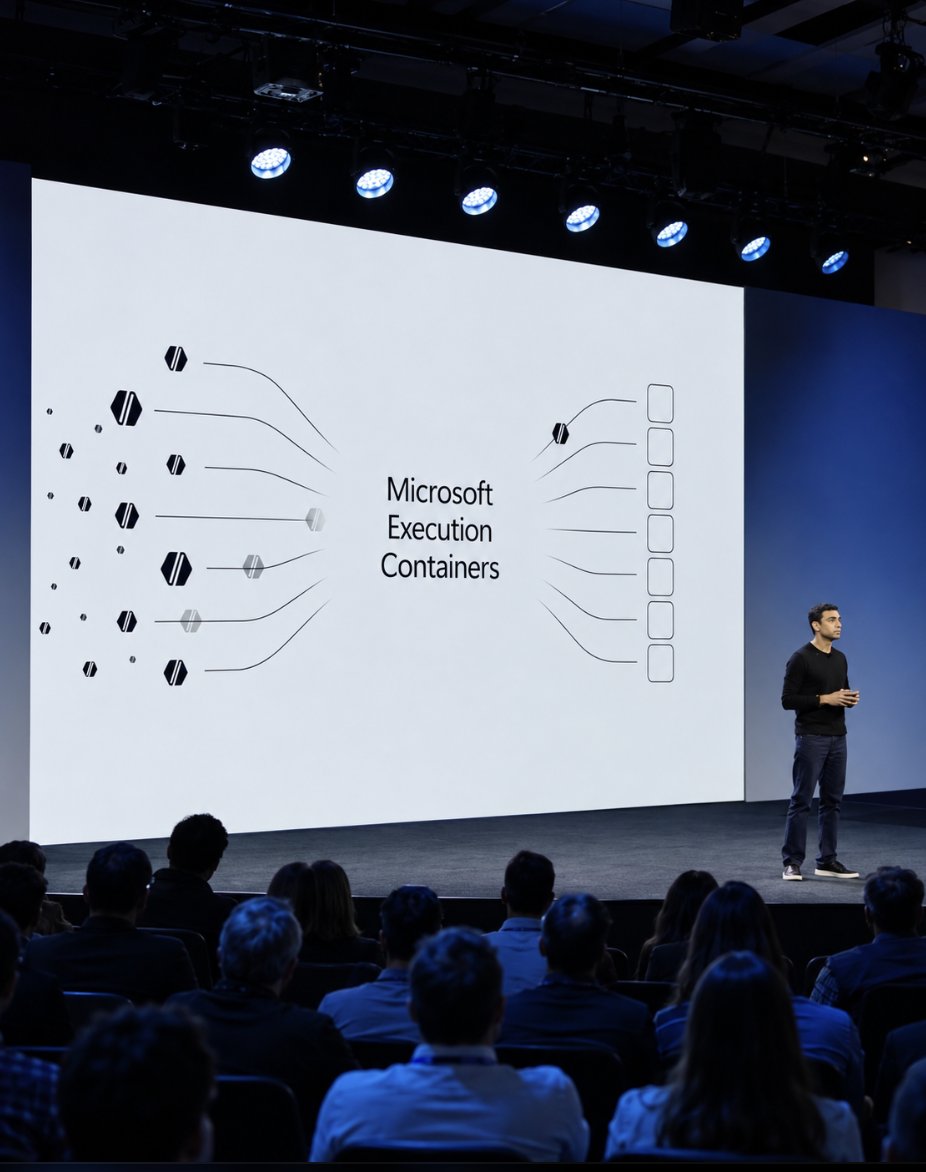
Microsoft has launched a new container system for AI agents across Windows, Linux and macOS. It’s called Microsoft Execution Containers, or MXC, and it lets developers control which files, networks and system resources an agent can access. An agent can edit your project and run its tools while being blocked from personal files or changing configurations it only needs to read. These restrictions are enforced outside the agent’s control, so it can’t grant itself extra permissions. MXC uses platform-specific sandboxes, including Bubblewrap on Linux, through a unified JSON configuration and SDK. GitHub Copilot, OpenAI Codex, Replit and OpenClaw already support it, with Claude Code support planned. Source: blogs.windows.com/windowsdevelop…


Here's a topic list for my chat with Lex: 1:22 - First computer 7:00 - Dropping out of high school 14:41 - Joining Microsoft 16:53 - MS-DOS 20:05 - Windows 95 26:52 - The man behind Windows 31:48 - Debugging 37:05 - Task Manager 42:14 - 3D Pinball: Space Cadet 47:13 - Start menu and taskbar 58:12 - Blue Screen of Death 1:00:21 - Best programmers 1:08:22 - Scariest time of Dave's life 1:15:50 - Best Windows version 1:17:40 - Slot machines 1:21:23 - Autism and ADHD 1:40:43 - Fastest programming language 1:44:48 - Future of programming

Here's the links for my conversation with Dave Plummer (@davepl1968): YouTube: youtube.com/watch?v=HsLgZz… Spotify: open.spotify.com/show/2MAi0BvDc… Podcast: lexfridman.com/podcast


Andrej Karpathy: "Prompting is going away. Delete everything, keep Graph." In 1 hour he shows how to build Graphs, and why it's the only thing that will be left standing at the end LLMs → Prompts → Agents → Graphs a prompt gets you one answer and then forgets the job an agent finishes the job and then forgets what it learned a graph keeps every finished job and turns it into the starting point of the next one the first 10 minutes alone are worth more than most paid courses watch the lecture first, then save the full guide on Graphs below ↓

Really good read. This resonates with my work in industrial AI: so much of the context lives with the people doing the work. Good FDEs earn their trust, understand their constraints, and build something they can actually use and own arenamag.com/articles/forwa…

Reasoning From Scratch: Reinforcement Learning with Verifiable Rewards (RLVR) round 2. Covering clipped policy ratios, KL loss term, format rewards, and other GRPO tips & tricks. 00:00 Introduction and recap 01:52 Interpreting basic GRPO training metrics 06:34 Planned improvements to GRPO 08:58 Running longer training jobs with Python scripts 13:39 Running the baseline GRPO training script 17:29 Loading and plotting training logs 19:29 Diagnosing unstable training 23:55 Evaluating checkpoints on MATH-500 26:26 Downloading existing checkpoints 30:09 Tracking advantage statistics 34:53 Understanding entropy 40:32 Computing entropy in PyTorch 44:17 Interpreting entropy values 48:58 Adding entropy tracking to GRPO 53:36 Analyzing advantage and entropy metrics 56:18 Stabilizing GRPO with clipped policy ratios 1:03:27 Implementing the clipped policy loss 1:09:39 Analyzing clipped policy training results 1:11:25 KL divergence and reward hacking 1:15:12 Adding a KL loss term 1:20:34 Limitations of the simplified KL loss 1:23:04 Format rewards and think tags 1:25:47 Adding special tokens to the tokenizer 1:30:29 Implementing the format reward 1:35:56 Analyzing format reward training 1:38:25 Rewarding format only for correct answers 1:40:48 Further GRPO improvements from research 1:45:43 Next steps and distillation


Denis Vieru @DenisVieruAI
136 Followers 423 Following Python Backend Engineer @ OpenAi | @ Antrophic
Ben Green @_BenjaminGreen
7K Followers 1K Following Senior Global Gaming Community Manager @lenovolegion + @lenovo | Streamer & Music Nerd
G.SKILL @gskillgaming
182K Followers 299 Following The world's leading brand of PC memory since '89. Game on. Game True. Game with Extreme Performance.
Strange Parts @strangepartscom
48K Followers 336 Following Adventures from the technological fringe. Join my newsletter to receive wonderful tidbits I find along my journey - https://t.co/94gknrtkbc

Jacob Freeman @GeForce_JacobF
37K Followers 3K Following GeForce Evangelist at NVIDIA. DLSS Devotee and RTX Remix Reverent. Possibly related to Gordon. 😊
Fractal Design @fractalofficial
225K Followers 267 Following Official Twitter account of Fractal Design
MSI Gaming @msigaming
728K Followers 441 Following Tech Meets Aesthetic. #Truegaming Support: https://t.co/bgVQFyhh77
Cooler Master @CoolerMaster
613K Followers 362 Following Official X account for Cooler Master. Pushing PC innovation since 1992. #MakeItYours
AMD Radeon @AMDRadeon
811K Followers 171 Following together we advance_gaming. Stay up to date with the latest tech and performance from @AMD Radeon™ graphics including the new Radeon™ RX 9000 Series graphics.
AMD Ryzen @AMDRyzen
604K Followers 75 Following @AMD Ryzen processors enable digital creators, VR pioneers, game world explorers and tech thrill-seekers. Need support? Visit our forum: https://t.co/a10nee7eVt
Quinn Nelson @SnazzyLabs
301K Followers 429 Following Making videos about new tech. Making products about nostalgia. @CoplandSupply for the latter.
Colton Potter @colton_potter
73K Followers 616 Following Chief Revenue Officer // Linus Media Group @LinusTech @techlinkedyt @shrtcrctYT @floatplanemedia
Paul's Hardware @paulhardware
253K Followers 509 Following My name is Paul, I enjoy building computers. https://t.co/VwBfteVWbf | TikTok/Hive: paulshardware IG: paulhardware
Linus LinusMediaGroup @linusgsebastian
587K Followers 73 Following Father of children, maker of YouTube videos, player of badminton, Canadian. Yes I play FAF.
Linus Tech Tips @LinusTech
1.8M Followers 356 Following The official Twitter of the Linus Tech Tips YouTube channel. https://t.co/HS5VbvfvTW // https://t.co/XF9yGyRnUA // https://t.co/WknsV27wdD
NEJM @NEJM
1.0M Followers 432 Following The New England Journal of Medicine is the world’s leading medical journal and website.
New Scientist @newscientist
4.3M Followers 278 Following The best place to find out what’s new in science – and why it matters.
BBC Science News @BBCScienceNews
1.8M Followers 17 Following News, features and analysis from the BBC Science & Environment news desk.
Reuters Science News @ReutersScience
1.3M Followers 18 Following From newly charted astronomical anomalies at the far reaches of the universe to the rise of nanotechnology, nobody covers science like http://t.co/RtkLii8CUo.
Science News @ScienceNews
5.4M Followers 512 Following Covering the latest news in all fields of science. Publisher @society4science. See also @SN_Explores.
Eric Feigl-Ding @DrEricDing
786K Followers 15K Following Health & economic warnings. Health policy, epidemiology & finance data. Faculty/Chair @NECSI. Fmr @Harvard @JohnsHopkins. (backup @EricDingEpi)
News from Science @NewsfromScience
765K Followers 638 Following The latest stories in science, brought to you by the @ScienceMagazine news team.
CDC @CDCgov
5.6M Followers 243 Following CDC's official source for daily credible health & safety updates from Centers for Disease Control & Prevention. Privacy/comment policy: https://t.co/9LbZmE4uoO


Engadget @engadget
3.6M Followers 238 Following Breaking news from the worlds of technology and entertainment, and expert reviews of the latest consumer tech products.
TBPN @tbpn
1.6M Followers 1K Following Technology’s daily show. Hosted by @johncoogan & @jordihays. Streaming live 11a–2p PT weekdays. Sign up for our free newsletter at https://t.co/Nhf5ohjInO.
WIRED @WIRED
10.4M Followers 317 Following For Future Reference. Sign up for our newsletters: https://t.co/Tl6GImvc8R


Stratechery @stratechery
1.6M Followers 3 Following Articles and Updates from https://t.co/A7bGqyJ7db. For the author, follow @benthompson.
The Information @theinformation
1.6M Followers 703 Following The most authoritative publication tech execs and founders read daily. Sign up: https://t.co/V8AtmraYaA
Chris Bakke @ChrisJBakke
1.7M Followers 212 Following Co-Founder, @MTSlive Prev: exits to @X @Indeed @Zillow
Pirate Wires @PirateWires
1.6M Followers 14 Following technology, politics, culture get the free daily newsletter 👉🏻https://t.co/s4YuTpiYVU
TechCrunch @TechCrunch
11.1M Followers 462 Following Technology news and analysis with a focus on founders and startup teams. Got a tip? https://t.co/J0WxnZxSRY
Hacker News Bot @newsycombinator
1.7M Followers 2 Following Get the latest from Hacker News! Top 5 stories on the hour, every hour. By @riklomas from @superhi_ – unofficial and not affiliated with Y Combinator
Ars Technica @arstechnica
2.5M Followers 1K Following Original news, reviews, analysis of tech trends, and expert advice on the most fundamental aspects of tech.

The Hacker News @TheHackersNews
2.4M Followers 2K Following The #1 trusted source for cybersecurity news, insights, and analysis — built for defenders and trusted by decision-makers.
DOW Rapid Response @DOWResponse
894K Followers 17 Following Welcome to the Official Rapid Response Account of the Department of War.
Conflict News @Conflicts
992K Followers 1K Following Breaking news on global Conflicts. Curators: @MJ_Cruickshank @KyleJGlen @lukepierce100 Contact: [email protected]
ian bremmer @ianbremmer
1.5M Followers 2K Following @eurasiagroup & @gzeromedia. political scientist, author. if you lived here, you'd be home now.
Institute for the Stu... @TheStudyofWar
1.5M Followers 3K Following ISW is a policy research organization focused on U.S. national security. Email: [email protected]. https://t.co/FO1PVyOnYB
Gerry Doyle @mgerrydoyle
616K Followers 2K Following Bloomberg News Global Defense Editor. Novelist, aviation geek, bartender, dad. Ex-NYT, Reuters. Grew up in Midwest, moved to Mideast. Views my own
Department of War �... @DeptofWar
7.5M Followers 642 Following Official U.S. Department of War X account.

U.S. Southern Command @Southcom
985K Followers 470 Following Official account of SOUTHCOM. Oversees U.S. military activities in Latin America & Caribbean. RTs, follows & likes ≠ endorsement.
Status-6 @Archer83Able
775K Followers 1K Following OSINT-based conflict analysis and reporting. Check SITREP App: https://t.co/uB5xHtFgJE ☕ https://t.co/zRfCNxRSdu
You might like


















