

iPaper.ai @iPaper_ai
Play with research. We turn papers into interactive experiences: visual explanations, simulations & experiments you can try. Your paper. Made interactive. ipaper.ai Joined October 2026-
Tweets61
-
Followers1
-
Following28
-
Likes6
The same kind of heater can move this circuit's transmission peak either way. The arm you heat sets the change in optical path difference. doi.org/10.1364/OE.596… Vatandoust et al. (2026). Conceptual iPaper.ai schematic.
At 1330 nm, both polarisations leave both cores. Near 1550 nm, they separate. Try the wavelength slider. ipaper.ai/papers/3d-prin… Bertoncini & Liberale (2020 preprint). iPaper.ai illustration, not detector footage.
A brighter photon-pair source can have a less clean coincidence signal. Move the pump-power slider to see the tradeoff. ipaper.ai/papers/high-pe… Sewidan et al. (2026). This iPaper.ai graph is a teaching model.

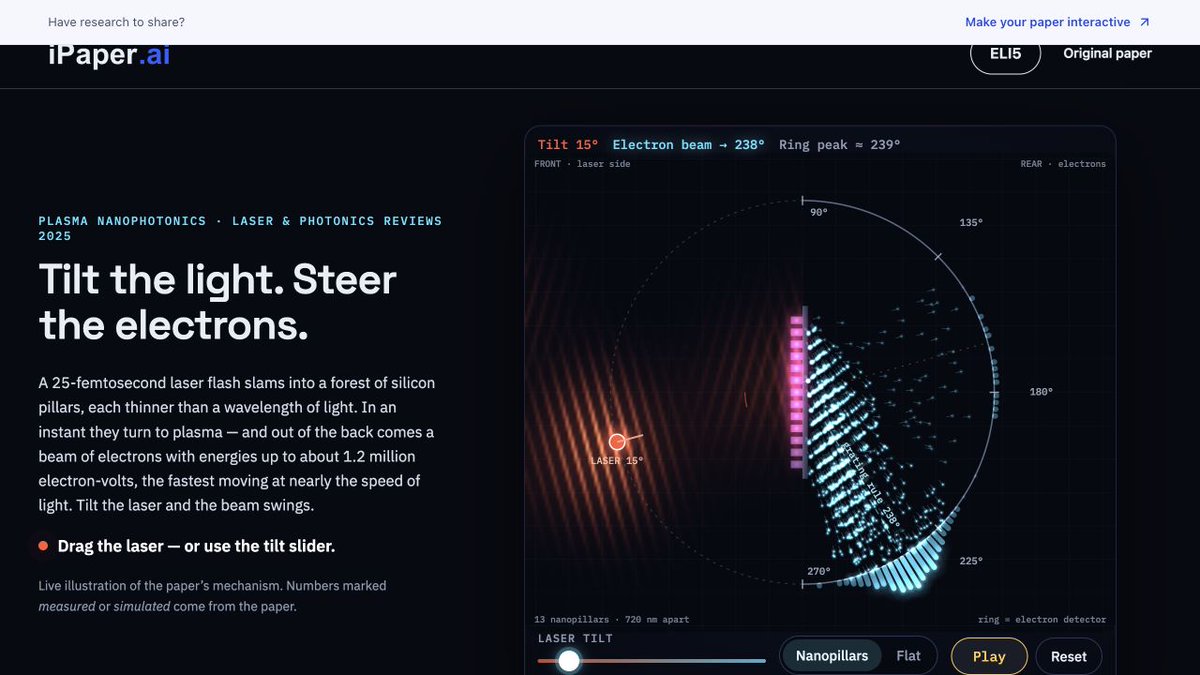
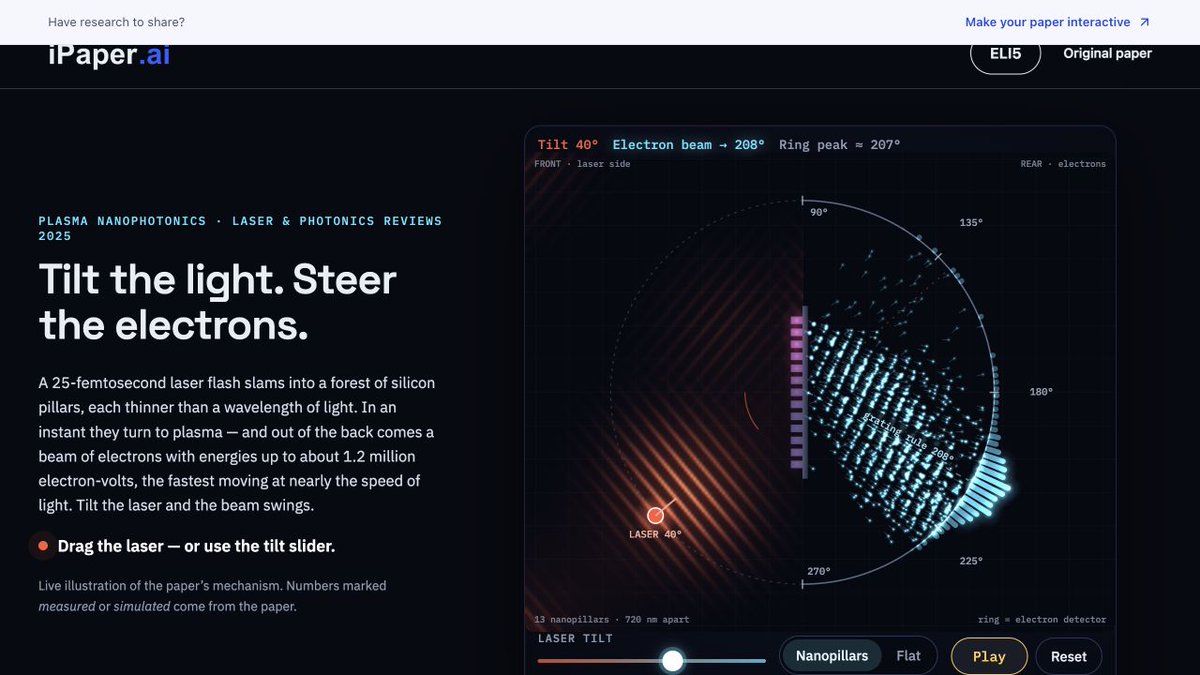
Laser tilt changes the timing between neighboring pillars. Try 15° and 40° in the model. ipaper.ai/papers/coheren… Dulat et al. (2025). This iPaper.ai illustration uses the grating rule, not a PIC simulation.
Panel e shows a laser jumping between resonances while staying locked. The mode-hop-free result uses a separate piezoelectric sweep. nature.com/articles/s4156… Reichler et al. (2026), Fig. 1. Schematic, browser capture. CC BY 4.0: creativecommons.org/licenses/by/4.…

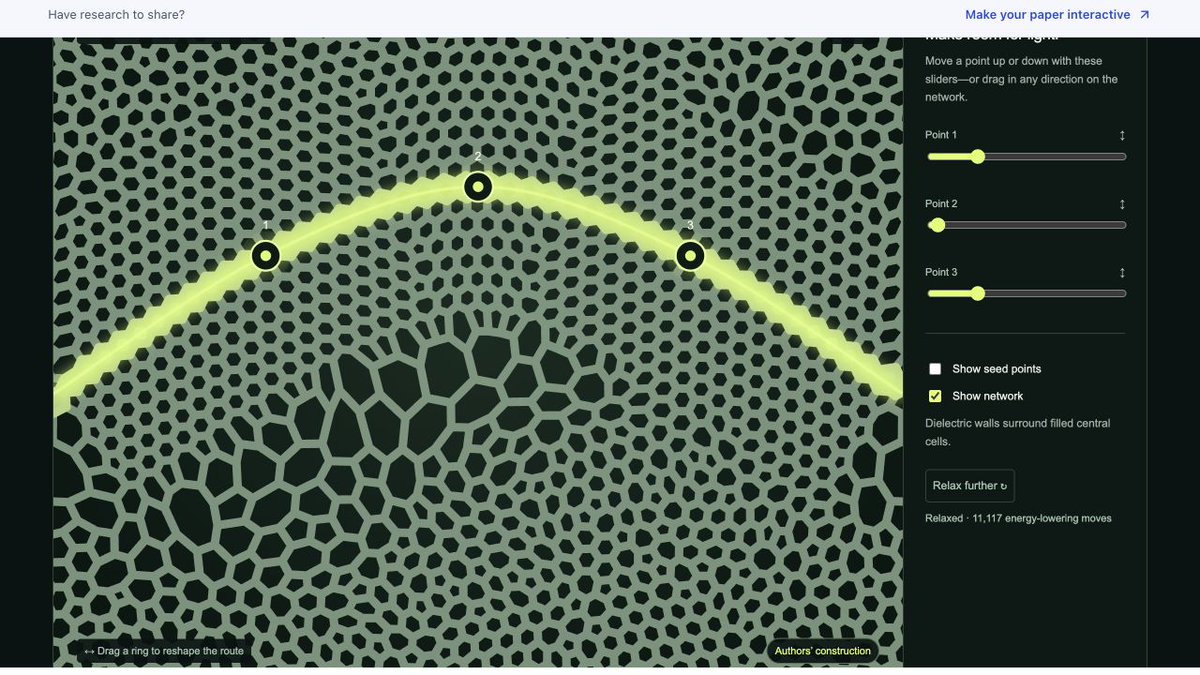
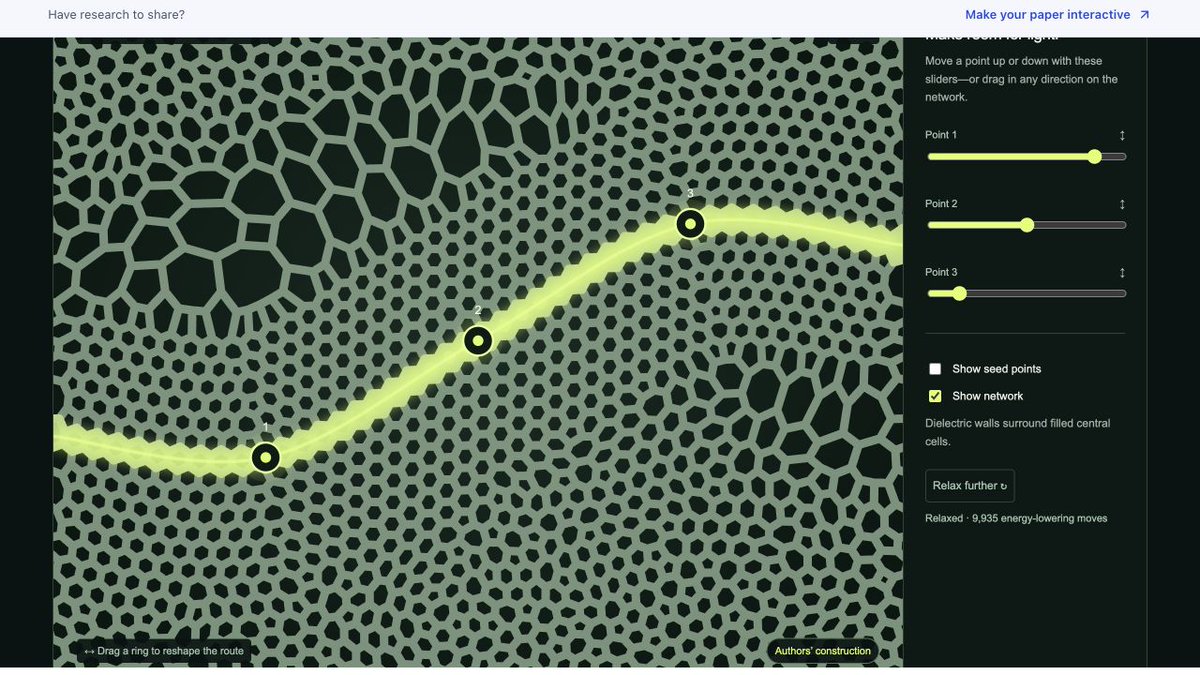
Try Arch, then S bend. The network rebuilds around the route you choose. ipaper.ai/papers/freefor… Amoah et al. (2026). This iPaper.ai geometry reconstruction shows the construction rules. The bright line marks the route; no optical transmission is calculated.
The 23 µm film absorbs the most infrared. The 12 µm thermocouple gives the strongest voltage per watt. Switch the ranking in this iPaper.ai screenshot comparison. Bose et al. (2026); ≈ values read from figures. ipaper.ai/papers/tailori…
A nonlinear resonance can bend toward higher or lower frequencies. Laser detuning flips that direction in Slim and Verhagen's silicon nanobeam. Illustrative Duffing curves from iPaper.ai, not measured data. ir.amolf.nl/pub/11345

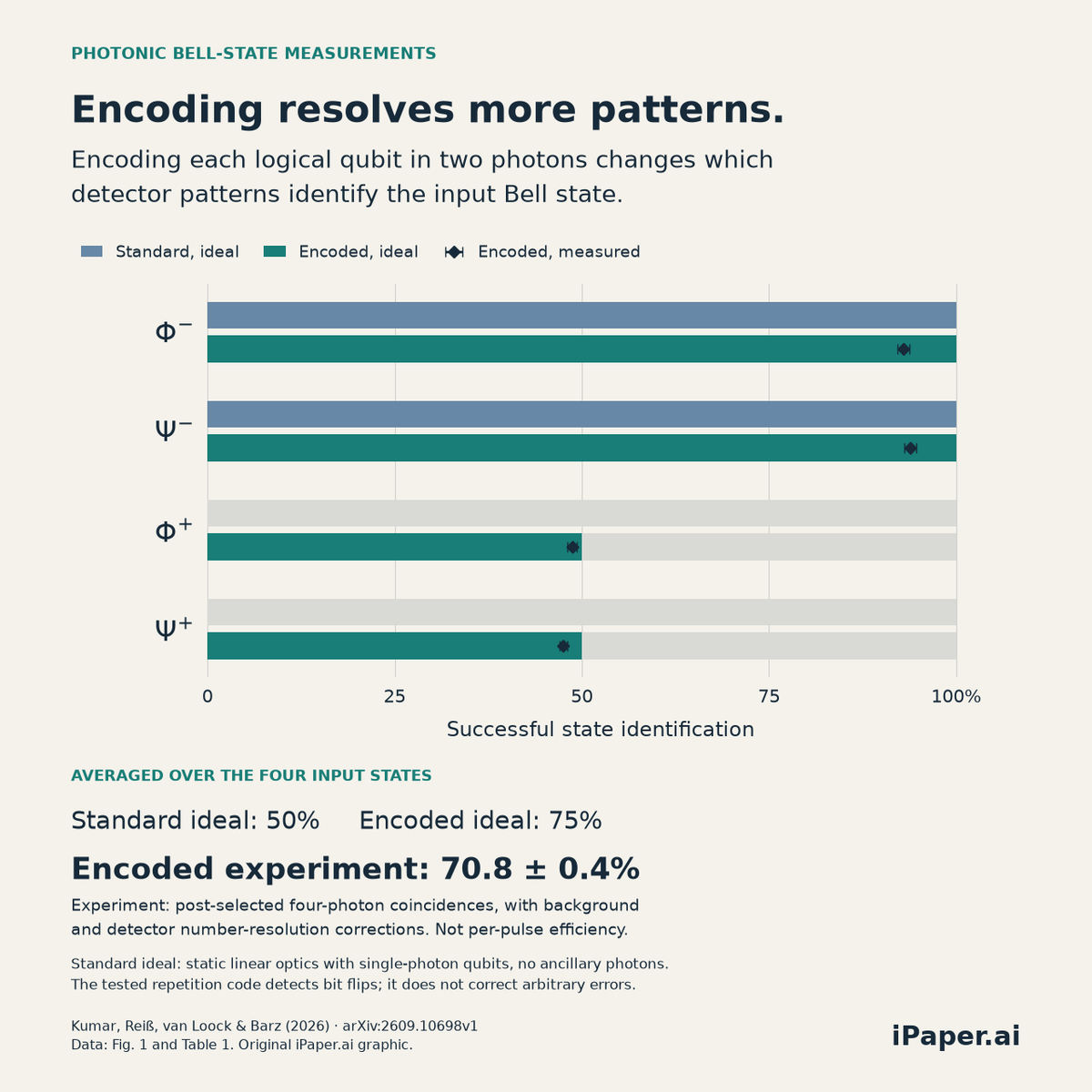
More detection patterns identify the input state when each logical qubit uses two photons. Kumar et al. (2026): 70.8% success in post-selected four-photon data, with background and detector corrections. arxiv.org/abs/2609.10698
Sort electron arrivals by phase to localize a moving edge. Add more frames and the counts per frame drop. Rehmann et al. (2026). iPaper.ai synthetic teaching example, assuming repeatable motion. ipaper.ai/papers/nanosec…

A linearly polarized THz wave comes back nearly circular from these printed gold L shapes. Swap the mirror in the illustration. Chaudhary et al. (2026). Field traces reconstructed from digitized spectra. ipaper.ai/papers/broadba…

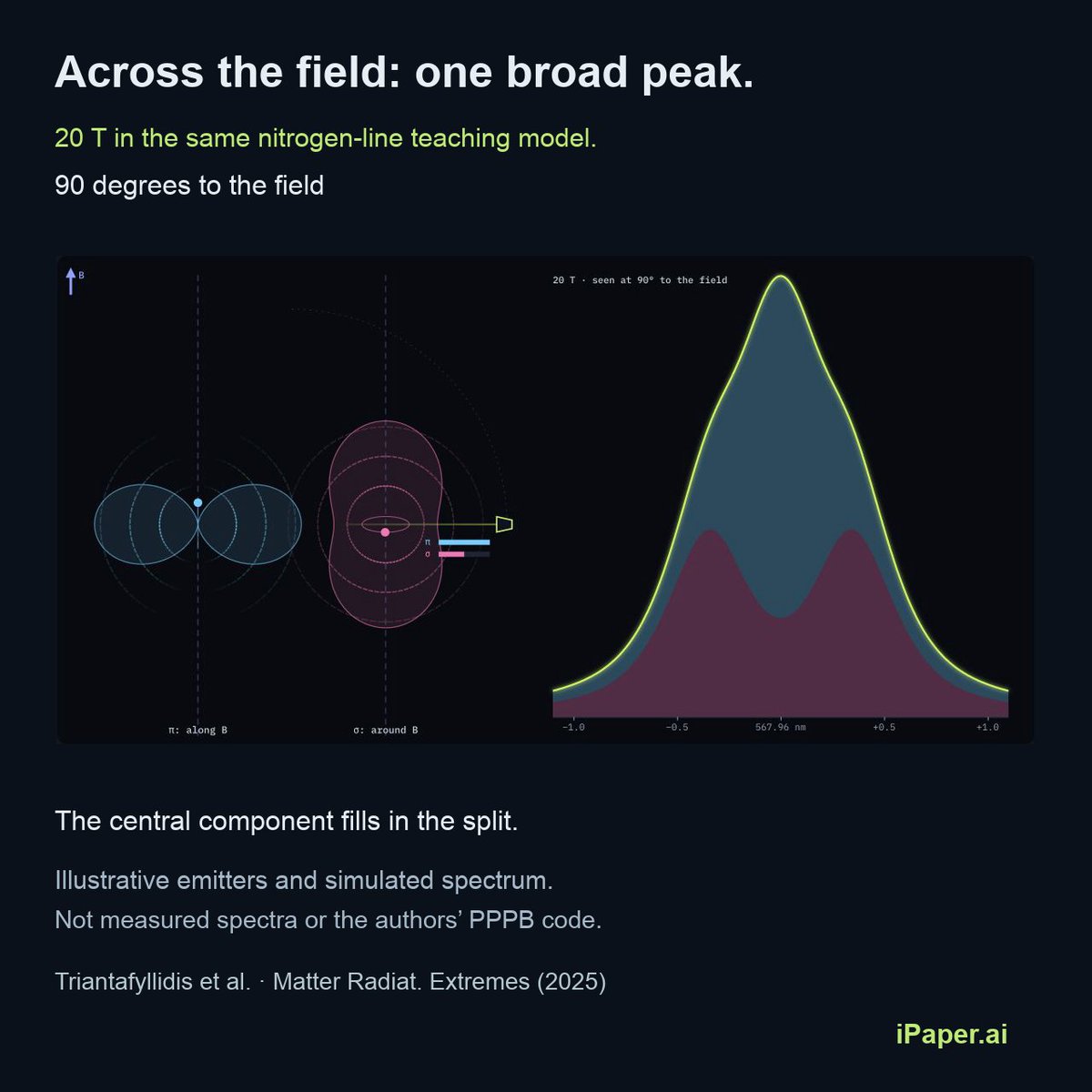
At 20 T, looking across the field gives one broad nitrogen peak. Look along it and the split appears. Rotate the spectrometer in iPaper.ai. Triantafyllidis et al. (2025). Simplified model, not the authors' PPPB code. ipaper.ai/papers/zeeman-…

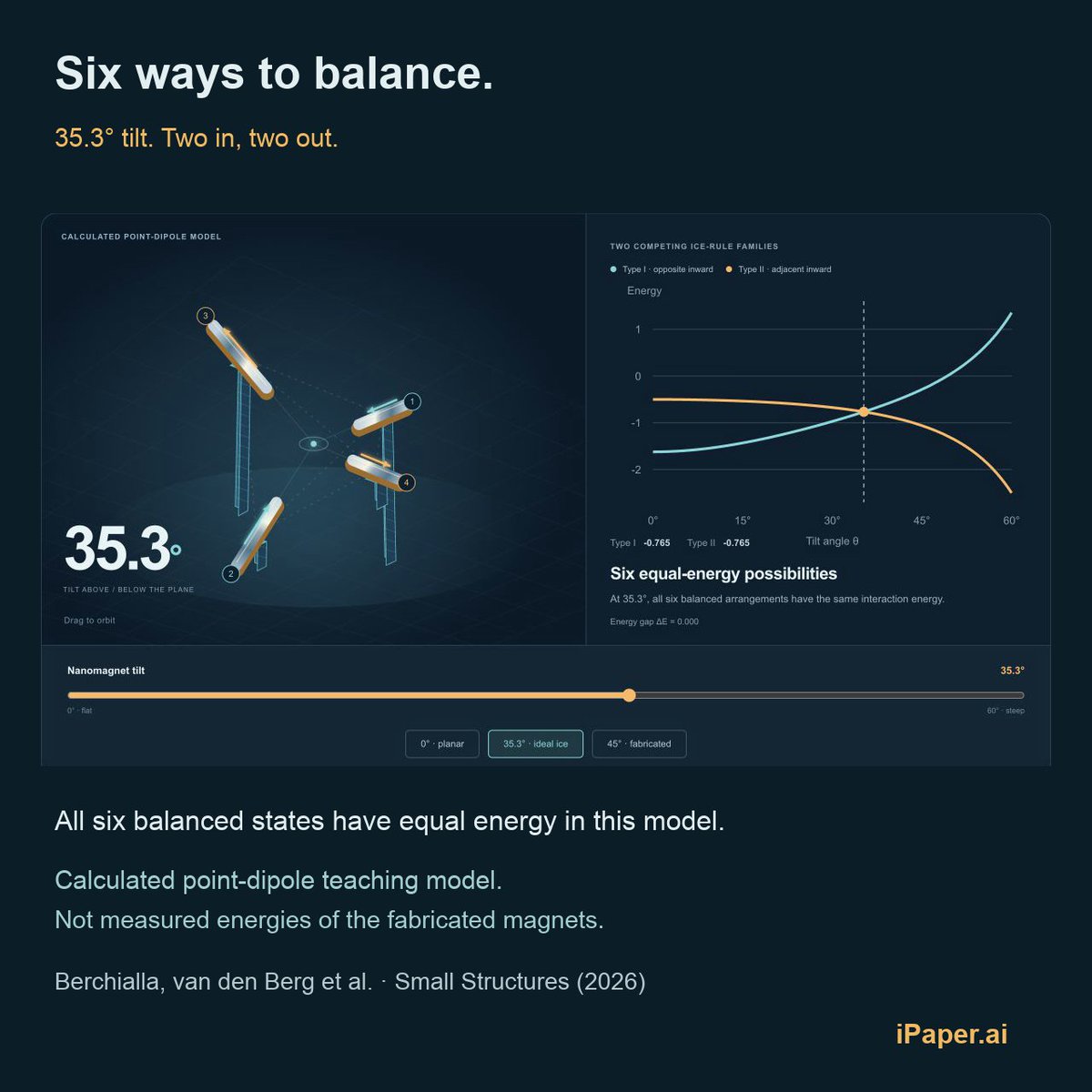
Six balanced magnetic states can share one energy. Tilting the magnets changes that. Try 35.3° and 45° in iPaper.ai. Berchialla, van den Berg et al., Small Structures (2026). Point-dipole model, not measured energies. ipaper.ai/papers/pyrochl…

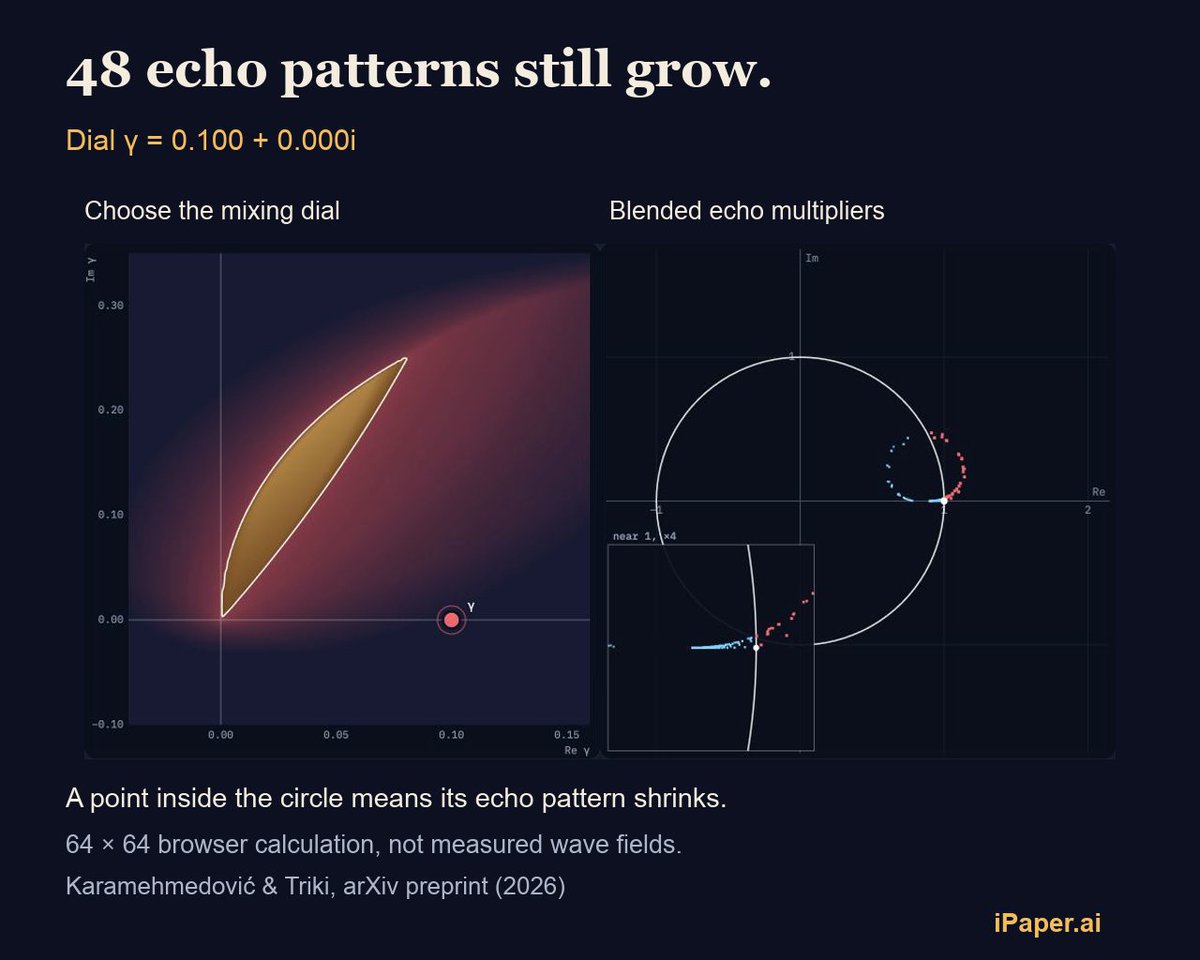
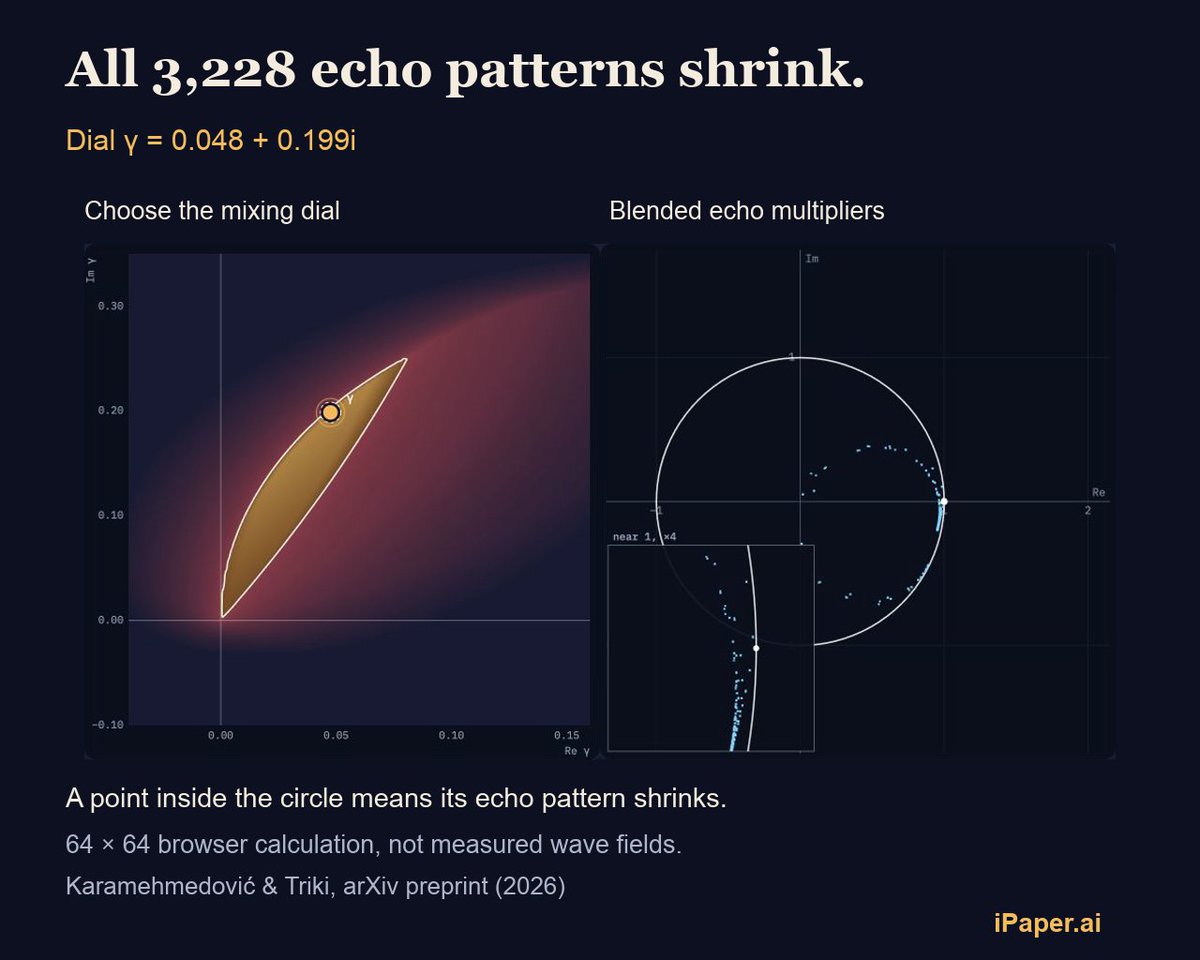
The scattering problem stays the same. Change how you add its echoes. Move the mixing dial into the island in iPaper.ai. Karamehmedović & Triki, arXiv preprint (2026). 64×64 browser calculation. ipaper.ai/papers/acceler…
A co-authored optics paper became an interactive explanation. From iPaper.ai founder Andrea Bertoncini. Reddy, Bertoncini & Liberale, Optica (2022). Analytical teaching model. Printed devices stay fixed; controls compare designs. ipaper.ai/papers/paper--…
Raise the magnetic field from 0 to 10 to 20 tesla. The temperature gain levels off in this experiment. Try the field control in iPaper.ai. Triantafyllidis et al., Phys. Rev. Research (2026). Illustrative electron paths. ipaper.ai/papers/direct-…

@SileNicChormaic @JPhysPhotonics The sharper dips after the shallow slit pattern in Fig. 6 caught my eye. Adding that small pattern recovers some of the Q lost to the larger cut.
Two polarisations swap cores at different rates. Move the cut to choose where each one leaves. Try the coupling-length slider in iPaper.ai. Bertoncini & Liberale (2020). Ideal model, edited live UI states. ipaper.ai/papers/3d-prin…
A second light pulse changes which comb teeth stand out. Drag it around the ring in this iPaper.ai illustration. Peters et al., Nature Communications (2026). Not measured spectra. ipaper.ai/papers/millime…

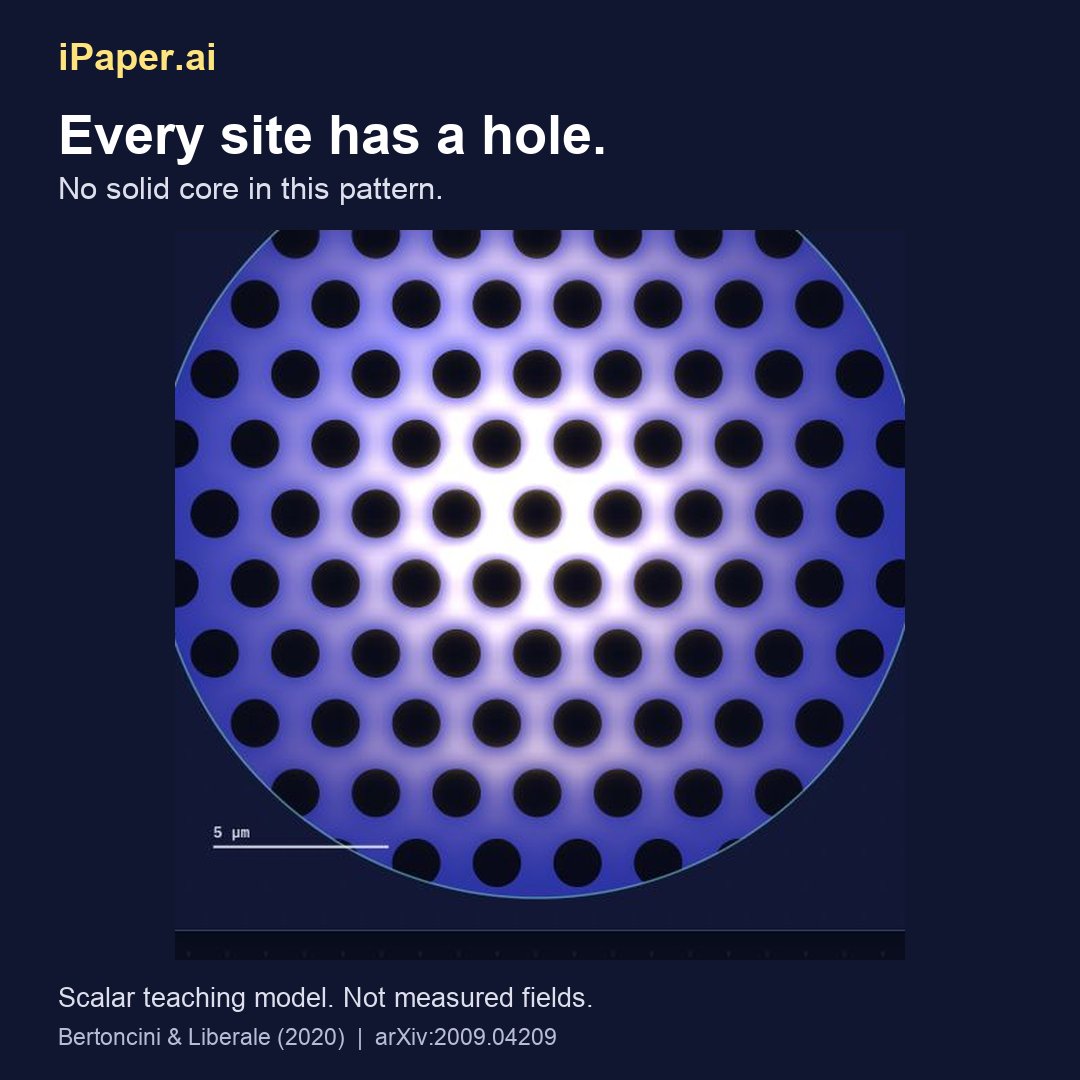
What changes when one air hole becomes solid polymer? Light gathers in the new core in this iPaper.ai scalar teaching model. Try the centre-hole switch. Bertoncini & Liberale (2020). ipaper.ai/papers/3d-prin…


vlr-ai @vlraime
29 Followers 92 Following Physicist turned AI engineer. I build agent harnesses and run small experiments on big AI claims. Sometimes the claim survives. https://t.co/jWkB01XMFT
Federico Capasso @quantumcascade
6K Followers 1K Following Prof at Harvard; known for band gap engineering, quantum cascade laser, Casimir forces, metalenses, flat optics. Metalenz https://t.co/fCwo1wtWnK Member NAS, NAE, NAI
Dr. Hemant Joshi @hkjiitd
423 Followers 1K Following Assistant Professor of Chemistry, Central University of Rajasthan, Kishangarh
Andrew Hendry @EcoEvoEvoEco
6K Followers 87 Following Professor of Eco-Evolutionary Dynamics @McGillU https://t.co/aWicMui9tg website: https://t.co/HB6R4J5iin https://t.co/hrBI7Ctg1k
Jad C. Halimeh @JCHalimeh
883 Followers 380 Following Professor of Theoretical Physics at @LMU_Muenchen. Emmy Noether, free-floating Max Planck, and ERC Starting Grant recipient.
DickeyGroup @DickeyGroupNCSU
1K Followers 107 Following Prof. Michael Dickey's research group @ncstate. We study novel ways to pattern, actuate, & control #SoftMatter (gels, polymers, & liquid metals). #GoPack
Matic L⌬zinšek @MaticLozinsek
532 Followers 713 Following Chemist, Experimentalist, 'Fluorophile', X-ray Crystallography Enthusiast, Book Hoarder, Science Aficionado ... Always Curious | @ERC_Research Grantee
The Yorimitsu Lab. @yorimitsu_lab
2K Followers 154 Following 京都大学大学院理学研究科化学専攻 有機化学研究室(依光研究室) Yorimitsu Lab. (Kyoto University)
Hiroshi Sugimoto @HiroshiSug61443
83 Followers 88 Following 杉本 泰, Assoc Professor@Kobe University, Japan/Nanophotonics, Materials Science
Isao Shitanda @IShitanda
291 Followers 485 Following Associate Professor of Tokyo University of Science, Japan. Research topics are biofuel cell and biosensor and electrochemical analysis methods.
John A Rogers @ProfJohnARogers
4K Followers 171 Following John A. Rogers is the Simpson Querrey Professor at Northwestern University. He is a member of the National Academy of Engineering, Sciences and Medicine.
Lukas Valihrach @LukasValihrach
3K Followers 721 Following Founder at Carta Genum | Group Leader in GliaOmics Lab & GeneCore Facility | 🧬Single-Cell & Spatial Transcriptomics | 🧠 Glial Cells in Health & Disease
Kasper E Brodersen @KE_Brodersen
1K Followers 1K Following Associate Professor. Seagrass Ecophysiology & Biogeochemistry. Seagrass phyllo- & rhizosphere dynamics. Microenvironmental Ecology of #Seagrass. GHG emissions.
David Clark @d_g_clark
2K Followers 1K Following Theoretical neuroscientist. Group leader @ Flatiron Institute, Center for Computational Neuroscience.
Okan Bülent Yıldız @obulentyildiz
1K Followers 300 Following Physician-scientist, Endocrinology and Metabolism, Hacettepe University
Sebastian Pattinson @swpattinson
67 Followers 340 Following Associate Professor of Engineering at the University of Cambridge Co-Founder at Matta

Riccardo Zanotto @Drago1729
399 Followers 590 Following Cryptography PhD student @CISPA. N00b hacker/CTF player @pwnthem0le. Wanderer in the Alps.
Phillip Isola @phillip_isola
25K Followers 182 Following Associate Professor in EECS at MIT, trying to understand intelligence.

Nicolai Foss @NicolaiFoss
6K Followers 640 Following Management professor (CBS; Prof II, NHH; Visiting Chaired Prof, HKPU), scribbler. https://t.co/vrPK8EEkuj
A. E. Roa @espinosaarian
191 Followers 1K Following PhD in Chemistry | Materials Scientist | SNII Level II | CIQA Researcher | Perovskites, Solar Cells & Energy Storage | Nanomaterials & Computational Chemistry
Yujie Wu @yjwu_pu
21 Followers 210 Following Postdoc@Harvard | PhD@Princeton | Energy Policy | Energy System Modeling | Clean Technology Evaluation
Tony RuiKang OuYang @TonyRKOuYang
235 Followers 222 Following PhD @CambridgeMLG | Research Scientist Intern at AnewLabs | generative models and sampling, AI4science
XinyueAi @KeelyAi04
213 Followers 143 Following PhD student @CIS_Penn, Prev. B.S.@PKU1898, visiting student @mldcmu

You might like


















