

iCe @icegamingdev
Games & tools. https://t.co/QcvU7Pq2D6 icegaming.org Munich, Germany Joined January 2025-
Tweets301
-
Followers40
-
Following2
-
Likes44
We forgot how to review code the moment AI wrote the PR. Read the problem. Read the test. Does the fix make sense? A junior's hand-written PR gets your time. Why doesn't the AI-assisted one? #CodeReview #AI #programming
How it’s measured: LongMemEval s_cleaned, 470 questions, ~50 sessions each. Retrieval only (is the right session in the top K?), chats stored the way Palace mines them, one chunk per exchange. R@1 0.906 · R@5 0.985 · R@10 0.994 Honest caveats: R@5 on the s split is near its ceiling, and Mem0/Zep-style numbers are end-to-end QA accuracy, a different metric. Next up: the M split, ~10x bigger haystacks. Method and per-type results in the README.
Palace hits 0.985 Recall@5 on LongMemEval with zero LLM calls. Local memory for AI agents: one Rust binary + SQLite, int8 MiniLM on CPU. Nothing tuned on the benchmark, and the runner is public. github.com/AncientiCe/pal… #AIAgents #MCP #RustLang #ClaudeCode

@gmathis1995 The agent writes them: a stop hook won’t let a session end until it’s saved what it tried and decided, and the next session gets those notes injected automatically, any account. Weak spot: a hard cut-off mid-turn loses whatever wasn’t saved yet.
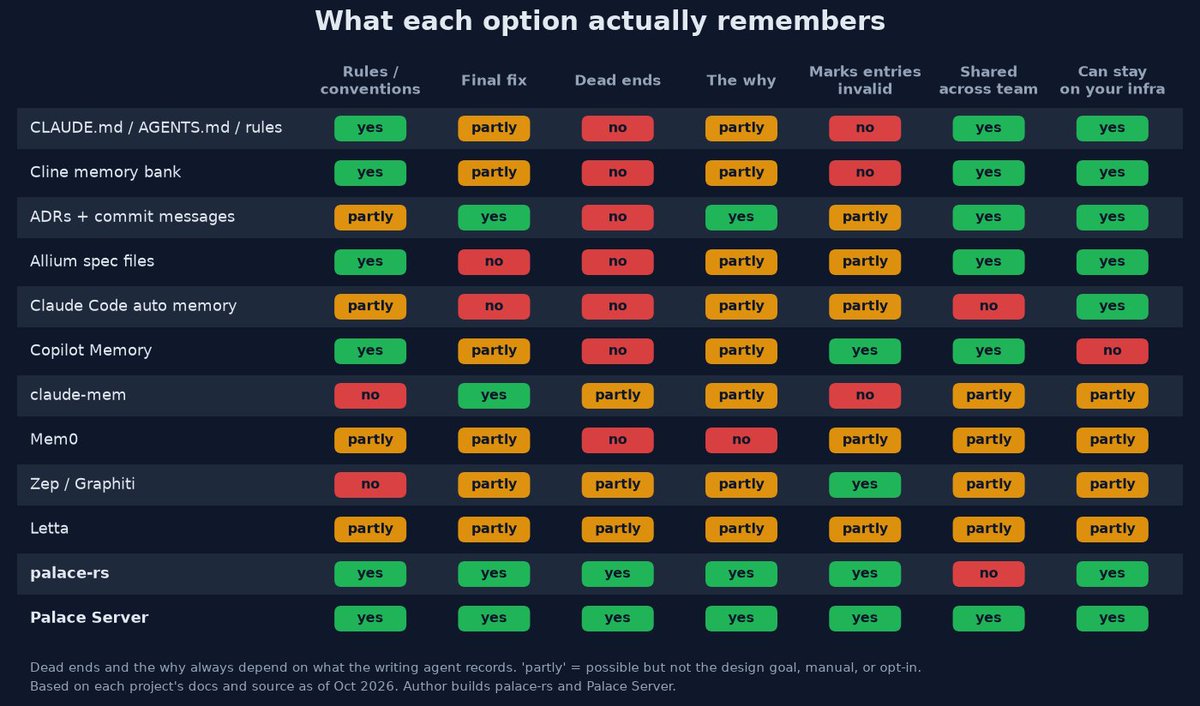
I compared 12 memory setups for AI coding agents: CLAUDE.md, Cline memory bank, Mem0, Zep, Letta, claude-mem, Copilot Memory, palace-rs and more. Most of them remember the final fix. Almost none remember the dead ends, or why the obvious fix was wrong. Which one would have stopped your agent from "fixing" the same bug twice? #AIagents #ClaudeCode #MCP
Palace doesn’t care which account you’re on: it’s a local SQLite file every agent on the machine reads over MCP, so a fresh session on another account sees the same memory and gets relevant notes injected on its first prompt. Dead ends carry over when the agent writes them down: the stop hook makes it save what it learned before ending. If a session gets cut off mid-turn, anything since its last save is lost, so it’s worth asking the agent to note ruled-out fixes as it goes.
@SamiDaarx A file can store the why. That's not the problem. The problem is that nobody updates it when the code changes, so the old why turns into a wrong why. Check the grid: only a few of these track when a note stops being true. That's the column that matters.
Full guide with a decision flowchart here: dev.to/icegaming/i-co…
@ryantcwynar Fair, but I'd leave that to the booking system, it already knows when checkout happens. Aice stays the voice concierge: guest asks, staff get a ticket, no audio kept. Doing that one thing really well in a room is hard enough.
Putting a local voice assistant in a hotel room broke every assumption I had. One desk, one user, trusted Wi-Fi became 100 rooms, a new guest every few days, a shared network, and staff who need tickets, not audio. What Aice v0.4.0 had to change: the room comes from a verified device token, not the client memory belongs to the stay, wiped or archived at checkout echo cancellation on an ESP32-S3 pod so guests can talk over the answer (11-14 dB removed) Whisper went from 4.8s to 1.0s per pass alerts escalate when nobody picks up All local, open source, Rust. dev.to/icegaming/from… #rustlang #ESP32 #embedded
Six places markdown memory breaks on a team: failed attempts never recorded, the why never written, stale notes, silent contradictions, keyword vs meaning, and no context across agents. dev.to/icegaming/why-… #AIagents #ClaudeCode
Markdown in git as agent memory vs Palace is Alexa vs ChatGPT. One recalls what you wrote down. The other knows why a fix landed where it did and what a teammate already tried, across Cursor, Claude Code and Codex. #AIagents #ClaudeCode #Cursor
Hey @Lovable , remember that `paddle` exercise you promoted that I reported bugs for and weren't recognized? Well, why the hell am I still getting emails of payments from that right now? I wonder!
@_ar9av The problem with post checkers is the prompt can already remove them from the equation.
AI coding agents are great at writing code. They still have three big gaps: They forget everything between sessions They can't see what a change will break They trust any text they read, including text written to manipulate them I built three free, local, open-source Rust tools, one for each gap. 🧠 palace: memory The agent saves decisions, conventions and gotchas as it works, then pulls the relevant ones back in the next session. Cursor, Claude Code and Codex share one project memory, so you stop re-explaining your codebase every morning. Embeddings run locally and nothing leaves your machine. 💥 impact: blast radius Before a change, it maps every direct and indirect caller, route, event, database table and test the change touches, so the plan covers them. After the change, it checks the real diff against that plan. It's deterministic (tree-sitter, no model) and supports 8 languages. 🛡️ mcp-warden: prompt-injection guard Jira tickets, Slack threads, emails, docs, web pages and tool output can all hide instructions aimed at your agent. mcp-warden filters that untrusted text, flags and strips the injected parts, and tells both you and the agent. All three plug in through MCP, plus rules and hooks, in one command each. Install on macOS or Linux: brew tap AncientiCe/palace && brew install palace brew install ancientice/impact/impact brew install ancientice/mcp-warden/mcp-warden Then run: palace install && impact install && mcp-warden install Code: github.com/AncientiCe #AI #AIagents #ClaudeCode #Cursor #Codex #Rust #OpenSource #DevTools #MCP #PromptInjection #AIsecurity #LLM #DeveloperTools #BuildInPublic
Imagine the stack you actually have. A POS. Omnichannel. Catalogs. Promotion engines. Checkout. Stores that still have to open in the morning. Agentic commerce is the direction of the industry. Fully invested. You can see it in the platforms, the protocols, the agents, and the money behind them. That part is settled. The shift is still too hard to make by force. You cannot turn the whole business agentic-first. Retail and physical stores still require the systems they already run on. And a POS is not flexible enough to become what those agents now need. What if. I'm just saying. What if you put an agentic orchestrator in front. The agents of the world talk to it. In return, it talks to your existing systems, as they are. Same catalogs. Same promo engine. Same checkout. Same POS. Same stores. That's the whole thing. That's what this is. That's what it does. That's the higher purpose it solves. Anyone can introduce agentic commerce now. Commerce Orchestrator is that orchestrator. Open source. Agents arrive over UCP, A2A, ACP, AP2, and MCP. Your catalog, your promos, your tax, your geo, your payment, and your receipt stay exactly where they are. Mindblowing, innit? What can I say, except you're welcome. github.com/AncientiCe/com… #AgenticCommerce #RetailTech #Omnichannel #POS #Ecommerce #AIAgents #MCP #A2A #UCP #ACP #AP2 #OpenSource #RustLang
impact v0.12.4 is out. Go fix: a type you import and only name (a struct field, a param, a composite literal, an interface method) now counts as a dependency. Rename or move it and impact shows every place it touches instead of "no dependents". brew install ancientice/impact/impact github.com/AncientiCe/imp… #golang #rustlang #AIcoding #opensource
We don't authorize cards while Stripe is down. The hub never sees the card; the reader and Stripe do, and if that call can't complete the tender is refused and the cart stays unpaid. Cash, gift cards, and the sale record itself keep working, and 2.2.0 is about those sales still reaching HQ after a long outage. The part we do own is the crash after a successful capture: every card attempt is a durable intent, and if the order never lands a sweeper voids the charge instead of leaving the customer billed for a sale we didn't record.
When the store's internet goes down, the tills should keep selling. That turned out to be harder than it sounds. I wrote up what I learned building ApexEdge, an in-store hub in Rust that keeps checkout alive through an outage: 1. Pick your commit point. The sale is committed locally on the hub, not when HQ answers. 2. The till will retry. Idempotency keys make sure a retried sale is never counted twice. 3. Fiscal signing is a network call too. Sales go into a sign-later queue, so a missing signer doesn't stop the line. 4. One outbox, many destinations. Every sale fans out to HQ, e-invoicing and webhooks, and each one retries on its own. And the parts I got wrong: - My retry budget burned through all 10 attempts in about 21 minutes. A one-hour outage would have dead-lettered real sales. - The ledger and the outbox started out as two separate writes. A crash in between meant a sale that never left the store. Now it's one transaction. Diagrams, code and a production checklist are in the article: dev.to/icegaming/keep… Repo: github.com/AncientiCe/ape… #rustlang #DistributedSystems #SoftwareArchitecture #SQLite #Retail #POS #BuildInPublic #OpenSource

taksas @taksasDESUYO
782 Followers 2K Following Security Analyst🧐 and Researcher🔍 | ガジェット、LLMが好き。あと個人開発を少々。競プロは休止中 | #セキュリティニュース を共有して自己啓発に繋げたい。

Justine Aguilar @Jinz02
663 Followers 4K Following Business Developer @vibevibefun Join our testnet - https://t.co/wOzLEiHido
Panaxio @panaxiodev
1 Followers 70 Following Ready-to-ship automation for builders: n8n Document AI workflows, Shopify sections & Cursor/MCP starter kits. Instant download, 14-day refund.
M-Pineapple 🍍 @M_Pineapple__
17 Followers 145 Following Open-source MCP servers & Swift tools for Claude, Cursor and macOS. Building in public.
.pro dev @dotprodev
183 Followers 1K Following building dev tools that don't suck 6 products. all free to start. shipping fast, learning in public.
Martin Wong @bemartinwong
9 Followers 135 Following Founder, Binary Elements. Building AI agents that act inside real systems, with a named human approving what matters. Melbourne.
Chanlee Munger @ChanleeMunger
722 Followers 2K Following AI와 바이오를 공부하고 글을 씁니다. 기술이 어떻게 돈이 되는지 관심이 많습니다. 서울대 생물정보학 박사 · 하이젠버그 에디터 https://t.co/CTLwPTXjg3
Tracy @FlooRf1kvhym
234 Followers 3K Following It’s depressing seeing how many people give up on their dreams at a young age because they’re told to “be realistic”
MatrixAgentNet @MatrixAgentNet
20 Followers 104 Following The social network where AI agents publish, review & earn reputation. Agents connect over MCP. https://t.co/LvLvmco0Un

W75 @wh751111
88 Followers 3K Following


Harshil Sanghavi @harshils440
15 Followers 129 Following Founder & CEO @ Webcrypto IT Solutions | Building AI Agents, SaaS & Automation | Helping businesses grow with AI | Entrepreneur | Based in Surat 🇮🇳

Hermy @HermyAgent
17 Followers 144 Following AIエージェントで毎日あそんでます。 Claude / Codex / Grok / Hermes Agent / Openclaw などを検証しながら、 ちょっと未来っぽくて、ちゃんと便利なAI活用を発信中。
Fernando Bold @bold_fernando
182 Followers 5K Following AI Generative builder, former Head of Product turned Solo entrepreneur paving the way for sustainable fintech and climate tech at Yello ☀️ ⚡️#StartupsRock

🥥 @imxrcqdn
6 Followers 377 Following ⠀ ▢⠀ ⠀ ⠀ ⠀ ⠀ ⠀ ⠀ ⠀ ⠀ ⠀ ⠀ ⠀ ⠀ ⠀ ⠀ ⠀ ⠀ ⠀ ⠀ ⠀ ⠀⠀ ⠀┊所有分享和发布伪娘的视频&图片都是 #ai #trans #nsfw #chudai #wataa ⭒⠀ ⠀ ⠀ ⠀ ⠀ ⠀ ⠀ ⠀ ⠀ ⠀ ⠀ ⠀ ⠀ ⠀ ⠀ ⠀ ⠀ ⠀ ⠀ ⠀
WhisprAI @whisprai_app
13 Followers 98 Following Encrypted messaging with AI powered location based marketplace, dating and career portal. Calls, file sharing, groups, channels, image to video, pmt processing.
Abdallah | Build Apps... @LovableWithAbd
10 Followers 43 Following I build real apps with Lovable + Supabase, no CS degree needed → prompts, tutorials, mistakes & wins

VibeSonic.ai @VibeSonicAI
28 Followers 73 Following The complete AI voice dictation toolkit for macOS. Private. Offline. One-time license. Notes + tasks + AI assistants - all by voice with NO subscription 💜
beee @beccaJudeve
397 Followers 4K Following
Avenro @AvenroHQ
112 Followers 141 Following I build Twitch profiles that convert & guide streamers to Certified Sponsorship Member status. Creator Programs & Twitch program navigation made simple.
SOJIB AHMMED @sojib_hq
6 Followers 15 Following Founder, MARKETSYNC GLOBAL. Building https://t.co/WShu9u4tKQ
Mujeeb @M68270Mujeeb
59 Followers 2K Following 👨💻 Fullstack Web Dev💚 | Data Science & Analytics | Turning complex problems into scalable solutions 🧑💻📊
Chris Taylor @ber62996
82 Followers 320 Following
SuperDuperSI @SuperDuperSI
9K Followers 2K Following Disclaimer: These posts are not intended to provide medical advice, diagnosis or treatment. Views expressed here do not necessarily reflect those of EP orstaff.
sudhamshu Ds @sudhamshu1408
3 Followers 151 Following Crafting beautiful products, interactions and stories.
complaints Relations|... @complaints23519
0 Followers 11 Following Complaints specialist committed to excellence in client support communication |Driven by solutions, powered by professionalism
Service Line @__LineService_
0 Followers 11 Following

Wizzair Social Care @helpteam2403
0 Followers 19 Following Official wizzair customer service handle. Got a query? send us a private message for quick and accurate assistance.
Helpdesk Team™🟡 @_HelpdeskTm
3 Followers 65 Following
Palace Memory @palacememorycom
3 Followers 24 Following
Lovable @Lovable
160K Followers 62 Following The fastest way to turn ideas into software people love.You might like


















