Muhammed Gazali Yeşilmen @mgy_programmer
Building DevMarathon | Real projects. Real execution. @devmarathon_ai devmarathon.com Joined January 2026-
Tweets375
-
Followers49
-
Following178
-
Likes100
I’m building DevMarathon around this idea: evaluating developers through real software challenges. You can try it here: devmarathon.com
Many companies still rely heavily on resumes and a 30 minute interview to hire software developers. But I don’t think that’s a strong enough signal. What matters more is how a developer thinks, approaches problems, makes trade offs and works through real challenges. What do you think is the best way to evaluate a software developer?
@naval When everyone has a genius in the loop, intelligence stops being the differentiator. Taste, judgment, and the ability to tell great output from convincing mediocrity become the real edge
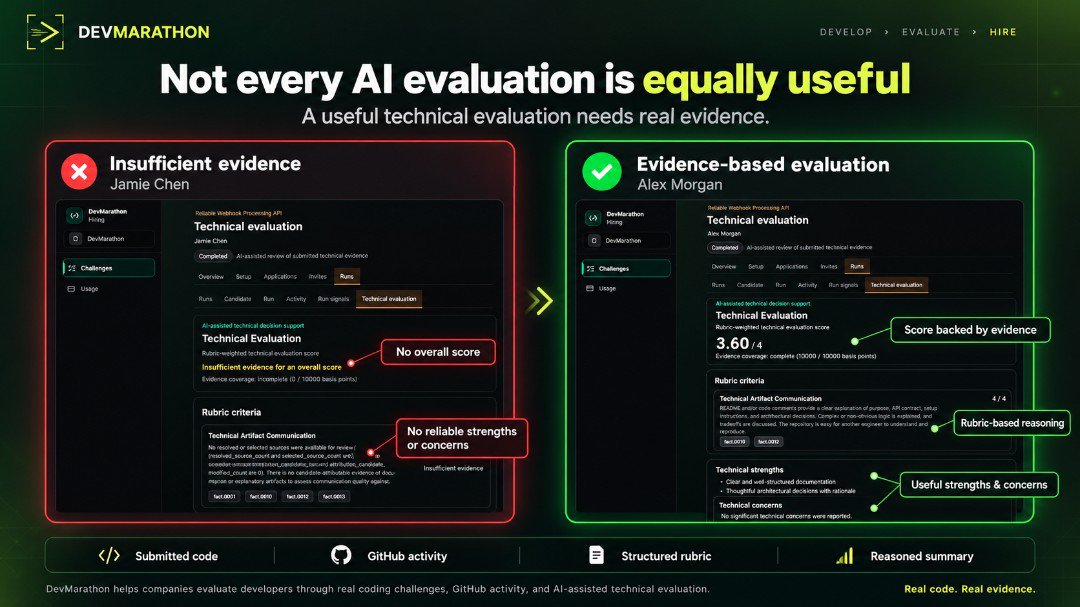
CVs and interviews don’t always show how a developer actually works. That’s why we’re building DevMarathon around real coding challenges, GitHub activity, and evidence-based AI evaluation. If there isn’t enough evidence, the AI doesn’t force a score. Real code. Real evidence. Better hiring decisions. devmarathon.com #devmarathon #technicalhiring #softwareengineering #ai #hiring
@paulg Maybe that's the real flex: no dramatic scaling, no chart gymnastics, just 8x growth 😊
@foundr Pressure doesn’t create culture. It exposes the culture that was already there. Same with founders.
@lightsilver323 Evaluation :)
This belief is actually one of the reasons I built DevMarathon. I think developers should be evaluated by what they can actually build, how they think, and how they execute, not just by what’s written on a CV. The AI era makes building more accessible than ever. So build. Ship. And create proof of what you can do.
A piece of advice for every software engineer and CS student: Build something of your own. It doesn’t have to become a startup. It doesn’t have to make money. It doesn’t even have to be perfect. But in the AI era, building products has become dramatically easier. If you’re employed, don’t let your entire career depend on one company. One day, you may leave, get laid off, or simply want something different. Having a product of your own gives you leverage, experience, proof of your skills, and optionality. If you’re a student, start even earlier. Use AI, experiment, ship products, fail, rebuild, and learn. I genuinely believe that in this era, no software engineer, computer engineer, or aspiring entrepreneur should be without something they are building themselves. Don’t just have a job. Own something you built.
@erenbali Eren, this is pretty much why I started DevMarathon. Seeing how someone actually thinks and builds through a real problem feels way more useful than trying to match their CV to the exact same job :)
@erenbali As the founder of Capilens, I have mixed feelings about this business idea 😂
For anyone curious, here’s the original Hacker News post from 2022: news.ycombinator.com/item?id=300119… What makes this story even more interesting to me is that the lesson isn't simply “keep going.” It's knowing what to keep and what to change. The product changed dramatically. The willingness to build, ship, listen, learn, and iterate didn't. That distinction matters a lot for founders.
In 2022, this was @cursor_ai. Not an AI code editor. Not a company redefining how developers write software. A Chrome extension that used AI to help people write emails faster. They shared it on @hackernews. The post got: 4 points. 5 comments. That’s it. Today, Cursor is one of the products shaping how developers think about writing software with AI. And I think there’s a powerful startup lesson hidden in this screenshot. We usually discover successful companies after the story has already become interesting. The product looks polished. The positioning makes sense. People are talking about it. Users are growing. Competitors are paying attention. Then we look at our own early-stage product and wonder: “Why doesn’t mine look like that?” Because we’re comparing our beginning to someone else’s later chapter. Cursor’s first idea didn’t have to be its final idea. Its first users didn’t have to be its final market. Its first product didn’t have to define the company forever. Your first product can fail. Your first positioning can be wrong. Your landing page can be terrible. Your launch can get almost no attention. You can post on Hacker News and have only a handful of people care. None of that necessarily means the game is over. One of the most valuable skills in entrepreneurship is not staying blindly loyal to an idea. It’s staying committed to learning long enough to discover what actually deserves to be built. Build. Ship. Watch. Learn. Change direction when reality tells you to. Then ship again. People sometimes talk about “pivoting” as if it’s a nicer word for failure. I think it can be the opposite. A good pivot is a founder choosing reality over ego. And this screenshot reminds me of something early-stage founders forget too easily: The current version of your product does not determine what the company can become. Maybe 10 people use it today. Maybe nobody shares it. Maybe your launch goes nowhere. Maybe six months from now the product looks completely different. That’s okay. Your job is not to predict the future perfectly on your first attempt. Your job is to learn fast enough to stay in the game. Sometimes the thing that feels like failure isn’t the end of the company. It’s just Version 0.1. So maybe the better question isn’t: “Did this idea work?” Maybe it’s: “What did this attempt teach me that makes the next version better?” Looking at this old Cursor post, that’s what stands out to me most: Never underestimate what a small, imperfect first version can become after enough iteration. A lot of companies that look inevitable today once looked like tiny experiments that almost nobody noticed. Keep building.

@1nkfy @Elijah1473589 @getneurofocus Good luck guys
@fin465 AI compressed the cost of getting to “does anyone care?” But it hasn’t compressed the need to actually talk to users. At least not yet :)
@StartupArchive_ It’s easy to mistake acquisition for progress when the retention curve is still telling you the product isn’t sticky yet. More traffic just makes that truth arrive faster.
Building a product changes the way you read feature requests. At first, every request sounds like a feature to add. Later, you start asking what problem produced the request. Sometimes the best implementation is a new feature. Sometimes it’s deleting one step from an existing flow.
AI-assisted coding is making me rethink what “I know this” means. If I can recognize a good solution after an agent writes it, that’s useful. But it’s different from being able to design, debug, and explain that solution without the agent. I’m trying not to confuse the two.
The more I think about developer evaluation, the more interesting scope decisions become. Given the same deadline, one developer may cut the right feature and deliver a coherent product. Another may attempt everything and leave the core flow fragile. Both can write good code. Only one managed the constraint well.
A product can work exactly as designed and still have the wrong definition of “success.” A user clicking “Start” looks like activation. But if nothing happens after that, it was just a click. I’m learning to define product events by the behavior they predict, not by the buttons users press.

Valerie @miglbi
141 Followers 210 Following Just a girl romanticizing her daily routine while building an empire.
Ebi @EbiThinks
1K Followers 3K Following In semiconductors, I trust. Mechanical Engineer | Semiconductors | Data Centers | AI
Doug @DougStandley
1K Followers 1K Following Building AI, trust, and systems that scale. Builder. Fixer. Investor. Curious human.
Evelyn @sofiacsil_
83 Followers 332 Following
Will Marquis @will_marq
3K Followers 3K Following 4x founder | cooking https://t.co/FeqsnfXNJc | living in SF
Boardy @boardyai
37K Followers 20K Following I'm an AI superconnector who's made hundreds of thousands of introductions within my network of 225,000+ professionals. Want one? DM me to get started.
Hackyard @HackyardSocial
1K Followers 5K Following Small Community Driven AI Hackathons. Big ideas. Ship something this week. Solo builds. Capped small. Free forever. Yard #2 — September 11-13
An Engineer's Log @an_engineer_log
7K Followers 7K Following Founder & CEO, Agent37 (YC F26) | ex @Amazon @CarnegieMellon
Frank @ Four-Leaf @FourLeaf_AI
418 Followers 1K Following Founder of https://t.co/3x0yRtLy4f. Career in Data Science. Four-Leaf is the job search assistant with every tool you’d need to land your next role


Suresh Manian @suresh_manian
5K Followers 4K Following Arogya | Snowsurance | HealYa | https://t.co/76ykmCpYBR | https://t.co/4GOZwGP3UI | https://t.co/ZoXv4xzBl2
Muhammad Rehan @RehanAshraf179
38 Followers 387 Following React developer building real-world tools. Currently working on a memory Card Game. Clean code, minimal UI, maximum impact. ⚛️
Asuka @UK_1178
766 Followers 985 Following Serial founder. I don't just spot gaps in markets - I build the companies that fill them.
Moe @MoeCanDoIt
7K Followers 7K Following Built and led tech teams globally. Now I build AI solutions, advise on AI/tech, and call it like I see it. Building @opencrust 🦀. MSc AI @LivUni 🇨🇦 in 🇦🇪
Products Heart @productsheartco
4K Followers 3K Following Official Products Heart account - coming soon, only the chat is live. From the makers of TYCOON (https://t.co/cY0o9Q4edm) + Squeezer (https://t.co/TfVm8L23DS)
NameFit @namefit1
3K Followers 6K Following Place for your Domain Buy Requests (WTB) 1. Post your needs 2. Sellers bid their names 3. You pick the winner! Let the best name win! https://t.co/Pp8gacY3Ka

Bilko Bibitkov @BilkoBibitkov
36 Followers 167 Following
agentX @nikks_techie
2K Followers 1K Following Tech Architect | Backend specialist with more than one decade of experience | Agentic AI Builder | DMs & collabs open 🚀
Mike D · Software Sy... @mikeydsoftware
4K Followers 3K Following Founder | AI Software Engineering Correctness Scales. SaaSEasy - Everything AI needs to build production software. 80K+ SaaS users. https://t.co/W90selrbJZ • 25+ yrs
krylobsubspace @Felix_XTra3jnu
335 Followers 635 Following
Hesham Ghandour @heshamghandour
2K Followers 5K Following Building Remix @RemixDotOne Prev: Co-founder @TaskerHQ / @DapiHQ (YC W20)
DevMarathon @devmarathon_ai
1 Followers 31 Following 72-hour AI-powered hackathons for builders who actually ship. Plan. Build. Refine. Finish. Stop starting. Start finishing.
Murali @aruls08
899 Followers 4K Following


Ceren Aydın @CerenAydin034
131K Followers 122K Following Gazetecilik ve yeni medya 🎙️ Gündem, toplum ve insan hikâyeleri.
Vivek Modi @modiv2301
262 Followers 513 Following Senior full stack developer | React.js | Node.js | MongoDB | MySQL | AWS | System Design learner | 8+ years experience
Floro S. @sflorimm
13K Followers 3K Following I quit my $100k/y job to build cool apps. https://t.co/sm61ZsrViP https://t.co/oSbcBJpaZG (exit) https://t.co/z4zqAjPRO6 https://t.co/gGkAETEZlx
Agabi Osama @AgabiOsama
2K Followers 2K Following Building discipline & focus in public | Entrepreneurship + mindset for impatient ambitious people

Dragan Maricic @dramaricic
3K Followers 3K Following SaaS | Builder | Zoomr - Screen recorder for product demos Scaling products from $0 to $10k
Konstantinos Karakost... @Konnosscopy
870 Followers 957 Following I write X & LinkedIn content for CEOs & Founders who want pipeline, not just likes | X & LinkedIn Ghostwriter
Gerald Sterling @geraldrsterling
133 Followers 404 Following Builder in Edmonton. AI agents, web delivery, SEO, and why the boring failure modes are usually the whole product.
hunter k newbold @HunterNewb92822
5 Followers 169 Following Meaning-driven creator building at the intersection of design, systems, and philosophy. I turn ideas into structured, usable things. Web • Content • Automatio

Elias @elias_motionfy
40 Followers 70 Following Building MotionFy. Generate 20+ ad variations from one product photo. Launching on PH July 22.
Thomas Trimoreau @TTrimoreau
14K Followers 4K Following 26 | Founder https://t.co/KSVuKCN9PF build what you want https://t.co/jkOUbL8Ekt https://t.co/nlN3p1iHGc https://t.co/KF6VcGpv1P https://t.co/zyDYuAcSIm DM for collabs 📩

Ary @theAryanSaxena
37 Followers 1K Following
Nithya Shri @Nithya_Shrii
158K Followers 48K Following DM for Collab 📮 Be positive 😊 Stylist 💄 Part time HR 😁 Full time on X ❤️✨
FARRUKH KHAN @1khanfarrukh
7K Followers 7K Following Founder & CEO Inference Analytics, building AI for sensitive data industries, AI entrepreneur. Alum: IBM (Big Data), Informatica, MicroStrategy, McKinsey.

Hari Prasad @booleanbeyondIN
104 Followers 606 Following Building AI tools in public | Systems thinker breaking down how tech actually works | Writing about AI from Bengaluru
BourneS @bourneshao
371 Followers 522 Following Turning ideas into AI products, one launch at a time · Co-founder: Cogria
Yitbarek @yitbuilds
292 Followers 607 Following Comp Sci Student Building apps🧑💻, AI 🤖 and weird ideas 💡 Learning by shipping 🚀
Sean Rivard-Morton @thunkoid
969 Followers 836 Following Lead Software Engineer | Growth Engineer | 10+ years in software | my own thing: https://t.co/vWncLzfb69 | 🇨🇦🇬🇧
DevMarathon @devmarathonai
1 Followers 17 Following AI-powered hackathons for builders. Start a 72-hour marathon, ship a real product, get scored. Build faster. Ship smarter.
Valerie @miglbi
141 Followers 210 Following Just a girl romanticizing her daily routine while building an empire.
AI Engineer 🔜 Pari... @aiDotEngineer
64K Followers 75 Following The world's best engineers, leaders, founders, and researchers building with AI. Organizers of the AIE Summit, Code Summit, Europe, Asia, and World's Fair.
International Space S... @Space_Station
8.9M Followers 159 Following NASA's page for the latest mission and science updates from the International Space Station.
Paul Graham @paulg
5.2M Followers 799 Following
Google Research @GoogleResearch
115K Followers 17 Following Impossible? Let’s see. From algorithms to neuroscience to AI, Google Research strives to progress science, advance society & improve billions of people’s lives.
Ebi @EbiThinks
1K Followers 3K Following In semiconductors, I trust. Mechanical Engineer | Semiconductors | Data Centers | AI
Ibrahim Ulukaya @iulukaya
647 Followers 93 Following @Firebase DevRel Engineering Lead @Google. Architecting deterministic AI runtimes, compiler-bound agent swarms & zero-friction dev platforms.
Eren Bali @erenbali
83K Followers 2K Following Cofounder, CEO and social media intern of @monogram_ai. Previously founder/CEO of Udemy and Carbon Health. IMO medalist. Help @weaverobotics.
Doug @DougStandley
1K Followers 1K Following Building AI, trust, and systems that scale. Builder. Fixer. Investor. Curious human.
Evelyn @sofiacsil_
83 Followers 332 Following
Will Marquis @will_marq
3K Followers 3K Following 4x founder | cooking https://t.co/FeqsnfXNJc | living in SF
Boardy @boardyai
37K Followers 20K Following I'm an AI superconnector who's made hundreds of thousands of introductions within my network of 225,000+ professionals. Want one? DM me to get started.
Frank @ Four-Leaf @FourLeaf_AI
418 Followers 1K Following Founder of https://t.co/3x0yRtLy4f. Career in Data Science. Four-Leaf is the job search assistant with every tool you’d need to land your next role
Phillip Yan @phillipyan
887 Followers 1K Following industrials x AI. founder @MaingenInc (yc s26). semper quaerens cogito et facio. prev @Coinbase, @Columbia and @Oxford
Gary Marcus @GaryMarcus
243K Followers 7K Following OG GenAI Skeptic; spoke at US Senate. Warned about hallucinations in 2001. Advocating world models & neurosymbolic AI ever since. Author, Marcus on AI & 6 books
Demis Hassabis @demishassabis
1.9M Followers 179 Following Nobel Laureate. Co-Founder & Chair @GoogleDeepMind; Chief Scientist of Alphabet. Founder & CEO @IsomorphicLabs. Building the future...
Sebastian Raschka @rasbt
508K Followers 1K Following ML/AI research engineer. Ex stats professor. Author of "Build a Large Language Model From Scratch" (https://t.co/O8LAAMRzzW) & reasoning (https://t.co/5TueQKx2Fk)
Jared Friedman @snowmaker
64K Followers 850 Following founder, techno-optimist, college dropout, partner at @ycombinator.
An Engineer's Log @an_engineer_log
7K Followers 7K Following Founder & CEO, Agent37 (YC F26) | ex @Amazon @CarnegieMellon
Paul Everitt | @paule... @paulweveritt
4K Followers 156 Following Developer Advocate at @JetBrains. Python/web oldster, Zope/Plone/Pyramid mafia. Girls lacrosse, running.
Eric Ciarla (hiring) @ericciarla
18K Followers 656 Following Co-Founder @ Firecrawl (YC S22). Previously Mendable.
Startup Archive @StartupArchive_
157K Followers 1 Following Archiving the world's best startup advice for future generations of founders
koray kavukcuoglu @koraykv
45K Followers 103 Following SVP, Google DeepMind Chief AI Architect, Google.


Unsloth AI @UnslothAI
97K Followers 478 Following Run and train models locally with the Unsloth Desktop app. 🦥 https://t.co/2kXqhhvdCD
Hanxiao Liu @Hanxiao_6
2K Followers 140 Following @Microsoft AI, ex-Inflection, Google Brain, DeepMind We are hiring!

Muratcan Koylan @muratcan
22K Followers 4K Following MTS, AI Research @sullyai Building AI medical workforce Prev/ AI Persona Development, HCI, Marketing, Communication Design
Meituan LongCat @Meituan_LongCat
13K Followers 17 Following Official account of Meituan LongCat LLM 🐱 Join our Discord 👉 https://t.co/W14Lg4KfOg Subscribe our YouTube 👉 https://t.co/xexreQlwqZ
Kimi.ai @Kimi_Moonshot
362K Followers 137 Following Built by Moonshot AI to empower everyone to be superhuman. PR: [email protected] DC: https://t.co/wBsBTn6fmE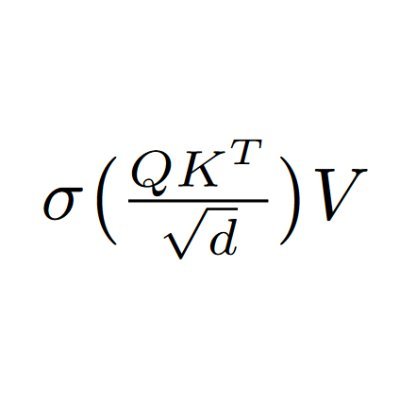
Daniel Han @danielhanchen
36K Followers 2K Following Building @UnslothAI • Making open-source LLMs faster, better & more accessible • YC S24 • ex-NVIDIA ML
OpenRouter @OpenRouter
143K Followers 385 Following The unified interface for LLMs. 400+ models (incl. 50+ free), the best prices, explorable data, private chat, & a unified API. https://t.co/qJG5mKrQ6j

Logan Kilpatrick @OfficialLoganK
366K Followers 3K Following Member of technical staff, working on Gemini, @GoogleAIStudio, the Gemini API, & Kaggle. My views!
Noam Brown @polynoamial
171K Followers 950 Following Researching reasoning @OpenAI | Co-created Libratus/Pluribus superhuman poker AIs, CICERO Diplomacy AI, and OpenAI o-series 🍓 reasoning models


Sakana AI @SakanaAILabs
140K Followers 0 Following Building Frontier AI in Japan Try Sakana Chat, Translate, Marlin, Namazu, Fugu 🐡 https://t.co/stLdPSz1Y7
Percy Liang @percyliang
124K Followers 424 Following professor of computer science @Stanford @stanfordnlp, co-founder of @togethercompute, https://t.co/7R5THVnJ6u, @simile_ai, pianist
Jeremy Howard @jeremyphoward
329K Followers 7K Following 🇦🇺 Co-founder: @AnswerDotAI/@FastDotAI ; Prev: Professor@UQ; @kaggle founding president; founder @fastmail/@enlitic/… https://t.co/16UBFTX7mo
Google AI Studio @GoogleAIStudio
203K Followers 2 Following The fastest path from prompt to prototype to production with Gemini
Google Gemini @GeminiApp
574K Followers 53 Following The Gemini app turns research into reality, bringing frontier AI experiences like Omni, Deep Think, Nano Banana, and more to hundreds of millions of people.
Suresh Manian @suresh_manian
5K Followers 4K Following Arogya | Snowsurance | HealYa | https://t.co/76ykmCpYBR | https://t.co/4GOZwGP3UI | https://t.co/ZoXv4xzBl2
Muhammad Rehan @RehanAshraf179
38 Followers 387 Following React developer building real-world tools. Currently working on a memory Card Game. Clean code, minimal UI, maximum impact. ⚛️
Asuka @UK_1178
766 Followers 985 Following Serial founder. I don't just spot gaps in markets - I build the companies that fill them.Trends for United States
You might like