

Papers.Data.Code @papersdatacode
Only meaningful ML signals. Papers, repos & datasets. Selected, not collected. Highlights, trends & TL;DRs. 📄💻📊 → https://t.co/nGRf9ZTJks t.me/papersdatacode Joined April 2026-
Tweets567
-
Followers66
-
Following22
-
Likes147
📋 ML Weekly Recap · Oct 19 – Oct 25 ⚡ Trends ▸ Synthetic executable environments are scaling agent training for GUI, data, and computer-use tasks ▸ Embodied world models increasingly use shared 3D/egocentric representations across humans and robots ▸ Efficiency-focused generative systems emphasize few-step or one-step rendering and video enhancement 🧭 TL;DR 📄 Learning from Fleet Experience: A Collective Learning Paradigm for Robots Chao Yu, Shu'ang Yu, Hao Lin et al. Fleet-log retrieval learning boosts real-robot success without new expert corrections. 📄 arxiv.org/abs/2610.25736 ⭐ Hy-Memory Practical persistent agent memory with hierarchical recall and zero-cost operations. ⭐ github.com/Tencent-Hunyua… 💡 Agents are shifting from static benchmarks toward executable, self-improving environments. → t.me/papersdatacode…
Links: ⭐ github.com/OpenImagingLab…
💻 OpenImagingLab/FlashVSR_Plus Runs one-step diffusion video super-resolution with untiled 4K inference using hybrid sparse attention and streaming decode options. Key points: • Untiled 4K inference on a single 24GB RTX 4090 • Hybrid attention gives up to 2× DiT acceleration • Cuts peak memory by 45% vs standard DiT attention Shows that high-quality diffusion VSR can reach practical untiled 4K inference on a single consumer GPU. ⭐ 142 stars

📄 Agent World Model in the Wild: Computer-Use Agent Environment Synthesis by Zhaoyang Wang (@zhaoywang_CS), Qianhui Wu et al. Builds open-source synthetic PC worlds with GUI, CLI, and MCP access, then generates and validates cross-interface tasks via multi-agent execution gates. Key points: • 341 long-horizon environment-task pairs synthesized • Tasks can require 100+ steps; GPT-6-Astra solves only 60% • Qwen models trained only in WildAWM improve on 8/8 OOD benchmarks Open-source synthetic computer worlds can train agents that generalize broadly beyond the generated environments.

📄 SolarRenderer: Few-Step Generative Reference Rendering by Guian Fang (@Enderfga), Shengju Qian et al. Uses native reference tokens as aligned structural controls, then adds a separate 4-step LoRA so one frozen backbone renders many structure types fast. Key points: • 4-step rendering is 12.3x faster than 50-step sampling • SOTA on both in-distribution and 16-type generalization benchmarks • Generalizes to 11 unseen structure types, including skeletons and point clouds A single reference-pathway control interface can generalize across heterogeneous and even unseen structural video representations.
💻 MemTensor/MemT-1.0 Adds persistent native memory to chat models so they can save, clear, and later reuse past interactions without replaying the original context. Key points: • Persistent state is ~66× smaller than full KV cache at 128K history • MemT-1.0-Flash and Nano rank 1st and 2nd on 11 memory benchmarks • Supports memory snapshots and restore via saved server-side state files Shows that long-horizon conversational memory can be carried in fixed-size latent state instead of replaying full text history. ⭐ 291 stars

📄 Ropedia W0: Scaling Loco-Manipulation World Models across Embodiments with Human Experience by Tianqi Liu, Hanfei Zhao et al. Replaces robot-specific action conditioning with shared camera-pose and skeleton controls, so one video world model can predict human and robot loco-manipulation. Key points: • SOTA across DreamDojo, Ψ0, ω-HOME, Xp-Teleop, and AgiBot • Human scaling: camera ATE drops 2.21→1.79 cm from 1k→10k h pretraining • Robot scaling on Ψ0: LPIPS improves 0.427→0.365 from 1k→10k h Large-scale human egocentric pretraining transfers to robot world modeling when locomotion and manipulation are expressed in a shared kinematic format.

📊 VDEBench by hongzhuyi Contains 3,506 dense document-page edit examples with image input, text instruction, target image, and optional masks for English and Chinese text/table edits. Key points: • 3,506 test examples total • 7 edit types: 3 text and 4 table tasks • Bilingual English and Chinese document images Useful for benchmarking models that must edit document images locally while preserving layout, typography, and nearby content. 📥 1.6k downloads

Links: 📄 arxiv.org/abs/2610.25736
📄 Learning from Fleet Experience: A Collective Learning Paradigm for Robots by Chao Yu, Shu'ang Yu et al. Failed rollout contexts retrieve similar successful segments from fleet logs, and those actions are prioritized to fine-tune a shared policy without new expert actions. Key points: • Phone packaging: 79.2% to 98.3% success with 96 robots • Across 5 tasks: 93.3-99.2% success over 120 eval trials per task • Removing failure-guided retrieval drops phone packaging from 86.7% to 64.2% Shared autonomous experience can materially improve deployed robot reliability without scaling expert corrective supervision.

📄 EgoXperience: Learning World-Grounded Egocentric Representations from Human Experience by Xinhao Ji, Hui En Pang et al. A joint feed-forward model for egocentric video that predicts camera, depth, hands, and object poses together in one metric world frame. Key points: • HOI4D camera nATE reduced by 68.9% vs strongest baseline • EgoX-Bench hand W-MPJPE and depth AbsRel cut by 65.6% and 42.9% • HOT3D object AUC-S50 improves by 28.0% vs strongest baseline Joint world-space supervision across camera, scene, hands, and objects yields much more coherent egocentric reconstruction than separate pipelines.

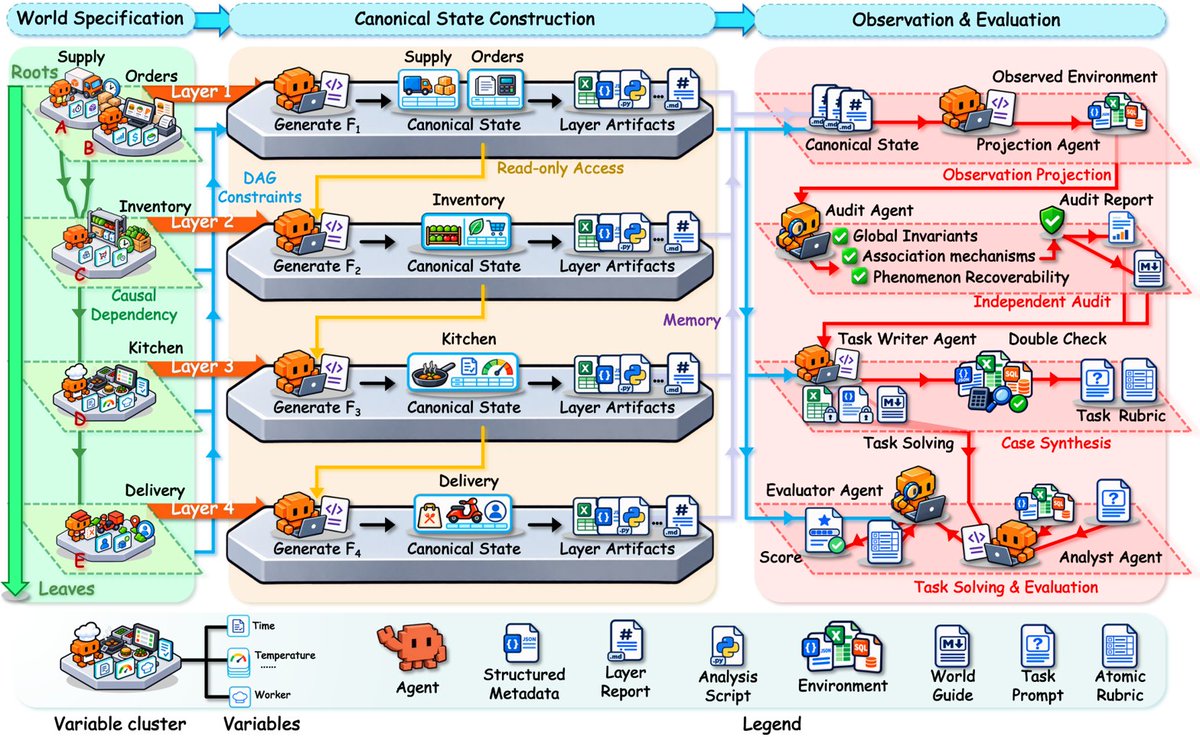
📄 Data World: Scaling Data Environments from Scratch by Zhanli Li, Zeyuan Xu et al. A mechanism-first pipeline that creates synthetic file environments, audited tasks, and rubric rewards from explicit world models rather than existing datasets. Key points: • +20.90 on DABstep-Hard over Qwen3.6-35B-A3B • +14.28 on DAComp over the base model • +7.06 on DataWorld-Bench over the base model Explicit generative worlds can supply scalable, verifiable supervision for training data-analysis agents on open-ended insight tasks.
📊 into-the-unknown by prometheus-eval Contains 15 paper-based research tasks and 135 agent submissions with PDFs, event logs, and working files for open-ended follow-up paper writing. Key points: • 15 tasks from published or submitted papers • 135 submissions from 9 agents • Includes PDFs, JSON trajectories, logs, and file-system snapshots Useful for benchmarking AI agents on end-to-end scientific research and follow-up paper generation. 📥 1.3k downloads


Hamburglar @hanischogseh
27 Followers 655 Following
++ @awkwardackerman
3 Followers 89 Following software engineer and AI infraestruture https://t.co/sKSRrpN7H1
Stella Carneiro @StellaCarneiro3
0 Followers 6 Following

@ @rchtchauhan
29 Followers 759 Following


Rahul Arora @codename_Rahul
244 Followers 296 Following Polymath | Programming | Data Science | Tech | History | Spirituality . . Everything!!!!


J @joy__Dip
0 Followers 406 Following
Mourya @MouryaKonathala
8 Followers 530 Following
Vamshi Vijay Krishna ... @jvamshivjkrsna
0 Followers 118 Following
sumit @holybeast7
16 Followers 71 Following Agency • AI • Helping startups ship fast | Open for gigs • DM
Ankita Sarkar @potatolaaaa1111
3 Followers 119 Following Dog Person. Engineer. PhD Scholar. Andamani
S MADHUSHREE @SMADHUSHREE2
7 Followers 312 Following
nibbana🛞 @the_nibbana
114 Followers 2K Following ....at some point something must have come from nothing.....
unkown @unkownman9999
0 Followers 25 Following
Kissan Jam @Aquamarine_lite
71 Followers 5K Following 21 Cricket, Anime, Telugu twitter Tweets kanna retweets ekkuva😶🌫️
nilamgrag @cheeku1976
17 Followers 413 Following
Preetham Tyson @preetham_tyson
51 Followers 557 Following Living an extraordinary boring life | Rant about Manchester United | Mostly here to repost LLM based resources.

Vishnu V R @vishnuravinadh
18 Followers 664 Following Engineering | Manufacturing | Industrial digitalization | Physical AI | Building Scalable systems


Jayita Bhattacharyya ... @jayitabhattac11
336 Followers 1K Following Building @domynai | Data Scientist | AI Nerd🤓 | Tech Speaker🎤 | Hackathon wizardry 🪄| Knucklehead🤪 | organizer @__bangpypers__
dawg @LakshyaJaigp68
9 Followers 242 Following
rajshekar kolichala @rajsh3kar
20 Followers 458 Following Asking questions to internet @ IIT Bhilai, గుర్తుకొచ్చింది రాసేస్త పెద్ద పట్టించు కోకండి

khushi 🦈 @smilewithkhushi
5K Followers 948 Following polymath🦇 • devrel & coordination @horizenglobal @ZKVProtocol • privacy, web3 & ai
atul kulkarni @atulkulkarni02
4 Followers 39 Following
mr. potter @potter_mr12929
4 Followers 659 Following
code @Bluesta63229343
0 Followers 29 Following
Yaswanth @yashwanth_V108
4 Followers 265 Following Building software. Exploring intelligence, systems, markets and consciousness. Writing about Agentic AI • System Design Crypto • Algorithmic Trading • Metaphys
Shashwat Rai @Shashwat__Rai
1 Followers 102 Following
Brian @Hhhbhhhhhjj
7 Followers 808 Following
ssssssssss @subhajitac81276
1 Followers 77 Following
Aman Kumar @amankumar_19
7 Followers 164 Following
Pushpak Mahalle @el_pushpak
27 Followers 315 Following
dhivin dharshan @DharshanDh99956
6 Followers 357 Following
Meet Joshi @meetxiv
0 Followers 15 Following Figuring life out, the DATA way, check out my journey, https://t.co/JyU5medUKG

Raghavendra Badiger @RaghavendraMTE
50 Followers 213 Following

shiva kumar @shivabkumar0
172 Followers 3K Following

نجمه @s4dsjm
264 Followers 504 Following
Biometric Update @BiometricUpdate
22K Followers 3K Following Biometric Update is the leading online source for breaking news, analysis, and research about the global biometrics industry.
Kosta Derpanis @CSProfKGD
88K Followers 202 Following #CS Associate Prof @YorkUniversity #ComputerVision Researcher, @VectorInst Affiliate @UofT status only, @ELLISforEurope Member, X-social media chair 4all vision
Ilir Aliu @IlirAliu_
57K Followers 832 Following Deep in robotics. Bringing together founders, investors & operators.
Aran Komatsuzaki @arankomatsuzaki
198K Followers 446 Following Sharing AI research. Early work on AI (GPT-J, scaling, MoE). Ex ML PhD (GT) & Google.
Rick Lamers @ricklamers
6K Followers 427 Following 👨💻 Senior AI Research Engineer @NVIDIA. Ex-Groq. Occasional angel investor. Opinions are my own.
Utkarsh ✈️ EMNLP ... @utk7arsh
2K Followers 542 Following ai/ml @Asteralabs | cs @penn & @ucla | Researching on VLMs, VLAs | #ynwa
Vidit Gujrathi @viditchess
140K Followers 891 Following Chess Grandmaster | Olympiad Gold with Team India | Candidates 2024 | Now also building AI things. Business: [email protected]

Jay Baxter @jaybaxter
8K Followers 2K Following @CommunityNotes founding ml lead @X / @SpaceXSI. built bayesDB @MIT

Chip Huyen @chipro
156K Followers 738 Following @aisysbooks @goodailist AI Engineering: https://t.co/94dv4uTU1H Designing MLSys: https://t.co/G81hL2dWmr Reading @chipslib
arXiv Daily @Arxiv_Daily
50K Followers 2K Following Daily feed of this week's top research articles published to https://t.co/ULrW4yLt6n. AI Research Papers, Curated by @DeepAI
Computer Vision and P... @CSVisionPapers
1K Followers 4 Following New Computer Vision and Pattern Recognition papers from https://t.co/NvCyo8SqfI: image processing. Thank you to arXiv for use of its open access interoperability.
OpenBMB @OpenBMB
13K Followers 394 Following OpenBMB (Open Lab for Big Model Base) aims to build foundation models and systems towards AGI. Connect with us: https://t.co/N9pevTnoOa
DAIR.AI @dair_ai
136K Followers 1 Following Democratizing AI research, education, and technologies. Learn about AI Agents for FREE at https://t.co/HHXg8rryu4
Sebastian Raschka @rasbt
530K Followers 1K Following ML/AI research engineer. Ex stats professor. Author of "Build a Large Language Model From Scratch" (https://t.co/O8LAAMRzzW) & reasoning (https://t.co/5TueQKx2Fk)
elvis @omarsar0
326K Followers 1K Following Building the frontier @dair_ai • Prev: Meta AI | Galactica LLM | Papers with Code | Elastic | PhD
Zhenjun Zhao @zhenjun_zhao
7K Followers 2K Following Postdoc @unizar | PhD @CUHKofficial | 3D vision, SLAM, Image matching (https://t.co/WZzEImwX03)

DailyPapers @HuggingPapers
22K Followers 4 Following Tweeting interesting papers submitted at https://t.co/rXX8x0HzXV. Submit your own at https://t.co/QhbJKXBd4Q, and link models/datasets/demos to it!
Biology+AI Daily @BiologyAIDaily
18K Followers 277 Following Protein/Antibody Designer, AI for drug design, Deep learning and large language model. Share daily papers on biology + AI
You might like

















