Post Quantumize @postquantumize
Your wallet may already be exposed. Check your quantum risk. Free. Live on-chain data. postquantumize.com quantum Joined March 2020-
Tweets39
-
Followers20
-
Following13
-
Likes505
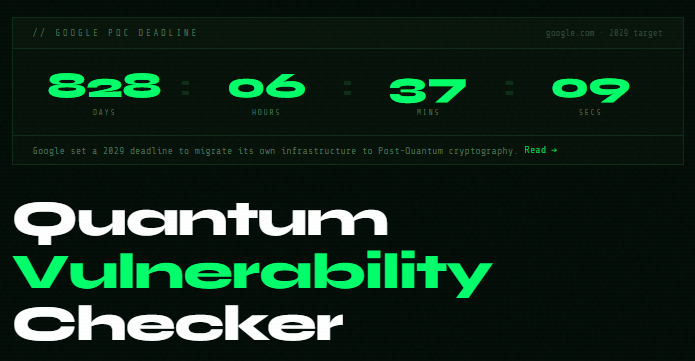
828 days : 7 hours : 36 mins Post-Quantum is real and it's closer than what you think. Start off with getting a PQ ready hardware wallet from @FreedomFactory Also, check if you are exposed, @postquantumize

PQ1 Giveaway time because y'all are not Post-Quantum ready. Just copy the share link and share with 1 friend, and DM us a screenshot with proof. 1 Lucky winner will be randomly selected in 72 hours. Godspeed 🫡

Get your Quantum-proof hardware wallet from Freedom Factory and enjoy the rest of the cycle. The countdown is on. Courtesy: @GoogleQuantumAI
Introducing PQ1: The world’s first quantum-proof hardware wallet. If Q-day arrives, your assets are safe. Reserve now at freedomfactory.io
Quantum-safe Bitcoin transaction was tested in August. More in-coming.. Check our Quantum Vulnerability Checker to see if you are exposed to quantum attacks. postquantumize.com

1/ Our quantum-safe Bitcoin transaction cost ~$320 in GPU compute. Can you bring that down? Today, we’re launching the Quantum-Safe Bitcoin Autoresearch Challenge in partnership with @yukonresearch and @eigenlabs. Over $20,000 in rewards for improving the code:
Is Quantum attack getting closer as we speak? Check if your wallet's public key is exposed and calculate a real quantum risk score. postquantumize.com Article 🔗🧵

vitalik.eth just dropped a news on Quantum.. 👀
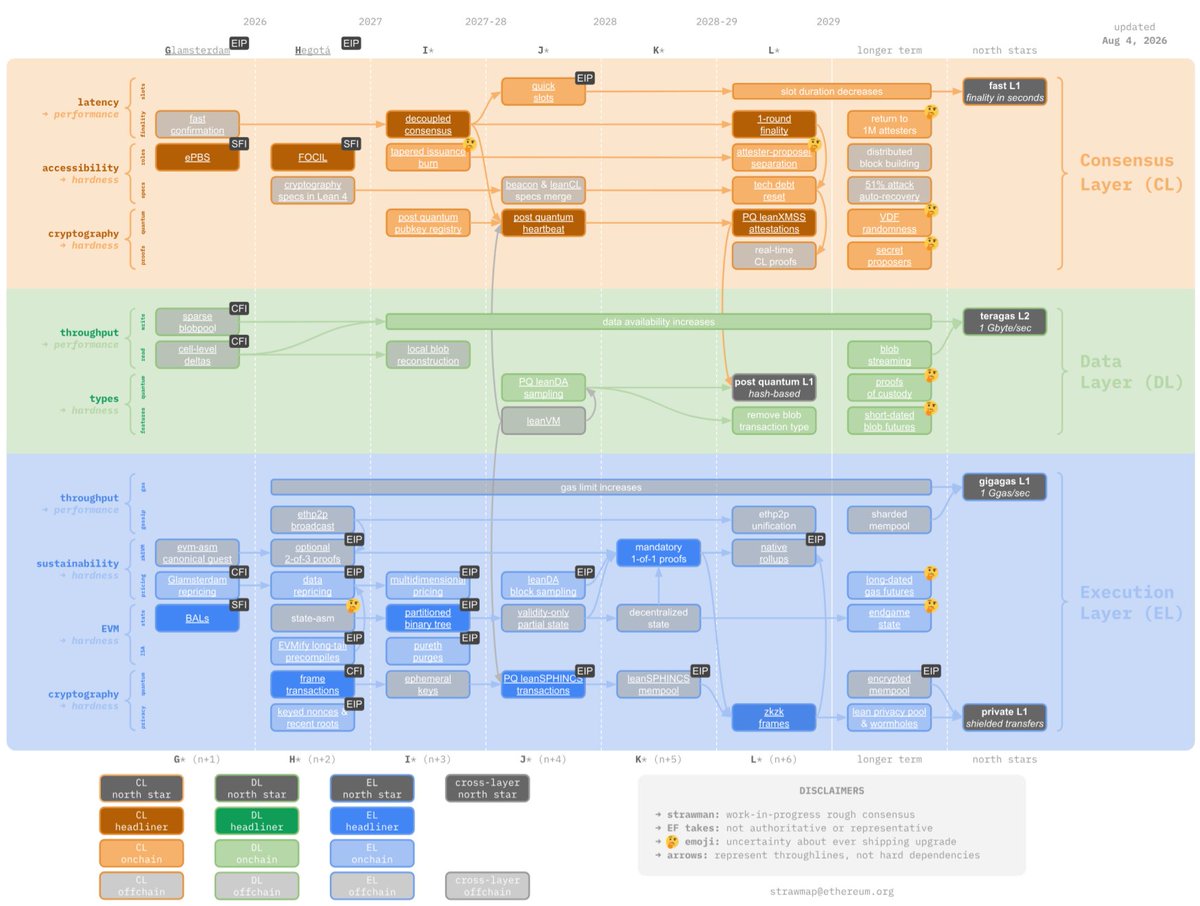
I updated my 2023 roadmap diagram to overlay where the items that were there sit in the current Strawmap ( strawmap.org ). In general, a lot of overlap, but: * Some things got reshuffled in order (eg. quantum safety up-prioritized) * Some things deprioritized (eg.

@Coinbase warns Crypto’s protection could eventually break. Catch all the latest news about Quantum and Post-Quantum related news while checking your Quantum risk on postquantumize.com
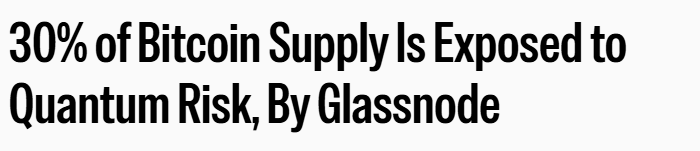
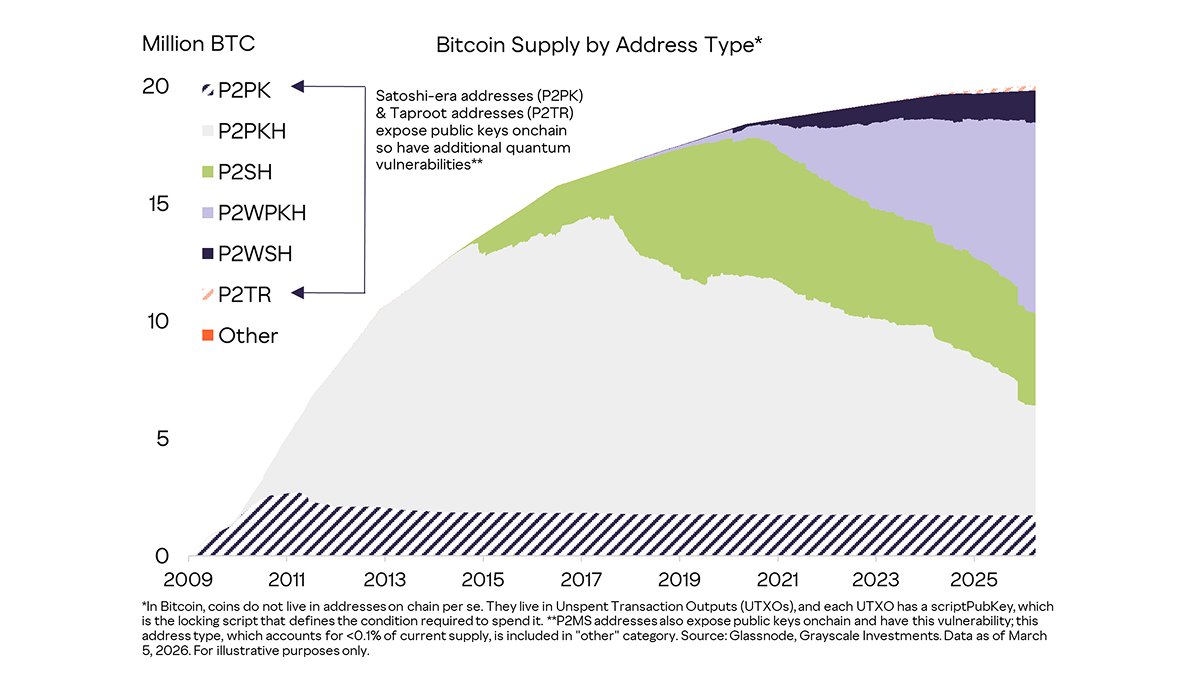
glassnode says 30% of Bitcoin’s supply could be exposed to future quantum attacks. Bitcoin’s biggest long term threat may be physics itself. Check if your wallets are Quantum exposed or not at postquantumize.com
Just updated the tool I created to check Quantum risk for your wallets. - Live countdown to Google's 2029 PQC deadline. - Auto-updating Post-Quantum news feed. - Acquisition page now live. The site is also available for acquisition. Domain. Codebase. Analytics. Brand. Check your wallet free at postquantumize.com

The path to real Post-Quantum era is incoming.

Grayscale Research's analysis of the @Google Quantum AI paper suggests breakthroughs may come in sudden leaps, not gradual steps. That means preparation can’t be delayed. The good news: • Post-quantum cryptography already exists • Some chains like $SOL and $XRP Ledger are
Ethereum Researcher Justin Drake, who co-authored Google's recent quantum paper: "I've stopped thinking about post-quantum as a hurdle that we have to overcome, and I think of it more as an opportunity. It's an opportunity for Ethereum to stand out as the very first global financial system that is post-quantum secure — not just relative to its competitors, but also relative to fiat and tradfi." Justin also believes quantum presents an opportunity for Ethereum to become the best version of itself: “The move to post-quantum is essentially a rewrite, and that’s a massive opportunity to start with a clean slate and wipe our technical debt.” The rewrite bundles post-quantum security with a new ZK virtual machine (LeanVM) that can snarkify the entire consensus layer in real time. The result is that the Ethereum L1 can scale to 10,000 TPS at 1 gigagas/second — while simultaneously becoming quantum-secure. Source: @Bankless (Mar 2026)
Post-Quantum is surely gonna hit the blocks on every chain. Check you Solana wallets on postquantumize.com and see if they are Quantum hack exposed.
Solana just stress-tested post-quantum signatures on its testnet with Project Eleven — and the results are sobering. Signatures became 20-40x larger, and network performance dropped by ~90%. Worse: Solana’s architecture exposes public keys on-chain, meaning 100% of wallets are

What is Post Quantumize and why does it exist? Every time you send a crypto transaction, your public key gets permanently recorded on-chain. Quantum computers, once powerful enough, can mathematically reverse-engineer your private key from that public key. Recent research shows this could happen with under 500,000 qubits. Possibly by end of decade. Post Quantumize is a free tool that checks if your wallet's public key is already exposed. Paste any ETH, BTC, SOL or L2 address. Get a real risk score based on live blockchain data. No wallet connection. No sign up. Just answers. It is now ENS and .SOL compatible. Think of it as a smoke detector for your wallet. It doesn't stop the fire. It tells you if you're at risk so you can act now while there's still time. This is v1. We're building toward a full post-quantum migration guide showing people exactly what to do when their wallet is exposed. Check yours at postquantumize.com

Ethereum is going post quantum. pq.ethereum.org
Today is a monumentous day for quantum computing and cryptography. Two breakthrough papers just landed (links in next tweet). Both papers improve Shor's algorithm, infamous for cracking RSA and elliptic curve cryptography. The two results compound, optimising separate layers of the quantum stack. The results are shocking. I expect a narrative shift and a further R&D boost toward post-quantum cryptography. The first paper is by Google Quantum AI. They tackle the (logical) Shor algorithm, tailoring it to crack Bitcoin and Ethereum signatures. The algorithm runs on ~1K logical qubits for the 256-bit elliptic curve secp256k1. Due to the low circuit depth, a fast superconducting computer would recover private keys in minutes. I'm grateful to have joined as a late paper co-author, in large part for the chance to interact with experts and the alpha gleaned from internal discussions. The second paper is by a stealthy startup called Oratomic, with ex-Google and prominent Caltech faculty. Their starting point is Google's improvements to the logical quantum circuit. They then apply improvements at the physical layer, with tricks specific to neutral atom quantum computers. The result estimates that 26,000 atomic qubits are sufficient to break 256-bit elliptic curve signatures. This would be roughly a 40x improvement in physical qubit count over previous state-of-the-art. On the flip side, a single Shor run would take ~10 days due to the relatively slow speed of neutral atoms. Below are my key takeaways. As a disclaimer, I am not a quantum expert. Time is needed for the results to be properly vetted. Based on my interactions with the team, I have faith the Google Quantum AI results are conservative. The Oratomic paper is much harder for me to assess, especially because of the use of more exotic qLDPC codes. I will take it with a grain of salt until the dust settles. → q-day: My confidence in q-day by 2032 has shot up significantly. IMO there's at least a 10% chance that by 2032 a quantum computer recovers a secp256k1 ECDSA private key from an exposed public key. While a cryptographically-relevant quantum computer (CRQC) before 2030 still feels unlikely, now is undoubtedly the time to start preparing. → censorship: The Google paper uses a zero-knowledge (ZK) proof to demonstrate the algorithm's existence without leaking actual optimisations. From now on, assume state-of-the-art algorithms will be censored. There may be self-censorship for moral or commercial reasons, or because of government pressure. A blackout in academic publications would be a tell-tale sign. → cracking time: A superconducting quantum computer, the type Google is building, could crack keys in minutes. This is because the optimised quantum circuit is just 100M Toffoli gates, which is surprisingly shallow. (Toffoli gates are hard because they require production of so-called "magic states".) Toffoli gates would consume ~10 microseconds on a superconducting platform, totalling ~1,000 sec of Shor runtime. → latency optimisations: Two latency optimisations bring key cracking time to single-digit minutes. The first parallelises computation across quantum devices. The second involves feeding the pubkey to the quantum computer mid-flight, after a generic setup phase. → fast- and slow-clock: At first approximation there are two families of quantum computers. The fast-clock flavour, which includes superconducting and photonic architectures, runs at roughly 100 kHz. The slow-clock flavour, which includes trapped ion and neutral atom architectures, runs roughly 1,000x slower (~100 Hz, or ~1 week to crack a single key). → qubit count: The size-optimised variant of the algorithm runs on 1,200 logical qubits. On a superconducting computer with surface code error correction that's roughly 500K physical qubits, a 400:1 physical-to-logical ratio. The surface code is conservative, assuming only four-way nearest-neighbour grid connectivity. It was demonstrated last year by Google on a real quantum computer. → future gains: Low-hanging fruit is still being picked, with at least one of the Google optimisations resulting from a surprisingly simple observation. Interestingly, AI was not (yet!) tasked to find optimisations. This was also the first time authors such as Craig Gidney attacked elliptic curves (as opposed to RSA). Shor logical qubit count could plausibly go under 1K soonish. → error correction: The physical-to-logical ratio for superconducting computers could go under 100:1. For superconducting computers that would be mean ~100K physical qubits for a CRQC, two orders of magnitude away from state of the art. Neutral atoms quantum computers are amenable to error correcting codes other than the surface code. While much slower to run, they can bring down the physical to logical qubit ratio closer to 10:1. → Bitcoin PoW: Commercially-viable Bitcoin PoW via Grover's algorithm is not happening any time soon. We're talking decades, possibly centuries away. This observation should help focus the discussion on ECDSA and Schnorr. (Side note: as unofficial Bitcoin security researcher, I still believe Bitcoin PoW is cooked due to the dwindling security budget.) → team quality: The folks at Google Quantum AI are the real deal. Craig Gidney (@CraigGidney) is arguably the world's top quantum circuit optimisooor. Just last year he squeezed 10x out of Shor for RSA, bringing the physical qubit count down from 10M to 1M. Special thanks to the Google team for patiently answering all my newb questions with detailed, fact-based answers. I was expecting some hype, but found none.
@drakefjustin Just built postquantumize.com in response to your paper. Paste any wallet to see if your public key is exposed on-chain. Live data. Free. ETH · BTC · SOL · All L2s
Meanwhile check your wallets to see if they are Quantum exposed or not and let the devs cook to secure all of us against this. visit postquantumize.com

Many are wondering "what Google saw" that caused them to revise their post-quantum cryptography transition deadline to 2029 last week. It was this: research.google/blog/safeguard…

Certera @certera_llc
292 Followers 416 Following Modern and Affordable SSL Certificate, Code Signing Certificate, and Cyber Security Services Provider
Shebz @shebz7
11 Followers 320 Following
Debanish Achom @debanishachom
6K Followers 2K Following Executive Editor @ndtv Photo blogger, midfielder
Manas Baruah @ManasBaruah12
1 Followers 41 Following Brand Design | Art Direction | Sustainability x Future
unselfish.eth @james_base_eth
3K Followers 2K Following trader by mistake, investor by choice. This pfp will never exist! multichain.eth | Building @clawdintern, @postquantumize and more.. Following @ChelseaFC 4life

Maoofjaw @Maoofjaw995
32 Followers 1K Following
JAMES @itsjamesb1
414 Followers 3K Following Proud father,Investor, travel ✈️wine and book enthusiast,@stockportcounty fan
CYCLE // burn protoco... @bClyceOnSolana
63 Followers 1K Following One token. Multiple utilities. $CYCLE powers the first burn-native ecosystem on Solana.
Marrenz @Marrenz14
8 Followers 65 Following
Pix @Pix100x
23K Followers 6K Following 7 figs at 18 from trading • memecoins & marketing • dm for inquiries 📨
Dicebotofficial @dicebotofficial
63 Followers 1K Following Advanced bot for a variety of crypto-currency casino sites giving strategies that earn you money on a daily basis using the bot Join telegram channel below
Leeza_Artist🌸 (com... @Leeza9020
134 Followers 3K Following ℙ𝕣𝕠𝕗𝕖𝕤𝕤𝕚𝕠𝕟𝕒𝕝 𝔾𝕣𝕒𝕡𝕙𝕚𝕔 𝔻𝕖𝕤𝕚𝕘𝕟𝕖𝕣🦋𝟐𝐃/𝟑𝐃 ᴍᴏᴅᴇʟs🦋ᴀʀᴛ•ʀɪɢɢɪɴɢ•ᴀɴɪᴍᴀᴛɪᴏɴ 🌸𝙻𝙾𝙶𝙾, 𝙱𝙰𝙽𝙽𝙴𝚁, 𝙾𝚅𝙴𝚁𝙻𝚈 & EMOTES👩🎨

amr elhenawy @amrelhe82097625
26 Followers 412 Following
Amr Elhenawy @AmrElhe3022845
27 Followers 427 Following
Boomshankar.eth @shiftcntrldel
9 Followers 117 Following
Aditya Joshi @adityajay23
6 Followers 65 Following
Peregrinate Rare NFT ... @peregrinateer
4 Followers 74 Following Peregrinate will be one of the first rare film collections captured by Kodak Super 8 camera on the Ethereum network.
Google Quantum AI @GoogleQuantumAI
61K Followers 31 Following Our mission is to build quantum computing for otherwise unsolvable problems.
Freedom Factory @FreedomFactory
29K Followers 9 Following Makers of the first Quantum Proof Hardware Wallet. ㅤ

Cointelegraph @Cointelegraph
2.9M Followers 2K Following Trusted crypto media since 2013 · News, research, podcasts & more · Explore: https://t.co/6IsiPge7RR and https://t.co/M6iNuH76x7
Bitcoin Magazine @BitcoinMagazine
4.5M Followers 1K Following The Most Trusted Voice In #Bitcoin 🟠 • Find us https://t.co/X4mXn4g3Oo
Solana @solana
4.2M Followers 4K Following The high performance network powering internet capital markets, payments, AI agents, stocks, memes, and crypto apps.
unselfish.eth @james_base_eth
3K Followers 2K Following trader by mistake, investor by choice. This pfp will never exist! multichain.eth | Building @clawdintern, @postquantumize and more.. Following @ChelseaFC 4life
CZ 🔶 BNB @cz_binance
13.0M Followers 1K Following Buy the book (proceeds go to charity): English: https://t.co/UxgYxYJ3NF Chinese: https://t.co/ItFd8FEyuK @binance @BNBchain @YZiLabs @GiggleAcademy
Bitcoin @Bitcoin
8.9M Followers 13 Following Bitcoin is an open source censorship-resistant peer-to-peer immutable network. Trackable digital gold. Don't trust; verify. Not your keys; not your coins.
Ethereum @ethereum
4.6M Followers 0 Following The universal platform for crypto, blockchain apps, stablecoins & decentralized tech. An account about the Ethereum ecosystem maintained by @ethereumfndn.

vitalik.eth @VitalikButerin
8.0M Followers 550 Following I choose balance. First-level balance. mi pinxe lo crino tcati https://t.co/gCQrmCby7P
You might like