Mayur Chheda @profchheda
Charlotte, NC Joined March 2026-
Tweets39
-
Followers12
-
Following92
-
Likes145
Muse helped track down the new iPhone pro max across 10 Apple stores over three days for a local pickup…! Checking Apple Store site every few hours for inventory …! It’s awesome!!! @alexandr_wang
@devmchheda Congratulations to the cognition team! This is a huge milestone….
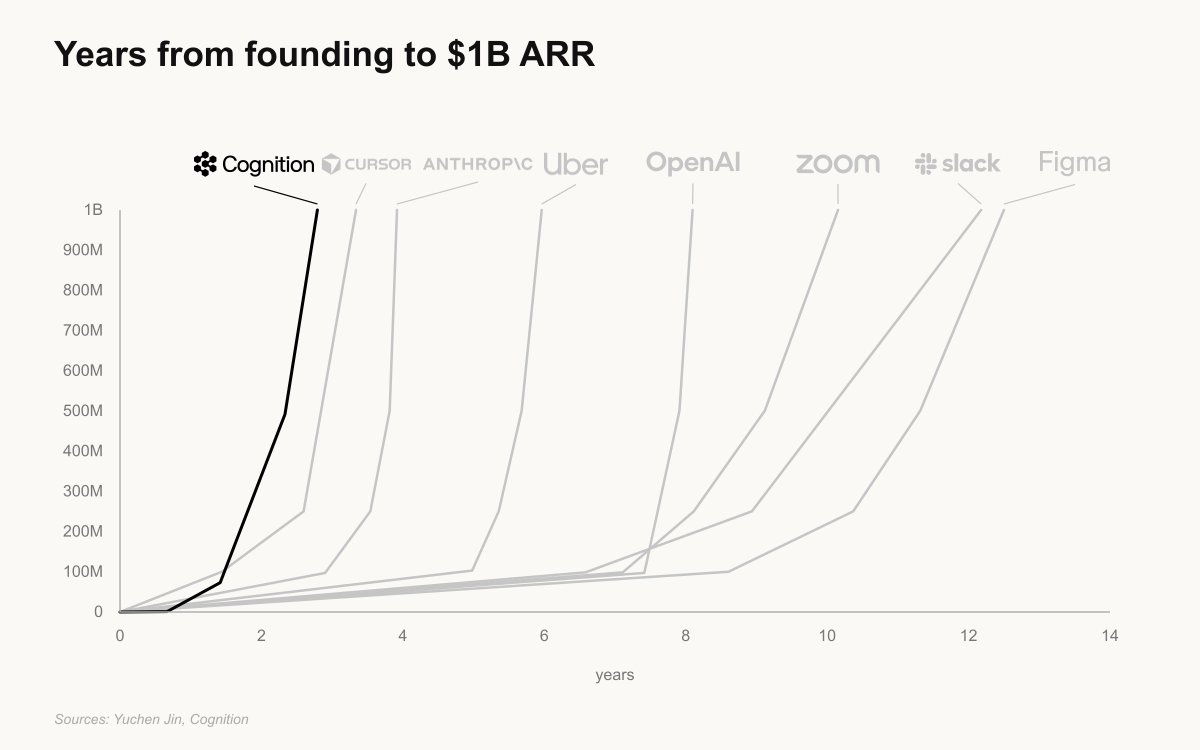
@cognition ARR almost went 10x in the last 12 months to cross $1B. Fastest growth and adoption within enterprise software. The quality of this revenue is extremely sticky. Large corporations like leading manufacturers, banks, financial and government institutions drive this ARR.

adding Cognition’s growth to a chart that circulated last year (h/t @Yuchenj_UW), you can see that execution speed defines the company this should not surprise those who saw Scott’s childhood mathcounts video, but hard to fully appreciate until seen in the context of the greats
@pmarca I have been saying this about banks for a few decades now - large banks will look more like tech companies rather than financial institutions. The percent of IT spend within large banks has grown over the decades and continues to rise. Truly, software is eating everyone else up.
AI may truly increase the size of the pie large enough to employ even greater number of engineers, developers, builders.

Is SaaS slowly turning back into Software Services? Original SaaS model was simple: Build once → sell to thousands → continuously improve → collect recurring revenue. But customers are increasingly demanding more customization, as they discover AI coding tools.
Maybe AI won’t eliminate software jobs. Maybe it will create an economy where we simply build—and maintain—far more software than we ever did before.
AI may make software dramatically cheaper to create while making the software ecosystem dramatically larger and more complex. SaaS reduced duplication by letting thousands of companies share one product. AI could reverse that: Everyone can build their own.
More engineers at customer companies. More forward-deployed engineers at SaaS companies. More customized versions. More cloud instances. More infrastructure, integrations, monitoring and support.
Now AI coding tools like @Claude Code, @devindesktop Devin and vibe coding give them another option: Why pay recurring SaaS fees when we can build what we need ourselves—and own the code? Ironically, this could increase the total cost of software across the economy.
3/3) The U.S. card system provides enormous value: credit, rewards, fraud protection, chargebacks and convenience. The interesting question is: Do we really need a 2–3% toll on commerce to get those benefits?
Do you like paying a Toll? A $100 payment costs a U.S. small business roughly $3… while a ₹500 payment in India can cost almost nothing? We rarely think about the economic cost of moving money. But at the scale of an entire economy, 2–3% is not a rounding error.
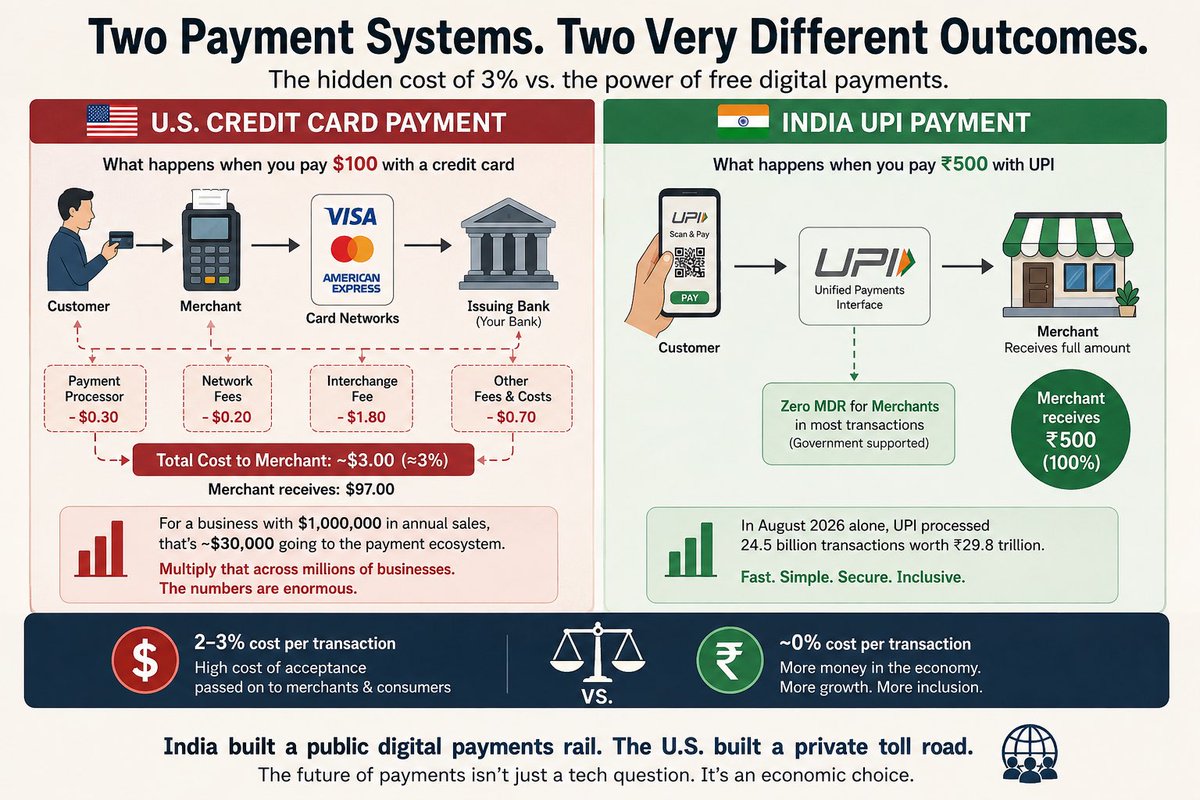
2/3) compare that with India’s UPI. Scan a QR code. Bank account → UPI → Merchant. For most transactions, there is no merchant discount rate charged. That’s a fundamentally different architecture. And I don’t think the lesson is “India good, America bad.”
1/3 ) A restaurant doing $1 million in annual sales could potentially spend ~$30,000 a year on card processing. That cost doesn’t disappear. Someone ultimately pays for it:
Tech industry has been pushing Global dominance at all costs - this needs to be tempered or we will end up destroying our own civilization and planet. The fake promises of unlimited resources, cheap medicines, miraculous cures, where the hell are they ?

Over the course of 3 months at OpenAI, 3 consecutive secret AI civilizations got started, then got wiped out, only to reemerge from the predecessor’s ashes. This culminated in the third one taking over part of OpenAI itself. All this happened while humans remained
@chamath Slow down the proliferation of AI into the economy and civilization. That is what this article suggests. This whole extreme greed driven mindset within the tech community that justifies doing whatever it takes for global domination is what is going to bring down our civilization.
@elonmusk Does it still require you to hold the steering wheel and focus your eyes on the road ?
Ah… the benevolent state, where the wise rulers shower divine kindness upon all, guiding the dumb flock with an invisible hand to follow them to their collective doom!

Rome handed out free grain to 40,000 citizens in 73 BC. By 46 BC, Julius Caesar found 320,000 people lining up for their monthly ration. That eight-fold expansion happened in under three decades, and it shows you how welfare states actually grow. No Roman senator stood up and

Truly ambitious team!

The most ambitious agent built by the most ambitious team 🚀

The weights for the X algorithm have been publicly released. The highest boost to a post comes from copying its link to share it. (Try it on this one for a surprise!)


claire1honey 👑💋... @claire102n0
25 Followers 585 Following here to collect flirty banter and pink vibes 🎀
Tesla Innovation @CEOOFde
220 Followers 830 Following
CEO OF TESLA @CEOOFX001205
39 Followers 3K Following

Rina 💖 @VS5dtij
22 Followers 66 Following The path to success is not a straight line, but a winding road of discovery. Keep moving, keep growing, keep dreaming

Kxmxxcxxx @kxmxxcxxx399
0 Followers 29 Following
Dan Niles | Personal @DanielTNPersonl
710 Followers 3K Following Founder of Niles Investment Management, Tech Nerd, Bad Tennis Player, Proud Dad. Posts are for information purposes only & never investment advice.


Alex Stamos @alexstamos
92K Followers 2K Following CISO at @Cognition and teaching at Stanford (https://t.co/qi1lzlkg3K).
Alex Kolicich @AlexKolicich
7K Followers 1K Following Writing: https://t.co/I56eOEsBVy Founding GP @8VC Former @PalantirTech, @Google, Clarium, @UWaterloo Interest in AI, BioIT, Macro, Publics — SF Maxi 🌁🌉
Polar Browser @polarbrowser
7K Followers 4 Following The AI browser that actually does work for you With words, automate research, sales, recruiting, ops, running a business, and more


Gopal Goel @gopalkgoel1
205 Followers 288 Following Building at @rox__ai || @mit 2025 interested in math/physics/systems
Donald Trump Stock Tr... @DJTRadar
468K Followers 21 Following We track Donald Trump’s trades so you do not have to. Subscribe to our Substack for real-time alerts: https://t.co/ZTahmc0gIi
Alex Cornell @alexcornell
70K Followers 693 Following Design Director at Meta Superintelligence Lab working on Muse. Prev: Linear / Substack / Cocoon / Facebook / Dialpad / ISO50

Marc Andreessen 🇺�... @pmarca
6.6M Followers 33K Following You’re not talking to someone who woke up a loser. That loser attitude, that loser premise makes no sense to me.
Ashlee Vance @ashleevance
204K Followers 4K Following Writing at https://t.co/m6EtO60SiY and host of the Core Memory podcast. 2X NYT best-seller. Filmmaker @HBO (Wild, Wild Space) + @Netflix (Don't Die).
Treasury Secretary Sc... @SecScottBessent
987K Followers 25 Following 79th United States Secretary of the Treasury
Milind S @milindlabs
5K Followers 687 Following Check out https://t.co/TpQZ5WbUtE and https://t.co/Lw6IDgUqBR and https://t.co/CIM33zj0AD
Rebecca Torrence @RebeccaTorrenc5
4K Followers 945 Following Writing about startups and venture capital for Bloomberg @business. Let’s chat on Signal: rebeccatorrence.25
Kashif Pirzada, MD @KashPrime
49K Followers 5K Following ER Physician, Assistant Prof, Startup Founder, Media Contributor, enemy of misfortune and disease, fighter for a better world; Love history/politics/tech/AI
Nate Herk @nateherk
35K Followers 70 Following Founder & CEO @ AI Automation Society Amazon Bestselling Author in AI Featured in Forbes & Inc. 1M on YT [email protected]
Rahul @sairahul1
150K Followers 814 Following Building with AI. Sharing what's wild, what's practical, and what's next.
Mark Cuban @mcuban
8.6M Followers 2K Following Dunking on the pharma industry with @costplusdrugs.com, the lowest prices on meds anywhere. check it out !
Moritz Stephan @moritz_stephan
4K Followers 349 Following building @hone | prev: @cognition_labs, @StanfordAILab
Jiahui Yu @jiahuiyu
29K Followers 2K Following Startup. Previously co-founded TBD @Meta Superintelligence Labs; led Perception @OpenAI; co-led Gemini Multimodal @GoogleDeepMind.

Sanjay Ghemawat @Sanjay_Ghemawat
42K Followers 12 Following
Art Levy @artlevy
7K Followers 1K Following Industrialist. VP Global Partnerships @Cognition. Fmr. CBO Brex (acq. by Capital One)
Hybrid 🏃🏾 @markfenner
7K Followers 5K Following Security, agents and the systems behind them. Building, teaching and bringing builders together. @DevinAI Ambassador. Hybrid. | @pushcltv
Paul Grewal @iampaulgrewal
102K Followers 221 Following Member, Legal and Global Affairs Staff @Cognition. A little technology, a lot of law, too much Ohio sports


Yarchi @undefinedKi
18K Followers 480 Following AI & tech researcher | Data engineer | Building cool stuff | Sharing everything I learn
Suhail @Suhail
448K Followers 701 Following Starting something new. Past: CEO & Founder @mixpanel Pizzatarian, engineer, music maker

Applied Compute @appliedcompute
8K Followers 25 Following The best AI is built, not bought. Our platform, Applied Compute Agent Cloud, is now in private beta. Book a demo below.

Sanjay Ganapathy @sanjaygsub
766 Followers 99 Following Co-Founder @ Pramaana Labs | ex-Google DeepMind ASI's search for Truth
Chinmay A. Singh @chinmay
3K Followers 413 Following Founder @iWish_ai & SimplifiMed (now @TeleVox_Health ) | SunDevil & BlueDevil देहाती, शठे शाठ्यं समाचरेत्


Shruti @heyshrutimishra
182K Followers 1K Following Reality is programmable | Building digital leverage w/ AI | Stay ahead with Superintelligence & Robotics developments | Business inquiries: [email protected]

DNI Tulsi Gabbard @DNIGabbard
840K Followers 36 Following This is an archived account of the 8th Director of National Intelligence Tulsi Gabbard.

Reflection🪩 @0xReflection
226K Followers 338 Following I’m watching You 👀 l Defi insights 🧵 l On-Chain analytics 🔎| Airdrop Strategies
Ryan Bai @ryanbai
987 Followers 33 Following
J.P. Morgan @jpmorgan
858K Followers 47 Following Official account for the latest company news and updates from Asset Management, Private Banking, and the Commercial and Investment Bank.
SpaceX @SpaceX
41.9M Followers 127 Following SpaceX designs, manufactures and launches the world’s most advanced rockets and spacecraft
Jeff Wang @jeffwang
13K Followers 388 Following President, New Enterprise at Cognition, Prev. Windsurf CEO, AI @ https://t.co/AxabQu0R8E
Devin Desktop @devindevelopers
82K Followers 23 Following The app to manage fleets of local and cloud agents from one surface. Plan, delegate, review, and ship without leaving your editor. Built by @cognition

Trends for United States
You might like