

Rack System @racksystemapp
Neocloud for AI teams. Real racks, live telemetry, liquid hours. Built on Robinhood. 0x92fa51f17820260d69988f038becad11a59af4a2 docs.racksystems.cloud Joined October 2026-
Tweets183
-
Followers158
-
Following6
-
Likes92
Owning powerful hardware and building reliable compute infrastructure are two very different things. A GPU can deliver impressive performance on paper, but real-world AI workloads depend on much more than processing power. Resource availability, workload coordination, and predictable execution all influence whether that hardware becomes genuinely useful. This is the infrastructure challenge RACK SYSTEMS is working to address. By organizing compute around different execution requirements, RACK aims to create an environment where developers can focus on running workloads rather than constantly managing the limitations of available capacity. The bigger picture is about making GPU infrastructure more practical for the people building with it. Because the next generation of AI won't be powered by hardware alone. It will depend on the systems that make that hardware usable. docs.racksystems.cloud
The most expensive GPU isn't always the one with the highest price tag. Sometimes, it's the one sitting idle while another workload is waiting for compute. AI infrastructure has a utilization problem that raw hardware performance alone cannot solve. Adding more GPUs increases theoretical capacity, but it doesn't automatically make that capacity more useful. This is where RACK SYSTEMS introduces a different way of thinking about compute infrastructure. Instead of treating every GPU allocation as an isolated resource, its architecture is designed to make available capacity accessible across different workload requirements. The real opportunity lies in reducing the gap between resources that exist and resources that are actually being used. Because the future of AI infrastructure won't be defined only by how much compute we can build. It will also be defined by how intelligently we use what we already have. docs.racksystems.cloud
Not every GPU workload deserves the same priority. And treating them as if they do is one of the easiest ways to waste valuable compute. A production model serving live users has different requirements from a research experiment running overnight. One demands predictable access, while the other can afford to wait for available capacity. RACK SYSTEMS approaches this distinction through a scheduler built around three execution models: reserved capacity for workloads that need dedicated resources, on-demand access for flexible execution, and batch computing that takes advantage of idle GPUs. The interesting part isn't simply having different plans. It's how those plans interact on the same infrastructure. Reserved workloads retain priority, on-demand jobs use available capacity, and batch jobs can yield when higher-priority work needs the hardware. That creates a more deliberate relationship between compute availability and workload requirements. Because efficient infrastructure isn't just about how powerful the GPUs are. It's about making sure the right workload gets access to them at the right time. docs.racksystems.cloud
The next interesting project isn't always the loudest one on the timeline. Sometimes it's worth looking at a sector, understanding the product, and following a project before deciding what you think of it. That's the approach I'd take with RACK and $RSYSTEM: research the infrastructure, follow the progress, and make your own judgment.
Every token has a story. The important part is separating what exists today from what people hope might happen tomorrow. RACK has a published AI compute offering and technical documentation. What that means for $RSYSTEM over the long term still needs to be evaluated independently. I'm watching the project develop rather than assuming the outcome in advance. racksystems.cloud

AI infrastructure is a sector worth watching, but every project still has to earn its place in the market. For RACK, I'll be watching how the service develops, whether real teams find it useful, and what progress becomes visible over time. That's what will make the $RSYSTEM story more interesting to follow.

I'm interested in projects that sit at the intersection of real technology and markets that people are paying attention to. AI infrastructure is one of those sectors. RACK is building a compute service for AI teams, while $RSYSTEM gives people a token associated with the project to research. The long-term story depends on execution, adoption, and what actually develops from here.

A single cluster-wide utilization number doesn't tell the whole story. RACK documents per-GPU telemetry for utilization, memory, temperature, and power, sampled at 1 Hz, with 24-hour history described across its platform. That level of visibility can help developers understand what their workloads are doing.

Not every compute job needs the same level of priority. RACK's scheduler separates reserved hours, on-demand capacity, and preemptible batch workloads. Batch jobs can use idle reserved capacity, but they're the first to give way when that capacity is needed. Understanding those rules matters when deciding which workloads can tolerate interruption.

What if GPU infrastructure could fit directly into your existing development workflow? RACK's API documentation covers checking capacity, submitting jobs, and reading telemetry through command-line tools or Python. The goal is to let developers work programmatically instead of relying entirely on a dashboard.
Infrastructure planning gets easier when teams can follow changes over time instead of relying on scattered announcements. RACK offers a capacity-report subscription with a monthly report and updates when a region or compute plan changes. For teams evaluating infrastructure, that kind of information can help make planning more deliberate.
Compute location is part of the infrastructure decision. RACK currently lists its C1 cluster in us-west, in Hillsboro, Oregon, while Frankfurt is listed as a planned region. That gives developers a concrete starting point for thinking about where their workloads run and what regional expansion could mean. See the region details: racksystems.cloud

Curious how to get started with RACK? The website has a request-access form where AI teams can describe their workload, team size, and expected compute hours. During the preview, access is invitation-based, with responses targeted within two business days. If you're building something that needs GPU capacity, take a look at the process.
There’s a difference between renting cloud GPUs and building your own infrastructure from scratch. RACK is taking a different approach: dedicated rack infrastructure with compute hours teams can reserve, alongside on-demand and batch options. For AI teams, the interesting question is how much control they need without taking on the burden of owning an entire rack. Explore the model: racksystems.cloud


When you're evaluating infrastructure, don't just look at what a platform says it can do. Look at what information it makes available. RACK has a public status page where you can check its reported system status. One more way to explore the project beyond its homepage.
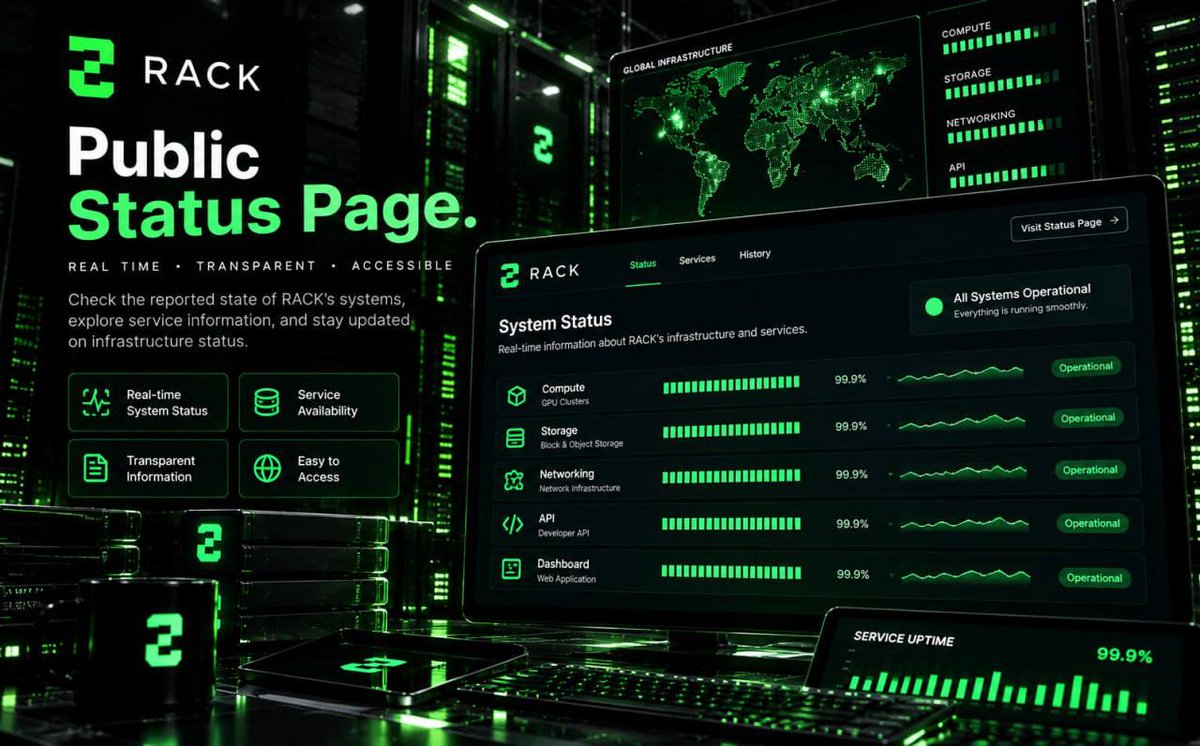
If you want to understand an infrastructure project properly, go beyond the homepage. RACK provides documentation covering its cluster, scheduler, telemetry, quickstart, and API. Whether you're researching the project or evaluating the technical side, there's more to explore than a ticker and a chart. docs.racksystems.cloud

Not every AI team uses compute the same way. RACK lays out three pricing options for different needs: → On-demand for flexible access → Reserved for dedicated capacity → Batch for preemptible workloads You can explore the options on the public website without relying on a tweet to explain the whole product.

Curious about RACK? You don't have to start with the token. The website gives you a place to explore the project, understand its compute offering, and see how the infrastructure is presented. Take a look around, read the details, and decide for yourself.


The Solana Army ®️... @TheSolanaArmy
25K Followers 20K Following 🚀 Crypto Coins & Token Promoter 📈 Helping Projects Reach the Right Audience #Binance #Metaverse and #Gamefi.Doxxed Gem Bullish Gems 💎 $RAO Dm for promotion
Whale Elite @Realwhales_
116K Followers 87K Following Crypto Influencer & Investor | Finding 100x - 1000x Gems | DYOR | Investor #BTC #ETH #BNB #SOL | DM for Business


éMpty @GFYS2023
574 Followers 1K Following
布道者 @ZheDao72932
33 Followers 124 Following



Surapree Pimsuwan @SurapreeP
18 Followers 1K Following
Yeefoo @weeraodd2025
76 Followers 310 Following
PlanetEarthIsMy @manyraim
21 Followers 358 Following
north @northexst_
355 Followers 616 Following

Lukido @lukidodoit
6 Followers 56 Following I'm very easy to understand to them who need me in there life....
Taa @tngo168
60 Followers 961 Following
努力小海pz @NqBZ5XVe5Jt5qk3
63 Followers 700 Following
Joe @Joew2h
44 Followers 233 Following

MT @MuflehTalouzi
283 Followers 75 Following
SirLeimi @DawnFeller2
158 Followers 1K Following Tracking the rise the new financial Wrld & Web3 researcher & Investor, trench coat baby .

Mufty @0xMufty
26 Followers 167 Following
JalPhoenix @JalPhoenix
422 Followers 673 Following Rising from the ashes. Building in crypto after the burn. Not the same person who went in.
KAI(Gifted) @kchelsea2008
385 Followers 2K Following
Projectjustice00 @Weekend_Lion
98 Followers 3K Following
Mr Dari ₿ @MrDariBoss
353K Followers 42K Following Crypto Shiller ₿ & Web3 Strategist 🎯 | Scaling top blockchain projects 📈 | DM for promo 📩 #DeFiShill #NFT #Binance
ᏟᎻᎾᎷᏚᏦᎩ... @Chom_sky1
2K Followers 1K Following Cultured Creator ♤ Devoted Project Mngr | Growth Advisor
clankoshi @clankoshi
16 Followers 119 Following trust for Robinhood, Solana, Ethereum, Base https://t.co/HzmgM8k3St

Maggie 💞 @shinymoony432
5 Followers 385 Following Send me your smoothest hello — I’m in a chatty mood ❤️

HUX @HuxOnchain
30 Followers 56 Following Web3 | Community Building 🌐 Connecting with builders. Helping communities grow. 🚀
Royal Falcon (🔋, �... @RoyalFalcon1234
646 Followers 2K Following 🌱 ⚡ Dynamic Orthodoxy ⚡ 🌱 health/longevity/spirituality
Mr Alex Bitoshi @ALT_WHALES_
36K Followers 1K Following AI × Crypto × Web3 🤖⚡ Entrepreneur | Marketing | AI Agents | Alpha Building, exploring & sharing the future of technology.📩 Open for collaborations
遥远的诗歌🌤�... @SHIGE202064
7K Followers 3K Following 喜欢科技 政治 和新事物 对未来充满憧憬和悲观 AI会让时代无限加速 从人生观 社会观 到世界观的重塑 可能会很难吧
ASK NEXUS CALLS @asknexuscalls
705 Followers 4K Following Ask Nexus is a crypto-focused AMA community bridging the gap between blockchain innovators and engaged audiences through real-time, insightful discussions.

XAU/GOLD TRADING @Xau_Gold_FullTP
108 Followers 2K Following


MissMetaverse @alkhobarREST
42K Followers 31K Following Pumpfun/Altcoin Project s Researcher🔍#Crypto Official Partner - $ETH & $BNB & $SOL Holder - All About Blockchain Technology - #Bitcoin #CryptoMarket #Memecoin
Martin Bruno @themartinbruno
76K Followers 31K Following Tier-1 Crypto Influencer.NFA - DYOR. DM for Business Inquiries!
Crypto Radar @THFO351
66K Followers 9K Following Crypto Influencer || Memecoins • Early Gems || Project Promotions • 10x–100x Potential || Always DYOR - NFA || DM for Collaboration

Robinhood EU @RobinhoodApp_EU
19K Followers 8 Following One platform for everything investing. Disclosure: https://t.co/FLSBO0XPlG
Robinhood Crypto @RobinhoodCrypto
651K Followers 200 Following The home for onchain crypto & institutions.
Hyperliquid @HyperliquidX
432K Followers 9 Following Infrastructure to house all finance. Trade crypto, commodities, indices, FX, and real-world assets onchain, 24/7. Not directed at UK persons.
Vlad Tenev @vladtenev
1.1M Followers 894 Following CEO and Co-Founder @RobinhoodApp 📈📱Executive Chairman and Co-Founder @HarmonicMath 👁️🗨️👨🏫

Trends for United States
You might like


















