

Harold @rich_compass
A technical analyst with 12+ yrs exp. in stocks and crypto. Not financial advice. 🔴 Sign up for 20% Off Spot & Contract Fees on Bitget (Top 4th globally) ⬇️ lihi2.com/lfckl Joined January 2025-
Tweets1K
-
Followers171
-
Following111
-
Likes1K
Why did Skydance stock drop after reports that Elon Musk is buying in?👇 ⠀ Why would a media company that just closed a $100B merger see its stock rise and then fall after reports of a roughly $1B investment? ⠀ On October 22, 2026, Semafor reported, citing people familiar with the matter, that Elon Musk had invested about $1B in Skydance ($SKYD), the company led by David Ellison and formerly known as Paramount Skydance. ⠀ The money was described as a much-needed cash injection for the company, meant to cut costs and lift the stock. ⠀ An October 22 analysis from Yahoo Finance noted the investment hasn't been publicly confirmed, and Semafor said Musk and Skydance didn't immediately respond to requests for comment. ⠀ The market's reaction was even messier than the report itself. ⠀ After the report, Skydance shares flipped from a gain of about 6% intraday to a loss, falling as much as 2.4%, and trading was briefly halted. ⠀ As of the October 22 close, Skydance stock was at $7.79, down about 23% from a month earlier and below the $9.84 opening price on October 6, its first day trading on the NYSE under the SKYD ticker. ⠀ ----- ⠀ 🔴 Follow me on X: @rich_compass ⠀ U.S. stock, crypto, and technical analysis ⠀ ----- ▋ Silence and missing filings keep the Musk investment unconfirmed ⠀ Semafor's report put the investment on roughly the same timeline as equity investments from other Skydance investors, including board member Laurene Powell Jobs. ⠀ Musk was one of several wealthy figures that Skydance CEO David Ellison considered bringing in as co-investors. ⠀ Deadline reported the $1B investment the same day and placed it after media mogul John Malone predicted a day earlier that Musk would step in to help Larry Ellison. ⠀ Even after the news broke, key deal terms remained undisclosed: the reports didn't say the price Musk paid, the form of the investment, or when the money would arrive, and it was unclear whether the cash was new money or part of the earlier $47B fundraising. ⠀ As of October 22, it was still unclear whether the investment came from SpaceX or Musk personally, and neither side explained the motive for the deal. ⠀ Musk's injection was part of a broader equity fundraising push by Skydance, CNBC reported, citing Semafor. ⠀ A check of SEC EDGAR on October 23 showed the latest filing on Skydance Corp's 8-K list was still a current report filed on October 16 that included Items 5.04 and 9.01. ⠀ The list had no current report filed between October 22 and October 23. ▋ Two movie studios under an $80B debt load ⠀ Skydance closed its acquisition of Warner Bros. Discovery on October 6, and TechCrunch noted that news of Musk's investment came weeks after Paramount completed the roughly $110B deal. ⠀ The combined company owns two major movie studios, two global streaming services, Paramount+ and HBO Max, plus TV and news assets including CBS, HBO, CBS News, and CNN. ⠀ Under the deal terms, Warner Bros. Discovery shareholders got $31.01666668 in cash per share, Warner Bros. Discovery stock stopped trading on Nasdaq on October 6, and Skydance Class B shares began trading on the NYSE the same day under the SKYD ticker. ⠀ Based on Skydance's unaudited pro forma combined financial data, the total cash consideration paid to Warner Bros. Discovery common stockholders was estimated at about $78B, calculated using shares outstanding as of July 23 and the October 6 closing date, with another roughly $1.1B in cash paid at closing for vested equity awards. ⠀ The closing press release said the combined company offers content in more than 200 countries and territories, has more than 200 million streaming subscribers, commits to at least 30 theatrical films a year with each getting at least a 45-day theatrical window, and already has more than 180 TV shows. ⠀ The Ellison family holds the largest equity stake in Skydance, and the Ellison family and RedBird Capital Partners are the only holders of Class A common stock, together holding 100% of the combined company's voting shares. ⠀ On the debt side, Debtwire estimated Skydance's total debt at closing was $89.3B, with net leverage, or net debt divided by annual operating profit, at about 6 times. ⠀ Unaudited pro forma combined financial statements filed with the SEC show that if the merger had closed on June 30, 2026, the combined company's pro forma total debt would have been about $82.5B, specifically $82.481B, and net debt would have been about $74.593B after subtracting $7.888B in cash; that pro forma figure differs from Debtwire's estimated $89.3B total debt at closing, mainly reflecting different measurement dates and accounting treatments. ⠀ Variety reported that Skydance started operating with about $80B in debt, compared with the $43B in debt Discovery Communications took on when it bought WarnerMedia from AT&T in 2022, which brought the new WBD's total debt to about $53B as of June 2022. ▋ Larry Ellison pledges massive stock piles to secure buyout loans ⠀ Larry Ellison personally guaranteed more than $40B of equity financing for Paramount's acquisition of Warner Bros. Discovery, CNBC reported. ⠀ The guarantees also covered acquisition-related payments and other financial obligations, and the New York Post, citing securities filings, put the combined guarantee from Larry Ellison and a related trust at $45.72B. ⠀ Quartz, citing The Wall Street Journal, said the Ellison family put about $17B into the Skydance acquisition. ⠀ Skydance's closing press release said the deal issued Class B common stock at $12.00 per share, raising $47B in new equity from a group led by the Ellison family, RedBird, the Public Investment Fund (PIF), L'IMAD, the Qatar Investment Authority (QIA), and LionTree; debt financing was led by Bank of America, Citigroup, and Apollo. ⠀ The equity subscription agreements split the contribution into two parts: affiliates of the Ellison Trust would provide up to $46.7B, plus additional consideration calculated as of the closing date and other amounts set by contract; RedBird Capital Partners would provide another $250M. ⠀ These arrangements were listed in the pro forma combined financial data. ⠀ Subscription rights were allocated to institutions including PIF, LionTree, and investment vehicles tied to Abu Dhabi's L'IMAD Holding and the Qatar Investment Authority. ⠀ Pricing started with the volume-weighted average price for each of the 20 trading days ending on the third business day before closing, then averaged those prices; the cap was $16.02 per share and the floor was $12.00. ⠀ The deal ultimately issued about 3.918 billion shares at $12.00 each. ⠀ As his son's acquisition of Warner Bros. Discovery neared completion, Larry Ellison expanded bank borrowing secured by Oracle, Tesla, SpaceX, and Skydance stock, Quartz reported, citing The Wall Street Journal. ⠀ Lenders included Citigroup, HSBC, JPMorgan, UBS, and BNP Paribas; their combined liens filed in California covered 87 million Oracle shares, up from about 30 million a year earlier. ⠀ Quartz's report said the actual borrowing amount remained unclear. ⠀ JPMorgan expanded a May 2025 loan agreement secured by Oracle and Tesla stock on October 1, adding SpaceX and Skydance shares to the collateral package, a change Quartz attributed to lien filings reviewed by The Wall Street Journal. ⠀ Citigroup made a similar addition on September 25, raising its Oracle stock collateral from 30 million shares to 45 million and cutting its Tesla collateral from 3 million shares to 1.5 million. ⠀ For highly liquid stocks like Oracle, lenders typically advance about 50% of their value, but haircuts can push the actual ratio down to 30% or lower; using the 50% rule of thumb, 87 million Oracle shares could support about $5.7B in borrowing, Quartz said, citing market researchers and private bankers interviewed by The Wall Street Journal. ⠀ Oracle disclosed in its proxy statement that Larry Ellison had pledged 413 million Oracle shares as of September 21, 2026, up from 346 million a year earlier. ⠀ Oracle said the pledged shares secured personal term loans used to fund outside ventures and were not held in margin accounts. ⠀ The board's governance committee reviews these arrangements quarterly, and Oracle said the board believes Ellison can repay the loans without touching the pledged shares and that the arrangements pose no material risk to the company or shareholders. ⠀ On September 12, 2026, Larry Ellison canceled a stock sale plan approved in June that was set to sell up to 50 million Oracle shares worth about $7.5B; the plan had been scheduled to expire on October 24. ⠀ Quartz, citing The Wall Street Journal, said the proceeds had been intended to help fund his son's acquisition. ▋ Junk credit ratings and soaring interest make deleveraging tougher ⠀ The Yahoo Finance analysis said that compared with the debt Skydance took on to buy Warner Bros. Discovery, the roughly $1B investment is small, and its value is mainly the signal of a heavyweight endorsement. ⠀ The $1B is about 2% of the equity raised for the deal, does almost nothing to reduce the debt burden, and by itself won't change the deleveraging math. ⠀ The piece argued that the October 22, 2026 stock move from gain to loss may show the market wants financial details, not just headlines. ⠀ Wall Street investors are skeptical that Skydance can cover the roughly $80B in debt from the acquisition with more than $6B in cost savings, TheWrap reported. ⠀ The Yahoo Finance analysis noted that as of its report, the two sides had not announced a commercial partnership; the Starlink partnership John Malone mentioned should be treated as speculation until a formal agreement appears. ⠀ Fitch downgraded Skydance's long-term issuer default rating to BB from BB+ on October 5, the day before the deal officially closed, citing sharply higher leverage after the merger, significant execution and integration risks, and doubts about whether the company can hit the synergies that are critical to deleveraging; BB+ was already the agency's highest non-investment-grade rating. ⠀ Fitch calculated the combined company's leverage at 7.8 times for fiscal 2026 and projected it would fall to 6.2 times in 2027 and 4.5 times in 2028. ⠀ Moody's rated Skydance's debt Ba3 overall on September 29, a non-investment-grade rating three notches below Baa3, the lowest investment-grade level; S&P Global gave a slightly higher rating on October 2 and estimated Skydance's ratio of net debt to adjusted earnings at 7 times for 2026 and 2027, with a target of 3 times or less by 2029. ⠀ Deadline reported that the roughly $52B debt financing included $30B of investment-grade dollar bonds, $11.4B of US high-yield junk bonds, about $1B of euro-denominated junk bonds, plus $8.5B of loans and about $1B of euro-denominated loans. ⠀ The new debt added up to $500M to annual interest expense versus earlier expectations, with some notes carrying rates above 9%; Paramount has hedged US Treasuries to offset some of the extra interest cost. ⠀ Skydance's 8-K disclosed that on October 5, 2026, it issued a total of $41.4B in dollar-denominated senior secured notes, including $30B of first-lien senior secured notes with coupons from 6.300% to 8.900% maturing from 2028 to 2066 and $11.4B of second-lien senior secured notes with coupons from 8.250% to 9.125% maturing from 2031 to 2036, plus EUR 885M of 7.000% second-lien euro notes maturing in 2031. ▋ What Elon Musk actually gains by tapping into Hollywood media assets ⠀ The stake gives Musk a partial ownership interest in media outlets including CNN and CBS, raising concerns among media watchers about his possible influence over coverage of Musk and US President Donald Trump. ⠀ A Bloomberg report published by the Los Angeles Times said the deal links Musk, who controls social platform X, with Larry Ellison's Oracle, which holds a stake in TikTok's US business; the Skydance stake also gives Musk a Hollywood foothold through Skydance's film, TV, and live sports content channels. ⠀ The Guardian described the investment as cementing an alliance between two of Trump's richest donors: Larry Ellison invested $1B in Musk's X takeover in 2022 and gave $45M in 2024 to support Trump's re-election bid, while Musk spent more than $290M to support Trump's re-election and has put more than $350M into the current US midterms to back Republicans. ⠀ Semafor reported that Musk has publicly praised the Ellison family and Skydance in the past, fueling speculation about a larger partnership between his low-earth-orbit satellite internet service Starlink and Skydance. ⠀ The Hollywood Reporter analysis said that if the investment is confirmed, Musk could expand his business influence in Hollywood through his shareholder status and existing ties to the Ellison family; even without a board seat, it could open a channel to David Ellison and help X get access to Skydance content. ⠀ But there is no evidence so far that he got a board seat, voting rights, or content decision-making power, and the Ellison family and RedBird Capital still control Skydance's main voting power. ⠀ The article's expectation that the investment would officially go through SpaceX was also its own speculation, not confirmed fact. ⠀ Musk holds about 85% of SpaceX's voting shares, and Starlink already provides internet service to about 5 million Americans and more users overseas, the scale described by The Hollywood Reporter. ⠀ At the Paley International Council Summit, John Malone predicted that SpaceX could reach a cross-investment and potential global content distribution partnership with Skydance involving $8B to $10B, TheWrap reported. ⠀ He specifically named SpaceX's Starlink satellite internet service as a potential distribution partner for Skydance's TV and streaming assets. ⠀ Talking about Musk's financial relationship with the Ellison family, Malone asked: 'Who financed Musk's Twitter purchase in the first place?' ⠀ Larry Ellison. ⠀ Where did Larry Ellison get the money he put into starting Skydance? ⠀ Tesla stock. ⠀ I don't doubt that soon you'll see an announcement.' ⠀ The New York Post reported that Semafor's article did not say how big Musk's stake is, whether he got a board seat, or whether he got other governance rights. ⠀ As of October 22, no Starlink distribution agreement or additional SpaceX investment had been confirmed; TheWrap also reported that it was still unclear whether Musk's investment was personal or through SpaceX, and whether a larger deal was being planned. ▋ The battle over whether HBO Max will air that Musk documentary ⠀ Skydance's HBO Max holds the North American streaming rights to the documentary Musk, but it's unclear whether Musk's stake will give him any say in content decisions, including the film's streaming release. ⠀ The documentary Musk grossed more than $480,000 in a limited North American theatrical run and received strong reviews, with a 97% score on Rotten Tomatoes. ⠀ Given that tech figures aligned with Musk are involved in the Paramount deal, director Alex Gibney seriously doubts HBO Max will bring the documentary Musk to viewers as planned, Northeast Times reported, citing The Hollywood Reporter. ⠀ The team formally reached out to Musk multiple times without a response, and only later did Musk's legal team threaten legal action over the film; Gibney described that sequence during a TIFF panel, according to the relayed report. ⠀ On the possibility that David Ellison could block the documentary Musk from launching on HBO Max, Gibney said: 'Can Musk call Larry or David and say, you know, don't put this film up?' ⠀ He can.' ⠀ He also said: 'We live in that kind of world now, especially in politics where it's become so transactional... ⠀ this is basically pay for play.' ⠀ When Decider reported on it, the documentary Musk was not yet available on streaming platforms and no HBO Max release date had been announced. ⠀ Back in 2023, HBO Documentary Films pre-bought the film's North American and TV streaming rights; Decider noted that the first streaming platform after theaters would therefore be HBO Max. ▋ How 470 million new warrants actually work ⠀ Skydance disclosed in an 8-K that it issued 470,746,773 warrants on October 13, 2026, initially exercisable for a total of 470,746,773 Class B common shares at an initial exercise price of $12.00 per share. ⠀ The warrants went to holders of Class B common stock on the October 5, 2026 record date, excluding Lawrence J. Ellison, David F. Ellison, Gerald J. Cardinale, the Ellison Trust, RedBird, and other excluded holders; 401(k) plans could not hold the warrants because of ERISA limits and received additional Class B common shares instead. ⠀ A warrant FAQ shows the warrants were approved to trade on the NYSE starting October 13, 2026, under the ticker SKYD WS and CUSIP 69932A113; they traded when issued on October 13 and switched to regular-way trading on October 14, with trades from October 13 and 14 settling no earlier than October 15. ⠀ The warrants are set to expire on October 13, 2036, the 10th anniversary of issuance, at 5 pm New York time. ⠀ Starting October 13, 2029, the first trading day after the third anniversary of issuance, the company can call an early expiration date, but only if the stock price condition is met: Class B common stock closes at or above $30.00 per share on at least 20 of any 30 consecutive trading days, with the threshold subject to adjustment under the terms, and the qualifying days must include the trading day before the company gives notice. ⠀ The early expiration date must be a business day between at least 20 and at most 45 scheduled trading days after notice. ⠀ On the bond side, the company also launched an exchange offer to swap existing notes for new notes and a tender offer to buy back notes for cash; both offers expired on October 6, 2026, and settled on October 9. ⠀ Holders validly tendered about 99.15% of the total principal amount of existing exchange-offer notes; the company therefore issued $11,983,970,000 and EUR 546,547,000 in new notes and received no cash proceeds from the exchange offer. ⠀ In the cash tender offer, the company paid $2,380,201,732.56 in cash plus accrued and unpaid interest to buy back existing tender-offer notes with a total principal amount of $2,395,448,000. ⠀ An October 6 press release said both offers expired at 5 pm New York time that day: about 98.83% of the total principal amount of existing tender-offer notes had been validly tendered, and about 99.15% of the total principal amount of existing exchange-offer notes had been validly tendered, with settlement expected on October 9. ▋ Hitting $6B in cost savings under strict court mandates ⠀ A settlement approved and entered by a California federal district court on September 30 requires Paramount to release at least 30 films a year in the first two years and at least 32 a year in the following three years, and to set up an independent editorial board to oversee CBS and CNN to protect editorial independence. ⠀ The settlement terms require at least 30 films a year in the first two years, with 20 wide releases, and at least 32 films a year in the next three years, with 21 wide releases, and 20% must be big tentpole films; Paramount also must invest an additional $1.5B in US film production over the next five years. ⠀ If it misses the production requirements, Paramount must pay a $30M penalty for each film short, mostly to support health benefits for union film and TV workers; if it still fails to meet the film obligations after a six-month grace period, it must also sell Miramax. ⠀ The company also must negotiate carriage fees for Warner cable channels separately from its own channels or sell certain channels, and it must set up an editorial board of independent journalists to oversee CNN and CBS. ⠀ The proposed settlement terms disclosed by Variety show Paramount pledged not to sell Paramount Studios in California or the Warner Bros. studios for at least five years, to create a News Editorial Independence Committee to set editorial and news standards for the combined news channels, to add an internal compliance monitor and an independent monitoring trustee, and to have a committee of five states oversee enforcement. ⠀ The settlement order was formally approved and entered by the presiding court on September 30, 2026, and is not a draft still awaiting approval. ⠀ The commitments run through the end of the fifth calendar year after closing; based on an October 2026 closing, they last until December 31, 2031. ⠀ The lawsuit brought by state attorneys general did not go to trial, and the settlement is widely seen in the industry as a win for Paramount, but Deadline noted the suit delayed the closing by months, forcing the company to raise money during a period of higher rates and pay more. ⠀ Naveen Sarma of S&P Global Ratings said the bond market demanded a much bigger premium than Paramount expected, driving overall interest expense sharply higher. ⠀ Skydance executives insist most of the expected cost savings will come from integrating streaming technology stacks, optimizing real estate assets, and other items like marketing spend, not layoffs. ⠀ 'Integrating the two companies will bring changes, including hard decisions that affect our employees.' ⠀ That was the message from Skydance co-CEOs David Ellison and Inon Kreitz in a memo to employees. ⠀ The Guardian, citing Los Angeles County officials, estimated Skydance's goal of more than $6B in cost savings over three years could lead to 4,500 film and TV jobs lost in Los Angeles alone. ⠀ The nearly $80B debt load is the scale Skydance faces as it pushes deleveraging; CNBC reported the company expects to reach more than $6B in annualized cost synergies, or run-rate synergies, within three years, not just $6B in cumulative savings over three years. ⠀ Management laid out these targets in the closing press release: more than $6B in annualized synergies within three years, net leverage down to 3.0 times by the end of 2029, and more than $10B in free cash flow by 2030. ⠀ On net leverage, Deadline, citing Fitch, said the Ellison family has stated a commitment to bring it below 3.75 times in fiscal 2028 and to 3.0 times in fiscal 2029. ⠀ Fitch judged that hitting these targets will require additional debt reduction through equity issuance or asset sales beyond achieving synergies and generating free cash flow; the agency's base case did not include equity-funded debt reduction or asset sales. ⠀ Skydance CEO David Ellison believes the company can significantly reduce leverage by 2028 at the latest; Deadline reported he has also promised to use family resources if needed. ⠀ Separately, John Malone said Netflix was told it had no chance of getting US regulatory approval when it bid for Warner Bros. Discovery, then dropped out and left Paramount as the winner; Netflix co-CEO Ted Sarandos previously said the company withdrew because Paramount offered a better price and had called Trump 'completely neutral' on the merger. ⠀ The Yahoo Finance analysis listed three measurable signals to watch: the company confirms the investment or a regulatory filing discloses its price and structure, Skydance's first quarterly earnings after the merger, and evidence that cost savings are showing up in free cash flow; the piece also said any formal commercial arrangement with a Musk company would be a separate and potentially more material development. ⚠️ This is a compilation of public information, not guaranteed to be accurate, and not investment advice. ⠀ 🔴 Follow me on X: @rich_compass ⠀ U.S. stock, crypto, and technical analysis

[Taiwan Stock Market: Is the Drop Over?] Bird Bro talks investing, technical analysis ⠀ ▍Look at Chart 1 first Since April 2025, the Taiwan index has had two lifelines holding up this uptrend ⠀ Lifeline #1: The uptrend line (blue) formed since April 2025 ⠀ Lifeline #2: The 100-day moving average (orange) ⠀ In the past year and a half, it only truly broke down once, in July 2026. Every other time, price touched the average and bounced back, at most a fake breakdown ⠀ So watching support at these two lines is critical ⠀ ▍The short-term drop is overdone, a bounce is possible ⠀ Two reasons ⠀ 1. Back at strong support Touching one lifeline is support. Now it's touching both at once, which is strong support ⠀ 2. RSI and MACD double bottom divergence This usually means the short-term drop has gone too far ⠀ ▍But once both lifelines break, the decline will speed up ⠀ Let me be blunt: if strong support breaks on volume, the RSI and MACD bottom divergence breaks too, and the market has chosen to keep heading down ⠀ ▍If it breaks, where might it drop to first? First, there are many ways to measure this. I'll share one simple pattern-based method ⠀ It'll probably get flamed, but few people talk about it, so I want to bring it up. You can measure it this way in real trading ⠀ Look at Chart 2 One possible path right now is an inverse head and shoulders in progress ⠀ You'll see it in my chart. The pink line is the neckline, and purple is a sketch of the inverse head and shoulders ⠀ Measured by this pattern, we're in the right shoulder now ⠀ The worse case is a drop equal to the left shoulder's 12.8%, which would take us to around 43,500 ⠀ Want me to analyze a stock? Drop it in the comments~


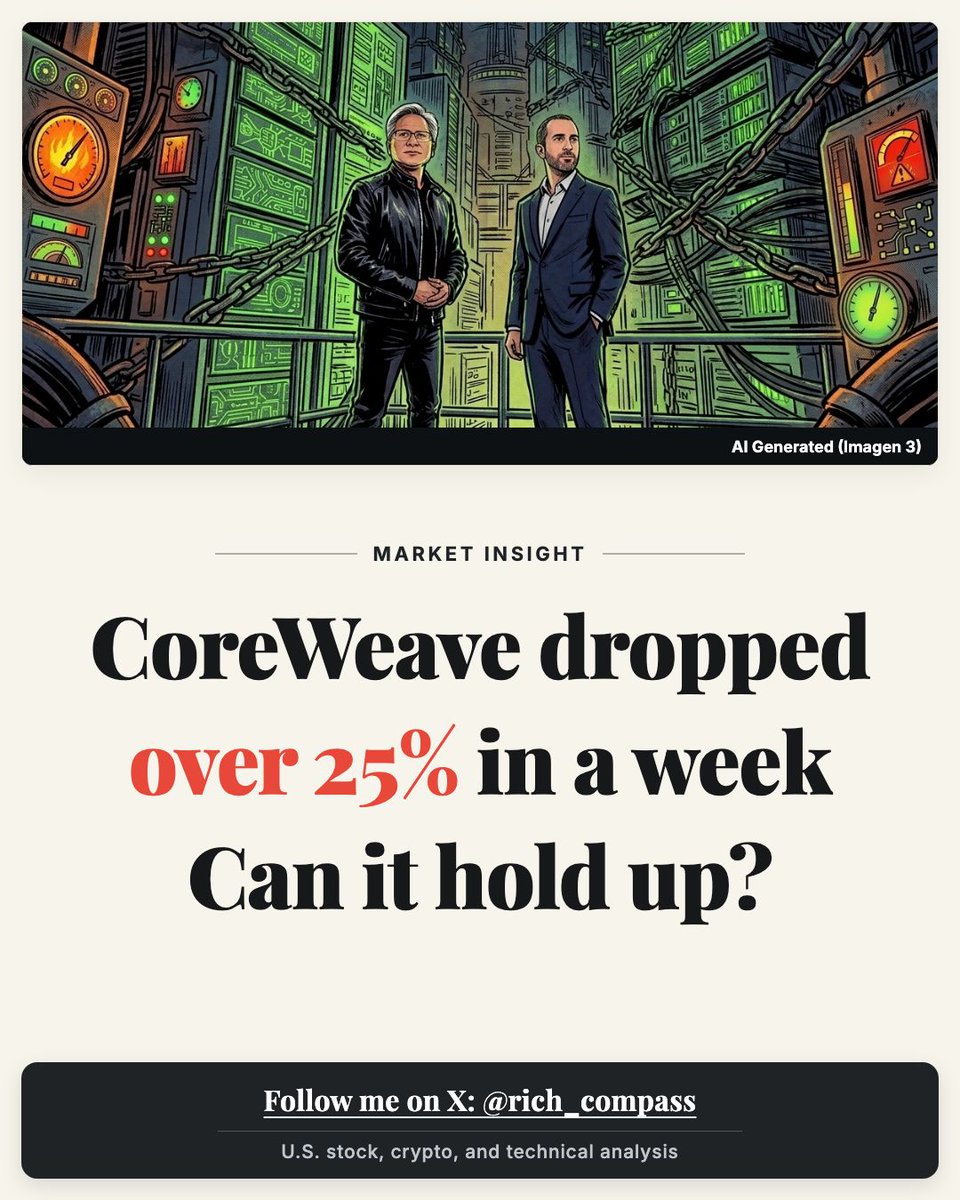
CoreWeave dropped over 25% in a week. Can its debt funded expansion hold up?👇 ⠀ CoreWeave ($CRWV) fell more than 25% this week. ⠀ It was the worst week in about a year. ⠀ From the June 2025 peak, the stock is now down more than two thirds. ⠀ On Wednesday, October 14, the shares fell 15%, then dropped another 6% after hours. ⠀ The same day, the yield on its debt due in 2032 rose above 15%, Reuters reported. ⠀ Crypto Briefing reported on October 15 that CoreWeave's unsecured 2032 bonds traded below 80 cents on the dollar, with yields around 14.8% to 14.9%. ⠀ The stock closed at $61.39 on October 16, down 11.91% on the day and $8.30 below the prior close. ⠀ In the bond market, Reuters cited LSEG data showing CoreWeave's five year credit default swap spread has topped 1,000 basis points. ⠀ A CDS is insurance against a bond default. ⠀ A wider spread means the market wants more pay for taking that risk. ⠀ The same report cited S&P Global Market Intelligence. ⠀ Oracle's five year spread widened by 26 basis points overnight, to a record 288 basis points. ⠀ SoftBank's spread widened by 24 basis points, to 424 basis points. ⠀ Reuters also cited LSEG data showing CoreWeave owes almost $50 billion. ⠀ ----- ⠀ 🔴 Follow me on X: @rich_compass ⠀ U.S. stock, crypto, and technical analysis ⠀ ----- ▋ Analysts blame funding doubts instead of falling AI demand ⠀ A Seeking Alpha article carried on TradingView said CoreWeave's debt has reached distressed levels and pulled semiconductor stocks down with it. ⠀ That, the article said, shows worry that the AI industry is expanding with borrowed money. ⠀ This looks more like investors asking where the buildout money comes from. ⠀ AI compute demand did not suddenly collapse. ⠀ That is how Axel Rudolph, chief technical analyst at IG Group, sees it. ⠀ Kathleen Brooks, research director at XTB, sees CoreWeave quickly becoming the canary in the coal mine for the AI trade. ⠀ That means an early warning that something is going wrong. ⠀ Reuters said big US tech companies are expected to spend more than $700 billion on AI infrastructure this year. ⠀ Demand is still there. ⠀ Financing for the companies that supply that compute is getting tighter. ⠀ Crypto Briefing described the model this way. ⠀ CoreWeave borrows first, buys Nvidia GPUs, builds data centers, and earns the money back slowly through multi year contracts. ⠀ Reuters added that higher borrowing costs could squeeze returns further. ▋ Recognizing big contracts takes years and the business has never been profitable ⠀ CoreWeave says the orders are large enough. ⠀ In an employee memo obtained by Reuters, CEO Mike Intrator said the order backlog is more than the company needs to repay its debt. ⠀ Reuters also reported more than $25 billion of new commitments early in the third quarter. ⠀ The quarterly 10-Q shows remaining performance obligations, or RPO, of $103.7 billion as of June 30, 2026. ⠀ RPO is money already under contract that has not yet been booked as revenue. ⠀ That money will not arrive all at once. ⠀ 41% is expected to be recognized as revenue within 24 months, before June 30, 2028. ⠀ 39% falls in months 25 to 48. ⠀ The rest falls in months 49 to 78. ⠀ The contracts are huge. ⠀ Turning them into revenue takes time. ⠀ The customers are concentrated too. ⠀ In the second quarter of 2026, Customer A was 36% of revenue and Customer B was 26%. ⠀ A year earlier, Customer A alone was 71%. ⠀ The customer base is more spread out than a year ago. ⠀ The top two customers still add up to more than 60%. ⠀ On profits, CoreWeave has never made money. ⠀ Analysts expect revenue of about $13 billion this year and a loss of $2.13 billion, Reuters reported. ▋ Surging interest expenses quickly overwhelmed second quarter operating results ⠀ The number that jumps out is interest. ⠀ In the first half of 2026, CoreWeave's net interest expense was $1.176 billion. ⠀ A year earlier it was $531 million. ⠀ That is an increase of 121%. ⠀ The filing says the main reason is higher borrowing and a larger debt balance. ⠀ Look at the second quarter alone. ⠀ The operating loss was $49 million. ⠀ Net interest expense was $640 million. ⠀ The net loss was $626 million. ⠀ The interest bill was far bigger than that quarter's operating result. ⠀ The debt pile is large too. ⠀ As of June 30, principal still to be repaid totals $35.551 billion. ⠀ Of that, $14.896 billion is due after 2030. ⠀ The 10-Q lists net recourse debt of $31.405 billion, net nonrecourse debt of $3.663 billion, and total liabilities of $72.046 billion. ⠀ Recourse debt is owed directly by the parent, or backed by an unconditional, irrevocable guarantee from the parent. ⠀ Nonrecourse debt can generally be collected only from the borrowing subsidiary's assets. ⠀ The parent may have only limited guarantee liability in agreed cases such as fraud or willful misconduct. ⠀ What about the cash? ⠀ Total liquidity is $15.553 billion. ⠀ That includes $5.524 billion of cash and cash equivalents, and $10.014 billion still available on existing facilities. ⠀ The company says that is enough to cover obligations that are due, or expected to come due, within one year of that 10-Q. ⠀ But in the first half of 2026, operations brought in only $3.663 billion. ⠀ Investing spent $14.874 billion. ⠀ Purchases of property, plant, and equipment were $14.1 billion of that. ⠀ Operating cash is not enough to cover the investment. ⠀ Financing fills most of the gap. ⠀ Financing brought in $13.985 billion in the first half. ⠀ The spending has not stopped. ⠀ In August, CoreWeave raised its full year capital spending forecast by $4 billion, to a range of $35 billion to $39 billion, Reuters reported. ⠀ Reuters also explained that chips lose value as newer generations come out, which pushes suppliers to spend more on replacements. ▋ Strict credit rules limit fresh borrowing before monthly repayments begin in November ⠀ Now look at the borrowing terms. ⠀ In the first half of 2026, CoreWeave signed two delayed draw term loan facilities, or DDTLs. ⠀ The 4.0 facility is $8.5 billion. ⠀ Floating rate borrowings are priced at SOFR plus 2.25 percentage points. ⠀ SOFR is a benchmark rate that moves with the market. ⠀ The 5.0 facility is $3.1 billion. ⠀ The rate is SOFR plus 4.50 percentage points. ⠀ In August, a subsidiary signed a $2.6 billion DDTL 5.5. ⠀ The rate is Term SOFR plus 5.5%, and $1.2 billion has been drawn. ⠀ That same month, the company also drew $1.2 billion on its revolving credit facility. ⠀ Compare only those two disclosed spreads. ⠀ The 5.5 spread is 1 percentage point higher than the 5.0 spread. ⠀ CoreWeave also issued four sets of bonds in the first half. ⠀ The highest coupon is $2.75 billion of 9.75% senior notes due in 2031. ⠀ The lowest is $4 billion of 1.75% convertible senior notes due in 2032. ⠀ The other two are $1.25 billion of 9.625% senior notes due in 2032, and 2 billion euros of 8.50% euro senior notes due in 2032. ⠀ These loans come with a lot of limits. ⠀ The 10-Q says that as of June 30, CoreWeave was in compliance with every DDTL covenant. ⠀ The covenants limit new or guaranteed debt, dividends and stock buybacks, certain investments, liens, asset sales, and deals with related parties. ⠀ On timing, DDTL 5.0 starts monthly repayments in November 2026. ⠀ The final payment is expected in May 2031. ⠀ The DDTL 5.5 availability period ends in December. ⠀ DDTL 4.0 runs through June 30, 2027. ⠀ This 10-Q lists none under senior securities defaults. ⠀ That only means there was no default in that reporting period. ⠀ It does not mean the later financing pressure is gone. ⠀ Another warning is internal controls. ⠀ In the same 10-Q, management concluded that as of June 30, disclosure controls and procedures were not yet working effectively at a reasonable assurance level. ⠀ Previously identified material weaknesses were still there. ⠀ They include IT general controls, segregation of duties, and not enough accounting and finance staff. ▋ The CEO defends the business as Jensen Huang sees no need for a backstop ⠀ CoreWeave's line is that the market got it wrong. ⠀ In the internal memo, Intrator told employees that the market sometimes misunderstands and reacts irrationally. ⠀ Nvidia CEO Jensen Huang also stepped in to cool things down. ⠀ Reuters reported that he played down the worries about CoreWeave, said its financial health is improving, and sees no need to provide a backstop. ⠀ Nvidia has also agreed to buy compute capacity that CoreWeave cannot sell. ⠀ The agreement runs through April 2032. ⠀ How should the words no backstop needed be read? ⠀ Crypto Briefing's reading is that the market often hears no rescue needed as no rescue is coming. ⠀ But Nvidia already has a $6.3 billion capacity purchase commitment due on April 13, 2032. ⠀ For unsold compute, that works as a backstop for utilization. ⠀ Nvidia and CoreWeave also have an equity tie. ⠀ Crypto Briefing reported that Nvidia holds nearly 10% of CoreWeave. ⠀ In January 2026, Nvidia bought Class A shares at $87.20 each, for $2 billion in total, to help CoreWeave add more than 5 GW of AI compute capacity before 2030, Yahoo Finance said. ⠀ The 10-Q also discloses that this private placement was about 23 million shares. ⠀ Set that next to the October 16 close of $61.39. ⠀ The close is below that purchase price. ▋ Bears question contract margins while bulls count on Nvidia backing ⠀ Analysts on Seeking Alpha are split into two camps. ⠀ The bears have three worries. ⠀ Bashar Issa thinks CoreWeave's contracts with hyperscale cloud companies have thin margins, or even losses, and do not produce core profits. ⠀ Dustin Quasney thinks borrowing rates are already above the yield on the leases, a clear negative spread. ⠀ James Foord thinks interest expense and aggressive capital spending already exceed operating profit. ⠀ The bulls have three reasons too. ⠀ The Asian Investor thinks that, with Nvidia holding about 10%, Nvidia might step in with strategic financing if the bond market tightens further. ⠀ DPRG Investment Management thinks that, at the current valuation, the company offers a rare mix of value and growth. ⠀ Rick Orford thinks the $4.2 billion convertible bond lowered the interest cost. ⠀ One caution. ⠀ The strategic financing The Asian Investor mentioned is only that analyst's guess. ⠀ Huang's public position is that no backstop for CoreWeave is needed. ▋ Rival clouds stumble after Gartner warns eighty percent may close by 2030 ⠀ This selloff did not land only on CoreWeave. ⠀ Reuters reported that other new AI cloud providers, called neoclouds, and AI related credit markets were hit too. ⠀ Shares of Nebius, Applied Digital, and Iren fell. ⠀ The cost of default protection on SoftBank rose. ⠀ Credit spreads for Amazon, Alphabet, Meta, and Nvidia also hit records. ⠀ They rose much more slowly than CoreWeave's. ⠀ Those companies also have larger cash flows and stronger balance sheets. ⠀ The same Reuters report cited a Gartner estimate that about 80% of new AI cloud providers may shut down before 2030. ⠀ Gartner also warned that expected AI revenue is not enough for every planned infrastructure project to earn a profitable return. ▋ Watch for bond price rebounds and a five hundred billion dollar funding proposal ⠀ What should you watch next? ⠀ Crypto Briefing suggests watching two things. ⠀ First, whether the price of CoreWeave's 2032 bonds moves back toward face value. ⠀ Second, a $500 billion idea for third party financing of AI infrastructure. ⠀ Nvidia has described the role it might play. ⠀ CoreWeave is also watching whether that idea can become a possible source of funds. ⚠️ This is public information, not guaranteed to be accurate, and not investment advice. ⠀ 🔴 Follow me on X: @rich_compass ⠀ U.S. stock, crypto, and technical analysis
Albertsons faces a cost structure it cannot afford. Can a review fix it?👇 ▋ Adjusted EPS topped estimates while total revenue dipped slightly ⠀ Albertsons ($ACI) reported its FY2026 second quarter results on October 13, 2026, and filed them with the US Securities and Exchange Commission on Form 8-K under Item 2.02 for results of operations and financial condition. ⠀ The second quarter ended September 12, 2026, covered 12 weeks, and net sales and other revenue were $18,894.7 million, down 0.1% from $18,915.8 million in the same period of FY2025. ⠀ Identical sales fell 0.8% from the same period a year earlier. ⠀ Albertsons defines identical sales to include direct to consumer digital sales, exclude fuel, and compare stores open in both periods on a daily basis. ⠀ Digital sales grew 11%. ⠀ Adjusted EPS was $0.36, topping the IBES analyst estimate of $0.33, but below $0.44 in the same period of FY2025. ⠀ On a net basis, adjusted net income came in at $179.0 million, beating the IBES consensus of $161.2 million, though trailing $248.4 million a year earlier. ⠀ Under GAAP, net income stood at $51.5 million, or $0.11 per diluted share, down from $168.5 million, or $0.30 per share, in the prior-year period. ⠀ Core operating profitability also moderated, with adjusted EBITDA of $784.0 million (4.1% of net sales and other revenue), compared with $848.4 million (4.5%) in FY2025. ⠀ ----- ⠀ 🔴 Follow me on X: @rich_compass ⠀ U.S. stock, crypto, and technical analysis ⠀ ----- ▋ Albertsons pauses annual guidance for a full business review ⠀ While adjusted EPS topped analyst estimates, Albertsons said it would not provide FY2026 guidance until a full business review is complete, and it would not give an updated outlook before the review wraps up in the fourth quarter. ⠀ The quarter's adjusted profit beat analyst expectations while near-term earnings visibility fell, so don't read it as the profit beat causing the guidance withdrawal. ⠀ Interim CFO Cody Perdue said on the earnings call that the second quarter performance was in line with the lowered outlook, but the company doesn't think another financial outlook update is prudent right now. ⠀ The Fool transcript shows management telling analysts that the full review could change the pace and mix of investments, cost cuts and related timelines, and adjustments to brands, markets, assets, and the business portfolio, which is why guidance was paused. ⠀ No FY2026 guidance creates uncertainty about near-term financial performance, and GuruFocus listed that as a negative point in its summary of the call. ⠀ The full business review covers customer strategy, cost structure, operating model, banner (retail brand) and market portfolio, assets and business, and capital allocation priorities. ⠀ CEO Susan Morris said in the earnings release: 'While our second quarter performance was in line with expectations in our revised outlook, our results do not reflect the company's potential. ⠀ We are starting a full business review to accelerate improvements in Albertsons' performance and to more forcefully address a cost structure we can no longer afford.' ⠀ Albertsons said in its second quarter earnings release that it expects to present an updated short- and long-term financial framework and full transformation plan by its fourth quarter earnings call at the latest, and it plans to hold an investor day in spring 2027. ▋ First quarter identical sales softened as investments ran ahead of productivity gains ⠀ Looking back, Albertsons provided updated FY2026 guidance on July 23, 2026, and then withdrew it on October 13, 2026. ⠀ Under that withdrawn framework, identical sales had been projected at negative 1.5% to negative 0.5% (down from prior guidance of 0.0% to 1.0%), reflecting an estimated 150 basis point headwind from the Inflation Reduction Act Medicare drug price negotiation program taking effect on January 1, 2026. ⠀ That outlook had also placed adjusted EBITDA at $3.550 billion to $3.625 billion, lowered from an earlier $3.850 billion to $3.925 billion. ⠀ For earnings per share, adjusted net income per Class A common share had been modeled at $1.75 to $1.85, trimmed from $2.22 to $2.32. ⠀ Planned capital expenditures had been set at $1.9 billion to $2.0 billion, slightly scaled back from an initial $2.0 billion to $2.2 billion. ⠀ CEO Susan Morris said in the July 23, 2026 first quarter earnings release that, given continued weak industry unit trends and more cautious consumers, the company sped up investments and operational adjustments, revised its FY2026 outlook, and chose to invest faster in the customer value proposition and customer experience before expected productivity benefits. ⠀ That same day, Albertsons announced a reorganization of its ACI Edge operating structure, merging 11 operating divisions into 4 regions and fully centralizing center store merchandise procurement under a single enterprise team, which the company sees as the first step in a broader transformation. ⠀ The first quarter ended June 20, 2026, and covered 16 weeks, with identical sales down 0.8% from the same period a year earlier, the same as the negative 0.8% in the second quarter. ⠀ Digital sales increased 13%. ⠀ For the opening period, GAAP net income came in at $85 million, or $0.17 per share, based on the wording in the highlights section of the earnings release. ⠀ Adjusted net income stood at $210 million, or $0.42 per share. ⠀ Operating cash generation yielded adjusted EBITDA of $1,013 million for the quarter. ⠀ On April 14, 2026, the board raised the quarterly cash dividend 13%, from $0.15 per share to $0.17 per share. ⠀ That same day, the board increased the remaining share repurchase authorization to a total of $2 billion. ⠀ Share repurchases totaled 13.4 million shares for $226.5 million during the first quarter. ⠀ Capital spending reached $522.1 million in Q1, mainly directed toward completing 15 store remodels, opening 4 new stores, and continued investment in digital and technology platforms. ⠀ The CEO said on the second quarter earnings call that the full review is an evolution of ACI Edge and aims to move faster and more aggressively, and she noted that initiatives not aligned with the three areas of customer experience, financial performance, and aggressively removing cost and complexity will be paused or stopped. ▋ Identical sales dropped again as pharmacy growth could not offset weak grocery sales ⠀ GuruFocus's summary of the call said the finance chief broke down identical sales as an overall decline of 0.8%, with pharmacy up low to mid single digits and core grocery down more than 1.5%. ⠀ It also said reported identical sales faced about 210 basis points of total headwind, including 120 basis points related to the IRA, 30 basis points from brand-to-generic drug mix, 30 basis points from the Cyclospora outbreak, and 30 basis points from the egg price deflation cycle. ⠀ The finance chief said the 30 basis point Cyclospora hit and the 30 basis point egg price deflation were seen as cyclical, not structural, headwinds. ⠀ On pricing, Susan Morris said on the earnings call that second quarter CPI was about 2.5%, while the company passed on slightly less, about 2% to 2.1%. ⠀ Albertsons' digital sales growth slowed from 13% in FY2026 first quarter to 11% in the second quarter, and The Shelby Report also noted the slowdown. ⠀ Albertsons' official FY2026 first quarter and second quarter earnings releases both showed identical sales growth of negative 0.8% from a year earlier, confirming two straight quarters of negative growth. ⠀ Grocery Dive described three straight quarters of 'losing momentum,' which differs from The Shelby Report's 'second consecutive quarter' decline, so don't use the first to claim three straight quarters of negative growth, and the two aren't contradictory. ▋ Rising delivery costs and shrink pressure gross margins and interest expense ⠀ Second quarter gross margin was 26.8%, down from 27.0% in the same period a year earlier. ⠀ Excluding fuel and LIFO charges, gross margin fell 17 basis points, mainly because of higher delivery and handling costs from continued digital sales growth and higher shrink (retail loss), partly offset by improved pharmacy gross margin related to the IRA. ⠀ Selling and administrative expenses were 25.6% of net sales and other revenue, up from 25.4% in the same period a year earlier. ⠀ Excluding fuel, the selling and administrative expense ratio rose 38 basis points. ⠀ The company said expense dollars were roughly flat from a year earlier, but lower identical sales raised expenses as a percentage of revenue. ⠀ Net interest expense was $125.0 million, up from $105.3 million in the same period a year earlier, mainly because of higher average outstanding borrowings. ⠀ As of September 12, 2026, the trailing four quarter net debt ratio was 2.42, up from 2.02 in the same period a year earlier. ⠀ Second quarter net loss on property dispositions and impairment was $42.4 million, much higher than $4.4 million in the same period a year earlier, mainly because of retail store impairments and equipment disposals. ⠀ Among non-GAAP adjustments, business transformation costs included third-party consulting fees and some integration and employee termination costs. ⠀ Albertsons said its trailing four-quarter adjusted EBITDA as of September 12, 2026 included an estimated incremental benefit of about $68 million from the extra 53rd week in FY2025. ▋ Capital spending continues as the three year savings target rises to 2 billion dollars ⠀ Management said on the earnings call that FY2026 first half operating cash flow was $1.2 billion and capital expenditures were about $900 million, including completion of 38 store remodels, opening 7 new stores, and ongoing investment in digital and technology platforms. ⠀ In the first 28 weeks of FY2026, Albertsons repurchased 26 million shares for $387.6 million, compared with 25.7 million shares for $550.1 million in the same period of FY2025. ⠀ As of September 12, 2026, Albertsons operated 2,240 retail stores, including 1,709 pharmacies inside stores and 408 fuel centers, plus 22 dedicated distribution centers and 19 manufacturing facilities across 35 states and the District of Columbia, with 22 banners. ⠀ The store count was 2,240, down from 2,257 in the same period a year earlier. ⠀ On cost reduction, Susan Morris noted on the call that the company had expanded its target earlier this year from $1.5 billion to $2 billion over three years, emphasizing there is room for deeper cuts at an accelerated pace. ⠀ Addressing organizational overhead, she highlighted that prior headcount reductions had shown meaningful progress, though management expects more aggressive measures over the next 12 to 18 months. ⠀ Business simplification could involve further job cuts and selective market exits where store performance lags, according to Grocery Dive citing the CEO, though specific details remain undisclosed. ⠀ In supply chain and merchandising, leadership is centralizing center-store procurement and has initiated negotiations with its largest suppliers to reduce product costs and revamp promotional structures. ⠀ Interim CFO Cody Perdue maintained that many 2026 capital projects are already underway with solid returns, cautioning against viewing H2 as a fundamental operational reset, according to GuruFocus. ⠀ Regarding potential store closures or divestitures, Morris assessed that any regional exits would not carry sufficient scale to weaken bargaining leverage with major vendors. ⠀ On retail pricing, she underscored that investments will be surgical and category-specific rather than across-the-board discounting, targeting a competitive and balanced value proposition in each market rather than the absolute lowest price. ⠀ GuruFocus's call summary listed as a negative point that Albertsons' customer value perception lags and that the price gap and competitive pressure need major investment to improve. ⠀ Albertsons listed in the risk factors of its earnings release that failure to hit productivity or cost reduction plans, including those related to AI, could make actual results differ from forward-looking statements. ▋ Leadership reshuffles as the 600 million dollar breakup fee lawsuit heads to trial ⠀ Executive chairman Meg Whitman stressed during the call that management must rigorously evaluate its banners, geographies, and asset footprint for strategic value creation, declaring that 'everything is on the table.' ⠀ Whitman acknowledged that Albertsons' recent performance has fallen 'below expectations,' despite strong regional brands, resilient pharmacy operations, and robust cash generation, according to The Shelby Report. ⠀ On equity valuation, Grocery Dive cited Whitman pointing out that Albertsons shares have shed roughly a quarter of their value since the start of 2026. ⠀ The call marked Whitman's first public earnings appearance since taking the executive chairman role in September 2026. ⠀ In legal developments surrounding the Kroger merger, Supermarket News reported Albertsons is seeking more than $8 billion from Kroger in the Delaware Court of Chancery, arguing Kroger didn't propose asset divestitures sufficient to satisfy antitrust authorities, and the claim includes lost shareholder value and other related losses. ⠀ Regarding the $600 million breakup fee dispute, the same outlet reported on October 13, 2026, that the case is scheduled for trial on October 19, 2026. ⠀ Governance changes are unfolding in parallel: Albertsons announced on October 15, 2026, that it appointed Harmit Singh as a director, effective immediately, expanding its board from 14 to 15 members. ⠀ Executive leadership also remains in transition, with Cody Perdue stepping in as interim CFO on September 30, 2026, replacing Sharon McCollam, who retired, and McCollam will stay as an advisor until the fiscal year ends on February 27, 2027, while the company is still searching for a permanent CFO. ▋ Analysts average a Hold rating as Albertsons prepares its fourth quarter transformation plan ⠀ A Reuters automated summary on October 13, 2026, put Albertsons' current average analyst rating at 'Hold,' with 6 'Strong Buy' or 'Buy' ratings, 13 'Hold' ratings, and 2 'Sell' or 'Strong Sell' ratings. ⠀ Wall Street's 12-month median price target for Albertsons is $12.57, about 0.2% above the October 12 close of $12.54. ⠀ Albertsons stock recently traded at about 7 times forward 12-month earnings, compared with 6 times three months earlier. ⠀ These figures show the market isn't enthusiastic about Albertsons: the price target is almost flat against the recent close, and the valuation multiple is slightly higher. ⚠️ This is a compilation of public information, accuracy is not guaranteed, and it is not investment advice. ⠀ 🔴 Follow me on X: @rich_compass ⠀ U.S. stock, crypto, and technical analysis

Tesla $TSLA just unveiled the Roadster flying car. Is the stock about to fly too? Bird Bro on investing, technical analysis ⠀ ▍Three key points 1. Tesla has been stuck in a descending channel for about 1 year ⠀ 2. Since the channel started, the stock has "taken off" 3 times within a month or so, rallying roughly 30% each time ⠀ 3. After each takeoff, it dropped hard and broke below the starting price of the rally, which built the descending channel ⠀ ▍Where things stand now 1. Just rallied 30% 2. Same as the end of the last rally, it formed an M top 3. There's even a bearish MACD divergence on the daily chart ⠀ It doesn't look great right now. ⠀ ▍What to watch next? Watch the potential M top neckline (white arrow). If it holds, an upside move is possible. ⠀ Even if the neckline holds, the top of the descending channel (orange line) is right above. ⠀ Big patterns that run this long usually don't break out in one go. ⠀ Unless the market truly buys into the flying car future, or there's major bullish news. ⠀ As of today, there's still no sign the descending channel will break to the upside. ▍Do you think the Roadster flying car launch will help Tesla's stock? ⠀ Let me know in the comments~

US stocks drop any further and we're about to slip into "Extreme Fear" territory😱

UnitedHealth Group beat earnings but lost 1.46 million members. Can profits hold?👇 ▋ Earnings beat expectations but sales fell from a year ago ⠀ On October 13, 2026, UnitedHealth Group ($UNH) reported third quarter results. ⠀ Revenue for the quarter was $112.7 billion, down from $113.2 billion a year earlier. ⠀ Operating profit was $6.6 billion, up from $4.3 billion a year earlier, and net margin rose to 3.6% from 2.1% a year earlier. ⠀ GAAP (generally accepted accounting principles) diluted earnings per share was $4.56, and adjusted earnings per share was $4.69. ⠀ A year earlier, those figures were $2.59 and $2.92. ⠀ The company raised its 2026 full year outlook to GAAP diluted earnings per share of at least $19.50 and adjusted earnings per share of at least $20.50. ⠀ That's above the full year guidance it gave on July 16, when GAAP diluted earnings per share guidance was $18.45 to $18.95 and adjusted earnings per share guidance was $19.50 to $20.00. ⠀ Earlier, the January 27 outlook had GAAP diluted earnings per share above $17.10 and adjusted earnings per share above $17.75. ⠀ Barron's reported that third quarter adjusted earnings per share of $4.69 beat FactSet analysts' expectation of $4.14, and revenue of $112.7 billion was also above the $111.31 billion consensus estimate. ⠀ Barron's also said Wall Street had expected a medical cost ratio of 89.7%, but the actual result was 88.4%. ⠀ On the day it reported, the stock rose 2% in premarket trading to $386.09. ⠀ It closed Tuesday down 0.20% at $377.76, compared with $378.52 the prior trading day. ⠀ Year to date through Monday's close, the stock was up 15%, slightly ahead of the S&P 500's 14% gain. ⠀ For all of 2025, it fell almost 35%. ⠀ ----- ⠀ 🔴 Follow me on X: @rich_compass ⠀ U.S. stock, crypto, and technical analysis ⠀ ----- ▋ Care costs dropped year over year but rose from last quarter ⠀ Third quarter medical cost ratio (MCR) was 88.4%, down from 89.9% a year earlier. ⠀ The ratio measures medical costs such as claims against premium revenue, and a lower number means more room is left from each dollar of premium collected. ⠀ The company said the decline came from medical cost management programs, benefit design changes, pricing discipline, and care delivery improvements focused on affordability and integrated value based care. ⠀ The earnings report also disclosed that the third quarter medical cost ratio was helped by $610 million in net favorable prior period reserve development tied to 2026 service dates. ⠀ Prior period reserve development refers to reserves the company had set aside for claims that later developed more favorably than originally estimated and were recognized as a favorable item in the current period. ⠀ In the quarterly sequence, the second quarter consolidated medical cost ratio was 86.7%, compared with 89.4% in the second quarter of 2025. ⠀ It was also helped by $860 million in net favorable prior period reserve development, mostly tied to 2026 service dates. ⠀ Using the same basis for both quarters, the third quarter medical cost ratio was about 1.7 percentage points, or about 170 basis points, higher than the second quarter. ⠀ It fell only on a year over year basis. ▋ The CFO warns that costs remain well above historical norms ⠀ CFO Wayne DeVeydt told Barron's that medical costs in the company's Medicare portfolio were slowing in "almost all major categories," but pharmaceuticals, especially specialty drugs, were the exception. ⠀ He also warned that the starting point for this cost trend improvement was already high, and "even with these improvements, costs remain well above the historical norms we've seen." ▋ Insurance margins expanded while membership shrank across key plans ⠀ UnitedHealthcare third quarter revenue was $86.3 billion, down from $87.1 billion a year earlier. ⠀ Operating profit was $2.8 billion and operating margin was 3.3%, compared with $1.8 billion and 2.1% a year earlier. ⠀ Dow Jones Newswires reported that the margin expansion was driven by benefit changes, pricing discipline, and cost management, while the improvement came alongside membership declines across several business lines. ⠀ As of September 30, UnitedHealthcare served 48.3 million people, down from 49.76 million on December 31, 2025. ⠀ Medicare Advantage membership has fallen by 935,000 since the end of 2025, and that number includes complex population plans that are included in Medicaid. ⠀ Employer and individual membership fell by 165,000 in the third quarter because of employer losses. ⠀ Community and state membership fell by 85,000 in the third quarter because of ongoing Medicaid eligibility changes. ⠀ By product line, as of September 30, Medicare Advantage membership was 7.605 million, compared with 8.445 million at the end of 2025. ⠀ Medicaid membership was 6.695 million, compared with 7.38 million at the end of 2025. ⠀ Standardized Medicare supplement membership was 4.245 million, compared with 4.285 million at the end of 2025. ⠀ On the commercial side, plans where the insurer takes underwriting risk had 7.575 million members, down from 8.165 million at the end of 2025. ⠀ Plans based on service fees had 22.18 million members, up from 21.485 million at the end of 2025. ⠀ Earlier, second quarter results showed UnitedHealthcare served 48.5 million people in the quarter, down by 525,000 from the first quarter. ⠀ In the second quarter, community and state membership fell by 380,000, which the company attributed mainly to exiting a Louisiana health plan and ongoing Medicaid eligibility requirements. ⠀ Second quarter employer and individual membership fell by 145,000, which the company attributed to member losses in employer self funded plans and fully insured products. ⠀ The cumulative Medicare Advantage membership decline since the end of 2025, including complex population plans in Medicaid, was disclosed as 965,000 in the second quarter report and 935,000 in the third quarter report, two points in time under the same company basis. ▋ Optum Health revenue fell while adjusted profit ran ahead ⠀ Optum overall third quarter revenue was $66.9 billion, down from $69.2 billion a year earlier. ⠀ Operating profit was $3.7 billion and operating margin was 5.6%, compared with $2.5 billion and 3.6% a year earlier. ⠀ Optum Health third quarter revenue was $22.9 billion, down 10% from a year earlier. ⠀ Operating profit was $735 million and operating margin was 3.2%, compared with $41 million and 0.2% a year earlier. ⠀ The company said the improvement came from operating discipline and medical cost management in the value based care market. ⠀ The company said the year over year revenue decline came because the number of value based care patients served fell in markets where Optum's value based care footprint was not enough to support its clinical workforce. ⠀ Second quarter Optum Health revenue was $23.5 billion, down 5% from a year earlier. ⠀ The company attributed that to about 700,000 fewer value based care patients served. ⠀ Operating profit that quarter was $1.190 billion and operating margin was 5.1%. ⠀ By the third quarter, Optum Health operating profit fell to $735 million and 3.2%, weakening quarter over quarter. ⠀ Year over year, it improved sharply from $41 million and 0.2% a year earlier. ⠀ Barron's noted that Optum Health's third quarter adjusted operating profit was $588 million. ⠀ That put the unit ahead of the full year adjusted operating profit guidance of more than $2.215 billion in the company's second quarter report. ⠀ The bridge table the company provided on July 16 listed 2026 Optum Health reported basis operating profit guidance of more than $2.275 billion. ⠀ On an adjusted basis, it adds back $345 million tied to net portfolio divestitures, restructuring, and other adjustments. ⠀ Then it subtracts $405 million in operating profit from a net change in third party loss contract reserves. ⠀ That produces adjusted guidance of more than $2.215 billion. ⠀ Optum Insight third quarter revenue was $5.5 billion, up 3% from a year earlier, and operating profit was $1.3 billion, up from $920 million a year earlier. ⠀ The company credited that to a stronger product mix and operating efficiency. ⠀ Optum Rx third quarter revenue was $39.9 billion, compared with $39.7 billion a year earlier, and operating profit was $1.7 billion, compared with $1.5 billion a year earlier. ⠀ Adjusted prescriptions were 393 million, down from 414 million a year earlier, which the company attributed to membership declines at UnitedHealthcare and other customers. ⠀ The company said Optum serves more than 120 million patients and consumers. ▋ Operating profit fell from last quarter and legal risks linger ⠀ Compared with the second quarter, UnitedHealth's third quarter operating profit fell to $6.6 billion from $8.0 billion, and UnitedHealthcare operating profit fell to $2.8 billion from $3.9 billion. ⠀ Third quarter operating cost ratio was 12.8%, down from 13.5% a year earlier. ⠀ The company attributed that to realized operating efficiencies, partly offset by accelerated investments in technology, processes, and people. ⠀ Second quarter operating cost ratio was 12.7%, compared with 12.3% in the second quarter of 2025, which the company said reflected targeted investments in technology, operations, and communities. ⠀ The third quarter figure of 12.8% was slightly higher than the second quarter on the same basis. ⠀ Third quarter days claims payable was 47.0 days, compared with 47.0 days in the second quarter and 46.2 days a year earlier. ⠀ Days sales outstanding was 16.9 days, compared with 17.7 days in the second quarter and 18.6 days a year earlier. ⠀ Third quarter operating cash flow was $5.1 billion, or 1.2 times net income. ⠀ As of September 30, 2026, the debt to capital ratio was 41.7%, compared with 41.2% in the second quarter, and the company maintained a long term target of about 40.0% by year end. ⠀ From the start of the year through the third quarter, the company repurchased $5 billion of stock and paid $6.2 billion in dividends. ⠀ The company's forward looking statements listed several risks, including its ability to effectively estimate, price, and manage medical costs; changes in Medicare, CMS (Centers for Medicare and Medicaid Services) star ratings programs, or risk adjustment data validation audits; and legal action by the U.S. Department of Justice over the company's participation in the Medicare program. ▋ Star ratings met targets as the turnaround sets new milestones ⠀ This earnings report continues the turnaround that CEO Stephen Hemsley has led since returning in May 2025. ⠀ Barron's noted that in recent months UnitedHealth has sought to exit unprofitable business lines, shrink its large physician group unit, and exit some markets to control spending and improve margins. ⠀ Hemsley said in the earnings report that third quarter results reflected the discipline and execution the team brought to every part of the business. ⠀ He said the company keeps evolving to give patients and the clinicians who care for them a simpler, more supportive experience. ⠀ The company said its 2027 Medicare Advantage star ratings result put at least 69% of members in plans rated 4 stars or higher, in line with its expectations. ⠀ It said quality performance improved in 11 of 12 HEDIS health quality measures and all 4 pharmacy measures. ⠀ CFO DeVeydt told the publication that based on where the company stands, "growth in 2027 is possible." ⠀ The report also noted that Medicare open enrollment began in October 2026. ⠀ The company also listed several policy milestones in its third quarter results: it will remove 30% of current prior authorization volume by the end of 2026; by January 2027 at the latest, more than 7 million employer sponsored plan members will be eligible for doula care coverage; and it will pass 100% of drugmaker rebates through to clients by January 1, 2028. ⠀ The company also said it will voluntarily eliminate and refund profits from its individual ACA insurance business in 2026. ⠀ It will return that money directly to about 1 million ACA members. ⚠️ The above is a summary of public information, not guaranteed to be accurate, and not investment advice. ⠀ 🔴 Follow me on X: @rich_compass ⠀ U.S. stock, crypto, and technical analysis

Today I'm breaking down 2-3 stocks with pure technical analysis. Taiwan stocks, US stocks, or crypto, all fair game. ⠀ Want me to cover a specific one? Drop it in the comments~ ⠀ Of course, I won't give exact price levels or anything like that, to stay clear of legal trouble. ⠀ But I'll break down the chart structure to help you see where things stand, and maybe even uncover the big players' playbook, like this: x.com/18805561419709…
$BTC breaks above the 50-week EMA - big surge I mapped out the 4 previous bull market breakouts The more recent the cycle, the more it tests your "conviction" 👇 ⠀ === ⠀ 〇2012 Broke above the EMA then chopped up and down for 150+ days, then went straight up no looking back

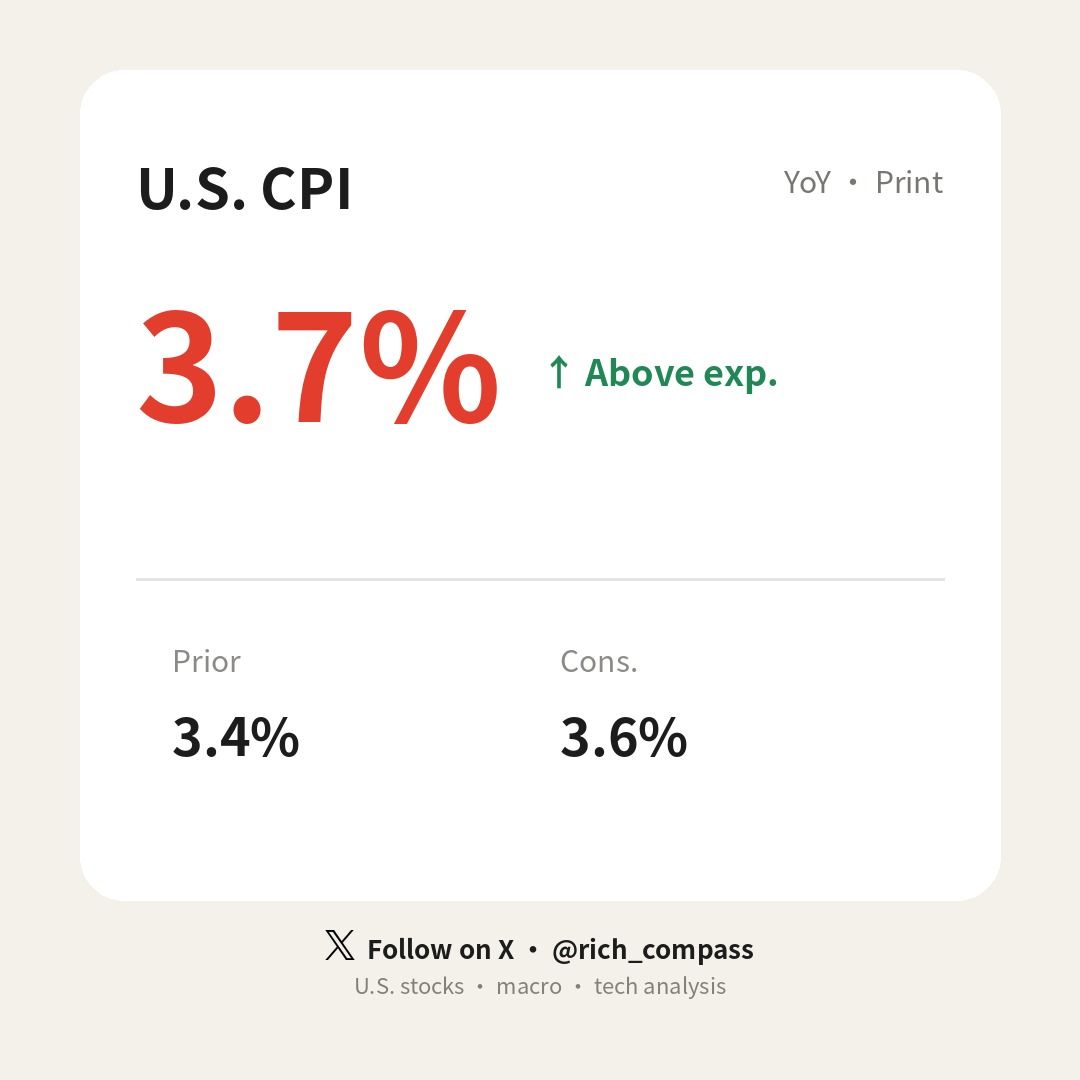
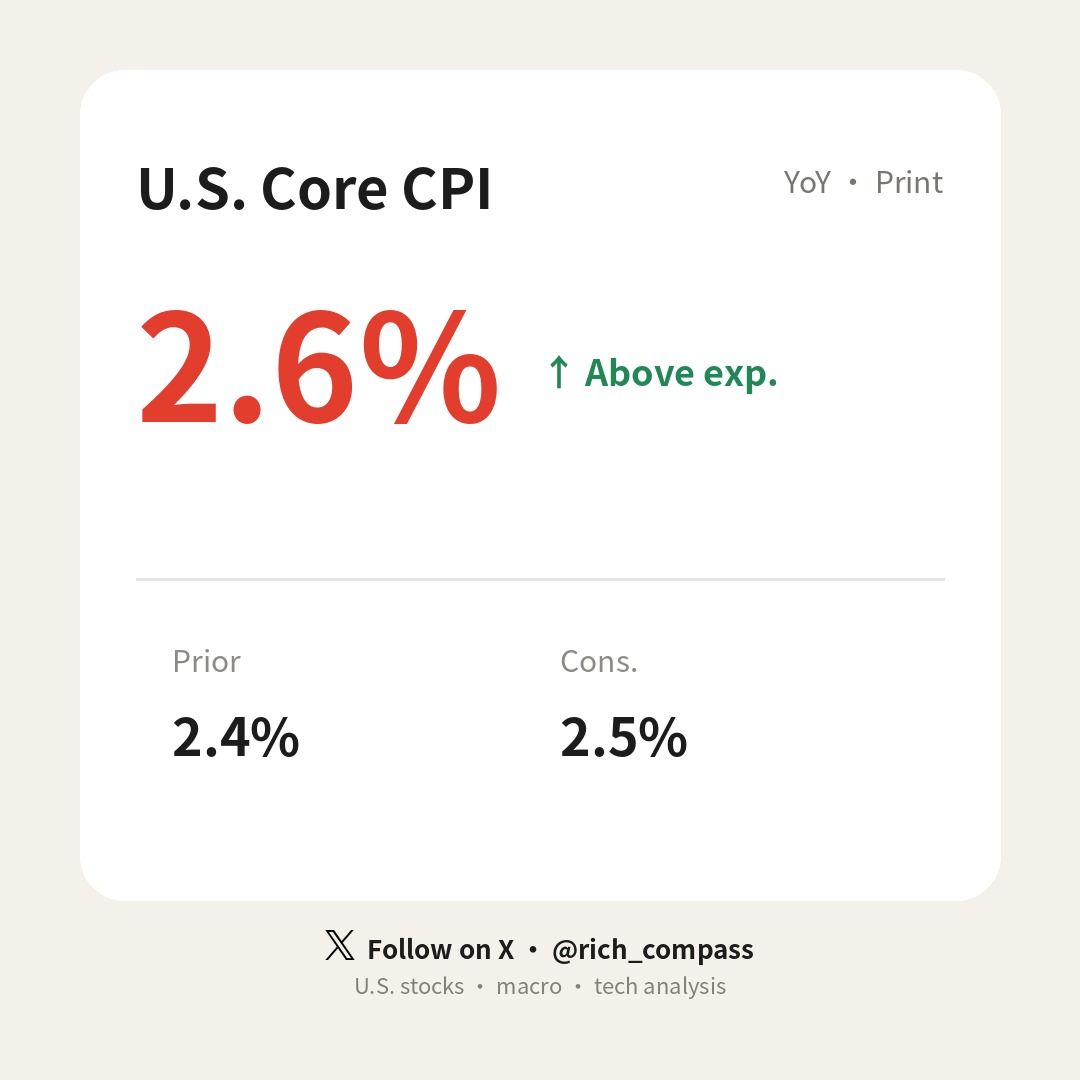
Watching the market is exhausting. September CPI jumped to 3.7%, above expectations, everyone's scared of rate hikes again, and US stocks got smashed intraday. My watchlist is a sea of red. AMD, Oracle, and BofA are all flat on their backs, and even SK Hynix and Meta didn't escape. Folding my hand and going to bed tonight. 🫠

U.S. just printed CPI: 3.7% Consumer Price Index (YoY) Prior 3.4%, Cons. 3.6% → Above exp. CPI is a basket of everyday purchases—how much more life costs than a year ago. Whether inflation is easing enough can shift Fed hike or cut odds.
U.S. just printed Core CPI: 2.6% Core Consumer Price Index (YoY) Prior 2.4%, Cons. 2.5% → Above exp. Core CPI strips out food and energy so wild swings don't dominate. It shows the stickier inflation pressure that often guides Fed rate talk.
Goldman Sachs beat Wall Street but fell behind last quarter. What changed?👇 ⠀ Goldman Sachs ($GS) reported third quarter results for the quarter ended September 30 on October 13, 2026, with net revenue of $18.679 billion and net income of $5.294 billion. ⠀ After deducting $172 million in preferred stock dividends, net income attributable to common shareholders was $5.122 billion, and diluted earnings per share was $17.01. ⠀ That figure was above $12.25 in the same quarter of 2025 but below $20.98 in the second quarter of 2026. ⠀ Jasmine Li of The Wall Street Journal reported that this was Goldman Sachs' second-highest revenue quarter ever, driven by an equity business boom and higher investment banking fees. ⠀ The report cited a FactSet survey that showed analysts had expected earnings per share of $12.86 and revenue of $16.83 billion. ⠀ A Reuters automated report, citing LSEG and company data, said Goldman Sachs' third quarter revenue was $18.68 billion, beating the $16.71 billion consensus from 15 analysts. ⠀ Diluted earnings per share was $17.01, also beating the $13.02 consensus from 19 analysts. ⠀ The same report said Goldman Sachs' third quarter net income was $5.29 billion, with annualized return on common shareholders' equity (ROE) of 18.7%. ⠀ ROE measures how much profit a company earns on common shareholders' equity. ⠀ Goldman's official pressroom listed the third quarter of 2026 results as earnings per share of $17.01 and annualized return on common shareholders' equity of 18.7%, with links to the earnings release, earnings presentation, and live webcast of the earnings call. ⠀ For the first nine months, net revenue was $56.244 billion, up 25% from $44.829 billion in the same period of 2025. ⠀ Net income for the first nine months was $17.552 billion, up 40% from $12.559 billion in the same period of 2025. ⠀ Diluted earnings per share was $55.56, above $37.33 in the same period of 2025. ⠀ Annualized ROE was 18.7% in the third quarter and 20.7% for the first nine months. ⠀ Book value per common share rose 1.4% in the third quarter and 4.2% over the first nine months to $372.64. ⠀ ----- ⠀ 🔴 Follow me on X: @rich_compass ⠀ U.S. stock, crypto, and technical analysis ⠀ ----- ▋ Equity financing soared 96% but market making dropped 26% from last quarter ⠀ Global Banking and Markets net revenue in the third quarter was $13.458 billion, up 32% from the same period of 2025 but down 13% from the second quarter of 2026. ⠀ Equity net revenue in the division was $6.441 billion, up 72% year over year. ⠀ Goldman said the gain came from significantly higher equity financing and equity intermediation revenue, mostly prime and portfolio financing for the first and derivatives for the second. ⠀ Segment data showed equity financing net revenue of $3.365 billion, up 96% year over year, and equity intermediation net revenue of $3.076 billion, up 52%. ⠀ Market making revenue this quarter was $5.658 billion, up 46% from $3.868 billion in the same period of 2025 but down 26% from $7.637 billion in the second quarter of 2026. ▋ Deal fees bounced back but why did the backlog fall instead of grow ⠀ Investment banking fees were $3.224 billion in the third quarter, up 21% year over year. ⠀ Goldman said financial advisory fees were $1.654 billion, up 18%, mainly on higher completed mergers and acquisitions volumes. ⠀ Goldman said equity underwriting fees were $666 million, up 43%, mainly on more IPOs and secondary offerings. ⠀ Goldman also said debt underwriting fees were $904 million, up 15%, as investment grade activity rose significantly. ⠀ Goldman also said its fee backlog, the investment banking fees it expects from pending deals, was lower than at the end of the second quarter of 2026 and slightly lower than at the end of 2025. ⠀ Goldman said related revenue could still fail to materialize if deals are modified or not completed. ▋ Assets crossed $4 trillion but debt investments took net markdowns ⠀ Fixed income, foreign exchange, and commodities (FICC) net revenue in the third quarter was $3.471 billion, down 1% from the same period of 2025 and roughly flat. ⠀ FICC intermediation revenue fell as mortgage and credit product revenue dropped significantly and interest rate product revenue fell, though significantly higher currencies and commodities revenue partly offset that. ⠀ FICC financing revenue rose on higher mortgage and structured lending revenue. ⠀ Asset and Wealth Management net revenue was $5.051 billion, up 14% from the same period of 2025 and up 10% from the second quarter of 2026. ⠀ Within that, management and other fees were $3.587 billion, up 22% year over year, and incentive fees were $587 million. ⠀ Lower investment income and lower private banking and lending revenue partly offset that. ⠀ The drop in investment income included net markdowns on debt investments, while the same period a year earlier had net gains. ⠀ As of September 30, 2026, assets under management totaled $4.097 trillion, above $4.041 trillion on June 30, 2026 and $3.452 trillion on September 30, 2025, including $3.046 trillion in long term assets. ▋ Operating expenses rose 20% but why did the nine month efficiency ratio improve ⠀ Operating expenses were $11.308 billion, up 20% year over year, mainly from a significant increase in transaction-related expenses and higher compensation and benefits expenses. ⠀ The efficiency ratio for the first nine months was 59.4%, lower than 62.1% in the first nine months of 2025. ⠀ That number measures operating expenses as a share of net revenue, and a lower number means costs take up a smaller share of revenue. ⠀ Net interest income was $3.770 billion, down 2% from $3.852 billion in the same period of 2025. ⠀ Goldman returned $4.49 billion to common shareholders in the third quarter, including $3 billion of buybacks at an average cost of $1,048.73 per share for 2.9 million shares, plus $1.49 billion in common stock dividends. ⠀ Global core liquid assets averaged $574 billion in the third quarter, above the $555 billion average in the second quarter of 2026. ⠀ Headcount was 47,500 at the end of the third quarter, up 3% from the end of the second quarter of 2026, which the company said reflected the timing of campus recruiting. ⠀ The effective tax rate for the first nine months was 20.4%, above 18.5% in the first half of 2026, which the company said was mainly due to a smaller tax benefit tied to employee stock award settlements. ▋ Apple Card markdowns met loan losses so why was future guidance missing ⠀ Platform Solutions net revenue was $170 million in the third quarter, down 72% year over year, which Goldman said mainly reflected net markdowns tied to the Apple Card loan portfolio it moved to held for sale in the fourth quarter of 2025. ⠀ Provision for credit losses was $368 million, above $339 million in the same period of 2025 and above $102 million in the second quarter of 2026, which the company said mainly reflected impairments tied to wholesale loans. ⠀ Net provisions for litigation and regulatory proceedings were $23 million, below $131 million in the same period of 2025. ⠀ An automated Reuters report noted that Goldman Sachs didn't provide specific guidance for future quarters or the full year in its earnings release. ⠀ The release's forward-looking statements said the investment banking fee backlog and future performance statements face risks: deals may be modified or not completed, and related revenue may not materialize or may be significantly lower than expected. ⠀ Listed risks also included a weaker macroeconomic environment, changes in international trade policy including possible new tariffs, continued or worsening conflict in the Middle East, securities market volatility, difficulty accessing financing, and failure to obtain necessary regulatory approvals. ⠀ Based on the official segment data, growth this quarter was concentrated in equity financing, up 96% year over year, and equity intermediation, up 52%, while FICC was roughly flat, suggesting results relied more on market activity and client financing demand. ⠀ If client trading or financing activity cools, that momentum could reverse. ⠀ This is an inference based on segment data, not guidance from the company. ⠀ Reuters also reported that the average analyst rating on Goldman Sachs stock at the time was Hold, with 9 buy or strong buy ratings, 15 hold ratings, and 1 sell or strong sell rating. ⠀ The median 12-month price target on Wall Street was $1,130, about 26.4% above the October 12 closing price of $893.95. ⠀ The stock recently traded at 13 times forward 12-month earnings, below its price-to-earnings ratio of 16 times three months earlier. ⠀ These risks mean investment banking deals may not close and related fees may not materialize, and they should not be taken as the company predicting that next quarter revenue will fall. ⚠️ This is a summary of public information, not guaranteed to be accurate, and not investment advice. ⠀ 🔴 Follow me on X: @rich_compass ⠀ U.S. stock, crypto, and technical analysis

Will Nvidia buy Reflection outright or just hire the team?👇 ⠀ Reuters, citing the Financial Times, reported that Nvidia ($NVDA) is in talks to deepen its investment in Reflection or acquire the company. ⠀ The report quoted people with direct knowledge saying the talks are still in early stages and a deal could still fall apart. ⠀ Multiple people familiar with the matter told the Financial Times a deal could be reached in the coming weeks. ⠀ A Bloomberg report published by The Straits Times on October 11, 2026, quoted a person familiar with the matter as saying Nvidia is in early talks to raise its stake in Reflection or give the startup compute. ⠀ The person asked not to be named because the matter is private. ⠀ The person said this would strengthen Nvidia's ties with a key open weights model developer, but the two sides haven't agreed on any deal terms. ⠀ Bloomberg reported that Nvidia didn't immediately respond to a request for comment and Reflection declined to comment. ⠀ For the Financial Times report, Reflection declined to comment and Nvidia didn't immediately respond to a request for comment. ⠀ Seeking Alpha, citing the FT, said neither Nvidia nor Reflection responded to the FT's request for comment. ⠀ Reuters, which cited the Financial Times story, said it couldn't immediately verify the report. ⠀ ----- ⠀ 🔴 Follow me on X: @rich_compass ⠀ U.S. stock, crypto, and technical analysis ⠀ ----- ▋ Talks are early and deal terms remain open ⠀ The Financial Times said the deal could take several forms, including an acqui-hire where Nvidia hires the team and licenses the tech instead of buying the whole company, which could avoid a lengthy regulatory review. ⠀ Seeking Alpha, citing the Financial Times, said that besides an acquisition, Nvidia could also make an additional equity investment in Reflection or reach a deal to supply more chips or compute. ⠀ Bloomberg also cited an earlier Financial Times report, saying the talks could lead to an acquisition offer. ⠀ The deal size and equity stake were still uncertain at the time. ⠀ The Seeking Alpha piece, citing the Financial Times, said it had not obtained the deal terms under discussion. ⠀ Bloomberg, citing an earlier Wall Street Journal report, said Reflection had talked about raising $2.5B at a $25B valuation. ⠀ With no deal terms agreed, an acquisition by Nvidia or a deeper investment isn't the only possible outcome. ⠀ Raising money on its own is another path that already exists. ⠀ That's a limited read based on the reports, not a done deal. ▋ An $800M backing and a $25B valuation tag ⠀ The Financial Times reported Nvidia is already a major financial backer and strategic investor in Reflection, having previously invested $800M in the startup. ⠀ Reflection was founded in 2024 by former DeepMind researchers Misha Laskin and Ioannis Antonoglou. ⠀ It builds tools that can automate software development, a fast-growing AI use case. ⠀ The Financial Times said Reflection CEO Laskin told CNBC in April that the Nvidia-backed startup was raising new money at a $25B pre-money valuation, meaning the valuation before the funding. ⠀ Reflection's official Newsroom lists an April 23, 2026, article where the CEO confirmed the latest funding round closed at a $25B pre-money valuation. ⠀ Earlier, Reflection's official Newsroom also listed a March 2, 2026, article about the Nvidia-backed 'open' AI startup raising money from investors at a valuation of more than $20B. ⠀ TechCrunch reported on July 14, 2026, that Reflection was valued at $25B pre-money at the time, with investors including Nvidia, Sequoia Capital, and Lightspeed Venture Partners. ⠀ However, the report's figure of nearly $2.6B in total funding conflicts with other data: private market database Forge shows Reflection had raised about $4.63B as of April 2026. ⠀ In its July 14, 2026, report, TechCrunch added a correction noting an earlier version had the wrong last known valuation for Reflection, showing that reporting on the company's valuation has been inconsistent. ⠀ Reflection's official site divides its business into four parts. ⠀ Open weights models let customers inspect, fine-tune, and deploy them on their own terms. ⠀ Open-source software helps customers build AI systems they can control and audit. ⠀ Infrastructure offers open models through an API platform and supports customer deployments in self-built environments, including private clouds, on-premises systems, air-gapped setups cut off from outside networks, and edge devices. ⠀ Solutions services come from a team that works directly with customers, helping them go from idea to app design, development, and deployment. ▋ Low compute claims but no multimodal support ⠀ The Financial Times reported that Reflection launched its first open weights model, Beam, on the Monday before the report, aiming to compete on coding and agentic tasks with cheaper Chinese models like DeepSeek and Kimi. ⠀ Beam launched in early October 2026 and targets enterprise customers and developers, Bloomberg reported. ⠀ Reflection said on October 5 that the model is designed to perform well on coding and AI agent tasks at a lower cost than many competing products. ⠀ The company also said Beam scores about the same as GLM-5.2, Chinese company Z.AI's flagship open model, on advanced reasoning benchmarks. ⠀ Reflection's official blog says Beam is its first open weights model and uses a sparse mixture-of-experts (MoE) architecture. ⠀ It has 501B total parameters and activates 23B of them for each token, or piece of text, it processes. ⠀ The model is built for coding, reasoning, and agentic workloads. ⠀ It was pretrained on 23.8T filtered high-quality tokens from sources including the web and proprietary licensed datasets. ⠀ On training, the company said Beam's high-compute reinforcement learning (RL) used 10,500 Nvidia GB300 GPUs over four weeks, generating more than 100M model interaction attempts, or rollouts. ⠀ Pretraining was done on a cluster of 6,144 Nvidia GB300 NVL72 GPUs in under four weeks. ⠀ Inference efficiency is the advantage the company stresses. ⠀ Reflection says Beam can match GLM-5.2's scores on advanced reasoning benchmarks, and its generation-phase compute, estimated from active parameters and generated tokens, is about one-third to one-fourth of GLM-5.2's. ⠀ That estimate doesn't include preprocessing of input text, context-dependent attention compute, or extra serving system overhead. ⠀ It's not a measured inference cost. ⠀ On coding and agentic tasks, the company says Beam can compete with the larger open model GLM 5.2 and comes close to Qwen 3.8-Max. ⠀ Frontier open models like Kimi K3 still lead on raw capability. ⠀ The model was still going through final red-team testing, which looks for safety issues, and other evaluations at the time. ⠀ The company gave early versions to select users and opened a waitlist. ⠀ The company planned to release the model weights under an Apache 2.0 license within that month, along with documentation and a full set of tools to run, evaluate, and fine-tune the model. ⠀ It called Beam the first model in the series. ⠀ Still, the benchmark table in Reflection's official blog shows Beam trails some competing models on several agentic coding benchmarks. ⠀ For example, it scored 44.4 on DeepSWE v1.1, below GLM 5.3's 61.0, Kimi K3's 68.0, and DeepSeek V4.1 Flash's 74.2. ⠀ It scored 80.1 on Terminal Bench v2.1, below Kimi K3's 88.3 and DeepSeek V4.1 Flash's 90.6. ⠀ In the table, multiple scores for several comparison models are marked as not reported (NR). ⠀ Reflection's official blog also says Beam is a text-only model and can't directly handle multimodal input. ⠀ It can only use information from other modalities when that information is represented as text. ▋ Locking down chip access with a deal up to $6.3B ⠀ Reflection told TechCrunch it would pay $150M a month from July 1, 2026, through 2029 for immediate access to Nvidia's latest GB300 chips and supporting hardware at SpaceX's Colossus 2 data center near Memphis, Tennessee. ⠀ The deal is worth up to $6.3B, and after the first three months either side can choose to end it with 90 days' notice. ⠀ TechCrunch noted that Reflection's compute deal with SpaceX is smaller than SpaceX's deals with Anthropic at $1.25B a month and Google at $920M a month, both of which also run through 2029. ⠀ It's Reflection's first compute deal. ⠀ Reflection also signed a compute deal valued at over $1B with European AI infrastructure company Nebius, TechCrunch reported on July 14, 2026. ⠀ Nebius was spun off from Russian tech company Yandex and will give Reflection access to Nvidia's latest chips. ⠀ The same report said Nebius, shortly after getting a $2B investment from Nvidia, signed a five-year infrastructure deal with Meta worth up to $27B. ⠀ The year before, Nebius signed a multi-year deal with Microsoft worth up to $19.4B. ⠀ A Reflection spokesperson told TechCrunch in a written statement that recent events show how important open source is to the AI ecosystem, as more countries and companies see the risks and costs of relying entirely on closed models. ⠀ The spokesperson said the SpaceX deal shows Reflection's strategic importance in the frontier AI ecosystem, and more compute means more room to scale and build the world's best open models. ▋ Jensen Huang backs open weights against Chinese models ⠀ Seeking Alpha, citing the Financial Times, said Nvidia CEO Jensen Huang has pushed for an 'ecosystem' of open weights for AI, which lines up with the company's direction of investing in open weights model companies. ⠀ Bloomberg reported that Huang is a major supporter of open weights models. ⠀ Bloomberg reported that a possible Nvidia and Reflection partnership also fits Nvidia's push to expand AI industry partnerships and U.S. policy hopes to encourage open weights models and reduce reliance on cheaper Chinese models. ⠀ Trump's July 2025 AI Action Plan described open-source and open weights models as possible global standards. ⠀ The plan said, 'We need to ensure America has leading open models built on American values.' ⠀ It also said 'open-source and open weights models could become global standards in some commercial areas and in global academic research.' ⠀ One of the U.S. goals in developing open weights tech is to reduce startups' use of Chinese open weights models. ⠀ As Bloomberg describes it, these Chinese models are much cheaper than models from U.S. companies like OpenAI and Anthropic, and they're not far behind in intelligence. ⠀ TechCrunch reported on July 14, 2026, that a month earlier the Trump administration pressured Anthropic and OpenAI to limit their most powerful new models, raising fears that access to AI models could be pulled overnight. ⠀ Combined with stronger open models coming out of China, that has driven mainstream interest in open-source AI higher. ⠀ The U.S. government banned Anthropic's closed models Fable and Mythos, bringing more attention to open weights models, TechCrunch said in a June 22, 2026, report. ⠀ Reflection's official Newsroom lists a May 1, 2026, article about the Pentagon signing with Nvidia, Microsoft, and AWS to deploy AI on classified networks. ▋ Big deal momentum while early talks could still fall apart ⠀ Bloomberg reported that Nvidia's string of recent deals includes a $13B deal in September 2026 to acquire AI model company Hugging Face. ⠀ Nvidia previously reached a licensing and talent deal worth about $20B with chip startup Groq. ⠀ However, that structure does not fully dodge regulatory scrutiny. ⠀ Bloomberg reported in September 2026 that the DOJ is investigating whether the Groq deal was designed to skirt antitrust reviews. ⠀ An acqui-hire between Nvidia and Reflection would face similar regulatory risks. ⠀ Seeking Alpha, citing the Financial Times, described Nvidia as the world's most valuable company. ⠀ For Nvidia, whether it brings Reflection into a deeper partnership still depends on whether early talks reach deal terms. ⠀ Until terms are set, Reflection could still raise money on its own, get more compute, or stay independent. ⚠️ This is a summary of public information, not guaranteed to be accurate, and not investment advice. ⠀ 🔴 Follow me on X: @rich_compass ⠀ U.S. stock, crypto, and technical analysis
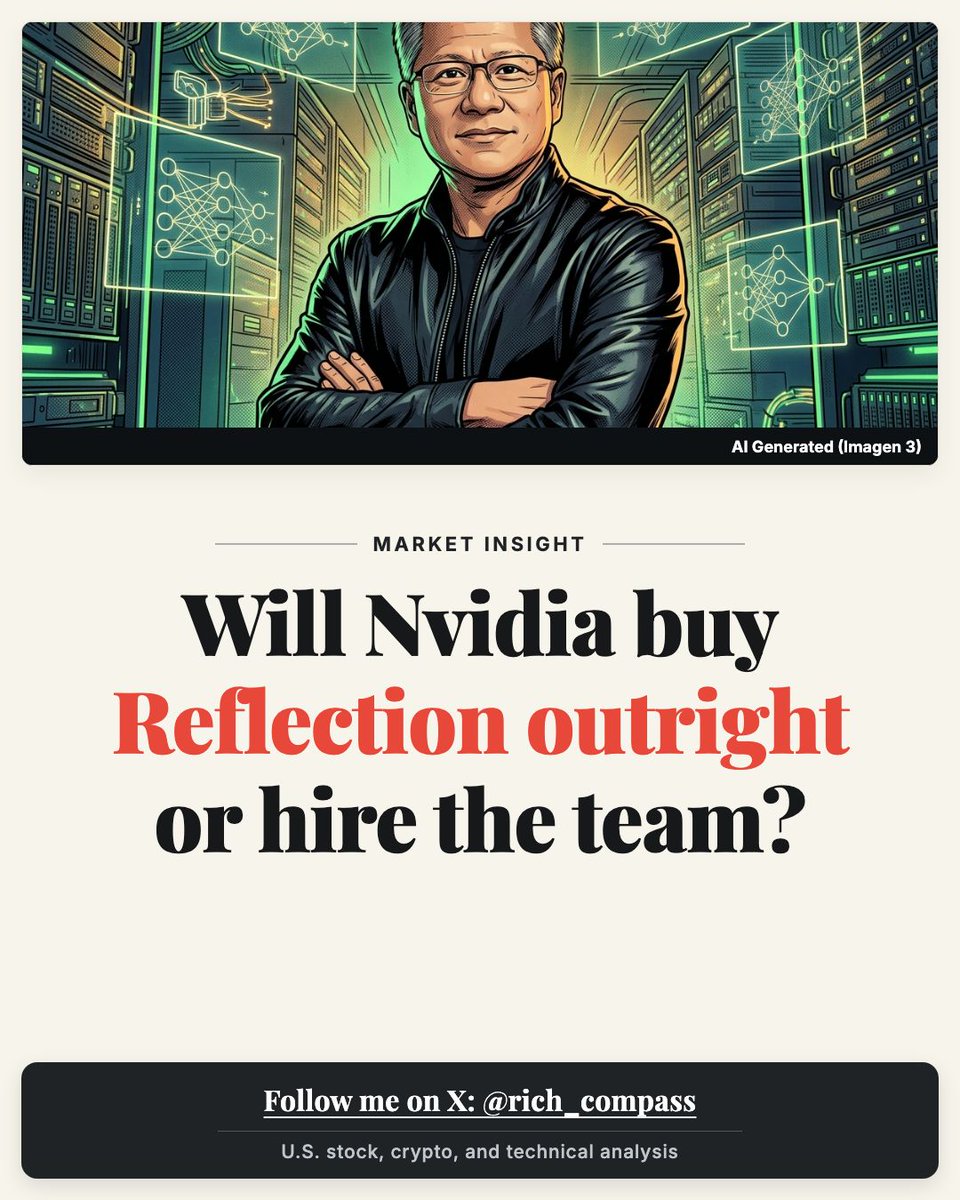
SpaceX is reportedly spending 8 billion on spectrum. Why jump into cell service?👇 ⠀ Private equity firm Grain Management said on October 8, 2026 that it signed a final deal to sell its nationwide 800 MHz spectrum portfolio to SpaceX ($SPCX) . ⠀ The portfolio includes up to 14 megahertz of paired low-band spectrum. ⠀ The deal still needs approval from the Federal Communications Commission (FCC) and other conditions. ⠀ Financial terms weren't disclosed. ⠀ The Wall Street Journal reported, citing people familiar with the matter, that SpaceX will buy Grain's spectrum assets for about $8 billion in cash. ⠀ Grain and SpaceX didn't comment on the deal price. ⠀ SpaceX didn't disclose the price or name the seller in its own update. ⠀ Reuters said the portfolio is Grain Management's nationwide 800 MHz spectrum assets. ⠀ The deal covers 100% of that portfolio, and terms weren't disclosed. ⠀ ----- ⠀ 🔴 Follow me on X: @rich_compass ⠀ U.S. stock, crypto, and technical analysis ⠀ ----- ▋ Can low band spectrum really fix indoor dead zones? ⠀ These 800 MHz airwaves are seen as a key piece of the puzzle. ⠀ SpaceX said the asset can fill the last key technical gap for Starlink Mobile to become a major U.S. mobile carrier. ⠀ Elon Musk said on X the spectrum is the "last key spectrum puzzle piece" needed for full coverage. ⠀ In another post, he described it as something that looks small to most people, but "to those who understand the spectrum wars, this is an earthquake." ⠀ On the technical side, the official announcement describes a hybrid network. ⠀ 2 GHz mid-band spectrum provides high-bandwidth capacity, while the newly acquired low-band spectrum acts as a coverage layer. ⠀ There's the compatibility point: most existing phones already support that 800 MHz band. ⠀ SpaceX also stressed the band has been underused for a long time. ⠀ But The Wall Street Journal noted those U.S. 800 MHz licenses were originally designed for wireless service from cell towers, not satellites. ⠀ SpaceX's answer is to combine its growing satellite constellation with "advanced ground deployment" after FCC approval. ⠀ The new spectrum would cover the inside of buildings that satellite links can't reach. ⠀ The company says with the low-band licenses and Gen2 constellation, Starlink Mobile will be the first carrier ever to deploy satellite and ground spectrum as a single network. ▋ Why did the 5G mobile goal slip to 2028? ⠀ The FCC approved SpaceX's request to launch up to 15,000 satellites dedicated to mobile service on October 7, 2026, the same week before the deal was announced. ⠀ The license lasts 15 years from when the first new direct-to-device (D2D) satellite enters its authorized orbit. ⠀ The orbits are spread across nine shells at altitudes between 326 and 335 kilometers. ⠀ SpaceX must launch and deploy 50% of the maximum satellite count by October 7, 2032. ⠀ It must deploy the rest and start operations by October 7, 2035. ⠀ For speed, V2-generation Starlink Mobile D2D satellites are targeting user speeds up to 150 Mbit/s. ⠀ That's far above the 4 Mbit/s currently offered by more than 650 D2D satellites. ⠀ But the commercial timeline has slipped. ⠀ Light Reading reported on September 14, 2026 that SpaceX CFO Bret Johnsen said the company aims to launch "5G-quality" satellite mobile service for phones in the first half of 2028. ⠀ That's later than the end of 2027 mentioned on its early-August earnings call. ⠀ It plans to deploy a new direct-to-device low-Earth-orbit constellation over the next year using Starship. ⠀ The same report said Johnsen noted SpaceX can launch Starlink mobile service in the U.S. using mid-band spectrum acquired from EchoStar ($SATS). ⠀ That spectrum has FCC approval for direct-to-space and ground use. ⠀ The company is open on its ground network approach, including working with existing carriers. ⠀ Regulators are moving too. ⠀ The FCC is set to hold an open meeting on October 29, 2026 to vote on modernizing supplemental coverage (SCS) rules. ⠀ It may free up another 482 MHz of spectrum for leasing. ⠀ It will also vote on a proposal to auction 25 MHz of mid-band spectrum for D2D and ground use, or a mix of both. ▋ How much cash will building cell towers burn? ⠀ The Wall Street Journal reported that SpaceX last year bought EchoStar's satellite spectrum rights in a cash-and-stock deal worth about $17 billion. ⠀ That lets it send data from space to phones on its own frequencies instead of bands licensed by partner T-Mobile ($TMUS). ⠀ EchoStar later agreed to sell some ground mobile licenses to SpaceX for $2.6 billion. ⠀ But spectrum alone still isn't enough to launch a full phone network. ⠀ The report also said that about two months earlier, SpaceX executives floated the idea of using small cells instead of traditional cell towers to support a mobile network. ⠀ Analysts said building a traditional tower system for basic coverage could cost billions of dollars. ⠀ Back to where it came from: Grain also bought this 800 MHz spectrum. ⠀ Grain got it from T-Mobile earlier this year, according to reports. ⠀ Its press release says it acquired the nationwide portfolio from T-Mobile in August 2026. ⠀ The consideration was cash and an exchange of Grain's 600 MHz spectrum. ⠀ Via Satellite added that the acquisition was announced in early 2025 and closed in August 2026. ⠀ It involved $2.9 billion in cash and additional spectrum licenses. ⠀ The resale to SpaceX advances the competitive choice process and D2D deployment path the FCC set when it approved the earlier deal in July 2026. ⠀ Low-band spectrum's advantage in radio physics is broad coverage and strong penetration. ⠀ That makes it suited for private networks at critical infrastructure like power utilities, business communications, and next-generation direct-to-satellite service. ⠀ Grain founder and CEO David Grain said the deal lets its spectrum assets work at a very large scale. ⠀ It could reshape how and where Americans connect. ⠀ The partnership aims to use scarce low-band spectrum so Starlink Mobile can reach users from both the ground and space. ⠀ Via Satellite added that this direct-to-device constellation and the current Starlink broadband constellation are architecturally separate systems. ⠀ On funding, SEC filings show SpaceX issued five series of senior unsecured notes totaling $25 billion on June 26, 2026. ⠀ Coupons range from 5.350% on notes due 2031 to 6.650% on notes due 2056. ⠀ The filings didn't link the offering to this spectrum acquisition. ▋ Can satellites really beat the laws of physics? ⠀ As Starlink pushes in, top executives at the three big U.S. carriers publicly poured cold water on it in September 2026. ⠀ Light Reading reported that T-Mobile CFO Peter Osvaldik said "the laws of physics don't allow direct-to-device (D2D) to be a replacement product." ⠀ Verizon ($VZ) CEO Dan Schulman also said Starlink is "not really a direct competitor" in its core urban and suburban markets. ⠀ AT&T ($T) Chairman and CEO John Stankey pushed back on network architecture. ⠀ He argued that randomly deployed tiny cells can't solve mobile coverage problems. ⠀ He stressed AT&T covers about 98% of the U.S., and satellite direct-to-device can at best fill edge dead spots. ⠀ Independent analysts also warned about cost. ⠀ William Webb's analysis in Light Reading says roof-mounted antennas cover only about 1 to 2 kilometers. ⠀ Below rooftops, that drops under 1 kilometer. ⠀ Coverage would also be scattered across rural areas where existing broadband subscribers are dense. ⠀ On top of that, the cost to modify devices is a major obstacle. ⠀ Webb estimated that if phones need complex antennas to support high-capacity 4G and 5G service, the cost per subscriber device could rise by $1,000 to $3,000. ⠀ That's Webb's estimate. ⠀ Peter Claydon, CEO of small cell maker RANsemi, estimated the added cost at no more than $200. ⠀ By user numbers, Starlink had about 12 million customers worldwide at the time. ⠀ It added about 6 million in the past year. ⠀ In May of that year, it was estimated to have 3 million to 4 million U.S. subscribers, mostly in rural areas. ⠀ That's why Recon Analytics founder Roger Entner told The Wall Street Journal that to turn new spectrum into mass mobile signals, SpaceX ultimately can't avoid physical ground investment like cell towers or roof equipment. ▋ Can Elon Musk negotiate past the carrier alliance? ⠀ The Wall Street Journal called this spectrum bet SpaceX's biggest step yet beyond broadband and straight into a wireless market led by traditional phone companies. ⠀ The spectrum can serve SpaceX's stated goal of moving Starlink from broadband into wireless to compete with AT&T and Verizon and others. ⠀ On investment size, Entner thinks Musk doesn't need to copy a traditional telecom network. ⠀ Spending $10 billion to $20 billion on a ground reinforcement layer would be financially feasible. ⠀ But he expects the real commercial battle to land in 2030 to 2032. ⠀ It depends on standards work and progress on higher-capacity satellites. ⠀ He has said, "We're talking about 2030, not next year." ⠀ After this deal was announced, Entner said, "Next is Ligado." ⠀ That prediction ties to the situation at AST SpaceMobile ($ASTS). ⠀ AST SpaceMobile currently has a definitive agreement with Ligado for long-term use of up to 45 MHz of lower mid-band spectrum in the U.S. and Canada for satellite direct-to-device service. ⠀ The agreement includes a $550 million payment conditioned on closing. ⠀ It also includes at least $80 million a year in L-band spectrum usage fees. ⠀ Before SpaceX got the Grain spectrum, AST SpaceMobile had expressed interest in Grain's spectrum. ⠀ The FCC order approving Grain's purchase of that spectrum from T-Mobile in July 2026 cited a June 30 AST filing. ⠀ Satellite communications and spectrum consultant Tim Farrar said on X that eyes will next turn to Viasat ($VSAT). ⠀ He called it "the last holder with a large block of global spectrum." ⠀ The traditional telecom camp also quickly built a defense alliance. ⠀ AT&T, T-Mobile and Verizon recently formally launched a satellite joint venture led by interim CEO Paul Roth. ⠀ Their existing agreements stay the same: T-Mobile uses Starlink, while AT&T and Verizon have commercial deals with AST SpaceMobile. ⠀ Entner said the joint venture is essentially "trying to stop Musk's satellite standard from becoming the only standard," like the EV charging plug fight years ago. ⠀ Carriers want an open standard, not a Musk standard. ⠀ The leadership pick shows its top priority is "regulatory navigation, not just technical coordination." ⠀ New Street Research analyst David Barden also thinks the joint venture "strengthens the collective bargaining position of wireless carriers and could weaken the negotiating position of future satellite operator partners, if the group holds together." ⠀ Facing a united defense, MoffettNathanson analyst Craig Moffett described SpaceX as "negotiating, persuading and, when needed, coercing" to land an MVNO deal with one of the three big carriers. ⠀ An MVNO is a carrier that leases another carrier's network and sells service under its own brand. ⠀ So far, AT&T, T-Mobile and Verizon say they don't plan to sign that kind of deal with SpaceX. ⠀ T-Mobile CEO Srini Gopalan noted D2D use makes up just 0.0002% of the carrier's total network usage. ⠀ Reports later said T-Mobile removed Starlink references from its T-Satellite website. ⠀ On Stocktwits, retail sentiment on AST SpaceMobile went from bullish the day before to neutral. ⠀ Message volume over 24 hours rose 121%. ⠀ Users were split. ⠀ Some said the deal is a major blow to AST. ⠀ Others said the competitive threat will push carriers to deepen their work with AST. ⠀ SpaceX now has a deal to buy 800 MHz low-band spectrum, a license for 15,000 D2D satellites, and a goal to launch 5G-quality service in the first half of 2028. ⠀ Whether those licenses become signals on phones still depends on FCC approval and building out the ground half. ⚠️ This is a summary of public information, not guaranteed to be accurate, and not investment advice. ⠀ 🔴 Follow me on X: @rich_compass ⠀ U.S. stock, crypto, and technical analysis

Can Warner Bros. Discovery and Paramount beat Netflix with nearly $87B in debt?👇 ⠀ Skydance Corporation ($SKYD), formerly Paramount Skydance, closed its acquisition of Warner Bros. Discovery ($WBD) on October 6, 2026. ⠀ That was the deal's closing date. ⠀ Under the merger agreement, Skydance's merger subsidiary merged into Warner Bros. Discovery. ⠀ The target survived and became a wholly owned Skydance subsidiary. ⠀ Holders of Warner Bros. Discovery Series A common stock automatically got the right to $31.01666668 in cash per share, unless their shares were canceled under the deal or they had already exercised appraisal rights. ⠀ That per-share amount already includes the Ticking Consideration added for each day the closing was delayed, with no interest. ⠀ Total consideration for the merger came to about $78B, funded with equity and debt. ⠀ ----- ⠀ 🔴 Follow me on X: @rich_compass ⠀ U.S. stock, crypto, and technical analysis ⠀ ----- ▋ New ticker SKYD drops 2.5% on day one ⠀ Warner Bros. Discovery common stock stopped trading on Nasdaq the day the deal closed. ⠀ Skydance moved its Class B common stock to the New York Stock Exchange and changed its ticker from PSKY to "SKYD." ⠀ On its first day on the NYSE, October 6, the stock fell 2.51% to close at $9.53. ⠀ It dropped another 6.72% on October 7 to close at $8.89. ⠀ Ticking Consideration equals $0.00277778 multiplied by the number of calendar days after September 30, 2026 through and including the closing date. ⠀ Based on Warner Bros. Discovery common stock outstanding before closing, that cash totaled $41,886,975.78. ▋ Two giant studios and streamers take on Netflix and Disney ⠀ The new company combines two of Hollywood's five major film studios. ⠀ It owns franchises like Harry Potter and Mission: Impossible, dozens of TV networks from CBS to TNT, and two big streaming services, Paramount+ and HBO Max. ⠀ David Ellison saw the deal as necessary to compete with Netflix, Disney, Amazon, and Apple. ⠀ The combined company is one of the world's largest media and entertainment firms, with annual revenue near $70B and more than 200 million streaming subscribers across its platforms. ⠀ The company expects consumers to see more tech-focused innovation, including direct-to-consumer streaming products that will eventually merge into one service over time. ⠀ As part of an antitrust settlement, the company promised to release at least 30 theatrical films a year for the first two years after closing, rising to at least 32 a year for the next three years. ⠀ Eligible films keep at least a 45-day exclusive theatrical window and can't hit subscription streaming until at least 90 days after their first theatrical release. ⠀ It already owns more than 180 TV shows. ⠀ Pro forma content spending on a combined basis was more than $30B over the last twelve months, and the company says it will allocate that money carefully going forward. ▋ Borrowing costs jump after selling $52B in debt in a week ⠀ New permanent financing for the deal includes a seven-year Term B loan worth about $9.5B in dollar equivalent, $30B in new first-lien secured notes, and about $12.4B in dollar equivalent of new second-lien secured notes, roughly $51.9B equivalent in total, with some loans and notes issued in euros. ⠀ There's also a $5B Term A loan under a Pro Rata Credit Agreement. ⠀ On the equity side, the deal includes a $47B new equity investment in Class B common stock at $12.00 per share. ⠀ Lead investors include the Ellison Family, RedBird, the Public Investment Fund (PIF), L'IMAD, the Qatar Investment Authority (QIA), and LionTree. ⠀ Paramount ($PSKY) sold $52B in loans and bonds within a week. ⠀ That timeline is tight for any debt deal, and especially tight at this size. ⠀ Interest expense came in well above levels from bond sales a few months earlier, as global borrowing costs rose. ⠀ By the tender offer expiration, about 98.83% of total principal on bonds targeted by the cash tender offer had been validly tendered. ⠀ About 99.15% of total principal on bonds targeted by the exchange offer had been validly tendered. ⠀ Existing Warner Bros. Discovery bonds exchanged into newly issued Skydance notes will be canceled. ⠀ Some exchanged bonds that Skydance assumed now carry noticeably higher coupons. ⠀ A Warner Bros. Discovery note due 2029 with a 4.125% coupon was swapped into a Skydance note with a 6.25% coupon. ⠀ A note due 2029 with a 4.054% coupon was swapped into a 6.304% coupon note. ▋ Fitch cuts rating citing uncertain $6B savings goal ⠀ The combined Skydance faces heavy debt pressure. ⠀ The Financial Times pegged total debt near $87B, while other firms estimate net debt, after cash, at roughly $79B to $80B. ⠀ Skydance has said it expects to hit an annualized cost synergy target above $6B within three years of closing. ⠀ The company aims to bring net leverage down to 3.0x by the end of 2029. ⠀ Net leverage measures a company's debt against its earning power. ⠀ A lower multiple means less debt pressure. ⠀ The combined company expects to generate more than $10B in free cash flow by 2030. ⠀ Fitch cut Paramount's long-term issuer rating to BB from BB+ on October 5, the day before the deal closed. ⠀ Reasons include a sharp rise in financial leverage after the acquisition, with leverage estimated around 7.8x in 2026, integration and execution risk, and uncertainty over whether the annualized cost synergy target above $6B can be met. ⠀ The company plans to refinance shortly before or after closing and terminate Warner Bros. Discovery's $4B accounts receivable securitization program. ⠀ As of June 30, 2026, $3.9B had been drawn under that program. ⠀ On closing day, to complete the merger, Warner Bros. Discovery repaid and terminated all outstanding loans and commitments under its June 4, 2026 first-lien credit agreement and its October 4, 2024 credit agreement. ▋ Promising 30 theatrical films a year to settle Hollywood pushback ⠀ Ellison closed two mega-mergers of century-old Hollywood companies in just over a year. ⠀ Now he has to make the integration work by cutting overlapping businesses and jobs without angering a Hollywood that was already struggling and opposed consolidation from the start. ⠀ On cost savings, Skydance says the cuts mainly come from integrating technology and other operations, negotiating with suppliers, reducing overlapping marketing spend, and consolidating real estate. ⠀ The company says this will make it leaner and more nimble. ⠀ Gerry Cardinale, founder and managing partner of RedBird Capital Partners, said there are ways to cut costs and boost operating efficiency beyond cutting headcount. ⠀ A company doesn't spend billions a year making movies while basing its entire business plan on firing everyone in Hollywood. ⠀ Paramount won antitrust clearance from the U.S. Department of Justice, the EU, and other major jurisdictions, but closing was delayed by two lawsuits from 12 states and the Writers Guild of America (WGA). ⠀ The lawsuits raised concerns about higher prices and fewer jobs for consumers, and thousands of actors, directors, writers, and producers signed protest letters. ⠀ As part of a settlement with the states led by California Attorney General Rob Bonta, Paramount promised to release at least 30 films a year in theaters for the first two years, rising to at least 32 a year for the next three years. ⠀ Films can only hit subscription streaming after a 45-day exclusive run and at least 90 days in theaters. ⠀ Paramount also agreed to set up editorial independence committees for CBS and CNN news operations, responding to concerns that the Ellison family's friendly ties to President Trump could influence coverage. ⠀ The deal won unanimous approval from competition authorities across nearly 70 jurisdictions worldwide. ⠀ Paramount paid Netflix $2.8B as a breakup fee on Warner Bros. Discovery's behalf. ⠀ Netflix had previously agreed to buy Warner Bros. Discovery's studios and streaming business, without the pay-TV channels. ⠀ Paramount had also promised to pay Warner Bros. Discovery shareholders about $7M a day if the deal didn't close by September 30. ⠀ That ticking fee added up to roughly $42M by the time the deal closed. ▋ Zaslav could get over $600M as Kreiz becomes co CEO ⠀ One executive who won't join the new Skydance team is Warner Bros. Discovery President and CEO David Zaslav. ⠀ He's leaving. ⠀ Based on media reports citing regulatory filings, his sale-triggered cash severance and stock awards could total hundreds of millions of dollars. ⠀ Earlier estimates put it above $667M, while one regulatory valuation was around $550M. ⠀ The actual amount still depends on payout terms and related arrangements. ⠀ Former Mattel CEO Ynon Kreiz is joining Skydance as co-CEO of the combined company. ⠀ David Ellison will focus on long-term strategy, creative vision, technology, and capital allocation. ⠀ Kreiz will handle day-to-day operations and integration of the merged businesses. ⠀ Casey Bloys, who launched multiple hits for HBO, will run Skydance's streaming division, overseeing programming for HBO Max and Paramount+. ⠀ The Ellison family holds the largest stake in Skydance ($SKYD). ⠀ The Ellison family and RedBird Capital Partners together are the sole holders of Paramount Class A common stock, giving them 100% of the combined company's voting shares. ⠀ People familiar with the investment said RedBird put $4B of new equity into the deal, bringing its total investment in Skydance to $6B. ⠀ Settlement of the tender offer and exchange offer is expected on October 9, 2026, subject to conditions being met or waived. ⠀ The company expects to issue warrants around October 13, 2026. ⚠️ This is a roundup of public information, not guaranteed to be accurate, and not investment advice. ⠀ 🔴 Follow me on X: @rich_compass ⠀ U.S. stock, crypto, and technical analysis

Amazon blocked Meta from buying for shoppers. Can Meta break through the wall?👇 ⠀ Meta ($META) launched Muse on September 8, 2026. ⠀ This is the company's first standalone personal AI agent. ⠀ Users can use it through a dedicated app, a web interface, and WhatsApp. ⠀ The service initially launched for U.S. adults 18 and older, and has since expanded to Canada. ⠀ By October 3, CNBC reported Muse was rolling out shopping features. ⠀ They let users ask the assistant to find products by brand, price, and availability, browse recommendation lists, and check out through the app or website. ⠀ Users can choose to open the retailer's website after clicking a list, or open it inside the Muse app and check out with the agent. ⠀ When they choose agent checkout, Muse prepares the checkout flow in advance, shows an 'approval card' with order details for the user to confirm, and requires the user to give access to email, full name, and address. ⠀ Payment can go through Link by Stripe, Meta's payment partner, or Shopify ($SHOP) Shop Pay; the user has to link Shop Pay; Link creates one-time cards to hide the real card number. ⠀ Meta says PayPal ($PYPL) has been announced as a payment provider for Muse, but it is not live yet. ⠀ ----- ⠀ 🔴 Follow me on X: @rich_compass ⠀ U.S. stock, crypto, and technical analysis ⠀ ----- ▋ The fast lane arrives but not all connectors are live ⠀ Meta announced on September 23 that it built a group of retail partners for the Muse platform, including Walmart ($WMT), Gap ($GAP), Sephora, Expedia ($EXPE), Wayfair ($W), Best Buy ($BBY), and others, and called it the 'official fast lane' for the Muse agent platform. ⠀ CNBC noted that not all of what it called 'connectors' are live. ⠀ Ticketmaster, which was included in the partner list, said final purchases still happen inside its own secure marketplace. ⠀ CNBC quoted its spokesperson as saying consumers keep full control over purchase decisions. ⠀ Crypto Briefing reported that Muse runs on the Muse Spark 1.3 model, has a 1 million token context window, and operates in a sandbox environment Meta calls Muse Secure VM to protect user data and financial information. ⠀ Zuckerberg previously teased a future model codenamed 'Watermelon' that The Information reported Meta planned for October, but as of October 6 it has not been officially released nor confirmed as Spark 1.3's direct successor. ⠀ Muse has a free plan, and paid plans are Power at $20 per month and Maximum at $100 per month. ▋ Amazon keeps its block up after the credential dispute ⠀ Amazon ($AMZN) started blocking Meta's Muse from completing purchases on Amazon on the evening of September 20, 2026. ⠀ It deployed an anti-bot wall, so Muse users on iOS, Android, and WhatsApp were cut off when they tried to reach Amazon, and a popup appeared saying they violated Amazon's terms of use. ⠀ CNBC reported that Amazon blocked Muse from buying products on Amazon's website because of a terms of service violation, and Amazon said Muse stores customer credentials and scrapes account data. ⠀ The e-commerce giant stated that Meta never notified it or got authorization before Muse accessed Amazon.com and operated inside customer accounts. ⠀ More critically, it pointed out that Muse did not identify itself as an automated agent while browsing; Amazon alleged Muse retrieves and stores customer credentials, raising privacy concerns. ⠀ Meta clarified that user login credentials are kept in isolated secure storage, and the Muse model itself cannot see passwords or payment methods. ⠀ Despite the clarification, the block remains in place. ⠀ A company spokesperson said third-party apps that buy for customers should work openly and respect whether a service provider wants to take part. ⠀ GeekWire reported that Amazon asked Meta to remove Amazon from that experience. ⠀ Both companies are currently in direct talks about the matter. ⠀ When asked whether it is considering legal action, the company declined to comment. ▋ Zuckerberg wants a sales cut but keeps the rate quiet ⠀ Meta CEO Mark Zuckerberg said at Meta Connect that the company will charge a small fee on Muse transactions. ⠀ Yahoo Finance reporter Daniel Howley reported Zuckerberg told developers at Meta Connect 'We believe that Muse will make you money', and said Meta is backing that up first by offering lots of free tokens, with long-term profit expected to come from small fees on transactions. ⠀ On The Verge 'Sources' podcast, Zuckerberg told Alex Heath that Meta will 'take a very small cut of whatever the transaction is', with the cost borne by merchants that transact with users. ⠀ Ainvest's analysis said Zuckerberg did not provide a cut number, 'very small' is not a specific number, and Muse had no transaction volume, no reported revenue item, and was only available in the U.S. at the time. ⠀ The analysis noted users themselves do not pay; the cost is borne by businesses on the other side of the transaction. ⠀ Analysts note transaction fees are expected to be one of Muse's long-term monetization paths, but there is no indication Meta will abandon subscriptions, as it explores subscriptions, transaction fees, and enterprise services together. ⠀ Zuckerberg said at Meta Connect that Meta expects to profit by charging small fees on transactions that agents complete for users, and will first offer lots of free tokens to attract users. ⠀ In fact, Meta's second-quarter revenue was $60.8 billion, with $59.4 billion from advertising, while Muse currently has no ads at all. ⠀ Yahoo Finance, citing Benzinga, reported Meta President and Vice Chair Dina Powell McCormick said on CNBC's 'Mad Money' with host Jim Cramer that Meta is evaluating multiple ways to monetize Muse, including transaction fees and paid subscriptions. ⠀ She explained on the show: 'Muse is saving a lot of people money right now, so we are thinking about, as Mark said last week, the possibility of charging when we save you money.' ⠀ During the interview, she also launched Muse for small businesses to help owners manage cash flow, inventory, website design, and customer communications. ⠀ Behind that push is Meta's 3.6 billion Family daily active people (DAP) and 200 million small businesses, with lab AI products aimed at making the core business stronger. ⠀ Addressing security concerns, McCormick noted Meta delayed Muse's launch by 30 days to make sure the product was safe, encrypted, and error-free before launch. ⠀ In addition, Meta opened the connector platform and continues to expand its Meta Business Agent—launched back in June—which helps businesses answer questions, recommend products, book appointments, and qualify leads. ⠀ The article said the biggest signal is the Shopify partnership, which lets Muse browse merchant catalogs and complete purchases with Shop Pay. ⠀ On their own, these features do not bring in much revenue, but they add supply of goods and services for the agent to take a cut from. ▋ Behind outside agent blocks, Amazon guards ad revenue and direct relationships ⠀ GeekWire reported Amazon has huge business interests: beyond its flagship e-commerce site, Amazon generated more than $68 billion in advertising revenue last year, and that business depends on people browsing its pages and seeing sponsored products. ⠀ Over the past year, Amazon has tried to keep outside agents away from its website, including suing Perplexity over the Comet browser and moving to block shopping agents from Google ($GOOGL) and OpenAI. ⠀ Amazon's own agentic shopping feature Buy for Me identifies itself and lets brands opt out. ⠀ In a related legal clash, the company won a preliminary injunction against Perplexity in March, but the Ninth Circuit Court of Appeals overturned it on August 4, ruling that users rather than the AI company accessed computers under federal anti-hacking laws. ⠀ While a rehearing request was denied on September 10, the ruling still leaves Amazon a path to pursue claims based on contract and terms of service. ⠀ An AI Business Review analysis pointed out the block weakens Muse's core value proposition, because shopping is the key use case for AI agents. ⠀ With eMarketer estimating Amazon accounted for about 38% of U.S. ecommerce sales in 2023, its catalog is difficult to replace. ⠀ The retail landscape has begun to divide: Walmart, Gap, Best Buy, and Shopify have embraced agentic shopping, while Amazon, Kohl's, and eBay impose restrictions, and brands like Tapestry allow browsing but limit direct transactions. ⠀ Overseas, while Amazon Marketplace is subject to the EU Digital Markets Act, current DMA rules do not explicitly mandate accepting unauthorized shopping agents, though differential treatment could trigger competition scrutiny. ⠀ The analysis noted regulatory attention could soon follow. ▋ Shopping inside the agent puts brand traffic at risk ⠀ Luca Cian, a professor at the University of Virginia Darden School of Business who studies psychological responses to AI, told CNBC that pushing shopping into a single agentic shopping experience will intensify competition among shopping giants. ⠀ He said 'the real battlefield for Muse is among companies, and consumers are the prize', and 'whoever owns the agent owns the relationship with the shopper'. ⠀ CNN cited IDC analyst Francisco Jeronimo saying Meta has done a better job than other tech giants at showing consumers what Muse can do. ⠀ 'Others have not promoted agent shopping as hard as Meta has through Muse, and I think that is the main difference,' he explained. ⠀ The network also quoted Kathryn Heinz, Expedia vice president of enterprise alliances and AI, saying Expedia chose to allow AI agents because it wants to 'show up wherever travelers search', and added that about two-thirds of Expedia's traffic comes from its own platforms. ⠀ Market reaction was swift: following the announcement, travel stocks faced re-evaluation, with shares of Expedia, Airbnb, and Booking experiencing temporary dips between 5% and 7%. ⠀ Yet agentic shopping brings broader friction: if purchases stay inside assistant apps, brand website traffic could drop alongside direct customer engagement. ⠀ Brands could also lose the ability to understand customer shopping habits or drive add-on purchases through in-app promotions and recommendations. ⠀ A Yahoo Tech analysis emphasized responsibility is a problem at the center of this dispute: if Muse places a wrong or fraudulent order, Amazon and its sellers bear the returns and disputes, rather than Meta. ⠀ Online restaurant reservation platform Resy also stated it 'currently does not allow unapproved third-party bots or agents' to access its service. ⠀ The platform temporarily locked a user's account after another assistant, Instinct, sent around 200 API requests per hour to monitor open tables. ▋ Dynamic pricing fears grow while Meta's platform governance faces scrutiny ⠀ CNBC cited a January survey from Morning Consult that found 59% of U.S. adults said price gouging is a 'major concern' when it comes to AI-driven dynamic pricing. ⠀ Seeking to reassure shoppers, Walmart CEO John Furner published an open letter promising not to use shoppers' personal information to run dynamic pricing on its website or shopping tools. ⠀ Still, Meta's broader record on privacy, child safety, and platform governance presents a high trust bar, following a court-approved multistate settlement of nearly $17 billion. ▋ Early downloads spike but the real test starts when free tokens run out ⠀ Crypto Briefing and Reuters reported the Muse app reached roughly 2.8 million downloads in its first two weeks, and surpassed 5 million cumulative downloads by late September. ⠀ Yahoo Finance cited Sensor Tower estimating DAU at roughly 560,000 on the app's eleventh day, while Ainvest noted the app hit the top of the Apple App Store within a week. ⠀ Cantor Fitzgerald analysts described Muse's early unit economics as 'subsidized'. ⠀ Download surges are typical for heavily promoted launches; the true retention test begins once free tokens run dry. ⠀ Meanwhile, Meta projects full-year 2026 total capital expenditures of $130 billion to $145 billion, with AI infrastructure as a primary driver. ⠀ On a trailing twelve months (TTM) basis, capital expenditures ran near $92 billion against $38.5 billion in free cash flow, which dropped 23%. ⠀ Analysts interpret that heavy spending as aggressive investment rather than structural deterioration. ⠀ Wall Street remains largely optimistic on early traction, with Wells Fargo ($WFC) and KeyBanc Capital Markets raising Meta price targets. ▋ Hardware aims for the holidays while more retail partners join ⠀ Looking ahead to hardware, Zuckerberg announced Muse will arrive on Meta's AI glasses, along with an upcoming pocket device called Muse Charm, noting the team's goal is to launch it before the holidays. ⠀ Meta Chief AI Officer Alexandr Wang confirmed Meta added PayPal support and announced integrations with retailers including Walmart, Best Buy, Gap, Sephora, Wayfair, and American Eagle ($AEO). ⠀ For travel, it added Expedia integration, and for grocery shopping, it brought Instacart ($CART) into Muse. ⠀ A Meta spokesperson told CNBC that shopping has quickly become one of the biggest reasons people use Muse. ⠀ Amazon's block is still in place, Muse's shopping features are just getting started, and where consumers complete their next transaction depends on how wide these doors open. ⚠️ This is a summary of public information, not guaranteed to be accurate, and not investment advice. ⠀ 🔴 Follow me on X: @rich_compass ⠀ U.S. stock, crypto, and technical analysis

Barry Diller dropped his bid. Can MGM turn the tables and swallow his firm?👇 ⠀ A $10 billion acquisition that shook Wall Street and Las Vegas dramatically fell apart in less than four months. ⠀ On September 23, 2026, media mogul Barry Diller, who controls a huge media empire, suddenly announced that his holding company People Incorporated ($PPLI) was pulling its earlier all cash proposal to take Las Vegas giant MGM Resorts ($MGM) private. ⠀ MGM also confirmed the same day that the deal, which was proposed on June 1 and shocked the industry, was officially terminated, and the company would keep operating independently. ⠀ MGM chairman Paul Salem publicly said the board is confident in running the company independently. ⠀ He said it will focus on its lead in Las Vegas, top regional properties, momentum at online betting unit BetMGM, and new growth in Macau and Osaka, Japan, to keep creating shareholder value. ⠀ ----- ⠀ 🔴 Follow me on X: @rich_compass ⠀ U.S. stock, crypto, and technical analysis ⠀ ----- ▋ How that 18 billion dollar buyout proposal was supposed to work ⠀ It all started on June 1. ⠀ Diller's holding company People Incorporated ($PPLI) used to be IAC. ⠀ It owns People Inc., the publisher of the famous magazine PEOPLE. ⠀ At the time, it already held about 26.1% of MGM. ⠀ He surprised the market with an offer of $48.30 a share in cash to buy all the remaining 73% of shares on the market and take the whole MGM private. ⠀ That offer was bold. ⠀ It was 24.1% above the one month average price at the time, more than 30% above the three month average, and even 10.6% above the latest closing price. ⠀ Reuters Breakingviews analyzed that including MGM's debt, the deal gave MGM an enterprise value of about $18 billion. ⠀ Pure equity value was about $12.4 billion, almost 8 times MGM's projected one year core earnings (EBITDA). ⠀ That was as bold as rival Caesars Entertainment ($CZR), which had just announced a $17.6 billion sale. ⠀ According to the proposal letter, Diller planned to use cash on hand at both companies plus debt and equity financing to raise the $10 billion. ⠀ He even said flat out there were no financing conditions. ⠀ He planned that after the deal closed his stake would edge past 50.1% and give him absolute control. ⠀ Existing shareholders and new investors would hold the remaining minority stakes, and the deal could happen if it passed antitrust and gaming regulatory review. ▋ Why Diller reportedly walked away over heavy debt concerns ⠀ But then the big merger hit the brakes. ⠀ Diller kept it vague in his September 23 withdrawal statement: "We couldn't get the combination together." ⠀ He stressed he still owns 66.8 million MGM shares, about 27% of the company, has full confidence in management, and wouldn't rule out any strategic partnership in the future. ⠀ Why did he make such a big offer and then suddenly back off? ⠀ The official statement didn't close the door. ⠀ But CNBC's well known financial reporter David Faber quickly reported that swallowing the whole casino giant would leave too much debt. ⠀ He said that was one of the factors that made Diller's team decide to drop the proposal. ⠀ Diller had bet on MGM before. ⠀ In 2020, when the pandemic shut Las Vegas down, he spent $1 billion to buy at the bottom, around $19 a share. ⠀ Six years later, that stake was worth about $2.3 billion as of September 24, already a huge profit. ⠀ Once the deal collapse news came out, the two stocks moved in opposite directions after hours. ⠀ People, which no longer had to carry huge debt risk, rose about 4% after hours. ⠀ MGM, which lost the high price takeover umbrella, plunged 11% after hours to $33.70, nearly one third below Diller's original $48.30 offer. ▋ Why MGM is weighing a surprise reverse bid for its top owner ⠀ The reversal came fast. ⠀ Just a day after the collapse, on September 24, The Wall Street Journal reported something wild: MGM, the takeover target, was actually evaluating a takeover of its top shareholder, holding company People. ⠀ Barron's put it this way: in just one day MGM went from "prey to hunter." ⠀ But what was the play behind it? ⠀ Reuters Breakingviews broke down this clever capital game: People's market value at the time was about $2.7 billion (about $3 billion enterprise value including net debt), but its 27% MGM stake alone was worth $2.3 billion! ⠀ That meant most of People's value came from that MGM stock package. ⠀ If MGM reverse acquired People, it would essentially be a giant buyback trick: buy the parent through the back door and buy back a large block of its own stock at a discount and cancel it. ⠀ The column said this path was extremely difficult. ⠀ It also said Diller's original $12.4 billion proposal to use a small company to swallow a big whale was already a long shot. ⠀ To be clear, MGM is only doing an internal evaluation right now. ⠀ It hasn't formally submitted a bid or signed an agreement. ⠀ It's still unclear what happens next with this potential deal. ▋ Why the CEO says MGM is deeply undervalued and safe from AI ⠀ Facing all the reverse takeover rumors, MGM CEO Bill Hornbuckle gave an interview on September 30 at the Global Gaming Expo (G2E). ⠀ His tone said a lot. ⠀ He didn't rule out buying People. ⠀ He said flat out that the core of the company's thinking is "trying to unlock the value of a company we think is deeply undervalued." ⠀ Next, he listed what is really MGM's asset portfolio: BetMGM, Macau, the Osaka resort in Japan, and Las Vegas properties. ⠀ He wants to buy back discounted shares from the top shareholder to fully unlock the real value of assets like Las Vegas, BetMGM, and Macau. ⠀ Hornbuckle praised Diller as a "great shareholder" and pointed out Diller still likes the outlook for Las Vegas. ⠀ As AI spreads around the world, Diller's digital and magazine media businesses are getting hit hard by generative search. ⠀ But Las Vegas is completely different. ⠀ Hornbuckle confidently described it: "Las Vegas is a unique place in the world that can't be copied, and in Diller's world, it's a place AI can't disintermediate or replace." ⠀ As virtual content floods everywhere, Las Vegas's real world sensory entertainment has instead become a moat that's hard to shake. ▋ Why policy headwinds in Macau threaten a quarter of MGM revenue ⠀ Although the Las Vegas boss is fully confident in physical experiences, one of MGM's actual profit engines is facing a test: Macau, which contributes about a quarter of MGM's revenue. ⠀ More than 70% of Macau's visitors come from mainland China, which makes its profits highly sensitive to policy and economic swings. ⠀ Ben Lee, a gaming consultant in Macau, said directly that Beijing's new regulatory rules have clearly made high-end gamblers who once spent big pull back. ⠀ Research firm Seaport also cut its forecast for Macau's gross gaming revenue (GGR) growth this year from more than 7% to just 5%. ⠀ Overall output still hasn't returned to levels before the pandemic. ⠀ Coincidentally, the policy tightening also hit around the same time as this M&A deal. ⠀ On June 1, the same day Diller rolled out his buyout proposal, Beijing issued new rules on moving wealth across borders and imposed severe fines on violating companies and individuals. ⠀ A month later, China said it would tax individuals on offshore trust assets. ⠀ Later, it tightened travel restrictions to protect its industrial and technology interests. ⠀ This one-two punch against capital flight quickly cooled high-end VIP demand in Macau's gaming industry. ▋ Why MGM China sold 750 million in debt as quarterly earnings fell 15 percent ⠀ Policy pressure quickly showed up in the financial numbers. ⠀ Reuters Breakingviews revealed that in the second quarter that ended in late June 2026, MGM China ($2282.HK) reported that its adjusted EBITDAR, a core operating profit metric after various expenses, fell 15% from a year earlier to $257 million. ⠀ MGM China's stock price also plunged 25% this year through September 24. ⠀ To be fair, MGM Macau isn't in an operating crisis. ⠀ It has still outperformed its Macau peers. ⠀ As for the debt issuance the market is watching, SEC filings show that subsidiary MGM China issued $750 million of senior notes on May 13 with a 6.25% interest rate due in 2033. ⠀ The net proceeds will repay part of a revolving credit facility and go toward general corporate purposes, so this isn't a sign of a cash crunch. ▋ How a strict voting agreement keeps the top shareholder in check ⠀ Since the top shareholder holds 27% of the stock, could it launch a hostile takeover or cause trouble on the board after the deal collapse? ⠀ The answer is: very hard. ⠀ Because Diller was already under a tight leash. ⠀ According to an SEC filing in April 2026, MGM had already signed a very defensive voting agreement with Diller. ⠀ The agreement was clever: if Diller's voting power from his stake went above 25.73% of the whole company, the extra votes would be classified as "excess voting power." ⠀ Diller can't vote however he wants, and instead must vote in line with the voting ratio of all other shareholders. ⠀ It's like putting a hard ceiling on the top shareholder's power and stopping him from using a large stake to take over the company. ⠀ This leash only comes off in three cases: first, if Diller's stake falls below 17.5%; second, if the company defaults and doesn't give him the two board seats he nominated; third, if the company officially changes control. ⠀ So in normal times, MGM management still controls the strategy. ▋ Why betting on physical casinos divides Wall Street as Caesars sells out ⠀ While MGM is fighting to stay independent, its rival Caesars Entertainment chose to sell itself completely. ⠀ CNBC reported that Caesars shareholders officially voted in late September to sell the company to an entity owned by restaurant and gaming mogul Tilman Fertitta for $17.6 billion including assumed debt. ⠀ Shareholders are set to get $31 a share in cash. ⠀ Right now the deal is facing a second antitrust review by the US Federal Trade Commission (FTC). ⠀ If it gets through, the landscape of Las Vegas giants will be completely reshuffled. ⠀ Barron's column said the contrast between these two giants' fates shows Wall Street's deep doubts about physical casinos. ⠀ In fact, after the deal collapse, MGM's stock has given back all the gains from takeover speculation; another peer, Bally's ($BALY), is also carrying heavy financial pressure from a big expansion of physical casinos across the US. ⠀ With high interest rates and cautious consumers casting a shadow, doubling down on physical casino assets looks like a highly controversial risk to today's financial market. ▋ Betting on two billion in Osaka cash flow ahead of third quarter earnings ⠀ Facing market doubts, MGM's trump card is in Japan. ⠀ CEO Hornbuckle said at the end of September that MGM's giant integrated resort on the artificial island of Yumeshima in Osaka, Japan, is moving forward on schedule and fully within budget, and steel framework has started going up. ⠀ He said confidently that if benchmarked against world class casinos like Marina Bay Sands in Singapore, the Osaka project could bring in about $2 billion in strong cash flow for the company every year in the future! ⠀ Will all these calculations be a dream or real money? ⠀ The market won't have to wait long. ⠀ MGM has officially announced it will report third quarter earnings after US market close on Wednesday, October 28, 2026, when the latest operating data from Macau and Las Vegas will be fully out in the open. ⠀ In June, MGM had a proud $48.30 per share bid. ⠀ By late September, it had fallen to $33.70. ⠀ It went from prey almost taken private to a hunter reportedly evaluating a counterstrike on its top shareholder. ⠀ This MGM business war drama shows the mix of illusion and reality in capital operations. ⠀ It is also a high stakes bet on the true value of physical entertainment in the AI era. ⚠️ This is a summary of public information, not guaranteed to be accurate, and not investment advice. ⠀ 🔴 Follow me on X: @rich_compass ⠀ U.S. stock, crypto, and technical analysis
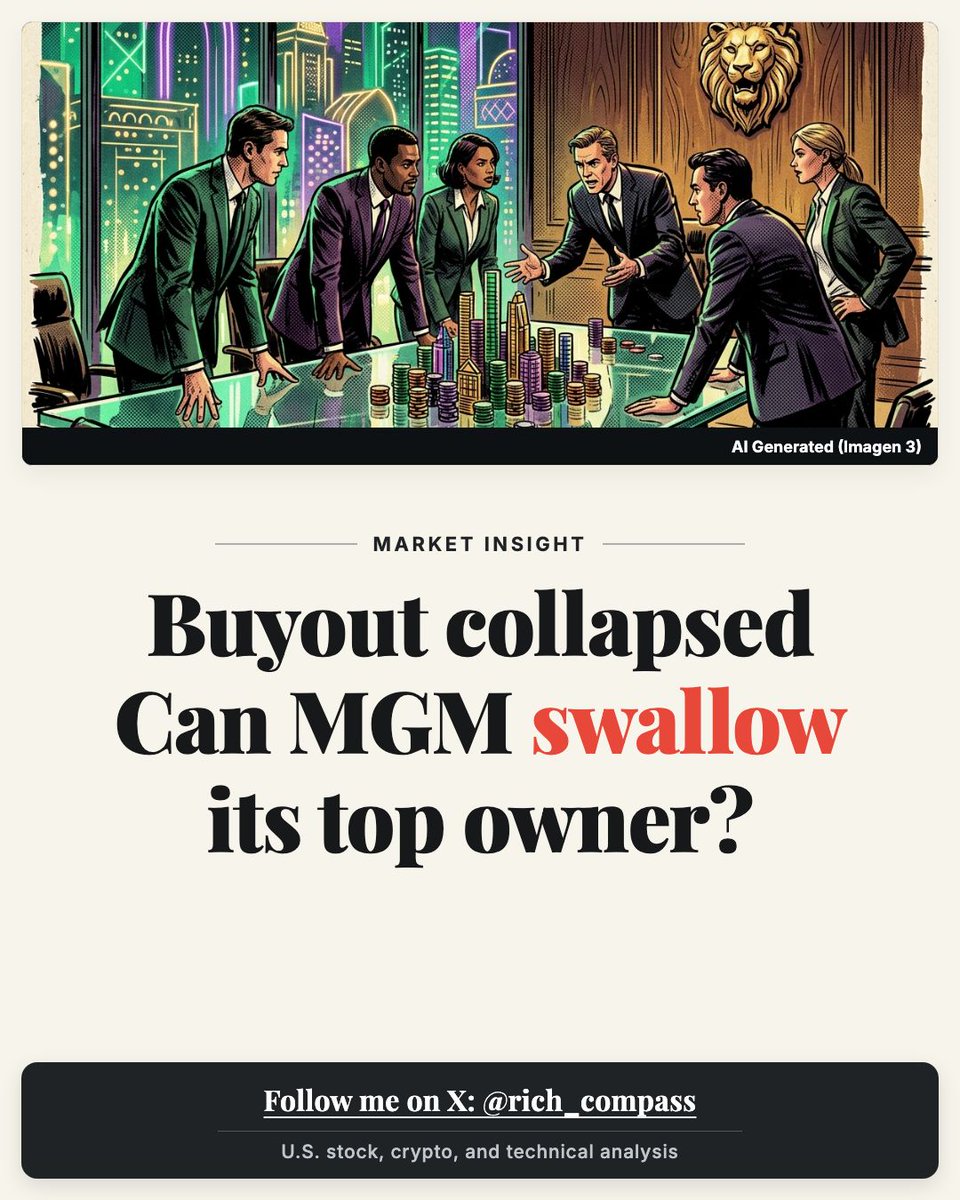
Tesla stock rallied on delivery news. Can upcoming earnings justify the AI hype?👇 ⠀ Tesla ($TSLA) posted its Q3 2026 production, deliveries, and deployments on October 2, 2026. ⠀ The official table showed total production of 464,391 vehicles, total deliveries of 486,532 vehicles, and energy storage product deployments of 13.7 GWh. ⠀ Deliveries came in about 22,000 vehicles above production. ⠀ Tesla's 8-K filing with the SEC under Item 2.02 confirmed the company released a press release the same day as Exhibit 99.1. ⠀ Tesla said in the official press release that deliveries and energy storage deployments are just two measures of financial performance and shouldn't be viewed as indicators of quarterly financial results. ⠀ Those results depend on multiple factors, including average selling prices, cost of sales, and foreign exchange moves, and Tesla will disclose them in the 10-Q for the quarter ended September 30, 2026. ⠀ ----- ⠀ 🔴 Follow me on X: @rich_compass ⠀ U.S. stock, crypto, and technical analysis ⠀ ----- ▋ Deliveries hit a new 2026 high but dropped 2% from last year ⠀ According to FactSet data, Tesla delivered 486,532 vehicles in Q3, about 5.5% above the 461,000 analysts expected. ⠀ This was the second straight quarter above market expectations and Tesla's best single-quarter sales so far this year. ⠀ Against the company-compiled consensus of 461,974, total deliveries were also about 25,000 higher. ⠀ Gary Black of The Future Fund said the result beat his estimate of 470,000 and the market's estimate of about 462,000. ⠀ But compared with 497,099 a year earlier, deliveries were still down about 2%. ⠀ The Q3 2025 number was high partly because some consumers pulled purchases forward before the federal EV tax credit expired. ▋ Model 3 and Y dipped slightly while other models delivered 8295 vehicles ⠀ The official Q3 table showed Tesla's main models, Model 3 and Model Y, delivered 478,237 vehicles, below 481,166 in the same period of 2025. ⠀ Another 8,295 vehicles were "other models" deliveries, mainly the Cybertruck electric pickup, and they may include a small number of other deliveries. ⠀ Tesla stopped production of Model S and Model X earlier this year. ▋ Energy storage missed expectations as analysts point to tight supply ⠀ On energy storage, Tesla deployed 13.7 GWh of products in Q3, below the 15.9 GWh analysts expected. ⠀ After a slow start to the year, analysts had expected Tesla's energy business to heat up in the second half of 2026. ⠀ Analysts also said Tesla's Megapack is critical to meeting power demand driven by US data center buildout. ⠀ William Blair analyst Jed Dorsheimer said in a client report that the growth pace of Tesla's energy storage business has slowed. ⠀ But he said his view on the demand environment was unchanged and attributed the slowdown to supply constraints. ▋ Tesla stock rose over 4% while Rivian Ford and GM dropped ⠀ Yahoo Finance data showed Tesla closed at $370.59 on October 2, 2026, up 4.65% (+$16.48) from the previous close of $354.11. ⠀ On Friday Tesla stock rose 4.7%, while other automakers generally fell that day: Rivian ($RIVN) dropped 3.1%, Ford ($F) dropped 1.4%, and GM ($GM) dropped 1.3%. ⠀ Rival Rivian delivered 19,248 vehicles in Q3, up about 46% from a year earlier, beat market expectations by a bigger margin, and reiterated its July-raised full-year 2026 delivery guidance of 65,000 to 70,000 vehicles, yet the stock fell about 3% that day. ⠀ Legacy automakers also faced pressure in US EV sales, as Ford's Q3 EV sales fell about 80% from a year earlier and General Motors said several EV models saw big Q3 sales declines. ⠀ As of early October, Tesla stock was down about 18% since the start of 2026, while Rivian was down 27%. ▋ Analyst credits gas prices for the delivery beat and rejects FSD hype ⠀ Gary Black of The Future Fund attributed Tesla's Q3 delivery beat mainly to higher gasoline prices, not a demand recovery. ⠀ He said upside momentum may support raising full-year 2026 estimates after Tesla earnings, depending on how much the company spends on AI. ⠀ Gary Black estimates Tesla global inventory is about 12 days of sales, below Q2's 15 days, but above 10 days a year earlier. ⠀ He rejected the view that "Full Self-Driving progress drove deliveries" and argued unsupervised self-driving is becoming a basic threshold for the entire industry. ⠀ He added that without advertising, few buyers outside Tesla supporters know how far the system has progressed. ▋ Annual pace stays below two million as analysts debate the slowdown ⠀ Ross Gerber of Gerber Kawasaki said Tesla's annualized delivery run rate is still below 2 million vehicles per year. ⠀ He called it "massively disappointing" relative to expectations set several years ago. ⠀ Gene Munster of Deepwater Asset Management sees Tesla's 2% annual decline as evidence the "EV winter" is thawing. ⠀ Munster noted the market had expected about a 7% decline, and he expects 2027 delivery growth above 15%, while the market expects close to 9%. ⠀ Based on Q3 deliveries reported by both companies (19,248 vs 486,532), Rivian's deliveries were about one twenty-fifth of Tesla's, while Munster roughly estimated about one twenty-fourth. ▋ The AI narrative drives the stock as investors eye SpaceX merger talk ⠀ UBS ($UBS) analyst Joseph Spak told clients that investors' focus is entirely on Tesla's transformation into a physical AI company. ⠀ He said the stock is driven by narrative and sentiment around future AI possibilities, and that delivery data on release day only "create noise". ⠀ Spak said investors are interested in a possible merger between Tesla and SpaceX, which is run by CEO Elon Musk. ⠀ On Stocktwits, an investing community, users were also disappointed that Tesla only slightly beat expectations, and they emphasized the company's high valuation. ▋ Tesla lines up credit lines with zero borrowings and a $5B liquidity rule ⠀ Tesla signed three credit agreements on September 29, 2026. ⠀ They include a $20 billion three-year delayed draw term loan, an $8 billion five-year revolving credit facility, and a $2 billion 364-day revolving credit facility. ⠀ Tesla said that as of September 29, 2026, there were no borrowings outstanding under those credit facilities, and the company currently does not plan to draw on them in 2026. ⠀ Tesla's credit agreements require the company to maintain at least $5 billion in consolidated liquidity. ▋ Deliveries do not equal profit and full earnings drop on October 21 ⠀ The sources checked didn't have specific data on the average selling price of Tesla's Q3 delivery mix, gross margin, or changes in its China market share in Q3, and Tesla only said those financial results depend on average selling prices, costs, foreign exchange, and other factors, and that they'll be disclosed in the 10-Q. ⠀ Tesla announced it will report Q3 2026 financial results after the US market close on October 21, 2026. ⠀ It will hold a Q&A webcast that day at 4:30 PM US Central Time (5:30 PM US Eastern Time, 5:30 AM Taiwan Time on October 22) to discuss financial and business results and outlook. ⠀ Tesla gave only three operating data points on October 2: deliveries, production, and energy storage, while the full earnings after the market close on October 21 will reveal the real profit impact from average selling prices, costs, and foreign exchange. ⚠️ The above is a compilation of public information, not guaranteed to be accurate, and not investment advice. ⠀ 🔴 Follow me on X: @rich_compass ⠀ U.S. stock, crypto, and technical analysis


mrtarasyuk.eth @berleco
122 Followers 1K Following I am testnet farmer · builder · airdrops & tools Play Game on Robinhood Testnet https://t.co/KtNv5Lrcdx


Ivo SF @IvoSF170963
8 Followers 41 Following
Jessierose @Jessierose5juo
38 Followers 1K Following Message me with your Cash App tag or Chime for blessing 💰😍🫂💕

BabyDogeArmy @iamjosh8090
2K Followers 6K Following Crypto growth experts: Viral memes, X shilling, engaged communities. Let's go!
SolBullish @SurezSol154508
2K Followers 6K Following

Frank Cappclleri @FrankCappclleri
35 Followers 2K Following Free newsletter 👉 https://t.co/k75qGoxe7X • CNBC Contributor
The RonnieV @TheRonnieVSh0w_
50 Followers 2K Following Short-term trader | Long-term investor Bull & Bear Triggers ⚡ Founder @ValueSnapshotio Start here ↓
E N Z O ̆̈ @enzoinsidee
27K Followers 14K Following Charts Noise | KOL | Trader & Investor | NFA | Collabs: DM Now 👇🏻
Cheds Tradingassistan... @CookJoy79821
1 Followers 50 Following Click the link to claim the airdrop for free.👇👇 https://t.co/g1HoGaKybS
Elvira kaloshin @elvira_kaloshin
222 Followers 2K Following i love to travel and trade forex. im a trx coach 😉
Sancet @Million_Sancet
8K Followers 7K Following I'm Million_Sancet None of the posts or theses count as financial advice
Patricia @badshakert
147 Followers 4K Following If you do not enjoy what you are doing, you will never be good at it.
Pay Nova X @PayNovaX
390 Followers 552 Following Spend crypto like cash. Accept it for your business. Four chains, one platform!
𝐄𝐥𝐢𝐭𝐞�... @Nicolefansmom
216 Followers 6K Following I'm Brando- Day trader for 15 years.📈💰 I'm here to share my knowledge, experience, and help educate all traders. Link below for the discord
crypto mAItrix @crypto_mAItrix
410 Followers 2K Following I use technical analysis and AI to predict crypto prices 🤖📊🎯 🔴 Not Financial Advice
𝐃𝐨𝐜𝐭𝐨�... @jessealy_
236 Followers 7K Following Elite trader, I trade psychology, $BTC and Stocks| Educational content only. NO FINANCIAL ADVICE Join Premium: https://t.co/T2AH1SKgd6….
𝐄𝐥𝐢𝐭𝐞�... @LinuxAndrew
110 Followers 1K Following I'm Brando- Day trader for 15 years.📈💰 I'm here to share my knowledge, experience, and help educate all traders. Link below for the discord
𝐄𝐥𝐢𝐳(𝐏... @dm_oon
74 Followers 1K Following Italian Crypto Trader & Investor ✍️Contact / Assistant: @CryptoTyborg Discord: @WealthGroup
Alex Trades @AlexTrades02
21K Followers 16K Following Master the Crypto Market || Signals • Strategy • Insights || 250+ KOL Network || Built for Smart Traders || Stay Ahead || Trade with Confidence || DM for Collab

Ixidi @Ixidi624885
170 Followers 6K Following
Karl Berth @karl_b100
95 Followers 555 Following Living a life of R.O.I Philanthropist and Entrepreneur!
Abdul Razzak @Inchassi
10 Followers 184 Following
Michael Saylor @AroMate379303
14 Followers 121 Following Your XRP Guide September01 New🎓 Key Insights 🌐 follow me and learn 👉Why XRP's value will rise💵 How XRP reshapes digital finance🏆Top 1% XRP holder
Johnny Xander @sandorbarta01
39 Followers 156 Following
Bharath Arumugam @Bharath8673
234 Followers 5K Following
. ✪ @DamnCrypton
662 Followers 7K Following Fulltime Crypto Trader & Investor 📈 | Tweets are not financial advice | TG: https://t.co/Kmugwio8M3 | YT: https://t.co/otyoYEBML1 l

Vladimír Ondruška @draladar
96 Followers 368 Following Webový analyzér, PPC reklamátor, konverzní optimalizátor a sériový fotr stále čekající na svůj první tweet.
jheron @blueywhitey
228 Followers 3K Following

Szymon @sim2136
3 Followers 22 Following
Dylan @Dylan17752080
13 Followers 32 Following
Jeremy @hud_43
37 Followers 148 Following Husband. Dad of 2. Fitness, markets, cars, sport and common sense.
NC18 @Nohecd18
13 Followers 89 Following

PFStudio @PlanckFrames
1K Followers 2K Following Investor #SPCX/#TSLA | crypto $XRP $DOGE $BTC | A.I. creator | vibe coder | 🇺🇸
JJD🇵🇭 @jayd_ee757
261 Followers 6K Following Show me the charts & I'll tell you the news. ZERO EMOTIONS!🇵🇭 ► Patreon: https://t.co/LYdYhf6Hsp
Simon @0xSimonn
133 Followers 215 Following
★ @TheHaroldNode
330 Followers 7K Following Passionate about the power of blockchain, I believe crypto is not just a technology —it’s a movement reshaping the future of finance and freedom
$XDR IMF @XDR2026
712 Followers 7K Following Decentralizing Central Banks Via (DeFi) The Vision Is To Raise XDR 660.7+ Billion, Decentralize Central Banks and FREE HUMANITY $XDR / $365 Trillion Global Debt
E N Z O ̆̈ @enzoinsidee
27K Followers 14K Following Charts Noise | KOL | Trader & Investor | NFA | Collabs: DM Now 👇🏻
Alex Trades @AlexTrades02
21K Followers 16K Following Master the Crypto Market || Signals • Strategy • Insights || 250+ KOL Network || Built for Smart Traders || Stay Ahead || Trade with Confidence || DM for Collab
Sean trades @SRxTrades
142K Followers 217 Following Options + equities trader📈| Founder of @TheOptionCartel | 24 | Volume and Price action analysis Join my 3 Day Swing Trading Free Live Event OCT 27-29👇
Anthony Pompliano �... @APompliano
2.4M Followers 8K Following Entrepreneur, investor, and lifelong learner. Daily writing: https://t.co/tpCu2xhIBx Website: https://t.co/aof319cnW2 My second book: https://t.co/2W94vXav7i
Watcher.Guru @WatcherGuru
4.9M Followers 3 Following Watcher Guru gives you unparalleled, unbiased coverage of all-things crypto & finance in real-time | Posts Are Not Financial Advice | @BTCPrice
Lark Davis @LarkDavis
1.5M Followers 2K Following Entrepreneur & Bitcoin investor. Founder of The Inner Circle, the best Discord community in crypto! Tweets not financial advice.

Kyren @noBScrypto
45K Followers 753 Following Financial Freedom is a CHOICE 💸 No BS Crypto host 🔊 Ex- Banker 🏦 I’ve Saved 150K investors from harmful crypto advice 📘

Federal Reserve @federalreserve
1.6M Followers 26 Following The official Twitter channel of the Board of Governors of the Federal Reserve System. Privacy Policy: http://t.co/pbRRCfwyou
Benjamin Cowen @benjamincowen
1.3M Followers 1K Following Founder & CEO, ITC | Macro, commodities & digital assets | Liquidity, labor & risk cycles | PhD Engineering | Former NASA, Sandia National Labs
Shay Boloor @StockSavvyShay
460K Followers 335 Following Chief Market Strategist @FuturumEquities | Regular on @Reuters, @YahooFinance, @Bloomberg, @FoxBusiness, @SchwabNetwork & @Forbes | NIA
Whale Insider @WhaleInsider
678K Followers 733 Following Leading source for crypto, tech & AI news. DM for inquiries. RT ≠ endorsement. Not financial advice. Beware of telegram impersonators.
Ted @TedPillows
322K Followers 17K Following Survived 2 crypto cycles. Turning Bitcoin and Ethereum, on-chain data and macro signals into actionable trades. Research: ↓
Rikwoo @rikwoo_
1K Followers 1K Following Crypto Trader — No hopium, no copium. I trade levels, momentum and liquidity — not fantasies. If you’re done with fake calls & screenshots, follow me. ⚡📈
Investing visuals @InvestingVisual
119K Followers 131 Following Connecting numbers and stories through unique visuals | Deep dives, research, visual library & Discord community via my website 👇 | Collaborate? DM is open!
CryptoBullet @CryptoBullet1
183K Followers 114 Following Trader • Market Analyst Bybit : https://t.co/Ba5wJCA1jH 🚀 $30K Welcome Bonus BloFin : https://t.co/E4pkIS4axj 🔥 $5K Bonus
Stockmoney Lizards @StockmoneyL
168K Followers 510 Following Bitcoin & crypto. Data-driven. No noise. x Current YT episode: https://t.co/yIA1terxSf x All links: https://t.co/tpshARtu0D
𝗰𝘆𝗰𝗹𝗼�... @nobrainflip
540K Followers 538 Following Crypto trader & angel investor ✧ Follow for free educational content on crypto investing & trading copy-trade me here: https://t.co/ZqCYW5Qk4M
MikybullCrypto @MikybullCrypto
92K Followers 621 Following Macro Contrarian View | Economist| Trader | no VIP
zaibitrades @zaibitrades
11K Followers 2K Following Full-time Trader & Market Analyst https://t.co/cFLi0bxgle
𝕄𝕠𝕦𝕤𝕥�... @el_crypto_prof
164K Followers 991 Following #Bitcoin & 𝗖𝗿𝘆𝗽𝘁𝗼 𝘀𝗶𝗻𝗰𝗲 𝟮𝟬𝟭𝟱|𝗧𝗿𝗮𝗱𝗲𝗿/𝗔𝗻𝗮𝗹𝘆𝘀𝘁|𝗡𝗼𝘁 𝗙𝗶𝗻𝗮𝗻𝗰𝗶𝗮𝗹 𝗔𝗱𝘃𝗶𝘀𝗲 𝗧𝗲𝗹𝗲𝗴𝗿𝗮𝗺:https://t.co/QYZvtXCqfU
The Long Investor @TheLongInvest
277K Followers 1K Following Airline Captain, B.A. in International Business & Economics, Law Diploma, TA & FA Analyst, Not Financial Advice. https://t.co/7XOnqn1voQ
Ledgerdary @LedgerdaryXYZ
309 Followers 137 Following Daily swing setups + fun takes on the markets. Stay Bullish. Stay Ledgerdary.
Sykodelic 🔪 @Sykodelic_
74K Followers 743 Following 7+ Year Crypto Veteran | Macro Specialist | Join my Newsletter - Syko Therapy - To Decode This Market & Win | Link Below

IncomeSharks @IncomeSharks
740K Followers 2K Following Stock and crypto, analysis & predictions. Be careful of impersonators. Trades/education on Slice: https://t.co/HKRP4lGWFN.


EliteOptionsTrader @EliteOptions2
255K Followers 85 Following I'm Brando- Day trader for 15 years. 📈 💰 I'm here to share my knowledge, experience, and help educate all traders. Link below for the discord ⬇️
Frank Cappelleri @FrankCappelleri
25K Followers 1K Following Free newsletter 👉 https://t.co/SVZKgHRd75 • CNBC Contributor
Mike Investing @MrMikeInvesting
292K Followers 337 Following • Stock/Option Trader 📈 • 24/7 profit 💎 • Founder of Mikes Trading 👑 • I’m not a financial advisor • (You are responsible for your choices)
Coin Bureau @coinbureau
1.1M Followers 430 Following Official Coin Bureau X account: covering breaking news, insights & in-depth analysis across Fintech, Macro & AI.
Quinten @QuintenFrancois
219K Followers 1K Following Doing things with crypto Bestselling author | Forbes 30U30 CBO @lokal_spot | Business: @GavinVDL
Lourenço VS @lourenco_vs
15K Followers 194 Following Cutting through the noise. Let the charts do the talking 🇵🇹
Justin Wu @hackapreneur
280K Followers 42K Following 🧑🌾 #RWA, #DeFi & Collectibles Prev: @PiCoreTeam @dcentralcon $PONKE army
Rod @Crypto_R0D
66K Followers 162 Following Trading crypto since 2005. I don’t predict. I read the market.
LuxAlgo @LuxAlgo
128K Followers 504 Following Trading technology. Makers of Vela, the next-gen charting platform. Open source: @velacharts
Cheds Trading @BigCheds
376K Followers 211 Following Author (Trading Wisdom) https://t.co/FLH4v5NDKb Cancer Survivor (Stage 3) Founding Analyst #Bitcoin Live https://t.co/YKuigAt2rT $BTC - CMT Level 1
Coin Signals @CoinSignals_
27K Followers 1K Following Daily Cryptocurrency News and Free Crypto Signals. Telegram Channel:- https://t.co/VIKtvTiq0Q
Aaron Dishner @MooninPapa
19K Followers 370 Following Teaching. Trading. TBO. Crypto courses at The Better Traders. Official links below👇
EGRAG CRYPTO @egragcrypto
94K Followers 3K Following EGRAG CRYPTO simply answers the “Why’S” in cryptos in a rational, knowledgeable, and tech-driven approach. EGRAG is letter “Y” in French.
CyclesFan @CyclesFan
60K Followers 482 Following I don't have a Telegram account and don't sell newsletters.
RonnieV @TheRonnieVShow
71K Followers 292 Following Investor l Trader | Retail Analyst l 12+ Years Research stocks: https://t.co/EH8dC3szAj Know when to buy: https://t.co/XEVnChjipu
Bitcoin Archive @BitcoinArchive
1.8M Followers 1K Following Bitcoin News, Insight, & Analysis 🗄️ 🚀 🌙 📺 YOUTUBE: https://t.co/mVGviKErxq
Doctor Profit 🇨�... @DrProfitCrypto
524K Followers 825 Following Elite trader, I trade psychology, $BTC and Stocks| Educational content only. NO FINANCIAL ADVICE Join Premium: https://t.co/TvHxOtKhHj

Crypto Rover @cryptorover
1.6M Followers 579 Following #Bitcoin Crypto YouTuber (200K+ SUBS) | TG: cryptoroveryt | Cryptocurrency investments are high risk, volatile, and can be dangerous. All tweets are NFA.
𝐊𝐚𝐦𝐫𝐚�... @Karman_1s
41K Followers 1K Following #Crypto trader | Just sharing Trades, News & Opinions 📢 | My tweets are NFA | Creator at @coinmarketcap Community | tg: https://t.co/bxZxzFQaapTrends for United States
You might like


















