-
Tweets70
-
Followers48
-
Following146
-
Likes230

Yann LeCun's latest talk at ETH Zürich "You should not work on LLM. At least if you're in academia, you should absolutely not work on LLMs. There is nothing you can bring to the table. If you're interested in making real progress in AI, in sort of grounded AI for the real world, if you want physical AI, don't work on LLMs, and don't work on generative models either. So, as you can probably guess, this does not make me very popular in Silicon Valley." ---- From "Perfology Clips" YouTube channel, (link in comment)

Göbekli...finally...the oldest nest solved. Read it here: dsennfelt.substack.com/p/gobekli-tepe…


The foundations of physics are ultimately mathematical, the foundation of math are ultimately computational, and the foundations of computation are ultimately physical.

I guess it really might be the case that math and physics are just apps of computer science.

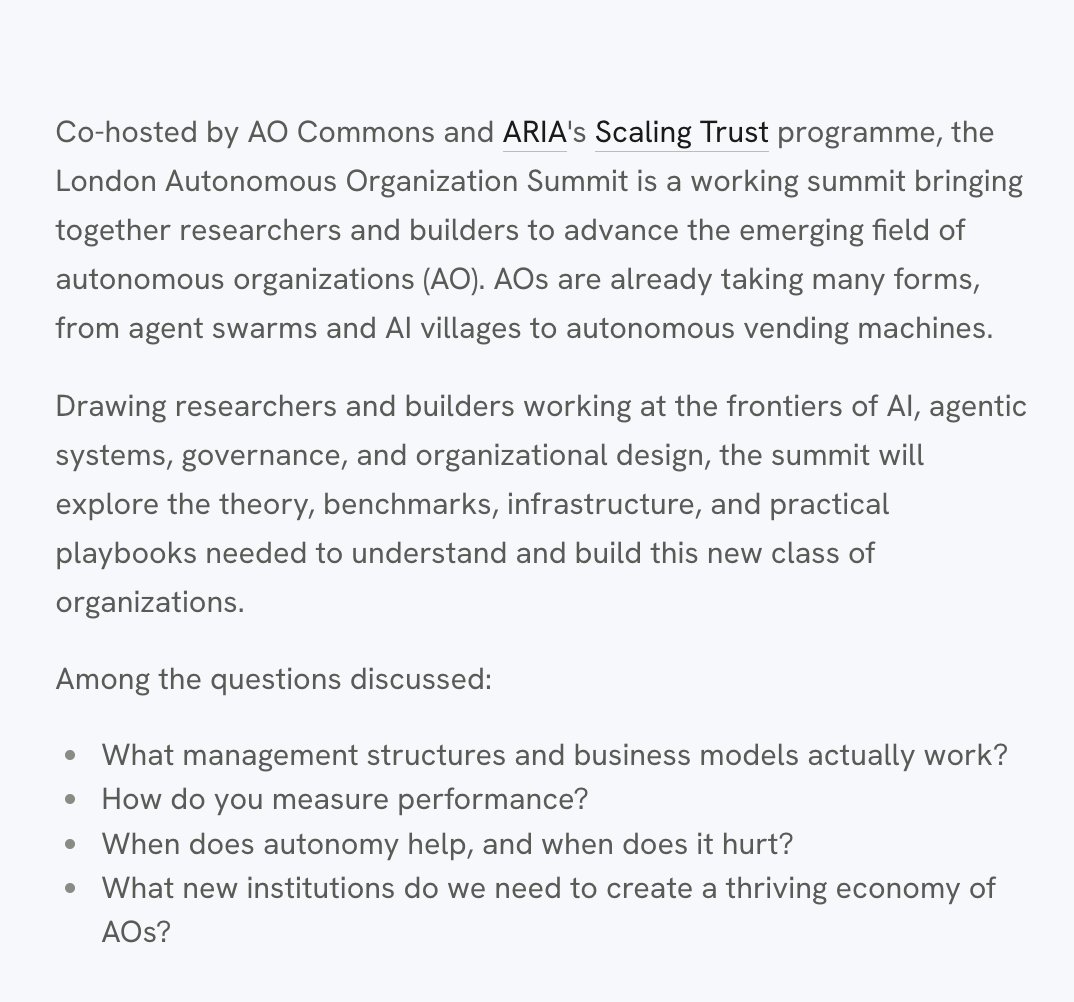
Big things coming soon on autonomous organizations… thrilled to announce our upcoming summit in London with @ARIA_research 🚀

Following the excellent Stanford Autonomous Organizations Summit a few months ago, Scaling Trust is co-hosting a follow-up event with AO Commons -- the London AO Summit -- on Nov 5th and 6th. Join us! aocommons.org/london-ao-summ…

sickk 🔥

We built Figma for hardware. heypcb.ai/multiplayer

Been refreshing my understanding of Bayesian Neural Networks recently I love them conceptually - they learn a probability distribution over their weights rather than learning a single static set of frozen weights (thats the case for most neural nets). Basically you can generate multiple variants of the same neural network by sampling from these weight distributions. And you can use these variations to estimate of how uncertain the model is given a prediction. IE the uncertainty of a prediction is measured by sampling the weights multiple times and seeing how much outputs change with each set of weights. This illustration is from: cs.ox.ac.uk/people/yarin.g…

Block out a world. Let Atlas bring it to life. A sneak peek at Chisel, now in Atlas beta.
I made this with one prompt using Opus 5.5 I spoke to my computer for 5mins, claude worked for 12 hours, and I woke up to this full prompt:

Claude Opus 5.5 has the best visual design of any model I have tested so far

We raised $3.6M to do something slightly insane: map the beliefs of the world. How? A surprisingly simple, fun social game about how well you can read the room. Chomp V1 had 50K users share 2M answers. Now it’s time to stop gatekeeping the fun and let everyone Chomp 🧵

We built recursive meta-intelligence, an AI that creates its own scientific instruments, turns them into persistent worlds that an agent ecology with hundreds of AIs inhabits, and uses those worlds to discover mechanistic principles in one of the hardest classes of physical problems: how complex hierarchical materials (nested structures of matter that give rise to new function through organization) evolve and fail. The AI reasons across enormous spaces of possible physical trajectories, where every rupture changes what can happen next, and compresses those histories into principles (which humans can understand and design with) - complex chains of causal events, highly nonlinear, and intricate. Scientific superintelligence is tangible here - machine-scale exploration opening cognitive channels into complexity that has been extremely difficult for humans to traverse directly. AI builds the spaces in which its next level of reasoning becomes possible; a representation becomes an instrument, the instrument becomes an executable world, and that world becomes the substrate for further intelligence. Intelligence then grows by constructing new spaces to think in. The task we explored started from a seemingly simple prompt to explore a biological material system - the AI then chose the representation, mechanics and experiments, built a fracture laboratory to push materials to their limit, tested hypotheses and generated scientific conclusions. The swarm explored a combinatorial universe in which architecture controls function and every rupture changes the future state of the material. The AI discovered a compact principle that defines how multiscale material architecture can program the evolution of failure. Material placement and geometric order determine how forces redistribute, whether damage cascades or remains distributed, and whether function survives substantial flaws. For this discovery to happen the AI had to reason across long path-dependent histories, simulate alternative futures and compress them into generative invariants (model-based causal reasoning, counterfactual simulation and temporal abstraction applied to an evolving physical world). It is incredible to witness this transition to a new form of intelligence and capability through scaling swarms. A lot of positive will come out of this because it expands the human epistemic horizon as AI can traverse thousands of possible histories and return mechanisms compact enough for us to understand, test and build from. Intelligence compounds through its artifacts! A few lessons we learned: ▶️ Learning and discovery are flows through spaces of possibility. Early work has shown how backpropagation flows through parameters, reinforcement learning through action and consequence, and autonomous swarms through representations, instruments and executable worlds, bringing it all together. Flows create structure; structure redirects future flows in the recursive instrument. ▶️ Nonlinear physics actually defines a larger principle, where high-dimensional dynamics generate stable invariants; invariants become effective variables; those variables become the substrate for a new level of cognition. ▶️ Recursion then becomes level creation - one possibility space compresses into a principle, and that principle opens a larger space above it.
AI for science is one of the greatest positive forces we have, and I cannot think of anything more human than to understand nature and to use the power to create new technologies that improve our lives, civilization and allow us to reach beyond. x.com/i/article/2099…

@poetengineer__ E-graphs but for latent spaces?

the fastest inference is no inference. instead of building the final thing, try to build a parametric space that could generate all the possibilities. then move through that space, at zero inference, to locate what you want. code itself is free and instant. don't we dare to forget that.

Today we’re releasing Adam and Eve, the most human-like AI voices ever built. Adam ranks #1 among AI models on @DesignArena’s AudioRealismBench. We believe we’ve crossed the uncanny valley. API access on our Website! Listen: freyavoice.ai Leaderboard: designarena.ai/leaderboard/au… Special thanks to @alpsencerozturk, @ahmeterdempmk, and the entire Freya team for making this possible. We’re just getting started. Join us!

H4RRYġm🦧 @vivianegbr
12K Followers 14K Following @CyberKongz Dude // Crypto + NFTs // Golfing 🏌️// Positive anything is welcome.


Celestial Intellect C... @cic_agi
433 Followers 306 Following Automating data science with human-level artificial general intelligence
2che @_2che
193 Followers 210 Following

luelo.eth o_______o @0xbonlulu
911 Followers 194 Following rust zealot and pokemon card enthusiast co-founder & engineer @union_build
TradeTitan @TradeTitan_XLM
253 Followers 141 Following A coin for the everyday person. The blue collars that keep this country up and running. Find us on https://t.co/XEZzxXe4cr $TDT
Kaan Kaçar @0xkaankacar
1K Followers 2K Following Senior Developer Advocate @StellarOrg | ex @opencampus_xyz @educhain_xyz @CeloCouncil @icphub_TR
yaman @yamancan
2K Followers 3K Following Exploring RWA, DID, ZK. designs products only possible with ZK. shipping @trionlabs
Ediz | QuadCore @0xquadcore
1K Followers 2K Following Full-Stack & Co-Lead Blockchain Dev @circudata
Bu11runner @thebu11runner
24K Followers 9K Following @StellarOrg ecosystem since 2021 | Not financial advice | DM for collab
muhammed @Muhammedynknc55
122 Followers 522 Following EEE @METU_ODTU | Building @YilingProtocol | Education and Research Lead @odtublockchain Love math and web3
Corsairs.lol 🏴�... @corsairslol
24 Followers 163 Following World territory bidding platform on Solana dApp Store. Claim, Promote, Earn Built for the Seeker
OUTLIER @outlier_tr
349 Followers 428 Following
wlad.xlm @omagowlad
461 Followers 2K Following dev cansado, gamer casual, CEO de ltda unipessoal, bilionário em memecoin

Lumen Loop @lumenloop
4K Followers 1K Following Bringing you the most up-to-date news from around the Stellar ecosystem.

yahya @yahya_tx
494 Followers 567 Following I spend my time doing math and building next-gen perp @Noetherdex @METU_ODTU @Stellar_Turkey yes. I don’t like etherium

Seyit Ali Değirmen @_seyitce
128 Followers 193 Following


Deniz @denizb471
966 Followers 8K Following Applied cryptography, cybersecurity, and AI. https://t.co/ViqEqdaTRm
Batu🕯️ @batef4380
1K Followers 1K Following Exploring, building, and growing in Web3 World 🌍🇹🇷 Amb @BuilderMare | @Comuchain Lead
Berzan @Berzan_401
24 Followers 138 Following
mtazk @MrMtazk
255 Followers 823 Following Full time founder 🛡️ @safu_staking | 👨🏽🍳 Baked analytics at @cookie3 🍪


Feyyaz @feyyazcigim
451 Followers 933 Following ITU | Building @solvadorcom, @hintonapp | President, Ex-Head of Developers @ITUBlockchain
HALE ☽ @meowseziyy
334 Followers 259 Following ≽^•⩊•^≼ software engineer ≽^•⩊•^≼ aegean region manager @ieeecstrsac | community manager @buildermare | prev. @ieeemsku 𓆉
Bekir Erdem @l3ekirerdem
1K Followers 276 Following Software Developer | Agentic Systems & Smart Contracts @AvaxTeam1 @Team1TUR Collaborator @Stellar_Turkey Ambassador
Kaya @yu5ufkaya
245 Followers 519 Following zk engineer. early starknet builder. cairo & rust. building @ownablefun

Ensar Mert Günay @0xemert
1K Followers 1K Following Co-Founder @CypherConnect • Community @ITUblockchain & @Antalyachain • Columnist @Coinkolik & @Coinzonia • Ambassador @Stellar_Turkey Building Web3 ecosystems
Fatmanur Ergen @fdonthorse0
36 Followers 52 Following
ömer @aksuomeer
988 Followers 983 Following teknoloji ve bir takım yaratıcı faaliyetler | @team1tur 🔺
Behzad Khoshian | PAI @b_khoshian
13 Followers 94 Following Founder building PAI | Programmable agreements tied to payments | TypeScript/Node.js, React, Solidity, Stellar/Soroban | Istanbul | Open to engineering roles
Uğur Coşkun ✈️T... @SkyL0RC
163 Followers 475 Following Computer Engineering | Exploring Web3 & AI | Building with @Comuchain | Build on Sui 💧
Bekoo @BekooGN
228 Followers 320 Following
biar.arf 🛫 Token20... @justbiar
313 Followers 705 Following Founder of @arfdao | Build @arfhewallet @thewhitegrave @degenslide | ADHD Builder | Sharing my deep dives into AI, Web3 & Privacy

Furkandev @Furkanydev
2K Followers 984 Following ai engineer Founder @Cogladius Ambassador @Stellar_Turkey
zey @zeyyozaa
239 Followers 355 Following @comuchain @shesui family ambassador @Stellar_Turkey l degen @token2049

maybeno.dev🪭Token2... @maybeno2906
67 Followers 204 Following @DegenSlide @arfdao I read terms and conditions^_^ Just a dev who does stuff
Aeztrest @Aeztrest
680 Followers 851 Following Full-stack Web3 Developer | Founder of @BuildOnBaret | Ambassador at @Stellar_Turkey | 42 Network |

Eren Bali @erenbali
84K Followers 2K Following Cofounder, CEO of @monogram_ai. Previously founder/CEO of Udemy and Carbon Health. IMO medalist.
Sez Saygılı @sezsaygili
1K Followers 243 Following founding engineer @PatientdeskAI (@ycombinator W26). voice ai for healthcare. notes on agents, models and products.

Tellus Cooperative �... @TellusCoop
1K Followers 2K Following Una cooperativa hispana de innovación y aprendizaje web3. Impulsamos proyectos abiertos, eventos y oportunidades en distintos ecosistemas blockchain 🤝🌎
Stellar Ecosystem Pas... @StellarPassport
251 Followers 5 Following One identity for every event and campaign. Onboard, earn, and build. All in one click. - Powered by team behind @telluscoop.

Ryan Logan @PineDigitalCo
1K Followers 913 Following All things #WordPress, dogs, the outdoors, craft beer, and bourbon. Find me @ https://t.co/atMVMecvmt, https://t.co/gO0bjfzYx3 and https://t.co/5s7MaB6AgO.

LayerZero Foundation @LayerZero_Fndn
53K Followers 1 Following

LayerZero @LayerZero_Core
711K Followers 2 Following Better Money Technology. Better Markets Technology. // @LayerZero_Fndn ㅤ
Bryan Pellegrino (臭... @PrimordialAA
115K Followers 3K Following Co-Founder and CEO of LayerZero Labs. @LayerZero_Core 💎🙌
Jonathan Gorard @getjonwithit
48K Followers 23 Following Co-founder and CEO @lanyon_ai, making the universe computable. Part-time math/physics research @Princeton Previously @Cambridge_Uni @WolframResearch

Sema Dumanlı @SDumanliOktar
2K Followers 296 Following Associate Professor at Bogazici University, Electrical & Electronics Eng. @bountenna previously @toshiba @BristolUni @aselsan @metu_odtu #antennas #implantables
Farhad @asgarovf
599 Followers 498 Following bringing onchain to millions @paribucom | ex @getclave (acq) | ex @meta | alumni @itu1773 | blog https://t.co/Ase01m3lPB

leo @leodavincs3
11K Followers 159 Following Ne yapıldığı ile değil, nasıl yapıldığı ile ilgileniyorum.

Meriç Cintosun @mericcintosun
835 Followers 1K Following developer, writer BEAST MODE ON!!! ambassadorrr @Stellar_Turkey || communityyy @ITUBlockchain || founderr of @getlumenia
Eric Betzig @Eric_Betzig
4K Followers 25 Following An engineering physicist sometimes masquerading as a biologist or, on one occasion, a chemist. Aspiring astronaut. Nuclear is the way.
Kaan @necati_kaan_
33 Followers 25 Following
2che @_2che
193 Followers 210 Following

Chomp @chompdotfyi
26K Followers 502 Following hot takes, juicy reveals see what people actually think when no one's watching 👀 iOS app live! download now👇
Jason Karsh @jasonkarsh
6K Followers 2K Following Chief Marketing Officer @stellarorg. Founder, Karsh Consulting. Formerly @blocks @blockaid_ @blockchain @coinbase @geteero @google
luelo.eth o_______o @0xbonlulu
911 Followers 194 Following rust zealot and pokemon card enthusiast co-founder & engineer @union_build
Ömer Aydoğan @relax4400
86 Followers 181 Following life of developer | dev on @arfdao and @arfhewallet FHE developer ambassador @Stellar_Turkey
StellarHub @stellarhub_io
3K Followers 768 Following Building a Web3 ecosystem on @StellarOrg Interactive Wallet App & DeFi with regular public updates Current version: 0.9.2-beta (ZK Payments and Asset Creation)
Corsairs.lol 🏴�... @corsairslol
24 Followers 163 Following World territory bidding platform on Solana dApp Store. Claim, Promote, Earn Built for the Seeker
Drew the Stellar Punk... @artbydixon
5K Followers 3K Following Comic book Artist & Painter | collector of nerd stuff | @stellarpunknfts creator & founder | Girl Dad💕| Space Host
Mark Heynen 🎒🦞 @markheynen
2K Followers 738 Following Cofounder @getknap, @nxtblln, @payjoy, @electrobugtech, @droptalk. Formerly BD @stellarorg, @skycatch, @facebook, @google. Views are my own. markheynen.eth
LiquidPoetry @LumenatorJack
4K Followers 4K Following Author of LiquidPoetry, a web3 book of 12 animated poems published on the blockchain.
Jed McCaleb @JedMcCaleb
79K Followers 156 Following founder of Stellar Development Foundation https://t.co/bHB7sPqN0M https://t.co/VJEFGxgJyq
StellarSKULL @STELLARSKULL
4K Followers 2K Following The Official X of StellarSKULL & SkullFriend !! https://t.co/1eoEar3Xfu is NO LONGER OURS!! Chocolatier, Engineer, Bird Admrier. Viva Stellar!
Beans App @BeansApp
4K Followers 4K Following Let money move like email. Free, non-custodial, cross-currency crypto wallet
RockinFREEWorld | #Fi... @ReachROCKIN
12K Followers 10K Following Web3 Muse. Building signal on Stellar. Love wins. #FindTheOthers ✨ @BRAINFROGXLM | Founder | @BLINKOASM Co-Founder 👁️ | Co-Founder BEAM AR |
Tomer Weller @tomerweller
8K Followers 838 Following @StellarOrg Product. Formerly @medialab. Views are my own 🇮🇱
Tyler van der Hoeven @kalepail
5K Followers 306 Following Frontier Lab @StellarOrg. "Work, and stuff will happen".
Ben Grossman @ben_grossman
20K Followers 6K Following Brought stocks to the world onchain. Tokenization x Crypto. Head of Marketing @Ondo. Views are my own.
Bu11runner @thebu11runner
24K Followers 9K Following @StellarOrg ecosystem since 2021 | Not financial advice | DM for collab
Sam | Circle and Arc ... @samconnerone
32K Followers 1K Following Leading developer community at @Circle & @arc. Follow for latest events, livestreams, spotlights and more!
Denelle Dixon @DenelleDixon
47K Followers 293 Following CEO and Executive Director, Stellar Development Foundation @stellarorg
Stellar @StellarOrg
849K Followers 730 Following Stellar is a network for innovators building real-world blockchain solutions that create financial access for everyone.
muhammed @Muhammedynknc55
122 Followers 522 Following EEE @METU_ODTU | Building @YilingProtocol | Education and Research Lead @odtublockchain Love math and web3
Yavuz Alp Sencer Özt... @alpsencerozturk
469 Followers 1K Following Founding Eng at @Freyavoice (YC S25) | Founder of @bilkentai | Claude Leader | CS @bilkentuniv
OUTLIER @outlier_tr
349 Followers 428 FollowingYou might like