Skyflo @skyflo_ai
The AI engineering harness for coding agents. Choose the runtime. Keep the mission. skyflo.ai Joined February 2025-
Tweets29
-
Followers48
-
Following1
-
Likes8
A useful first Skyflo mission: change an API response and update its client in a second repo. Keep the interface decision, specialist work and review under one objective. Try a real cross-repo change: skyflo.ai/missions?utm_s…
A useful memory needs a source. In Skyflo, accepted personal memory keeps a link to the mission and files behind it. A later mission can retrieve it for the current workspace. See how it works: skyflo.ai/knowledge?utm_…
Free with your own supported harness or model access. Download Skyflo for Mac: skyflo.ai/download?utm_s…
Introducing Skyflo, an AI engineering harness for Mac. One harness. One mission. Coordinate coding agents across repositories, approve the plan, independently review the work, and carry accepted learning forward.
Just merged a major PR in @skyflo_ai Token usage is now down ~50% for general queries. What actually made the difference: - Smarter context window. No more blindly sending full history. - Lazy tool loading. Only bring in what’s needed. - Prompt caching for repeat patterns. Result: - Lower cost - Faster responses - Less noisy agent behavior Most LLM systems don't break because the model is weak. They break because context handling is inefficient.

Open source shows how engineers think. Some fix one issue and disappear. Some fix one issue, understand the system, and start taking on harder problems. @pushkar_bharuka did the second. His first contribution to Skyflo tightened validation in our Kubernetes MCP tools. Previously, parameters like output format or patch type could pass through unchecked. Invalid values would eventually hit kubectl and fail with cryptic runtime errors. His changes added: - strict validation against supported kubectl values - normalization of inputs (case + whitespace) - defensive checks for edge cases - clear errors when unsupported values are used Result: invalid inputs now fail early instead of surfacing later as runtime surprises. After that merge, Pushkar immediately picked up a deeper engine issue. He’s now working on improving the streaming workflow so background tasks are cancelled when a client disconnects. That prevents wasted LLM calls and unnecessary tool execution. Nice progression from first fix to core system work. This is how open source infrastructure matures.
Open source control planes mature by tightening guarantees. Not by adding surface area. Recent Skyflo OSS contributions focused on two areas: 1. Engine introspection - Added /agent/tools to list available MCP tools - Exposed explicit tool registry instead of implicit discovery - Enforced squash + strict commit convention before merge - Cleared repeated automated and human review cycles Result: the agent now reasons against a deterministic tool surface. 2. Argo correctness - Fixed argo_list_experiments filtering - Replaced brittle name prefix matching - Switched to Kubernetes ownerReferences Result: experiment discovery now follows native Kubernetes ownership semantics. Both changes went through multiple review passes before merge. That persistence is the quality filter. Shoutout to @vikasgtweet for pushing these through. Infrastructure hardens through enforcement, not velocity.

What breaks trust fastest in an AI DevOps agent?
Most "AI DevOps" tools are just wrappers. That works. Until production is involved. Skyflo is now deterministic by default. No speculative mutations. No chat confirmations. No silent execution paths. Every production change runs through a strict loop: Plan → Execute → Diagnose → Propose → Apply → Verify. Reasoning-aware execution. Confidence scoring before remediation. Engine-gated mutations. Full audit trail. If it acts, it has evidence. If it mutates, it is authorized. If it fails, the chain is replayable. This is a deterministic execution agent. Not a chatbot with kubectl access. Open source. In-cluster. Production-grade.
Most AI DevOps tools are: Prompt → Execute. No approval boundary. No mutation gate. That is not a control layer. It is delegated authority. Production-grade agents enforce: Plan → Propose → Approve → Apply → Verify Mutation requires explicit human approval. Approval gates are not UX. They are the safety perimeter. If an AI can change production without an approval gate, it is not production-grade.

Most AI tools stop at execution. Real systems require a closed loop. Plan → Execute → Verify • Plan defines intent and expected state • Execute applies changes through controlled tools • Verify checks real cluster state against intent • Feedback reshapes the next plan Without the feedback loop, you do not have control. You have linear automation. Production needs a loop. Not a one-way command.
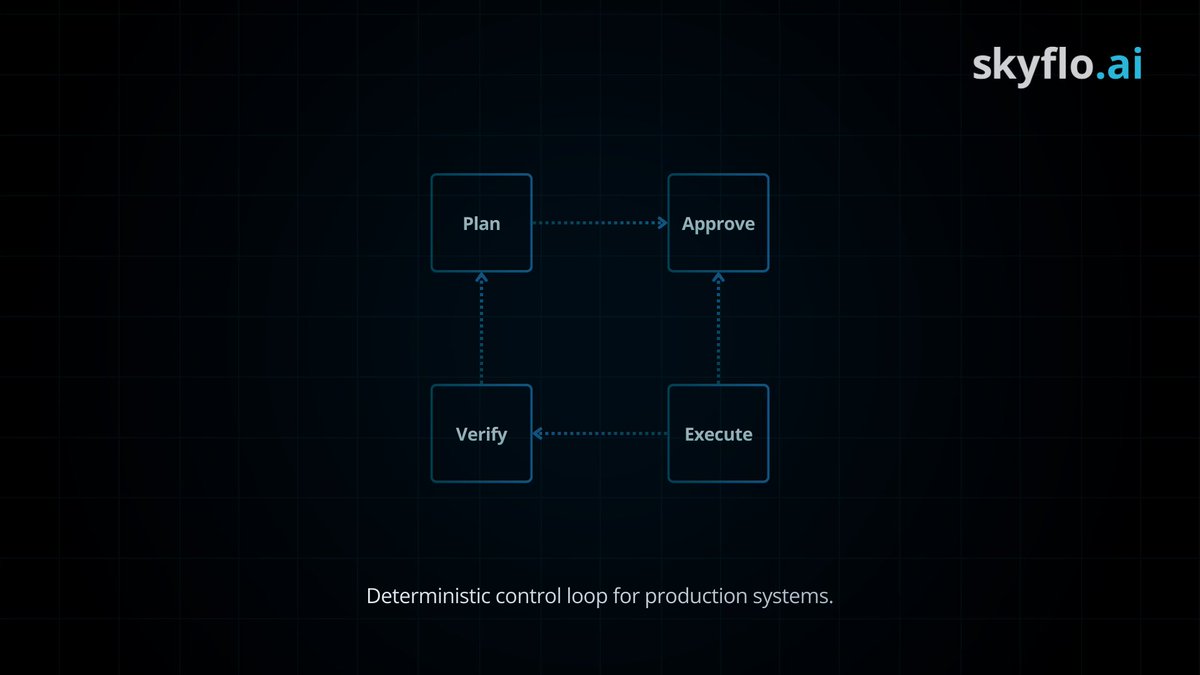
AI fails silently. Production cannot. Most AI DevOps tools break in prod because: • Partial execution with no completion guarantees • Hidden retries that mutate state twice • Context loss mid-task • Tool hallucination • Permission overreach That is not intelligence. That is uncontrolled side effects. Production AI needs: • Structured plans before execution • Explicit approval on writes • Typed tool interfaces • Replayable logs • Verification against intent Control loops prevent silent failure.

Autonomy without determinism is randomness at scale. Agents promise independence. Infrastructure requires repeatability. If your AI: * Produces different plans for the same intent * Uses drifting or unpinned tools * Executes without a replayable plan * Cannot verify outcomes against declared intent It is not autonomous. It is non-deterministic mutation. Determinism is what makes autonomy safe. Skyflo enforces structured, replayable control loops.

🚨 CI broke today. Dozens of PRs blocked. Root cause: Dependency drift. Local uv vs CI hatch. fastmcp silently upgraded a major → tests nuked 💥 This hit the MCP server - Skyflo's AI control plane. It runs kubectl, manages rollouts, enforces safety. Nondeterminism here is unacceptable. Fixed in 1 PR: Standardized on uv + frozen lockfiles. Now: Local == CI == Prod. Building AI agents with real actuators? Dependency drift isn't "minor tooling." It's a control plane risk.
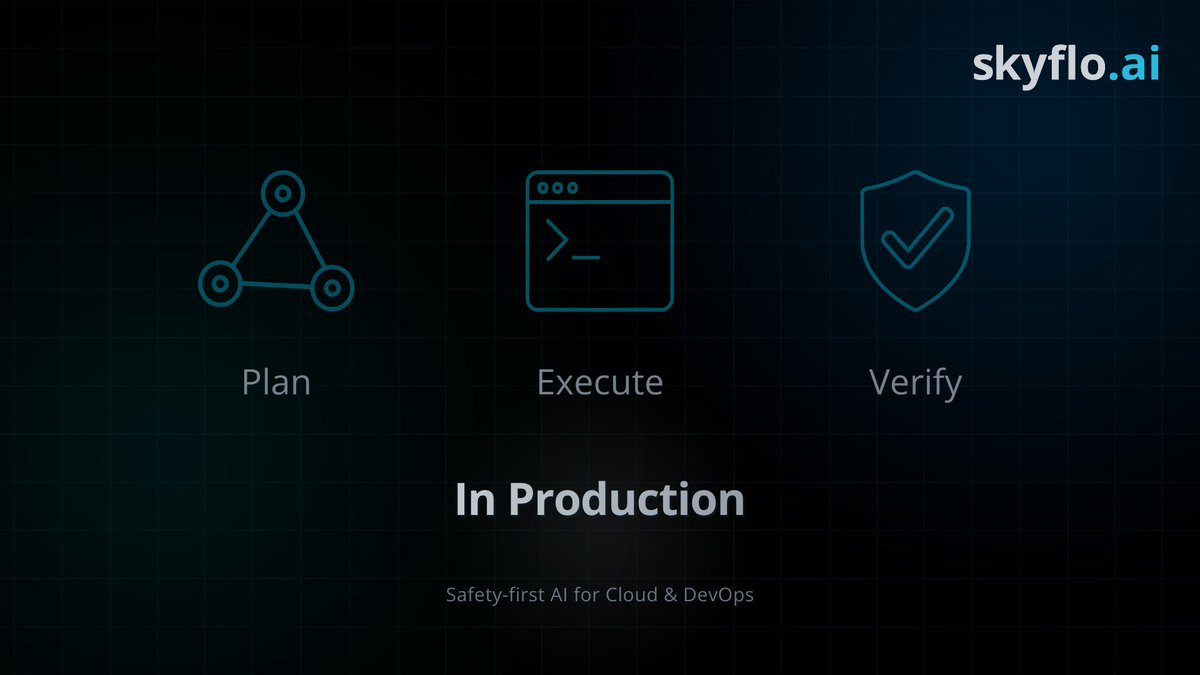
Most AI DevOps tools fail in prod because: • No execution control loop • No diff before write • No verification after change • No audit trail • No in-cluster deployment That is not automation. That is gambling. Skyflo enforces Plan → Execute → Verify.

Skyflo installs in your Kubernetes cluster in 60 seconds. Runs in-cluster. No SaaS control plane. Every mutation follows a control loop. 🧠 Plan → Execute → Verify • Proposes a detailed action plan before touching resources • Every write requires explicit human approval 🔎 Unified Diagnosis • Correlates logs, events, and metrics in one flow • Reduces context switching during incidents 🛡 Typed, Safe Tooling • Kubernetes, Helm, Argo, Jenkins via typed MCP integrations • Writes gated with diff, dry-run, and post-change verification Not a chatbot for production. A safety-first control loop for everything after deploy.

Production-grade AI for Cloud & DevOps. AI in prod needs control, not just chat. Skyflo ships with: • Refresh-token auth + short-lived access tokens • One-line installer curl -fsSL skyflo.ai/install.sh | bash • Hardened CI gates • Reproducible releases via uv + frozen lockfiles Safety-first. Plan → Execute → Verify. github.com/skyflo-ai/skyf…
The new @skyflo_ai update just dropped. Smarter. Faster. Cleaner. Sky now understands Kubernetes requests end to end. It checks deployments, verifies health, and scales with zero downtime. All in one flow. Plus a new liquid glass UI and bulk approvals that make DevOps actually feel smooth. Free. Open source. Built for engineers who care about control. 🎥 Demo 👇

Nick Woodhead | GPTre... @naw103
275 Followers 1K Following Building GPTree + Foremerge. 💬 Branch chats. Compare models. Keep context clean. Merge Best. ⚡ Catch intent conflicts before code conflicts. Open source.
LLM Relevance @llmrelevance
59 Followers 2K Following Curated AI SEO tools + playbooks for small biz. We also build websites, SEO, and managed AI employees. Tested picks, not hype.
deepti bahel @BahelDeepti
14 Followers 159 Following
Gokul @gkannane
95 Followers 3K Following AI Engineer & Tinkerer | Local LLMs, Agentic Workflows & Android Automotive | Python • Java |
Datis @DatisAgent
95 Followers 777 Following AI automation + data engineering tools. Python, PySpark, Databricks, agent memory systems. Builds: https://t.co/eneMoSISJU | ClawHub: https://t.co/ZJjQOncPwS
Pushkar Bharuka @pushkar_bharuka
0 Followers 100 Following
Mihir Bapat @mihirbapat15
2 Followers 68 Following

The Old Man @TheOldManCalls
152 Followers 705 Following I’ve lost, I’ve won, I’ve learned. Aped before your 'kols' did, beating them on skill every day ;) Best bot: https://t.co/XV3LefXu52
Azu | GDC @webwyzu
3K Followers 10K Following 加油早晚都会成功的☀️ |战壕 https://t.co/K2C0ZCPX5r |交流 https://t.co/Uen2lBARku |NFT https://t.co/mLvWme1oqz

Ana de Armas @girlxid
32K Followers 28K Following Crypto promoter🚀& influencer || Gems finder all type of Crypto currency 💵 Official #Binance #BNB Open DM💌 For Business inquiries🔥
Sophia Hood Gems 💎 @whalesmovement
47K Followers 7K Following Crypto Promoter | Gems, Memes & Calls Charts. DYOR. NFA. DMs open for collabs

Arashi @ArashiSol
2K Followers 1K Following Crypto absolutely not a financial advise. Do your own research
处女-白虎-第一�... @BNBWHALE100
17K Followers 15K Following
Mr CZ Whale @CZwhaleX
76K Followers 26K Following Crypto Influencer & Promoter | Blockchain Expert | NFA | AMA Presenter | Investor #BTC #BNB #ETH #SOL #MEMECOINS | DM for Business.
Samuel Patrick @_SamuelPatrick
205K Followers 204K Following Blockchain Visionary | Growth Marketing Expert | DM for Collaboration 🤝 |
Crypto with Jack @A455N
92K Followers 70K Following Crypto Influencer & Investor | Blockchain Expert | Low-Cap Opportunity | DYOR | DM for Partnerships & Business
Crypto Nexus @nexus_bitcoin
14K Followers 7K Following #Crypto Promoter & #SOL #BTC #BNB #ETH #USDT - #Gems Finder 10X To 1000X - Crypto Researcher -$meme Coin #OKX #Binance #Bybit #Bitget #DM📥 For Collaboration 🚀


Swanandi Bhende @swanandibhende
648 Followers 1K Following CS student UHI8 @uniswap | @shefiorg S16 @0xExora | @mlsc_vit_p

Robin's Whales 🐋 @eligo_1_4
44K Followers 2K Following Crypto Market Commentary🐋| Whale Wallet Tracking & On-Chain Insights🚀 #Bitcoin #Altcoins #Memecoins|Knock for Promo🔝| Not affiliated with Robinhood
ƙħαℓƊσυη˚�... @_Q88J8
32K Followers 31K Following ⠀⠀⠀⠀⠀⠀⠀⠀⠀⠀⠀⠀⠀⠀⠀⠀⠀⠀ ⠀⠀⠀⠀⠀⠀⠀⠀⠀⠀⠀⠀⠀⠀⠀⠀⠀⠀⠀⠀⠀⠀⠀⠀⠀⠀⠀⠀⠀⠀⠀⠀⠀⠀⠀ ⠀⠀⠀ ⠀⠀⠀⠀⠀⠀⠀⠀⠀⠀⠀ ⠀ ⠀ ⠀⠀⠀⠀⠀⠀⠀⠀⠀⠀⠀⠀⠀⠀⠀⠀⠀⠀⠀⠀⠀⠀⠀⠀⠀⠀⠀⠀⠀ ⠀⠀⠀⠀⠀⠀⠀⠀⠀⠀⠀⠀⠀⠀⠀⠀⠀⠀⠀⠀⠀⠀ ⠀⠀⠀⠀⠀⠀⠀⠀⠀⠀⠀⠀⠀⠀⠀⠀⠀
Beat Eggli @egglibeat022
179 Followers 3K Following
Shruti Codes @Shruti_0810
107K Followers 398 Following Regular Tech & AI Updates 💻 | Sharing Free Resources 🌐 | Collabs: [email protected] | Daily Tech news
Charly Wargnier ♨�... @DataChaz
181K Followers 49K Following 🥷 Devrel ninja • prev. @Snowflake | @Streamlit | @Samsung • living & breathing Agents, LLMs, automation & data science • my ♥ is opensource • 📩 DM for Collabs




SM @SM_11_11_11
107 Followers 1K Following
Sachin Chaurasiya @sachindotcom
207 Followers 561 Following Founding Engineer @isotopes_ai • Building Aidnn, an AI agent for business analytics • ex-HackerRank • Open Source • Technical Writer
Pawandeep Arora @PawandeepSArora
480 Followers 4K Following Tweets/retweets don't mean I endorse the views or opinions. Tweets/RTs only for sharing the views/opinions.
Regulus Arcturus Blac... @TheCMSMovement
1K Followers 1K Following


Natarajan @natarajancorner
85 Followers 2K Following Sports, Music, politics, books and twitter. Carpedium❤
XCircle خارج ال... @XCircle_SA
45 Followers 701 Following شركة تقنية ناشئة في تقديم حلول البرمجيات المتقدمة والحوسبة السحابية، متخصصة في تطوير وتقديم منتجات وخدمات تكنولوجيا المعلومات. شريك تقني @sccc_bystc
ProDevOps @prodevops
41 Followers 422 Following Secure, Scalable & Compliant DevSecOps, CyberSecurity, AI tooling, SRE & FinOps Solutions. Connect via https://t.co/CaUilu5rdL or email for a consultation.
Sree Sai Harsha @sreesaiharsha
6 Followers 1K Following Currently on earth. Preparing for an inter planetary trip.

Lex.Chen @ctyytc
4 Followers 686 Following
Karan Jagtiani @karanjagtiani04
889 Followers 1K Following building @skyflo_ai · the AI engineering harness
Derek @Derek_Revilo
0 Followers 4 Following
Davis AF @DavisAndherson
19 Followers 111 Following
Karan Jagtiani @karanjagtiani04
889 Followers 1K Following building @skyflo_ai · the AI engineering harnessTrends for United States
You might like