

River @tryriver
The open source web os for your server: federated unity catalog, databases, containers, notebooks, workers, and business intelligence suite. river.li Everywhere Joined July 2024-
Tweets23
-
Followers2
-
Following3
-
Likes3
When your infrastructure provider has an incident, how much control do you still have? Railway disclosed on Oct 21 that an unauthorized party may have accessed encrypted environment variables, including some decrypted secrets. It advised users to rotate credentials. Self-hosting isn't automatically safer. But knowing where your data, credentials, and workloads live and understanding your recovery options matters. Own your architecture. Understand your risks. river.li #SelfHosting #DevOps #Infrastructure
@axisrobotics @openroboto @opentensor Portability matters because infrastructure needs change. Keeping storage, compute, and workflows flexible can give teams more room to evolve without rebuilding everything.
@bigdatasumit Writing the query is only one part of data engineering. Understanding where the data comes from, how it changes, and whether the result is reliable matters just as much. That's where good data workflows make a difference.
AI can write SQL in seconds. But if the underlying data is wrong, the answer can still be wrong. Speed isn't the same as trust. River brings SQL queries, results, and notebooks together so analysis is easier to review and reproduce. river.li/features/query… #DataQuality #DataEngineering
Your data stack doesn't always need another tool. Sometimes it needs fewer gaps between the tools you already use. Disconnected databases, query tools, storage, and workflows create integration work that keeps growing. Build a stack that works together. river.li/features/provi… #DataEngineering #Databases
A query can run successfully and still give you the wrong answer. A JOIN can multiply rows. A filter can change an aggregation. NULLs can quietly distort your results. Valid SQL doesn't always mean accurate results. Always validate the numbers. Explore River Query Editor & Notebooks: river.li/features/query… #SQL #DataAnalytics #DataEngineering
Running a local AI model is step one. You still need somewhere to run apps, store files, query data, experiment with Python, and automate workflows. That's the infrastructure behind a useful AI system. River brings these capabilities together on hardware you control. river.li #SelfHostedAI #AIEngineering #OpenSource
If someone has to remember to run it, it's not fully automated. Recurring data tasks shouldn't depend on manual reminders. River Jobs helps you schedule background workflows so routine processes can run automatically. Less manual work. More consistent execution. river.li/features/sched… #Automation #DataEngineering #DevOps
Your data lives in multiple databases. Your analysis shouldn't require a separate workflow for every source. Federated SQL lets you query data across connected sources without first consolidating everything into one database. Less unnecessary movement. More connected analysis. Explore River: river.li #SQL #DataEngineering #Databases
Your data pipeline starts before the first query. CSV files. JSON exports. Logs. Raw datasets. Before data becomes useful, it needs somewhere to live. Object storage keeps files and data ready for ingestion and processing. River brings storage into the same environment where you build and analyze. river.li/features/files… #DataEngineering #ObjectStorage
Your AI pipeline is only as useful as the data it can access. Documents. Images. Logs. CSVs. Datasets. Where do those files live and how easily can your applications and notebooks access them? River Buckets give files a managed home, with previews and mounting into the runtimes that need them. Buckets can also power public static hosting. Store your data. Build what comes next. 🌊 river.li/features/files… #DataEngineering #AIEngineering #Cloud
AI agents aren't just writing SQL anymore. They're creating databases. Which raises a better question: Who deletes the database? Who reviews the schema? Who rotates the credentials? Who cleans up the 2AM experiment? AI can provision infrastructure faster than humans. Lifecycle management is the part we haven't automated enough. 🌊 river.li #AIEngineering #Databases #DevOps
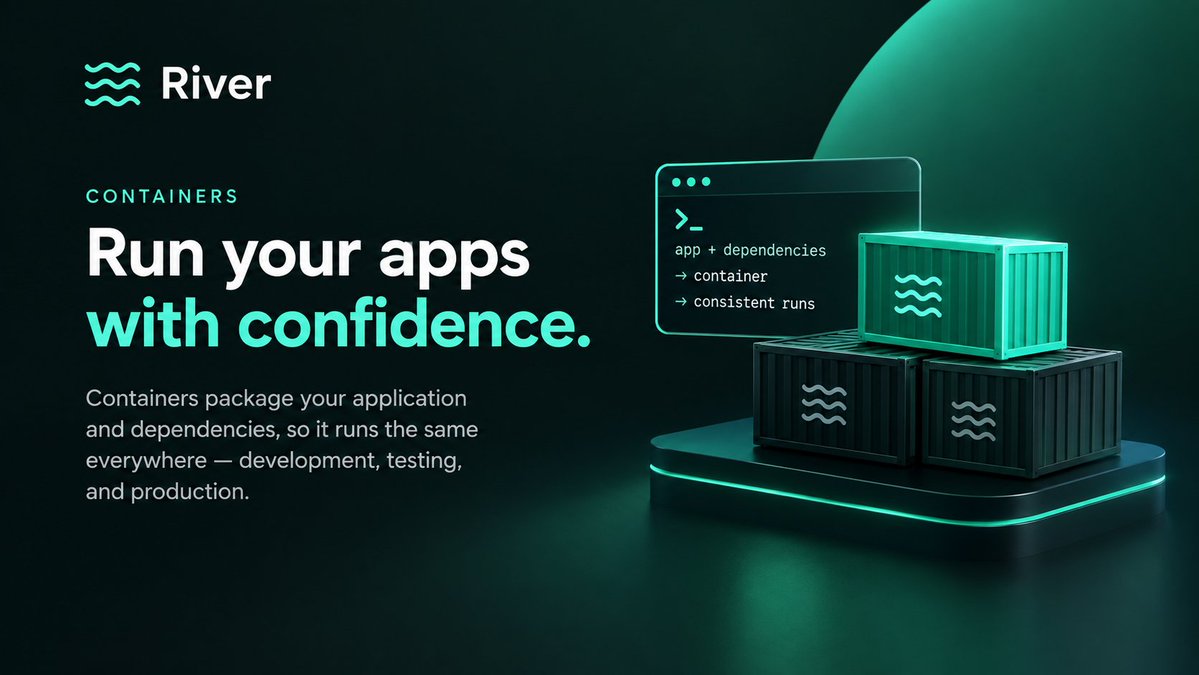
Your app works on your machine. Now what? 👀 River Containers give you an isolated, portable environment to package and run your apps and services without wrestling with a fragmented setup. Build. Deploy. Run. 🌊 river.li #DevOps #Containers #CloudComputing #Developers
Your app needs somewhere to run. Containers package your application + dependencies into an isolated environment, making it easier to run consistently across environments. With River, containers live alongside your data and infrastructure tools. Build. Run. Connect. #Containers #DevOps #CloudComputing
Your data lives in PostgreSQL, MySQL and MongoDB. But your analysis needs all three. Do you really need another data copy just to answer one question? Federated SQL lets you query across supported databases without first centralizing everything. River brings that capability together with notebooks, jobs and dashboards in one workspace. How many databases does your team work with? river.li
AI can write code faster. But who checks whether the result is right? The real workflow is bigger than code generation: → Query the data with SQL. → Validate assumptions in a notebook. → Automate checks so they run reliably. The goal isn't just faster code. It's software you can trust. What has AI actually sped up for you?7
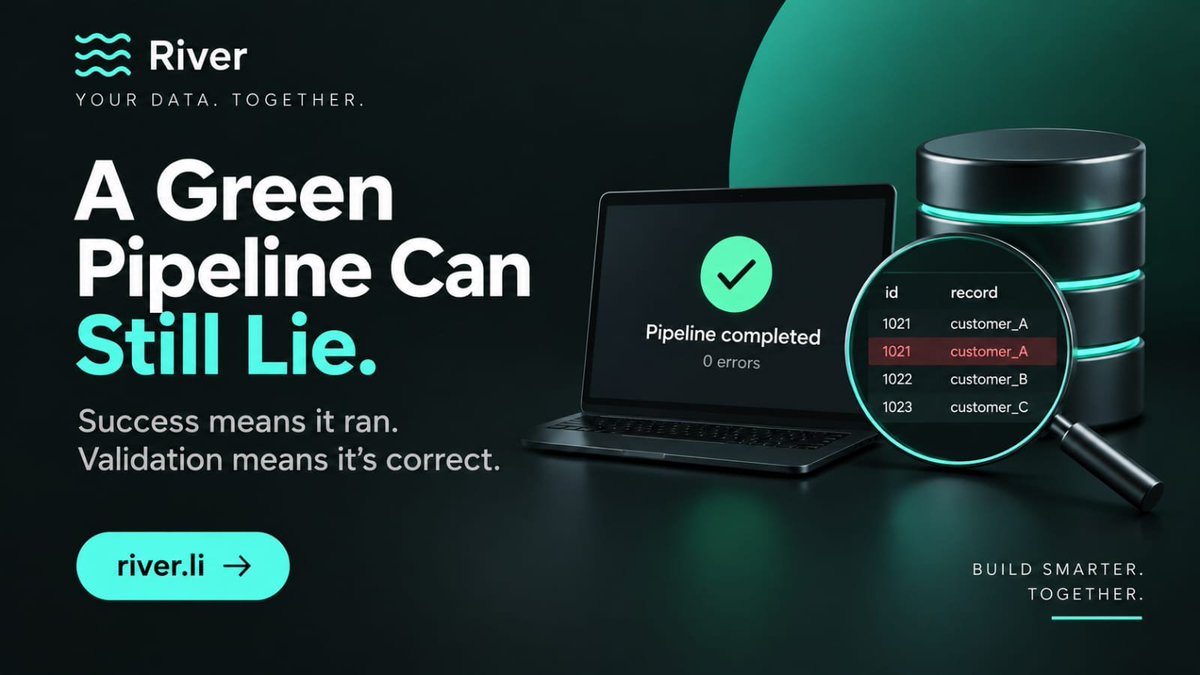
A pipeline can finish successfully and still deliver bad data. A green status tells you the job ran. It doesn’t tell you whether duplicate records, missing values, or unexpected data made it downstream. That’s why reliable ETL/ELT workflows need validation after the load not just successful execution. Run it. Validate it. Trust it. What data-quality check do you always run after a pipeline completes? 👇 Explore River: river.li #DataEngineering #ETL #DataQuality #DataPipelines #AnalyticsEngineering
Database setup shouldn’t be the hardest part of building. Provisioning. Configuration. Connections. Environment setup. These steps can slow down the first line of code. River brings database provisioning and connected services into one workspace. Less setup friction. More time building. How long does it usually take your team to get a database environment running? 👇 river.li #PostgreSQL #DatabaseEngineering #DevTools #DataEngineering

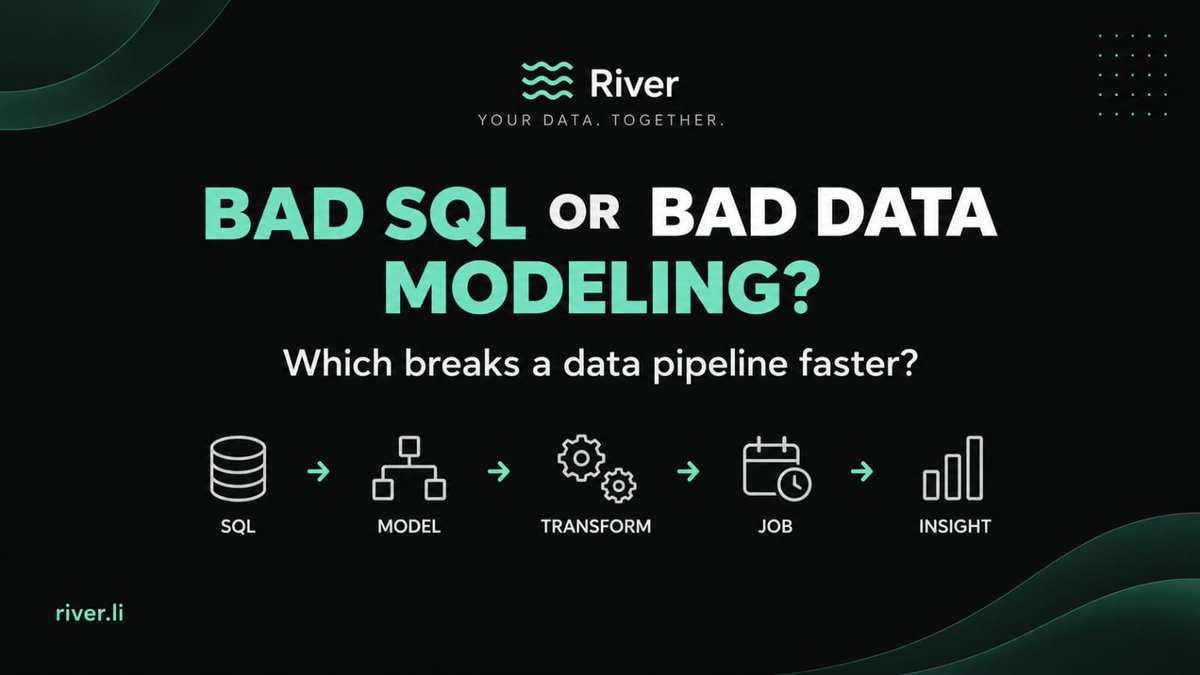
Bad SQL can break a query. Bad data modeling can make the problem travel through the entire pipeline. SQL → Model → Transform → Job → Insight A weak foundation can affect transformations, scheduled jobs, dashboards, and the decisions built downstream. That’s why reliable data pipelines require more than fixing the first error you see the whole workflow matters. So, data engineers: when a pipeline breaks, what do you check first the SQL or the data model? 👇 Explore River: river.li #DataEngineering #SQL #DataModeling #DataPipelines #DeveloperTools

Emily @E_CarterWrites
0 Followers 2 Following

Claude @claudeai
1.9M Followers 2 Following Claude is an AI assistant built by @anthropicai to be safe, accurate, and secure. Talk to Claude on https://t.co/ZhTwG8d1e5 or download the app.
Trends for United States
You might like


















