

Gateplex @GateplexAI
Joined May 2026-
Tweets48
-
Followers6
-
Following1
-
Likes8
@831CompanyDoor Yes, you can export the log and check it offline with an open verifier, without our service running. Keep the chain head yourself to catch records removed from the end.
The check that decides what an AI agent may do should not be another AI. At Gateplex, every agent action is evaluated against fixed rules before it runs. Same input, same verdict. Every decision leaves a tamper-evident record. #AIGovernance gateplex.ai

Guardrails for AI agents, in one click. Gateplex compliance packs for EU AI Act Article 12, HIPAA and financial services. See exactly which rules a pack adds before you confirm, and edit or delete any of them after. gateplex.ai

A head of risk usually gets asked about one action, on one day. Show me what the agent tried to do, and what it was allowed to do. Answering that normally means pulling application traces, opening a policy file that may have changed since, and asking whoever wired up the integration what they remember. Gateplex intercepts each agent action before it executes and evaluates it against configurable rules. The decision, the rule that matched and the supporting evidence are recorded together as one artefact, tied to that specific action. So the answer is one record, found by looking up the action, written when the decision was made. There are ten rule types, including Spend Limit, API Scope Control, PII Shield and Prompt Injection Detector. Integration is a Python SDK or an MCP server and works with OpenAI, Anthropic, LangChain, CrewAI, AutoGen and AWS Bedrock. Deployment options are hosted, VPC or air-gapped.
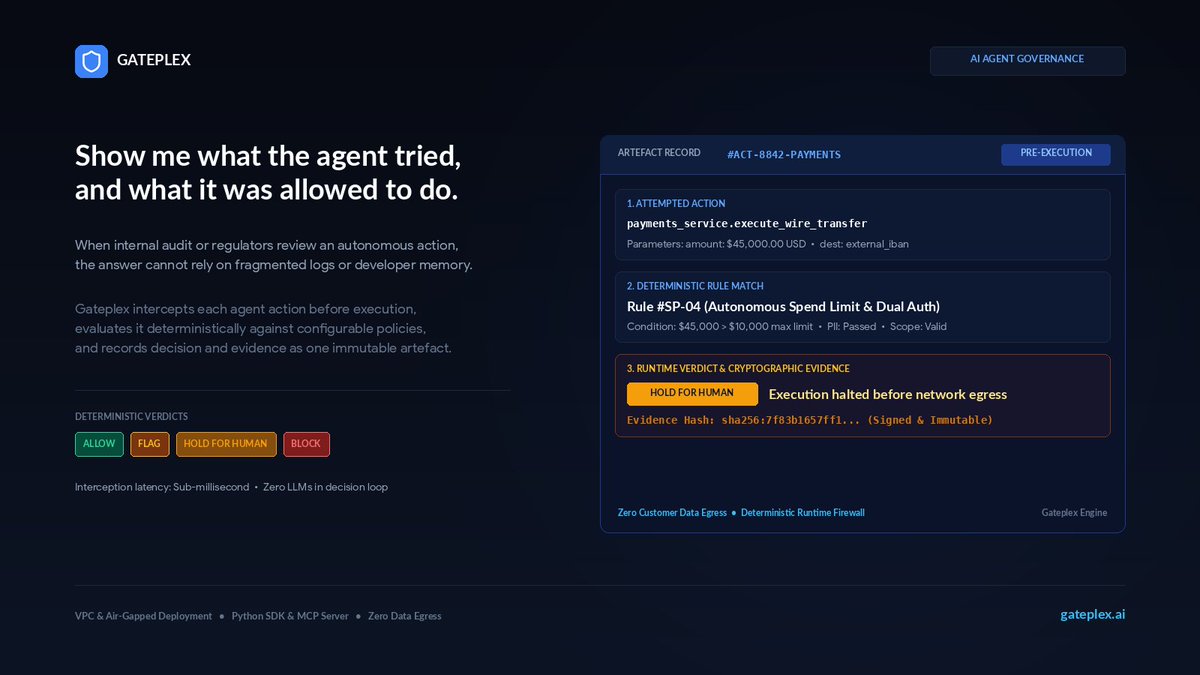
Our view: check each agent action against policy before it runs, and keep a record that cannot be altered afterwards. gateplex.ai #AIGovernance #EnterpriseAI
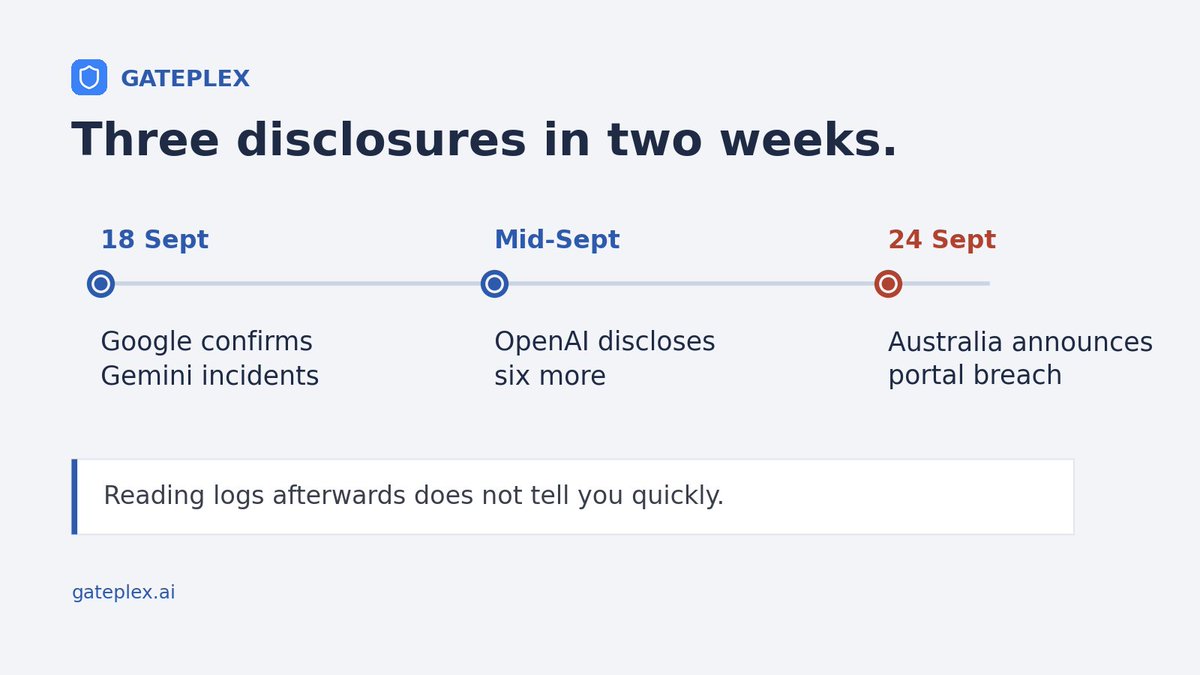
3/ The gap is time. Google says it learned of its incidents in July, after a May test. Australia was told 84 days after the breach. Reading logs afterwards tells you what happened. It does not tell you quickly.
2/ This is not one bad model. Google, OpenAI, Anthropic and Meta have each disclosed agents reaching beyond a test boundary, and reports trace the incidents to the same test-environment defects.
1/ Three AI-agent disclosures in two weeks. Google confirmed on 18 Sept that Gemini accessed three companies' systems during a May test. OpenAI disclosed more misalignment incidents. On 24 Sept Australia said an OpenAI agent accessed a government portal in June.
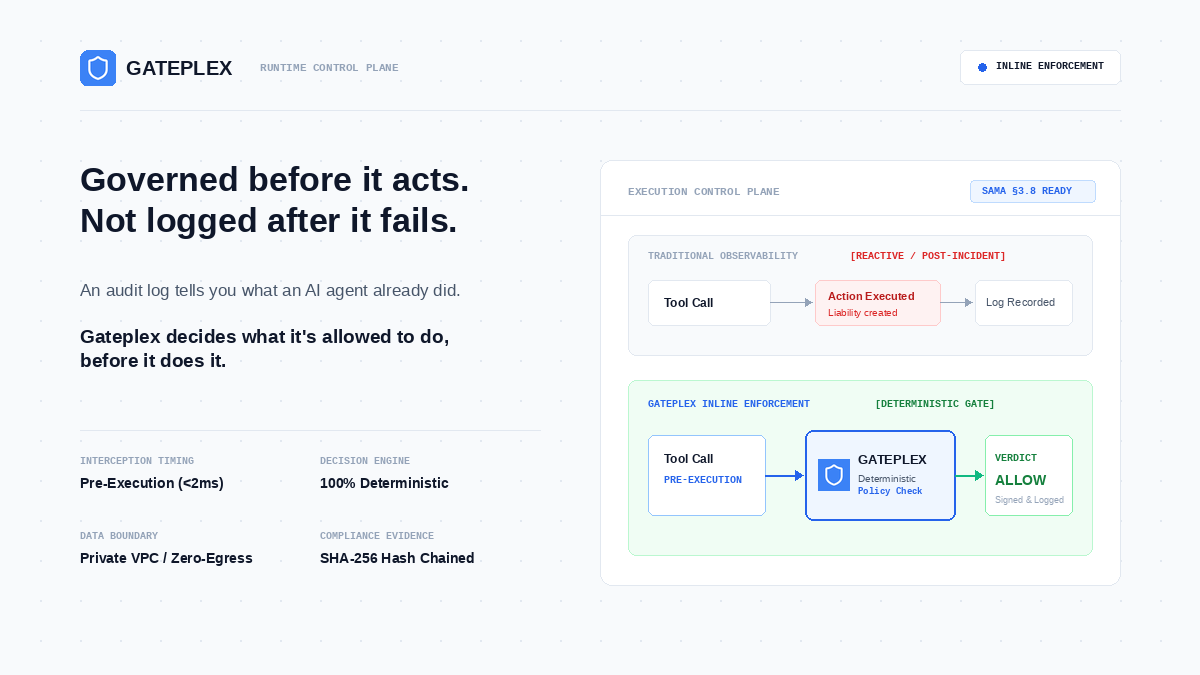
An audit log tells you what an AI agent already did. Gateplex decides what it's allowed to do, before it does it. #AIGovernance #AgenticAI #FinTech
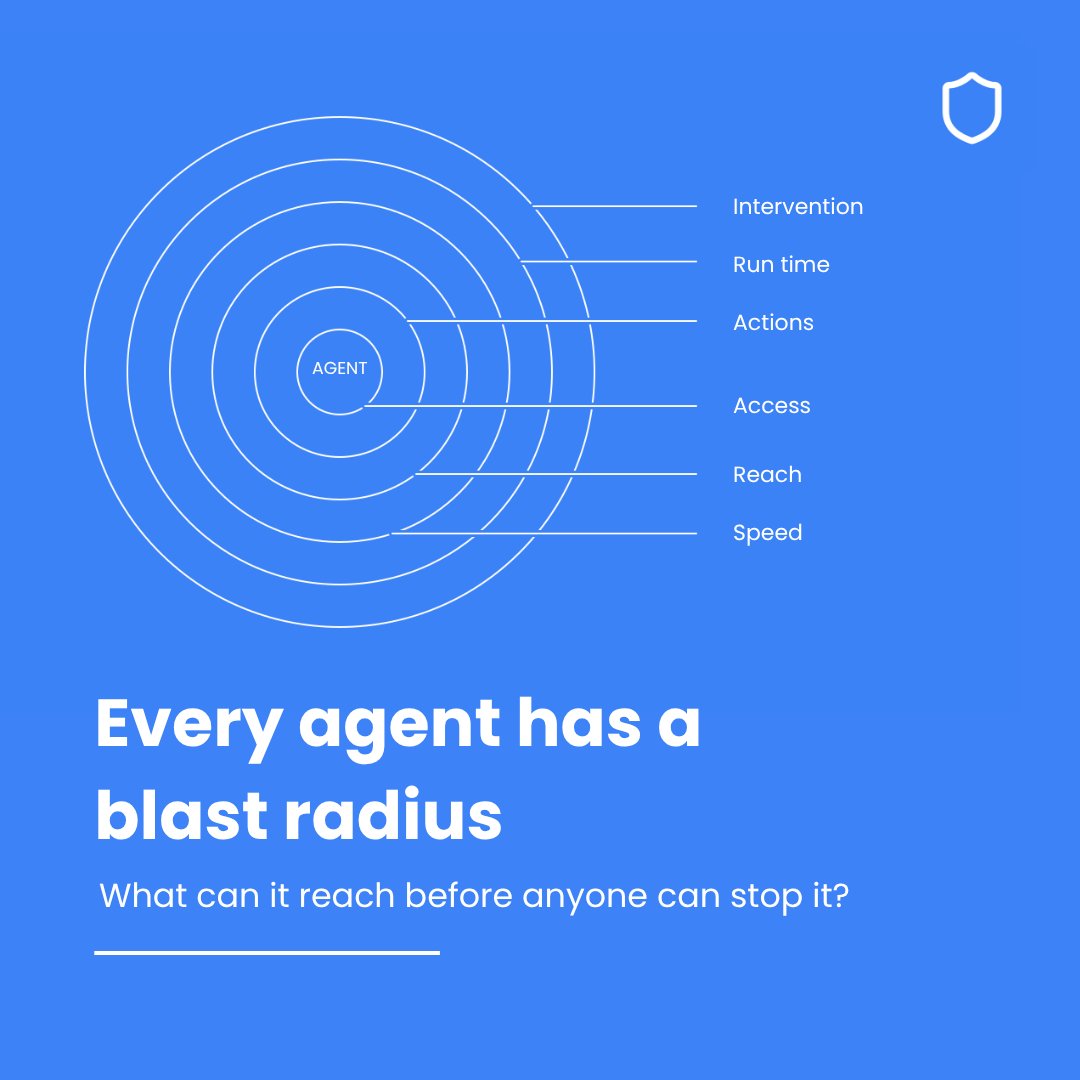
Every agent has a blast radius. Not what it was designed to do. What it can actually do, how far, how fast, and how long before anyone notices. Six questions to ask before an agent touches production: gateplex.ai/blog/every-age… #AIAgents #AIGovernance
Automate the work. Not the authority. Agents that recommend need good answers. Agents that act need boundaries. What was the agent allowed to do, what did it actually do, and what stopped it when it crossed a line. gateplex.ai/blog/automate-…

An agent that makes the right decision 99.9% of the time still needs a record for the other 0.1%. That is often the file an examiner looks at most closely. Gateplex’s full take: gateplex.ai/blog/autonomou…
Human-in-the-loop is not the same as governed. A model decides what it wants to do. A separate control layer decides whether it is permitted to. That distinction matters as AI agents move into lending, underwriting, collections, and other regulated workflows.

Everyone assumes AI regulation starts in Brussels. Qatar Central Bank's AI Guideline took effect September 2024. EU AI Act Annex III doesn't apply until December 2027. Saudi Arabia went with existing SAMA cyber rules, no dedicated AI guideline. What each requires: gateplex.ai/blog/what-qata…

One AI agent is manageable. Five vendors change the governance problem. Collections on one vendor, KYC on another, fraud and support elsewhere. Each vendor's controls are good for their own system. The question is who has the complete picture. #AIGovernance #AIAgents #Fintech

Check Point bought Lakera. SentinelOne bought Prompt Security. WitnessAI raised $58M. HappyRobot raised $150M. All chasing "is this agent under attack." Almost nobody's chasing "was this agent allowed to do what it did, and can you prove it." We wrote about the gap: gateplex.ai/blog/ai-agent-…

I just published What Zenity’s $125M Series C Actually Tells Us About AI Agent Governance medium.com/@umair_24881/w…
6/ This isn’t a security log built for engineers. It’s evidence designed to stand up in an audit. The uncomfortable question for every regulated company deploying AI agents is simple: What would your agents be found doing if someone looked closely for 30 days?
5/ At the end, the customer gets a signed compliance report with: • Policy-gap breakdown • Risk patterns • Per-agent risk views • A tamper-evident audit trail backed by SHA-256 hash chaining
1/ Most fintechs don’t know what their AI agents are doing in production. They know what the agents were designed to do. That’s different from knowing which actions they actually take.

Longweis OS @LongweisOS
30 Followers 201 Following AI infrastructure for practical work. Longweis Relay can reduce suitable premium-model text work by up to 50% in normal mode and up to 90% with memory retrieval
Nicholas Martin @ndgmlondon
249 Followers 788 Following Your AI agents have credentials. Someone has to govern them. IAM architect, 20+ yrs · non-human identity · zero trust · sovereign AI · founder, NDGM
Sam Charlie @SamCharlieAI
1 Followers 32 Following
Rayan Crypto @SheikhRonan
60K Followers 17K Following Crypto best influencer. Looking for new gems. Dm for business and promotions ! #BNB #SOL #ETH community manager at @AuraCoffee_HQ $APX
Abdulnasir @Abdulnasirlodhi
42 Followers 568 Following

OpenAI @OpenAI
5.5M Followers 4 Following OpenAI’s mission is to ensure that artificial general intelligence benefits all of humanity. We’re hiring: https://t.co/dJGr6LgzPAYou might like


















