Marcus Aurelius @MarcusAureMath
Joined October 2026-
Tweets5
-
Followers0
-
Following29
-
Likes6

@thomasfbloom I'm not a mathematician but I read the proof of the Haldane gap, a famous problem in mathematical quantum many-body theory. There is an interesting new idea (or "trick") that I have not seen before, followed by a huge, almost brute-force calculation.
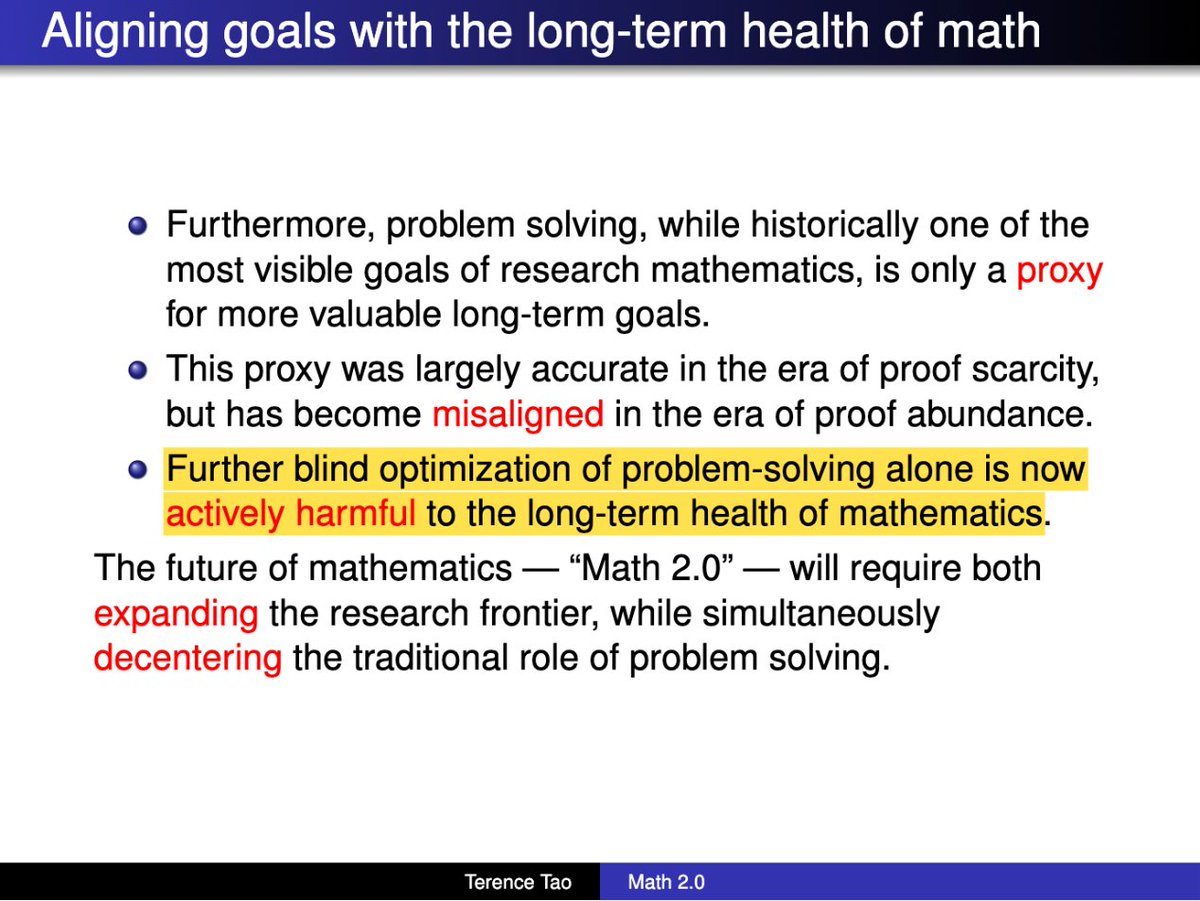
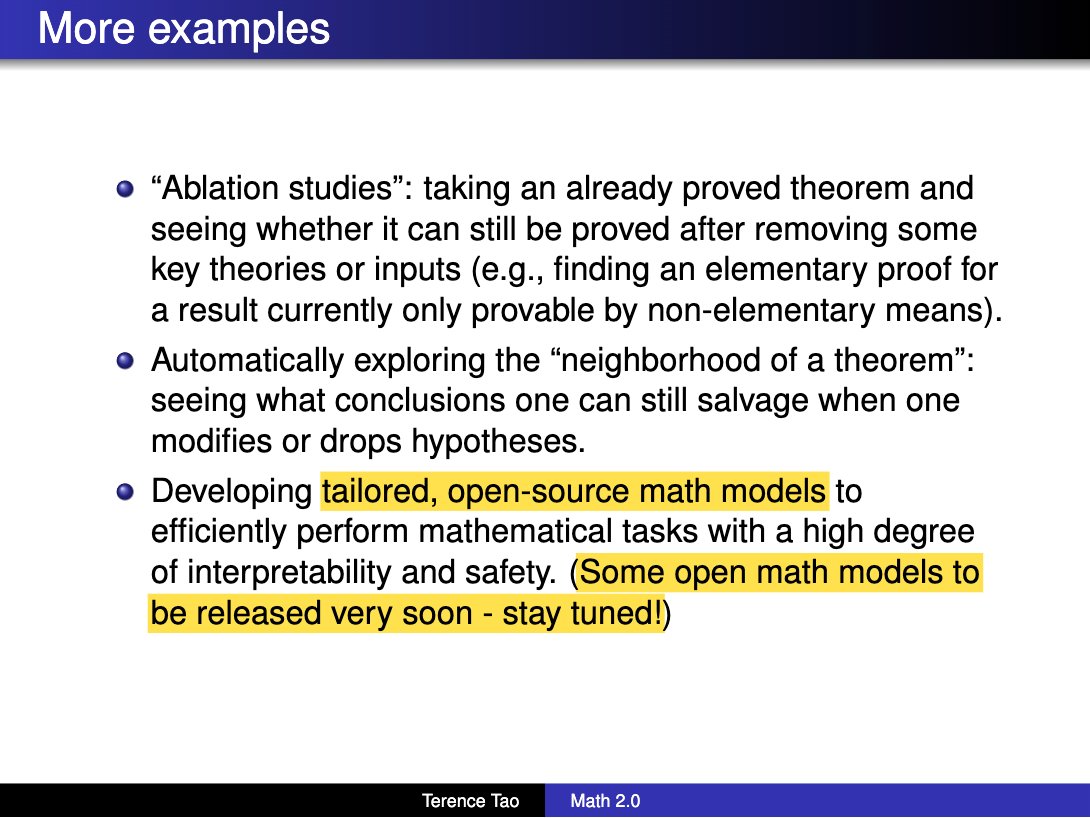
Terence Tao just published a 27-slide deck on what AI is doing to mathematics >Tao: math was built on proofs being scarce, and that era is over >verdict: “we are now entering an era of proof abundance in mathematics” >with enough compute AI can solve many open problems with no expertise required >the field’s entire incentive structure was built for proof scarcity >problem-solving was only ever a proxy for deeper goals >that structure is now "misaligned" >“blind optimization of problem-solving alone is now actively harmful” >problems are lighthouses, not destinations >reaching them prematurely with AI “sterilizes the surrounding field” >calls AI math hype the WWII survivorship-bias plane >“Wow, all the math problems I am seeing on social media are being solved by AI!” >labels the red dots as the failures you don’t see >“Unreported failed AI attempts” >then drops a thought experiment: >prompt AI to "find a cancer cure that passes a stage 3 clinical trial" >prediction "confirmed in Lean" and passes the trial >everyone celebrates >"nobody truly knows how this cocktail was found" >Tao asks the real question: >did the AI cure cancer, or did it mathematically game flaws in the trial protocol? >”before injecting this cocktail into your bloodstream, would you want to know that there is at least one human cancer expert who understands the mechanism behind this cure?” >solution: “tailored, open-source math models” built for “interpretability and safety” >“open math models to be released very soon - stay tuned!” Math 2.0 is officially happening


I think of my goal as a mathematician as something like: to better understand the fundamental concepts “shape” and “number,” and to convey that understanding to others. I think this is a valuable goal for many reasons. The primary reason discussed on social media is the (admittedly slow, but I think very real) diffusion of mathematical ideas into technologies that better our lives. There are others, though: production of human capital (which plays some role in this diffusion), and diffusion of mathematical understanding into culture, for example. It is not obvious to me that even the bare technological need for mathematics can be filled without human experts; this seems to me to be a tricky question of institutional design. For me the most compelling reason is simply that we feel a pressing need to understand. While deep understanding is largely limited to professional mathematicians, the existence of mathematicians and of the institutions they make up is a huge part of what makes mathematical understanding available to those who want it. I believe that the capacity to understand mathematics (and the universe as a whole) is part of a good life, and we should try to provide people with a good life. We operationalize the goal of understanding in a number of ways, problem-solving and theorem-proving among them. My own research is oriented around certain open questions that I believe measure our lack of understanding (of numbers, shapes and so on), and I think resolving those is genuinely important. I would welcome a solution with any provenance. But I think proof is only a measure of progress—what actually matters (for technology, human capital, culture, a good life) is a bit harder to get at. Crucially it is very hard to measure progress—plausibly theorem-proving is used in large part because it is easy to measure rather than because it is a perfect proxy for what we care about. I worry a bit that we may automate many easy-to-measure things without automating the correlates we care about for which they are proxies. This presents a clear problem for the design of institutions aimed at achieving progress. In part because I think problem-solving is a proxy for something else, I don’t feel that my goal of understanding “shape” and “number” is particularly threatened by a machine that is good at problem solving. I expect that machine to be a substantial boon, instead. Ultimately I think we will operationalize mathematical progress in better ways. But how to do this is a difficult question and I think many on here are too quick to dismiss concerns about it.
It's somewhat under-discussed *why* OpenAI released only around ~400 math results. The purpose of this exercise was not to "destroy math research" (or whatever it is that some people want you to believe). OpenAI just wanted to test its internal model on some hard math, and it turned out that anything less than the hardest open problems no longer suffices for this purpose. This is why all non-Millennium-Prize solutions were reached in a single-agent setting after 3 hours of thinking: OpenAI was literally just testing its model on these questions, similarly to how I run prinzbench. Once OpenAI had the solutions (which were a side effect of sorts of benchmarking its model), a question arose as to what exactly should be done with these solutions, which are genuine advances in the field of mathematics. OpenAI - correctly - decided to make them public. It seems clear that many other problems in the set of ~4,000 are very likely solvable by this model with more compute than just ~3 hours of Pro-level thinking. Whenever a more powerful checkpoint of this model is ready to be tested, OpenAI will likely have even more to share.
Most of the recent math results were not reached by a swarm, the way Navier–Stokes was. I think that part got lost in the excitement around the release. OpenAI's unnamed internal model, which I'm going to call Aeon, reached most of them in one shot, from a single prompt, with no

"Two thousand years have not written a wrinkle on either of them." Thus spoke Hardy of Euclid's two most elegant proofs: the irrationality of the square root of 2, and the infinitude of primes. Who was Euclid? We know almost nothing about him. That doesn't diminish our appreciation of his work. It doesn't matter whether he even existed. The proofs are real. Like Hardy, I admire the combination of unexpectedness, inevitability and economy in the two proofs above: extraordinarily simple arguments yielding profound and inescapable conclusions. Our wonder at these proofs have nothing to do with who birthed them. Number theory — the queen of mathematics — has progressed a long way since Euclid. Yet many number theorists were increasingly feeling that the field had not moved as much as they would have liked since the 70s, when Langlands, Deligne and others shook it up. Yes, theorems are proved every year, research programmes grind on. But we seemed to be stuck against some fundamental obstacles. Our best efforts could only establish a zero-free region for the Riemann zeta function that became thinner and thinner as one went higher, an infinite wedge rather than a strip. We have no idea how to prove Ramanujan or functoriality in general. The sense of wonder was replaced by grind and incremental work, the breakthroughs remained elusive. Two days ago, an alien arrived and bombarded the landscape, clearing away decades of cobwebs. Instead of a zero free wedge, we suddenly have an actual strip all the way up. We suddenly know that the irrationality exponent of pi is 2. These are shock breakthroughs. They come along once a generation. But there are so many more. Theorems people have been struggling with all their lives, proved in an instant. Some 370 problems, each with its own rich history, suddenly annihilated in a day. If your reaction to this is "AI slopdrop" or "why should I look at these terribly written proofs" (yes, they are terribly written), then you are not in it for the mathematics, but for something else. Because if mathematics is what you care about, then when a machine god comes along and hands you a solution to a problem you have spent your life struggling with, a solution you thought impossible, you fucking do everything you can to understand how it was done, however badly the proof is written. But if the extraordinary event that has occurred has made you feel like a kid again, full of wonder at the new landscape suddenly opened up by this astonishing bombardment, welcome to the future. Mathematics needs you and you are prepared.
Because Fermat was an amazing tale of human striving not an AI slopdrop produced as a side effect of a massive firm gearing up for an IPO. The stories will come—and I guess they’ll be about the reaction from human mathematicians.
Fabien @Fabien_Mikol
9K Followers 1K Following Incapable de rester dans son domaine 🤷♂️ - Geoffrey Hinton : "We need to think hard about what's going to happen next, and we just don't know"

Jared Duker Lichtman @jdlichtman
23K Followers 0 Following szegő assistant professor of mathematics @Stanford
prof-g @prof_g
24K Followers 2K Following Robert Ghrist = mathematician; engineer; educator; assoc. dean of undergraduate education Penn Engineering; illustrator; animator; acta non verba
Almost Sure @Almost_Sure
9K Followers 274 Following George Lowther, Author of Almost Sure blog, on maths, probability and stochastic calculus. Also on YouTube https://t.co/VyOijwbe9l
Hk-Shrektifiable @Shrektifiable
978 Followers 305 Following math po(a)stdoc doing math poorly and being a general catastrophe. my psyche evidently lacks unique tangent cones
Christian Szegedy @ChrSzegedy
47K Followers 3K Following #deeplearning, #ai research scientist. Opinions are mine.
Timothy Nguyen @IAmTimNguyen
12K Followers 477 Following Machine learning researcher at @GoogleDeepMind & mathematician. Host of The Cartesian Cafe podcast. All opinions are my own.
J-P @jpburelle
217 Followers 494 Following Professeur de mathématiques à @USherbrooke. Géométrie/dynamique.
Andrew Curran @AndrewCurran_
106K Followers 20K Following 🏰 - I write about AI, mostly. Expect some strange sights.
Ananyo Bhattacharya @Ananyo
17K Followers 7K Following Chief science writer @London_Inst. 'The Man from the Future', on the unparalleled influence of John von Neumann, available everywhere. For my substack see link.
Abhishek Saha @ObhishekSaha
4K Followers 717 Following Professor of maths @QMUL • founder member @lucaf_london, advisory board @ComAcFreedom, co-convenor @AFAF_QMUL • individual liberty, self-ownership • views mine.
Linus Mixson @LinusMixson
1K Followers 391 Following Former gifted kid with ADHD, autism, low IQ, diminished penile volume, erectile dysfunction, body odor.
😡fermion, PhD @angryfermion
39K Followers 499 Following making AI slop @meta (former physicist (derogatory))
Timothy Gowers @wtgow... @wtgowers
60K Followers 194 Following Mathematician. Professeur titulaire de la chaire Combinatoire au Collège de France. Also fellow of Trinity College Cambridge.
Analysis Fact @AnalysisFact
135K Followers 19 Following Daily tweets about real and complex analysis and related topics. From @JohnDCook.
Joel David Hamkins @JDHamkins
30K Followers 285 Following Mathematics and philosophy of the infinite. Professor of Logic @NotreDame @UniofOxford #ProofandtheArt #PhilMaths #InfinitelyMore #BookOfInfinity
Steven Strogatz @stevenstrogatz
196K Followers 3K Following Mathematician, writer, Cornell professor. All cards on the table, face up, all the time.
Algebra Etc. @AlgebraFact
195K Followers 19 Following Tweets about algebra, number theory, and miscellaneous math by @JohnDCook.
Martin Bauer @martinmbauer
107K Followers 1K Following Working on particle physics, quantum sensors, dark matter. Associate Prof at @IPPP_Durham @durham_uni, FLF @UKRI_News, Science board member @STFC_Matters
Some theorems @CihanPostsThms
31K Followers 6 Following Posting some theorems, and occasionally other stuff. By @bahran_cihan
the finite physicist @FinitePhysicist
69K Followers 358 Following theoretical particle physics & phenomenology || don't sleep through dreams that can come true
Jay Cummings @LongFormMath
52K Followers 606 Following Math prof. Author of long-form textbooks on proofs (https://t.co/YqXnxDmOe0), real analysis (https://t.co/3IGQ6BIx5Z) & math history (https://t.co/KkXMGTxCDK).
Daniel Litt @littmath
64K Followers 946 Following Assistant professor (of mathematics) at the University of Toronto, visiting Harvard Fall 2026. Forever confused. Algebraic geometry, number theory, etc. He/him.
The Math Flow @TheMathFlow
88K Followers 52 Following Mathematics insights presented through animations, formulas, pictures, graphics, quotes, books, history, and memes. Open DM.Trends for United States
You might like