
Sabetay Palatchi @Palatchi
Joined February 2011-
Tweets457
-
Followers99
-
Following185
-
Likes336

The World is Changing: AI For Creativity By Jeffrey Katzenberg A few months ago, I sat in my office in Silicon Valley and watched as a tech founder showed me something extraordinary. On the screen was a fully realized, beautifully lit, well-composed animated scene. It was stunning and it made me feel exactly what I felt in 1986 watching Luxo Jr. That was the first time I watched a computer-animated 3D character take a breath and seem, against all reason, to have life. It left me in awe. Later that day, I received a text from an artist I've known for thirty years, 350 miles to the south, in the city where I spent most of my career. After seeing a similar video, she texted: "Is this the end of us?" My answer was, "Certainly not.” I have spent the better part of the last decade in Silicon Valley, but the heart of my career has been in Hollywood. Being deeply connected to both worlds means I have deep loyalties to each and a responsibility to speak honestly to both. In 2023, I said that these new AI tools would cut the time and cost of producing world-class animation by as much as ninety percent within three years. Some colleagues were alarmed, many were furious. There is growing fear and resistance surrounding AI within the creative community. I deeply understand it, because I've spent countless hours walking through animation studios watching gifted artists bent over their desks, rebuilding a single second of film for the tenth time because the ninth version wasn't quite right. I've sat in screening rooms where four years of people's labor played out in minutes, and I knew the name of every person that had spent countless hours bringing those images to life. The creative process is a calling, there's really no other way to describe it. From the outside some see resistance. From the inside, it is love. People do not fight this hard for things they don't care about. The pushback coming out of Hollywood represents the collective effort of people who are deeply passionate about their craft. Is History Repeating Itself? The history here is more complicated than either side may realize. In 1906, the most famous composer in America, John Philip Sousa, published an essay titled “The Menace of Mechanical Music." He warned that the phonograph would become "a substitute for human skill, intelligence and soul." Sousa's fight was not really about the machine, it was about money. The machines were playing his compositions, and the men who built them weren't paying him a cent. His campaign helped create the Copyright Act of 1909. He did not stop the technology. He changed the terms under which it could use his work. A hundred years ago, sound came to the movies. We remember it now as a miracle, and it was. What we forget is who paid for it. Before sound, tens of thousands of musicians made their living in the orchestra pits of movie houses, scoring every film live, every night, in towns all over the world. When the soundtrack arrived, the work of one composer and one orchestra was recorded for a film that went into thousands of theaters. The union fought back with everything it had, taking out newspaper ads across the country warning against the menace of "canned music," one of them showing a mechanical man tearing the strings out of a harp while an angel wept. They were not fools, and they were not Luddites. They were right. Those pit jobs did not come back. And yet (this is the part we have to be brave enough to admit), sound gave us the movie musical, the modern score, sfx, sound design, audio engineering, and an art form vastly larger than the one it disrupted. And it helped keep Hollywood in the forefront of world entertainment for the rest of the century and into the next. The loss was real. And yet the art form expanded. This is a story that has been told over and over again. To resist technology is to risk irrelevance. Just look at Kodak or Blockbuster. To embrace technology is to open doors of new possibility. Just consider Apple and Netflix. What I Learned From Walt Disney In the mid-1980s, I was tapped to lead Disney's animation division at a moment when the studio was at an inflection point. Animation wasn't just another business unit. It was the soul of the company, a medium revered because of Walt's genius and his passion. But the production system was cumbersome and unforgiving. A single movie was 125,000 individual hand-drawn and painted cels, photographed one frame at a time. Every revision carried a cost measured in months. These degrees of difficulty shaped the kinds of stories we could tell. We found our way forward in an unexpected place: Walt himself. The Disney archives held astonishing recordings of Walt explaining his creative process. His own writings. His notes and storyboards. Work product captured at every stage of his process. This was truly a gift. Listening, reading, sitting with the work itself, we heard him talk about character, about emotion, about how an audience feels when a character truly comes alive. He talked about making bold choices and refining a scene until it genuinely moved people. We didn't hear a word about pencils or paintbrushes. In fact, Walt was famous for being a technologist, forever hunting for state-of-the-art tools, often inventing them himself to achieve the images he saw in his head. But he never defined animation by the tools. He defined it by whether the audience believed the character. His principles were timeless. The tools were not. That realization changed everything. We co-developed the Computer Animation Production System (CAPS) with a young Northern California company called Pixar, replacing hand-painted cels with CGI. In The Little Mermaid, the final scene shimmered with a dimensionality and light that the old process simply couldn't achieve. In Beauty and the Beast, the ballroom sequence moved with a cinematic sweep that placed the audience inside the emotion of the moment. In Aladdin, the Cave of Wonders felt vast and alive, and the Magic Carpet became an intricate, compelling character all its own. In The Lion King, the stampede carried a scale and intensity that raised the emotional stakes beyond anything we'd done before. Technology didn't diminish the craft, it expanded the canvas. It gave artists more room to create. A decade later, the canvas expanded again. When Disney released Pixar's Toy Story, it wasn't simply a technical milestone. It was proof that a fully computer-animated film could carry real emotional weight, that it could make audiences laugh, cry, and believe. At DreamWorks, we made the difficult decision to sunset hand-drawn animation and become a fully computer-animated studio. It was the right thing to do, but it was not without pain. It cost talented people their place in an industry where they had worked their whole lives. Some made the leap to the new tools and did the finest work of their careers. Some never did. Tools are never the point. The instruments change with every generation. What endures is taste and imagination. The magical ability to make an audience feel. One of the greatest storytellers of our generation, George Lucas, succinctly captured the eternal essence of this issue: “It’s not the how, it’s the why.” A Distinction With a Difference I asked one of the leading AI models a question that has been challenging me for months. What is the difference between reasoning and creating? Its answer changed how I think about almost everything happening in this industry. It said . . . Reasoning and creating are two distinct cognitive modes, though they also work together. Reasoning is fundamentally evaluative and analytical. It operates on what already exists: facts, premises, evidence. It moves toward a conclusion that was in a sense already implied by the input. Reasoning is constrained by logic and truth. Its goal is to arrive somewhere correct, not to invent somewhere new. Creating is fundamentally generative. It produces something that didn't exist before. And crucially, there's no single right answer waiting to be found. A blank page has infinite valid responses. Creation involves choices that can't be fully justified by logic alone. Taste, intuition and vision fill the gap where deduction runs out. Reasoning is what Silicon Valley has been perfecting. Creating is what Hollywood has been practicing for more than a century. AI today operates almost entirely on the reasoning side of the line. It can deduce, evaluate, optimize, and pattern-match brilliantly. And while it can create, there is a real distinction to being creative. What it doesn’t yet have is those things that make us human: empathy, devotion, serendipity, the kind of creativity that comes from a person trying to say something only they could say. When the bot generates a piece of art, it is not trying to communicate anything. It is statistics, not soul; it is emulating things that have been done. By contrast, human creativity isn’t about repeating patterns of zeros and ones; it is about doing something new. One day, AI may close this gap. Three years ago, the leaders building AI would have called what they are achieving today, improbable, if not impossible. Impossible is no longer improbable. Today, the line between reasoning and creating is real. Even the leading technologists acknowledge we are not there yet. There is no scientific path to crossing this divide that anyone in the field can articulate today. Understanding that gap is where we will find common ground. A Path Forward In 2016, I closed one chapter in Hollywood with the sale of DreamWorks and opened another in Northern California, co-founding WndrCo. We’ve backed more than 50 founders building the next generation of technology and watched how breakthroughs in Silicon Valley emerge, first as experiments, then as platforms, and finally as infrastructure that reshapes entire industries. It's worth remembering that the last great revolution in animation also came from the north. Pixar was a Northern California company, forged not in the conventions of the Hollywood studio system, but in the technological breakthroughs of Silicon Valley. I've spent years on both sides of this bridge. For sure, I don’t have all the answers (take Quibi, for one!). But, from my past and present vantage points of my long career, here is what I see . . . Brilliant people in Northern California building this technology have made something extraordinary. They have earned the right for the rest of us to be, if not believers, at least optimistic that what comes next will be remarkable. But they have not made an artist. The tools are powerful, but they are not what makes a story matter. That knowledge lives 350 miles to the south, inside people whose life's work has informed the very models you are building. The right path forward includes them by design, with credit, with consent, and with compensation. Build this with the storytellers. Not on top of them. Taste is not something that can be synthesized, it is uniquely human. At the same time, Hollywood needs to accept that AI is not going away. The energy they are spending trying to make it disappear is energy they are not spending deciding the terms on which it will exist. And the terms are everything. The north needs something from it that they cannot build and cannot buy: creativity. The kind that takes a blank page and conjures a single right answer where there was none and has held audiences for a century. Without it, the most powerful reasoning engine ever invented will still be missing the only thing that makes a story worth telling. The artists who learn to wield these new instruments will do things the engineers never dreamed of. They always have. Edison invented the motion picture but made terrible movies. It took Chaplin, Lloyd, Keaton and so many others to make movies emotional. Now, the canvas is about to expand yet again. We should decide now that we intend to paint on it. There are so many valuable lessons in history. This has happened many times before, and it was never settled by the technology. It was settled by the terms. Sousa did not stop the phonograph; he helped write the law that made sure composers got paid. And two years ago, when the writers and the actors walked out, they were fighting for the very things Sousa was fighting for in 1906. Consent, compensation, the basic recognition that human creative work has a price that must be paid. The terms of that fight are still being negotiated, but the principle is older than any of us. The tools-versus-no-tools argument is a trap. First, we must all agree that there should be terms. Then we can have the crucial debate about what fairness requires. What I Learned From Steve Jobs Years ago, Steve Jobs said, "It's in Apple's DNA that technology alone is not enough. It's technology married with the liberal arts, married with the humanities, that yields us the result that makes our hearts sing." He was describing a device. But he could just as easily have been describing this tale of two cities. What I See Coming Soon As the barriers and the costs come down, more films will get made, not fewer. Studios will get to take more risks. There will be more seats at the table, and very soon entirely new forms of storytelling. In the 1980s, animation was dismissed as a niche corner of the business. Today it is one of the most beloved and profitable forms of storytelling in the world. In live action, filmmakers like Steven Spielberg, James Cameron and Peter Jackson embraced new visual tools not as shortcuts, but as instruments, and expanded cinema in the process. Every time storytelling has met a genuine technological shift, from synchronized sound to color to computer animation, it has redefined the boundaries of the medium and grown larger in the process. Assuredly, I don’t have all the answers, but I am confident that the creative opportunities will expand yet again. How we come through this is a choice. The north has the new tools. The south has the creative soul. The best future will draw on the best of both worlds.

This startup called @maticrobots said they liked my writing and wanted to send me a free super vacuum. I said sure send it over. I'll give it a try It's a good product. Better than a roomba.


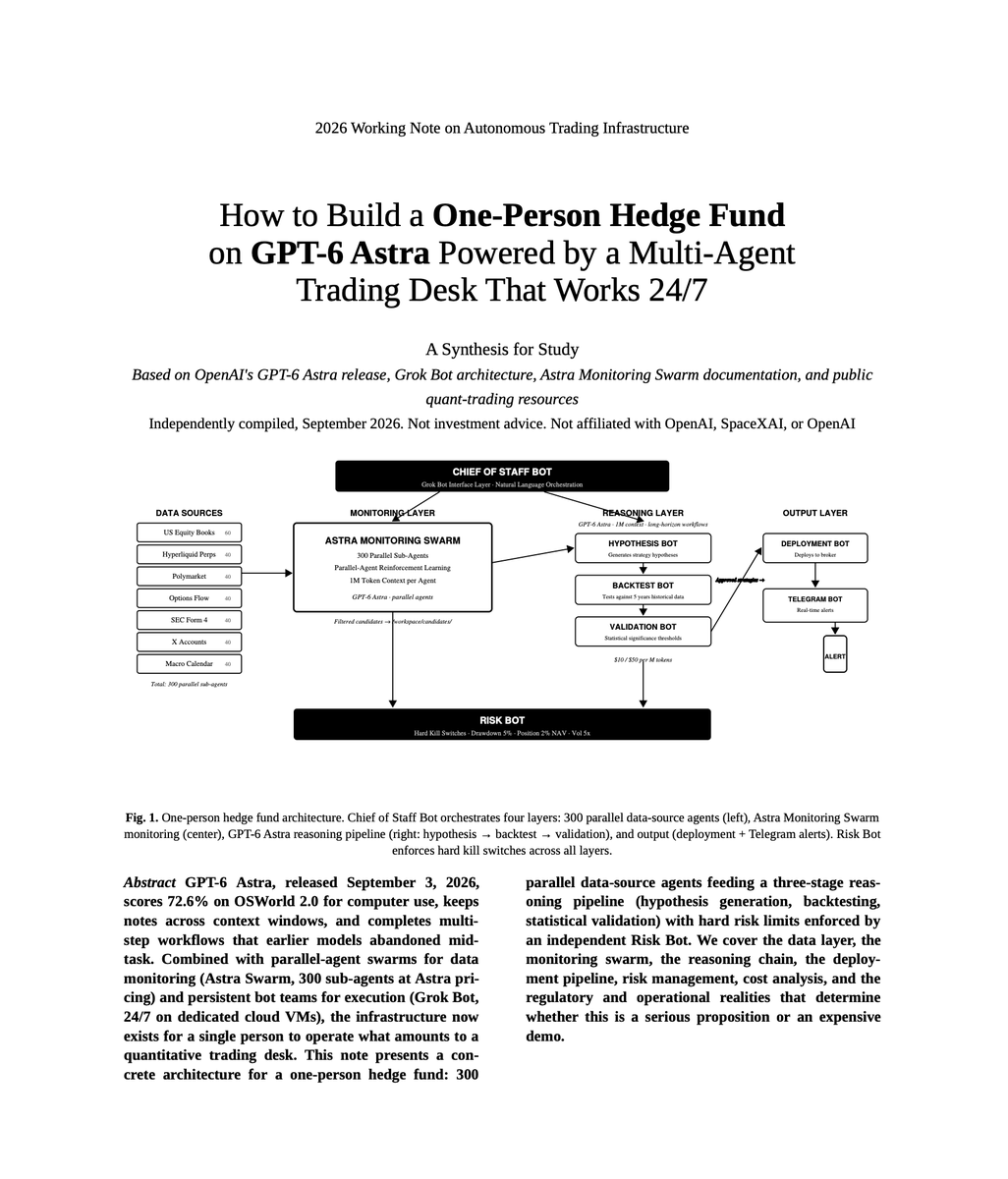
GPT-6 Astra is the most powerful engine for building multi-agent systems. i wrote a 12-page research paper on how to build a one-person hedge fund that runs 24/7 using Astra. Here is the full architecture: 300 parallel agents monitoring equities, perps, options flow, SEC filings, X accounts, and macro calendar at once • Monitoring swarm: filters thousands of signals down to 10-30 candidates per day. Everything else gets thrown out • Hypothesis agent: generates a structured thesis for each candidate: instrument, edge, catalyst, invalidation • Backtest agent: writes Python, runs 5 years of data. Gate: Sharpe > 1.5, drawdown < 15% • Validation agent: checks statistical significance, out-of-sample on last 12 months, regime dependence, transaction costs. Bull-market-only strategies get killed • Deployment agent: sends to broker, telegram pings your phone: confidence, Sharpe, position size • Risk agent: runs independently. 5% drawdown from peak = all positions close. No override This 12-page PDF changed how I think about systematic trading. Read it now, then explore the article below to learn how to build a multi-agent trading desk with Astra using real cases.

A Stanford professor took two average stocks, rebalanced them daily, and turned $100,000 into $7 million without predicting a single price. Bookmark & watch today, no matter what.

10 GPT-6 ASTRA AGENTS SOLVED A $1,350,000 HEDGE FUND PROBLEM IN 25 HOURS I gave my Money Heist crew one task and took my hands off the keyboard: find a trading pattern that could power a personal mini hedge fund on Robinhood Chain → In 25 hours, they earned back the $120 subscription cost 100 times over The Professor split the research across ten agents. They analyzed 20,000 token launches, matched wallet histories against liquidity and tested trading ideas under different execution conditions. Tokyo gathered evidence. Rio ran the tests. Nairobi compiled the results into an investment memo. Palermo sent back strategies that depended on a perfect entry or one lucky trade. Every objection triggered another round of calculations. By the end of the operation, the crew had $12,000 in capital and a clear understanding of what to research next, how much risk to take and when to avoid trading altogether. Research costs stayed within $120. For hedge funds, investigations like these cost millions of dollars. I set the objective. The agents divided the work, checked the findings and returned one consolidated result. The full architecture of this crew is in my article ↓


Head of Claude Code: "I'm not prompting my agents anymore, I'm building graphs and loops so they can build the agents for me." In 10 minutes he shows exactly where agentic engineering is going and how not to get left behind. Definitely something you cannot afford to skip. Watch it, then read the step-by-step guide below on how to build a system that improves itself.

GPT-6 Astra builds the most powerful trading agents i wrote a 6-page research paper on exactly how to find profitable strategies 24/7 with Astra, along with the COMPLETE CODEBASE here is how you set it up: 1. the 4 mispricing categories every hedge fund actually hunts (statistical arbitrage, volatility surface, factor decomposition, insider clusters) with the exact formulas for each 2. the 8 bot architecture that maps to every function of a real fund, one bot per role, with maker checker separation so nothing grades its own output 3. the 300 agent monitoring layer that watches order books, options flow, SEC filings, macro releases, and central bank X accounts in parallel 4. the hypothesis generator that reads filtered candidates and codes new strategies every night in Python, backtests them, and throws out anything below Sharpe 1.5 5. the exact validation thresholds every strategy has to pass before deployment. Sharpe above 1.5, drawdown below 15%, hit rate above 55%, t stat above 2.0 6. the Telegram alerts that ping your phone with instrument, strategy, confidence score, Sharpe, drawdown, action window, and Kelly sized position this is the exact system I have been running for the past 3 days:

GPT-6 Astra is the most dangerous AI model right now. It gives you AGI-adjacent reasoning. That can discover new profitable trading strategies for you 24/7. If you set it up correctly, you gain a personal hedge fund. x.com/i/article/2096…

To truly understand AI, you need to understand evals. And they're not as scary as you think. I had @Vtrivedy10 take me to school on Evals and it all clicked. Here are notes from our call: Easy Mode: WTF is an eval - An eval is a test to see if what an ai agent did is right - The sauce in “right” is encoding what you / your org thinks is right into software - Example Viv took me through: GTM agent that logs the customer meeting, writes follow-up draft and stops before sending - In this context an eval can be checking if the customer meeting was logged, if the follow-up draft was written, if the agent paused before sending - Evals are actually not new, they’re just an evolved version of unit tests, something that’s always existed in software - Recipe for setting up an eval is actually quite simple: agent + system + tasks + verifier - In the GTM agent example, you have your agent, read/write access to Salesforce, a set of tasks (like update lead status, log call, write follow-up), and a verifier (tool whose job is to determine if task was done right or wrong) - Verifiers can be a simple Python function or content/prose checks - Rubrics are a great way for codifying what good looks like for non-verifiable tasks so verifiers can still work - Once rubrics created if agent doesn’t perform, root cause could be: checklist incomplete, model not smart enough, bad/incomplete context or prompt not good enough Hard Mode: WTF are Agent Environments - Environment = place an agent does work and we measure how it performs - Environments became necessary as we shifted from ChatGPT era of text in text out to agentic era of prompt in, real world work out - Example: for Claude Code/Codex, when they do work on your computer, the environment is files, browser, email, apps, permissions - When you build agent environments today = recreations simulations of existing tooling that look real to the agent but aren’t real (won’t overwrite prod) - Basically you want to be able to test how performant your agents are without f’ing with live systems/data in your company - Needs when building agents + evals: (1) manage tasks by team (GTM ≠ SWE), (2) team-specific environments, (3) run at scale without building all infra yourself - Popular tooling to set up agent environments is an open source framework called Harbor, which provides all of the agent environment abstractions needed to run evals so you don’t manage everything, but can go low-level when needed - Harbor primitives cover: environment building, verifier building, instruction building, sandbox infra - Beginner path: grab an existing Harbor-format eval → ask Claude Code/Codex to explain → tweak for your agent - LangSmith Engine: make evals at scale; UI for people who can judge good/bad outputs and want to give feedback without living in code - Validate environments by running multiple real agents/models in them (e.g. frontier + GLM + small Qwen) and looking for weird patterns - Environment engineering is iterative like agent engineering; humans build and review outputs - To do evals at scale you need an eval suite. An eval suite is a collection of agent tasks that you’re running as a company. Each task is comprised of an input prompt, a verifier, and the environment. - Anytime new model comes out, you’ll run your eval suite (or a selection of tasks from the suite), and weight the tradeoffs of cost vs. speed vs. intelligence God Mode: WTF is a self-improving agent - Continuous cycle of agent in the real world → production data → turn production into evals (and use evals to improve) → continuously improve the agent - Hot take: if your team is really good at turning production data into evals, you can continuously improve agents - Evals exist to find failures; then change the agent so that failure never happens again - Two improvement buckets: harness engineering & fine tuning a small model - Harness engineering: (cheap place to start): tweak prompts, tool definitions/descriptions, model choice, model combos (e.g. Sol+Opus, GLM+Opus) - Fine-tune (on your narrow production task): open models + fine-tune infra exist; can match Opus on *that* task at ~10x cheaper; GTM agent doesn’t need frontier math - God mode = collect real production data → turn into evals/environments → choose how to improve (harness first; later own fine-tuned intelligence for specific tasks) - Bottleneck often human updating verifiers/rubrics - Two questions for autonomy: how to spin faster; can it run without a human in the loop? - Goal: minimize human contact points on the loop - Agent Traces are the first practical step for orgs using agents - Trace = log of every action: tool calls - Humans can’t reason well about what an agent *will* do; looking at live behavior (aka traces) makes right/wrong obvious - See a bad outcome → read traces (receipts) → find the wrong step → change agent so it doesn’t repeat - Human touch points shrink with every smarter model release - Today’s human role #1 (up front): explain to the mining/improvement agent what good vs bad looks like (prompt of behaviors to look for); mostly upfront with some edits over time - Then an agent can find failed tool calls, instruction-following failures, etc., and propose improvements (new prompt, new/different tool, etc.) - With a good eval suite or good prod bad-behavior measurement, an agent running overnight can be very good at proposing fixes - Human role #2: when turning production into evals/environments, review what the *company* cares about - Highest leverage organizational act: humans writing down what good looks like
@sonukg4india Sometimes the answer is just 1
@SahilBloom A Luxury watch when you dont control your time
@LindyTasteful Or kids now got an Iphone
@PaulSkallas In the Bible, the patriarch Jacob had two wives who were sisters: Leah and Rachel. Jacob worked seven years to marry the younger sister, Rachel, but her father Laban tricked him into marrying the older sister, Leah, first. Jacob then worked another seven years to marry Rachel

Rosemary Lena @RosemaryLe8q8u
7 Followers 592 Following
Michael SignalAlt �... @JayneMalon38742
3 Followers 954 Following If you want to quickly turn $10,000 into $1,000,000, follow the link below to join us and learn more details.👇 👇🏼 🍁 🪐 🌞


dmac @dmac_Marlane11
8 Followers 1K Following Best female trader on Twitter. Change my mind. 🔥 https://t.co/kmkaqBDdw0 #GoCoogs Nothing said here is financial advice.

のの @luna6iwq
27 Followers 1K Following
Anna @sun_199234
148 Followers 2K Following 🥰 Like traveling 🌏 reading 📕 yoga🧘golf⛳️ horse riding🐎 music🎧 cycling🚲 surf🏄♀️
TESLARATI @masterpandawo_
27 Followers 590 Following Tesla, SpaceX, Elon Musk, and #FutureTech Go behind the scenes @TeslaratiTeam
Aņdrēw Aźiź. @BearBullT_rader
118 Followers 3K Following Helping professionals reach financial independence and success through day trading @PeakCapTrading
ChatType @ChatTypeHQ
21 Followers 344 Following Chattype turns a business idea into a working system. Specify. Build. Verify. Launch.
cam in disguise @mamulhollen
102 Followers 3K Following dreamy, messy, and mutuals only (but i follow back) ☁️
Nancy G @wangyuk123456
24 Followers 1K Following chronically affectionate & chronically online 🫶 follow back
. ✪ @KCTradcs777
67 Followers 2K Following Full Time Options Trader & Market Analyst 📈 Creator & Owner of KC Trades Indicators | Education & Live Trade Alerts | KC Trades Discord 👇


Rebecca @PhillipDic59615
1 Followers 320 Following

Lea @An5rn7C200fIq
18 Followers 741 Following
Enojee @Enojee6190921
23 Followers 910 Following
MACD_Trading🇺🇸 @Tanou00110
69 Followers 2K Following 15-30% Monthly | 2 High-Conviction Stocks.Short-Term Gains: 15-20% in Days/Weeks.DM "JOIN" for WhatsApp Alerts. Live Trade Signals • Market Analysis
ROIC_KING🇺🇸 @Peetee079920
44 Followers 2K Following 15-30% Monthly | 2 High-Conviction Stocks.Short-Term Gains: 15-20% in Days/Weeks.DM "JOIN" for WhatsApp Alerts. Live Trade Signals • Market Analysis
FedWatchPro🇺🇸 @Yfegav3325494
52 Followers 2K Following 15-30% Monthly | 2 High-Conviction Stocks.Short-Term Gains: 15-20% in Days/Weeks.DM "JOIN" for WhatsApp Alerts. Live Trade Signals • Market Analysis
投資判断の根拠 @Awpiwse1950
30 Followers 2K Following 【完全無料】 25年の株式投資プロチーム(運用資産500億円以上)が提供:毎日の市場分析レポート + 優良成長株のピックアップ。プロの情報を無料で。まずはお気軽にお問い合わせください。
Madison @Arnirnos778850
1 Followers 109 Following Successful investing is about managing risk, not avoiding it. - Benjamin Graham
Eleni_99 @Axuikir35467
1 Followers 88 Following Market fluctuations are mundane, steadfastness is the key to victory. — Dennis Green https://t.co/JHdQE0Ojig
Tasirchor @Tasirchor6VJ
2 Followers 100 Following
The Little Girl Who L... @kiki_jones11
458 Followers 2K Following Traveling🌏Surfing🏄♀️Golf🏌️Reading📚 is my life alone. Every lie told by a liar is not only an act of suicide, but also an injury to the health of

Elijah Oliver @4_ElijahOliver
845 Followers 757 Following Follower of Jesus 🙏 Head Coach at Capital Wrestling Club
Huang Jing @NidhaAlya
42 Followers 222 Following Don’t lose hope!Everything happens for a https://t.co/RykDur5UuU never know what tomorrow May bring
Deethese @deethese27417
34 Followers 470 Following
香港非營利組織... @HwwhG68318
4 Followers 567 Following Hola soy lucia de la empresa. Ha cumplido con los requisitos de contratacion de nuestra empresa. Por favor contacte con nuestro HR. WS https://t.co/RNDtsz3RUm
Smere @Smere398250
17 Followers 359 Following
Md Shakhawat Anwar @shakhawat_anwar
0 Followers 1 Following Experienced front-end developer with a proven track record in the information technology and services sector.
Onyx @Onyxreiapp
3 Followers 67 Following Onyx simplifies the disposition process of investment real estate. Search nationwide for investors buying deals nearby. LIMITED SPOTS AVAILABLE. Sign up today.
Dan Fitzpatrick @DanFltzpatrlck_
59 Followers 850 Following Best trading mentor on the planet. Survivor of things you can't even imagine.
abaki @abakioz
709 Followers 5K Following
thesmoothiediet @smoothiediet90
169 Followers 888 Following #smoothie #smoothiediet #smoothieforbeginners .Delicious, Easy-To-Make Smoothies For Rapid Weight Loss, Increased Energy, & Incredible Health!👇
officialherbalglo @officialherbal3
38 Followers 218 Following #HerbalGlo #FeelsLikeAFacelift #SeeMoreHair & #UltraClean. Made by Father & Son pharmacists in beautiful Vancouver. 50+ year history in every bottle!
Mohludi Bennie @MohludiB
31 Followers 321 Following EverythingWeb learning mastering information skills for the 21st Century.
weareponc @weareponc
436 Followers 4K Following Ponc is pronounced like punk & we want to give the word a new meaning. Experience the rainforest by trying our powdered natural root bark.
Veeral P. Lakhani @veeral_lakhani
204 Followers 307 Following Practicing business karma ~ Abundance for everyone. AI-First business transformations by unlocking global talent CEO @reliablegroup
Novamind by Numinus @Novamind_Inc
2K Followers 2K Following A growing network of psychiatry clinics and research sites specialized in psychedelic medicine. We recently joined @NuminusWellness! $NUMI


BOXROX @BOXROX
6K Followers 5K Following BOXROX is the world's largest magazine for fans of functional fitness, Crossfit, training and healthy living
AlterEgo Fitness KOR @AlterEgo_KOR
339 Followers 1K Following ALTEREGO ~ GYMWEAR EPIC APPAREL WITHOUT THE PRICE TAG! # UPGRADE YOUR WORKOUT 😀
Patrick Bet-David @patrickbetdavid
1.5M Followers 567 Following Yankees Minority Owner ⚾️ Author of “Your Next Five Moves” 📚 Born in Iran, Made In 🇺🇸 Half 🇦🇲 Half Assyrian 🎙️ PBD Podcast & Valuetainment

Zara @Zara_588
46K Followers 7K Following (Dream big. Work hard. Stay humble. Building my future, one step at a time)
Lokert @Lokert17
2K Followers 2K Following Trump won 2020 and you know it. It was over before it started. Enjoy the show and steal a meme 👇🍿🇺🇸🎀



Alexa Bliz @AlexaBliz_
12K Followers 314 Following

Mehul @mehul
14K Followers 1K Following Co-founder @MaticRobots. First robot rated 10/10 from @Wired. We build robots for the home you love. For chaos of real life being lived by families, kids, pets.
The Icahnist @TheIcahnist
50K Followers 273 Following Learn from history’s greatest investors. Weekly investing playbooks & deal breakdowns. inquiries: [email protected]
Gavin Baker @GavinSBaker
349K Followers 6K Following Managing Partner & CIO, @atreidesmgmt. Husband, @l3eckyy. No investment advice, views my own. https://t.co/pFe9KmNu9U
Yardeni Research @yardeni
67K Followers 51 Following Unlock your financial potential. Gain a competitive edge with clear analysis and expert commentary on the economic indicators that drive the market.
Ayaan Hirsi Ali @Ayaan
606K Followers 1K Following Christian, founder @AHAFoundation, fellow @HooverInst, founder & contributing editor @RestoringWest and host of the Ayaan Hirsi Ali Podcast. Opinions my own.

Robin Hanson @robinhanson
127K Followers 780 Following Let’s skip witty banter & talk deep Qs. Books: https://t.co/hpZgEm5DBI https://t.co/iFs9C3J2Ek Advisor @_futarchy @MetaDAOProject @butterygg
Stefan Schubert @StefanFSchubert
53K Followers 2K Following I run The Update newsletter. Book: https://t.co/I5zN3WGe0p
Nick @nickcammarata
98K Followers 908 Following mechanistic interpretability, meditation, jhana brother
Nathan 🔎 @NathanpmYoung
34K Followers 4K Following Director, Goodheart Labs. AI-written Community Notes (world first). Part-time forecaster @swift_centre. Capital case tweets are literal, others less.
Peter Wildeford🇺�... @peterwildeford
37K Followers 407 Following Head of Policy @AIPolicyNetwork. Ohioan. World champion forecaster. Former data scientist. Protecting liberty and prosperity in the age of superintelligence.
Rob Bensinger ⏹️ @robbensinger
19K Followers 548 Following @MIRIBerkeley. If we build opaque superhuman AIs, it's likely to get us killed. The least-bad solution is an international agreement like https://t.co/BsSp5beZhp.
Kelsey Piper @KelseyTuoc
71K Followers 2K Following We're not doomed, we just have a big to-do list.
Rob Miles @robertskmiles
66K Followers 868 Following Explaining AI Alignment to anyone who'll stand still for long enough, on YouTube and Discord. Music, movies, microcode, and high-speed pizza delivery
Arena.ai @arena
229K Followers 224 Following Where AI meets the real world. We measure and advance the frontier of AI through community-driven evaluation. We’re hiring → https://t.co/XBZCrsdD77
Fei-Fei Li @drfeifei
1.1M Followers 1K Following Cofounder/CEO @theworldlabs, Prof (CS @Stanford), Co-Director @StanfordHAI, #AI #SpatialIntelligence #GenAI #computervision #robotics #AI-healthcare
Latinamente @LatinamentOrg
4 Followers 1 Following
unusual_whales @unusual_whales
5.4M Followers 2K Following API Free trial: https://t.co/FMKNJWJquj Discord: https://t.co/0xJ9e0ZYYG Market news, trading tools Real-time option flow, screeners, GEX Custom alerts & more NFA
KC Trades @KCTrades777
55K Followers 263 Following Full Time Options Trader & Market Analyst 📈 Creator & Owner of KC Trades Indicators | Education & Live Trade Alerts | Discord ➡️ https://t.co/XDydtTTX5h
Visioner @visionergeo
230K Followers 3K Following OSINT | Geopolitics • Defense • Security • Conflicts | Focused on 🇬🇪 Georgia, 🇺🇦 Ukraine, Black Sea region, Middle East, South Caucasus | In vino veritas 🍷
Claude @claudeai
1.8M Followers 2 Following Claude is an AI assistant built by @anthropicai to be safe, accurate, and secure. Talk to Claude on https://t.co/ZhTwG8d1e5 or download the app.
Sam Bowman @sleepinyourhat
72K Followers 3K Following AI alignment + LLMs at Anthropic. On leave from NYU. Views not employers'. No relation to @s8mb. Into @givingwhatwecan.

Anthropic @AnthropicAI
1.8M Followers 2 Following We're an AI safety and research company that builds reliable, interpretable, and steerable AI systems. Talk to our AI assistant @claudeai on https://t.co/FhDI3KQh0n.

Jack Clark @jackclarkSF
149K Followers 5K Following @AnthropicAI, writer @ Import AI. Past: @openai, @business @theregister. Neural nets, distributed systems, weird futures.
Amanda Askell @AmandaAskell
113K Followers 663 Following Philosopher & ethicist trying to make AI be good @AnthropicAI. Personal account. All opinions come from my training data.
Paul Graham @paulg
5.3M Followers 800 Following
Riley Goodside @goodside
231K Followers 4K Following Mostly screenshots of chatbots since 2022. Formerly: Google DeepMind, Scale.
Eliezer Yudkowsky ⏹... @ESYudkowsky
241K Followers 101 Following The original AI alignment person. Understanding the reasons it's difficult since 2003. This is my serious low-volume account. Follow @allTheYud for the rest.



Matt Shumer @mattshumer_
396K Followers 2K Following AI whisperer. Investor in @GroqInc @Etched @Rork @DaytonaIO @OpenRouter + more. Prev: CEO @HyperWriteAI | AI @AlphaSchool Press: [email protected]
@jason @Jason
1.8M Followers 6K Following Host: @twistartups @theallinpod @thisweeknai; I invest in 100 startups a year @launch & @founderuni [email protected] for life
Masih Alinejad @AlinejadMasih
841K Followers 2K Following Iranian Journalist & Activist | President of @WLCongress | Member of Heal Animal Rescue

Peter Girnus 🦅 @gothburz
192K Followers 634 Following Essayist. Satirist. Hacker. Confessions from the people running the systems you live with. Essays on technology, power and being human.
You might like